

-
- No Comments
- August 27, 2026

Health Tech Headphone Partnerships
Introduction
Health tech headphone partnerships are changing what a pair of earbuds can do. Headphones were once made mainly for music, calls, and entertainment. Now, some models can also collect useful information about the person wearing them.
This shift is happening because audio companies are working with health technology developers, fitness platforms, chipmakers, hearing specialists, and research institutions. Together, they are placing sensors, intelligent software, and health tracking features inside devices that already fit naturally into daily life.
In this article, we will explore real partnerships, the health features they are developing, the benefits they may offer, and the limitations readers should understand. We will also look at how earbuds could become more capable health wearables in the future.
Quick Answer: What Are Health Tech Headphone Partnerships?
Health tech headphone partnerships are collaborations between audio brands and companies working in health, fitness, medical research, artificial intelligence, or wearable technology.
Each partner brings a different piece of the product. A headphone brand may provide the earbuds and audio experience, while a health technology company develops the sensors or algorithms. A fitness platform can then turn the collected information into workout guidance or wellness insights.
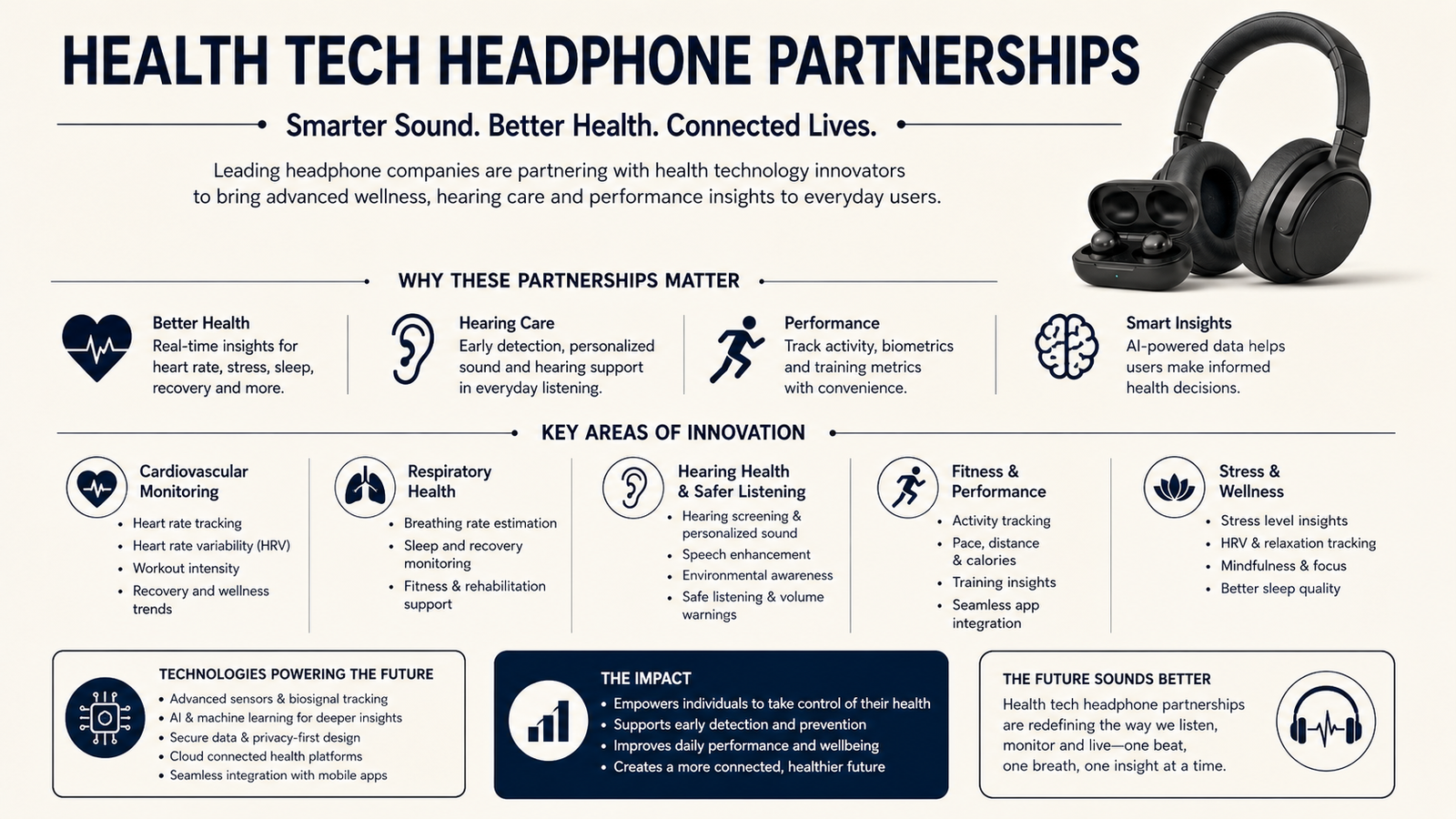
The goal is to make earbuds useful beyond listening. Depending on the product, they may support heart rate monitoring, activity measurement, hearing enhancement, respiratory tracking, stress insights, or remote health monitoring.
However, not every health feature has the same purpose. Some are designed for everyday fitness and wellness, while others are still being tested for possible medical or clinical use.
Why Are Headphones Becoming Health Devices?

The ear is a surprisingly useful place for collecting health information. Earbuds sit close to the skin and can maintain more stable contact than a loose wearable moving around on the wrist.
This position may help sensors detect changes connected with blood flow, heart rate, movement, temperature, or breathing. Microphones and speakers may also collect acoustic signals that intelligent software can study for useful patterns.
Another advantage is familiarity. Millions of people already wear earbuds while exercising, working, travelling, taking calls, or relaxing at home. They do not need to learn how to use an entirely new type of device.
That regular use matters. A health feature cannot provide much value if the device is uncomfortable or remains forgotten in a drawer. Earbuds have the potential to collect information during activities where people already want music, coaching, communication, or noise control.
Comfort and fit remain important. Health readings can become less reliable when an earbud moves, sits incorrectly, or loses contact with the skin. Manufacturers therefore need to balance sensing ability with sound quality, battery life, and everyday comfort.
Why These Companies Need Partnerships
Creating a reliable health focused earbud requires knowledge from several different industries. It is difficult for one company to handle every part of the process alone.
A headphone manufacturer may understand sound quality, microphones, comfort, wireless connections, batteries, and mass production. It may not have the medical knowledge required to measure physiological signals or explain health results responsibly.
A health technology company may have an impressive sensor or algorithm. However, it may not have the factories, retail connections, product design experience, or consumer applications needed to place that technology inside a successful pair of earbuds.
Chipmakers are also important because the device must process information without draining a tiny battery. Fitness and healthcare platforms are needed to turn raw measurements into something the user can actually understand.
This is where health tech headphone partnerships become valuable. They allow audio engineering, biometric sensing, medical knowledge, software, and distribution to meet inside one practical product.
How Health Tech Headphone Partnerships Work

A successful partnership is not simply about placing a sensor inside an earbud. Every partner must help the complete system work smoothly, from collecting a signal to showing the user a meaningful result.
The Headphone Manufacturer
The headphone manufacturer builds the product people will actually wear. It is responsible for the physical design, audio performance, microphone quality, controls, comfort, and overall listening experience.
It must also protect battery life while making space for sensors, processors, and wireless components. If the earbuds feel uncomfortable, sound poor, or require constant charging, the health features will have limited value.
Manufacturing and distribution are equally important. An established audio brand can produce devices at scale, maintain quality standards, provide customer support, and place the product in front of a large consumer audience.
The Health Technology Company
The health technology company provides the specialized sensing system. This may include optical sensors, acoustic sensing methods, motion analysis, temperature measurements, or software that identifies patterns in physiological data.
Its algorithms help turn signals from the ear into estimates such as heart rate, heart rate variability, breathing activity, or physical movement.
This partner may also support testing and validation. It must help determine how movement, sweat, ear shape, skin contact, background noise, and individual differences affect the readings.
The Chipmaker
A tiny earbud has limited processing power and battery capacity. The chipmaker provides the technical foundation needed to manage audio, Bluetooth, sensor information, and artificial intelligence without using too much energy.
The chip can process some information directly inside the earbuds. This may make results faster and reduce the amount of sensitive information that needs to be sent elsewhere.
A widely used audio platform can also help a health technology reach more manufacturers. Instead of creating a completely separate system for every brand, developers may adapt their feature to a platform already used in many wireless audio products.
The Fitness or Healthcare Platform
Raw health data is rarely useful on its own. A fitness or healthcare application organizes the readings and shows the user what they may mean.
For a runner, the platform might display heart rate, workout intensity, pace, distance, and recovery information. For a wellness user, it could show activity patterns or changes in stress related signals.
A healthcare platform may eventually connect suitable data with a rehabilitation program, medical study, or remote care service. This requires much stronger privacy protection, clinical evidence, and regulatory oversight than a normal fitness application.
The Research Institution
Research institutions study whether a new sensing method actually works. They design tests, examine accuracy, develop algorithms, and compare the results with established measurement tools.
Researchers may also discover ways to use components already inside headphones. For example, speakers and microphones could potentially collect physiological signals through carefully controlled sound and advanced signal processing.
This stage is important because a successful laboratory experiment is not automatically a finished consumer product. The technology must still work across different users, ear shapes, environments, and daily activities.
The Hearing Health Partner
Hearing health specialists bring audiology knowledge into the partnership. They understand hearing loss, speech clarity, listening comfort, sound exposure, and the ways different people experience audio.
Their expertise can support personalized sound profiles, speech enhancement, safer volume controls, environmental awareness, and possible hearing screening features.
They can also help companies understand the difference between ordinary headphones, smart hearables, and regulated hearing instruments. That distinction becomes increasingly important as earbuds begin offering more health related functions.
Major Health Tech Headphone Partnerships

The growth of health tech headphone partnerships becomes easier to understand when we look at real examples. Some collaborations have already produced consumer fitness products, while others remain research projects or technology platforms.
That difference matters. A pair of earbuds that measures workout heart rate is not automatically a medical device. In the same way, a promising laboratory system should not be presented as something consumers can already buy and use for diagnosis.
Beats and Nike
The Nike edition of Powerbeats Pro 2 is one of the clearest consumer examples of headphones moving into fitness tracking.
Beats provides the earbuds, audio engineering, secure ear hooks, noise control, battery system, and connection with Apple devices. Nike adds its fitness identity and integration with the Nike Run Club application.
The earbuds include built in optical sensors that measure heart rate during a workout. When the feature is active, the sensors direct light into the ear and study changes in blood flow to estimate the user’s heart rate.
That information can appear inside a supported fitness application, allowing the user to follow workout intensity without wearing a separate chest strap. The secure ear hook design also helps the earbuds remain in position during running and other active exercises.
This is mainly a fitness partnership. Heart rate information can help someone understand whether a workout feels light, moderate, or intense. It may also make it easier to follow effort across different training sessions.
However, the Powerbeats Pro 2 should not be described as a tool for diagnosing heart disease. Workout tracking and medical diagnosis are very different purposes. Anyone concerned about unusual symptoms or heart health still needs appropriate medical advice and professional testing.
Nokia Bell Labs and Cambridge Future Tech
The partnership between Nokia Bell Labs and Cambridge Future Tech follows a different path. Instead of starting with a finished consumer fitness product, it focuses on turning advanced research into a commercial venture.
The technology began with ear worn computing research at Nokia Bell Labs in Cambridge. Cambridge Future Tech then helped build a company called OmniBuds around that research.
OmniBuds is being developed as an ear worn computing platform that could continuously monitor vital signs while also providing augmented hearing features. The aim is to combine physiological sensing, sound, computing, and artificial intelligence inside one device worn close to the body.
The platform could eventually support health research, activity monitoring, remote care, or more personalized hearing experiences. It may also create new ways for people to interact with artificial intelligence because the device can hear, process information, and collect physical signals from the user.
This does not mean OmniBuds should be treated as a proven replacement for hospital equipment. It is better understood as a research commercialization project with several possible future applications.
MindMics and Qualcomm
MindMics is working on a different way to collect cardiovascular information from the ear. Its technology uses very low frequency sound signals to detect physical activity connected with blood movement and the heartbeat.
The company joined Qualcomm’s Voice and Music Extension Program and worked to make its in ear sensing technology compatible with Qualcomm audio platforms. These platforms provide processing, wireless communication, and other technical functions used in modern audio devices.
This kind of partnership is important because a sensor company does not always need to create its own consumer headphone brand. It can instead make its technology work with a chip platform already available to audio manufacturers.
That can open the door to several possible products. Earbud brands, hearing aid developers, gaming companies, or professional audio manufacturers could explore the technology without rebuilding the complete sensing system from the beginning.
The partnership also shows why the chip inside an earbud matters. Health measurements require constant signal processing, but earbuds have small batteries. The system must study the data without making the product too warm, too large, or too demanding to charge.
MindMics has discussed possible measurements such as heart rate and heart rate variability. These uses remain separate from a formal medical diagnosis unless a particular finished product receives the necessary testing and regulatory authorization.
Google Research and Audioplethysmography
Google Research explored whether ordinary parts inside noise cancelling headphones could also be used to monitor the heartbeat.
The method is called audioplethysmography. The name sounds complicated, but the basic idea is easier to understand.
A headphone speaker sends a very low intensity ultrasound signal into the ear canal. The feedback microphone listens to the returning signal. Small changes inside the ear canal caused by blood vessel movement affect the way that signal returns.
Software then studies those tiny changes and looks for patterns connected with heart rate and heart rate variability. The clever part is that the method uses speakers and microphones already found inside many noise cancelling earbuds.
Google evaluated the method in an eight month study involving 153 participants. The research examined how it performed during different conditions, including movement and music playback.
This work should be presented as a research pathway, not a normal commercial partnership. Google demonstrated that the method could work in testing, but that does not make every pair of noise cancelling headphones a health monitor.
More product development, independent evaluation, privacy planning, and possibly regulatory review would be needed before such a system could be trusted for medical decisions.
Still, the research points toward an interesting future. Headphones may gain health features through better software and signal processing rather than through a growing collection of extra sensors.
Intel, SMS Audio, Valencell, and RunKeeper
Health focused headphones are not a completely new idea. One notable early example appeared in 2014 through work involving Intel, SMS Audio, Valencell, and RunKeeper.
The SMS Audio BioSport headphones combined regular audio hardware with an optical sensor that continuously measured heart rate. The sensing technology was connected with Valencell, while Intel contributed wearable computing and system expertise.
SMS Audio turned the technology into a consumer headphone product. RunKeeper provided the fitness application where users could combine heart rate information with pace, distance, elevation, and estimated calorie use.
This early collaboration brought together the same main ingredients we see in modern health tech headphone partnerships. There was an audio company, a biometric sensing specialist, a computing company, and a fitness platform.
The product was wired and drew power through the audio connection. Modern earbuds now have better wireless communication, smaller processors, more efficient sensors, and stronger mobile applications.
The original idea has therefore become more practical. What once required a wired fitness accessory can now fit inside small wireless earbuds that people already carry throughout the day.
Valencell and Sonion
The partnership between Valencell and Sonion connected biometric sensing with the hearing health industry.
Valencell contributed knowledge of wearable biometric sensors. Sonion brought experience in miniature audio components, manufacturing, and products made for hearing instruments and other devices worn at the ear.
The companies worked on making biometric sensing modules smaller, more affordable, and more energy efficient for in ear and on ear products. Their target areas included consumer hearables, hearing health products, medical applications, and professional communication devices.
This partnership is important because consumer earbuds and hearing care devices are beginning to share some similar technology. Both need comfortable designs, miniature components, clear sound, efficient power use, and close contact with the ear.
A future device could potentially provide hearing enhancement while also collecting selected fitness or wellness information. However, the medical status would depend on what the product claims to do and whether those claims have been properly tested.
USound and ZenoWell
USound and ZenoWell represent a more experimental side of ear worn health technology.
USound develops very small audio systems based on MEMS technology. ZenoWell works on ear based vagus nerve stimulation devices intended to support areas such as sleep, stress relief, and nervous system balance.
The companies announced a cooperation to explore how compact acoustic sensing might complement ZenoWell’s existing stimulation platform. The idea is to investigate whether a future ear worn device could both collect physiological information and provide a form of nerve stimulation.
This could eventually support more personalized systems. A device might observe certain physical signals and use those patterns to adjust how its wellness features operate.
For now, this remains an exploratory collaboration. It does not prove that a clinically established headphone treatment for anxiety, pain, sleep problems, or mental health conditions is already available.
The partnership is useful as an example of where the industry may be going. It shows that companies are exploring earbuds not only as listening and sensing devices, but also as possible platforms for carefully controlled health interventions.
USound and WuQi Technologies
USound announced another important collaboration with WuQi Technologies in May 2026. This partnership focuses on bringing sensor free in ear biosensing to future true wireless earbuds and related products.
The phrase sensor free does not mean the device contains no technology for measurement. It means the system aims to use existing MEMS audio hardware for both sound and biometric sensing instead of adding separate optical sensors and other dedicated components.
USound contributes its acoustic sensing system and algorithms. WuQi provides a low power wireless audio platform with connectivity, processing, and edge artificial intelligence capabilities.
Edge artificial intelligence means that some information can be processed directly on the device. This may provide quicker results, lower power use, and better privacy than sending every raw signal to a cloud server.
The platform could potentially support heart rate, respiratory monitoring, wellness tracking, and biometric user identification. It is designed for possible use in wireless earbuds, sleep earbuds, and over the counter hearing devices.
These should be described as platform possibilities rather than guaranteed medical features. A manufacturer would still need to integrate the system into a finished product, test its performance, explain its intended purpose, and meet any relevant regulatory requirements.
Even with that caution, the collaboration reveals an important direction for health tech headphone partnerships. Future earbuds may collect useful health signals using the same compact hardware that already produces the sound.
Health Features These Partnerships Are Developing

The most interesting health tech headphone partnerships are moving earbuds beyond music and phone calls. Their aim is to collect useful physical signals from the ear and turn them into information people can understand.
Some of these features are already available in fitness products. Others are still being developed, tested, or studied for possible future use.
Heart Rate and Cardiovascular Monitoring
Heart rate monitoring is currently one of the most practical health features found in earbuds. It can help users understand how hard their bodies are working during exercise.
Some earbuds use optical sensors. These sensors shine a small amount of light into the skin and study changes in blood flow. Software then uses those changes to estimate the number of times the heart beats each minute.
Other systems use acoustic sensing. Instead of relying on light, they study tiny sound changes inside the ear that may be connected with blood movement and the heartbeat.
These methods may also estimate heart rate variability. This measures the small changes in time between individual heartbeats rather than simply counting the beats.
Fitness applications can use heart rate and heart rate variability to show exercise intensity, training load, and possible recovery patterns. A user might notice that the same workout feels harder when tired or that recovery is improving over several weeks.
These readings are most useful when viewed as trends. One number taken during movement should not be treated as a complete picture of cardiovascular health.
Respiratory Monitoring
Future ear worn platforms may also estimate how quickly or deeply a person is breathing.
Microphones, movement sensors, and acoustic sensing systems could look for patterns associated with inhaling and exhaling. Artificial intelligence may then organize those signals into an estimated breathing rate.
During exercise, this information could help a person understand how their breathing changes as the workout becomes more intense. It may also support breathing exercises or guided recovery sessions.
Researchers could use respiratory information during sleep studies, rehabilitation programs, or long term health studies. A validated system might eventually help care teams observe changes while a person is outside a hospital.
However, breathing measurements from consumer earbuds should be treated carefully. Movement, talking, poor fit, background noise, and individual differences can affect the result.
A future ear worn platform may provide useful breathing trends, but that does not automatically make it suitable for detecting a respiratory illness.
Hearing Health and Safer Listening
Not every health feature needs to measure the heart or breathing. Some partnerships are focusing directly on hearing health.
Personalized sound is one possible area. An application may test how well a person hears different frequencies and then adjust the sound profile to make music or speech clearer.
Speech enhancement can help separate a voice from background noise. This could be useful in crowded offices, restaurants, public transport, or conversations where several people are speaking.
Hearing screening is another possible feature. Earbuds may guide users through a basic hearing check and suggest whether they should consider a professional assessment.
Environmental awareness can help users hear important sounds around them. A transparency or awareness mode may allow traffic, announcements, alarms, and nearby voices to pass through while the earbuds remain in place.
Volume warnings can also encourage safer listening. The application may alert the user when the sound level is too high or when listening exposure has continued for too long.
Partnerships with audiology companies and hearing component specialists may connect consumer earbuds with more advanced hearing support. Still, a personalized sound setting is not automatically the same as a professionally fitted hearing instrument.
Exercise and Performance Tracking
Earbuds can collect heart rate while a connected phone or fitness application records pace, distance, route, workout duration, and estimated calorie use.
Bringing this information together gives the user a clearer view of the workout. Instead of checking several devices, a runner may hear music, receive coaching, and follow exercise intensity through one connected system.
This convenience is one reason fitness companies are interested in health capable earbuds. Many people already wear headphones at the gym, while running, or during cycling sessions.
Secure fit is essential. An earbud that moves during exercise may lose skin contact and produce incomplete or unusual readings.
Comfort matters as well. A device may have excellent sensors, but users will not wear it through a long workout if it creates pressure or regularly falls out.
The most useful performance tracking system is therefore not simply the one with the most measurements. It is the one that remains comfortable, stays in position, and presents the information clearly.
Stress and Wellness Insights
Some developers are exploring whether earbuds could recognize patterns associated with stress, tiredness, or recovery.
Heart rate variability may provide one signal. Voice characteristics, breathing patterns, movement, temperature, and daily activity could provide others.
An application might combine these signals and notice that the user’s body appears different from its normal pattern. It could then suggest rest, slower breathing, a short walk, or a less demanding workout.
This information should be presented as a wellness estimate. Stress is complex, and the same physical pattern can have several possible causes.
A faster heart rate might come from anxiety, exercise, caffeine, excitement, lack of sleep, or illness. Software cannot fully understand the cause from a small collection of signals.
An earbud application may help someone notice personal patterns, but it cannot diagnose anxiety, depression, or another mental health condition. Those decisions require qualified professionals and appropriate clinical assessment.
Remote Patient Monitoring
Validated ear worn devices could eventually support monitoring outside clinics and hospitals.
A person recovering from surgery or completing cardiac rehabilitation might wear a device during selected activities. The system could collect approved measurements and send useful information to a care platform.
Researchers may also use ear worn devices during clinical studies. Participants could provide information during normal daily life instead of visiting a laboratory for every measurement.
This could help researchers study longer periods and more realistic conditions. It may also make participation easier for people who live far from a research centre.
Remote monitoring requires much more than a working sensor. The data must be accurate, secure, clearly explained, and connected with a reliable clinical process.
Healthcare professionals must know what the information means and when they should act. Patients also need clear instructions about what to do if a reading looks unusual.
Most consumer earbuds are not replacements for professional medical equipment. A device designed for music and fitness should not be used for clinical decisions unless its manufacturer has provided appropriate evidence and authorization.
How These Partnerships Create Business and Consumer Value

Health technology inside earbuds is not valuable simply because it sounds advanced. The product must solve a real problem for the company and the person wearing it.
The right partnership can reduce development time, improve the final product, and make health information easier to use.
Faster Technology Development
Building an earbud from the beginning requires expertise in audio, wireless communication, batteries, sensors, software, manufacturing, and user experience.
Partnerships allow companies to use technology that has already been developed. A headphone brand might adopt an existing biometric sensor, while a health company may build its system on an established audio chip platform.
Research institutions can provide tested sensing methods and scientific knowledge. Chipmakers can provide processing tools that are already suitable for small wireless devices.
This approach can save years of work. It also allows each company to focus on the area it understands best.
Faster development does not mean testing should be rushed. Health features still need careful evaluation before companies make strong claims about accuracy or medical usefulness.
Better Product Integration
A health sensor has limited value when it is placed inside an uncomfortable or unreliable product.
The headphone manufacturer must make the sensor work without damaging sound quality, battery performance, weight, or fit. The sensing system should feel like a natural part of the earbuds rather than an extra feature forced into the design.
Software integration is just as important. Users need to know when monitoring begins, whether the sensor has good contact, and where they can view the results.
The application should present clear information rather than a confusing collection of numbers. It should also explain what the readings can and cannot tell the user.
Good integration makes the technology almost invisible. The user wears the earbuds normally while the hardware and software work together in the background.
Wider Market Access
A small health technology company may develop an excellent sensor but struggle to reach consumers.
Working with an established headphone brand can provide access to product designers, factories, retail channels, customer support, and a large audience.
A partnership with a chipmaker can create another route to the market. If the health technology works on a popular audio platform, several headphone manufacturers may be able to consider it for future products.
The smaller company gains reach without having to build an entire consumer brand. The larger company gains a specialized feature without developing the underlying health technology alone.
This model can help promising research move out of a laboratory and into practical products. It can also encourage competition as more manufacturers gain access to similar technical capabilities.
More Useful Health Information
A sensor produces raw signals, not automatic understanding.
The application is responsible for converting those signals into information a person can use. It may show workout intensity, changes in heart rate, recovery patterns, breathing trends, or listening exposure.
Context makes the information more useful. A heart rate number means more when it appears beside workout duration, pace, distance, and the user’s normal training range.
A wellness application might compare today’s patterns with the user’s usual activity rather than judging everyone by one general number.
A healthcare platform may present validated measurements to a professional as part of a larger care plan. In that situation, the information needs clear labels, reliable timing, and a record of how it was collected.
The best application does not simply show more data. It helps the user understand what matters without creating confusion or unnecessary fear.
Fitness Tracking Is Not Medical Diagnosis
This distinction is one of the most important parts of any conversation about health headphones.
A feature may be useful for following heart rate during exercise without being approved to detect heart disease. It may show breathing trends without being able to diagnose a respiratory condition.
Fitness products usually help users understand workouts, activity, and general wellness. Medical devices are designed for specific clinical purposes and normally require stronger evidence, controlled testing, and regulatory review.
The difference often depends on the intended use and the claims made by the manufacturer. The same type of sensor may appear in both a wellness product and a medical device, but the products should not automatically be treated as equal.
Before trusting a health claim, readers should check exactly what the company says the feature does. Words such as tracks, estimates, supports, detects, diagnoses, and treats do not mean the same thing.
Readers should also look for independent research, study details, regulatory information, and clear explanations of accuracy. A company demonstration is interesting, but it is not the same as a large independent clinical study.
If an earbud produces an unusual result, the number should be considered alongside symptoms, activity, fit, and other information. It should not be used alone to make a medical decision.
Challenges Facing Health Tech Headphone Partnerships

Bringing health features into earbuds creates exciting possibilities, but it also introduces difficult questions.
Companies must balance accuracy, privacy, comfort, battery performance, and responsible communication. A weakness in any one of these areas can reduce trust in the entire product.
Accuracy and Independent Validation
Earbuds collect signals from a small and constantly changing part of the body. That creates several challenges.
Movement can disturb the sensor during running or intense exercise. Sweat may change contact between the earbud and the skin.
Ear shapes vary widely. A design that fits one person securely may feel loose or uncomfortable for someone else.
Background noise may affect acoustic measurements. Skin and tissue differences may also influence certain optical sensing methods.
Algorithms can reduce some of these problems, but they cannot remove every source of error. A system trained on a limited group of people may not perform equally well for a much wider population.
Readers should separate company reported performance from independent clinical validation. A company may test its product carefully, but independent researchers provide another level of evidence.
Study size matters too. A small controlled experiment can show that an idea is promising, while a larger study across different people and environments provides a stronger picture of how the system performs in real life.
Health Data Privacy
Health capable earbuds may collect much more than a normal pair of headphones.
Depending on the product, the data could include heart rate, movement, exercise habits, voice information, location, breathing patterns, hearing ability, or possible stress signals.
Readers should find out where this information is processed. Some calculations may happen inside the earbuds or phone, while others may require data to be uploaded to a company server.
They should also check who can access the information. The application should explain whether data is shared with service providers, advertisers, research partners, healthcare organizations, or other companies.
Deletion controls matter. Users should be able to understand how to remove stored information and what happens when they close an account.
Consent should be clear and specific. Agreeing to use a music application should not quietly become permission for unrelated health data collection.
Privacy policies are often long, but the basic questions are simple. What is collected, why is it collected, where is it stored, who receives it, and how can the user remove it?
Medical Regulation
Wellness products and medical devices do not follow exactly the same rules.
A product that tracks exercise intensity may face different requirements from one that claims to detect a heart condition. The more serious the medical claim, the stronger the expected evidence and oversight usually become.
Regulators often examine the intended use, product design, software, testing, and marketing language. A company cannot make a device medical grade simply by using health related words in an advertisement.
Requirements can also differ between countries. A feature authorized in one market may have a different status or may not be available in another.
Readers should check the regulatory status of the specific feature and product. Approval of one function does not automatically mean that every measurement offered by the device has received the same review.
Battery Life and Comfort
Continuous health monitoring requires energy. Sensors, microphones, wireless connections, and artificial intelligence processing can all place pressure on a small battery.
Manufacturers may need to increase battery size, reduce monitoring frequency, or process information in a more efficient way. Each choice affects the user experience.
Closer skin contact may improve some readings, but it can also create discomfort. An earbud that presses too firmly may become painful during a long workout or workday.
Additional components can affect size, weight, balance, and heat. These details may sound minor, but they determine whether people continue wearing the product.
A successful health earbud must remain a good earbud. Clear sound, reliable controls, sensible charging, and a comfortable fit still matter.
False Alerts and Misunderstood Results
An unusual reading does not always mean something is medically wrong.
The earbud may have moved. Sweat may have interrupted contact, or background noise may have affected an acoustic signal.
The user may also have been walking, talking, drinking caffeine, feeling excited, or recovering from exercise. All of these factors can change certain measurements.
Applications should explain uncertainty rather than presenting every number as perfectly accurate. They should also help users repeat a measurement when fit or movement may have caused a problem.
False alerts can create unnecessary anxiety. At the same time, a wellness product should not falsely reassure someone who has serious symptoms.
One unexpected measurement should not be treated as a diagnosis. If a person feels unwell or remains concerned, professional medical advice is more appropriate than repeatedly checking a consumer earbud.
What Readers Should Check Before Trusting Health Headphones

Start by asking what the headphones actually measure. Do they directly collect a signal, or does the application estimate a result from several indirect signals?
Check whether the advertised feature is available now. Some companies discuss possible future functions that are still in research or development.
Look at application compatibility. A health feature may work only with certain phones, operating systems, fitness services, or subscription plans.
Find out whether independent testing exists. Pay attention to the number of participants, the conditions used, and whether the study reflects normal movement and daily use.
Review the intended purpose. Is the product designed for exercise, general wellness, hearing support, research, or medical care?
Examine privacy controls before sharing sensitive information. Check what data is collected, where it goes, whether it is shared, and how it can be deleted.
Think about comfort and fit. A sensor cannot collect reliable information if the earbuds regularly become loose or painful.
Consider battery performance with health monitoring turned on. The normal listening time may be different when sensors and continuous processing are active.
Finally, read the product language carefully. Trust clear explanations, realistic limitations, and strong evidence more than dramatic promises.
Health headphones can be useful tools, but the best products will tell you honestly what they know, what they estimate, and what they cannot determine.
Health Features These Partnerships Are Developing
Health technology inside headphones is still developing, but several useful features are already taking shape. Some are available in consumer fitness products, while others remain research ideas that need more testing.
Heart Rate and Cardiovascular Monitoring
Some earbuds use optical sensors to measure heart rate. A small light shines into the skin, and the sensor studies changes in blood flow. Software then turns those changes into an estimated heart rate.
Other systems use acoustic sensing. Speakers send a quiet signal into the ear while microphones listen for small changes associated with the heartbeat and blood movement.
These approaches may also measure heart rate variability. This looks at the small differences in time between individual heartbeats and may help users follow exercise effort and recovery patterns.
During a workout, heart rate can show whether the body is working lightly or intensely. Over time, the information may help users compare training sessions and notice whether recovery is improving.
These measurements are most useful as general trends. They should not be treated as a complete assessment of cardiovascular health.
Respiratory Monitoring
Future ear worn platforms may estimate how quickly or deeply a person is breathing.
Microphones, movement sensors, and acoustic signals can look for patterns connected with inhaling and exhaling. Artificial intelligence may then convert those patterns into an estimated breathing rate.
During exercise, this information could help users understand how breathing changes as effort increases. It might also support guided breathing and recovery sessions.
Researchers could use respiratory information during sleep studies, rehabilitation programs, or long term clinical research. Validated devices may eventually help care teams monitor selected breathing patterns while patients are outside hospitals.
However, talking, movement, poor fit, and background noise can affect the result. Consumer earbuds should not be presented as tools for diagnosing respiratory conditions unless the specific product has appropriate evidence and authorization.
Hearing Health and Safer Listening
Some partnerships are focusing directly on hearing health rather than general fitness.
Personalized sound can adjust different frequencies according to the user’s hearing profile. This may make music, phone calls, and spoken conversations easier to hear.
Speech enhancement can help separate voices from surrounding noise. This could be useful in busy offices, restaurants, public transport, or social situations.
Earbuds may also offer basic hearing screening. A guided test could help users notice possible changes and decide whether they need a professional hearing assessment.
Environmental awareness features allow important outside sounds to remain audible. Traffic, alarms, public announcements, and nearby voices can pass through while the earbuds remain in place.
Volume warnings can encourage safer listening. An application may notify the user when the sound is too loud or when exposure has continued for an unsafe amount of time.
Connections with hearing health companies could bring consumer earbuds closer to hearing support products. Still, a personalized audio profile is not automatically the same as a professionally fitted hearing instrument.
Exercise and Performance Tracking
Health capable earbuds can collect heart rate while a connected phone or fitness application records pace, distance, route, workout duration, and estimated calorie use.
Bringing these measurements together can give the user a clearer picture of the workout. A runner may listen to music, receive coaching, and follow exercise intensity through one connected system.
Convenience is the biggest attraction. People who already wear earbuds during exercise may not want another device around the chest or wrist.
A secure fit remains essential. If an earbud moves during a run or loses contact with the skin, the readings may become incomplete or inaccurate.
Comfort matters just as much. A device may contain impressive sensors, but people will not continue wearing it if it creates pressure or regularly falls out.
Stress and Wellness Insights
Future wellness applications may use several signals to recognize patterns connected with stress, tiredness, or recovery.
Heart rate variability may provide one clue. Voice characteristics, movement, breathing, temperature, and daily activity could provide others.
An application might compare these signals with the user’s normal patterns. It could then suggest a break, a breathing exercise, more rest, or a lighter workout.
These results must be explained carefully. A faster heart rate or different voice pattern can have many causes, including exercise, caffeine, excitement, lack of sleep, illness, or emotional stress.
A wellness estimate is not a mental health diagnosis. Earbuds may help users notice changes in their routines, but they cannot confirm anxiety, depression, or another mental health condition.
Remote Patient Monitoring
Validated ear worn devices could eventually support rehabilitation, clinical studies, or monitoring outside hospitals.
A patient completing a rehabilitation program might wear an approved device during selected activities. The information could then be shared with a secure healthcare platform.
Researchers may also use ear worn devices to collect information during normal daily life. This could provide a broader picture than measurements taken only during short laboratory visits.
Remote monitoring requires more than a working sensor. The data must be accurate, secure, understandable, and connected with a reliable clinical process.
Healthcare professionals also need to know when a result requires attention. Patients need clear instructions about what the device can measure and what they should do when a reading looks unusual.
Most consumer earbuds are not replacements for professional medical equipment. They should not guide clinical decisions unless the specific device and feature have been properly validated for that purpose.
How These Partnerships Create Business and Consumer Value

Health features become valuable when they solve a clear problem. The right partnership can reduce development time, improve the finished product, and make collected information easier to understand.
Faster Technology Development
Creating health capable earbuds requires knowledge of audio, sensors, wireless communication, batteries, artificial intelligence, manufacturing, and medical research.
A partnership allows companies to use technology that already exists. A headphone brand can adopt an established sensor, while a health company can build its system on an existing audio chip platform.
Research institutions can provide tested sensing methods. Chipmakers can provide processors designed for small wireless devices.
This approach allows each company to focus on what it understands best. It can also reduce the time needed to move a promising idea from research into a practical product.
Faster development should not mean rushed testing. Health claims still need careful evidence before they are presented to consumers.
Better Product Integration
A good sensor becomes far more useful when it works inside comfortable, reliable hardware.
The headphone manufacturer must protect sound quality, fit, battery life, and ease of use while adding the health technology. The sensing feature should feel like a natural part of the product.
Application design is equally important. Users need to know when monitoring begins, whether the earbuds fit correctly, and where the results can be viewed.
The application should explain the information in clear language. Showing more numbers is not helpful if the user cannot understand what they mean.
Good integration makes the technology feel simple. The user wears the earbuds normally while the hardware and software work together in the background.
Wider Market Access
A small health technology company may create an impressive sensor but lack factories, distribution, customer support, or a recognizable consumer brand.
Working with an established headphone manufacturer can provide access to all of these resources. The technology can reach more people without the smaller company building an entire product business alone.
A chipmaker partnership can create another route to the market. If the health feature works with a popular audio platform, several manufacturers may be able to consider it for future earbuds.
The smaller company gains reach. The larger company gains a specialized feature without developing the complete sensing system from the beginning.
More Useful Health Information
Sensors collect signals, but applications turn those signals into something meaningful.
A fitness application can combine heart rate with distance, pace, workout duration, and training history. This gives the number a useful context.
A wellness application may compare current readings with the user’s normal patterns. It can show gradual changes rather than treating one result as a final answer.
A healthcare platform may present validated measurements to a professional as part of a larger care program. In that case, the information needs clear labels and a reliable record of when and how it was collected.
The best application does not simply display more data. It helps the user understand what matters without causing confusion or unnecessary fear.
Fitness Tracking Is Not Medical Diagnosis
This distinction protects readers from exaggerated marketing claims.
A feature can be useful for following exercise intensity without being approved to detect heart disease. It can show breathing patterns without being able to diagnose a respiratory condition.
Fitness products are generally designed to support workouts, activity, and everyday wellness. Medical devices are developed for specific clinical purposes and usually require stronger testing and regulatory review.
The intended use matters. A similar sensor may appear in both a fitness product and a medical device, but that does not make the two products equal.
Readers should pay close attention to the words used by the manufacturer. Tracks, estimates, supports, detects, diagnoses, prevents, and treats have very different meanings.
Supporting evidence matters as well. A company demonstration or small study may show promise, but it is not the same as a large independent clinical study.
Readers should check the regulatory status of the exact product and feature. Approval of one function does not mean every measurement offered by the device has received the same review.
Challenges Facing Health Tech Headphone Partnerships
Developers must balance accuracy, privacy, comfort, battery performance, and responsible communication. A weakness in one area can reduce trust in the complete product.
Accuracy and Independent Validation
Movement can disturb a sensor during running or intense exercise. Sweat may change the contact between the earbud and the skin.
Ear shapes also vary. A design that fits one person securely may feel loose or uncomfortable for someone else.
Background noise can affect acoustic measurements. Optical methods may also perform differently depending on skin contact, tissue characteristics, and sensor position.
Algorithms can reduce some of these problems, but they cannot remove every possible error. A system trained on a limited group may not perform equally well for a wider population.
Company testing is useful, but readers should separate company reported performance from independent validation.
Study size and design matter. A small controlled experiment can show that an idea is promising. A larger study involving different people, activities, and environments provides stronger evidence of real world performance.
Health Data Privacy
Health capable earbuds may collect much more than a normal audio device.
The information could include heart rate, exercise habits, movement, voice, location, breathing, hearing ability, or possible stress patterns.
Users should check where this information is processed. Some calculations may happen inside the earbuds or phone, while other information may be uploaded to company servers.
It is also important to know who can access the data. The privacy policy should explain whether information is shared with service providers, advertisers, researchers, healthcare organizations, or other companies.
Deletion controls matter. Users should be able to understand how to remove stored health information and what happens when an account is closed.
Consent should be specific. Agreeing to use a music application should not quietly become permission for unrelated health data collection.
Medical Regulation
Wellness products and medical devices usually face different rules.
A product that tracks workout intensity may not need the same review as a device that claims to detect or monitor a medical condition.
The product claim often determines the level of testing and regulatory review required. Stronger medical claims generally require stronger evidence.
Rules can also differ between countries. A feature available in one market may have a different status or may not be offered in another.
Readers should check the status of the specific product and feature. General words such as health technology or advanced monitoring do not prove that a device has medical authorization.
Battery Life and Comfort
Continuous sensing requires energy. Sensors, microphones, wireless connections, and artificial intelligence processing can all place pressure on a small earbud battery.
Manufacturers may need to increase battery size, reduce monitoring frequency, or use more efficient processing. Each decision affects the user experience.
Closer skin contact may improve some readings, but it can also cause discomfort. An earbud that presses too firmly may become painful during a long workout or workday.
More components can affect weight, size, heat, and balance. These details determine whether people continue wearing the product regularly.
A successful health earbud must still be a good earbud. Sound quality, fit, charging time, controls, and reliability remain important.
False Alerts and Misunderstood Results
An unusual reading does not always mean something is medically wrong.
The earbud may have moved, sweat may have interrupted contact, or background noise may have affected the signal.
The user may also have been walking, talking, drinking caffeine, feeling excited, or recovering from exercise. All of these factors can change certain measurements.
Applications should explain uncertainty. They should also help users repeat a measurement when poor fit or movement may have created a problem.
False alerts can cause unnecessary anxiety. At the same time, a wellness product should not reassure someone who is experiencing serious symptoms.
One unexpected reading should not automatically be treated as a diagnosis. Professional medical advice is more appropriate when symptoms or concerns continue.
What Readers Should Check Before Trusting Health Headphones
Begin by checking what the device actually measures. Find out whether it collects a direct physical signal or estimates the result from several indirect signals.
Confirm that the feature is available now. Companies sometimes discuss future capabilities that are still being researched or tested.
Check application compatibility. A health function may work only with selected phones, operating systems, fitness services, or subscription plans.
Look for independent testing. Pay attention to the number and variety of participants, the testing conditions, and whether the study reflects normal movement and daily use.
Review the intended purpose. The product may be designed for fitness, general wellness, hearing support, research, or medical care.
Study the privacy controls. Check what data is collected, where it is stored, who receives it, and whether it can be deleted.
Comfort and secure fit should also influence the decision. Sensors cannot collect reliable information when the earbuds regularly become loose.
Battery performance may change when continuous health monitoring is active. Readers should check the expected listening and monitoring time rather than relying only on the largest advertised battery number.
Most importantly, trust clear explanations and realistic limitations. A responsible company should explain what its product measures, what it estimates, and what it cannot determine.
The Future of Health Tech Headphone Partnerships
The next generation of earbuds may combine several sensing methods rather than depending on one heart rate sensor.
Partnerships will be important because these products require expertise in audio, sensors, artificial intelligence, hearing science, healthcare, privacy, and manufacturing.
Multimodal Earbuds
Multimodal earbuds collect information through several types of hardware.
A future device might combine optical sensing, acoustic signals, movement sensors, microphones, temperature readings, and artificial intelligence.
Each sensor can provide a different part of the picture. Motion data may help the system understand whether a heart rate change happened during exercise. Temperature and breathing patterns could add more context.
Artificial intelligence may compare these signals and look for patterns that one sensor could not identify alone.
More data does not automatically create better health information. The system still needs accurate sensors, careful testing, clear explanations, and strong privacy controls.
Health Sensing Through Existing Audio Hardware
Some researchers and companies are exploring ways to use speakers and microphones for health sensing.
The speaker can send a quiet signal into the ear, while the microphone studies how that signal changes. Software may then look for patterns related to heart activity, breathing, movement, or whether the earbud is being worn correctly.
This approach could reduce the need for separate optical sensors and other physical components.
Using existing audio hardware may help control size, power use, and manufacturing cost. It could also make health sensing easier to add to future earbuds.
The technology still needs to work during music playback, exercise, conversation, and noisy daily environments. Promising research must therefore be followed by careful product testing.
More Processing Inside the Earbuds
Future earbuds may process more health information directly inside the device.
This is known as on device processing. Instead of sending every raw signal to a cloud server, the earbud can analyse some information locally.
Local processing may provide faster results because the system does not need to wait for an internet connection. It may also reduce battery use and improve reliability in places with weak connectivity.
Privacy could improve as well. If sensitive raw information remains on the earbuds or phone, less personal data needs to travel across external networks.
Local processing does not solve every privacy problem. Companies must still explain what information leaves the device, where it goes, and how long it is stored.
Growth From Fitness to Healthcare
The market is likely to develop in stages.
Workout earbuds are already the most visible category. They can offer heart rate monitoring, exercise tracking, coaching, and application integration.
Wellness earbuds may add breathing guidance, recovery patterns, stress estimates, sleep support, and more personalized sound.
Hearing support products could combine speech enhancement, hearing profiles, safe listening, and environmental awareness.
Research platforms may collect long term physiological information during studies. They could help scientists understand how health signals change during normal daily life.
The most carefully tested devices may eventually enter clinical care. These products would need clear medical purposes, strong evidence, secure data systems, and appropriate regulatory authorization.
Consumer earbuds will not suddenly become hospital equipment. The change will happen gradually as individual features are tested and shown to be reliable.
Frequently Asked Questions About Health Tech Headphone Partnerships
What Are Health Tech Headphone Partnerships?
Health tech headphone partnerships are collaborations between audio brands and companies working in biometric sensing, fitness, healthcare, chip design, hearing science, artificial intelligence, or medical research.
The partners combine their knowledge to place useful health and wellness features inside earbuds or other ear worn devices.
Can Earbuds Really Measure Heart Rate?
Yes, some commercial earbuds can measure heart rate during workouts.
Optical systems study changes in blood flow, while acoustic systems may study small sound changes connected with the heartbeat.
Performance depends on the sensing method, earbud fit, movement, sweat, and product design. The result may be useful for fitness tracking without being suitable for medical diagnosis.
Are Health Monitoring Headphones Medical Devices?
Most health monitoring headphones are sold as fitness or wellness products.
They should only be treated as medical devices when the manufacturer gives them a clear medical purpose and obtains the appropriate regulatory authorization.
A health related feature or impressive sensor does not automatically make the complete product medical grade.
Can Health Earbuds Replace a Smartwatch?
Health earbuds may be more convenient during workouts because many people already wear them for music or coaching. Their position inside the ear may also support certain measurements.
Smartwatches usually have larger batteries, screens, and a wider selection of health and daily activity features. They can also remain on the wrist when the user does not want to wear headphones.
The better choice depends on comfort, supported measurements, application compatibility, battery life, and how the person plans to use the device.
For many users, earbuds and smartwatches may complement each other rather than compete directly.
What Health Data Could Future Earbuds Collect?
Future earbuds may collect or estimate heart rate, heart rate variability, breathing patterns, movement, temperature, activity, and hearing information.
They may also combine several signals to identify general wellness or recovery patterns.
These possibilities should not be confused with proven disease detection. Each feature needs its own testing, explanation, and regulatory review when medical claims are involved.
Are Health Headphones Safe and Private?
Physical comfort, sound exposure, and data protection all matter.
Users should choose earbuds that fit correctly and follow safe listening guidance. Volume warnings and listening exposure information can help reduce hearing risks.
Privacy depends on how the company collects, processes, stores, and shares information. Users should review permissions and avoid granting access that is not required for the feature.
A trustworthy application should provide clear consent controls, understandable privacy information, and a practical way to delete stored data.
Conclusion
Health tech headphone partnerships are turning everyday audio products into possible fitness, wellness, hearing, research, and healthcare platforms.
The strongest collaborations bring together comfortable hardware, reliable sensors, efficient chips, useful applications, and responsible scientific testing. When those parts work together, earbuds can offer much more than music and calls.
The technology is promising, but excitement should not replace careful judgment. Readers should examine accuracy, privacy protections, intended use, independent evidence, and regulatory status before trusting any health claim.
Read Our Latest Blog
If you want to explore more useful technology developments and practical guides, continue reading the latest articles on the Eadoz blog.


