-
- No Comments
- March 14, 2026

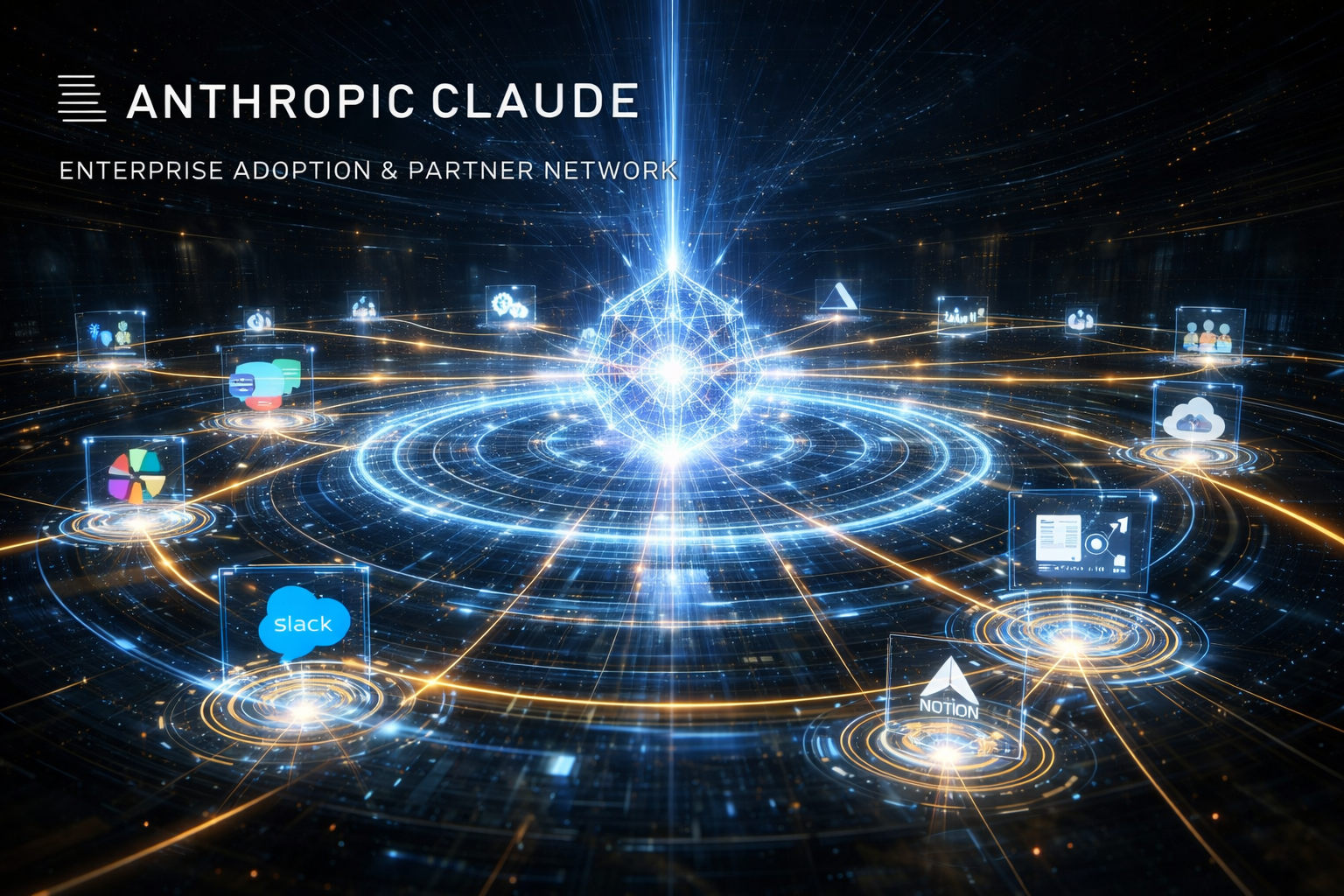
Anthropic Claude AI enterprise adoption and partner network launch
The Quiet Giant Just Got Loud
470,000 employees. One AI model. One deal.
When Deloitte signed on the dotted line to deploy Claude across its entire global workforce, it didn’t just make headlines — it made a statement. This wasn’t a cautious pilot programme, a limited beta rollout, or a proof-of-concept gathering dust in an innovation lab. This was one of the world’s most influential professional services firms betting its operational future on a single AI, at a scale most organisations won’t reach in a decade of trying.
And Deloitte wasn’t alone.
Cognizant followed with 350,000 seats. Accenture built an entire Business Group around it. Seventy percent of Fortune 100 companies quietly folded it into their technology stack. The numbers, when you line them up, stop looking like adoption metrics and start looking like a rout.
Here’s what makes that remarkable: Anthropic — the company behind Claude — was never supposed to be a sales machine.
Founded in 2021 by former OpenAI researchers, Anthropic built its identity around something the industry wasn’t exactly clamouring for at the time: restraint. Constitutional AI. Safety-first development. A refusal to ship fast and fix later. In a market intoxicated by capability benchmarks and demo-day theatrics, Anthropic was the lab that kept asking “but should we?” — and meant it.
That reputation earned respect. For a while, it also earned a ceiling.
Enterprise buyers are not, historically, early adopters of caution. They want performance, integration, compliance, and a partner network they can actually call when something breaks at 2am. Safety is a procurement checkbox, not a sales pitch. And for much of 2023 and 2024, Anthropic’s commercial footprint reflected that tension — formidable in research circles, still finding its footing in the boardroom.
Then something shifted.
The enterprise world began to realise that safety-aligned AI wasn’t a limitation — it was infrastructure. In regulated industries, in legal departments, in healthcare systems handling patient data, Claude’s Constitutional AI foundation wasn’t just philosophically appealing. It was the difference between a vendor you could actually deploy and one your legal team would never sign off on. Anthropic’s greatest asset turned out to be hiding in plain sight.
The floodgates opened.
By late 2025, Anthropic was serving over 300,000 business customers. High-value accounts — those spending over $100,000 annually — had grown sevenfold year-over-year. More than 500 clients were crossing the million-dollar annual spend threshold. And on March 12, 2026, Anthropic made its most unambiguous signal yet that the quiet phase was over: a $100 million commitment to launch the Claude Partner Network, a structured ecosystem designed to embed Claude into enterprise operations at a speed and scale no single company could achieve alone.
This wasn’t a press release dressed up as strategy. This was a declaration.
The question is no longer whether Anthropic has enterprise ambitions. The question — the one worth actually answering — is how did a safety-first AI lab become the model of choice for the world’s most complex, most demanding, most risk-averse organisations?
The numbers have a story to tell.
300,000 Customers. 70% of the Fortune 100. This Isn’t a Pilot Programme.

There’s a particular kind of statistic that doesn’t just inform — it reorients. The kind that makes you put down whatever you’re reading, stare briefly at the middle distance, and recalibrate your mental model of an entire industry.
Anthropic has several of those right now.
Start with the headline figure: over 300,000 business customers as of late 2025. That’s not registered users. That’s not free-tier experimenters kicking the tyres on a chatbot. These are organisations — teams, departments, entire enterprises — that have made a commercial decision to build Claude into how they work. Three hundred thousand of them.
But raw customer count, in enterprise AI, can flatter to deceive. Volume without value is a freemium metric. So look deeper.
Customers spending over $100,000 annually grew sevenfold year-over-year. Seven times. In a single year. That’s not a growth curve — that’s a category signal. It means enterprises aren’t just experimenting with Claude; they’re expanding, renewing, and committing budget that, in most organisations, requires a business case, a procurement cycle, and a sign-off chain that goes all the way up. That kind of spending doesn’t happen by accident, and it doesn’t happen twice without results.
Then there’s the figure that stops CFOs mid-sentence: more than 500 clients now exceed one million dollars in annual spend. Half a thousand organisations writing seven-figure cheques — annually — for access to a single AI model. These aren’t vanity deployments. At that investment level, Claude isn’t a tool on someone’s desktop. It’s embedded in workflows, integrated into systems, and tied to outcomes that matter to the business.
The Fortune 100 picture is arguably the most striking of all. Seventy percent of the world’s largest companies — the most scrutinised, most compliance-burdened, most change-resistant organisations on the planet — are running Claude. Not evaluating it. Not piloting it in one division while the rest of the business waits. Running it. Anthropic’s estimated market share in key enterprise AI categories sits at approximately 29%, a number that would have seemed audacious as a five-year target just two years ago.
To understand why these numbers are significant, you need context.
The enterprise AI market is not short of options. Every major technology vendor — from the hyperscalers to the legacy software giants — has an AI story to tell. Most have multiple. The space is crowded with capable models, aggressive pricing, and the kind of marketing budgets that can make any product look indispensable. Breaking through that noise to achieve genuine, repeatable, high-value enterprise adoption requires something the noise can’t manufacture: trust.
Trust that the model performs consistently under real-world conditions. Trust that it handles sensitive data with the appropriate guardrails. Trust that the company behind it will be there in three years, still developing, still supporting, still improving. In enterprise procurement, trust isn’t a soft metric — it’s the hardest one to earn and the last one to erode.
What Anthropic’s numbers suggest is that trust, once earned at this scale, compounds. The 7x growth in high-value accounts doesn’t just reflect new customers won — it reflects existing customers deepening their commitment. Expansion revenue, in SaaS terms. In AI terms, it means organisations that deployed Claude, found it delivered, and responded by deploying it further.
That is a fundamentally different dynamic from the hype-driven adoption cycles the industry has lived through before. This isn’t the enterprise market chasing a trend. This is the enterprise market embedding a capability.
And yet for all the weight these numbers carry they represent only where Anthropic has been, not where it’s going. The 300,000 customers, the Fortune 100 dominance, the million-dollar accounts: these are the foundation. What got built on top of that foundation on March 12, 2026 is what changes the trajectory entirely.
So how did a safety-first AI lab accumulate this kind of enterprise gravity in the first place and what happens now that it’s decided to pour $100 million into going faster?
That story starts with the deals.
Multi-Cloud. Safety-Aligned. Built for the Regulated World.

Winning in enterprise AI isn’t about having the most impressive benchmark score. It isn’t about the smoothest demo, the largest context window, or the most breathless press coverage. It’s about answering convincingly, repeatedly, and in writing a deceptively simple question that every CTO, CIO, and Chief Risk Officer asks before any serious procurement conversation begins:
“Can we actually deploy this?”
For a surprising number of AI models, the honest answer is complicated. For Claude, increasingly, the answer is yes and the reasons why reveal something important about how Anthropic has engineered its enterprise advantage.
The Multi-Cloud Reality Nobody Talks About Enough
Here’s a truth that doesn’t make it into many AI vendor pitch decks: the average large enterprise doesn’t live in one cloud. It lives in several, simultaneously, often for reasons that are as much political and historical as they are technical. An acquisition brought in a legacy AWS environment. The finance division standardised on Azure three years ago. The data science team built everything on Google Cloud. Now someone in the C-suite wants enterprise AI, and the last thing the IT architecture team needs is another vendor that only plays nicely with one of them.
Claude is available natively across AWS, Google Cloud, and Azure. All three. That’s not a trivial differentiator it’s a procurement unlock. It means an enterprise doesn’t have to restructure its cloud strategy to adopt Claude. It doesn’t have to negotiate exceptions, build custom middleware, or explain to the board why deploying an AI model requires migrating half the infrastructure stack first.
It meets the enterprise where it already is. And in complex IT environments, that kind of frictionless integration is worth more than almost any capability benchmark.
Multi-cloud availability also speaks to a deeper strategic concern: vendor lock-in. Enterprise technology leaders have spent the better part of two decades learning expensively what over-dependence on a single vendor feels like when that vendor changes its pricing, its roadmap, or its terms. The ability to run Claude across multiple cloud environments isn’t just convenient. It’s a risk management argument. It tells procurement committees and enterprise architects that flexibility is built into the foundation, not bolted on as an afterthought.
Constitutional AI: From Philosophy to Procurement Argument
When Anthropic introduced Constitutional AI the framework that trains Claude against a defined set of principles rather than relying purely on human feedback it was largely discussed in academic and ethical terms. A more principled approach to alignment. A safer architecture. A model that reasons about its own outputs against a consistent value system.
What the enterprise world quietly recognised was something more practical: a model less likely to go off-script in production.
In regulated industries, the word “hallucination” isn’t a technical curiosity it’s a liability. A hallucinating AI in a legal department drafting contracts, a healthcare system summarising patient histories, or a financial services firm generating compliance documentation isn’t just unhelpful. It’s a regulatory event. It’s a lawsuit. It’s the kind of failure that lands on the front page of an industry publication and triggers a procurement freeze across an entire sector.
Constitutional AI doesn’t eliminate model errors no architecture does but it introduces a structural disposition toward consistency, caution, and self-correction that maps directly onto what regulated industries need from their AI vendors. It means Claude is less likely to confabulate confidently, less likely to produce outputs that create downstream compliance exposure, and more likely to flag uncertainty rather than paper over it with fluent-sounding nonsense.
For a Chief Compliance Officer signing off on an enterprise AI deployment, that disposition isn’t a nice-to-have. It’s the threshold requirement.
Safety Alignment as Competitive Moat
There’s a broader strategic point here that the industry hasn’t fully absorbed yet.
For years, AI safety was positioned fairly or not as a constraint on capability. The assumption was that there was a trade-off: safer models were less powerful, more restricted, less useful in production. Move fast, ship capable, patch the safety issues later. That was the implicit operating logic of much of the early generative AI market.
Enterprise buyers broke that assumption.
When organisations began deploying AI at scale not in sandboxes, but in live workflows touching customer data, financial records, and regulated processes the cost calculus inverted. A model that was marginally more capable but materially less predictable created operational risk that no benchmark advantage could offset. The question stopped being “how impressive is this model?” and became “how much do I trust this model at 3am on a Friday when no one is watching it?”
Claude’s safety alignment answers that question in a way that resonates through every layer of enterprise procurement from the technical evaluation team to the legal review to the board-level risk committee. It’s not a philosophical position Anthropic holds. It’s a feature set enterprises buy.
Data Governance: The Conversation That Closes Deals
Underneath every major enterprise AI deployment is a data governance conversation that happens long before any contract is signed. Who has access to our data? Where is it processed? What are the retention policies? Can this model be used to train future versions on our proprietary inputs? What happens in the event of a breach?
These are not abstract concerns. They are the questions that stall enterprise AI programmes for months or kill them entirely.
Claude’s architecture and Anthropic’s enterprise agreements have been structured to meet these concerns head-on, with clear data handling policies, enterprise-grade privacy controls, and the kind of contractual specificity that large organisations require before they’ll let an AI model anywhere near sensitive information. In sectors like healthcare, where HIPAA compliance is non-negotiable, or financial services, where data residency requirements vary by jurisdiction, this isn’t about ticking a box. It’s about survival.
The enterprises deploying Claude at scale the Deloittes, the Accentures, the financial institutions and healthcare systems operating below the headline coverage chose it not in spite of Anthropic’s safety-first identity, but precisely because of it. They needed an AI partner whose constraints aligned with their obligations.
That alignment, engineered into Claude’s core rather than added as a compliance layer, is the enterprise edge. And it’s one that’s considerably harder to replicate than a benchmark score.
The Firms Betting Big: Deloitte, Accenture, Cognizant, Infosys, Salesforce

Aggregate statistics tell you the scale. The individual deals tell you the story.
Behind Anthropic’s extraordinary enterprise numbers are specific organisations that made specific decisions decisions that, when examined closely, reveal not just confidence in Claude as a product, but a conviction that AI-native operations are no longer a future aspiration. They are a present-tense competitive requirement. Each of these partnerships is, in its own way, a case study in what it looks like when an enterprise stops experimenting and starts committing.
Deloitte — 470,000 Employees. One AI. No Going Back.
Start with the number: 470,000.
That’s not a department. That’s not a region. That’s Deloitte’s entire global professional workforce auditors, consultants, tax advisors, risk specialists, technologists operating with Claude embedded into their working environment. It is, by any measure, Anthropic’s largest enterprise deployment to date, and almost certainly one of the largest AI rollouts in the history of professional services.
What makes the Deloitte deal significant isn’t just its size it’s what size at this level actually means for a Big Four firm. Deloitte doesn’t operate like a technology company with a unified codebase and a single deployment pipeline. It operates as a federation of member firms across 150+ countries, each with its own regulatory environment, client obligations, data governance requirements, and risk appetite. Rolling Claude out across that structure isn’t a technical project. It’s a change management programme at civilisational scale, requiring alignment across legal, compliance, IT architecture, client services, and executive leadership simultaneously.
The fact that Deloitte did it and did it at this scope sends a signal the rest of the professional services industry cannot ignore. When the firm that advises the world’s largest organisations on risk, transformation, and technology strategy decides that Claude is infrastructure rather than innovation, the conversation in every other boardroom changes. This isn’t an experiment Deloitte is running. Experiments have exit ramps. This is a structural decision, embedded in how the firm delivers work, how its professionals operate, and how it intends to compete in a market where AI-augmented advisory is rapidly becoming the baseline expectation.
Accenture — Building the Practitioner Army
If Deloitte’s deal is the headline, Accenture’s partnership is the architecture.
Announced in December 2025, Accenture’s multi-year commitment to Claude went well beyond a licensing agreement. It established a dedicated Business Group a formal organisational structure within one of the world’s largest consultancies, built specifically around Claude implementation and committed to training 30,000 professionals as Claude practitioners. Thirty thousand people whose professional expertise is, in part, defined by their ability to deploy Claude effectively in client environments.
To appreciate what that means, consider the supply-side dynamics of enterprise AI adoption. The bottleneck in most large-scale AI programmes isn’t budget, and it isn’t technology. It’s talent specifically, the scarcity of people who understand both the AI capability and the operational context well enough to implement it reliably in complex, regulated, real-world environments. Most organisations can find the budget. Very few can find the people.
Accenture’s 30,000 trained practitioners represent a direct attack on that bottleneck. They create one of the largest Claude practitioner ecosystems in existence a talent pool that Accenture’s clients can access through engagements, and that Anthropic benefits from as an implementation force multiplier. Every Accenture consultant trained on Claude is, effectively, an extension of Anthropic’s enterprise reach into client organisations that Anthropic itself would never have the salesforce to touch directly.
It is, in the most precise sense of the term, a platform play. And Anthropic locked it in for multiple years.
Cognizant — Speed as a Competitive Statement
Cognizant’s deployment tells a different kind of story one about execution velocity.
Equipping 350,000 staff with Claude is not, on its own, the remarkable part. The remarkable part is the speed and operational coherence with which Cognizant moved from decision to deployment across a workforce that spans dozens of countries, multiple service lines, and an extraordinarily diverse range of client-facing functions. IT services firms like Cognizant live and die by delivery efficiency their entire business model is predicated on doing complex work faster and more accurately than their clients could do it internally.
For Cognizant to deploy Claude at this scale, this quickly, is less a statement about Claude specifically and more a statement about what enterprise AI readiness actually looks like in practice. It requires clear executive mandate, pre-built integration frameworks, training infrastructure that can onboard tens of thousands of employees without grinding productivity to a halt, and governance models that can handle the compliance implications across multiple jurisdictions simultaneously.
Cognizant had all of that. The deployment happened. Which makes it one of the more instructive case studies available for enterprise technology leaders trying to build the internal case for large-scale AI adoption not because of what Claude did, but because of how an organisation of Cognizant’s complexity made it work.
Infosys — The Center of Excellence Signal
When an organisation builds a Center of Excellence around a vendor, it’s making a long-term declaration that goes well beyond procurement.
Infosys’s Anthropic Center of Excellence is precisely that kind of declaration. A CoE isn’t a project team. It’s an institutional investment in research, in capability development, in the accumulation of proprietary methodologies and implementation knowledge that becomes a durable asset over time. Building one around Claude signals that Infosys doesn’t view its Anthropic relationship as a vendor arrangement to be renegotiated at the next renewal cycle. It views it as a strategic capability it intends to develop, deepen, and differentiate on.
The CoE’s specific focus on regulated sector deployment is equally telling. Healthcare, financial services, government, pharmaceuticals these are the industries where AI adoption has been slowest precisely because the consequences of getting it wrong are most severe. They are also, not coincidentally, the industries where the value of getting it right is highest, and where trust-aligned AI like Claude holds its strongest structural advantage.
Infosys, through its CoE, is positioning itself as the implementation partner of choice for exactly these environments bringing together Anthropic’s safety-aligned model, Infosys’s sector expertise, and a growing body of regulated-industry deployment knowledge that competitors will struggle to replicate quickly. It’s a long game, and Infosys is playing it deliberately.
Salesforce — Where Claude Meets the Customer
The four partnerships above are, in different ways, about deploying Claude internally embedding it into the operations of large organisations. The Salesforce integration is about something different: putting Claude at the point where enterprises meet their customers.
Salesforce’s selection of Claude as the preferred model for Agentforce its agentic AI platform for customer-facing workflows places Claude at the centre of enterprise sales, service, and CRM operations for thousands of Salesforce clients worldwide. This isn’t Claude as a back-office efficiency tool. This is Claude as the AI layer through which enterprises interact with their customers, handle service requests, manage sales pipelines, and execute the workflows that directly generate revenue.
For regulated industries in particular insurance companies managing policyholder interactions, financial advisors handling client communications, healthcare providers navigating patient engagement the Salesforce integration provides a path to AI-augmented customer operations that carries the compliance credibility those sectors require. Claude’s safety alignment, in this context, isn’t just a governance feature. It’s a customer experience feature. It’s the difference between an AI agent that handles a sensitive customer interaction appropriately and one that creates a regulatory incident out of a routine service call.
The commercial mechanics matter here too. The Claude Marketplace allows enterprises to purchase Claude-powered tools and solutions using their existing Salesforce or cloud commitments removing a significant friction point from the buying process. Instead of a separate procurement cycle, a new vendor relationship, and a fresh budget allocation, organisations can activate Claude capabilities against spend they’ve already approved. In enterprise sales, that kind of purchasing simplicity is a genuine accelerant. It turns evaluation conversations into deployment conversations, faster.
Taken together, these five partnerships form something more than a list of notable clients. They form an ecosystem a self-reinforcing network of implementation capacity, trained practitioners, sector expertise, and distribution reach that extends Claude’s presence far beyond what Anthropic could build through direct enterprise sales alone.
And that ecosystem just got a $100 million injection.
$100 Million. One Network. The Moment Anthropic Got Serious About the Channel.

There are announcements that generate coverage, and there are announcements that generate consequences. Most live in the first category a well-timed press release, a favourable news cycle, a metrics-rich headline that gets shared across LinkedIn before the week is out and forgotten by the next one.
The Claude Partner Network launch on March 12, 2026 belongs firmly in the second.
Not because of the number though $100 million is not a figure that invites dismissal but because of what the number is being used to build, and what that construction reveals about where Anthropic believes its enterprise future actually lies.
What the Claude Partner Network Actually Is
Strip away the launch-day language and the Claude Partner Network is, at its core, a structured bet on the channel.
In technology markets, “the channel” refers to the ecosystem of partners consultancies, systems integrators, implementation firms, specialist resellers through which a vendor’s products reach customers who would otherwise be inaccessible, underserved, or too costly to reach through direct sales alone. Building a channel is what technology companies do when they’ve decided that the market opportunity is larger than their own salesforce can capture, and that the right partners, properly equipped, can extend their reach in ways that compound over time.
Anthropic has decided the market opportunity is very large indeed.
The Claude Partner Network brings together implementation partners currently anchored by Accenture, Deloitte, and Infosys — under a unified framework designed to accelerate enterprise deployments through shared infrastructure, shared knowledge, and shared investment. It is not a referral programme. It is not a badge on a website. It is a deliberately architected ecosystem with formal structures, investment commitments, and operational tooling built specifically to make partners more effective at deploying Claude in enterprise environments.
The $100 million committed for 2026 alone funds four distinct pillars: training and enablement, technical certifications, sales playbooks, and co-marketing. Each pillar addresses a specific friction point in the enterprise AI implementation lifecycle. Together, they represent a comprehensive attempt to solve the problem that has quietly undermined more enterprise AI programmes than any technical limitation: the gap between a capable model and a successfully deployed one.
The $100M Breakdown — Where the Money Goes and Why It Matters
Investment announcements are only as meaningful as the specificity behind them. So it’s worth examining what Anthropic’s $100 million is actually buying.
Training and enablement addresses the talent gap head-on. The bottleneck in enterprise AI adoption, as discussed, isn’t budget or technology — it’s the scarcity of people who can implement reliably across complex, regulated environments. Funding partner training at scale means more organisations can deploy Claude faster, with less risk, and with less dependence on the small pool of AI implementation talent that currently commands a significant premium in the market.
Technical certifications — specifically the Claude Certified Architect designation, launched immediately alongside the Partner Network — create a standardised, verifiable signal of implementation competence. This matters enormously for enterprise procurement. When a Chief Information Officer is evaluating implementation partners for a seven-figure AI deployment, the ability to verify that the team assigned to the project holds a recognised certification is a risk-reduction mechanism. It replaces subjective claims of expertise with objective evidence. The certification doesn’t just benefit partners who earn it — it benefits every enterprise customer who uses it as a selection criterion.
Sales playbooks solve a subtler but equally important problem. Even with a capable model and trained practitioners, enterprise AI sales are complex, long-cycle, and require a nuanced understanding of how to navigate procurement processes, address compliance objections, structure commercial terms, and build internal business cases that survive the journey from initial interest to signed contract. Anthropic’s investment in shared sales playbooks means partners don’t have to learn these lessons individually and expensively. They inherit a body of commercial knowledge built from hundreds of enterprise engagements — and they can apply it from day one.
Co-marketing extends the reach of the network in both directions simultaneously. Anthropic’s brand and credibility amplify partner capabilities in front of enterprise buyers. Partner sector expertise and client relationships amplify Anthropic’s presence in markets and verticals it would otherwise approach cold. It’s a leverage arrangement, and at $100 million of annual investment, the leverage is substantial.
The Claude Certified Architect: Building the Talent Pipeline
The certification launched immediately — not as a future roadmap item, not as a commitment to deliver within the year, but on the day the Partner Network went live. That timing is deliberate and worth noting.
The Claude Certified Architect designation establishes a formal professional credential for individuals who have demonstrated the knowledge and competence to design and implement Claude-based solutions in enterprise environments. It is, in effect, Anthropic’s answer to the AWS Solutions Architect certification, the Salesforce Certified Architect programme, or the Microsoft Azure equivalent — credentials that became, over time, standard hiring requirements across entire industries.
The ambition embedded in that comparison is not subtle. Anthropic is not just training practitioners for today’s deployments. It is seeding a talent ecosystem that, if the programme scales as intended, will produce a generation of enterprise technology professionals whose career identity includes Claude expertise as a core component. That’s a long-duration supply-side investment — one whose returns compound over years, not quarters.
For enterprises currently planning AI deployments, the practical implication is immediate: the certification provides a reliable filter for evaluating implementation partners and hiring technical talent. For technology professionals, it represents a career development opportunity in a field where certified expertise commands a significant market premium. For the broader industry, it signals that Claude implementation is becoming a recognised professional discipline — not a niche skill but a mainstream enterprise capability.
The Partner Portal — What Partners Actually Get
Beyond the investment and the certification, the Partner Network provides operational infrastructure through a dedicated Partner Portal a centralised platform through which accredited partners access the resources, tooling, and support that make the network functional rather than ceremonial.
The Portal’s practical value lies in what it removes: the friction of navigating Anthropic’s organisation individually, of building relationships from scratch with each engagement, of recreating implementation assets that other partners have already developed. It provides shared access to technical documentation, implementation frameworks, co-marketing assets, and the kind of institutional knowledge that typically takes years to accumulate through direct enterprise experience.
The Code Modernisation Kit deserves particular mention. Legacy system modernisation is one of the most persistent, most expensive, and most strategically critical challenges facing large enterprises today. Organisations running core business processes on systems built in the 1990s — or earlier — face a compound problem: the systems are too complex and too embedded to replace wholesale, but too outdated and too brittle to meet modern operational requirements. AI-assisted modernisation, applied thoughtfully, offers a path through that dilemma that previous approaches couldn’t provide.
The Code Modernisation Kit gives partners a pre-built toolset for exactly this use case — accelerating the translation, documentation, and refactoring of legacy code using Claude’s capabilities. It’s a concrete, practical offering aimed at one of the most financially significant pain points in the enterprise technology market. And it positions Claude not just as an AI assistant for new workflows, but as an infrastructure tool for repairing and upgrading the foundations of existing ones.
The Security Partner Waitlist — Reading the Signal
One final element of the Partner Network launch merits attention, not for what it provides today but for what it signals about where demand is concentrating.
Anthropic has established a dedicated waitlist for security-focused partners — organisations specialising in the implementation of Claude within security-sensitive, compliance-heavy, or otherwise highly regulated environments. The existence of a waitlist implies demand that outpaces current capacity. The decision to create a separate track for security-focused partners implies that this segment of the market has specific requirements that require specific attention.
Reading between the lines: Anthropic is telling the market that the next significant wave of enterprise Claude adoption will come from the most demanding, most scrutinised, most valuable segment of the enterprise landscape — the organisations where AI deployment is hardest, the stakes are highest, and the competitive advantage of getting it right is most durable.
That’s not a footnote to the Partner Network launch. That’s a preview of the next chapter.
The Platform Play: How Anthropic Is Building a Moat Through Its Ecosystem
Step back far enough from the individual announcements — the partnerships, the certifications, the $100 million, the waitlist — and a single strategic picture comes into focus.
Anthropic is no longer competing as a model vendor. It is competing as a platform.
That distinction is not semantic. It is the difference between a business that wins by having the best product and a business that wins by making its product the default choice within an ecosystem that self-reinforces over time. It is, in the most precise strategic sense, the difference between competing and compounding.
The Playbook Anthropic Is Running
The Claude Partner Network is not a novel invention. It is a deliberate, sophisticated execution of a playbook that the enterprise technology industry has seen work — at extraordinary scale — several times before.
Salesforce built its partner ecosystem through the AppExchange and its certified administrator and developer programmes. Today, the Salesforce ecosystem generates significantly more economic value than Salesforce itself — a network of consultancies, independent software vendors, and implementation specialists whose livelihoods depend on Salesforce’s continued dominance. That dependency is not a coincidence. It is the intended outcome of deliberate ecosystem investment made over many years.
Microsoft’s partner network — one of the largest in enterprise technology — operates on the same logic. Azure certifications, co-selling programmes, partner incentive structures: all designed to align the economic interests of hundreds of thousands of independent businesses with Microsoft’s continued growth. When a Microsoft partner wins a client engagement, Microsoft wins. When Microsoft wins market share, the partner’s certified expertise becomes more valuable. The alignment is structural, not accidental.
AWS built its partner ecosystem through the AWS Partner Network, which now encompasses tens of thousands of consulting and technology partners worldwide. The investment in partner training, certification, and co-marketing wasn’t charity. It was infrastructure — the scaffolding through which AWS extended its reach into enterprise markets that its own salesforce could never have penetrated at equivalent speed or depth.
Anthropic, with the Claude Partner Network, is running a version of this exact playbook — compressed into a much shorter timeframe, but structurally identical in its logic. Invest in partners. Certify practitioners. Create shared tooling. Align economic incentives. Watch the network effects accumulate.
The Certification Moat — Harder to Cross Than It Looks
Of all the components of the Partner Network, the Claude Certified Architect programme may be the most strategically durable.
Here’s why: certifications, once established, create self-reinforcing talent markets. As more enterprises specify Claude Certified Architect credentials in hiring requirements and partner evaluation criteria, the demand for certified professionals increases. As demand increases, more professionals pursue the certification. As more professionals hold it, the credential becomes a more reliable market signal, which increases its use in hiring and procurement decisions. The loop feeds itself.
Breaking into an established certification ecosystem from the outside requires convincing enterprises to change their hiring criteria, professionals to pursue an alternative credential, and partners to rebuild their capability investments — simultaneously, against the inertia of an embedded standard. That’s a formidable barrier to replicate, and it has nothing to do with model quality.
The talent moat, in other words, is not primarily technical. It’s institutional. And institutional moats, once established, are among the most durable in enterprise technology.
Why Ecosystems Win in B2B — And What It Means for the AI Market
There is a fundamental dynamic in B2B technology markets that differs profoundly from consumer markets: the switching cost is not just financial, it’s organisational. When an enterprise embeds a technology deeply enough — trains its staff on it, certifies its partners for it, integrates it into core workflows, builds internal business cases that depend on its continued performance — the cost of switching is not just the cost of a new contract. It’s the cost of retraining, recertification, re-integration, and the organisational disruption that comes with each.
This is why enterprise technology markets tend toward consolidation around a small number of deeply embedded platforms, rather than constant churn toward the newest capability. And it is precisely why Anthropic’s ecosystem investment, at this stage of the market’s development, is so strategically significant.
The enterprise AI market is still early enough that organisational embedding is not yet complete. Most enterprises are still in the process of choosing their primary AI platforms — still building the workflows, still training the staff, still making the integration decisions that will determine their switching costs for years to come. Anthropic’s Partner Network accelerates that embedding process for Claude, with the explicit intention of making Claude the deeply integrated default before the window for easy switching closes.
The $100 million isn’t just an investment in 2026 deployments. It’s an investment in 2028 retention. And in enterprise technology, retention is the business.
The model vendors who haven’t yet built their partner ecosystems are watching Anthropic make a move they’ll need to respond to — or spend years explaining why they didn’t.
The enterprises still evaluating their AI strategy are watching a platform crystallise in real time, with the talent infrastructure, implementation capacity, and commercial frameworks to make deployment faster, lower-risk, and more deeply integrated than any direct-vendor relationship could provide.
And the partners — the Accentures, the Deloittes, the Infosyses — are watching their investment in Claude expertise appreciate in value with every new enterprise that chooses the network over the alternative.
That is what a moat looks like when it’s being built. Not a wall. A web — and Anthropic just spent $100 million making it stickier.
The Enterprise AI Race Has a New Frontrunner. The Question Is Whether You’re On Board.

Remember that number. 470,000.
We opened with it because it demanded attention — the sheer, almost incomprehensible scale of a single enterprise AI deployment, one firm, one model, one decision that said more about the direction of the market than any analyst report published that year. But having travelled through everything that number represents — the partnerships, the platform architecture, the $100 million ecosystem investment, the certification programmes, the regulated-sector strategy — it reads differently now.
It isn’t just a data point about Deloitte. It’s a data point about direction.
The organisations that moved early — that made the structural commitment, trained the practitioners, embedded the workflows, and built their operational futures around Claude before the market fully caught up — weren’t being reckless. They were being perceptive. They saw, before the rest of the market did, that Anthropic’s safety-first identity wasn’t a constraint on commercial ambition. It was the commercial ambition. That the lab which kept asking “but should we?” was, paradoxically, building the most deployable AI in the most demanding environments on earth.
What’s important to understand about this moment — March 2026, the Partner Network launch, the $100 million commitment, the ecosystem crystallising in real time — is that it does not represent the peak of a cycle. It represents the beginning of a phase.
Hype cycles peak and correct. Platforms compound. And what Anthropic has built, with deliberate patience and now with considerable force, is the infrastructure of a platform: certified talent, aligned partners, embedded workflows, co-marketing reach, and a commercial framework that makes choosing Claude easier and leaving it harder with every passing quarter.
The next twelve to twenty-four months will test that infrastructure at scale. As the Claude Certified Architect programme matures and the practitioner pool deepens, as the Code Modernisation Kit finds its way into the legacy system overhauls of financial institutions and healthcare networks, as the security-focused partner waitlist converts into live deployments in the most demanding regulated environments — the network effects that Anthropic has engineered will begin to compound visibly. Not in press releases. In procurement decisions. In hiring criteria. In the quiet, durable, organisation-level choices that determine which platforms define the next decade of enterprise technology.
The firms that are part of that network — as partners, as certified practitioners, as enterprises with Claude embedded in their core operations — will not be making those choices from the outside. They will be making them from inside an ecosystem that is, by design, increasingly difficult to leave and increasingly valuable to stay in.
That leaves a question worth sitting with, wherever you are in your organisation’s AI journey.
Not “is Claude the right model?” — the enterprise market has been answering that question, loudly and at scale, for the better part of two years. The more useful question is “where are we in the window?”
The window for embedding early, for certifying practitioners before the credential becomes standard, for joining a partner network before it reaches the scale that makes differentiation harder — that window does not stay open indefinitely. Enterprise technology markets consolidate. Ecosystems mature. The organisations that move while the infrastructure is still being built get to help shape it. The ones that wait inherit a standard someone else set.
The move, if you’re ready to make it, is clear.
Explore the Claude Partner Network and understand what partnership or implementation access looks like for your organisation. If security-focused deployment is your priority, the partner waitlist is the right starting point — and the waiting list’s existence tells you something important about where the most serious enterprise demand is already concentrated.
If you’re a technology professional watching the certification landscape, the Claude Certified Architect programme is live. The professionals who hold that credential in two years will be in a market that has decided it matters. Getting there early is not a small advantage.
And if this piece has clarified something about the direction of enterprise AI that others in your organisation, your network, or your industry need to hear — share it. The conversation about where AI infrastructure is heading is one worth having before the decisions are made, not after.
470,000 employees. One AI. One deal.
That was the opening line. But the real story was never about the size of a single deployment. It was about what that deployment signalled — about a company, a model, and a moment in enterprise technology when the quiet giant stopped being quiet.
The race has a frontrunner. The ecosystem is being built. The window is open.
The only question left is the one you’ll have to answer for yourself:
Are you on board?
📎 Primary Sources & Announcements
| # | Source | Description | Link |
| 1 | Anthropic Official | $100M Claude Partner Network Commitment announcement | anthropic.com/news |
| 2 | CXO Digital Pulse | $100M Partner Network — enterprise expansion analysis | CXO Digital Pulse |
| 3 | CRN | Anthropic channel strategy, partner structure & network details | CRN Channel Strategy |
📊 Adoption Statistics & Market Data
| # | Source | Description | Link |
| 4 | GetPanto | Claude AI stats 2026 — users, revenue, enterprise penetration | GetPanto Claude Stats |
| 5 | AIBusinessWeekly | Claude enterprise adoption data — Fortune 100, market share | AIBusinessWeekly |
| 6 | Investing.com | Partner Network $100M launch — financial & commercial context | Investing.com |
🤝 Official Partnership Pages
| # | Source | Description | Link |
| 7 | Anthropic × Accenture | Official multi-year partnership page — 30,000 practitioners, Business Group details | Accenture-Anthropic Partnership |
| 8 | Claude Marketplace | Enterprise buying hub — existing commitments, partner waitlist, security solutions | Claude Marketplace |
| 9 | MEXC News | Full Partner Network launch article — structure, scope, certifications | MEXC News |
📰 Supporting Coverage
| # | Source | Description | Link |
| 10 | Anthropic News Hub | Cross-reference for all major partnership announcements — Deloitte, Cognizant, Infosys, Salesforce | Anthropic News |
Frequently Asked Questions
Q1. What is the Claude Partner Network and who is it designed for?
The Claude Partner Network is Anthropic’s formally structured ecosystem for consultancies, systems integrators, and implementation firms that deploy Claude within enterprise environments. Launched on March 12, 2026, and backed by a $100 million investment for the year, the network is designed for organisations that want to accelerate enterprise AI adoption at scale — particularly in complex, regulated, or legacy-heavy environments where implementation expertise is as critical as the technology itself. Current anchor partners include Accenture, Deloitte, and Infosys, with a growing waitlist for security-focused solution providers. Whether you are an enterprise evaluating implementation partners or a consultancy looking to build Claude capabilities into your service offering, the Partner Network is the structured entry point into Anthropic’s broader enterprise ecosystem.
Q2. How is Claude different from other enterprise AI models available on the market?
Claude’s enterprise differentiation operates on three distinct levels. First, its Constitutional AI foundation makes it structurally more predictable and compliance-friendly than models trained without explicit safety alignment — a critical advantage in regulated industries where inconsistent or hallucination-prone AI outputs create legal and operational risk. Second, its native availability across AWS, Google Cloud, and Azure gives it unmatched flexibility for enterprises operating across heterogeneous cloud environments, eliminating the infrastructure restructuring that competing deployments often require. Third, and perhaps most practically, Claude now comes with an entire partner ecosystem — certified architects, trained practitioners, shared implementation tooling, and co-marketing support — that competitors without equivalent channel infrastructure simply cannot match at equivalent speed or depth.
Q3. What is the Claude Certified Architect certification and why does it matter for my organisation?
The Claude Certified Architect is a professional credential launched alongside the Partner Network, designed to verify that an individual has the knowledge and competence to design and implement Claude-based solutions in enterprise environments. Think of it as Anthropic’s equivalent of an AWS Solutions Architect or Salesforce Certified Architect designation — a standardised, market-recognised signal of implementation expertise. For enterprises, it provides a reliable filter when evaluating implementation partners or hiring technical talent for internal AI programmes. For technology professionals, it represents a career development opportunity in a field where certified expertise is already commanding a market premium — and where demand is only set to increase as Claude’s enterprise footprint expands over the next twelve to twenty-four months.
Q4. How can my organisation start deploying Claude — and what is the fastest route to implementation?
The fastest route depends on your organisation’s starting point. Enterprises with existing Salesforce or hyperscaler commitments can begin through the Claude Marketplace, which allows Claude-powered tools and solutions to be purchased against spend already approved — removing a significant procurement friction point. Organisations seeking guided implementation at scale — particularly in regulated sectors — should engage directly with a Claude Partner Network member such as Accenture, Deloitte, or Infosys, whose trained practitioners can accelerate deployment while managing compliance requirements from day one. For organisations with legacy system modernisation on their roadmap, the Code Modernisation Kit available through the Partner Portal offers a practical, pre-built starting point. The partner waitlist is the recommended entry point for security-sensitive environments requiring specialised implementation support.
Q5. Is enterprise AI adoption with Claude only viable for large corporations, or can mid-market organisations benefit too?
While the headline deployments — 470,000 Deloitte employees, 350,000 Cognizant staff — reflect enterprise-scale commitments, Claude’s commercial architecture is designed to serve organisations well below Fortune 100 scale. The Claude Marketplace’s existing-commitment purchasing model lowers the procurement barrier for mid-market organisations that lack the dedicated vendor management infrastructure of larger enterprises. The Partner Network’s growing ecosystem of implementation specialists means mid-market organisations can access Claude expertise through partner engagements without building that capability entirely in-house. And Claude’s multi-cloud availability ensures that organisations without standardised, enterprise-grade cloud infrastructure can still find a deployment path that fits their existing environment. The scale of the headline deals reflects confidence in Claude’s capability not a restriction on who can access it.