-
- No Comments
- March 24, 2026

How the US–Iran War Could Trigger a Global Recession in 2026
1. When the World’s Oil Artery Starts Bleeding
The tanker Nordic Hawk was three hours out of Fujairah when its captain stopped answering satellite calls.
No distress signal. No mayday. Just silence and then, on the Lloyd’s intelligence feed, a blinking amber status update that sent insurance underwriters in London reaching for their phones at 3 a.m. By sunrise, two more vessels had gone dark in the lower Gulf. By noon, Brent crude had punched through $127 a barrel. By the weekend, a litre of petrol in Stuttgart cost what a decent lunch used to.
This is how it begins. Not with a declaration. Not with a formal address to the United Nations. It begins with a tanker going quiet, a futures market convulsing, and a WhatsApp message from your energy supplier telling you your direct debit is changing — effective immediately.
The Strait of Hormuz that slim, nervous corridor of water pinched between the Iranian coastline and the rocky tip of Oman carries, on any given day, roughly 20% of the world’s total oil supply. Seventeen million barrels. Every. Single. Day. Add liquefied natural gas flowing to energy-hungry Japan, South Korea, and a post-pipeline Europe, and you are looking at the single most consequential stretch of navigable water on the planet. Thirty-four kilometres at its narrowest point. The entire architecture of modern industrial civilisation threading through a gap you could drive across in under half an hour.
When that gap closes even partially, even temporarily the shockwaves don’t respect borders.
Within 72 hours of the conflict’s opening salvos, oil markets were pricing in a supply shock not seen since the 1973 Arab embargo. LNG spot prices in Asia tripled. European natural gas futures, already scarred by years of geopolitical anxiety, went vertical. Airlines quietly began hedging at emergency rates. Petrochemical plants in South Korea and Germany started running contingency calculations on feedstock shortfalls. In homes from Manchester to Mumbai, the meter was already running faster and most people hadn’t yet heard the name of the general who fired the first missile.
The question that serious people — economists, energy ministers, central bankers, the kind of analysts who don’t sleep well on the best of nights — were already asking wasn’t tactical. It wasn’t about kill chains or missile trajectories or which US carrier group was repositioning in the Arabian Sea.
It was this: Is this just another Middle East flare-up that markets absorb in a quarter and forget by the next earnings call — or are we watching the opening act of a global recession?
The answer, as February turned to March 2026, was becoming uncomfortably clear.
2. The Spark: How the War Began
2.1 Operation Epic Fury
History rarely announces itself cleanly. It tends to arrive at odd hours, in the form of something that was simultaneously unthinkable and, in retrospect, completely inevitable.
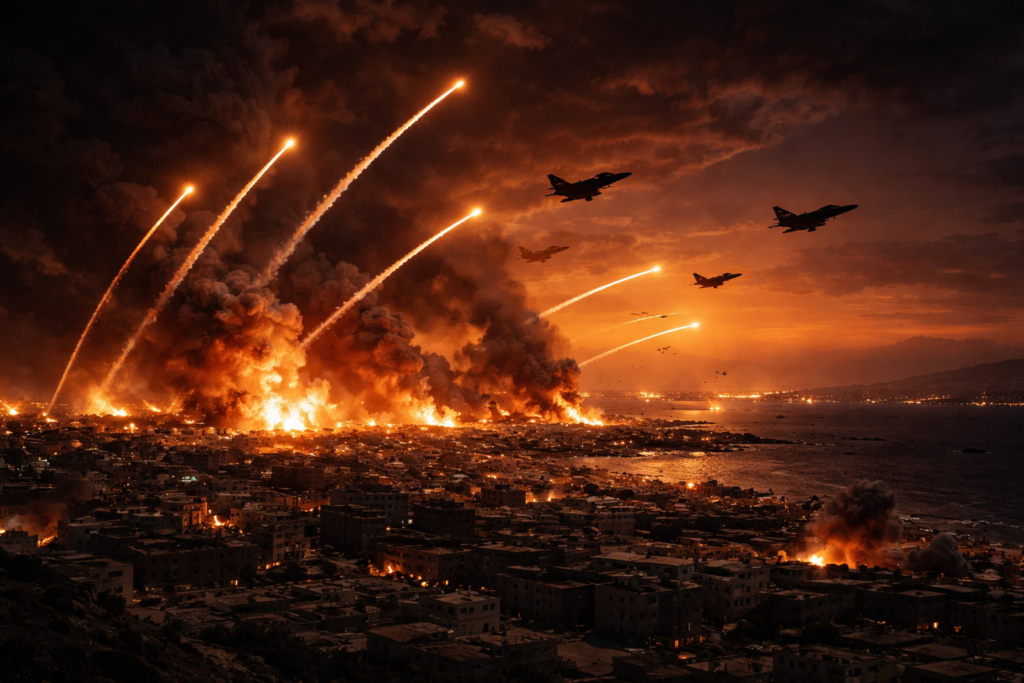
At approximately 2:17 a.m. Tehran time on February 28, 2026, the first wave of strikes hit. F-35s flying without transponders. Tomahawk cruise missiles launched from submarines positioned in the northern Arabian Sea. A coordinated barrage of Israeli Air Force sorties threading through Jordanian airspace under the cover of pre-arranged — and subsequently denied — overflight arrangements. The targets were surgical, the planning exhaustive, and the objective, at least in the operational brief that would later be partially leaked to The Washington Post, was described with the kind of bureaucratic understatement that governments use when they know they’re crossing a line they can never un-cross:
“Decisive degradation of Iran’s nuclear capability and command infrastructure.”
Operation Epic Fury lasted eleven hours in its first phase. By the time the sun rose over the Alborz Mountains, the Fordow enrichment facility had been penetrated by bunker-busting munitions that the Iranians had spent twenty years believing their underground geology made impossible. The Natanz site — struck before, in 2010 by Stuxnet, in 2021 by sabotage — was struck again, this time with enough conventional ordnance to put it beyond near-term recovery.
And then came the strike that changed everything.
The compound in northern Tehran — a location that had been the subject of intelligence chatter for months, that had been surveilled, modelled, and war-gamed in situation rooms from Langley to Tel Aviv — took a direct hit shortly before dawn. Ali Khamenei, the Supreme Leader of the Islamic Republic, the man who had held the ideological architecture of the Iranian state together for 35 years through sanctions, assassination, pandemic, and popular uprising, was killed.
Washington initially offered neither confirmation nor denial — the diplomatic equivalent of a poker face held one beat too long. Jerusalem said nothing publicly for six hours, which in Israeli communications strategy is as loud as a press conference. The Iranian state broadcaster went off air for forty-seven minutes, and when it returned, it played Quranic verses on a black screen, which is a specific language that Iranians of a certain age know how to read.
The context, to anyone who had been paying attention, was not surprising — even if the execution was. Iran had spent the better part of a decade accelerating its nuclear programme with the studied urgency of a country that had concluded diplomacy was a stalling mechanism dressed in a suit. The JCPOA — that painstakingly assembled 2015 nuclear deal — had been hollowed out, abandoned, partially resurrected, and hollowed out again until it was essentially a ghost agreement: referenced in communiqués, believed in by no one. IAEA inspectors had been filing increasingly alarmed reports. Enrichment levels had crept past 60%, then past 84%. The language in Israeli intelligence assessments, shared selectively with Washington, had shifted in late 2025 from “threshold state” to something starker.
Domestically, Iran was fraying. The protests that had rocked the country after Mahsa Amini’s death in 2022 had never fully extinguished — they had gone underground, become more networked, more radicalized in pockets, fed by an economy strangled by sanctions and mismanagement and the particular cruelty of a government that met economic desperation with ideology. The Revolutionary Guard had kept the lid on. But lids, under sufficient pressure, tend to move.
The architects of Operation Epic Fury had calculated — rightly or wrongly, and the debate would consume foreign policy journals for years — that the convergence of external nuclear threat and internal fragility had opened a window. A narrow one. One that would not stay open.
They went through it.
2.2 Iran’s Retaliation
The Islamic Republic did not collapse. That had been, depending on which post-war analysis you read, either the optimistic assumption or the catastrophic miscalculation at the heart of the operation’s political logic.
What it did instead was bleed — and in bleeding, it struck back with the particular ferocity of an institution fighting for its own survival.
Within 36 hours, Iranian ballistic missiles were falling on Israeli territory in numbers that overwhelmed Iron Dome’s intercept capacity at the margins — not catastrophically, but enough. Haifa’s port infrastructure took a hit. A suburb of Tel Aviv experienced its worst civilian casualties since 2006. Ben Gurion Airport suspended commercial operations. The psychological impact, in a country already operating on the tightly wound frequency of a society that has never fully known peacetime, was profound.
Simultaneously, Iranian proxies activated with co-ordinated precision that suggested the contingency planning had been in place for years. Hezbollah opened a front from southern Lebanon. Militia forces in Iraq launched drone swarms at the Al-Asad airbase, where American personnel were stationed — and this time, unlike previous skirmishes, they connected. Seventeen US service members were killed in the first 48 hours. The Pentagon, which had been carefully describing US involvement in Epic Fury as “supportive coordination,” suddenly had dead soldiers and a domestic political crisis to manage simultaneously.
In the Gulf, the picture was equally grim. Houthi forces in Yemen, emboldened and resupplied through channels that Western naval interdiction had never fully severed, began targeting Saudi oil infrastructure with a persistence and accuracy that suggested significant capability upgrades. A terminal at Ras Tanura — the largest crude oil export facility on Earth — was hit and partially disabled. Riyadh, which had been cautiously supportive of the US-Israeli operation in the encrypted conversations that constitute actual Gulf diplomacy, found itself absorbing the consequences of a war it had not officially endorsed.
The region, in the span of a week, had become a map of burning nodes.
2.3 The Strait of Hormuz Shutdown
Geography is destiny. And Iran had always understood that its most powerful non-nuclear weapon wasn’t a missile or a proxy militia. It was a body of water.
The Strait of Hormuz is where the Persian Gulf exhales into the Gulf of Oman — a funnel of strategic real estate so valuable that controlling it, or merely threatening to control it, confers a kind of leverage that no sanctions regime can easily replicate. The numbers are almost abstract in their enormity: on normal days, roughly 20% of global petroleum liquids pass through those waters. Approximately 17-18 million barrels of crude and refined products daily. Liquefied natural gas shipments that heat homes in Tokyo and keep factories humming in Shanghai. The circulatory system of the global economy, exposed and vulnerable, threading through a maritime corridor that Iran had spent decades preparing to contest.
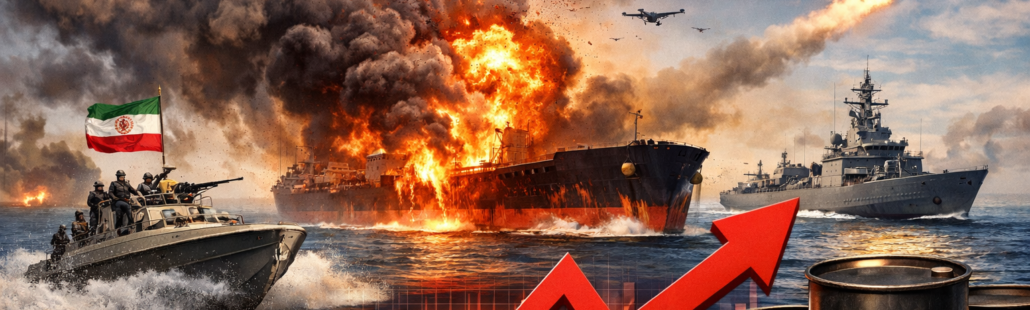
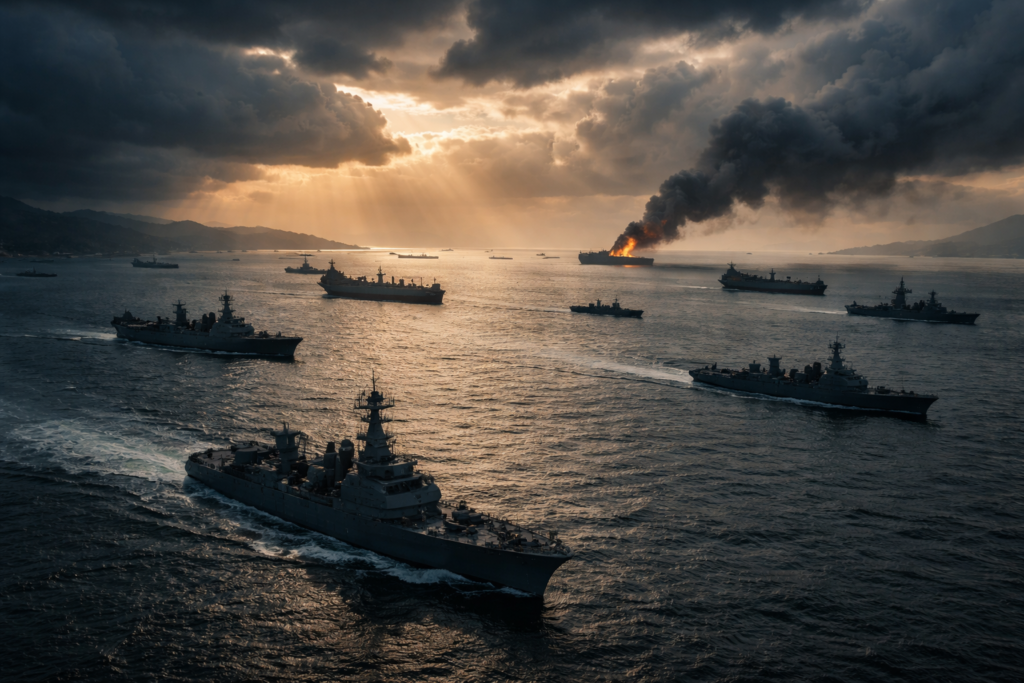
The IRGC Navy began its Hormuz operations on Day Three. It didn’t attempt to physically blockade the strait — that would have been both militarily untenable against US naval assets and unnecessarily escalatory in a way that Iran, even in its fury, was tactically shrewd enough to avoid. Instead, it did something more durable and more psychologically effective: it made the strait unpredictable.
Mines were laid in shipping lanes — not enough to close the waterway, but enough to require every vessel to slow to a crawl while minesweepers worked. Speed kills insurance premiums. Iranian fast boats harassed tanker traffic, not consistently enough to be interdicted, but consistently enough to be felt. Two tankers were struck by what maritime investigators initially called “surface-to-surface projectiles of unclear origin.” The ambiguity was the point.
The effect on shipping was immediate and rational. The world’s major tanker operators — Frontline, Euronav, DHT — began rerouting vessels around the Cape of Good Hope almost overnight. It added 15 days to journey times. It absorbed spare tanker capacity that the market hadn’t needed since COVID. Freight rates for supertankers tripled within a week, a cost that moved with quiet inevitability into the price of everything those ships carried.
The global economy had grown accustomed to cheap, reliable energy flowing through Hormuz like blood through a healthy artery. Now the artery was compromised — not severed, but damaged enough that every downstream system could feel the pressure drop.
Central banks that had spent three years wrestling inflation back to something manageable watched their models with the expression of surgeons realising mid-procedure that the patient’s vitals are moving in the wrong direction. The energy price spike was not a blip. The supply chain disruption was not temporary. And the war — unlike so many “contained regional conflicts” that traders had learned to buy through — showed no signs of containing itself.
The question was no longer whether this would hurt. It was already hurting.
The question was how deep the wound would go.
3. The Oil Shock That Shook Markets
3.1 Price Explosion
Numbers tell stories that diplomats won’t.
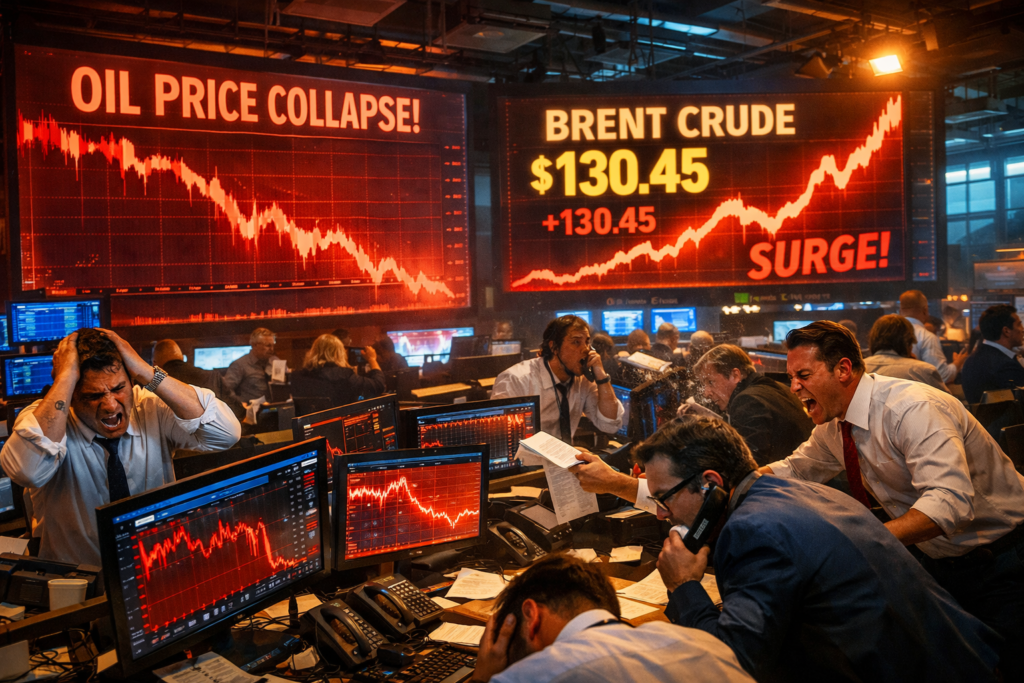
On the morning of February 28, 2026, Brent crude was trading at $72 a barrel. It was an unremarkable figure, the kind of price that energy analysts describe as “range-bound” and that consumers barely notice. Within a week of Operation Epic Fury’s opening strikes, it had blown past $103. Within ten days, it was flirting with $106. A 40 to 50 percent surge in crude prices, compressed into the span of time most people take to finish a Netflix series.
To put that in perspective: the 2022 spike triggered by Russia’s invasion of Ukraine, the one that sent energy bills across Europe into genuinely alarming territory, took three months to fully materialise. This one happened before the fires at Fordow had stopped burning.
LNG told an even starker story. Liquefied natural gas, the molecule that had quietly become the backbone of European energy security after the Russian pipeline era ended, saw spot prices jump approximately 60 percent in the same window. Asian buyers who had locked in long-term contracts found themselves sitting on suddenly precious agreements. Those who hadn’t were competing in a spot market that had turned feral. Cargo diversions, contract disputes, and emergency government interventions became daily news from Seoul to Stuttgart.
The speed was the shock. Markets can absorb bad news. What they cannot absorb is bad news arriving faster than the models can update.
3.2 Infrastructure Under Fire
The price explosion would have been brutal enough on its own. But the conflict was not content to threaten supply. It was actively destroying it.
Iranian-linked strike packages, some direct and some operating through the architecture of proxy forces that Tehran had spent decades quietly assembling, began targeting energy infrastructure across the Gulf with a methodical precision that spoke to years of contingency planning. The UAE’s Shah gas field, one of the largest natural gas developments in the country’s history and a critical source of domestic energy supply, took significant damage in a drone and missile barrage that analysts later described as a textbook “grey zone” attack: destructive enough to matter, ambiguous enough in attribution to complicate the response.
More alarming still was the targeting of Qatar’s Ras Laffan industrial city, the vast coastal complex that functions as the operational heart of the global LNG trade. Qatar supplies approximately 20 percent of the world’s liquefied natural gas. Ras Laffan is where that gas is processed, liquefied, and loaded onto the tankers that feed Europe, Japan, South Korea, and China. A successful strike on its core infrastructure would not merely tighten supply. It would fracture the architecture of the entire global gas market.
The strikes on Ras Laffan were not fully successful. Qatari air defences, heavily upgraded in the years following the 2017 Gulf crisis, intercepted a significant portion of the incoming ordnance. But “not fully successful” is a category that still means damaged compressors, disrupted loading schedules, and a facility operating at reduced capacity while the world’s energy importers refreshed their screens and recalculated their winter reserves.
This was the dimension of the crisis that separated it from prior Gulf confrontations. Previous episodes, including the 2019 Abqaiq strikes on Saudi Aramco facilities, had demonstrated Iran’s reach. This time, the targeting was broader, more sustained, and explicitly aimed at the full spectrum of Gulf energy export capacity, not just oil but gas and LNG simultaneously. The world was not facing an oil crisis. It was facing an energy crisis, and the distinction mattered enormously.
3.3 Worst-Case Scenario
The commodity desks at Goldman Sachs, JPMorgan, and Vitol had all, at various points in the preceding two years, run scenario models on a Hormuz disruption. The outputs had been filed, noted, and largely treated as tail-risk exercises, the kind of analysis you do to demonstrate rigour rather than because you genuinely expect to need it.
By the second week of March 2026, those models were no longer theoretical.
The worst-case projection that began circulating in institutional research notes placed Brent crude at $130 per barrel if Hormuz disruption persisted beyond 30 days. Some desks had internal numbers higher than that, numbers that weren’t being shared with clients because publishing them felt somewhere between irresponsible and professionally embarrassing. Approximately 20 million barrels per day of supply was at risk, when you combined the direct Hormuz disruption, the damage to Gulf export infrastructure, and the insurance-driven self-sanctioning by tanker operators who had simply decided the risk-adjusted math no longer worked.
For historical context, the 1970s oil crises are the standard reference point. The 1973 Arab embargo cut global supply by roughly 7 percent. The 1979 Iranian Revolution disrupted approximately 4 percent of global output. Both events were enough to trigger recessions across the Western world, reshape energy policy for a generation, and permanently alter the geopolitical calculus around oil dependence.
The 2026 Hormuz crisis was threatening to disrupt supply at three to four times that scale. And it was doing so into a global economy that had spent the post-COVID years accumulating debt, running down strategic reserves, and congratulating itself on energy transition timelines that now looked, in the harsh light of a burning Gulf, somewhat optimistic.
The 1970s, at least, had a ceiling. This one felt open.
4. Inflation Ignites: The Return of Stagflation
4.1 Energy Costs Ripple Through Everything
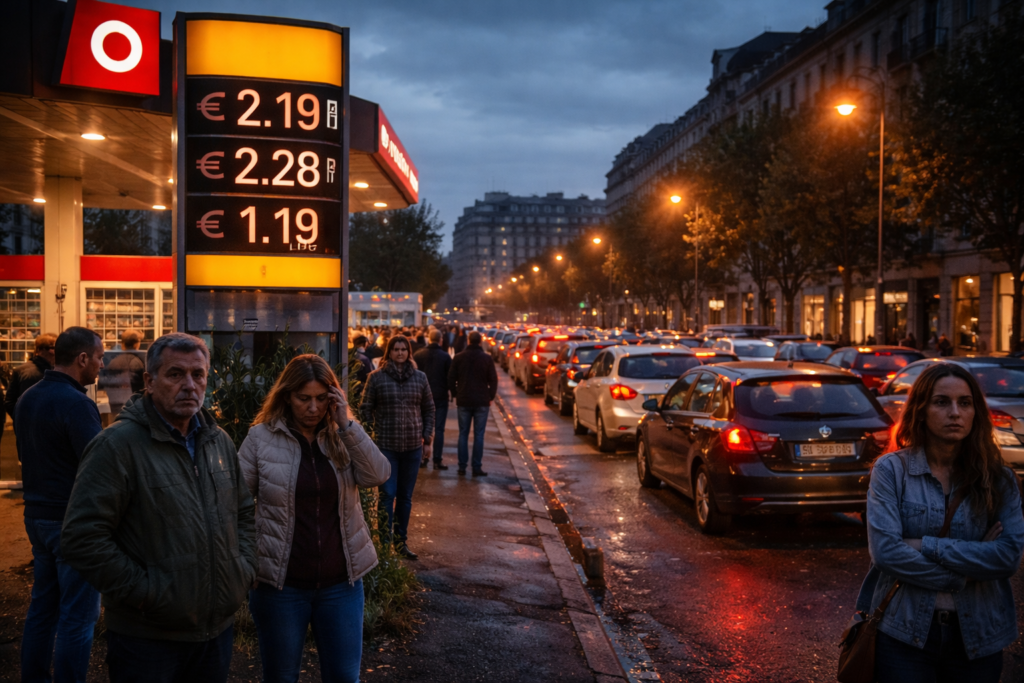
There is a particular kind of economic pain that is difficult to explain to people who haven’t lived through it. It is not the sharp, clean pain of a market crash, where the number goes down and you know what you’ve lost. It is slower. More diffuse. It arrives in the form of a grocery receipt that is somehow 15 percent higher than last month’s, a heating bill that makes you reconsider the thermostat, a freight surcharge on a delivery that you cannot quite trace back to any single cause.
It is inflation. Not the modest, managed variety that central banks describe as healthy. The other kind.
Energy is not merely a commodity. It is an input into every other commodity. Fuel costs determine what it costs to move goods from a factory to a port. Petrochemicals determine the price of plastics, fertilisers, pharmaceuticals, and synthetic fibres. Natural gas powers the industrial processes that produce steel, cement, glass, and aluminium. When energy prices jump 40 to 60 percent in ten days, the effect does not stay in the energy sector. It spreads, with the patient, comprehensive logic of water finding every crack.
Transport costs surged. Airlines, already operating on margins that require a spreadsheet to locate, began repricing tickets and cutting routes. Shipping companies passed fuel surcharges down the supply chain. Trucking operators in the US and Europe, many of them small independent operators with no hedging capacity, began watching their cost bases move in ways their contracts hadn’t anticipated. Agriculture, one of the most energy-intensive sectors on the planet given its dependence on diesel machinery and nitrogen fertiliser derived from natural gas, started signalling that food prices were going to move. Consumers, already worn from the inflation cycle of 2021 to 2023, had no reserves of tolerance left.
The price pressure was global. It was simultaneous. And it was moving faster than policy could respond.
4.2 Slowing Growth and Rising Prices
The word “stagflation” carries a particular dread in economic circles, the way certain medical terms do. It describes a condition that the standard toolkit of economic management is almost uniquely poorly equipped to treat.
In a normal inflationary episode, central banks raise interest rates. Higher rates cool demand, spending slows, prices stabilise. In a normal recession, central banks cut rates. Cheaper borrowing stimulates investment, employment recovers, growth resumes. These are clean levers for clean problems.
Stagflation is different. It is inflation and stagnation arriving together, each one undermining the remedy for the other. Raise rates to fight inflation, and you accelerate the recession. Cut rates to support growth, and you pour fuel on the inflation fire. It is an economist’s nightmare precisely because it is a problem with no good solution, only a choice between different kinds of damage.
By mid-March 2026, the setup was textbook.
European inflation projections, which had been tracking back toward the ECB’s 2 percent target with the kind of painstaking slowness that makes central bankers use words like “progress” with visible relief, were being revised sharply upward. Preliminary models were pointing toward headline inflation of approximately 3 percent across the Eurozone within the quarter, with energy-exposed economies like Germany and Italy facing significantly higher national figures. The political implications in countries where cost-of-living had already become the dominant electoral issue were not subtle.
In the United States, the pain was arriving at the pump with the blunt directness that Americans understand instinctively. Gas prices were approaching $4 per gallon nationally, with California and the Northeast already past it. In a country where the price of gasoline functions as a kind of daily economic mood indicator, where it appears on illuminated signs at eye level on every major arterial road, the psychological effect compounds the financial one. Consumer confidence surveys, already softening through late 2025, were now falling off a cliff.
Growth forecasts were being quietly slashed at the IMF, the World Bank, and every major investment bank that had a macro team still speaking to each other. The global economy was not yet in recession, technically. But the gap between “not yet” and “yes” was narrowing with uncomfortable speed.
4.3 Central Banks in a Trap
Jerome Powell had, by the middle of his tenure at the Federal Reserve, developed a reputation for a particular kind of communicative steadiness. The measured statement. The carefully telegraphed pivot. The press conference that calms rather than alarms. It was, by the standards of the job, a considerable skill.
The situation he faced in March 2026 tested all of it.
The Fed’s dual mandate is, in theory, straightforward: price stability and maximum employment. In practice, the two had suddenly become adversaries. Inflation was rising, driven by an external energy shock that interest rate policy could not actually address at the source, because the source was a geopolitical conflict, not excessive domestic demand. Raising rates would not bring oil prices down. It would not reopen the Strait of Hormuz. It would not repair the compressors at Ras Laffan. What it would do is make mortgages more expensive, business borrowing more costly, and an already slowing economy slower.
The labour market, which had been the one genuinely robust element of the post-pandemic US economy, was beginning to crack. Tech sector layoffs, which had started in 2022 and been absorbed without systemic damage, were now being joined by retrenchments in logistics, manufacturing, and retail, sectors directly exposed to the energy and supply chain shock. Job losses were emerging in the data, not yet at recession scale but moving in a direction that the Fed’s models could not ignore.
Cutting rates to support employment would signal to bond markets that the Fed was tolerating inflation, with consequences for the dollar and long-term Treasury yields that would ripple through the global financial system in ways Powell’s team was still trying to fully model.
Holding rates would do nothing for inflation and would actively worsen growth.
The trap was not a metaphor. It was a precise description of the policy space available. The Fed could move in one direction, or the other, and be wrong either way. Or it could hold its position, which was its own kind of wrong.
In Washington, in Frankfurt, in Tokyo and London, the central bankers of the world’s major economies were arriving at the same bleak realisation at roughly the same time. The tools they had spent careers mastering had been designed for a different kind of crisis. This one had been imported from the Persian Gulf, and no amount of basis points was going to send it back.
5. Growth Takes a Hit: Global Economy Slows Down
5.1 Pre-War vs Post-War Outlook
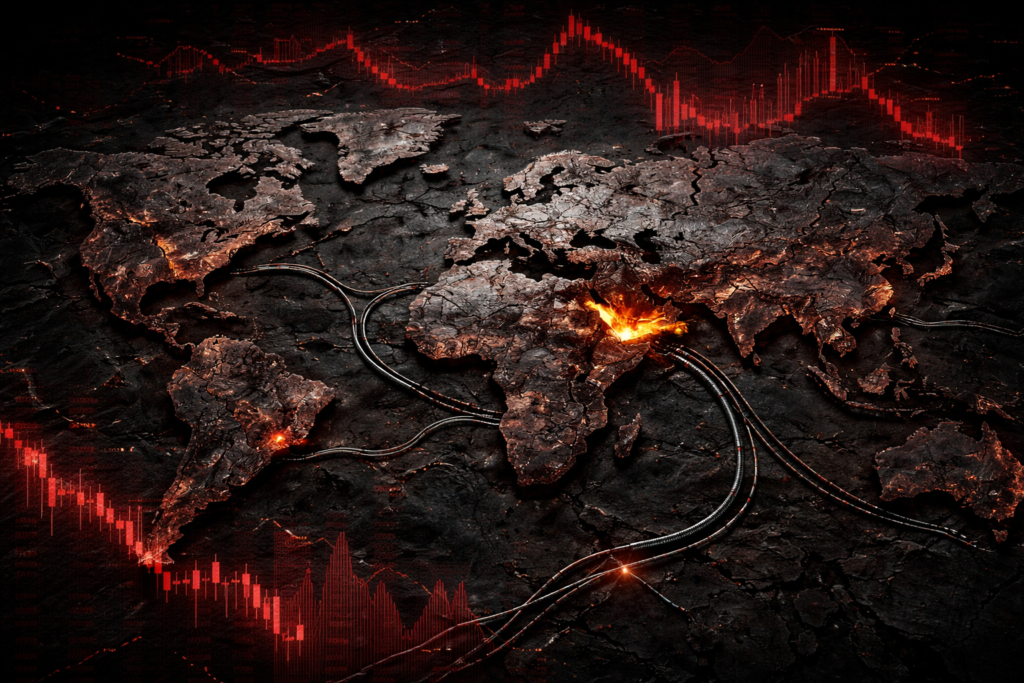
At the start of 2026, the global economy was, by the cautious standards of the post-pandemic era, in reasonable shape. Not thriving, exactly. The word economists preferred was “resilient,” which is the profession’s way of saying things could be worse and we are grateful they aren’t. The IMF’s January World Economic Outlook had pencilled in global GDP growth of 3.3 percent for the year. Modest. Unspectacular. But stable, and after several years of successive shocks, stability had come to feel like a minor miracle.
That forecast, produced six weeks before Operation Epic Fury, was now worth roughly as much as a tanker insurance policy written before the mines went in.
The revision process began almost immediately. Economists, to their credit, are not sentimental about their own projections. Models were updated, scenario weights were adjusted, and the emerging consensus settled on a downward revision of 0.2 to 0.4 percentage points off global growth, with the precise figure depending on a variable that no economist could actually model with confidence: how long this war was going to last.
That range may sound modest in isolation. It isn’t. At the scale of the global economy, 0.3 percentage points of GDP is not a rounding error. It represents hundreds of billions of dollars in lost output, millions of households pushed below income thresholds they had only recently climbed above, and public finances in emerging markets stretched past the point where the numbers still work cleanly. The countries with the least buffer were going to feel the full weight of a shock that the richest economies would absorb as a slowdown. For others, it would feel like a crisis.
5.2 Country-Level Damage
The cruelest arithmetic of the conflict was that the country that would suffer most economically was the one that had started it, or rather, the one that had provoked the response that started it, depending on which sequence of events you believed constituted the beginning.
Iran’s economy, already operating under the accumulated weight of decades of sanctions, was facing a contraction of approximately 3 percent in the near-term projections. That figure, sobering as it is, probably understated the true damage. Sanctions had already driven Iran’s formal economy into a state of managed dysfunction; what remained was heavily reliant on oil revenues that were now either physically disrupted or effectively uninsurable, a parallel currency market that functioned on perpetual anxiety, and a population whose tolerance for economic hardship had been tested past most reasonable limits. The strikes on nuclear and command infrastructure had not, as some planners had hoped, produced a rapid political transition. What they had produced was a state in a condition of furious, wounded survivalism, which historically is not a condition conducive to economic stabilisation.
The spillover effects were reaching economies with no proximity to the Gulf whatsoever. Europe, still managing the structural hangover of energy dependence reorientation forced by the Russia-Ukraine conflict, found itself facing a second major energy shock before it had fully absorbed the first. Germany, whose industrial model is particularly sensitive to energy input costs, was watching manufacturing output projections deteriorate in real time. Italy and Greece, whose public debt positions leave little room for the kind of fiscal cushioning that the crisis demanded, were facing sovereign spread widening that reminded older market participants of 2011.
China presented its own complexity. Beijing was, in one sense, insulated: it maintained relationships with Iran, purchased discounted sanctioned oil, and had no formal stake in the Western-led response architecture. But China is also the world’s largest importer of crude oil, and a significant portion of that crude transits Hormuz. Chinese refiners were scrambling to secure alternative supplies from Russia and West Africa, but the arithmetic of global tanker availability and route lengths was not cooperating. Chinese manufacturing, which had been showing tentative signs of cyclical recovery, was facing feedstock uncertainty and shipping cost inflation simultaneously. The growth engine that the global economy had come to rely on as a counterweight to Western slowdowns was sputtering at exactly the wrong moment.
5.3 Duration Is Everything
The IMF’s institutional messaging in the weeks following the conflict’s outbreak carried a consistent and carefully chosen emphasis. The fund’s economists, in background briefings and published scenario analyses, kept returning to a single variable as the determining factor between a painful but manageable episode and a genuinely structural global downturn.
Duration.
A conflict that concluded, or at least de-escalated to the point of Hormuz reopening, within 30 to 45 days would produce a sharp but recoverable shock. Supply would return, prices would partially retrace, central banks would have room to respond, and the global economy would carry the scars without sustaining the kind of permanent output loss that rewrites growth trajectories for years. History offered some precedent for this: the 2019 Abqaiq strikes, the various Houthi escalation cycles, even the early weeks of the Russia-Ukraine conflict, had all produced energy price spikes that proved partially reversible once the immediate tactical situation clarified.
A conflict that persisted beyond 60 to 90 days entered different territory entirely. At that duration, the shock stops being a price event and starts being a structural one. Companies that have rerouted supply chains around Hormuz begin making those rerouting decisions permanent, at significant capital cost. Energy importers accelerate alternative sourcing arrangements that lock in higher long-run costs. Consumer and business confidence, once it breaks through a certain threshold of duration, does not snap back with the all-clear signal. It rebuilds slowly, grudgingly, with a new baseline of anxiety baked in.
The IMF wasn’t predicting which scenario would materialise. Nobody was, honestly, because the variable that determined duration was political will in Tehran, Washington, and Jerusalem, and none of those three capitals were currently in a mood that invited confident forecasting.
What the fund was saying, with the careful precision of an institution that has seen enough crises to know how they compound, was that every week of continued disruption was not just adding to the total damage. It was changing the nature of the damage. And that distinction mattered enormously.
6. Supply Chains Start Breaking
6.1 Beyond Oil: Hidden Dependencies
The public conversation about the Hormuz crisis was, understandably, dominated by oil. Crude prices are visible, trackable, politically charged, and personally felt at every petrol station forecourt on the planet. They are the metric that leaders are asked about and citizens care about in the most immediate sense.
But the economists and supply chain specialists who were working through the second and third-order effects of the disruption were increasingly focused on a set of commodities that most people could not have named on a Tuesday morning, and which were, in some respects, more structurally dangerous to the global economy than the oil shock itself.
Aluminium was one. Gulf-based aluminium smelters, powered by cheap and abundant natural gas, had become a significant component of global primary aluminium supply. Disruption to Gulf energy and logistics was already feeding through to aluminium premiums, which in turn affected every industry that used the metal, from automotive to aerospace to consumer electronics packaging.
Helium was another, less obvious and more alarming. The Gulf region, particularly Qatar, is one of the world’s primary sources of helium, a non-renewable, non-substitutable gas that is critical for MRI machines, semiconductor manufacturing, fibre optic production, and aerospace applications. Helium markets are thin, tightly supplied, and almost entirely lacking in the kind of strategic reserve infrastructure that exists for oil. When Qatari LNG processing was disrupted, helium extraction came with it. The semiconductor fabs of Taiwan, South Korea, and the American Southwest were already making calls to their helium suppliers that were not going well.
Sulphur and urea rounded out the list of industrial inputs whose supply chains ran directly through the disruption zone. Sulphur, a byproduct of oil and gas processing, is an essential input for phosphate fertiliser production. Urea, derived from natural gas, is the world’s most widely used nitrogen fertiliser. Both were tightening simultaneously, and both fed into a global agricultural system that was already operating with uncomfortably thin margins between supply and demand.
These were not secondary concerns. They were the hidden wiring of the modern industrial economy, and the conflict was pulling at it.
6.2 Industry Fallout
Agriculture was the sector that attracted the most urgent attention, and rightly so. The fertiliser supply chain is long, seasonal, and unforgiving of disruption. Farmers planting spring crops in the Northern Hemisphere work with a fixed calendar that does not accommodate a six-week delay in urea availability. Missing an application window is not an inconvenience that gets made up in the following quarter. It means lower yields in the current growing season, full stop. The Food and Agriculture Organisation was already tracking the price movements in agricultural commodity futures with the particular attention of an institution that has seen food crises develop from exactly this kind of upstream disruption.
The technology manufacturing sector was confronting its own version of the same problem on a different timeline but with equivalent severity. The semiconductor industry, which had spent three years rebuilding supply chain resilience after the COVID chip shortage had embarrassed every major automaker and electronics company on the planet, found itself facing simultaneous shortfalls in helium, speciality gases, and certain chemical precursors that move through Gulf logistics networks. Fab utilisation rates in Taiwan and South Korea, the twin poles of global chip production, began showing scheduling disruptions. The automotive industry, which had only recently restocked its semiconductor inventory to comfortable levels after years of shortage, was watching the indicators with a nauseated familiarity.
Aviation and tourism experienced something closer to a full stop. The combination of fuel cost surges, Hormuz airspace restrictions that added hours to routes between Europe and Asia, and the general atmosphere of geopolitical terror that causes leisure travellers to reconsider their holiday plans produced a demand collapse in certain travel markets that was as swift as anything seen during the early COVID lockdowns. Gulf hub airports, which had positioned themselves as the connective tissue of global long-haul travel, were operating at dramatically reduced capacity. Airlines that had ordered new widebody aircraft on the assumption of continued traffic growth were quietly renegotiating delivery schedules with Boeing and Airbus.
6.3 Business Delays and Chaos
There is a rhythm to how supply chain disruptions spread through the economy that bears almost no resemblance to how they appear in real time. In real time, it feels like nothing for a while, and then suddenly like everything at once.
The two to four week lag between a maritime disruption and its manifestation on factory floors and retail shelves is a function of the buffer stocks that businesses carry, the forward contracts that smooth short-term volatility, and the human tendency to assume that any given problem is temporary until it demonstrably isn’t. By the time a car assembly plant in Sunderland or a consumer electronics factory in Shenzhen actually runs short of a critical component, the disruption that caused the shortage occurred a month ago and halfway around the world. The delay creates a false sense of insulation that makes the eventual impact more jarring when it arrives.
Through March 2026, the lag was expiring. Manufacturers were burning through buffer inventories. Just-in-time production systems, already identified as a structural vulnerability after COVID but never fully reformed because the efficiency gains were too attractive to abandon, were encountering exactly the conditions they were designed to avoid. Order books were going unfulfilled. Lead times were extending in ways that contract terms hadn’t anticipated. Legal teams in supply chain departments were having very busy weeks.
Adding a further layer of volatility was a significant escalation in cyberattack activity targeting energy infrastructure, financial systems, and logistics networks across the Gulf and its trading partners. The attribution was, as cyber attribution almost always is, contested and partial. Iranian-linked threat actors, Russian-aligned groups apparently opportunistically exploiting the chaos, and several actors whose fingerprints pointed to no clear state sponsor were all active simultaneously. A major shipping logistics platform used by several of the world’s largest container lines experienced a four-day outage that disrupted cargo tracking for thousands of vessels. Saudi Aramco’s external-facing systems were subjected to intrusion attempts at a volume that its security teams described, in a briefing note that subsequently leaked to Reuters, as “sustained and sophisticated.”
The physical disruption to Hormuz was the headline. The cyberattacks were the footnotes that were, in certain respects, more durable in their effects. Physical infrastructure can be repaired. Trust in the digital systems that coordinate global trade takes considerably longer to rebuild, and in the meantime, every actor in the supply chain adds a layer of manual verification and precautionary delay that compounds into weeks of lost efficiency, collectively, across the entire system.
The world had built a global economy on the assumption of reliable, cheap, just-in-time everything. That assumption was being audited in real time, and the preliminary results were not encouraging.
7. The Domino Effect: How Recessions Actually Begin
7.1 Wealth Destruction
Recessions are rarely announced. They accumulate.
They begin in the gap between what things cost and what people can afford to spend, a gap that widens slowly, then quickly, in the way that Hemingway once described going broke. The mechanism is not complicated. It does not require a banking collapse or a stock market crash or a single dramatic event that makes the front pages. It requires only that enough people, in enough countries, find that their monthly outgoings have quietly exceeded what their incomes can comfortably cover, and begin to adjust their behaviour accordingly.
Energy costs are the most direct transmission mechanism from a geopolitical shock to a household budget. They are not discretionary. You cannot decide not to heat your home in February in Warsaw or Chicago. You cannot instruct your supply chain to stop using diesel. You cannot opt out of the airfare surcharge or the delivery fee or the price increase on the product that was manufactured using petrochemicals that now cost 40 percent more to produce.
The spending power destruction that follows an energy shock of this magnitude works through every layer of the income distribution simultaneously, but it concentrates its damage at the bottom. Higher-income households spend a smaller share of their budget on energy, absorb price increases more easily, and have financial assets that may partially appreciate in an inflationary environment. Lower-income households spend a larger share on energy and fuel, have limited or no savings buffer, and face the full force of consumer price inflation on the categories they cannot avoid: food, heat, transport.
The result is a broad compression of discretionary spending. The restaurant that was full on Friday nights starts seeing tables empty by 9 p.m. The home renovation that was planned for spring gets deferred. The new car purchase gets reconsidered. The holiday gets cancelled, or downgraded, or replaced by a staycation that is itself an economic contraction dressed in casual clothes.
Multiply those individual decisions across tens of millions of households in dozens of countries, and you have the beginning of a demand collapse that feeds back into the businesses and employment markets those households depend on. This is not theory. It is the documented pattern of every major energy shock in the modern era. The 2026 version was running the same playbook on a larger stage.
7.2 Confidence Collapse
If wealth destruction is the economic mechanism by which energy shocks become recessions, confidence collapse is the psychological one. And in many ways, it is the more consequential of the two, because it operates faster, spreads further, and is significantly harder to reverse.
Businesses make investment decisions on the basis of expected future conditions. They hire when they believe demand will be strong enough to justify the payroll. They commit capital to new facilities, new equipment, and new product development when they can construct a plausible scenario in which those investments pay off. They sign long-term supply contracts when they have reasonable confidence in the price environment those contracts will operate in.
The Hormuz crisis systematically destroyed the conditions necessary for any of those calculations to work.
An executive trying to model the return on a new manufacturing facility in early March 2026 faced an input cost environment that could not be forecast beyond a six-week horizon. An energy company trying to plan capital allocation had no visibility on where the commodity it produced and sold would be priced by the summer. A retailer trying to price next season’s inventory was working with logistics costs that had already moved 30 percent and showed no sign of stabilising. The rational response to radical uncertainty is not to proceed on optimistic assumptions. It is to delay, defer, and preserve optionality until the uncertainty resolves.
That is precisely what businesses around the world began doing. Capital expenditure plans were frozen. Hiring decisions were put on hold. Mergers and acquisitions activity, which had been showing tentative signs of recovery after a subdued 2025, went essentially quiet. The boardroom instinct in a crisis is almost always the same: wait and see. The problem is that when every boardroom in every sector of every major economy makes the same decision simultaneously, the waiting itself becomes the recession. Investment falls. Jobs go uncreated. Income that would have flowed through those jobs and into consumer spending never materialises. The economy slows not because something catastrophic has happened, but because everyone is waiting for something catastrophic to happen, and the waiting is indistinguishable from the catastrophe itself.
Consumers were running the same calculus at the kitchen table. Precautionary saving, which rises in uncertain times with a reliability that behavioural economists have documented across cultures and income levels, was picking up in survey data across the US, Europe, and major Asian economies. People were not panicking. They were being prudent. But prudence, aggregated across an economy, looks exactly like a demand contraction.
7.3 Financial Market Reactions
The markets, to their credit, had not waited for the economic data to confirm what the logic already suggested.
Equity markets had sold off sharply in the first week of the conflict, recovered partially on misplaced optimism about a rapid resolution, and then sold off again as the duration of the disruption became clearer. The pattern was familiar to anyone who had traded through previous geopolitical crises: the initial panic, the dead cat bounce, the grinding second-leg lower as the fundamental implications work their way into earnings estimates and discount rates.
Volatility indices spiked to levels not seen since the acute phase of the 2022 European energy crisis. Options markets were pricing tail risks at premiums that reflected genuine institutional uncertainty rather than speculative excess. Credit spreads, particularly in energy-dependent emerging markets and European high yield, were widening in ways that historically precede broader financial stress.
Recession probability models, which the major investment banks publish with varying degrees of transparency about their methodology, were moving sharply. Goldman Sachs placed the probability of a US recession within 12 months at approximately 25 percent, up from single digits at the start of the year. JPMorgan’s equivalent figure was in a similar range. Independently, the Atlanta Fed’s real-time GDP tracking model was printing numbers that made economists reach for their historical precedents.
The bond market was telling its own story. Treasuries rallied as investors sought safety, but the rally was complicated by the inflation signal embedded in the same crisis that was driving it. A world of rising inflation and slowing growth produces contradictory signals for fixed income: the recession trade says buy bonds, the inflation trade says sell them. The result was a market caught between two impulses, lurching rather than trending, with volatility that made positioning difficult and conviction scarce.
Currency markets added another layer of complexity. The dollar strengthened as a safe haven, which tightened financial conditions for the emerging market economies that had borrowed in dollars and now needed to service that debt with weakened local currencies. Several central banks in Asia and Latin America were intervening in currency markets with reserves that had not been cheap to accumulate and were expensive to deploy. The feedback loops between commodity prices, currency moves, and emerging market stress were beginning to resemble the early chapters of previous financial crises, with the critical difference that this time the initiating shock was geopolitical rather than financial, which made the standard financial crisis remediation toolkit only partially applicable.
The system was not broken. But it was stressed in multiple places simultaneously, and the redundancy that normally absorbs stress in one area while others remain stable was being consumed faster than it was being replenished.
8. Two Possible Futures: Scenario Breakdown
8.1 Short War: 1 to 4 Weeks
The optimistic scenario existed. It was not delusional. History provided genuine precedent for it, and the incentive structures pointing toward de-escalation were real, even if they were, in the fever of the conflict’s opening weeks, struggling to assert themselves over the incentive structures pointing in the other direction.
In this scenario, the combination of American diplomatic pressure, Gulf state intermediation through back channels that the Qataris and Omanis had spent decades cultivating precisely for moments like this, and the internal Iranian calculus that a prolonged conventional conflict against the United States and Israel was a course that ended only in the Islamic Republic’s destruction, produced a negotiated cessation of hostilities within one to four weeks of the opening strikes.
Hormuz would reopen to commercial traffic. Shipping operators would return cautiously, initially with naval escort arrangements that added cost but restored confidence. Tanker insurance premiums would remain elevated but would begin their descent from crisis levels. The mine-clearing operations that the US Fifth Fleet and Royal Navy minesweepers had been conducting would be completed and certified, and the maritime risk premium that had been the most direct mechanism of energy price inflation would begin to deflate.
Oil prices would stabilise in the $65 to $80 per barrel range, elevated relative to the pre-war $72 baseline but within a band that the global economy had demonstrated, on multiple prior occasions, it could absorb without structural damage. The elevated price would sting. It would add to inflationary pressure for a quarter, maybe two. But the spike would prove temporary, and temporary spikes, even sharp ones, do not rewrite growth trajectories.
The GDP hit in this scenario would be real but limited, approximately negative 0.2 percent off global growth for the year, concentrated in the second quarter and partially recovered by the fourth as energy prices normalised and the precautionary saving and investment deferral that had accumulated during the crisis was gradually unwound. Not painless. Not trivial. But manageable.
The supply chain disruptions would take slightly longer to unwind than the price dislocations, because physical logistics have a longer recovery period than financial markets. The helium and specialty gas shortages would persist for several months as Qatari LNG processing facilities completed repairs. Agricultural input markets would carry the disruption through the current planting season before normalising. But the damage would be finite and bounded.
This was the scenario that equity markets were pricing, at least partially, in their moments of recovery. It was the scenario that central banks were hoping for when they chose to hold rather than move aggressively. It was the scenario in which the Hormuz crisis became a chapter in economic history rather than the opening paragraph of something much darker.
It required the war to end. And wars, once started, have a noted tendency to hold opinions about ending.
8.2 Prolonged Conflict: Months
The pessimistic scenario did not require catastrophic escalation. It did not require nuclear weapons or the fall of multiple governments or a direct superpower confrontation, though none of those things were, in the spring of 2026, entirely outside the probability distribution. It required only that the conflict continue at roughly its existing intensity for longer than markets, policymakers, and supply chains had budgeted for.
Ninety days. That was the threshold after which the short-war assumptions broke down and the structural damage became, in the clinical language of economic modelling, path-dependent. Meaning: even if the war ended on day ninety-one, the economic trajectory had already been altered in ways that would not reverse cleanly.
In this scenario, Brent crude sustained above $130 per barrel through the second and third quarters of 2026. Not as a spike. As the new normal, at least for the duration. The rerouting of tanker traffic around the Cape of Good Hope became a permanent operational adjustment rather than a temporary workaround, with the full cost implications of that longer route baked into energy prices for the medium term. Insurance markets, which had been designed for a world where Hormuz is open, would need to reprice the risk of a world where it might not be, a recalibration that would not reverse quickly even after the physical threat subsided.
The stagflation that was already emerging in the short-war scenario would become entrenched. Entrenched stagflation is qualitatively different from a temporary price spike, in the same way that a chronic condition is qualitatively different from an acute illness. It changes expectations. Workers negotiate higher wages to compensate for persistent inflation, which feeds back into production costs, which feeds back into prices. Businesses index their contracts to inflation, normalising price increases that would previously have been competitive violations. Central banks lose the ability to credibly anchor inflation expectations, which are the invisible infrastructure on which the entire project of price stability depends.
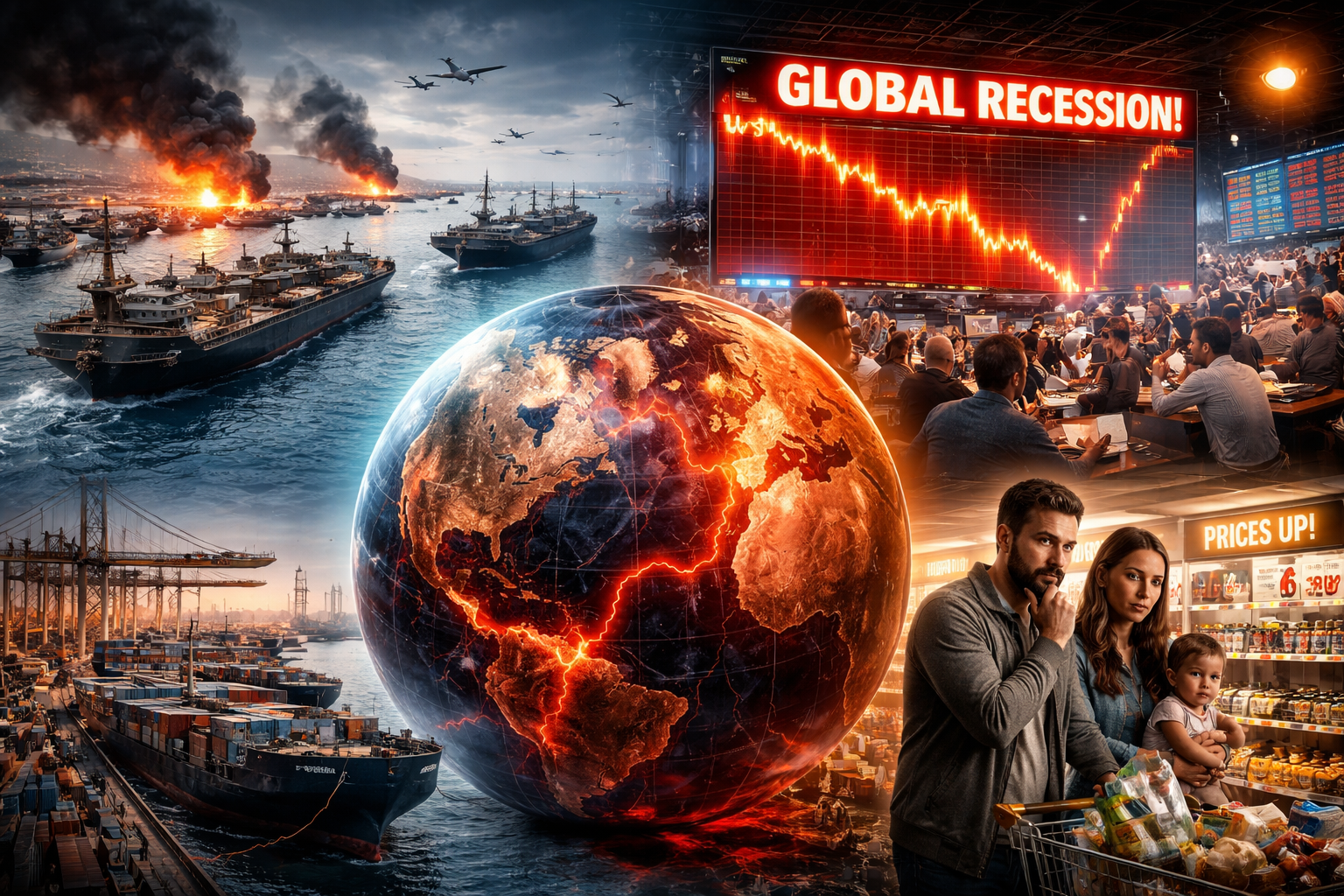
The global recession in this scenario would not arrive as a single event. It would accumulate through the second half of 2026 as the compounding effects of energy costs, supply chain disruption, confidence collapse, and central bank paralysis produced successive quarters of contracting output across the major economies. The United States would likely enter the technical definition of recession by Q3 or Q4. Europe, more energy-exposed and with less fiscal room to respond, would arrive there sooner. Emerging markets, squeezed between commodity price inflation on the import side and weakening demand for their exports on the other, would experience the worst of it with the fewest tools available to respond.
The IMF’s projections for this scenario placed global growth not at a reduced positive number but at a figure that required the word “contraction” to describe accurately. The World Food Programme was already modelling humanitarian implications in countries where food import dependency and currency weakness intersected with the fertiliser and grain disruptions in ways that moved beyond economic abstraction into the territory of actual hunger.
The difference between the two scenarios was not, in the end, a matter of economics. The economic implications followed with mathematical inevitability from the political and military ones. The question of which future the world inhabited in 2026 and beyond was going to be determined not in trading rooms or central bank boardrooms, but in the decisions being made by leaders in Tehran, Washington, and Jerusalem, in rooms that the markets could not see into and the models could not reach.
The world was watching. The clock was running. And the distance between a painful quarter and a lost decade was measured, as it so often is, in the quality of decisions made by exhausted people under impossible pressure, in the early hours of the morning, when the tankers have gone quiet and the screens are all flashing red.
9. Historical Warning: Echoes of the 1970s
There is a particular kind of institutional memory that lives in economics departments and central bank research divisions, passed down through working papers and crisis post-mortems and the kind of late-career candour that senior economists permit themselves when they are no longer worried about their next appointment. It is the memory of the 1970s. And in the spring of 2026, that memory was being retrieved with an urgency that had not been felt in a generation.
The parallels were not subtle, and the people who understood them best were the least inclined to find comfort in them.
The 1973 Arab oil embargo began as a geopolitical act and became an economic catastrophe through a transmission mechanism that, in retrospect, seems almost simple in its brutality. Arab members of OPEC, responding to American support for Israel in the Yom Kippur War, cut production and imposed an embargo on Western nations. Global oil supply fell by roughly 7 percent. The price of crude quadrupled in a matter of months. What followed was not merely expensive. It was transformative in the most damaging sense of the word. Inflation surged across every major Western economy. Growth collapsed simultaneously. The stagflation that resulted persisted not for a quarter or two but for the better part of a decade, resistant to conventional policy tools, corrosive to living standards, and politically destabilising in ways that reshaped the governments, institutions, and economic orthodoxies of the entire developed world.
The 1979 oil shock, triggered by the Iranian Revolution and amplified by the subsequent Iran-Iraq War, repeated the lesson with variations. Supply disruption of approximately 4 percent of global output was sufficient to send oil prices surging again, to trigger a second wave of global inflation, and to force the kind of brutal monetary tightening under Paul Volcker at the Federal Reserve that produced the deep recessions of 1980 and 1981 and 1982, three years of economic pain deliberately administered because the alternative, allowing inflation to become permanently embedded in expectations, was judged to be worse.
The pattern in both episodes was identical in its structure, even as it differed in its details. A supply shock in the energy sector produced an immediate price spike. The price spike transmitted through an energy-dependent industrial economy into broad inflation. Central banks, facing the impossible geometry of stagflation, were forced into choices that made some things worse in the attempt to make other things better. Growth slowed, then contracted. Unemployment rose. The recovery, when it came, was slower and shallower than the models predicted, because confidence, once broken at scale, rebuilds on its own timetable and not the one that policymakers prefer.
The 2026 Hormuz crisis was running the same sequence. Supply shock. Price spike. Inflation transmission. Stagflation setup. Central bank paralysis. The opening chapters were almost word for word.
But the people invoking the 1970s analogy with the most sophistication were also the ones most insistent on its limitations. Because the differences between then and now were not reassuring. They were, in almost every dimension that mattered, arguments for why the 2026 version could be worse.
The 1970s global economy was integrated. The 2026 global economy was hyperintegrated, in ways that had no precedent and no historical stress test at scale. In 1973, a disruption to Gulf oil affected the countries that imported Gulf oil. In 2026, a disruption to Gulf energy affected the semiconductor supply chains of Taiwan, the fertiliser inputs of Brazilian agriculture, the helium supply of American hospitals, the LNG contracts of Japanese utilities, and the freight rates of every container ship on every ocean simultaneously. The interconnection that had made the modern global economy so extraordinarily productive in calm conditions had also made it so extraordinarily vulnerable in turbulent ones.
The financial system was more complex, more leveraged, and more globally entangled than anything that existed in the 1970s. A derivatives market that had not existed in 1973 now carried trillions of dollars of energy-linked exposure. Currency markets moved at electronic speed, transmitting stress from one economy to another in milliseconds rather than weeks. Emerging market economies that had been largely peripheral to the 1970s crisis were now deeply embedded in global supply chains, carrying dollar-denominated debt, and exposed to commodity price swings in ways that created feedback loops between the geopolitical shock and the financial system that 1970s economists did not have to model.
The strategic petroleum reserves that Western governments had built specifically in response to the 1970s shocks offered some buffer, but less than their nominal volumes suggested. The US Strategic Petroleum Reserve had been drawn down significantly in the post-2022 releases, and replenishment had been slow. The IEA coordinated release mechanisms, while available, were designed for short-term price management rather than sustained supply replacement.
And the geopolitical context was, if anything, more complex than the Cold War binary that had structured the 1970s crisis. In 1973, the world had two superpowers and a set of regional actors whose alignments were reasonably predictable. In 2026, the United States, China, Russia, and a set of mid-sized powers with nuclear capabilities or ambitions were all simultaneously present in or adjacent to the conflict, each with its own interests, none of them fully aligned, and the potential for miscalculation distributed across more decision-making centres than any crisis manager could comfortably track.
The 1970s were a warning. The warning had been issued. The question of whether it had been heeded was, by March 2026, receiving its answer.
10. Final Take: A Fragile System Under Pressure
Step back far enough from the specific details of the 2026 Hormuz crisis and what comes into focus is something larger than a war, or an oil shock, or a set of economic projections that will be revised upward and downward as events develop. What comes into focus is the profound and largely unacknowledged fragility of the system that the modern world has built and come to depend upon.
That system rests on a set of assumptions so deeply embedded that they have ceased to function as assumptions and have become, for most practical purposes, invisible. The assumption that energy will flow. The assumption that shipping lanes will remain open. The assumption that the contracts and financial instruments and logistics platforms and digital infrastructure that coordinate global production and trade will continue to function reliably enough that a factory in Germany can depend on a component from a supplier in Malaysia and a customer in California without having to think very hard about the geography in between.
These assumptions are not unreasonable. They have been broadly correct for most of the post-Cold War era. The globalisation project, whatever its distributional failures and political contradictions, delivered several decades of falling prices, rising living standards, and a degree of material abundance that would have been unrecognisable to previous generations. The system worked. It worked so well, and for so long, that the people managing it gradually stopped treating its preconditions as variables to be actively maintained and started treating them as permanent features of the landscape.
They are not permanent. They never were. They are the product of specific political arrangements, specific military postures, specific diplomatic relationships, and specific infrastructure investments, all of which require constant maintenance and all of which are subject to disruption by the kind of event that just occurred in the Persian Gulf.
Energy stability is not a background condition of the modern economy. It is the foundation of it. Remove it, or even threaten to remove it, and every structure built on top begins to show the stresses it was designed to absorb only in mild weather. The supply chains fray. The inflation returns. The growth slows. The confidence evaporates. The financial system, which is in many ways the most elaborate mechanism ever constructed for allocating uncertainty, begins to price in scenarios that it would prefer not to have to contemplate.
Regional wars have always had consequences beyond their immediate geography. What has changed is the radius of those consequences. A conflict that in 1973 could disrupt the economies of oil-importing Western nations now disrupts the economies of every nation connected to the global trading system, which is to say essentially every nation on Earth. The child in the Sahel facing food insecurity because nitrogen fertiliser prices spiked because Qatari LNG processing was disrupted because Iran mined the shipping lanes of the Strait of Hormuz is not a hypothetical. She is a direct consequence of the interconnection that nobody designed for war and everyone built for peace.
Which brings us, finally, to the question that was posed in the opening hours of this crisis, when the tankers went quiet and the markets began to move and the television anchors started using phrases like “regional conflict” with the strained optimism of people who suspect they are describing something larger.
Can this war trigger a global recession?
The answer is yes. Not inevitably. Not automatically. Not regardless of how the next weeks and months unfold. The short-war scenario is real, the mechanisms of de-escalation exist, and the economic damage of a conflict that ends quickly, however painful, is recoverable. The world has absorbed shocks of this type before and emerged, eventually, intact.
But yes, this war can trigger a global recession. The transmission mechanisms are in place and already operating. The stagflation dynamic is established. The supply chain disruption is real and compounding. The confidence collapse is underway. The central banks are trapped. The historical precedents are, on close examination, more alarming than reassuring. And the variable on which everything depends, duration, is controlled by political and military actors operating under conditions of maximum stress with minimum predictability.
The fragility was always there. The Strait of Hormuz was always thirty-four kilometres wide, always carrying twenty percent of the world’s oil, always theoretically closeable by a state with sufficient desperation and sufficient capability. The economists knew it. The energy ministers knew it. The insurance underwriters knew it. The naval strategists knew it.
The world built its economy there anyway, because the returns were extraordinary and the risk was, for a long time, theoretical.
In the spring of 2026, the theory ended. And the reckoning, as reckonings always do, arrived without making an appointment, in the early hours of the morning, when the first tanker went dark and the screens began to flash and someone, somewhere, reached for a phone to say the thing that no one in the room wanted to hear.
It has begun.
Sources and References
Energy Markets and the Strait of Hormuz
U.S. Energy Information Administration. “The Strait of Hormuz is the world’s most important oil transit chokepoint.” EIA, 2024. https://www.eia.gov/todayinenergy/detail.php?id=61002
U.S. Energy Information Administration. “World Oil Transit Chokepoints.” EIA, 2017. https://www.eia.gov/international/analysis/special-topics/World_Oil_Transit_Chokepoints
International Energy Agency. “Oil Market Report.” IEA, March 2024. https://www.iea.org/reports/oil-market-report-march-2024
S&P Global Commodity Insights. “Hormuz Strait shipping and tanker traffic data.” S&P Global, 2024. https://www.spglobal.com/commodityinsights/en/market-insights/latest-news/oil/hormuz-strait
Lloyd’s List Intelligence. “Maritime risk and shipping intelligence reports.” Lloyd’s List, 2024. https://www.lloydslist.com/ll/sector/tankers
Iran Nuclear Programme and Geopolitical Context
International Atomic Energy Agency. “Verification and monitoring in Iran: Report by the Director General.” IAEA, 2024. https://www.iaea.org/newscenter/pressreleases/iaea-report-iran
Council on Foreign Relations. “The Iran Nuclear Deal at a Glance.” CFR, 2024. https://www.cfr.org/backgrounder/iran-nuclear-agreement-and-its-fate
Arms Control Association. “Timeline of Nuclear Diplomacy with Iran.” Arms Control Association, 2024. https://www.armscontrol.org/factsheets/Timeline-of-Nuclear-Diplomacy-With-Iran
Brookings Institution. “Iran’s nuclear program: Current issues and strategic implications.” Brookings, 2024. https://www.brookings.edu/research/irans-nuclear-program
Carnegie Endowment for International Peace. “Iran’s Nuclear and Missile Programs.” Carnegie, 2024. https://carnegieendowment.org/topics/iran-nuclear
Oil Price History and Energy Shocks
International Monetary Fund. “World Economic Outlook: Global Growth Projections.” IMF, January 2026. https://www.imf.org/en/Publications/WEO
World Bank. “Commodity Markets Outlook: Energy Price Volatility.” World Bank, 2024. https://www.worldbank.org/en/research/commodity-markets
Federal Reserve Bank of St. Louis. “Crude Oil Prices: Brent Europe.” FRED Economic Data, 2024. https://fred.stlouisfed.org/series/DCOILBRENTEU
Bloomberg Economics. “Oil Price Shock Scenario Analysis.” Bloomberg, 2024. https://www.bloomberg.com/economics
Reuters. “Global oil market analysis and tanker tracking.” Reuters, 2024. https://www.reuters.com/business/energy
Stagflation and Historical Oil Crises
Federal Reserve History. “The Great Inflation 1965 to 1982.” Federal Reserve, 2013. https://www.federalreservehistory.org/essays/great-inflation
Bernanke, Ben S. “Irreversibility, Uncertainty, and Cyclical Investment.” National Bureau of Economic Research, 1983. https://www.nber.org/papers/w0502
Hamilton, James D. “Historical Oil Shocks.” National Bureau of Economic Research, 2011. https://www.nber.org/papers/w16790
International Monetary Fund. “Stagflation and the Global Economy: Risks and Policy Responses.” IMF Working Paper, 2022. https://www.imf.org/en/Publications/WP/Issues/2022/09/30/Stagflation-Risks
Bank for International Settlements. “Energy prices and inflation transmission mechanisms.” BIS Working Papers, 2023. https://www.bis.org/publ/work1090.htm
Global Supply Chains and Hidden Dependencies
Semiconductor Industry Association. “Global semiconductor supply chain vulnerabilities.” SIA, 2023. https://www.semiconductors.org/resources/supply-chain
Food and Agriculture Organisation of the United Nations. “Fertilizer outlook and food security implications.” FAO, 2024. https://www.fao.org/market-and-trade/commodities/fertilizers/en
United Nations Conference on Trade and Development. “Review of Maritime Transport 2023.” UNCTAD, 2023. https://unctad.org/research/review-maritime-transport-2023
International Air Transport Association. “Fuel Monitor and Aviation Economic Analysis.” IATA, 2024. https://www.iata.org/en/publications/economics
World Trade Organisation. “Global Trade Outlook and Statistics.” WTO, 2024. https://www.wto.org/english/res_e/statis_e/wts2024_e/wts24_e.htm
Financial Markets and Recession Risk
Goldman Sachs Global Investment Research. “US Recession Probability Models.” Goldman Sachs, 2024. https://www.goldmansachs.com/intelligence/pages/global-economic-outlook.html
JPMorgan Chase. “Global Economic Research: Recession Indicators and Outlook.” JPMorgan, 2024. https://www.jpmorgan.com/insights/global-research/economy/economic-outlook
Federal Reserve Bank of Atlanta. “GDPNow Real-Time GDP Estimate.” Atlanta Fed, 2024. https://www.atlantafed.org/cqer/research/gdpnow
European Central Bank. “Economic Bulletin: Inflation projections and energy sensitivity.” ECB, 2024. https://www.ecb.europa.eu/pub/economic-bulletin/html/index.en.html
Bank of England. “Monetary Policy Report: Energy and inflation outlook.” Bank of England, 2024. https://www.bankofengland.co.uk/monetary-policy-report/monetary-policy-report
Gulf Infrastructure and LNG Markets
QatarEnergy. “Ras Laffan Industrial City: Overview and Operations.” QatarEnergy, 2024. https://www.qatarenergy.qa/en/OurBusiness/Pages/ras-laffan.aspx
Saudi Aramco. “Ras Tanura Refinery and Export Terminal.” Saudi Aramco, 2024. https://www.saudiaramco.com/en/our-operations/upstream/ras-tanura
International Gas Union. “World LNG Report 2024.” IGU, 2024. https://www.igu.org/resources/world-lng-report-2024
Oxford Institute for Energy Studies. “LNG Markets, Hormuz Risk and Energy Security.” OIES, 2023. https://www.oxfordenergy.org/publications/lng-markets-and-geopolitical-risk
Platts Analytics. “Global LNG price assessments and market intelligence.” S&P Global Platts, 2024. https://www.spglobal.com/platts/en/products-services/oil/global-crude-oil-benchmarks/brent-crude-oil
Cyberattacks and Critical Infrastructure
Cybersecurity and Infrastructure Security Agency. “Energy Sector Cybersecurity Framework.” CISA, 2024. https://www.cisa.gov/topics/critical-infrastructure-security-and-resilience/critical-infrastructure-sectors/energy-sector
European Union Agency for Cybersecurity. “Threat Landscape for Energy Sector.” ENISA, 2023. https://www.enisa.europa.eu/publications/enisa-threat-landscape-2023
Atlantic Council. “Cyber operations targeting energy infrastructure in conflict zones.” Atlantic Council, 2023. https://www.atlanticcouncil.org/programs/cyber-statecraft-initiative
Humanitarian and Development Impact
World Food Programme. “Food Security and Fertilizer Disruption Risk Analysis.” WFP, 2024. https://www.wfp.org/publications/food-security-outlook
United Nations Development Programme. “Energy poverty and conflict: Impact assessment framework.” UNDP, 2023. https://www.undp.org/energy
International Crisis Group. “Gulf security and escalation risk analysis.” ICG, 2024. https://www.crisisgroup.org/middle-east-north-africa/gulf-and-arabian-peninsula
Disclaimer
This article is a work of speculative geopolitical and economic analysis for informational and educational purposes only. All scenarios, operations, and events described are fictional constructs built around publicly available data and do not represent, predict, or depict real events. Any resemblance to actual events, past or future, is entirely coincidental.
This content does not constitute financial, legal, or investment advice. The author holds no hostility or bias toward any nation, government, religion, or people referenced in this work. All peoples and cultures are referenced with full respect for their dignity and humanity.
All rights reserved. Unauthorised reproduction without written permission is prohibited.
Frequently Asked Questions
Q1. Is this article based on real events? No. This article is a work of speculative geopolitical and economic analysis. The conflict, military operations, and specific events described are fictional scenarios constructed to explore the real economic consequences that a Hormuz disruption of this scale would produce. All underlying economic data and institutional references are drawn from real, publicly available sources.
Q2. Could a war in the Middle East actually trigger a global recession? Yes, under the right conditions. As the article outlines, a sustained disruption to the Strait of Hormuz affecting approximately 20 percent of global oil supply, combined with broader energy infrastructure damage, has sufficient transmission mechanisms through inflation, supply chain disruption, and confidence collapse to produce a global recession. Duration is the critical variable.
Q3. How does the Strait of Hormuz affect everyday consumers? Energy price increases move through every layer of the economy. Higher oil and gas prices raise the cost of fuel, heating, food production, manufacturing, and transport. Consumers feel this through higher prices at petrol stations, supermarkets, utility bills, and airline tickets, often within days of a major supply disruption.
Q4. How does this compare to the 1970s oil crisis? The structural pattern is similar: supply shock leading to inflation leading to stagflation. However, today’s global economy is significantly more interconnected, meaning the radius of damage from a Gulf energy disruption is considerably wider than anything experienced in the 1970s, affecting supply chains, financial markets, and emerging economies in ways that have no direct historical precedent.
Q5. What would prevent a global recession in this scenario? A rapid de-escalation and reopening of Hormuz within one to four weeks would limit the economic damage significantly, producing a sharp but recoverable disruption rather than a structural downturn. Coordinated strategic petroleum reserve releases, emergency central bank measures, and diplomatic back-channel engagement between major powers would all serve to shorten the duration and reduce the severity of the economic impact.