
-
- No Comments
- January 17, 2026

How to optimize meta tags for SEO
1. Introduction
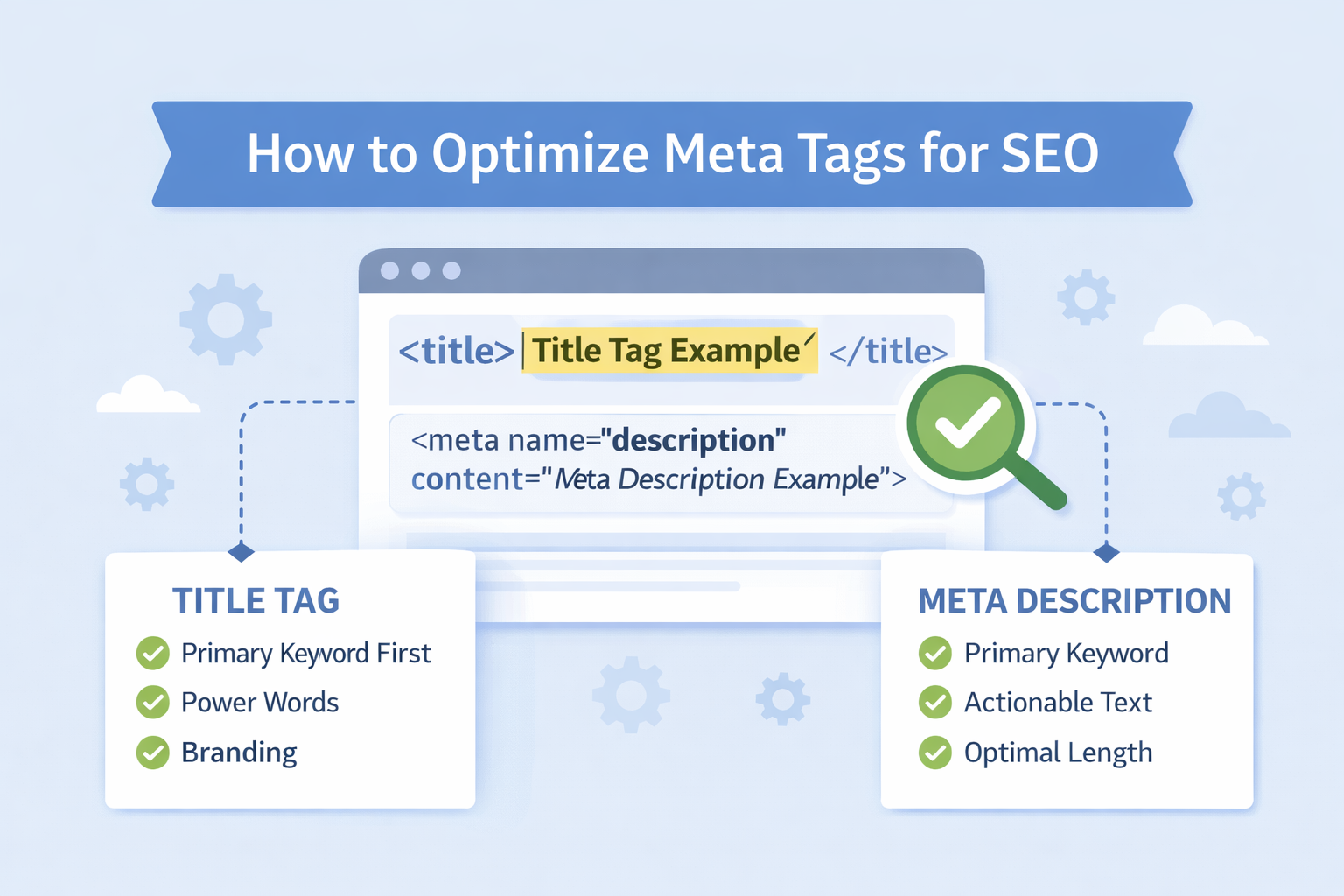
Meta tags are small pieces of HTML code with an outsized impact. They sit quietly in the background of your pages, yet they shape how search engines interpret your content and how users decide whether to click your result or scroll past it.
Optimizing meta tags isn’t just a technical SEO task it’s a visibility and persuasion game. Well-written titles and descriptions can improve relevance, boost click-through rate (CTR), and send stronger engagement signals to search engines. Poorly optimized ones, on the other hand, can bury great content beneath the competition.
In this guide, you’ll learn what meta tags actually do, why they matter for both SEO and CTR, and how to use them correctly to help search engines understand your pages while encouraging real users to click. No fluff, no outdated myths just practical optimization that works.
2. What Are Meta Tags and Why They Matter for SEO
Definition of Meta Tags
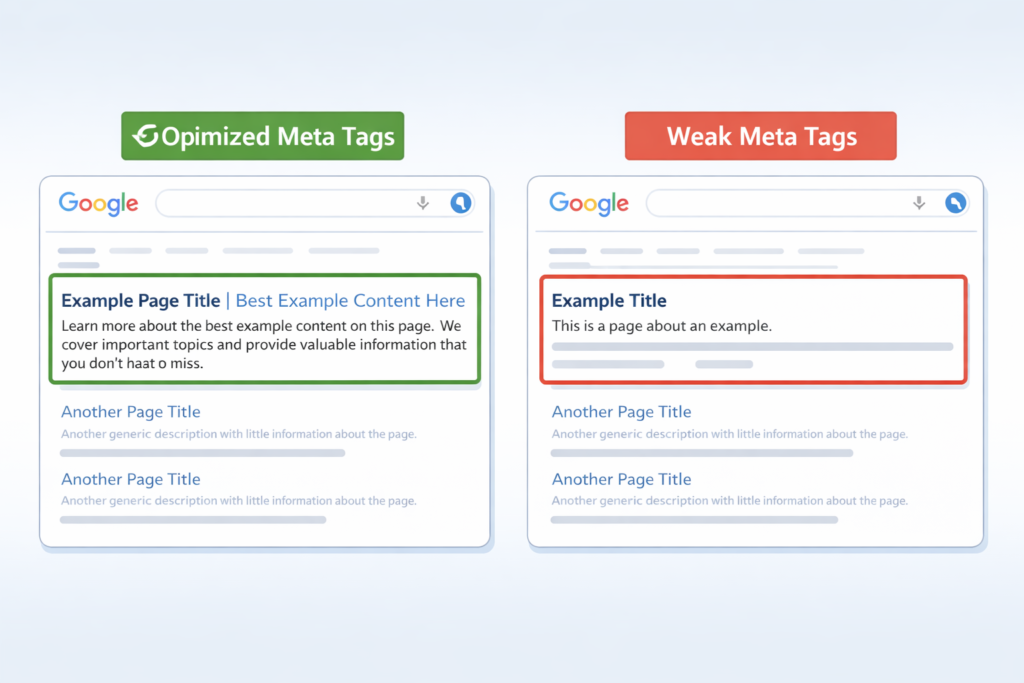
Meta tags are HTML elements that provide information about a webpage to search engines and browsers. They don’t appear on the page itself but live in the <head> section of your HTML, helping machines understand what the page is about before a user ever sees it.
Common meta tags include the title tag, meta description, robots meta tag, and canonical tag each serving a distinct SEO purpose.
How Search Engines Use Meta Tags
Search engines rely on meta tags to quickly interpret a page’s topic, intent, and indexing instructions.
- Title tags help determine relevance for search queries
- Meta descriptions influence how listings appear in search results
- Robots tags guide crawling and indexing behavior
- Canonical tags clarify which version of a page should be prioritized
Together, these signals help search engines crawl smarter and rank pages more accurately.
Impact on Rankings vs Click-Through Rate
Not all meta tags directly affect rankings but many influence performance indirectly.
- Title tags are a confirmed ranking factor
- Meta descriptions don’t affect rankings directly but strongly impact CTR
- Robots and canonical tags influence how and whether pages are indexed
Higher CTR, better crawl efficiency, and reduced duplication all contribute to stronger overall SEO performance.
Common Misconceptions About Meta Tags
One of the biggest myths is that meta tags alone can rank a page. They can’t. They support SEO, they don’t replace content quality. Another misconception is keyword stuffing cramming titles and descriptions with keywords often reduces trust and performance. Finally, many assume Google always uses their meta descriptions, when in reality relevance matters more than exact length or wording.
Used correctly, meta tags don’t manipulate search engines they communicate clearly, which is exactly what modern SEO rewards.
3. Essential Meta Tags You Must Optimize
Before diving into tactics, it’s important to understand which meta tags actually move the needle. Not every tag deserves equal attention. A handful of core meta tags play a direct role in how search engines interpret your pages and how users engage with them in search results.
Title Tag
The title tag is the most critical meta element for SEO. It tells search engines what your page is about and acts as the main headline in search results. A well-optimized title improves relevance, rankings, and click-through rate.
Meta Description
The meta description is your search snippet pitch. While it doesn’t directly affect rankings, it heavily influences CTR by summarizing the page and convincing users to click.
Robots Meta Tag
The robots meta tag controls how search engines crawl and index your pages. It’s especially useful for managing thin content, testing pages, or sections that shouldn’t appear in search results.
Canonical Tag
The canonical tag prevents duplicate content issues by telling search engines which version of a page should be treated as the primary one. This helps consolidate ranking signals and improve crawl efficiency.
4. How to Optimize the Title Tag for SEO
4.1 What Makes a Strong SEO Title Tag
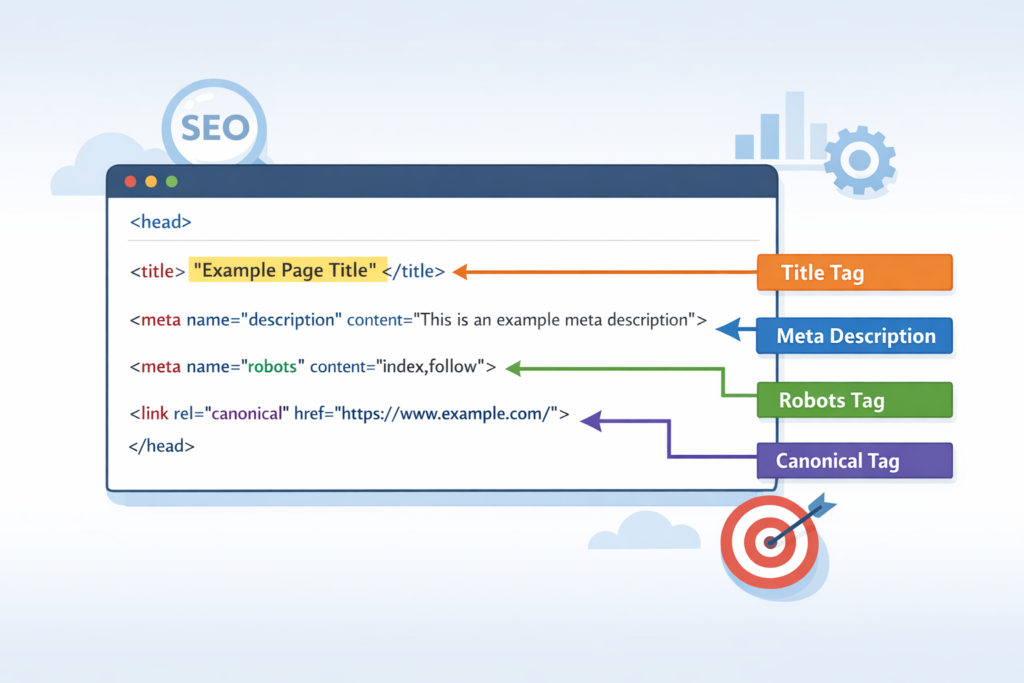
A strong SEO title tag balances clarity, relevance, and persuasion. It must communicate the page topic instantly while aligning with how users search.
Character limits (50–60 characters)
Keep titles within 50–60 characters to avoid truncation in search results. Shorter, focused titles are easier to scan and more likely to display fully.
Keyword placement and relevance
Place the primary keyword as close to the beginning of the title as possible. This improves relevance signals and increases the chance of bolded keyword matches in SERPs.
4.2 Title Tag Best Practices
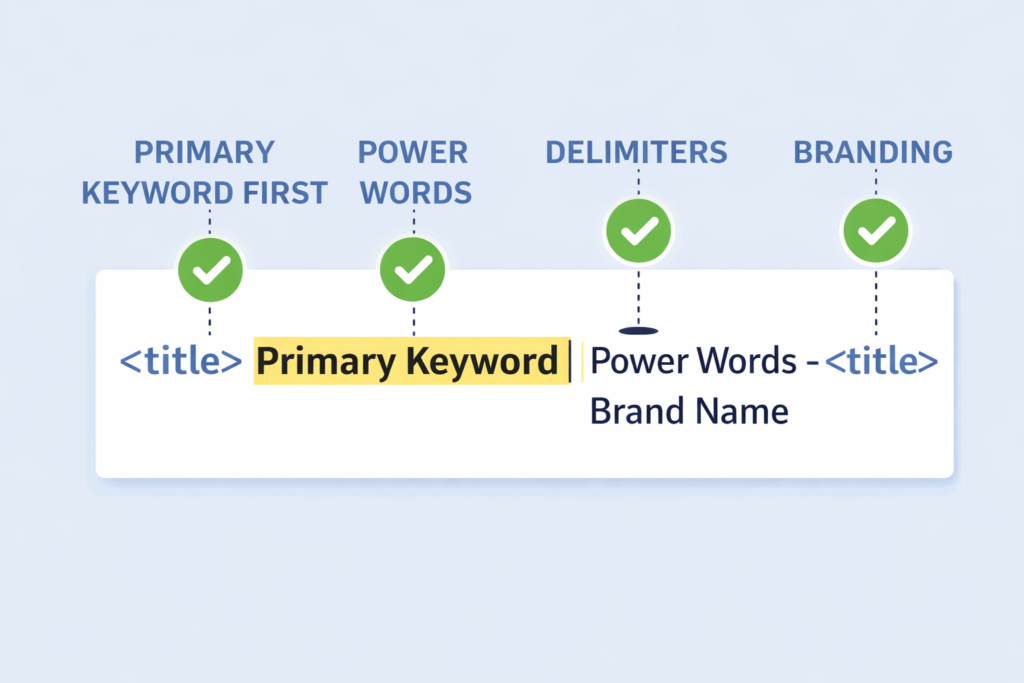
Using primary keywords first
Front-loading your main keyword helps search engines and users understand the page topic instantly.
Power words and modifiers
Add words like Best, Guide, Tips, 2026, or Proven to increase emotional pull and click-through rate.
Delimiters and branding
Use separators such as | or – to structure titles cleanly. Including your brand name at the end can build recognition without diluting keyword focus.
Avoiding keyword stuffing and clickbait
Overloading titles with keywords or using misleading phrases damages trust and can reduce both CTR and rankings. Precision beats exaggeration every time.
4.3 Title Tag Examples
Good Title Tags
- How to Optimize Meta Tags for SEO | Complete 2026 Guide
- Meta Tag Optimization Best Practices for Higher CTR
Bad Title Tags
- Meta Tags Meta Tags SEO Meta Tags Optimization
- Click This Now to Rank #1 on Google Fast
Good titles are clear, relevant, and intent-driven. Bad titles chase attention at the expense of trust and search engines notice.
5. Meta Description Optimization Best Practices
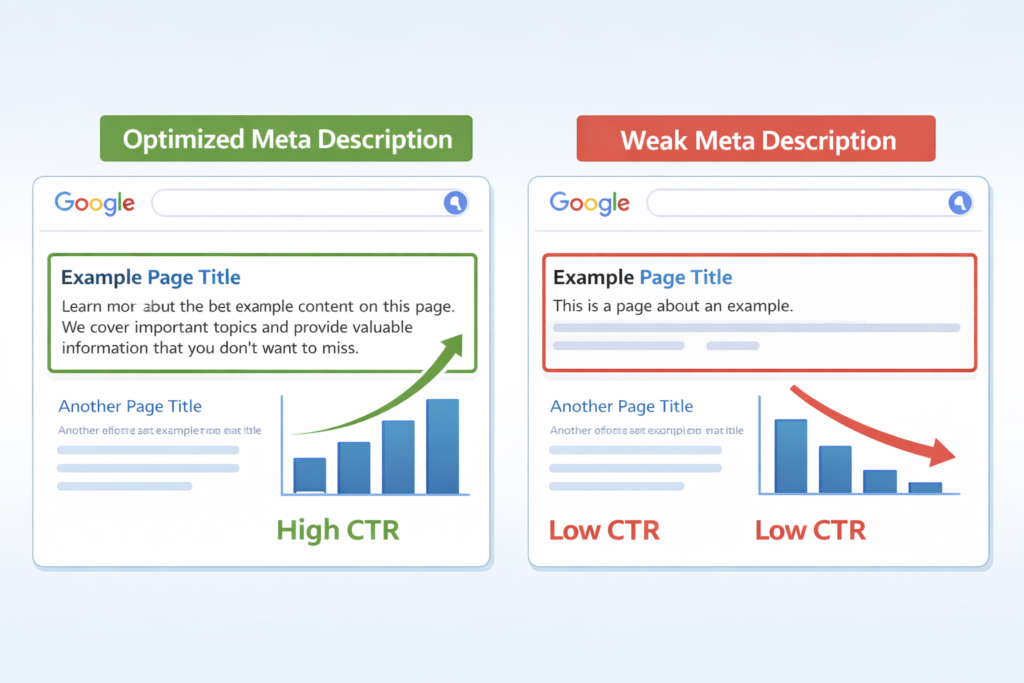
Meta descriptions are your chance to sell the click. They don’t push rankings directly, but they strongly influence whether a user chooses your page over the ten others competing for attention.
5.1 What Meta Descriptions Do (and Don’t Do)
Role in CTR
Meta descriptions act as preview copy in search results. A clear, relevant description that matches user intent can significantly improve click-through rate, even when your ranking position stays the same.
Google rewrites explained
Google doesn’t always use the meta description you write. If it believes another snippet from your page better matches the search query, it may rewrite it. That’s why relevance matters more than hitting an exact character count.
5.2 How to Write High-CTR Meta Descriptions
Ideal length guidelines
Aim for around 150–160 characters for desktop. This helps avoid truncation, but don’t obsess over length clarity and intent alignment matter more.
Matching search intent
Your description should directly reflect what the searcher is looking for. Informational queries need clarity and depth, while commercial queries benefit from benefits and differentiation.
Natural keyword usage
Include primary keywords naturally to reinforce relevance and trigger bolding in SERPs. Forced or repetitive keywords reduce readability and trust.
Calls to action and value propositions
Encourage action with phrases like Learn more, Discover how, or Get the guide, while clearly stating what value the user will gain from clicking.
5.3 Meta Description Examples
Optimized Meta Description
Learn how to optimize meta tags for SEO, improve CTR, and avoid common mistakes with this step-by-step guide.
Weak Meta Description
This page talks about meta tags and SEO and meta descriptions and optimization techniques.
Strong descriptions focus on benefits and intent. Weak ones waste space without persuading the user to click.
6. Using the Robots Meta Tag Correctly
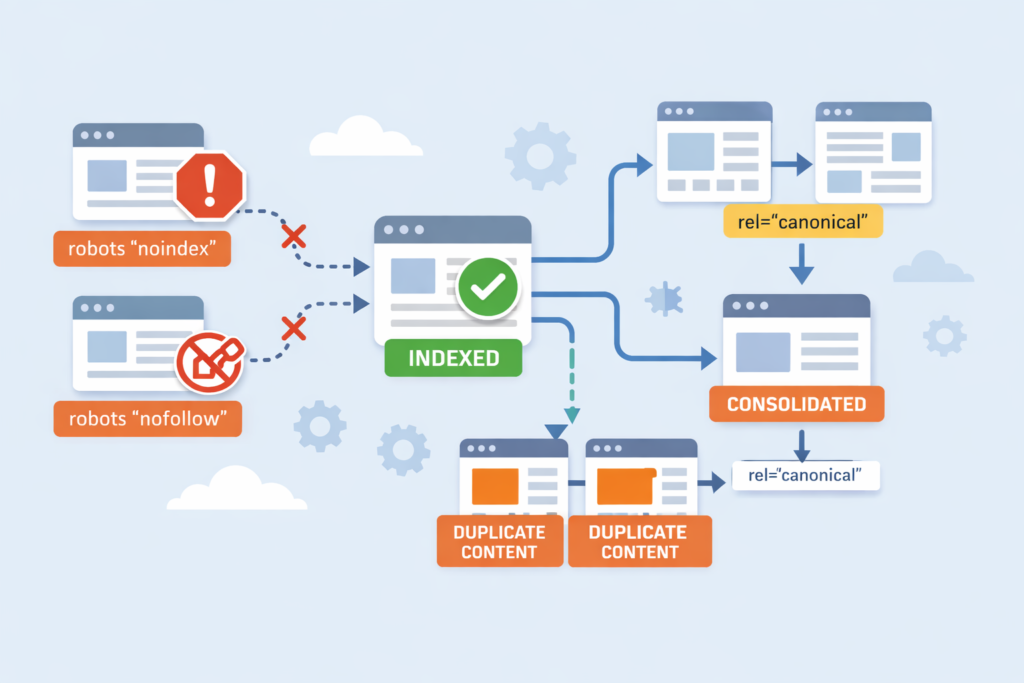
The robots meta tag gives you precise control over how search engines treat individual pages adding an extra layer of instruction beyond robots.txt.
6.1 What the Robots Meta Tag Controls
Indexing vs crawling explained
Crawling determines whether search engines can access a page. Indexing determines whether that page appears in search results. Robots meta tags let you control these behaviors at the page level.
6.2 Common Robots Meta Directives
index, noindex
- index allows a page to appear in search results
- noindex prevents the page from being indexed, even if it’s crawled
follow, nofollow
- follow allows search engines to pass link equity
- nofollow tells engines not to follow links on the page
These directives can be combined for precise control.
6.3 Best Use Cases for Robots Meta Tags
Thin pages
Use noindex, follow on low-value pages to prevent indexing while preserving internal link flow.
Internal search pages
Blocking internal search results helps avoid duplicate or low-quality pages appearing in SERPs.
Testing or low-priority URLs
Robots tags are ideal for staging content, temporary pages, or URLs that don’t deserve long-term visibility.
Used correctly, robots meta tags protect your site’s quality signals while keeping crawl efficiency intact.
7. Canonical Tags and Duplicate Content Control
Duplicate content confuses search engines, dilutes ranking signals, and wastes crawl budget. Canonical tags exist to solve this exact problem by clearly identifying which version of a page should be treated as the primary one.
7.1 What a Canonical Tag Is
A canonical tag is an HTML element that tells search engines which URL represents the preferred version of a page. When multiple URLs contain similar or identical content, the canonical tag consolidates ranking signals into one authoritative URL.
How it prevents duplicate content issues
Instead of competing against yourself in search results, canonical tags guide search engines to index and rank a single version. This improves crawl efficiency, strengthens ranking signals, and reduces the risk of the wrong page appearing in SERPs.
7.2 Canonical Tag Best Practices
Self-referential canonicals
Every important page should include a canonical tag pointing to itself. This reinforces URL consistency and protects against accidental duplication from tracking parameters or alternate versions.
Paginated and similar content
Canonical tags are especially useful for paginated lists, filtered category pages, and similar content variations. They help consolidate authority while allowing users to navigate different versions.
When and when not to use canonicals
Use canonicals when content is substantially similar. Don’t use them to mask poor site structure or force unrelated pages to rank together. Canonicals are signals, not commands misuse can lead to ignored directives.
7.3 Canonical Tag Examples
Correct implementation
<link rel=”canonical” href=”https://example.com/meta-tags-seo-guide”>
Incorrect implementation
<link rel=”canonical” href=”https://example.com/unrelated-page”>
Correct canonicals point to the most relevant, authoritative version of the content. Incorrect ones confuse search engines and weaken trust.
8. Order of Meta Tag Optimization for Maximum SEO Impact
Not all meta tags deliver equal returns. Optimizing them in the right order ensures you focus on what moves results fastest.
Why titles and descriptions come first
Title tags directly influence rankings, and meta descriptions strongly impact click-through rate. Together, they offer the highest SEO ROI and should be optimized before anything else.
When to prioritize canonicals
Canonical tags become critical once your site has duplicate or near-duplicate URLs. After titles and descriptions are solid, canonicals help consolidate authority and improve crawl efficiency.
How robots tags fit into the strategy
Robots meta tags are a precision tool. Use them last to control indexing, protect site quality, and prevent low-value pages from entering search results without disrupting internal linking.
Optimized in the right sequence, meta tags don’t just improve SEO they make it predictable and scalable.
9. Tools to Implement and Test Meta Tags
Optimizing meta tags is only effective if you implement them correctly and measure their impact over time. The right tools make this process faster, safer, and more scalable.
9.1 CMS and Plugin-Based Optimization
Yoast
Yoast simplifies meta tag optimization for content teams. It allows you to edit title tags and meta descriptions at the page level, provides length previews, and flags duplication issues before they become SEO problems.
RankMath
RankMath offers more advanced control with bulk editing, AI-powered suggestions, and built-in schema integration. It’s especially useful for larger sites that need consistent meta tag optimization across many pages.
9.2 Testing and Validation Tools
Google Search Console
Search Console shows how your pages actually appear in search results. It helps you identify rewritten meta descriptions, indexing issues, and performance changes after optimization.
SERP previews
SERP preview tools let you see how titles and descriptions will display before publishing. This helps prevent truncation, improves readability, and ensures your messaging aligns with search intent.
9.3 Measuring Performance
CTR tracking
Monitor click-through rate at the page and query level to see how title and description changes affect user behavior. Rising CTR is often the first sign of successful optimization.
Analytics-based refinements
Use analytics data to refine underperforming pages. If impressions are high but clicks are low, meta tags are usually the fastest lever to pull.
10. Common Meta Tag Mistakes to Avoid
Even small meta tag errors can quietly undermine your SEO efforts. Avoid these common pitfalls.
Duplicate titles and descriptions
Using the same meta tags across multiple pages confuses search engines and weakens relevance signals.
Over-optimization
Stuffing keywords or forcing modifiers into every title reduces trust and can hurt both rankings and CTR.
Ignoring user intent
Meta tags written for algorithms instead of humans fail to attract clicks. Relevance always beats cleverness.
Blocking important pages accidentally
Misused robots tags or incorrect canonicals can remove valuable pages from search results entirely. Always double-check before deploying changes.
Clean implementation and thoughtful testing turn meta tags from a technical detail into a competitive advantage.
11. Recommended Resources for Meta Tag Optimization (With Links)
Here are trusted, industry-standard resources you can rely on for accurate and up-to-date meta tag guidance:
- Google Search Central
https://developers.google.com/search
Official documentation straight from Google on how meta tags, indexing, and crawling actually work. - Search Engine Journal
https://www.searchenginejournal.com
Practical SEO articles, experiments, and updates on title tags, meta descriptions, and SERP behavior. - Moz
https://moz.com/learn/seo
Beginner-friendly yet authoritative explanations, especially strong on canonical tags and technical SEO. - HigherVisibility
https://www.highervisibility.com/seo/learn
Actionable SEO guides with a focus on CTR improvement and on-page optimization. - OutreachMonks
https://outreachmonks.com/blog
Implementation-focused SEO practices, checklists, and real-world optimization strategies.
12. Conclusion
Meta tag optimization is one of the most controllable and impactful parts of SEO. When done correctly, it helps search engines understand your content, improves click-through rates, and ensures your best pages receive the visibility they deserve.
Start by auditing your existing pages. Fix duplicate titles, rewrite weak meta descriptions, and confirm that canonicals and robots tags are working in your favor not against you.
Most importantly, treat meta tag optimization as an ongoing process. Search behavior changes, competitors adapt, and algorithms evolve. Regular reviews and refinements keep your site relevant, competitive, and consistently discoverable in search results.
FAQ: Meta Tag Optimization for SEO
1. Do meta tags still matter for SEO in 2026?
Yes. Title tags directly impact rankings, while meta descriptions influence CTR. Robots and canonical tags control indexing and duplication, making them essential for modern SEO.
2. Can meta descriptions improve rankings?
Meta descriptions don’t directly affect rankings, but higher click-through rates can improve overall search performance and visibility.
3. Why does Google rewrite my meta description?
Google rewrites descriptions when it believes on-page content better matches the user’s search intent. Relevance matters more than exact length.
4. Should every page have a canonical tag?
Yes. Important pages should use self-referential canonical tags to prevent duplication issues caused by parameters, filters, or alternate URLs.
5. What happens if I misuse the robots meta tag?
Incorrect robots directives can remove important pages from search results or block link equity flow, which can significantly harm SEO.