-
- No Comments
- March 27, 2026

Iran vs West: Is Europe at Risk of Missile Attacks?
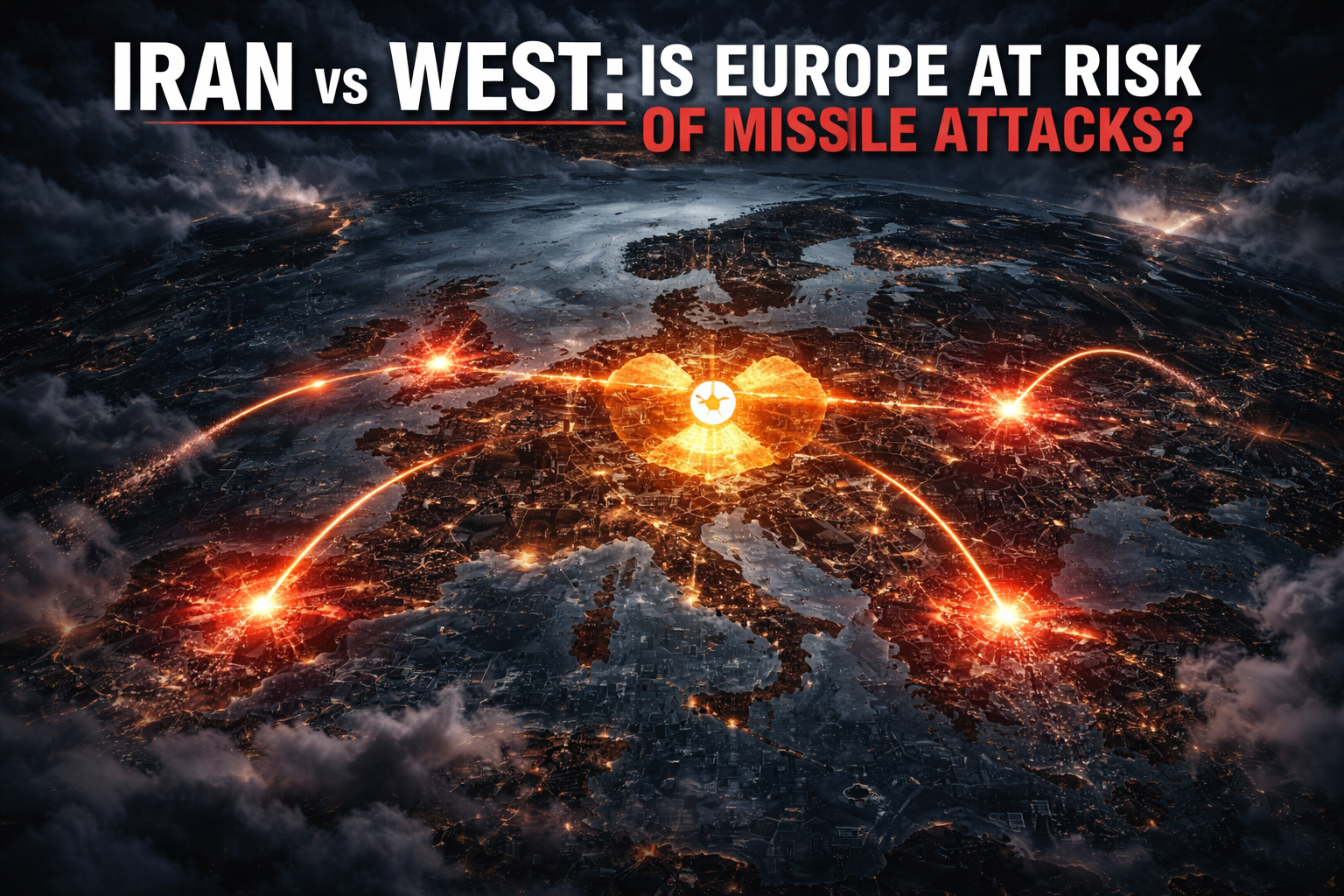
Introduction: Iran vs West: Is Europe at Risk of Missile Attacks? A Question Reshaping European Security
It starts quietly. No sirens. No explosions. Just a flicker on a trading screen, a sudden spike in oil prices, a classified briefing in Brussels that leaks hours later. Somewhere in the Middle East, a missile test stretches farther than expected. Somewhere in Europe, intelligence agencies begin connecting dots that were never meant to be visible. And just like that, a distant conflict starts feeling uncomfortably close.
This is the new reality of the Iran vs West: Is Europe at Risk of Missile Attacks? debate. Not a headline built on panic, but a question rooted in shifting power, evolving weapons, and a geopolitical chessboard that is no longer confined to one region. For years, Europe has watched tensions between Iran and the West from a strategic distance. Now, that distance is shrinking not necessarily in miles, but in consequences.
The truth is unsettlingly nuanced. A direct Iranian missile strike on European soil remains unlikely in the immediate term. The technical limitations, the political calculations, the sheer weight of retaliation all act as barriers. But focusing only on missiles misses the bigger picture. Because the battlefield is no longer defined by what flies through the air. It is defined by what moves in the shadows.
Cyberattacks that can cripple energy grids overnight. Proxy networks capable of turning quiet cities into flashpoints. Covert operations that blur the line between war and deniability. And above it all, a nuclear question that refuses to stay contained. This is where the real tension lies not in what is happening today, but in what is becoming possible tomorrow.
So when we ask Iran vs West: Is Europe at Risk of Missile Attacks?, we are really asking something deeper. Not just whether missiles can reach Europe, but whether the conflict itself is already reaching Europe in ways that are harder to see, harder to stop, and far more unpredictable.
This is not a story about a single threat. It is about a system of risks, layered, evolving, and increasingly interconnected. And to understand where this is heading, we need to go beyond the obvious and step inside the full spectrum of modern conflict from long range missile capabilities to cyber warfare, proxy networks, and the nuclear dimension that could redefine everything.
Iran vs West: Is Europe at Risk of Missile Attacks? Understanding the Missile Capability Gap

If the question is whether Iran can strike Europe, the answer sits in a grey zone between physics and politics. Iran’s missile program is one of the largest in the Middle East, built for deterrence, regional dominance, and strategic signaling. But scale does not always equal reach. Most of what Tehran possesses today is designed for a different battlefield one that stretches across the Gulf, Israel, and parts of the eastern Mediterranean, not deep into Europe.
This is where the idea of a “missile capability gap” comes in. On paper, Iran is advancing fast, testing longer range systems and pushing technological boundaries. In reality, however, there is a clear difference between what can theoretically be achieved and what can be reliably executed in a real conflict. Europe, for now, sits just beyond that line. But not by a comfortable margin and not forever.
Iran vs West: Is Europe at Risk of Missile Attacks? The Reality of Current Missile Ranges
Iran’s operational missile backbone is built around medium range ballistic missiles, typically spanning between 1,300 and just over 2,000 kilometers. That range is significant. It comfortably covers Israel, U.S. bases in the Gulf, Turkey, and large parts of the Middle East. It even brushes the edges of southeastern Europe depending on launch positions.
But distance matters. Western Europe cities like Paris, Berlin, and Madrid remain largely outside this immediate strike envelope. Even Central Europe sits at the edge rather than the center of Iran’s current reach. In practical terms, this means that while Iran can threaten its regional adversaries with relative confidence, projecting that same threat deep into Europe is not yet part of its standard operational playbook.
So when analysts say Europe is not an immediate missile target, this is what they mean. It is not immune, but it is not directly exposed either at least not with the systems Iran can deploy reliably today.
Iran vs West: Is Europe at Risk of Missile Attacks? The Rise of 4,000 km Missiles
This is where the conversation shifts from present reality to future possibility. Recent reports and military assessments suggest Iran is developing longer range missile systems that could stretch as far as 4,000 kilometers. If that capability becomes fully operational, the map changes overnight.
Suddenly, cities like Rome, Vienna, and Budapest move from theoretical edge cases into realistic range scenarios. Push the envelope further, and even major Western capitals like Paris or Berlin begin to enter the conversation depending on trajectory, payload, and launch positioning.
But this is not just about geography. It is about signaling. Long range missile development is as much a message as it is a weapon. It tells adversaries that distance is no longer a guarantee of safety. It expands Iran’s deterrence footprint beyond the Middle East and into the strategic thinking of European defense planners.
Still, it is critical to understand that “can reach” does not mean “ready to strike.” These systems are emerging, not fully integrated, and not yet proven under real combat conditions.
Iran vs West: Is Europe at Risk of Missile Attacks? The Difference Between Range and Real Threat
This is the part often lost in headlines. A missile’s maximum range is only one piece of the puzzle. What truly defines a credible threat is a combination of accuracy, reliability, survivability, and the ability to penetrate advanced defense systems.
A missile that can theoretically travel 4,000 kilometers means little if it cannot hit its target with precision, avoid interception, or perform consistently under pressure. Modern European defenses, combined with NATO capabilities, are not easy to bypass. Interception systems, early warning networks, and layered defenses all reduce the probability of a successful strike.
Then there is the question of consistency. Experimental or newly developed missiles may work in controlled tests but behave very differently in real world scenarios. Reliability under combat conditions is a barrier that takes years, sometimes decades, to overcome.
So the real picture is this. Iran is moving closer to a capability that could put parts of Europe within reach. But reach alone is not readiness. And readiness is what ultimately determines whether a threat remains theoretical or becomes dangerously real.
Iran vs West: Is Europe at Risk of Missile Attacks? Current Threat Level Explained

Capability tells you what could happen. Intent tells you what might happen next. And right now, when you zoom out from the maps and missile charts, the consensus across security circles is clear: a direct Iranian missile strike on European soil sits in the category of low probability, high impact.
Low probability because the costs would be enormous. High impact because if it ever happens, it would instantly redraw the security architecture of the continent. This is not a scenario anyone stumbles into. It is one that would signal a full scale escalation between Iran and the West, with consequences far beyond a single strike.
So the real question is not just whether Iran can hit Europe. It is whether it would. And for now, the answer leans toward restraint not out of weakness, but out of calculation.
Iran vs West: Is Europe at Risk of Missile Attacks? Why Europe Is Not an Immediate Target
Europe is not Iran’s primary battlefield. It never has been. Tehran’s strategic focus remains anchored in its immediate sphere of influence the Gulf, Israel, and regional rivals where pressure can be applied with faster impact and lower escalation risk.
Striking Europe directly would cross a different kind of line. It would almost certainly trigger a unified NATO response, pulling multiple Western powers into direct confrontation. That is a level of escalation Iran has historically avoided, preferring indirect pressure, plausible deniability, and layered responses instead of outright confrontation.
There is also a strategic imbalance at play. Europe, despite its vulnerabilities, still operates within a broader NATO security umbrella. Any direct attack would not just be against a single country but against a collective defense system. For Iran, that transforms a tactical move into a strategic gamble with unpredictable consequences.
So in the short term, Europe remains outside the immediate strike calculus not because it is irrelevant, but because it is too consequential to target lightly.
Iran vs West: Is Europe at Risk of Missile Attacks? What Could Trigger an Escalation
That restraint, however, is conditional. It holds as long as the conflict remains contained. The moment that containment breaks, the risk equation shifts.
One clear trigger would be sustained Western military action against Iran whether through direct strikes, coordinated campaigns with regional allies, or deep involvement in a broader Middle East war. At that point, Tehran may feel compelled to expand the میدان, not necessarily to win militarily, but to reshape the psychological and political cost for its adversaries.
Another scenario is regional spillover. If conflict intensifies across multiple fronts involving Israel, Gulf states, and proxy groups the pressure to respond asymmetrically increases. Europe, as a political and logistical extension of the West, could move from observer to participant in Iran’s strategic calculations.
Then there is the element of signaling. Even a limited, symbolic strike outside the Middle East could be used to demonstrate reach and shift deterrence dynamics. Not to start a war with Europe, but to remind it that distance is no longer a shield.
Escalation, in this context, is not a single event. It is a chain reaction. And once it starts, the boundaries that once felt stable begin to blur fast.
Iran vs West: Is Europe at Risk of Missile Attacks? Likely Targets Beyond Europe
If escalation does occur, the first blows are unlikely to land on European cities themselves. Instead, they would be directed at the connective tissue of Western power outside the continent.
Think NATO bases in the Middle East. Logistics hubs that move equipment and fuel. Ports that handle military and energy flows. These are high value, lower risk targets where impact can be felt without immediately triggering the full weight of European retaliation.
Energy infrastructure is another critical node. Pipelines, shipping routes, and storage facilities tied to European supply chains offer strategic leverage. Disrupting them sends shockwaves through economies without crossing the threshold of a direct homeland attack.
This layered targeting approach allows Iran to escalate pressure while maintaining a degree of control over the conflict. It is not about avoiding confrontation. It is about shaping it.
Iran vs West: Is Europe at Risk of Missile Attacks? The Growing Hybrid Warfare Threat

While missiles dominate headlines, the real battlefield is already shifting and it is far less visible. The most immediate and credible threat to Europe is not a ballistic arc across the sky. It is hybrid warfare operating quietly, persistently, and often deniably.
This is where the Iran vs West tension becomes harder to track and harder to counter. Because hybrid threats do not announce themselves. They infiltrate systems, exploit vulnerabilities, and create disruption without a clear starting point or a clean attribution.
In many ways, this is already happening. The question is not whether Europe could face hybrid attacks. It is how far those attacks could go if tensions continue to rise.
Iran vs West: Is Europe at Risk of Missile Attacks? Cyberattacks on Critical Infrastructure
Modern Europe runs on interconnected systems energy grids, financial networks, telecom infrastructure, transport logistics. And that connectivity, while efficient, creates exposure.
A well executed cyberattack does not need to destroy a city to create chaos. It can shut down power in key regions, freeze financial transactions, disrupt airports, or cripple communication networks. The impact is immediate, widespread, and deeply destabilizing.
For Iran, cyber operations offer a strategic advantage. They are scalable, relatively low cost, and most importantly, deniable. Attribution is complex, response thresholds are unclear, and retaliation is not always straightforward.
In a high tension scenario, cyberattacks could become the first line of pressure not as a precursor to missiles, but as an alternative to them.
Iran vs West: Is Europe at Risk of Missile Attacks? Sabotage and Covert Operations
Beyond cyberspace lies the physical shadow war. Sabotage operations, arson attacks, and targeted disruptions of infrastructure represent another layer of hybrid threat.
These actions are designed to be ambiguous. A fire at a logistics facility. A disruption in a rail network. An unexplained failure in a critical supply chain. Individually, they may look like isolated incidents. Collectively, they can signal something more coordinated.
The challenge for Europe is not just prevention, but attribution. Proving state involvement in covert operations is difficult, and that ambiguity can delay or dilute response.
This is the essence of hybrid warfare pressure without clear fingerprints, impact without open conflict.
Iran vs West: Is Europe at Risk of Missile Attacks? Drone and Precision Strike Scenarios
Sitting between cyber warfare and full scale missile strikes is a middle ground that is becoming increasingly relevant drones and precision guided systems.
Unlike ballistic missiles, drones are cheaper, more flexible, and harder to detect in certain scenarios. They can be launched from closer ranges, potentially even through proxy actors, and used to target specific infrastructure with surgical intent.
This creates a new kind of risk. Not large scale destruction, but precise disruption. A strike on an energy facility. A hit on a logistics node. A targeted attack designed to send a message rather than start a war.
In this space, the line between direct and indirect conflict becomes even thinner. And for Europe, that is where the real near term danger lies not in a sudden missile barrage, but in a slow, strategic escalation that operates just below the threshold of open war.
Iran vs West: Is Europe at Risk of Missile Attacks? Iran’s Proxy Networks Inside Europe
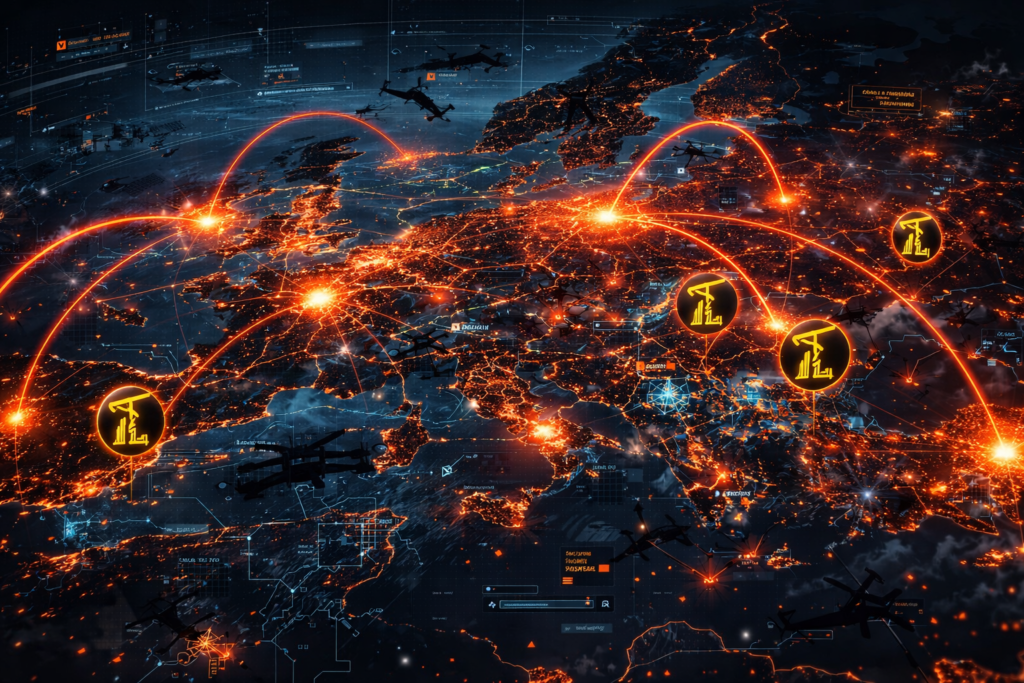
Missiles grab attention. Networks create leverage. And across Europe, the more immediate vulnerability does not sit in the sky it sits within. Quietly embedded, often invisible, and built over years, Iran’s proxy footprint represents a different kind of threat. One that does not rely on distance, launch sites, or radar detection.
This is where the Iran vs West: Is Europe at Risk of Missile Attacks? question takes a sharper turn. Because even if missiles never cross European airspace, influence, disruption, and targeted violence can still emerge from within Europe’s own borders. Not as a conventional invasion, but as a layered system of pressure designed to stay just below the threshold of open war.
Iran vs West: Is Europe at Risk of Missile Attacks? The Role of IRGC and Hezbollah
At the center of this networked strategy are two key actors Iran’s Islamic Revolutionary Guard Corps and its external operations wing, alongside Hezbollah. Their role is not simply operational. It is strategic. They extend Iran’s reach far beyond its geography, allowing it to act without always appearing to act.
These networks operate through a mix of ideological alignment, logistical support, and local facilitation. In Europe, that can translate into surveillance of targets, recruitment pipelines, financial channels, and coordination nodes that remain dormant until needed. The objective is not constant activity, but readiness the ability to activate pressure points when the geopolitical moment demands it.
This creates a form of asymmetric leverage. Iran does not need to deploy missiles to project influence. It can rely on distributed networks that are harder to detect, harder to attribute, and often harder to deter.
Iran vs West: Is Europe at Risk of Missile Attacks? Sleeper Cells and Covert Networks
The term “sleeper cell” carries a cinematic weight, but in reality, it is less dramatic and more methodical. These are not always highly visible operatives waiting for a signal. They can be individuals or small clusters embedded within communities, connected loosely through intermediaries, and activated only under specific conditions.
What makes these networks effective is patience. They do not operate on a constant timeline. They exist in a state of readiness, gathering information, maintaining low profiles, and blending into everyday environments. Activation, when it comes, is often tied to escalation points moments when direct confrontation becomes too risky, and indirect action becomes more attractive.
In a high tension scenario, these networks could be used for targeted disruption. Not necessarily large scale attacks, but precise actions designed to create fear, signal capability, or destabilize key systems. And because they operate within European societies, the response becomes more complex, blurring the line between internal security and external threat.
Iran vs West: Is Europe at Risk of Missile Attacks? Past Plots and Foiled Attacks
This is not a hypothetical framework. European security agencies have already spent years tracking and disrupting plots linked to Iranian networks and affiliated groups. From surveillance operations targeting dissidents and diplomatic sites to planned attacks against specific communities, the pattern is consistent quiet buildup, followed by attempted execution.
Many of these plots have been intercepted before reaching their final stage, which speaks both to the capability of European intelligence and the persistence of the threat itself. The key takeaway is not just that these attempts failed, but that they were attempted at all.
It reinforces a critical point. The infrastructure for proxy driven action in Europe is not something that could emerge overnight. In many ways, it already exists. What changes in a crisis is not the presence of these networks, but the level at which they are activated.
Iran vs West: Is Europe at Risk of Missile Attacks? The Nuclear Factor Changing Everything
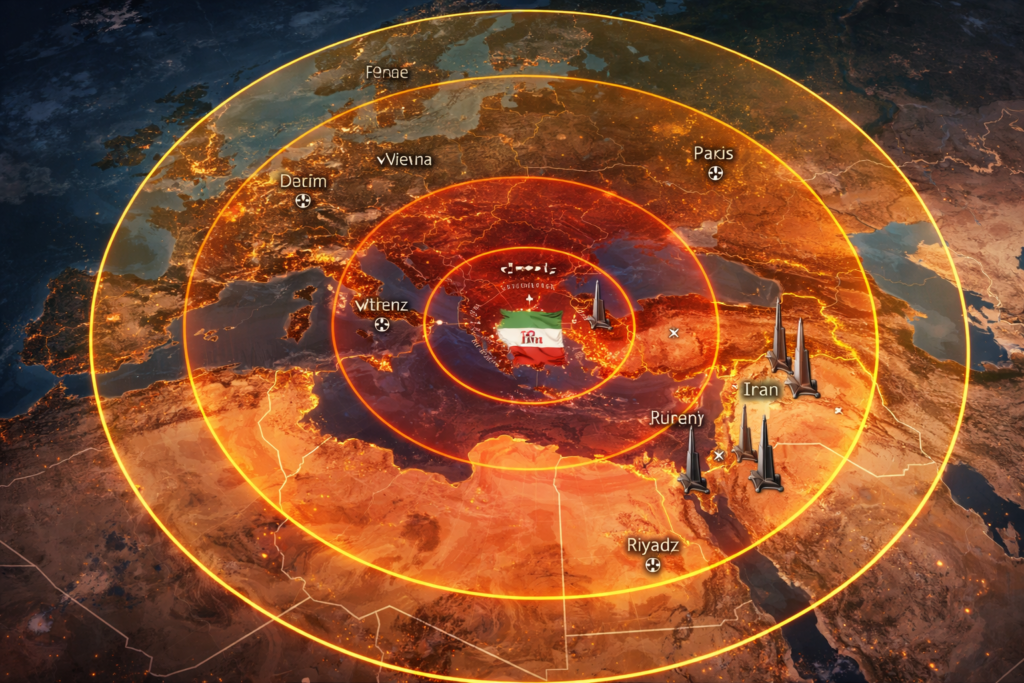
If missiles define reach and proxies define access, nuclear capability defines consequence. It is the variable that does not just increase risk it transforms it. In the context of Iran vs West: Is Europe at Risk of Missile Attacks?, the nuclear dimension is what turns a contained geopolitical tension into a potential global inflection point.
Because once nuclear capability enters the equation, every other calculation shifts. Deterrence becomes sharper. Escalation becomes riskier. And the margin for error becomes dangerously thin.
Iran vs West: Is Europe at Risk of Missile Attacks? Europe’s Concerns Over Iran’s Nuclear Program
Across European capitals, concern over Iran’s nuclear trajectory has been building steadily. Diplomatic language has grown firmer, signaling unease not just about enrichment levels, but about the broader direction of Iran’s strategic posture.
For Europe, the issue is not isolated to the Middle East. A more advanced nuclear program introduces new layers of uncertainty into an already volatile relationship. It complicates negotiations, strains alliances, and raises the stakes of any potential confrontation.
There is also a credibility factor. If Iran moves closer to a nuclear threshold, it strengthens its deterrence posture, making it harder for Western powers to apply pressure without risking escalation. For European leaders, this creates a delicate balance between containment and confrontation.
Iran vs West: Is Europe at Risk of Missile Attacks? What Happens If Iran Goes Nuclear
If Iran were to achieve a fully operational nuclear capability, the entire risk landscape would shift from caution to consequence. Missile discussions would no longer be about range alone, but about payload. Proxy conflicts would carry an added layer of strategic backing. And every escalation scenario would be viewed through a nuclear lens.
Deterrence would become more complex. On one hand, nuclear capability can discourage direct attacks due to the fear of retaliation. On the other, it can embolden more aggressive indirect actions, knowing that adversaries may hesitate to escalate further.
For Europe, this creates a paradox. The likelihood of a direct strike might still remain low, but the cost of miscalculation would rise dramatically. A single ভুল judgment, a misread signal, or an unintended escalation could carry consequences far beyond conventional conflict.
In that sense, the nuclear factor does not just increase the risk of missile attacks. It redefines what risk itself means turning distant threats into strategic realities that can no longer be ignored.
Iran vs West: Is Europe at Risk of Missile Attacks? How Prepared Is Europe Today
Preparation is where theory meets reality. And when you look at Europe’s defensive posture through the lens of the Iran vs West: Is Europe at Risk of Missile Attacks? question, the picture is mixed measured strength in some areas, noticeable gaps in others.
For decades, Europe has not needed to build its security architecture around the threat of long range missile barrages. Its focus has been different counterterrorism, intelligence coordination, and more recently, cyber resilience. The result is a system that is sophisticated, but not fully optimized for the kind of multi domain pressure that Iran could potentially apply.
This does not mean Europe is exposed. It means Europe is evolving, adapting to a threat landscape that is changing faster than traditional defense models were designed to handle.
Iran vs West: Is Europe at Risk of Missile Attacks? Missile Defense Limitations
Unlike regions that have lived under constant missile threat, Europe does not yet operate a deeply layered, continent wide missile defense shield. Systems exist, but they are unevenly distributed, nationally controlled, and often designed for limited scenarios rather than sustained, high intensity attacks.
Compare that to more mature defense architectures built specifically to intercept waves of missiles, drones, and rockets in real time. Europe’s setup is more fragmented, relying on a mix of national capabilities and broader alliance support rather than a single, unified shield.
This creates a strategic reality. Europe is not defenseless, but it is not optimized for rapid, large scale missile interception either. The gap is not absolute, but it is significant enough to shape how risks are calculated both by defenders and potential adversaries.
Iran vs West: Is Europe at Risk of Missile Attacks? NATO’s Response and Strategic Shifts
Recognizing these gaps, NATO has been adjusting. Slowly at first, then with increasing urgency as global tensions rise. Air and missile defense is moving higher up the priority list, with discussions around integration, modernization, and expanded coverage gaining momentum.
The shift is not just about hardware. It is about coordination. Aligning radar systems, sharing real time intelligence, and creating a more unified response framework across multiple countries. In a crisis, speed and synchronization matter as much as capability itself.
At the same time, NATO’s broader strategy is evolving from static defense to dynamic deterrence. The goal is not only to intercept threats, but to discourage them before they are launched by making the cost of escalation clear and immediate.
Iran vs West: Is Europe at Risk of Missile Attacks? Cyber and Intelligence Defenses
Where Europe is strongest is not necessarily in intercepting missiles, but in preventing crises from reaching that point. Cyber defense, intelligence gathering, and counter network operations are areas where European systems are far more mature.
Intelligence agencies across the continent work in tight coordination, tracking threats, disrupting plots, and monitoring networks that could be activated during escalation. Cyber units are increasingly focused on defending critical infrastructure, from energy grids to financial systems, against sophisticated intrusions.
This reflects a strategic choice. Rather than preparing only for visible attacks, Europe is investing heavily in stopping invisible ones before they materialize. It is a defensive posture built around anticipation, disruption, and resilience rather than purely reaction.
Iran vs West: Is Europe at Risk of Missile Attacks? Risk Assessment Low Probability High Impact
After mapping capability, intent, networks, and defenses, the conclusion becomes clearer and more complex at the same time. The risk is not binary. It is layered.
Direct missile attacks on Europe remain unlikely in the current environment. But unlikely does not mean impossible. And more importantly, it does not capture the full spectrum of threats already in motion.
The real story is about imbalance. Low probability events sitting alongside high impact consequences, while more subtle, more frequent threats operate just below the surface.
Iran vs West: Is Europe at Risk of Missile Attacks? Short Term Outlook
In the short term, Europe is not on the brink of missile strikes. The barriers geopolitical, technical, and strategic are still holding. Iran’s focus remains regional, and the cost of expanding conflict into Europe remains too high to justify under current conditions.
But beneath that surface, pressure is building. Cyber operations, proxy activity, and hybrid tactics are becoming more relevant, more refined, and more difficult to counter. The absence of missiles does not mean the absence of conflict. It simply means the conflict is taking a different form.
Iran vs West: Is Europe at Risk of Missile Attacks? Long Term Strategic Risk
Look further ahead, and the equation starts to shift. Missile technology is advancing. Ranges are increasing. Systems are becoming more sophisticated. At the same time, the nuclear question continues to hover unresolved, adding a layer of strategic uncertainty that cannot be ignored.
Over time, these factors converge. What is theoretical today can become operational tomorrow. What feels distant now can move closer not suddenly, but gradually, through steady technological and geopolitical change.
This is where the long term risk lies. Not in an immediate strike, but in a trajectory that slowly reduces the margin of safety.
Iran vs West: Is Europe at Risk of Missile Attacks? The Real Danger Europe Faces
The most immediate danger, however, is not a missile crossing the sky. It is everything that happens before that point and often instead of it.
Cyberattacks that disrupt daily life without warning. Proxy networks that can be activated with precision. Covert operations that create instability without clear attribution. These are the tools that define modern conflict, and they are already part of the strategic landscape.
In this context, Europe is not waiting for a threat to arrive. It is already navigating one. Just not in the form most people expect.
Iran vs West: Is Europe at Risk of Missile Attacks? Final Take
So is Europe at risk of missile attacks? The honest answer is not a simple yes or no. It is a direction.
Today, Europe is not under immediate missile threat. The systems, the politics, and the calculations all point toward restraint. But the trajectory of the Iran vs West conflict tells a more complicated story one where distance is shrinking, capabilities are expanding, and the nature of conflict itself is evolving.
Because the real shift is not just about missiles. It is about proximity. A world where wars no longer stay contained within borders, where influence travels faster than weapons, and where the line between external conflict and internal disruption becomes harder to define.
Europe may not be in the direct line of fire today. But it is no longer standing outside the battlefield either. And in a conflict that is constantly adapting, that distinction may not hold for long.
Sources and References
Below are detailed sources you can place at the end of your blog. These are written in clean, copy-paste format so you can either hyperlink them in your CMS or keep them as raw URLs.
- Greek Reporter
Iran ballistic missile range and potential European targets
https://greekreporter.com/2026/03/02/iran-ballistic-missile-range-potential-targets-europe/ - ABC News Australia
Iran’s longest range ballistic missile and Europe reach discussion
https://www.abc.net.au/news/2026-03-24/iran-longest-ballistic-missiles-launch-range-europe-reach/106485468 - JNS.org
The terror threat of Iran and Hezbollah networks in Europe
https://www.jns.org/feature/the-terror-threat-of-iran-and-hezbollah-in-europe - Euronews
As Iran war reaches Europe’s borders, security concerns explained
https://www.euronews.com/my-europe/2026/03/11/as-iran-war-reaches-europes-borders-can-the-continent-really-rest-easy - Iran International
EU and UK concerns over Iran nuclear program expansion
https://www.iranintl.com/en/202505191375 - Vision of Humanity
How Iran conflict could drive terrorism in the West
https://www.visionofhumanity.org/how-the-iran-conflict-could-drive-a-new-wave-of-terrorism-in-the-west/
Disclaimer Note
This article is intended for informational and educational purposes only. It is based on publicly available reports, expert analysis, and media sources to provide a general overview of geopolitical developments related to Iran vs West: Is Europe at Risk of Missile Attacks?.
The content does not promote, support, or encourage violence, conflict, or harm toward any country, community, religion, or group. All references to nations, organizations, or geopolitical actors are made strictly within the context of global security analysis and public discourse.
The author respects all religions, cultures, and beliefs, and this article does not intend to offend, target, or misrepresent any faith or community.
Readers are advised that geopolitical situations are complex and constantly evolving. This content should not be considered legal, political, or security advice. The publisher and author are not liable for any actions taken based on the information provided in this article.
FAQ Section
1. Iran vs West: Is Europe at Risk of Missile Attacks right now?
At present, the risk of direct missile attacks on Europe is considered low. Iran’s current missile systems are mostly designed for regional targets, and political consequences make direct strikes on Europe unlikely in the short term.
2. Can Iran’s missiles actually reach European cities?
Some newer missile developments suggest that parts of southern and central Europe could theoretically fall within range. However, having range capability does not automatically mean reliable or operational strike readiness.
3. What is the biggest threat to Europe in the Iran vs West conflict?
The most immediate threat is hybrid warfare. This includes cyberattacks, proxy operations, sabotage, and covert activities rather than direct missile strikes.
4. Could the situation escalate into direct conflict with Europe?
Yes, but only under specific conditions such as large scale Western military involvement against Iran or major regional escalation. Even then, indirect targeting is more likely than immediate direct strikes on European soil.
5. How does Iran’s nuclear program affect Europe’s risk level?
Iran’s nuclear development increases long term risk by raising the stakes of any conflict. If Iran were to achieve nuclear capability, it would significantly change global deterrence dynamics and increase the consequences of escalation.
Related Insights: Iran vs West: Is Europe at Risk of Missile Attacks?
To fully understand the bigger picture behind Iran vs West: Is Europe at Risk of Missile Attacks?, you also need to look beyond military capability and into the economic shockwaves this conflict is already creating. The reality is simple modern wars are no longer just fought with weapons, they ripple through oil markets, inflation, and global stability.
If you want to explore how this conflict could reshape the global economy, you can read this deep breakdown on how a US Iran war could trigger a global recession in 2026
https://eadoz.com/how-the-us-iran-war-could-trigger-a-global-recession-in-2026/
The energy dimension is just as critical. The Strait of Hormuz remains the world’s most important oil chokepoint, and any disruption there can send prices soaring overnight, as seen in recent market reactions . You can explore this further here
https://eadoz.com/strait-of-hormuz-crisis-why-oil-prices-are-exploding-right-now/
For a broader geopolitical angle, especially how Europe is positioning itself in this conflict, this analysis breaks down the growing divide within the West and what it means going forward
https://eadoz.com/europe-says-not-our-war-what-this-means-for-the-future-of-the-west/
The situation is not isolated. It is part of a much larger global instability trend involving war, inflation, and economic uncertainty. This article connects those dots in detail
https://eadoz.com/global-crisis-2026-war-inflation-and-economic-collapse-risks/
Oil remains the pressure point. As prices surge past critical levels, economists warn of inflation spikes and recession risks if disruptions continue . For a focused breakdown on oil crossing $100 and what it signals, read
https://eadoz.com/oil-prices-surge-to-110-is-a-global-recession-coming-in-2026/
And finally, if you want a complete macro view of how the Middle East war is shaking global markets, supply chains, and financial systems, this piece ties it all together
https://eadoz.com/middle-east-war-2026-how-its-shaking-the-global-economy-oil-price/