

-
- No Comments
- December 7, 2025

SEO best practices for e-commerce stores in 2025
1. Introduction
SEO in 2025 isn’t the same game it was even a year ago. Search engines have become sharper, context-driven, and far more selective about what they reward. With AI-generated summaries, zero-click results, and intent-heavy ranking systems shaping the way people shop online, the rules of visibility have shifted and e-commerce brands can no longer rely on outdated playbooks.
For online stores, adapting to these new ranking factors isn’t optional. Google now evaluates how well a page satisfies search intent, how fast it loads across devices, how structured the data is, and how original and authoritative the content feels. If your product pages, category pages, and technical foundation don’t meet these expectations, you’re invisible before the customer even gets a chance to browse.
This guide breaks down exactly what e-commerce stores must focus on in 2025 search intent alignment, long-tail keyword targeting, site structure, Core Web Vitals, schema markup, high-quality content, and authority-building strategies. You’ll learn how each component works, why it matters, and how to implement it across your store for consistent, long-term organic growth.
2. Understanding Search Intent in 2025
Search intent has become the defining signal behind Google’s 2025 ranking systems. It’s no longer enough to simply target keywords your pages must match the reason a customer is searching. Whether they want to compare products, learn something, or make a purchase right now, Google favors pages that deliver exactly what the user expects with clarity, structure, and speed.
2.1 Why Search Intent Matters More Than Ever
Google’s AI-driven ranking models are built to answer one question:
“Does this page satisfy what the user truly wants?”
If your content misses the intent—even if the keyword is correct—you lose visibility. In 2025:
- AI Overviews pull answers from pages that perfectly match intent.
- Zero-click searches highlight the most relevant and concise content.
- Transaction-ready users get pushed directly to pages optimized for conversions.
- Misaligned pages are filtered out, even if they have backlinks or strong authority.
For e-commerce, intent alignment is the difference between a product being buried on page three or appearing in the snippet, carousel, or “Products” section.
2.2 How to Identify Transactional vs Informational Intent
Understanding the type of intent behind each keyword helps you decide which page to build—or optimize.
Transactional Intent
(Users ready to buy or compare options.)
Keywords usually include:
- “Buy”
- “Best price”
- “Deals”
- “Near me”
- “Whey isolate price”
- “Running shoes for flat feet”
These keywords belong on product pages, category pages, or comparison pages.
Informational Intent
(Users want answers before deciding.)
Keywords often include:
- “How to choose”
- “Benefits of”
- “What is the difference”
- “Best protein for beginners”
- “Is whey isolate good for weight loss”
These belong in blog articles, guides, or support content that educates and builds trust.
2.3 Using Google’s “People Also Ask” for Intent Alignment
Google’s “People Also Ask” (PAA) box has evolved into one of the strongest intent indicators in 2025. It reveals:
- The real questions users ask
- Pain points behind the keyword
- Whether the searcher is seeking info, comparison, or purchase guidance
- Variations you can integrate into headings or FAQs
For example, if you search “best whey isolate protein powder,” PAA may show:
- “Which whey isolate tastes the best?”
- “Is whey isolate good for beginners?”
- “Which brand has clean ingredients?”
This tells you users want taste, ingredients, and suitability addressed—insights you can directly apply to your category and product pages
2.4 Applying Intent Research on Product & Category Pages
Here’s how smart stores in 2025 integrate intent research:
On Category Pages
- Use long-tail, intent-rich keywords like “best tasting whey isolate protein powder”.
- Add comparison elements (top sellers, flavor options, use cases).
- Answer PAA-style questions in short FAQ blocks.
- Include filters that match user motivations (taste, ingredients, goals).
On Product Pages
- Add details users repeatedly ask in PAA boxes.
- Integrate customer reviews that answer intent-based questions.
- Use structured data (product, reviews, price, availability) to match Google’s purchase signals.
- Include benefits, specs, and “Is this right for you?” sections.
By aligning your content with what people actually want, you increase your chances of appearing in AI summaries, product carousels, and the top organic spots that still drive the highest-converting traffic.
3. Keyword Research for Modern E-Commerce SEO
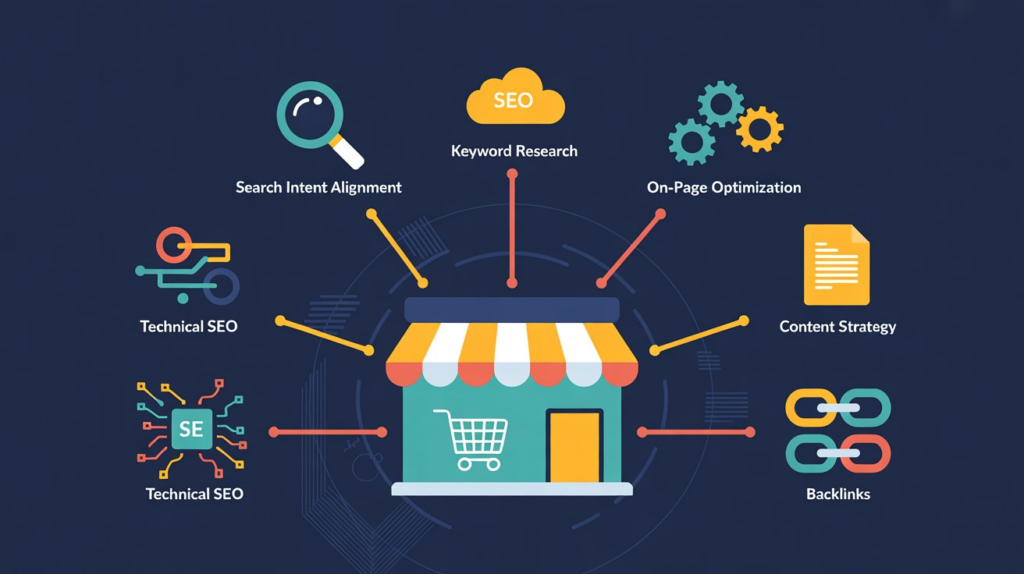
Keyword research in 2025 isn’t about chasing the biggest numbers—it’s about understanding how people search, why they search, and which queries represent intent strong enough to convert. Google increasingly prioritizes specificity, context, and user satisfaction, which is why long-tail, intent-rich keywords have become the backbone of effective e-commerce SEO.
3.1 Long-Tail Keyword Strategy for 2025
Long-tail keywords are no longer optional—they’re the most reliable way to reach high-converting shoppers in today’s AI-driven search environment.
In 2025, long-tail keywords:
- Capture highly specific user needs
- Indicate stronger buying intent
- Face much lower competition
- Fit perfectly with product and category page optimization
- Boost visibility in AI Overviews and zero-click summaries
Examples:
- Instead of “protein powder,” target:
“best tasting whey isolate protein powder” - Instead of “running shoes,” target:
“running shoes for flat feet beginners 2025” - Instead of “gaming keyboard,” target:
“low-profile rgb gaming keyboard quiet switches”
This precision helps Google understand your products better—and ensures your page satisfies exactly what the searcher is looking for.
3.2 Volume, Difficulty & Intent Balancing
In 2025, keyword selection is a balancing act between three factors:
1. Search Volume
You want queries people are actually searching, but they don’t need to be high-volume.
Long-tails with 50–800 monthly searches often outperform broad terms in conversions.
2. Keyword Difficulty
Lower-difficulty long-tails are easier to rank for, especially in competitive niches like supplements, fashion, or electronics.
3. Search Intent
This is the most important factor.
A low-volume keyword with strong transactional intent is often more valuable than a high-volume informational term.
For example:
- “whey protein benefits” = high volume, informational, low conversions
- “best whey isolate for muscle gain 2025” = lower volume, high conversions
Prioritize keywords where intent + difficulty + volume align in your favor.
3.3 Tools to Use (SE Ranking, Ahrefs)
Two tools dominate e-commerce keyword research in 2025:
SE Ranking
Best for:
- Identifying long-tail keyword clusters
- Tracking SERP volatility
- Assessing low-difficulty opportunities
- Mapping search intent profiles
Ahrefs
Best for:
- Deep keyword analysis
- Competitor keyword extraction
- Backlink opportunities
- Content gap analysis
Using both together provides a complete view of:
- What people search
- What your competitors rank for
- What Google prioritizes
- Which pages to build or improve
3.4 Example: Optimizing a Category Page with Long-Tail Queries
Let’s take the category “Whey Isolate Protein Powder” as an example.
Step 1: Identify long-tail keywords
Using SE Ranking + Ahrefs, gather variations like:
- “best tasting whey isolate protein powder”
- “clean whey isolate no artificial sweeteners”
- “high protein low carb whey isolate”
- “whey isolate for beginners”
Step 2: Identify user intent
From the data + People Also Ask:
- Users want flavor comparisons
- Users care about ingredients
- Users want beginner-friendly recommendations
- Users want diet-specific options (keto, low-carb, lactose-free)
Step 3: Build page structure around intent
A category page optimized for 2025 might include:
- H1: Best Tasting Whey Isolate Protein Powders (2025)
- Comparison grid: Flavor, macros, price, reviews
- Filters: Taste, diet type, ingredient purity
- Short FAQs:
- “Which whey isolate tastes best?”
- “Is whey isolate good for beginners?”
- “Which isolate is cleanest?”
- “Which whey isolate tastes best?”
Step 4: Add schema + UX enhancements
- Product schema
- Review schema
- Breadcrumbs
- Internal links to top-selling product pages
By layering long-tail keywords with intent-driven content, you create a category page that ranks faster, converts better, and aligns perfectly with Google’s 2025 expectations.
4. On-Page Optimization Essentials
On-page SEO in 2025 is all about clarity, relevance, and structure. Google’s AI-powered crawlers evaluate not just keywords, but context, intent, and user experience. For e-commerce, this means your product and category pages must be deeply informative, technically polished, and semantically rich.
Below are the core on-page essentials for maximizing visibility and conversions in the 2025 search landscape.
4.1 SEO-Friendly Titles, Meta Descriptions & H1 Rules
Your metadata is your first impression — both to Google and to your customers. In 2025, clean and intent-focused metadata improves click-through rates and helps your page get featured in AI Overviews.
Title Tag Best Practices
- Keep under 60 characters
- Place primary keyword at the start
- Add a unique value hint (e.g., flavor, model, price range)
- Avoid keyword stuffing
Example:
Best Tasting Whey Isolate Protein Powder | 2025 Top Picks
Meta Description Rules
- Keep under 150 characters
- Use natural language
- Include a soft CTA
- Mention primary and secondary keywords in a non-forced way
Example:
Discover the best whey isolate powders of 2025. Compare taste, purity, and top-rated options. Shop confidently.
H1 Guidelines
- One H1 per page
- Reflect the search intent and main keyword
- Match or closely echo the title for clarity
Example:
H1: Best Tasting Whey Isolate Protein Powders in 2025
4.2 LSI Keywords & Semantic Relevance in 2025
Google’s 2025 ranking systems prioritize semantic understanding, meaning they interpret the context around your main keywords. LSI (Latent Semantic Indexing) terms help Google confirm that your page fully covers the topic.
For a whey isolate category page, semantic keywords might include:
- “flavor comparison”
- “clean ingredients”
- “low carb protein”
- “muscle recovery”
- “lactose-free isolate”
- “macro profile”
You weave these naturally into:
- product descriptions
- category intros
- FAQs
- comparison tables
When Google sees these semantic signals, it confidently ranks your page for multiple long-tail variations — boosting traffic without extra pages or content duplication.
4.3 Image Optimization (Alt Text + Compression)
Images matter more than ever for SEO and conversions. They impact rankings, AI Overviews, load speed, and user engagement.
Image Optimization Checklist
- Alt Text:
- Describe what the image actually shows
- Include keywords naturally
- Keep it human-readable
- Example: “Vanilla whey isolate protein powder in container – 5lb size”
- Describe what the image actually shows
- Compression:
- Reduce file size without losing clarity
- Use WebP or AVIF formats for top performance
- Ensure images remain under 150–200 KB when possible
- Reduce file size without losing clarity
- Lazy Loading:
- Load images only when they appear in the user’s viewport to improve LCP.
- Load images only when they appear in the user’s viewport to improve LCP.
Optimized images not only rank better in Google Images, but also significantly improve page speed — a Core Web Vitals priority for 2025.
4.4 Advanced Product Page Optimization
To compete in 2025, product pages must feel complete, credible, and conversion-ready. Google favors pages that satisfy both informational and transactional intent at the same time.
Here’s how to build a high-performing product page:
Detailed Descriptions
Your product descriptions should:
- Answer the questions users ask in “People Also Ask”
- Include all relevant specs, benefits, and use cases
- Use scannable formatting (bullet points, short paragraphs)
- Add semantic keywords without forcing them
Example description sections:
- Flavor profile
- Ingredients + purity
- Who it’s best for
- Usage instructions
- Nutritional highlights
Customer Reviews
In 2025, reviews aren’t just conversion boosters — they’re ranking signals.
Google evaluates:
- Review volume
- Freshness
- Keyword relevance
- User-generated media (photos, videos)
Best practices:
- Display verified buyer reviews prominently
- Highlight common questions in review snippets
- Encourage photo/video submissions
- Include sentiment-rich review summaries (“Most users say…”)
Calls-to-Action
CTAs should be:
- Clear
- Above the fold
- Action-driven
- Intent-aligned
Examples:
- Add to Cart
- Check Availability
- Compare Flavors
- See Customer Results
Micro-CTAs throughout the page further reinforce engagement.
Product Schema Markup (Price, Availability, Ratings)
Schema markup is essential for rich results and AI Overviews in 2025.
Implement Product Schema including:
- Product name
- Image
- SKU
- Price
- Availability (In Stock / Out of Stock)
- Rating value
- Review count
- Brand
Why it matters:
- Improves click-through rates
- Enables rich snippets (stars, price, stock status)
- Helps Google understand product specifics
- Supports visibility inside AI-generated shopping results
Validating through Google Rich Results Test ensures your schema is properly recognized.
5. Site Architecture & Crawlability
A strong site structure is the backbone of high-performing e-commerce SEO. In 2025, Google’s crawlers prioritize clarity, hierarchy, and user-first navigation. Your architecture determines how efficiently search engines discover your products — and how smoothly customers move toward checkout.
5.1 Clean, Keyword-Rich URL Structures
Your URLs must be simple, descriptive, and tightly tied to keywords.
Avoid unnecessary parameters like ?ref=123 or confusing folder layers.
Best practices:
- Keep URLs short and human-readable
- Include primary keywords (category or product name)
- Use hyphens instead of underscores
- Avoid dates, tracking parameters, or needless folders
Examples:
- Good: example.com/mens-running-shoes
- Avoid: example.com/cat123/dp?id=98234&type=product
Clean URLs help Google understand page context faster, improving crawl efficiency and ranking clarity.
5.2 Intuitive Navigation, Menus & Breadcrumbs
Your navigation should guide users and crawlers effortlessly.
Winning elements for 2025:
- Simple mega menus categorized by user intent
- Clear hierarchy: Home → Category → Subcategory → Product
- Breadcrumbs enabled on every product and category page
- Avoid overly deep nesting (no more than 3–4 levels)
Breadcrumbs also add structured data that enhances search appearance and click-through rates.
5.3 Internal Linking for Product & Category Depth
Internal linking is one of the strongest (yet underused) SEO levers.
Where to add strategic internal links:
- Category → Subcategory
- Category → Best-selling products
- Product → Related or complementary products
- Product → Category (anchor text example: “Back to Men’s Running Shoes”)
Benefits:
- Boosts crawl depth
- Distributes authority to important pages
- Helps Google understand topic clusters
- Improves user flow and increases conversions
Use keyword-relevant anchor text, but keep it natural.
5.4 XML Sitemaps, Robots.txt & Indexation Rules
This is where your crawl control becomes strong and clean.
XML Sitemap
- Include only indexable, valuable URLs
- Split large sitemaps by type (products, categories, blog posts)
- Update frequently for stores with changing inventory
Robots.txt
- Block cart, checkout, filters, and duplicate parameters
- Allow only essential, searchable pages
- Avoid accidentally blocking resources like JS or CSS
Indexation Tips
- Use noindex for low-value pages (wishlist, account, login, filters)
- Use canonical tags for variants or similar products
- Prevent Google from wasting crawl budget on unnecessary pages
5.5 Removing Duplicate Pages & Thin Content
Duplicate content is a major e-commerce SEO killer in 2025.
Common sources:
- Product variants (color, size)
- Filtered pages
- Auto-generated tag pages
- Near-identical product descriptions
Fixes:
- Use canonical tags to consolidate authority
- Merge thin pages (under 200 words) into stronger hubs
- Write unique product descriptions instead of manufacturer copy
- Remove or noindex thin auto-generated pages
A cleaner site means faster crawling — and higher rankings across your entire store.
6. Technical SEO & User Experience Upgrades
Technical SEO is now tightly connected to user experience. In 2025, Google rewards e-commerce stores that load fast, feel smooth, and provide structured clarity for both users and search engines. This section covers the essential upgrades every modern store must implement.
6.1 Meeting Core Web Vitals Standards
Google’s Core Web Vitals are non-negotiable for e-commerce. They directly impact rankings, conversions, and user trust.
Key Targets for 2025
- Largest Contentful Paint (LCP): Below 2.5 seconds
- First Input Delay (FID): < 100ms
- Cumulative Layout Shift (CLS): < 0.1
How to Improve Web Vitals
✔ Page Speed Optimization (< 2.5s LCP)
- Compress large hero images and product banners
- Preload critical assets
- Reduce heavy sliders or animations on product pages
✔ Minifying CSS & JS
- Remove unused CSS
- Minify and combine JS files
- Limit third-party scripts (chat widgets, popups, trackers)
✔ Use a CDN (Content Delivery Network)
- Delivers assets faster to global customers
- Reduces server load
- Improves consistency of page speed
✔ Lazy Loading
- Load images only when users scroll near them
- Ideal for category pages with 30–100 product images
- Significantly reduces initial load time
6.2 Mobile-First Priority (80%+ traffic)
With 80%+ of e-commerce traffic coming from mobile, Google prioritizes mobile UX for ranking decisions.
Mobile-first best practices:
- Responsive layout with clean spacing
- Thumb-friendly buttons & CTAs
- Fast-loading mobile product images
- Simplified category filtering
- Avoid intrusive popups that block the screen
- Ensure all desktop features work flawlessly on mobile
A mobile-optimized store directly increases search visibility and conversions.
6.3 Structured Data for Better Visibility
Structured data helps Google understand your products better and display rich results in the SERP, leading to higher CTR.
Must-Have Schemas for E-Commerce
✔ Product Schema
Includes:
- Price
- Availability
- Rating
- Review count
- Brand
Essential for showing rich product snippets.
✔ FAQ Schema
Great for:
- Informational pages
- Buying guides
- Category page FAQs
Boosts search visibility and SERP space.
✔ Breadcrumb Schema
Shows hierarchical navigation in search results:
Home > Category > Product
This increases relevance and improves click-through rate.
6.4 Testing & Validating with Google Tools
Implementation is only half the job — validation ensures everything works correctly.
✔ Google Rich Results Test
Use this tool to check:
- Product schema
- FAQ schema
- Breadcrumb schema
- Any other structured data markup
It shows errors, warnings, and improvements.
✔ Google Search Console Reports
Monitor:
- Core Web Vitals
- Mobile usability
- Crawl stats
- Indexing issues
- Enhancements (Products, Breadcrumbs, FAQs)
Search Console is your real-time health check for ongoing SEO performance.
7. Content Strategy for E-Commerce in 2025
A strong content strategy is no longer optional for e-commerce stores. In 2025, Google rewards brands that demonstrate expertise, originality, and helpfulness through their content. With AI Overviews and zero-click search growing rapidly, your content must do more than attract traffic — it must prove authority and deliver value instantly.
7.1 Building E-E-A-T Through Original Content
E-E-A-T (Experience, Expertise, Authoritativeness, Trustworthiness) is one of the most important ranking signals for e-commerce brands in 2025.
How to build E-E-A-T:
- Write from real-world experience (use product testing insights, customer stories, expert reviews)
- Showcase credentials or expertise in niche categories (e.g., nutritionists reviewing supplement products)
- Use author bios with real names and background
- Cite credible sources for health-, tech-, or safety-related claims
- Include high-quality product photos and videos, preferably original
Google increasingly rewards content that demonstrates hands-on experience — not generic, AI-generated text.
7.2 Blog Types That Boost Authority
Strong blog content helps e-commerce brands dominate SERPs, especially for high-intent keywords.
1. Long-Form Guides
Examples:
- “Complete Guide to Choosing the Right Protein Powder in 2025”
- “How to Pick the Best Laptop for Remote Work”
Why it works:
- Captures informational intent
- Builds topical authority
- Earns backlinks naturally
2. Case Studies
Examples:
- “How Customers Increased Hair Growth Using Our Biotin Serum”
- “From 3-Minute Loads to 30-Second Spins: Real Washer Performance Results”
Why it works:
- Builds trust through data
- Unique content Google cannot find elsewhere
- Great for social media and email funnels
3. Comparison Articles
Examples:
- “Whey Isolate vs Whey Concentrate: Which Is Better in 2025?”
- “iPhone 16 vs Samsung S26: Real-World Performance Review”
Why it works:
- Attracts high-intent searchers ready to buy
- Targets long-tail keywords
- Reinforces your authority in your niche
7.3 Avoiding AI Duplication & Thin Content
With AI-generated content flooding the internet, Google is stricter than ever about originality.
Avoid penalties by:
- Writing content that includes unique insights or brand data
- Adding product photos, videos, or charts that AI can’t replicate
- Avoiding auto-generated or generic paragraphs
- Not copying competitors’ content or AI outputs
- Expanding thin pages with FAQs, buyer guides, comparisons, and internal links
In 2025, Google’s algorithms detect and demote repetitive AI content at scale — authenticity wins.
7.4 Updating Content for Zero-Click & AI Overview Trends
AI Overviews and zero-click SERPs mean a large portion of search traffic never hits a website. Your content must be optimized to survive this shift.
How to adapt:
- Provide clear, concise answers at the top of articles for AI Overview extraction
- Use structured headings (H2/H3) for easy parsing
- Add short factual summaries that AI tools can use
- Include FAQ sections, since they often feed AI-generated answers
- Refresh outdated content every 3–6 months
- Track keyword changes influenced by zero-click shifts
When your content is frequently updated and highly structured, AI systems are more likely to pull from it — boosting visibility even without clicks.
8. Off-Page SEO: Backlinks & Reputation Signals
Off-page SEO remains one of the strongest ranking factors for e-commerce stores in 2025. However, what Google rewards has evolved: quality, relevance, brand reputation signals, and trust now outweigh sheer backlink volume. This section explains how to build a powerful off-page strategy that improves visibility and credibility.
8.1 Quality Over Quantity Approach
Backlinks are still essential, but Google’s 2025 updates heavily penalize spammy links, mass directory submissions, and AI-generated link schemes.
What “quality” means in 2025:
- Links from websites with high topical relevance
- Pages with strong E-E-A-T indicators
- Sites with real traffic, not inflated metrics
- Editorial links naturally placed within articles
- Mentions on respected industry blogs, news sites, or niche communities
Why fewer, stronger links win:
- Higher trust signals
- Longer-lasting ranking benefits
- Reduced risk of penalties
- Better referral traffic
In 2025, one reputable link is more powerful than 50 low-quality ones.
8.2 Guest Posts, Influencer Collabs & Digital PR
These are the most effective and safest backlink strategies for e-commerce right now.
✔ Guest Posting
Publish high-value articles on:
- Niche blogs
- Industry magazines
- Authoritative review sites
Benefits:
Positions your brand as knowledgeable, builds relevance, and earns editorial links.
✔ Influencer Collaborations
Influencers produce:
- Product reviews
- Unboxings
- Tutorials
- Social mentions
- Blog features
Why it works in 2025:
Influencers who run blogs or post long-form content often provide natural, trusted links that Google highly values.
✔ Digital PR
Ideal for bigger authority boosts.
Examples:
- “Trending product of the month” features
- Founder story publications
- Unique brand research or surveys
- PR statements about innovations or milestones
Digital PR can land premium links from:
- News outlets
- Magazines
- High-authority domains
- Industry reports
8.3 Local Citations & NAP Consistency
Even e-commerce brands benefit from local signals — especially stores offering pickup, delivery, or region-specific products.
NAP Consistency (Name, Address, Phone):
Ensure your business info matches exactly across:
- Google Business Profile
- Yelp
- Yellow Pages
- Local business directories
- Social media profiles
- Industry-specific listing sites
Why it matters:
- Improves trust signals
- Helps search engines verify brand legitimacy
- Boosts local and branded search visibility
- Supports reputation management
Consistent citations strengthen both local and national SEO.
8.4 Tracking Backlink Health with Ahrefs
Monitoring backlink quality is crucial to avoid penalties and maintain authority.
Use Ahrefs to track:
- New vs lost backlinks
- Spam links or toxic domains
- Anchor text distribution
- Domain Rating (DR) trends
- Competitor backlink gaps
- Top pages attracting links
What to fix or disavow:
- Mass directory submissions
- Irrelevant foreign sites
- Auto-generated links
- Link farms
- Unnatural anchors (exact-match spam)
Ahrefs helps ensure your backlink profile stays clean, healthy, and aligned with Google’s 2025 quality standards.
9. Performance Tracking & Continuous Optimization
SEO isn’t a one-time setup; it’s a continuous process. Even the most optimized e-commerce store can fall behind if performance isn’t tracked and improvements aren’t regularly implemented. In 2025, measuring results and refining strategies is essential to maintain rankings, traffic, and conversions.
9.1 Monitoring Rankings, Traffic & Conversions
To understand your SEO effectiveness:
- Track keyword rankings for high-priority product and category pages
- Measure organic traffic by channel and device
- Monitor conversion rates for product views → add-to-cart → purchases
- Identify high-performing pages and pages that need improvement
- Benchmark against competitors for visibility gaps
This data informs where to invest time, content, and technical enhancements.
9.2 Using Google Analytics & Google Search Console for Insights
These two tools provide complementary insights:
Google Analytics
- User behavior metrics (bounce rate, session duration, scroll depth)
- Conversion tracking (purchase, signup, or add-to-cart goals)
- Traffic sources (organic vs paid vs referral)
- Funnel performance per product or category
Google Search Console
- Keyword impressions, clicks, CTR
- Index coverage and crawl errors
- Core Web Vitals metrics
- Structured data reports (product, FAQ, breadcrumbs)
- Identify pages appearing in AI Overviews or rich results
Together, GA and GSC give a complete view of your SEO health and user experience.
9.3 Updating Pages Based on Behavior Metrics
Behavior metrics reveal which pages need tweaks:
- High impressions + low CTR: Optimize titles, meta descriptions, and featured snippets
- High traffic + low conversions: Improve product descriptions, images, reviews, CTAs, or checkout flow
- High bounce rate: Check page speed, mobile usability, or relevance to search intent
- Pages with outdated content: Refresh with new stats, images, FAQs, and structured data
Regular updates keep your pages competitive and aligned with evolving search trends.
9.4 Monthly SEO Maintenance Checklist
To stay ahead in 2025, implement a routine SEO audit every month:
- Keyword Review: Track ranking changes and identify new long-tail opportunities
- Content Audit: Update thin, outdated, or zero-click pages
- Technical Checks: Validate Core Web Vitals, structured data, and crawl errors
- Internal Linking: Ensure links point to top-performing pages and new products
- Backlink Health: Check for spam links and monitor new authoritative links
- Mobile Usability: Test responsive layout, navigation, and page speed
- Analytics Review: Assess traffic, conversion trends, and exit pages
- Competitor Monitoring: Compare keywords, content, and backlinks for gaps
- Schema Validation: Re-run Rich Results Test for product, FAQ, and breadcrumb markup
A disciplined monthly maintenance routine ensures your store remains optimized for both users and Google’s 2025 algorithms.
10. Practice Area Breakdown (Mini-Checklist)
| Practice Area | Key Actions | Tools / Resources |
| Keyword Targeting | Long-tail, intent-focused, volume & difficulty balance | Ahrefs, SE Ranking |
| Site Speed | Image compression, minify CSS/JS, CDN, lazy loading | PageSpeed Insights, NitroPack |
| Structured Data | Product, FAQ, Breadcrumb schema for rich results | Schema.org, Google Rich Results |
| Backlinks | Guest posts, influencer collaborations, NAP citations | Ahrefs, BuzzSumo |
This mini-checklist offers a quick reference for the key e-commerce SEO priorities and the tools that make implementation straightforward.
11. Additional Resources (Internal + External)
Essential 2025 Guides & External Resources
- 2025 eCommerce SEO Checklist – NitroPack — a comprehensive step‑by‑step checklist to optimize your store for 2025 search.
- The 8 Most Powerful SEO Trends of 2025 – Coalition Technologies — an overview of evolving SEO trends shaping e‑commerce and content in 2025.
- Online Store SEO Checklist – Shopify Blog — Shopify’s own checklist tailored to online stores, useful especially for Shopify-based shops.
- Best SEO for Shopify Stores 2025 – Flatline Agency — actionable SEO recommendations for Shopify stores in 2025.
- Best SEO Practices – Backlinko Hub — a general but authoritative resource covering a wide range of SEO best practices.
- SEO Tips & Strategies – AIOSEO — useful SEO tips that complement e‑commerce optimization.
- The State of eCommerce SEO in 2025: How to Win in Today’s Product SERPs – Aleyda Solis — deep insights on how product SERPs have evolved in 2025.
- eCommerce SEO Strategies Hub – Analyzify — a collection of strategy articles for e‑commerce SEO.
- SEO Trends Blog – SEO.com — insights on general SEO trends that affect e-commerce as well.
- E-commerce SEO Trends 2025 – RunMarketing Blog — analysis of current e‑commerce SEO trends and best practices.
Related Article Suggestions (Internal Links)
- Optimizing Product Pages for Search Intent
- Best On-Page Tactics for 2025
- Schema Types for E‑Commerce
- Site Architecture for Crawlability
12. Conclusion
2025 e-commerce SEO requires a holistic approach that balances search intent, on-page optimization, technical excellence, content authority, and off-page signals.
Key Takeaways
- Prioritize long-tail keywords and intent-aligned content for higher conversions
- Optimize site speed, mobile experience, and Core Web Vitals for better rankings
- Implement structured data and maintain a clean site architecture
- Build quality backlinks and reputation signals through guest posts, influencer collaborations, and local citations
- Monitor performance consistently using Google Analytics and Search Console
Final Reminders
- SEO is continuous, not one-time — test, update, and adapt regularly
- Focus on E-E-A-T, originality, and user-first design to survive AI-driven SERPs
- Regular audits, content refreshes, and performance tracking will keep your store competitive in 2025
By following these practices, e-commerce stores can achieve sustainable visibility, authority, and conversions in the evolving search landscape.
Frequently Asked Questions (FAQ)
1. What are the most important SEO factors for e-commerce in 2025?
The top priorities include aligning content with search intent, optimizing site speed and Core Web Vitals, implementing structured data (Product, FAQ, Breadcrumb schemas), creating original and authoritative content, and building quality backlinks.
2. How do I optimize my product pages for search intent?
Focus on long-tail keywords relevant to user queries, write detailed and unique product descriptions, include customer reviews, implement schema markup, and ensure your images are optimized with alt text and compression. Address both informational and transactional intent.
3. Which tools are best for tracking e-commerce SEO performance?
Key tools include Google Analytics for traffic and conversion tracking, Google Search Console for indexing and structured data insights, and Ahrefs or SE Ranking for keyword research, backlink monitoring, and competitor analysis.
4. How can I improve my e-commerce site’s Core Web Vitals?
Optimize page speed by compressing images, minifying CSS/JS, using a CDN, and enabling lazy loading. Prioritize mobile-first design and ensure responsive layouts with tappable buttons to enhance user experience.
5. What types of content help build authority and boost SEO?
Create original, E-E-A-T-focused content such as long-form guides, case studies, comparison articles, and FAQs. Avoid AI-generated duplicate content and regularly update pages to adapt to zero-click and AI Overview trends.