
-
- No Comments
- January 25, 2026

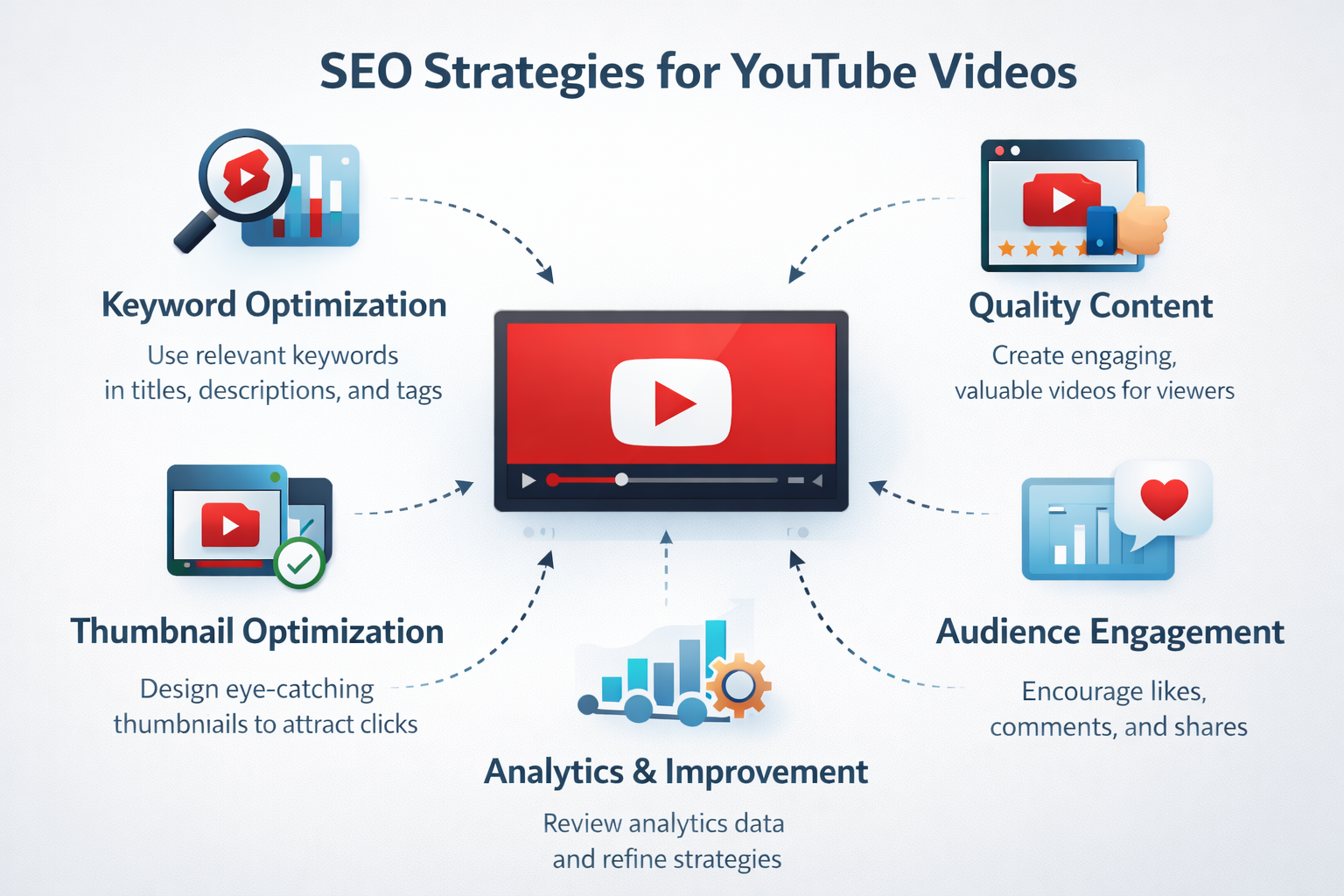
SEO strategies for YouTube videos
1. Introduction: Why YouTube SEO Still Matters in 2026
YouTube is no longer just a video platform. It’s the second-largest search engine in the world, and in 2026, it’s more competitive than ever. Millions of videos are uploaded every single day, all fighting for the same limited attention span. In that chaos, YouTube SEO is what decides whether your video gets discovered or disappears.
What YouTube SEO Is
YouTube SEO is the process of optimizing your videos and channel so they appear higher in YouTube search results, Suggested videos, and Browse features. It’s not about gaming the system. It’s about aligning your content with how YouTube understands relevance, quality, and viewer satisfaction.
At its core, YouTube SEO ensures:
- Your video is understood by the algorithm
- Your content is shown to the right audience
- Your videos earn consistent, compounding traffic over time
How the YouTube Algorithm Actually Works
The YouTube algorithm has one primary goal: keep people on the platform longer.
To do that, it measures three things relentlessly:
- Relevance – Does your video match what the user is searching or watching?
- Watch time – How long do people actually stay on your video?
- Engagement – Are viewers liking, commenting, sharing, or continuing to watch more content?
If your video satisfies these signals better than others, YouTube promotes it. Simple logic. Brutal execution.
Why SEO Is the Difference Between Buried Videos and Consistent Traffic
Most creators fail because they rely on luck. One viral spike. Then silence.
SEO flips that model. Instead of hoping for views, you engineer discoverability. A well-optimized video can bring views for months or even years, especially when it targets search intent. That’s the difference between chasing trends and building an asset library that works while you sleep.
2. How YouTube SEO Works (Algorithm Fundamentals)
To win YouTube SEO, you need to understand where views actually come from. Not all traffic is equal, and not all sources behave the same.
Search vs Suggested vs Browse Traffic
- Search traffic comes from users actively typing queries into YouTube. This is where keyword optimization matters most.
- Suggested traffic appears next to or after other videos. It’s driven heavily by watch history and session time.
- Browse traffic comes from the homepage and subscriptions feed, influenced by past behavior and performance velocity.
A strong SEO strategy targets search first, then expands into Suggested and Browse as watch time builds.
Core Ranking Signals Explained Simply
YouTube doesn’t rank videos because they’re “optimized.”
It ranks videos because people watch them and keep watching.
Key signals include:
- Click-through rate from titles and thumbnails
- Average view duration and retention curves
- Likes, comments, and shares
- Session continuation (what viewers watch next)
SEO gets you the click. Content quality earns the promotion.
Why Watch Time + Engagement Beat Everything Else
YouTube will always choose a video that keeps viewers engaged over one that’s perfectly keyword-stuffed. That’s why SEO without retention fails.
When viewers watch longer, interact, and continue their session, YouTube reads that as satisfaction. And satisfied viewers mean more recommendations. Every single time.
3. YouTube Keyword Research (The Foundation of Ranking)
If YouTube SEO were a building, keyword research would be the foundation. Skip it, and everything collapses later.
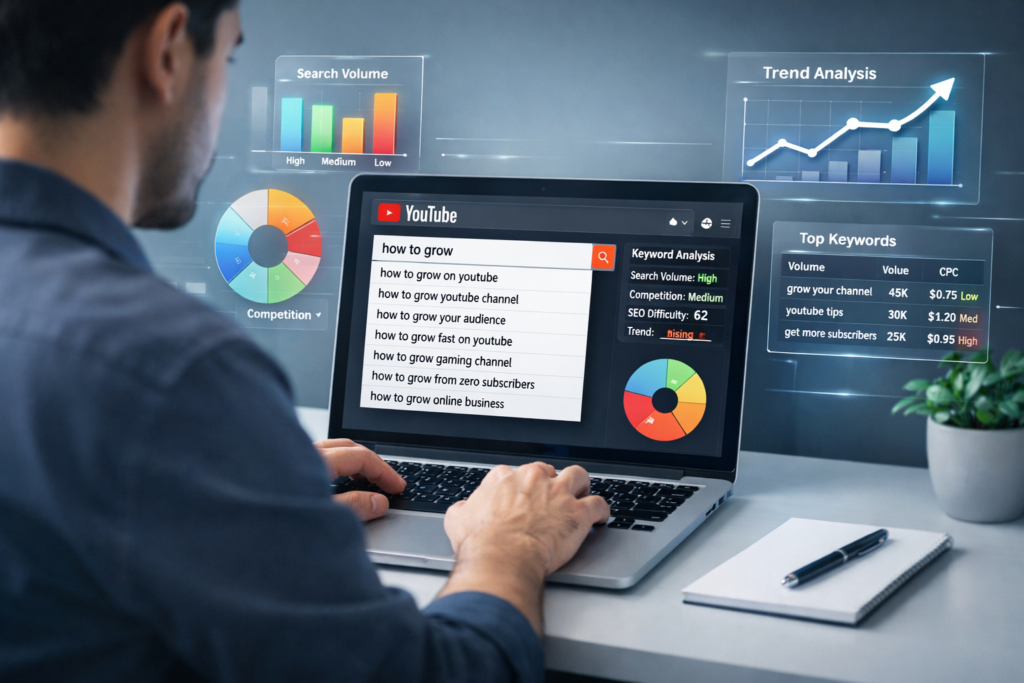
3.1 Using YouTube Autocomplete for Real Search Intent
YouTube autocomplete is raw demand data straight from users. Start typing a seed phrase and let YouTube finish the sentence. Those suggestions exist because people are actively searching them.
This method reveals:
- Real phrasing used by viewers
- Emerging trends before tools catch up
- Long-tail opportunities with clear intent
If YouTube suggests it, YouTube wants to rank it.
3.2 Validating Keywords with Tools (Volume + Competition)
Autocomplete shows demand. Tools confirm feasibility.
Platforms like Keyword Analytics for YouTube help you check:
- Monthly search volume
- Competition level
- Keyword difficulty
A smart target usually has 500+ monthly searches with relatively low competition. Big enough to matter. Small enough to win.
3.3 Competitor Keyword Analysis (What Top Videos Are Doing Right)
Ranking videos leave clues. Study them.
Look at:
- Exact wording in titles
- Keyword placement in descriptions
- Video length and structure
- Chapters and formatting
Patterns repeat for a reason. Your job is not to copy, but to outperform with intent clarity and better execution.
3.4 Choosing Long-Tail Keywords That Actually Rank
Short keywords attract competition. Long-tail keywords attract qualified viewers.
Phrases like:
- “YouTube SEO for beginners 2026”
- “How to rank YouTube videos fast”
- “YouTube SEO step by step”
These keywords:
- Match clear intent
- Convert better
- Rank faster
- Build topical authority over time
Long-tail keywords aren’t small wins. They’re strategic leverage.
4. Optimizing Video Titles for Higher Rankings & CTR

Your title is the handshake between your video and the viewer. If it’s weak, nothing else matters. Strong titles do two jobs at once: signal relevance to the algorithm and seduce the human brain into clicking.
4.1 Ideal Title Length and Keyword Placement
The sweet spot for YouTube titles is under 60 characters. Anything longer risks being cut off, especially on mobile, where most views happen.
Best practices:
- Place your primary keyword within the first 40 characters
- Lead with clarity before creativity
- Avoid filler words that dilute intent
YouTube reads titles left to right. Viewers do the same. Front-loading keywords helps both.
4.2 Power Words, Numbers, and CTR Psychology
CTR isn’t random. It’s psychological.
Titles that include:
- Numbers
- Timeframes
- Clear outcomes
- Power words like ultimate, fast, proven, simple
consistently outperform vague ones. Data shows titles with numbers can drive 8%+ higher click-through rates when paired with strong thumbnails.
The key is promise without deception. If your video can’t deliver, retention drops and rankings follow.
4.3 Examples of High-Performing YouTube SEO Titles
Well-optimized titles balance search intent + curiosity:
- YouTube SEO 2026: Rank #1 Faster Than Ever
- How to Do YouTube SEO Step by Step (Beginner Guide)
- 7 YouTube SEO Mistakes Killing Your Views
- YouTube SEO for Beginners: Get Views Without Ads
Each example:
- Targets a clear keyword
- Signals value immediately
- Sets expectations the content fulfills
That alignment is what sustains watch time.
4.4 A/B Testing Titles Inside YouTube Studio
YouTube Studio now allows title and thumbnail experiments, removing guesswork entirely.
Use A/B testing to:
- Compare keyword-first vs curiosity-first titles
- Test numbers against emotional hooks
- Measure real CTR impact over time
Let data choose the winner. Small changes in titles can unlock massive view growth.
5. SEO-Optimized Descriptions and Tags
Descriptions don’t just support SEO they shape viewer behavior. When written correctly, they improve rankings, retention, and session time.
5.1 Writing the First 125 Characters for Search Visibility
The first 125 characters are critical. They appear in search previews and carry the strongest SEO weight.
Best approach:
- Include your main keyword naturally
- Clearly explain what the video delivers
- Avoid fluff or keyword stuffing
Think of this section as your video’s meta description.
5.2 Structuring Long Descriptions for Retention and Clicks
An effective description typically has 2–3 short paragraphs:
- Keyword-focused summary
- Context, resources, and internal links
- Calls to action or related content
This structure helps users find value quickly and encourages them to explore more of your channel boosting session duration.
5.3 Using Timestamps to Boost Watch Time and Key Moments
Timestamps aren’t just a convenience feature. They create chapters, which:
- Improve retention by reducing friction
- Enable “Key Moments” in Google and YouTube search
- Help viewers jump to relevant sections without bouncing
Clear chapters signal quality to the algorithm and keep users engaged longer.
5.4 Tag Strategy: What to Use and What to Avoid
Tags matter less than they used to but they still help with context.
Use:
- 5–10 focused tags
- Your main keyword first
- Close variations and common misspellings
Avoid:
- Tag stuffing
- Irrelevant trending keywords
- Repeating the same phrase endlessly
Tags should support clarity, not confuse the algorithm.
6. Thumbnails and Captions (Hidden SEO Multipliers)
YouTube SEO doesn’t stop at text. Visual and audio signals quietly influence performance more than most creators realize.
6.1 Thumbnail Design That Drives Clicks
A strong thumbnail can increase CTR by 2–10%, which directly impacts rankings.
High-performing thumbnails usually include:
- Bold, minimal text (1–4 words max)
- Human faces showing clear emotion
- High contrast colors
- Consistent branding across videos
Design thumbnails before filming so the visual promise aligns perfectly with the content.
6.2 Captions and Transcripts for SEO & Accessibility
Manual captions outperform auto-generated ones because they’re:
- More accurate
- Better structured
- Easier for the algorithm to understand
Uploaded SRT files improve:
- Accessibility
- Keyword comprehension
- Watch time (by up to 12%)
When YouTube can “read” what’s spoken, it can recommend your video more confidently.
7. Content Optimization for Watch Time and Engagement

SEO gets the click. Watch time keeps the ranking.
If viewers don’t stay, YouTube stops showing your video no matter how well it’s optimized.
7.1 The First 15 Seconds: Hooks That Stop Scrolling
The first 15 seconds decide everything.
This is where most creators lose the algorithm’s trust. Effective hooks:
- Open with a question the viewer is already asking
- Drop a surprising stat or bold promise
- Show the outcome before the explanation
Avoid long intros, logos, or greetings. Viewers didn’t click to meet you they clicked to solve a problem. Deliver momentum immediately.
7.2 Structuring Videos Around Search Intent
Every ranking video answers one main question. Structure your content to match that intent cleanly and quickly.
A high-retention structure looks like:
- Confirm the problem
- Preview the solution
- Deliver step-by-step value
- Reinforce the outcome
When viewers feel guided, they stay. When they feel confused, they leave. YouTube notices both.
7.3 Ideal Video Length for SEO Performance
There’s no magic number but there is a performance range.
For most SEO-driven videos, 10–20 minutes performs best because it:
- Allows deeper topic coverage
- Increases total watch time
- Encourages session continuation
Longer videos only work if retention stays high. Short videos only win when they’re exceptionally focused.
7.4 Retention Boosters: Pattern Interrupts, CTAs, End Screens
Retention isn’t passive it’s engineered.
Effective boosters include:
- Pattern interrupts (visual changes, B-roll, tone shifts)
- Mid-video CTAs for likes or comments
- Teasing upcoming sections to reduce drop-off
End screens and cards should guide viewers into related playlists, not random videos. Session time is the algorithm’s love language.
8. Pillar Videos, Shorts, and Topic Clusters
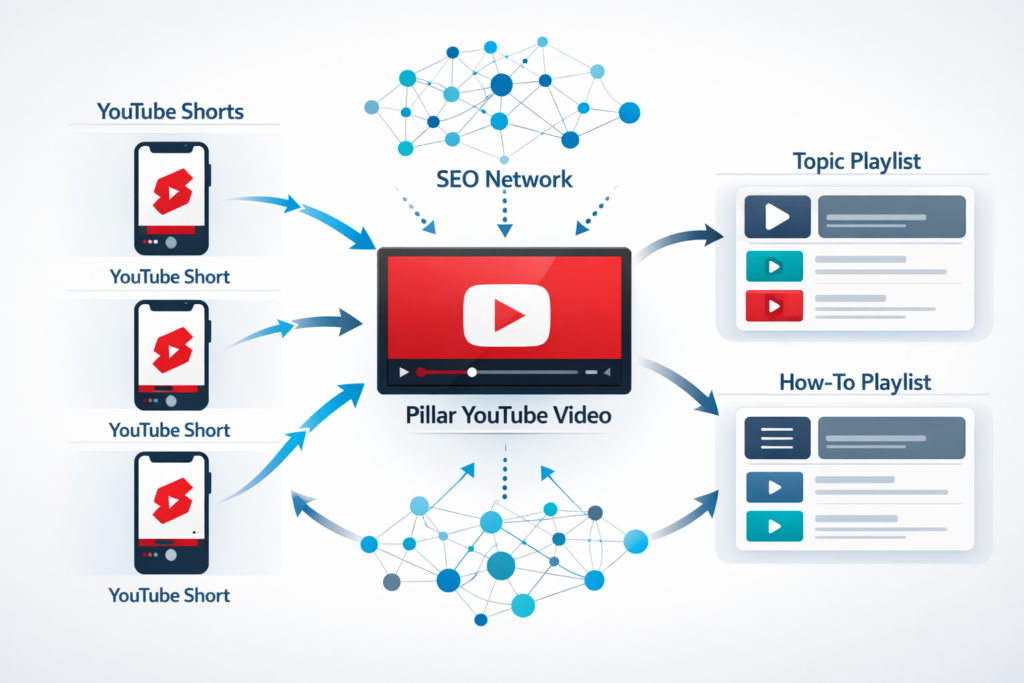
Modern YouTube SEO isn’t about single uploads. It’s about ecosystems.
8.1 Pillar Video Strategy Explained
A pillar video is a long-form, comprehensive piece targeting a core keyword.
Its job:
- Rank in search
- Establish topical authority
- Act as the hub for related content
Think of it as the anchor that supports everything else you publish around that topic.
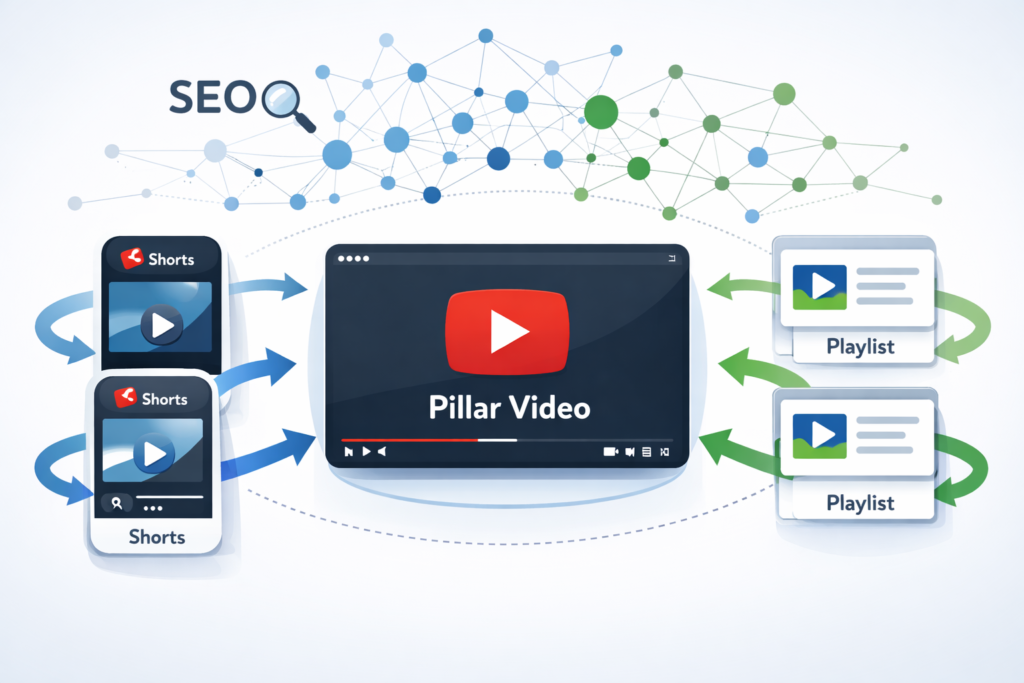
8.2 Supporting Shorts for Discoverability
Shorts are discovery engines.
By creating 8–12 Shorts from one pillar video, you:
- Expand reach to new audiences
- Feed traffic back to long-form content
- Increase overall channel signals
Each Short should highlight one idea and push viewers toward the full video or playlist.
8.3 Playlists as SEO Assets (Session Time Boosts)
Playlists are underused ranking tools.
Keyword-optimized playlists:
- Increase session duration
- Improve Suggested traffic
- Help YouTube understand topical relevance
When videos are grouped logically, viewers binge and YouTube rewards that behavior.
9. Channel-Level YouTube SEO Tactics
Individual videos matter but channels rank too. YouTube evaluates consistency, topical focus, and audience behavior across your entire channel.
9.1 Optimizing Channel Name, Bio, and Branding
Your channel metadata is permanent SEO real estate.
Best practices:
- Include a primary keyword or niche indicator in your channel name where natural
- Optimize the first 100–150 characters of your channel bio with core topics
- Keep branding consistent across thumbnails and banners
This helps YouTube instantly understand who your channel is for and what problem you solve.
9.2 Keyword-Rich Playlists and Consistent Publishing
Playlists function like mini-channels inside your channel.
Use playlists to:
- Group videos by keyword theme
- Improve session time and Suggested traffic
- Rank playlists themselves in search
Pair this with consistent publishing. Regular uploads train both the algorithm and your audience to expect value, reinforcing channel authority over time.
9.3 Using Channel Trailers for Retention
A channel trailer is your elevator pitch.
An effective trailer:
- Runs 30–60 seconds
- Highlights transformation, not features
- Directs viewers to a playlist or flagship video
For new visitors, trailers increase initial retention and guide them deeper into your content ecosystem.
9.4 Comment Engagement and Community Signals
Comments are engagement signals not vanity metrics.
Replying quickly:
- Increases interaction velocity
- Encourages more comments
- Signals active community health
Pinned comments with questions or links can extend discussions and keep viewers on your channel longer.
10. Tracking Performance and Iterating for Growth
YouTube SEO is not “set and forget.” It’s observe, refine, and double down.
10.1 Key Metrics Inside YouTube Studio
The most important metrics to monitor are:
- Watch time – the strongest ranking signal
- CTR – measures title and thumbnail effectiveness
- Retention graphs – reveal exactly where viewers drop
- Impressions – show how often YouTube is testing your content
Check performance 48 hours after publishing before making changes.
10.2 Using External Tools for Competitive Insights
Third-party tools add visibility YouTube doesn’t provide.
They help you:
- Analyze competitor tags and metadata
- Track keyword rankings over time
- Identify content gaps worth attacking
Use tools to validate decisions not to blindly copy competitors.
10.3 Adapting to 2026 YouTube SEO Updates
YouTube evolves fast.
In 2026, key shifts include:
- Stronger separation between Shorts and long-form feeds
- Improved content matching via chapters and transcripts
- More emphasis on satisfaction metrics over raw clicks
The creators who win aren’t chasing hacks they’re building systems that adapt.
10. Tracking Performance and Iterating for Growth
YouTube SEO isn’t a one-time checklist. It’s a data-driven cycle of testing, learning, and refining. What matters today might shift tomorrow so savvy creators watch metrics closely and iterate fast.
10.1 Key Metrics Inside YouTube Studio
To grow strategically, focus on these core performance signals:
- Watch time — the total amount of time viewers spend watching your videos and one of YouTube’s strongest SEO signals.
- CTR (Click-Through Rate) — percentage of viewers who click your video after seeing it in search or recommendations; higher CTR drives more impressions.
- Retention curves — overall and segment retention show where viewers drop off, helping you pinpoint improvement areas.
- Impressions — how often YouTube surfaces your video; a drop may indicate metadata or relevance issues.
Check these within YouTube Studio analytics, especially after the first 48 hours when early performance trends start to stabilize.
10.2 Using External Tools for Competitive Insights
Internal analytics is just one view of the picture. External tools like vidIQ, TubeBuddy, and others help you compare your SEO performance against competitors, revealing:
- Popular tags and keywords competitors are ranking for
- Competitor engagement patterns
- Historical search trends and seasonal opportunity spikes
Use them to fill gaps in your strategy but always validate insights with your actual performance data.
10.3 Adapting to 2026 YouTube SEO Updates
YouTube’s algorithm evolves continually. In 2026, major shifts include:
- Intent-based ranking: The platform now prioritizes what users really want over strict keyword matches, blending behaviors and micro-intent signals.
- AI-driven recommendations: Deeper predictive models shape both search and suggested content behavior.
- Shorts influence: Shorts performance now boosts long-form discoverability more than ever.
- Rich metadata: Timestamps, chapters, and accurate captions now improve both indexing and retention signals.
Adaptation means tuning your workflow plan, optimize, measure, repeat and stay up to date on platform signals rather than chasing shortcuts.
11. Tools and Resources for YouTube SEO (Cited Sources)
Below are helpful resources you can cite directly in your blog with short explanations and links:
- Semrush Guide – Comprehensive step-by-step YouTube SEO guide with algorithm context and a full optimization checklist for creators. Semrush YouTube SEO Guide (2025)
- HubSpot Tips – Practical YouTube SEO tactics covering titles, descriptions, tags, thumbnails, and hashtags with hands-on tips. HubSpot YouTube SEO Tips
- Xoance 2026 Strategies – Latest YouTube SEO roadmap for 2026 emphasizing intent-based search and AI personalization. YouTube SEO 2026 Strategy (Xoance)
- Learning Revolution Best Practices – Data-driven YouTube best practices, including real tools for keyword trends, transcripts, thumbnail design, and analytics. Learning Revolution YouTube SEO Insights
- Keyword Tool Dominator – A practical tool to generate long-tail keywords and uncover demand directly from YouTube autocomplete. Keyword Tool Dominator YouTube SEO Guide
(Tip for your blog: Add each link followed by ≤30-word summaries to make your resources both credible and scannable.)
12. Related Guides (Internal Linking Section)
To help your readers dive deeper, link to these related articles on your site:
- Best YouTube title templates for higher CTR
- How to structure a pillar video and supporting Shorts
- Optimal length and chapter strategy for YouTube videos
- How to perform YouTube keyword research in 2026
- How to write an SEO-optimized video description (example textfiled)
These internal links help with SEO while keeping readers engaged longer on your site.
13. Conclusion: Building a Long-Term YouTube SEO System
YouTube SEO isn’t a checklist it’s a long-term growth engine.
Why Consistency + Optimization Compound
Every optimization you make from titles and thumbnails to retention improvements adds up. Videos that consistently rank build evergreen traffic, and the algorithm rewards this momentum with ongoing visibility.
The magic happens when:
- You research deeply
- You optimize metadata strategically
- You improve retention systematically
- You track data and iterate regularly
You’re not chasing views. You’re building evergreen discoverability.
Final Actionable Takeaway for Creators and Bloggers
Start with small wins:
- Optimize your next video’s title, description, tags, and thumbnail
- Track the key metrics (CTR, watch time, retention, impressions)
- Adjust based on early analytics and what audiences actually engage with
Repeat this workflow consistently and your content begins to work for you, not the other way around.
Frequently Asked Questions (FAQ)
1. How long does it take for YouTube SEO to show results?
YouTube SEO results typically appear within 2–6 weeks, depending on competition, watch time, and engagement. Search-focused videos often rank faster than Suggested or Browse traffic videos.
2. Do tags still matter for YouTube SEO in 2026?
Tags have limited impact compared to titles, descriptions, and watch time, but they still help YouTube understand context especially for new channels, misspellings, and niche keywords.
3. Is YouTube SEO more important than content quality?
No. SEO helps YouTube discover your video, but content quality determines how long viewers stay. Without strong retention and engagement, even well-optimized videos won’t rank long-term.
4. Can YouTube Shorts help long-form videos rank?
Yes. Shorts increase discovery and channel signals, which can indirectly boost long-form video visibility when they’re linked to pillar videos or keyword-optimized playlists.
5. What is the biggest YouTube SEO mistake creators make?
The biggest mistake is focusing on keywords alone while ignoring watch time, retention, and viewer intent. YouTube rewards satisfaction, not keyword stuffing.