
-
- No Comments
- March 8, 2026

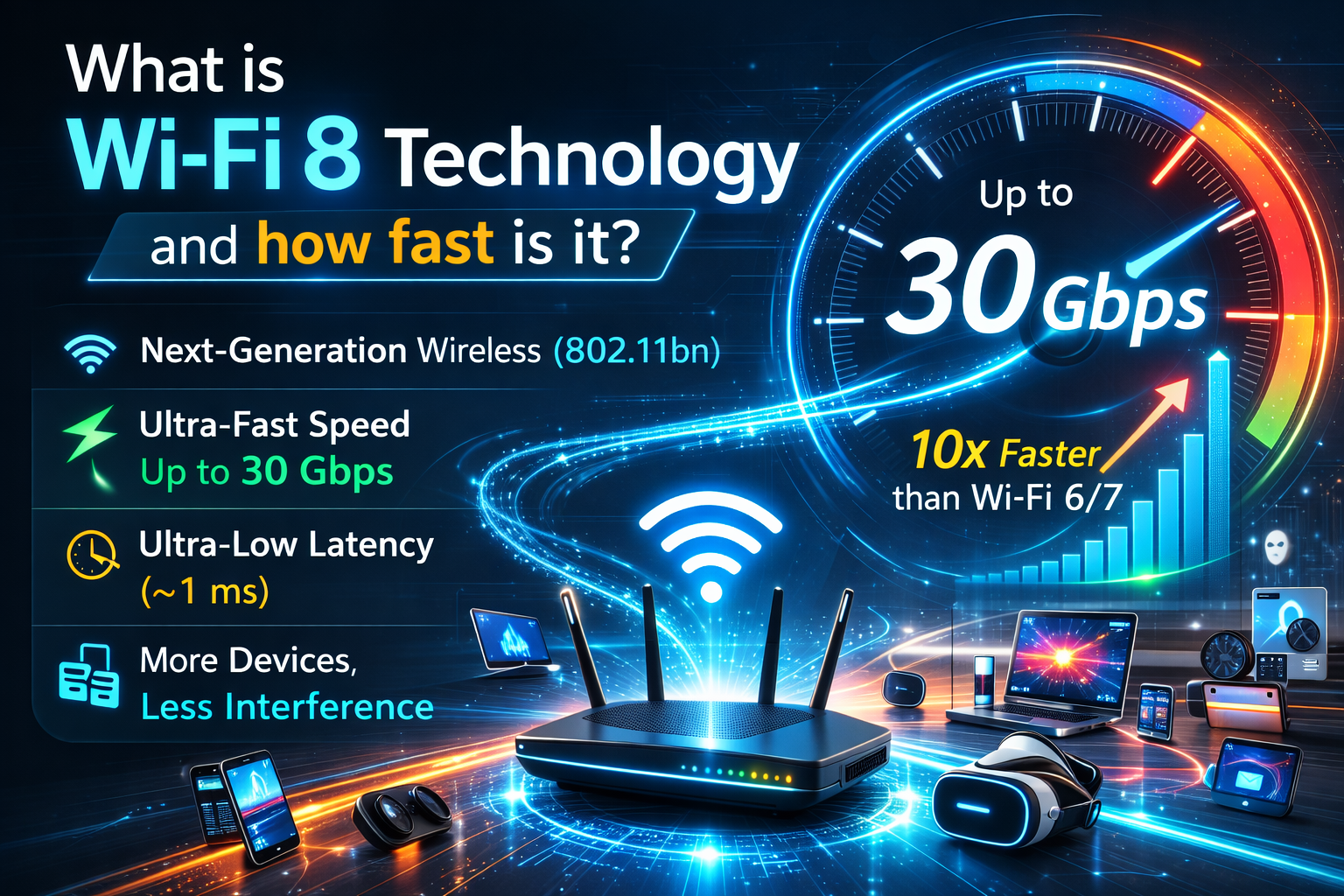
What is Wi-Fi 8 technology and how fast is it
1. Introduction
Wi-Fi has quietly evolved through several generations, each one pushing wireless networking a little further than the last. From early standards that struggled to deliver a few megabits per second to modern systems capable of multi-gigabit speeds, every new version has focused on improving how devices connect, communicate, and share bandwidth. Over the years we’ve seen breakthroughs in channel width, modulation techniques, and multi-band support that dramatically boosted performance.
But the way we use the internet has also changed. Homes are no longer powered by a single laptop and router. Today’s networks support dozens of connected devices at once smartphones, laptops, smart TVs, security cameras, gaming consoles, and an ever-growing collection of IoT gadgets. Add emerging technologies like cloud gaming, augmented reality, and extended reality (XR), and suddenly wireless networks are handling far more complexity than they were originally designed for. In busy environments such as apartment buildings, offices, airports, or stadiums, wireless interference and congestion can quickly degrade performance.
This is where the next generation of wireless technology steps in. The upcoming standard, commonly referred to as Wi-Fi 8, aims to improve how networks perform in real-world conditions rather than simply chasing higher peak speeds. While the maximum theoretical speed remains similar to Wi-Fi 7, the real goal is to deliver more consistent connections, lower latency, and better reliability in crowded environments. In other words, Wi-Fi 8 focuses on making wireless networks smarter, not just faster.
2. What is Wi-Fi 8 Technology?

Wi-Fi 8 is the next major generation of wireless networking technology currently being developed by the Institute of Electrical and Electronics Engineers. Technically known as IEEE 802.11bn, this upcoming standard represents the evolution of modern Wi-Fi with a focus on improving reliability in complex networking environments.
Unlike earlier generations that were mostly defined by faster peak speeds, Wi-Fi 8 introduces a new design philosophy. It is often referred to as Ultra High Reliability (UHR) Wi-Fi, highlighting its main purpose: maintaining stable, dependable wireless connections even when networks are crowded or interference levels are high.
At its core, Wi-Fi 8 aims to deliver stronger and more predictable performance. Instead of prioritizing maximum theoretical throughput alone, the standard focuses on improving how efficiently wireless networks operate under real-world conditions. This includes reducing latency, minimizing packet loss, and ensuring smoother connections as devices move between access points.
What makes Wi-Fi 8 different from previous generations is this shift toward reliability and efficiency. Earlier standards such as IEEE 802.11ax (Wi-Fi 6) and IEEE 802.11be (Wi-Fi 7) introduced faster speeds and wider channels, but Wi-Fi 8 builds on that foundation by optimizing how networks manage interference, device density, and roaming. The result is a wireless system designed to perform better not just in ideal conditions, but in the busy environments where people actually use it.
3. Why Wi-Fi 8 Focuses on Reliability Instead of Speed

For years, each new Wi-Fi generation competed to deliver higher headline speeds. While those improvements were important, modern wireless networks now face a different challenge: maintaining stable performance in environments packed with devices and overlapping signals.
In many urban areas, dozens of routers can operate within the same apartment building or office floor. Each router broadcasts across shared spectrum bands, creating interference that can reduce signal quality and slow down connections. Even if a router supports extremely high theoretical speeds, that performance often drops when multiple networks compete for the same wireless space.
Device congestion adds another layer of complexity. A typical home network might include smartphones, laptops, tablets, streaming devices, smart speakers, security cameras, and IoT sensors. When dozens of devices attempt to transmit data simultaneously, routers must constantly coordinate traffic to avoid collisions and maintain efficiency.
Another common issue is roaming. When a device moves through a large home, office, or public venue, it may need to switch between different access points in a mesh network. If that transition isn’t handled smoothly, users can experience lag, dropped connections, or interruptions during video calls, gaming sessions, or streaming.
Because of these challenges, simply increasing peak speeds no longer solves the real problems users face. What matters more is consistent performance across the entire network. Wi-Fi 8 addresses this by prioritizing stability, improved coordination between access points, and smarter spectrum management. The result is a wireless system that delivers better performance where it matters most in real-world, high-density environments rather than in isolated speed tests.
4. Wi-Fi 8 Core Specifications
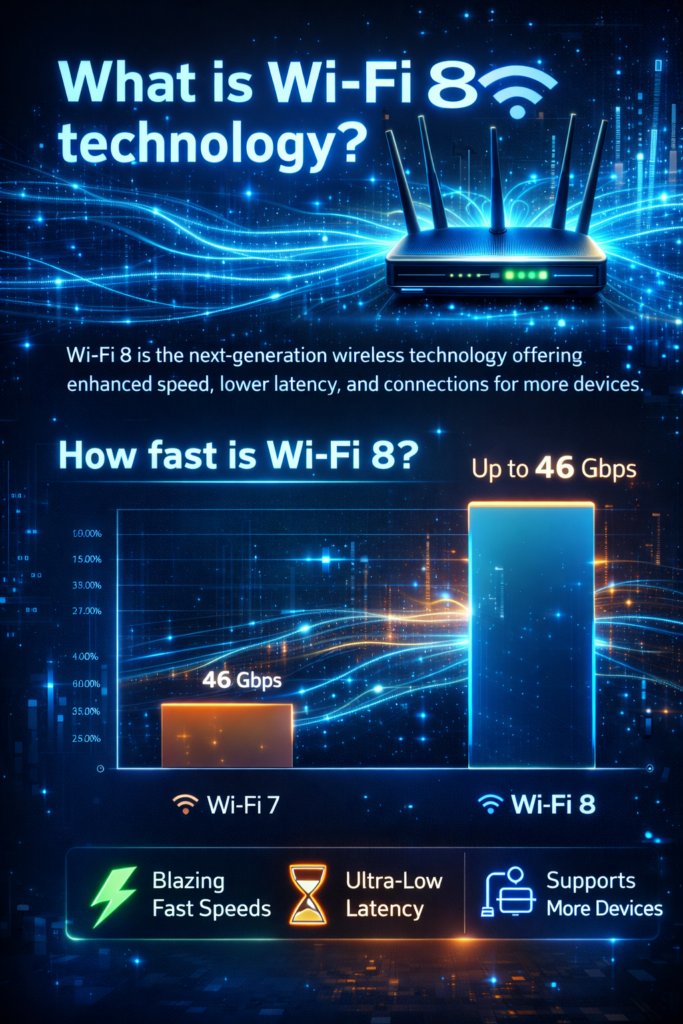
While Wi-Fi 8 introduces several new reliability features, its technical foundation remains similar to the previous generation. The upcoming standard, officially known as IEEE 802.11bn, builds upon the physical layer improvements introduced by IEEE 802.11be while shifting the focus toward network efficiency and real-world stability.
Below are the key technical specifications that define the baseline capabilities of Wi-Fi 8.
4.1 Supported Frequency Bands
Wi-Fi 8 will continue operating across the same three wireless bands already used by modern routers:
2.4 GHz
The 2.4 GHz band offers the longest range and better wall penetration, making it useful for devices located farther from the router. It is commonly used by IoT devices and smart home equipment.
5 GHz
The 5 GHz band provides faster speeds and lower interference compared to 2.4 GHz, making it the primary band for most modern devices like laptops, smartphones, and gaming consoles.
6 GHz
Introduced with newer Wi-Fi generations, the 6 GHz band offers significantly more available spectrum and less congestion. It enables high-performance wireless connections with lower latency and improved throughput.
By supporting all three bands, Wi-Fi 8 devices can intelligently distribute traffic across the spectrum to maintain optimal performance.
4.2 Channel Bandwidth
Wi-Fi 8 supports channel widths of up to 320 MHz, matching the maximum bandwidth introduced in the previous generation. Wider channels allow routers to transmit larger amounts of data simultaneously, increasing potential throughput for compatible devices.
However, in real-world environments where interference can limit usable channel sizes, Wi-Fi 8 introduces smarter mechanisms to make better use of available bandwidth.
4.3 Modulation Technology
The standard continues to use 4096-QAM (Quadrature Amplitude Modulation), an advanced modulation technique that encodes more data within each transmitted signal.
Higher modulation schemes allow networks to transfer more bits per symbol, increasing efficiency when signal conditions are strong. In simple terms, 4096-QAM helps maximize data throughput without requiring additional spectrum.
4.4 Spatial Streams
Wi-Fi 8 supports up to eight spatial streams, enabling multiple simultaneous data transmissions between a router and connected devices.
Spatial streams use multiple antennas to send and receive parallel data streams, increasing overall network capacity. This capability becomes especially valuable in environments where multiple devices need to communicate with the router at the same time.
4.5 Maximum Theoretical Data Rate
Despite being a next-generation standard, Wi-Fi 8 does not increase peak theoretical speed beyond the previous generation. The maximum physical layer data rate remains around 23 Gbps (approximately 23,059 Mbps).
This means the top-end speed of Wi-Fi 8 is essentially the same as Wi-Fi 7. Instead of chasing higher peak throughput numbers, the new standard focuses on delivering more consistent speeds, lower latency, and better stability in real-world conditions.
5. Key Features of Wi-Fi 8

The real innovation of Wi-Fi 8 lies not in raw speed but in how networks manage interference, congestion, and device coordination. Several new technologies are designed to improve performance in dense environments where many access points and devices operate simultaneously.
5.1 Multi-Access Point Coordination
One of the most important upgrades in Wi-Fi 8 is the introduction of multi-access point coordination.
Traditionally, each wireless access point operates independently. Wi-Fi 8 changes this by allowing multiple access points to cooperate and coordinate transmissions. By sharing information and synchronizing activity, routers can reduce signal interference and improve network efficiency across large coverage areas.
5.2 Coordinated Spatial Reuse (Co-SR)
Coordinated Spatial Reuse (Co-SR) improves how networks share wireless spectrum in crowded environments.
Instead of avoiding overlapping transmissions entirely, coordinated spatial reuse allows nearby access points to intelligently reuse parts of the spectrum when interference levels are manageable. This approach increases overall network capacity and helps maintain higher throughput even in densely populated areas.
5.3 Coordinated Beamforming (Co-BF)
Coordinated Beamforming (Co-BF) enables multiple access points to direct wireless signals toward devices more precisely.
Beamforming technology already exists in modern routers, but Wi-Fi 8 expands the concept by allowing several access points to coordinate their signal patterns. This creates stronger, more focused connections and reduces wasted energy broadcasting signals in unnecessary directions.
5.4 Dynamic Sub-Channel Operation (DSO)
Dynamic Sub-Channel Operation (DSO) improves spectrum efficiency when different devices operate using different channel widths.
In traditional networks, a device using a narrower channel may limit how the wider channel can be used. Wi-Fi 8 introduces dynamic mechanisms that allow routers to split and allocate sub-channels more intelligently. This helps maintain high throughput even when devices with mixed capabilities are connected.
5.5 Seamless Roaming Domain (SMD)
Wi-Fi 8 introduces Seamless Roaming Domain (SMD) technology to improve device handoffs between access points.
When a device moves across a mesh network or enterprise environment, it may need to switch from one access point to another. SMD aims to make these transitions nearly instantaneous, reducing latency spikes, dropped packets, and connection interruptions.
For applications like video calls, cloud gaming, or augmented reality, smoother roaming can significantly improve the user experience.
5.6 Enhanced Long Range (ELR)
Enhanced Long Range (ELR) expands connectivity for devices located farther away from the router.
This feature is especially important for IoT devices, which often operate at low power and may be placed in locations with weaker signal coverage. ELR helps maintain reliable communication across larger distances without sacrificing network stability.
5.7 Distributed Resource Units (DRUs)
Wi-Fi 8 also introduces Distributed Resource Units (DRUs) to improve uplink efficiency.
In current Wi-Fi systems, devices must compete for uplink transmission opportunities. DRUs help coordinate how devices send data back to the router, allowing transmissions to be scheduled more efficiently. This reduces contention and improves overall network performance when many devices are active.
5.8 Power-Saving Modes
Another important advancement in Wi-Fi 8 is improved power-saving capabilities for both access points and connected devices.
These new power management mechanisms allow devices to conserve energy while maintaining reliable connectivity. For battery-powered devices such as smartphones, wearables, and IoT sensors, better power efficiency can significantly extend operational life without compromising performance.
6. How Fast Is Wi-Fi 8?

Speed is usually the first question people ask about any new Wi-Fi generation. But with Wi-Fi 8, the story is a little different. Instead of pushing the limits of peak throughput, the standard focuses on improving how networks perform under real-world conditions. That means smoother connections, fewer interruptions, and more consistent speeds even when dozens of devices are competing for bandwidth.
In practical terms, Wi-Fi 8 may not deliver dramatically higher maximum speeds than its predecessor, but it significantly improves how efficiently networks handle interference, congestion, and roaming between access points.
6.1 Maximum Theoretical Speed
The maximum theoretical speed of Wi-Fi 8 remains around 23 Gbps. This peak physical layer data rate is essentially the same as the one introduced in IEEE 802.11be, the standard behind Wi-Fi 7.
Maintaining the same top-end throughput allows Wi-Fi 8 to build on existing hardware capabilities while focusing its innovation on improving reliability and network efficiency rather than pushing higher headline numbers.
6.2 Real-World Performance Improvements
While the peak speed remains unchanged, Wi-Fi 8 is designed to deliver about 25 percent higher throughput in real-world conditions.
This improvement comes from smarter spectrum management and coordination between access points. In environments with heavy interference or many connected devices, Wi-Fi 8 can maintain stronger and more stable connections, resulting in faster average speeds for users.
6.3 Latency Improvements
Latency is another area where Wi-Fi 8 shows measurable gains. The new standard targets around 25 percent lower latency at the 95th percentile, meaning fewer delays during demanding applications.
Lower latency is particularly important for activities like cloud gaming, real-time collaboration, video conferencing, and immersive technologies such as extended reality. With Wi-Fi 8, network responsiveness becomes more consistent even during peak usage periods.
6.4 Packet Loss Reduction
Dropped packets are a common problem in busy wireless environments, especially when devices move between access points in large homes, offices, or public venues.
Wi-Fi 8 aims to reduce this issue significantly, with around 25 percent fewer dropped packets during roaming. This improvement helps maintain smoother connections when switching between routers or mesh nodes, ensuring that streaming, gaming, or video calls remain uninterrupted.
7. Wi-Fi 8 vs Wi-Fi 7
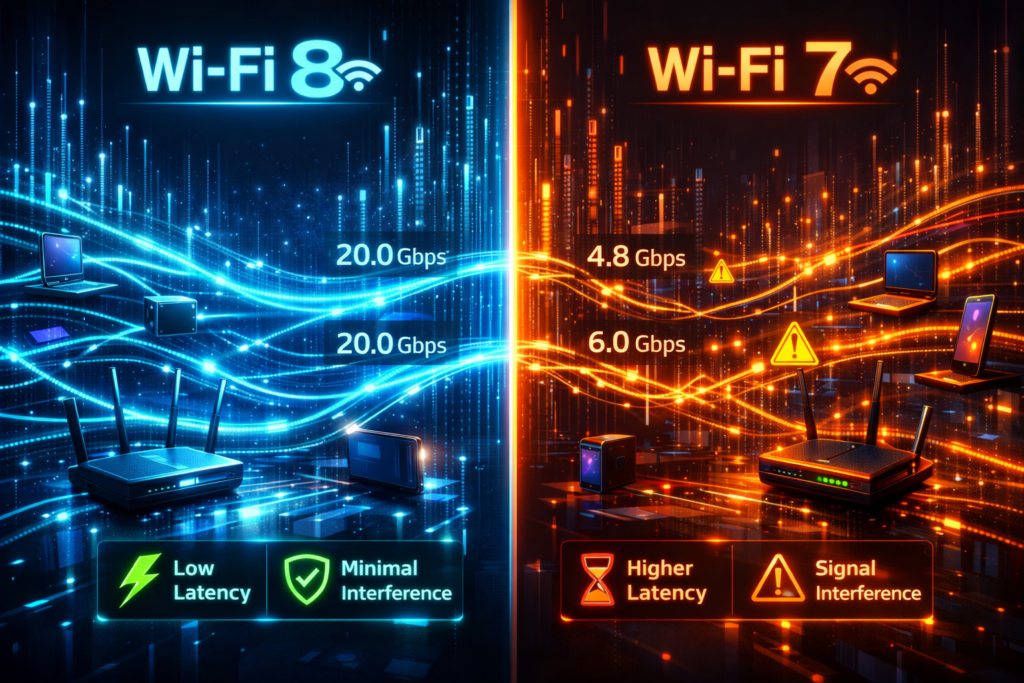
To understand what Wi-Fi 8 brings to the table, it helps to compare it directly with its predecessor. While both standards share similar technical foundations, the goals behind them are quite different.
Peak Speed Comparison
At the hardware level, Wi-Fi 8 and Wi-Fi 7 share many of the same physical layer capabilities. Both support 320 MHz channels, advanced modulation, and multi-band operation. As a result, their maximum theoretical throughput is nearly identical.
The main difference is that Wi-Fi 8, based on IEEE 802.11bn, shifts the focus from increasing peak speed to optimizing how networks behave under real-world conditions.
Reliability Improvements
Reliability is where Wi-Fi 8 truly stands apart. Through technologies such as multi-access point coordination and improved spectrum management, networks can operate more efficiently even in crowded wireless environments.
This leads to more stable connections, fewer interruptions, and better overall performance when multiple routers and devices are competing for the same spectrum.
Latency Differences
Wi-Fi 8 is designed to reduce tail latency, meaning the worst-case delays that can occur during heavy network activity. Lower latency results in smoother performance for time-sensitive applications such as online gaming, video calls, and remote collaboration.
By minimizing delays, Wi-Fi 8 ensures that networks remain responsive even when usage spikes.
Network Stability in Dense Environments
One of the biggest advantages of Wi-Fi 8 is its ability to maintain stable connections in dense environments. Apartment complexes, offices, conference centers, and public venues often contain dozens or even hundreds of overlapping wireless networks.
Wi-Fi 8 introduces smarter coordination mechanisms between access points to reduce interference and maximize spectrum efficiency, helping networks perform better in these challenging scenarios.
8. Real-World Use Cases for Wi-Fi 8
The improvements introduced in Wi-Fi 8 are particularly valuable in environments where wireless networks must support large numbers of devices or handle demanding applications.
Smart Homes with Dozens of Connected Devices
Modern homes can easily contain dozens of connected devices, including smartphones, laptops, smart TVs, security cameras, and IoT sensors. Wi-Fi 8 helps manage this device density more efficiently, ensuring consistent performance across the entire home network.
Enterprise Networks and Offices
Businesses rely heavily on stable wireless connectivity for communication, cloud services, and collaborative tools. Wi-Fi 8 improves reliability and roaming between access points, which is critical in large office spaces where employees frequently move between areas.
Stadiums, Airports, and Dense Public Spaces
Large public venues often struggle with network congestion due to thousands of connected users. Wi-Fi 8’s ability to coordinate multiple access points and manage interference can dramatically improve connectivity in places such as stadiums, airports, and conference centers.
Cloud Gaming and XR Applications
Emerging technologies like cloud gaming, augmented reality, virtual reality, and extended reality require extremely low latency and stable connections. Wi-Fi 8’s improvements in latency reduction and packet reliability make it well suited for these high-performance applications.
IoT Ecosystems
The growth of IoT devices is placing new demands on wireless infrastructure. From smart home devices to industrial sensors, these systems require stable and energy-efficient connectivity.
Wi-Fi 8 introduces technologies designed to support long-range connections and improved power efficiency, making it an important step forward for expanding IoT ecosystems.
9. Wi-Fi 8 Development Timeline
The development of Wi-Fi 8 is already underway, but like most wireless standards, it follows a multi-year process involving research, testing, and global standardization. The technology is currently being developed under the official designation IEEE 802.11bn, which represents the next stage in wireless networking evolution.
IEEE 802.11bn Task Group Formation (2021)
The development process began in 2021, when the IEEE formed the 802.11bn task group. This group of engineers, researchers, and industry experts was tasked with designing the next Wi-Fi generation with a focus on Ultra High Reliability (UHR). Their goal is to address modern wireless challenges such as network congestion, interference, and roaming instability.
Standard Expected Approval – September 2028
Like previous Wi-Fi generations, the final technical standard takes several years to complete. Current projections suggest that the full Wi-Fi 8 specification will reach official approval around September 2028.
Once finalized, manufacturers can fully align their products with the completed standard.
Wi-Fi Alliance Certification – Early 2028
Before the standard is finalized, the Wi-Fi Alliance typically launches its certification program. For Wi-Fi 8, certification is expected to begin in early 2028.
Certification ensures that devices from different manufacturers work together reliably and meet performance requirements defined by the standard.
Possible Early Devices Around 2026
Interestingly, consumers may start seeing early Wi-Fi 8 hardware as early as 2026. This often happens because networking companies release pre-standard products based on draft specifications, similar to how Wi-Fi 6 and Wi-Fi 7 devices appeared before their standards were officially finalized.
These early products help manufacturers test real-world performance while giving early adopters access to the latest wireless technologies.
10. When Will Wi-Fi 8 Devices Be Available?
Although the official standard is still under development, the rollout of Wi-Fi 8 devices will likely begin gradually over several years as chipmakers and networking companies integrate the technology into their products.
Early Chipset Vendors
The first step in bringing Wi-Fi 8 to market will come from semiconductor companies that design wireless chipsets. Companies such as Broadcom, Qualcomm, and MediaTek typically lead the industry in developing next-generation Wi-Fi hardware.
Once these chipsets are available, device manufacturers can integrate them into routers, laptops, smartphones, and other connected devices.
Router Manufacturers Adopting Early Versions
Major networking brands will likely introduce early Wi-Fi 8 routers soon after compatible chipsets become available. Companies such as Netgear, TP-Link, and ASUS have historically released pre-standard routers ahead of final certification to stay competitive in the high-end networking market.
These early models will likely target enthusiasts, enterprise users, and smart home setups that demand the latest wireless performance.
Expected Adoption Timeline for Consumers
For most consumers, widespread Wi-Fi 8 adoption will likely happen between 2027 and 2029. During this period, routers, smartphones, laptops, and other devices will begin shipping with built-in Wi-Fi 8 support as the technology becomes more standardized.
As prices drop and compatibility improves, Wi-Fi 8 will gradually replace older standards, delivering more reliable wireless performance across homes, offices, and public networks.
11. The Future of Wi-Fi Connectivity
For many years, the evolution of wireless networking followed a predictable pattern: every new generation promised faster speeds. But the reality of modern connectivity has changed. Today’s networks must support dozens of devices simultaneously, handle high-bandwidth applications, and remain stable in crowded environments filled with overlapping signals. Because of this shift, the future of Wi-Fi is no longer defined purely by speed, but by reliability, consistency, and intelligent network management.
The upcoming standard IEEE 802.11bn, commonly known as Wi-Fi 8, reflects this new direction. Instead of focusing on higher peak throughput numbers, it prioritizes maintaining stable performance even when networks are under heavy load. This approach ensures users experience smoother connections, fewer interruptions, and more predictable performance in everyday situations.
One area where this change will have a major impact is smart homes. Modern households often contain dozens of connected devices including smart speakers, security cameras, thermostats, TVs, laptops, and IoT sensors. Wi-Fi 8’s improved coordination between access points and devices will help manage this growing device ecosystem more efficiently, keeping networks responsive even as the number of connected gadgets continues to rise.
Enterprise environments will also benefit significantly. Offices, campuses, and large buildings rely heavily on seamless wireless connectivity for cloud services, video conferencing, collaboration tools, and mobile workflows. By improving roaming performance and reducing interference, Wi-Fi 8 can provide more stable coverage across large spaces where employees frequently move between access points.
Perhaps most importantly, Wi-Fi 8 prepares networks for the next wave of internet applications. Emerging technologies such as extended reality (XR), cloud gaming, real-time collaboration platforms, and advanced IoT systems require extremely stable, low-latency connections. With its emphasis on consistent performance and reduced packet loss, Wi-Fi 8 creates the foundation needed to support these demanding applications in the years ahead.
In short, the future of wireless networking is not simply about moving data faster. It is about building smarter, more reliable networks that can adapt to the increasingly complex digital environments we live and work in.
12. Conclusion
Wi-Fi 8 represents the next stage in the evolution of wireless networking. Known technically as IEEE 802.11bn and often referred to as Ultra High Reliability Wi-Fi, this new standard focuses on solving many of the real-world challenges that modern networks face, including congestion, interference, and unstable connections in dense environments.
While its maximum theoretical speed remains similar to the previous generation, the biggest change lies in how efficiently wireless networks operate. Through innovations such as multi-access point coordination, improved roaming, and smarter spectrum management, Wi-Fi 8 is designed to deliver stronger and more consistent connections where it matters most.
So when asking the question “How fast is Wi-Fi 8?”, the answer goes beyond raw speed numbers. Wi-Fi 8 may not dramatically increase peak throughput, but it aims to deliver something far more valuable: better real-world performance, lower latency, and more reliable connectivity across crowded networks.
For deeper technical details and further reading, you can explore the following sources:
- https://en.wikipedia.org/wiki/IEEE_802.11bn
- https://www.zdnet.com/home-and-office/networking/what-is-wi-fi-8-explainer/
- https://www.netgear.com/hub/technology/what-is-wifi-8/
- https://www.tomsguide.com/home/smart-home/first-official-wi-fi-8-details-emerge-and-its-slower-than-you-might-expect
- https://research.samsung.com/blog/IEEE-802-11bn-Ultra-High-Reliability-UHR-Wi-Fi-8
- https://www.pcworld.com/article/2518469/meet-wi-fi-8-which-trades-speed-for-a-more-reliable-experience.html
- https://www.networkworld.com/article/4112600/wi-fi-8-in-2026-next-gen-wireless-standard-prioritizes-reliability-over-speed-gains
- https://www.qualcomm.com/wi-fi/wi-fi-8
Frequently Asked Questions (FAQ)
1. What is Wi-Fi 8 and how is it different from previous Wi-Fi generations?
Wi-Fi 8 is the upcoming wireless networking standard designed to improve connection reliability and performance in crowded environments. Technically known as IEEE 802.11bn, it focuses on delivering stable connections, lower latency, and better spectrum efficiency rather than simply increasing peak speeds. Unlike earlier standards that prioritized raw throughput, Wi-Fi 8 is built to perform better in real-world networks filled with multiple devices and interference.
2. How fast is Wi-Fi 8 compared to Wi-Fi 7?
Wi-Fi 8 offers a maximum theoretical speed of about 23 Gbps, which is roughly the same peak speed as IEEE 802.11be (Wi-Fi 7). However, the key advantage of Wi-Fi 8 is improved real-world performance. It is designed to deliver around 25% higher throughput, lower latency, and fewer dropped packets in busy wireless environments.
3. When will Wi-Fi 8 be available?
Early Wi-Fi 8 devices may start appearing around 2026, even before the standard is fully finalized. The official specification is expected to be approved around September 2028, with certification programs handled by the Wi-Fi Alliance beginning earlier. Widespread adoption in consumer devices will likely occur between 2027 and 2029.
4. Will I need a new router to use Wi-Fi 8?
Yes. To take advantage of Wi-Fi 8 features, you will need a Wi-Fi 8 compatible router and devices that support the new standard. Older devices will still work with Wi-Fi 8 routers because Wi-Fi standards are backward compatible, but they will not benefit from the advanced reliability improvements.
5. Who will benefit the most from Wi-Fi 8?
Wi-Fi 8 will be especially useful in high-density environments where many devices connect at the same time. This includes smart homes with dozens of connected devices, enterprise offices, large venues such as airports and stadiums, and advanced applications like cloud gaming, extended reality, and IoT ecosystems. The improvements in reliability and latency will make these networks more stable and efficient.