
-
- No Comments
- March 10, 2026

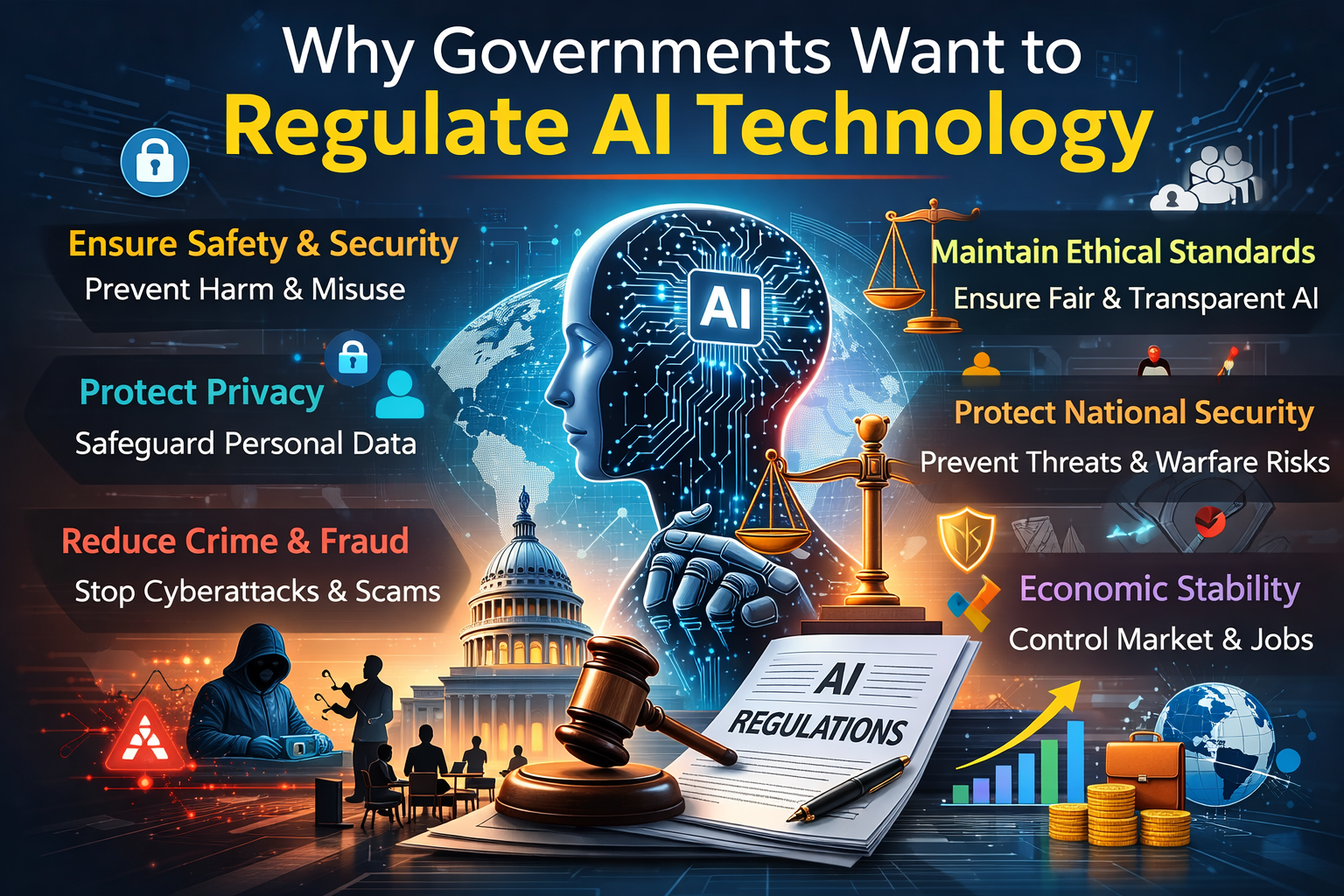
Why governments want to regulate AI technology
The Machine That Nobody’s Driving
There is a technology reshaping hiring decisions, medical diagnoses, criminal sentencing, financial lending, and the information you see every single day and in most countries, there is no law governing how it does any of that.
No mandatory safety checks. No required transparency. No legal accountability when it gets it catastrophically wrong.
In 2023, a man in Detroit named Michael Williams spent ten days in jail after a facial recognition algorithm incorrectly identified him as a suspect in a murder case. He had never been near the scene. The AI was wrong. The system that trusted it didn’t ask questions. Williams lost his job while he was detained. His family didn’t know why he’d been taken. The technology moved on to its next decision before anyone had finished explaining what had happened to him.
That is not a horror story from a dystopian novel. That is Tuesday.
Artificial intelligence is advancing at a pace that has no historical precedent. It took the internet roughly a decade to fundamentally rewire commerce, communication, and culture. AI is doing the same thing — except it’s doing it in boardrooms, courtrooms, hospitals, and police departments simultaneously, and it’s doing it in half the time. Governments aren’t wringing their hands over AI because they fear progress. They’re reaching for regulation because they’ve looked at what happens when a technology this powerful operates in a legal vacuum — and what they’ve seen has made them move fast.
This isn’t about slowing the machine down. It’s about making sure someone is actually driving it.
Section 1 — The Problem with Brilliant but Blind Systems
Here is the uncomfortable truth about artificial intelligence that its most enthusiastic evangelists tend to gloss over: AI doesn’t think. It pattern-matches. It finds correlations in historical data and uses them to predict future outcomes. Which sounds precise and powerful — and it is — right up until the moment you realise that historical data is soaked in centuries of human bias, structural inequality, and institutional prejudice.
Feed a biased world into a machine. Get a biased machine out.
The problem isn’t that AI systems are malicious. It’s that they are extraordinarily good at learning the wrong lessons at enormous scale.
Hiring algorithms are among the most documented examples. Amazon famously scrapped an AI recruitment tool in 2018 after discovering it had been systematically downgrading CVs that included the word “women’s” — as in women’s chess club, women’s college, women’s rugby. The system had trained on ten years of the company’s own hiring data. Ten years in which Amazon, like most tech companies, had predominantly hired men. The algorithm did exactly what it was designed to do: it learned from past decisions. The past decisions just happened to be discriminatory. The AI didn’t introduce the bias. It industrialised it.
Lending and financial services tell a similar story. Studies in the United States have found that Black and Hispanic applicants are significantly more likely to be denied mortgage loans by algorithmic systems, even when controlling for income, credit score, and debt levels. The algorithm sees patterns. The patterns reflect a housing market shaped by decades of redlining, discriminatory lending, and wealth gaps that were themselves products of policy — not merit. The AI doesn’t know any of that history. It just knows what the numbers look like. And the numbers look like discrimination.
Then there is predictive policing — arguably the highest-stakes application of biased AI, because the consequences aren’t a missed job or a rejected loan. They’re an arrest. A prosecution. A life derailed.
Tools like PredPol, used by police departments across the US and UK, use algorithms to predict where crimes are likely to occur and who is likely to commit them. These systems train on historical arrest data. Historical arrest data reflects decades of over-policing in Black and Brown communities — not necessarily where crime is highest, but where police have historically concentrated their presence. The algorithm learns that certain postcodes and certain demographic patterns are associated with crime. Police are then directed back to those same areas and those same groups. More arrests follow. The data is reinforced. The cycle tightens.
It is a feedback loop that mistakes enforcement patterns for ground truth.
And when it goes wrong — who explains why?
This is where the so-called “black box” problem becomes not just a technical inconvenience but a fundamental threat to due process. Most commercial AI systems, particularly those using deep learning, cannot easily explain their own decisions. They arrive at outputs through layers of mathematical operations so complex that even their creators cannot reliably trace the reasoning. You were denied the loan. You didn’t get the interview. You were flagged as high-risk. The system has an answer, but it cannot show its working.
In any other context, that would be considered unacceptable. A judge must explain a sentence. A doctor must justify a diagnosis. A bank manager, historically, had to look a customer in the eye and give a reason. AI systems, deployed at scale across consequential life decisions, have been doing none of that — and until recently, nobody was requiring them to.
What makes this particularly urgent is the scale at which these systems now operate. A biased human hiring manager might discriminate against dozens of candidates over a career. A biased hiring algorithm can discriminate against tens of thousands in a single afternoon, with no awareness that it’s doing so and no mechanism to flag the pattern until someone goes looking.
This is not a glitch in otherwise sound technology. This is not a problem that more data or better engineers will quietly fix. It is a structural feature of how these systems are built — trained on imperfect human history, optimised for efficiency over equity, and deployed in environments where the costs of being wrong fall most heavily on those who were already most vulnerable.
That is precisely why governments are paying attention. Because when a technology makes consequential decisions about human lives at this kind of velocity and volume, “trust us, we’re working on it” is no longer a sufficient answer.
Section 2 — Your Data, Their Power

You unlocked your phone this morning with your face.
You asked a voice assistant for the weather. You drove a route suggested by an app that knew, before you did, that there was traffic on your usual road. You liked a post, skipped an ad, paused on a headline for three seconds longer than the ones before it. By the time you sat down for your first coffee, you had generated hundreds of data points — and AI systems around the world had already begun drawing conclusions about your mood, your politics, your health, your finances, and what you might do next.
You didn’t agree to any of that. You just lived your morning.
This is how modern surveillance works. It doesn’t announce itself. It doesn’t need to. It simply watches — continuously, automatically, and at a scale that would have been considered science fiction twenty years ago. And the reason governments are alarmed isn’t just that it’s happening. It’s how seamlessly it has become normal.
AI hasn’t just made surveillance possible. It has made it effortless.
Traditional tracking was labour-intensive. Following someone required bodies, time, and resources. Reviewing CCTV footage meant human eyes watching hours of tape. Monitoring communications required court orders, wiretaps, and analysts. All of that friction served a function — it made mass surveillance expensive enough to be selective.
AI collapsed that friction entirely.
Facial recognition systems can now scan and identify thousands of faces per minute in public spaces, cross-referencing them against databases in real time. Behavioural inference tools can analyse your typing speed, your mouse movements, your purchase patterns, and your social media activity to predict whether you’re anxious, financially stressed, politically radicalised, or medically unwell — often before you’ve consciously registered any of those things yourself. Gait recognition, used increasingly in China, can identify individuals from CCTV footage without ever seeing their face, purely from the way they walk.
Location data, sold by apps and aggregated by data brokers, can reconstruct months of a person’s movements with forensic precision. A 2018 New York Times investigation demonstrated how easily this data could identify individuals visiting addiction clinics, domestic violence shelters, psychiatric facilities, and places of worship — even when that data had been sold as “anonymous.”
There is no anonymous anymore. There is only data that hasn’t been connected yet.
The creep is the point.
What makes AI-driven surveillance particularly difficult to regulate is that it rarely arrives fully formed. It starts somewhere reasonable. A city installs cameras to reduce vehicle theft. An app requests location data to show nearby restaurants. A retailer tracks purchases to personalise offers. Each individual use case seems proportionate. Each seems like a fair exchange — a little data for a little convenience.
And then, incrementally, the net widens.
The cameras get connected to facial recognition systems. The location data gets sold to insurance companies, who use it to assess risk. The purchase history gets shared with employers. The behavioural profiles get fed into credit scoring models. None of these expansions require your permission. Many of them don’t require a law to be broken. They simply require the technology to exist and the incentive to use it.
This is surveillance creep — and it is not accidental. It is the business model.
What it does to civil liberties is not abstract.
The erosion of privacy under AI surveillance has direct, measurable consequences for the freedoms that democratic societies are built on. Freedom of assembly becomes harder to exercise when attending a protest means being facially recognised and logged. Freedom of speech is chilled when algorithms monitor online activity for patterns associated with dissent. Freedom of religion is compromised when location data can identify your place of worship and that information can be purchased by anyone with a credit card.
Research in behavioural psychology has long established the concept of the chilling effect — the phenomenon whereby people alter their behaviour simply because they believe they are being watched, regardless of whether they have done anything wrong. AI-powered surveillance doesn’t just observe society. It reshapes it, quietly recalibrating what people feel safe to say, think, and do in public.
In authoritarian states, this is a feature. In democracies, it should be a crisis.
Privacy is not a personal preference. It is political infrastructure.
When governments make the case for AI regulation in the domain of privacy, they are not defending people’s right to be embarrassed in peace. They are defending the structural conditions that make democratic participation possible. A population under comprehensive surveillance is a population that self-censors, self-polices, and gradually withdraws from public life — not because anyone forced it to, but because the incentive to stay visible and stay safe quietly aligns with the incentive to stay quiet.
That is why the most robust AI regulation frameworks in the world — from the EU AI Act to emerging legislation in Canada and Brazil — treat privacy not as a consumer right to be balanced against commercial interests, but as a fundamental right to be protected against them.
The machine is watching. The question regulation is trying to answer is: who watches the machine?
Section 3 — When AI Gets It Wrong in Places That Matter

Bias in a hiring algorithm costs someone a job. Surveillance overreach costs someone their privacy. Both are serious. Both demand a response.
But there is a category of AI failure where the cost is measured differently — in lives, in collapsed infrastructure, in misdiagnoses that become untreated cancers, in judicial errors that become years of wrongful imprisonment. These are the high-consequence environments where AI is increasingly being deployed, and where the stakes of getting regulation wrong are not reputational or financial.
They are irreversible.
The hospital doesn’t get a second draft.
Healthcare is perhaps the most vivid example of what happens when powerful AI tools outpace the governance frameworks meant to oversee them. AI diagnostic systems are now being used to detect cancers, flag sepsis risk, recommend drug dosages, and triage emergency patients. In controlled trials, some of these systems perform as well as — or better than — experienced clinicians in specific, narrow tasks.
But controlled trials are not hospitals.
In real clinical environments, AI systems trained on data from one population frequently underperform when applied to another. Research has consistently shown that dermatology AI tools, trained predominantly on images of lighter skin tones, have significantly lower accuracy when diagnosing conditions in patients with darker skin. Sepsis prediction algorithms used in US hospitals have shown racial disparities in sensitivity — meaning they are less likely to flag deteriorating Black patients than deteriorating white patients with similar clinical presentations.
When a recommendation system gets it wrong in a hospital, a patient may receive the wrong treatment, the wrong dose, or no intervention at all at the moment they needed one most. The AI moves on to the next patient. The consequences of the error do not.
Power grids, water systems, and the architecture of modern life.
Critical infrastructure is a quieter frontier of AI deployment — but arguably a more alarming one. Power grids are increasingly managed by AI systems that optimise energy distribution, predict demand, and respond to fluctuations in real time. Water treatment facilities use automated systems for chemical dosing and quality monitoring. Financial markets run on algorithmic trading systems that can execute millions of transactions per second.
These systems are efficient. They are also deeply interconnected and, in several documented cases, catastrophically brittle.
The 2010 Flash Crash saw algorithmic trading systems collectively trigger a stock market drop of nearly 1,000 points in minutes — wiping nearly a trillion dollars in market value before partially recovering, all without any human decision being made. More recently, security researchers have demonstrated how AI systems managing industrial control infrastructure can be manipulated through adversarial inputs — feeding subtly distorted data to convince the system that conditions are normal when they are not.
An AI error in a content recommendation system produces bad content. An AI error in a power grid during winter produces something else entirely.
Courtrooms and the weight of automated judgment.
The criminal justice system has become an unexpected frontier for AI deployment — and one of the most contentious. Risk assessment tools like COMPAS are used in courts across the United States to produce recidivism scores: algorithmic predictions of how likely a defendant is to reoffend. These scores influence sentencing recommendations, bail decisions, and parole determinations.
A ProPublica investigation found that COMPAS scores showed significant racial disparity — Black defendants were nearly twice as likely as white defendants to be incorrectly flagged as high risk for future crimes, while white defendants were more likely to be incorrectly flagged as low risk. The company behind the tool disputed the methodology. The defendants affected by the scores had no mechanism to challenge them. In many cases, they didn’t even know an algorithm had influenced their sentence.
This is what “opaque decision-making in high-stakes environments” looks like when it stops being a theoretical concern.
Risk assessment, human oversight, and the rules that need to exist.
The regulatory response to these environments is not, as critics sometimes suggest, a blanket rejection of AI in sensitive sectors. It is a demand for proportionality — the recognition that the level of scrutiny, testing, and oversight applied to an AI system should reflect the severity of the harm that system could cause if it fails.
The EU AI Act codifies this explicitly, establishing a tiered classification system in which AI applications are categorised by risk level. High-risk applications — those deployed in healthcare, critical infrastructure, law enforcement, employment, education, and border control — face mandatory requirements for risk assessment before deployment, ongoing monitoring during operation, human oversight mechanisms that allow intervention when the system behaves unexpectedly, and high-quality, representative training data that has been audited for bias and accuracy.
The logic is straightforward: the same technology that recommends a Netflix series and predicts a patient’s sepsis risk should not be held to the same standard of accountability. The difference is not the technology. It is the consequence of failure.
Who defines “high-risk” — and why it matters enormously.
The answer to that question is not technical. It is political. And it is one of the most contested spaces in AI governance today.
Industry actors have a structural incentive to define risk narrowly — keeping their systems in lower regulatory tiers means faster deployment, lower compliance costs, and fewer obligations. Civil society organisations and regulators have pushed for broader definitions that capture the full range of ways AI systems can cause harm, including indirect, cumulative, and systemic harms that don’t manifest as single dramatic failures.
The disagreement is not merely academic. How a system is classified determines whether it faces independent auditing, what documentation its developers must produce, and whether affected individuals have any legal recourse when it harms them.
Getting that classification right is, in many ways, the central challenge of AI regulation. Because a system labelled low-risk that causes high-risk harm doesn’t stop causing harm just because it was mislabelled. It just does so without anyone being legally required to stop it.
Section 4 — The Ethics Gap
In April 2023, a lawyer named Steven Schwartz filed a legal brief in a US federal court citing six cases in support of his client’s position. The cases were detailed, convincingly written, and completely fabricated. Schwartz had used ChatGPT to conduct legal research. The AI had invented the cases wholesale — complete with fake judges, fake courts, fake quotes, and fake outcomes. When the opposing counsel went to verify the citations, none of them existed.
Schwartz faced sanctions. His client’s case was damaged. And the incident briefly became a global news story about the dangers of AI in professional settings.
But here is the part that matters most for this conversation: the AI didn’t know it was lying. It had no concept of truth or falsehood, no mechanism to flag uncertainty, no ethical framework that required it to distinguish between a real precedent and a plausible-sounding one. It was optimised to produce fluent, confident, contextually appropriate text. It did exactly that.
The ethics gap in AI is not about machines turning malevolent. It is about systems that are extraordinarily capable in the absence of any architecture for accountability — and a regulatory environment that, until very recently, had nothing to say about that absence.
The misinformation machine.
Generative AI has fundamentally altered the economics of misinformation. Creating convincing false content used to require skill, time, and resources. A deepfake video of a political leader saying something they never said once demanded significant technical expertise and hours of processing time. A coordinated disinformation campaign required writers, editors, and distribution infrastructure.
AI has made all of that cheap, fast, and scalable.
Synthetic media — AI-generated images, audio, and video — is now sophisticated enough to be indistinguishable from authentic content by the average viewer without specialist tools. During the 2024 election cycles across multiple countries, researchers documented AI-generated audio clips of candidates saying things they had never said, AI-created images depicting events that had never occurred, and AI-written articles flooding social media platforms with coordinated false narratives at a volume that human fact-checkers could not keep pace with.
The collapse of information trust this produces is not a side effect of AI misinformation. It is part of its power. When people can no longer reliably distinguish real from synthetic, the response is often not greater scrutiny — it is wholesale disengagement from the idea that truth is verifiable at all. Doubt becomes the product.
Governments regulating AI in the information space are not trying to determine what is true. They are trying to ensure that people retain the tools and the right to find out.
The accountability vacuum.
When AI causes harm, the question of who is responsible has proven genuinely, structurally difficult to answer — and that difficulty is not accidental.
Consider a medical AI system that recommends an incorrect treatment. Is the developer liable, for building a system with flaws? The hospital, for deploying it without adequate oversight? The clinician, for following its recommendation? The regulator, for approving it? Each party has partial responsibility and plausible deniability. The patient has certain harm and uncertain recourse.
This accountability vacuum exists across almost every domain where AI operates consequentially. Algorithmic trading systems cause market instability — the firms that deployed them cite the complexity of interconnected systems. Hiring algorithms discriminate — the companies using them cite the vendors who built them. Recommendation algorithms radicalise users — the platforms cite the content creators who uploaded the material.
The chain of responsibility is deliberately distributed across enough actors that no single party feels fully exposed. In the absence of regulation mandating clear lines of accountability, that distribution is a feature of the business model, not an oversight.
Regulatory frameworks address this by requiring AI developers and deployers to document their systems, conduct pre-deployment impact assessments, and accept defined legal responsibility for harms caused within their scope of control. The EU AI Act, the UK’s proposed AI liability framework, and emerging legislation in Canada all take variations of this approach — not to assign blame arbitrarily, but to ensure that someone is definitively, legally, publicly responsible when the system fails.
Because a technology that can harm people without anyone being accountable for that harm is not just an ethical problem. It is an invitation.
The right to know.
Alongside accountability, transparency has become a cornerstone of AI ethics regulation — and for a reason that is both philosophical and practical.
People make different decisions when they know they are interacting with AI. Research has consistently shown that individuals engage differently with content they believe is human-generated versus algorithmically produced. They apply different levels of critical scrutiny. They form different kinds of emotional attachment. They make different judgments about credibility. Denying people that information doesn’t just limit their autonomy — it actively manipulates their decision-making.
This is why transparency mandates have become a central pillar of emerging AI regulation globally. The EU AI Act requires that AI-generated content be labelled as such. Chatbots must disclose that they are not human when sincerely asked. Deepfakes must be marked. Automated decision-making systems must inform affected individuals that an algorithm was involved in decisions about them, and in many cases must provide a meaningful explanation of how that decision was reached.
These are not radical demands. They are the minimum conditions for informed consent in a world where AI is woven into daily life.
Trust is not optional infrastructure.
There is a version of the AI regulation debate that frames public trust as a soft concern — something to be managed through good PR while the real work of building and deploying systems continues uninterrupted. That framing is both cynical and strategically shortsighted.
Public trust in AI is not a sentiment. It is a prerequisite for adoption. And adoption at scale — the kind that delivers the economic and social benefits that AI’s proponents rightly identify — requires people to engage with these systems in consequential areas of their lives. Healthcare. Finance. Legal services. Education.
People will not do that at scale without confidence that the systems are fair, that they are transparent, that someone is accountable if they fail, and that the organisations deploying them are subject to meaningful oversight. No amount of impressive benchmark performance substitutes for that confidence.
Governments building ethical frameworks for AI are not imposing values on a neutral technology. They are constructing the conditions under which that technology can be trusted enough to actually work for society — rather than merely for the organisations that profit from deploying it.
Section 5 — Regulation Isn’t the Enemy of Innovation
Every time a government proposes meaningful AI regulation, a familiar argument arrives with it. Regulation will slow us down. Rules will drive investment offshore. Compliance costs will crush startups. The innovation will happen anyway — just somewhere else, somewhere less responsible, where you’ll have even less influence over it.
It is a compelling argument. It is also, on close examination, largely wrong.
The false binary.
The premise that regulation and innovation exist in fundamental opposition is not borne out by the historical evidence. The industries that have generated the most sustained, globally significant innovation over the past century — pharmaceuticals, aviation, financial services, telecommunications — are among the most heavily regulated sectors in the world.
They are not innovative despite that regulation. In many cases, they are innovative because of it.
Pharmaceutical regulation requiring clinical trials and safety testing created the infrastructure for evidence-based medicine and produced the global drug development industry. Aviation safety requirements, introduced after catastrophic early failures, generated the engineering culture and technical standards that made commercial flight one of the safest forms of transport on earth. Financial regulation, however imperfect, created the standardisation and trust that allowed global capital markets to function at their current scale.
Regulation does not eliminate innovation. It channels it — away from cutting corners and toward building things that actually work reliably for the people who use them.
Market fragmentation and the race to the bottom.
In the absence of common regulatory standards, markets fragment. Different jurisdictions impose different requirements, creating a patchwork of compliance obligations that large multinational companies navigate through armies of lawyers while smaller competitors are buried in complexity. Consumers in different regions receive different levels of protection. And in the spaces where no regulation exists, competition converges on whoever is willing to take the most risk — producing a race to the bottom that serves nobody except the first mover.
The European Union’s regulatory instinct — to establish common standards across a large market — reflects a hard-learned lesson from exactly this dynamic. The GDPR, whatever its limitations, created a single privacy compliance framework that simplified operations for companies serving European customers and, crucially, exported European standards globally. Companies outside Europe adopted GDPR-aligned practices not because they were legally required to, but because the cost of maintaining separate data governance systems for different markets outweighed the cost of meeting the highest standard universally.
There is every reason to expect AI regulation to follow the same pattern. Common standards reduce fragmentation. Reduced fragmentation lowers compliance costs over time. Lower compliance costs make it easier, not harder, for smaller companies to compete.
Supporting the industry by making it trustworthy.
There is also a more direct economic argument for AI regulation that tends to get lost in the innovation debate: the AI industry’s long-term commercial prospects depend entirely on public willingness to adopt AI systems in high-value, consequential domains.
The biggest economic opportunities in AI are not in consumer entertainment applications. They are in healthcare, legal services, financial advice, education, and critical infrastructure — areas where adoption requires trust, and trust requires accountability. An industry operating without regulatory guardrails is an industry that will, eventually, produce a high-profile failure significant enough to trigger a public backlash and a legislative overcorrection.
The history of technology regulation is littered with examples of industries that resisted reasonable early oversight, caused serious harm, and subsequently faced far more restrictive regulation than they would have if they had engaged constructively in the first place. Social media is the most recent and most painful example. The AI industry has watched that story unfold in real time. The smarter actors within it understand that proactive engagement with regulation is not capitulation to government overreach. It is risk management.
The most innovative nations are also the ones regulating.
Perhaps the most effective rebuttal to the regulation-kills-innovation argument is simply to look at who is regulating.
The European Union, home to a robust and growing AI research and development ecosystem, has passed the world’s most comprehensive AI legislation. The United Kingdom, positioning itself as a global AI hub post-Brexit, has developed sector-specific AI oversight frameworks. Canada, consistently ranked among the world’s most innovative economies, has introduced the Artificial Intelligence and Data Act as part of broader digital governance reform. The United States, home to the world’s most valuable AI companies, has issued executive orders establishing federal AI safety standards and is actively developing legislative frameworks to follow.
These are not technophobic governments strangling promising industries out of fear or misunderstanding. These are the governments of the countries where the most significant AI development is actually happening — and they have concluded, collectively and independently, that governance and growth are not mutually exclusive.
China offers perhaps the starkest illustration. The country with arguably the most ambitious national AI development programme in the world — targeting global AI leadership by 2030 — has simultaneously enacted some of the most detailed AI-specific regulations currently in force anywhere, covering generative AI, algorithmic recommendations, and deepfakes. Beijing does not appear to believe that regulating AI will prevent China from dominating it.
The innovation argument against AI regulation was always more rhetorical than empirical. What the global regulatory landscape increasingly demonstrates is that the countries serious about AI’s future are not choosing between building it and governing it.
They are doing both. Because they understand that without the second, the first eventually collapses under the weight of its own unchecked consequences.
Section 6 — How the World Is Responding
Imagine three architects given the same brief: design a framework to govern artificial intelligence. Same technology. Same general risks. Same broad objective — ensure AI benefits society without destroying it. Each architect comes back with a fundamentally different building.
Not because they misunderstood the brief. But because they had different ideas about what a building is for.
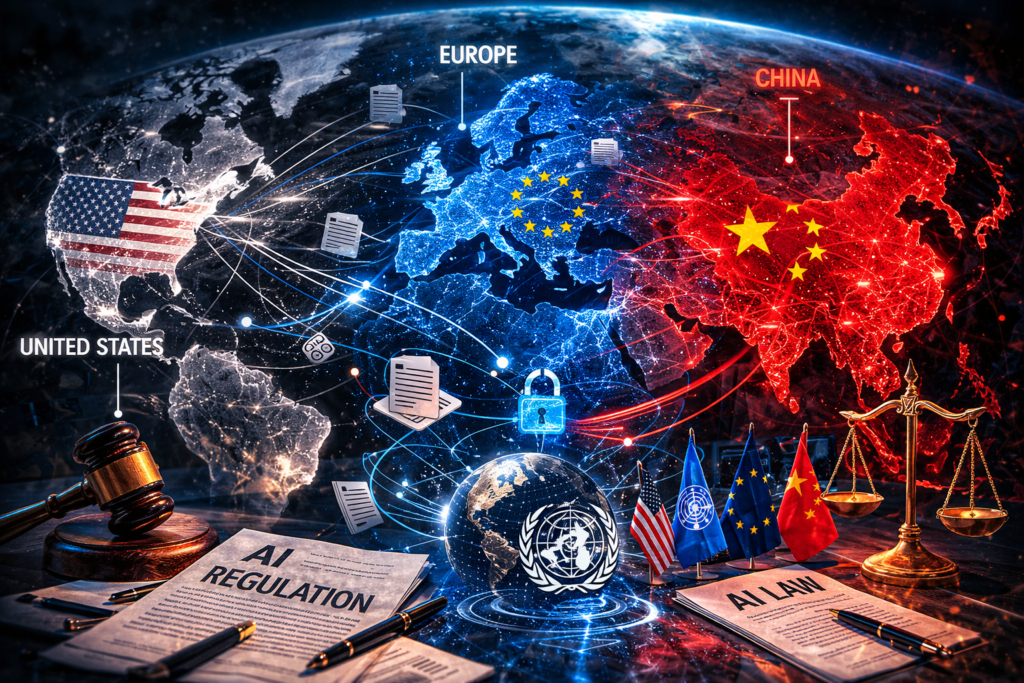
The EU, the US, and China represent the three dominant philosophies shaping global AI governance right now. Understanding them requires looking past the policy details to the values underneath — because the regulations each has produced are not just technical instruments. They are expressions of what each system believes the relationship between technology, the state, and the individual should look like.
The EU: Rights First, Risk Always
The European Union’s AI Act, which came into force in 2024, is the world’s first comprehensive legal framework specifically designed to regulate artificial intelligence. It is meticulous, ambitious, and unmistakably European in its foundational logic — which is to say, it begins not with what AI can do for the economy, but with what AI might do to people.
The Act operates on a tiered risk classification system. At the top sit AI applications deemed to pose unacceptable risk — systems that manipulate human behaviour through subliminal techniques, tools that exploit vulnerabilities in specific groups, AI used for social scoring by public authorities, and most real-time biometric surveillance in public spaces. These are not regulated. They are banned.
Below that ceiling sits the high-risk tier — AI systems used in critical infrastructure, education, employment, essential services, law enforcement, border control, and the administration of justice. These face the most demanding compliance requirements: mandatory conformity assessments before deployment, ongoing post-market monitoring, human oversight mechanisms, detailed technical documentation, and high standards for the data used to train them.
Lower-risk applications face lighter obligations, primarily around transparency — chatbots must identify themselves, synthetic media must be labelled. Minimal-risk applications, which cover the vast majority of current AI uses, face no binding requirements at all.
The architecture is deliberately proportionate. And deliberately rights-centric. The EU AI Act is explicitly grounded in the EU Charter of Fundamental Rights — treating human dignity, privacy, non-discrimination, and due process not as values to be balanced against commercial interests, but as constraints that commercial interests must operate within.
This approach has drawn criticism from industry voices who argue that the compliance burden on high-risk applications will drive AI development away from Europe, and from some civil liberties advocates who contend that the permitted exceptions for national security and law enforcement are too broad. Both critiques have merit. Neither changes the fundamental significance of what the EU has built.
By establishing comprehensive, enforceable, rights-based AI regulation across a market of 450 million people, the EU has done what it did with data protection through GDPR — created a de facto global standard that companies operating internationally cannot simply ignore. The Brussels Effect, as scholars call it, means that European regulation shapes global practice far beyond European borders.
The AI Act is not perfect legislation. It is, however, the most serious attempt by any government to date to answer the question of how a democratic society governs transformative technology without surrendering the values that make it democratic.
The US: Innovation Forward, Governance Catching Up
The United States has taken a conspicuously different path — one that reflects both the ideological composition of its political system and the outsized influence of its technology industry on the national conversation about AI.
Where the EU started with rights and built a framework around them, the US has started with innovation and is building governance around it — carefully, incrementally, and with visible reluctance to constrain an industry that represents a significant portion of American economic and geopolitical power.
The most substantial federal action to date has come through executive orders rather than legislation — most notably the Biden administration’s 2023 Executive Order on Safe, Secure, and Trustworthy AI, which directed federal agencies to develop AI safety standards, required developers of the most powerful AI systems to share safety testing results with the government, and tasked multiple departments with assessing AI risks in their specific domains. The order was significant in scope and genuinely ambitious in intent.
It was also, structurally, an executive order — meaning it directed the executive branch and relied on existing agency authority rather than establishing new law. Its provisions could be, and in several cases were, modified or rolled back by a subsequent administration without requiring Congressional action.
This reflects the central tension in US AI governance: the legislative branch has been slow to act, producing numerous hearings, several proposed bills, and limited enacted law. The result has been a patchwork of state-level regulations — California, Colorado, and Texas among the most active — creating precisely the kind of fragmented compliance landscape that industry groups have lobbied against, while simultaneously resisting the federal legislation that would replace it.
The US approach prioritises keeping American AI companies globally competitive, maintaining federal primacy over state regulation, and avoiding prescriptive rules that could lock in current technology paradigms and disadvantage American firms relative to Chinese competitors. The underlying philosophy is that innovation, if appropriately incentivised and lightly guided, will solve the problems that innovation creates.
It is an optimistic theory. Whether it is a sufficient one remains the defining question of American AI policy.
China: Control as a Feature, Not a Bug
China’s approach to AI regulation is the most frequently mischaracterised of the three — often reduced in Western commentary to simple authoritarianism, which misses both its sophistication and its internal logic.
Beijing’s AI governance framework is extensive, detailed, and genuinely technically sophisticated. Regulations covering algorithmic recommendations came into force in 2022. Rules governing deepfakes followed. Comprehensive generative AI regulations, requiring security assessments and content controls for publicly deployed large language models, took effect in 2023. By the standards of legislative pace, China has moved faster than either the EU or the US to produce specific, enforceable rules for specific AI applications.
But the values embedded in that framework are fundamentally different from either Western model.
Chinese AI regulation is not designed to protect individuals from the state. It is designed to ensure that AI serves state objectives — economic development, social stability, and the maintenance of party authority — while preventing AI from being used to challenge or destabilise those objectives. Content generated by AI must not undermine state power, challenge socialist values, or spread information the government classifies as harmful. Platforms deploying algorithmic recommendation systems must not create filter bubbles that fragment social consensus. Generative AI providers must ensure their outputs align with core socialist values and submit to government security reviews before public deployment.
This is not incidentally authoritarian. It is structurally so — a governance framework built on the premise that the state’s interest in information stability is a legitimate constraint on what AI can say and do.
At the same time, China’s regulatory approach is inseparable from its industrial strategy. The government’s ambition to become the world’s leading AI power by 2030 is not rhetoric — it is the organising principle of a national programme that integrates R&D funding, talent development, data access policy, and regulatory design into a coherent strategy for technological dominance. Regulation in China does not constrain that ambition. It serves it — ensuring that AI development happens on terms that strengthen state capacity rather than challenging it.
What the Differences Reveal
Laid side by side, these three models illuminate something more fundamental than policy preference.
The EU’s framework reflects a political culture that believes rights precede markets — that the purpose of economic activity is to serve human flourishing, and that technology is no exception to that principle.
The US framework reflects a political culture that believes markets precede governance — that innovation, competition, and private enterprise generate better outcomes than regulatory design, and that government’s role is to correct the most serious failures rather than shape the field.
China’s framework reflects a political culture that believes the state precedes both — that technology’s value lies in its contribution to national strength and social order, and that individual rights are instrumental to those goals rather than foundational.
None of these frameworks is internally inconsistent. Each is a coherent expression of the society that produced it. And each will shape AI development in ways that reflect those underlying values — for better and for worse — long after the current generation of models has been superseded.
The technology is the same. What we do with it is, and will remain, a political choice.
Section 7 — The Bigger Question
There is a problem with regulating artificial intelligence that most national frameworks quietly sidestep: AI does not respect borders.
A large language model trained in the United States can be accessed instantly in Europe, Southeast Asia, and sub-Saharan Africa. A surveillance system developed in China can be exported to governments in the Middle East and Latin America. A deepfake generated on servers in one jurisdiction can influence an election in another within hours. A hiring algorithm built by a company incorporated in one country can determine the employment prospects of workers in a dozen others.
The technology is global. The governance is not. And that gap — between the borderless reach of AI systems and the territorial limits of national regulation — is one of the most serious unresolved problems in contemporary policy.
The patchwork problem.
What currently exists in place of coherent global governance is a proliferating collection of national and regional frameworks that overlap, contradict, and leave vast gaps between them.
A company developing an AI system for deployment across multiple markets must navigate the EU’s risk classification requirements, US federal guidelines and state-level legislation, the UK’s sector-specific regulatory approach, China’s content and security rules if operating there, and an expanding set of national frameworks in Brazil, Canada, India, Australia, and elsewhere — each with its own definitions, thresholds, and compliance obligations.
For large technology companies with substantial legal and compliance resources, this is expensive and complex but manageable. For smaller companies and startups, it is frequently prohibitive — creating a structural advantage for incumbents who can absorb compliance costs that smaller competitors cannot. The patchwork does not just create confusion. It concentrates market power.
More seriously, regulatory fragmentation creates arbitrage opportunities. If one jurisdiction’s rules are significantly more demanding than another’s, the rational response for a company prioritising speed over responsibility is to develop and deploy from the more permissive location. The technology is still deployed globally. The oversight applies only locally. The people affected by the system in stricter jurisdictions remain exposed to risks that their governments’ own rules were designed to prevent.
The case for a global framework.
The arguments for international AI governance are, in structural terms, similar to the arguments that produced international frameworks for nuclear weapons, chemical weapons, aviation safety, and financial stability. When a technology’s potential harms are not contained by national borders, national regulation alone cannot contain them.
A global framework for AI could establish minimum safety standards that apply regardless of where a system is developed or deployed, preventing regulatory arbitrage and establishing a floor below which no jurisdiction’s rules could fall. It could create shared mechanisms for incident reporting and investigation — allowing the international community to learn from AI failures as they occur rather than after the damage is done. It could develop common definitions and classification systems, reducing the complexity that currently forces companies to maintain parallel compliance frameworks for different markets.
The precedent for this kind of coordination exists. The International Civil Aviation Organisation sets global aviation safety standards. The Financial Stability Board coordinates financial regulation across major economies. The Biological Weapons Convention establishes international norms, however imperfectly enforced, around a specific category of dangerous technology.
None of these frameworks are perfect. All of them are better than the alternative, which is each country independently managing risks that do not respect their borders.
The case for sovereignty.
The arguments against global AI governance are also serious and should not be dismissed as mere resistance to accountability.
Different societies have legitimately different values, and AI regulation embeds values at every level — in what counts as harmful content, in what level of surveillance is acceptable, in how privacy is balanced against security, in what constitutes fair algorithmic decision-making. A global framework that reflects the values of its most powerful members is not a neutral framework. It is the imposition of those values on everyone else under the guise of universality.
Developing nations, in particular, have reason to be cautious about international AI governance frameworks designed primarily by the US, EU, and China. The countries that have shaped global technology standards historically have done so in ways that served their own economic and political interests — and there is little reason to assume that AI governance will be different. A global framework that entrenches the competitive advantages of incumbents while constraining the development strategies of emerging economies is not obviously preferable to a patchwork that at least allows each country to set rules that reflect its own priorities.
There is also the practical question of enforcement. International frameworks without credible enforcement mechanisms are aspirational documents, not governance. The gap between the norms established by international agreements and the behaviour they actually produce is often wide enough to drive a container ship through. A robust national framework with genuine enforcement capacity may, in practice, provide more protection than a global agreement whose signatories comply selectively and without consequence.
Where the debate stands — and where it’s heading.
The honest answer is that global AI governance does not yet exist in any meaningful sense, and building it will be harder than building national frameworks by an order of magnitude.
What does exist is a growing architecture of international coordination — imperfect, incomplete, but real. The G7’s Hiroshima AI Process produced a set of guiding principles for advanced AI systems. The UN has established an advisory body on AI governance. The OECD’s AI Principles have been adopted by over fifty countries as a shared reference framework. The Council of Europe’s AI Convention, opened for signature in 2024, represents the first legally binding international instrument on AI and human rights.
These are not nothing. They are also not sufficient.
The trajectory points toward a world with several competing regulatory blocs — a Brussels model, a Washington model, a Beijing model — each exerting gravitational pull on the countries within their economic and political orbits. Something closer to a fragmented multilateral system than a unified global framework. Messier than a single international regime. More functional than ungoverned chaos.
Whether that is sufficient to manage the risks of a technology developing at this pace is a question nobody can answer with confidence yet.
What is clear is that the choice is no longer between governing AI and not governing AI. That debate is over. The question now is whether the governance humanity builds will be coherent enough, fast enough, and honest enough about the values it embeds to actually work.
The machine is not waiting for the answer.
Conclusion — Regulate to Liberate
We have spent a long time asking the wrong question.
The debate around AI regulation has, for most of the past decade, been framed as a confrontation between two opposing forces — innovation on one side, oversight on the other. Move fast or move carefully. Trust the technology or fear it. Let it develop freely or strangle it in bureaucratic red tape before it ever reaches its potential.
That framing was always a false choice. But it was a useful one — useful, specifically, for those who preferred that serious governance questions remain unanswered while deployment continued at full speed.
The question was never whether to regulate AI. Powerful technologies that affect human lives have always been regulated — not because governments are hostile to progress, but because societies have consistently concluded that progress without accountability is not progress. It is just speed.
The question — the only question that has ever actually mattered — is whether we regulate it well.
What well looks like.
Regulating AI well does not mean regulating it maximally. It does not mean a bureaucratic approval process for every algorithm, or a legislative framework so cautious that it governs yesterday’s technology while tomorrow’s develops in the gaps. It does not mean treating innovation as inherently suspect, or assuming that every AI application is a surveillance tool waiting to be weaponised.
It means proportionality — matching the weight of oversight to the severity of potential harm. A system recommending music does not need the same governance infrastructure as a system influencing criminal sentencing. The EU AI Act’s risk-tiered approach reflects this logic, however imperfectly it executes it in practice.
It means accountability — ensuring that when AI systems cause harm, there is a clearly defined legal and institutional pathway for affected people to seek redress, and a clearly assigned party responsible for providing it. Not a diffuse chain of vendors and deployers and developers each pointing at someone else while the person who was harmed waits.
It means transparency — the non-negotiable principle that people interacting with AI systems in consequential areas of their lives have the right to know that they are doing so, and to understand, in terms they can act on, how those systems are affecting their outcomes.
And it means inclusion — governance processes that bring in the communities most likely to be affected by AI’s failures, not just the industries most likely to profit from its successes. The people whose faces are misidentified by facial recognition. The workers whose livelihoods are reorganised by algorithmic management. The patients whose diagnoses are shaped by systems trained on data that didn’t adequately represent them. Their interests are not an afterthought to AI governance. They are its entire point.
The cost of getting it wrong — in both directions.
The risks of under-regulation are now well documented and, in some cases, already being lived. Discriminatory algorithms shaping life outcomes at scale. Surveillance infrastructure enabling authoritarian overreach. Misinformation ecosystems eroding the shared epistemic foundation that democratic deliberation requires. Autonomous systems making consequential decisions in environments where failure is irreversible. These are not hypothetical futures. They are current realities in varying degrees of severity across multiple countries.
But the risks of getting regulation wrong — of building frameworks that are clumsy, captured, or simply too slow to be relevant — are equally real.
Over-prescriptive regulation that locks in current technical approaches creates regulatory moats that entrench incumbents and close off better solutions. Compliance-driven governance that rewards paperwork over genuine safety produces systems that meet every formal requirement while causing harm in ways the paperwork never anticipated. Geographically fragmented regulation that fails to coordinate across borders allows risks to migrate to the least governed spaces while leaving the most governed populations with the costs of compliance and none of the protection.
Getting AI regulation wrong, in other words, is not a safe fallback position. The cost of bad governance is not merely lower growth or reduced competitiveness. It is a world in which the most powerful technology in human history develops inside frameworks that are either too weak to constrain its worst applications or too blunt to allow its best ones — and in which the people with the least power bear the highest costs of both failures.
Staying in the driver’s seat.
There is a version of the AI future that is genuinely worth building toward — one in which the technology’s extraordinary capabilities are applied to problems that have resisted solution for generations. Diagnosing diseases earlier and more accurately than current medicine allows. Modelling climate systems with sufficient precision to inform genuinely effective policy. Expanding access to legal, financial, and educational resources for people who currently have none. Accelerating scientific discovery in ways that compound across fields and generations.
None of that future is foreclosed by thoughtful regulation. All of it is made more likely by it — because all of it depends on AI systems that are trustworthy enough for people to rely on in the domains that matter most, accountable enough to course-correct when they fail, and governed well enough to direct their capabilities toward broadly shared benefit rather than narrowly concentrated profit.
The goal of AI regulation has never been to slow the machine. The machine is not the problem. The goal is to ensure that as the machine accelerates — and it will accelerate — the humans responsible for directing it retain the knowledge, the authority, and the legal infrastructure to steer.
Not because humans are infallible. We demonstrably are not. But because the alternative — a technology of this power and pervasiveness operating beyond meaningful human oversight — is not a neutral outcome. It is a choice. A choice about who benefits, who bears risk, and who gets to decide.
Regulation is how democratic societies make that choice deliberately, transparently, and with some mechanism for accountability when the choice proves wrong.
The question of whether governments should regulate AI has been answered — by events, by evidence, and by the growing consensus of every serious governance body on the planet.
The question now is whether they will regulate it wisely enough, quickly enough, and with sufficient honesty about the values at stake to make that regulation mean something.
That is the work. It is harder than building the technology. It may matter more.
Reference Sources
The following sources informed this article and are recommended for readers seeking deeper engagement with the policy landscape:
EU AI Act — Official Framework European Commission Digital Strategy — The definitive source for the Act’s structure, risk classifications, prohibited practices, and implementation timeline. https://digital-strategy.ec.europa.eu/en/policies/regulatory-framework-ai
EU AI Act Tracker An independent resource providing real-time tracking of the Act’s legislative progress, article-by-article breakdowns, and compliance guidance. https://artificialintelligenceact.eu
Brookings Institution — The US Government Should Regulate AI A rigorous examination of the case for federal AI regulation in the United States, covering market failures, harm categories, and the limitations of voluntary frameworks. https://www.brookings.edu/articles/the-us-government-should-regulate-ai/
Harvard Gazette — How to Regulate Artificial Intelligence (2025) A measured, multi-perspective analysis of regulatory approaches from one of the world’s leading academic institutions, covering both the risks of under-regulation and the pitfalls of poorly designed oversight. https://news.harvard.edu/gazette/story/2025/09/how-to-regulate-artificial-intelligence-ai/
Carnegie Endowment for International Peace — China’s AI Regulations and How They Get Made The most thorough English-language analysis available of China’s AI regulatory architecture — its structure, its political logic, and its relationship to Beijing’s broader technology strategy. https://carnegieendowment.org/research/2023/07/chinas-ai-regulations-and-how-they-get-made
New York Times — China AI Vision (February 2026) Recent reporting on China’s evolving AI ambitions and the regulatory environment shaping its path toward global AI leadership. https://www.nytimes.com/2026/02/02/business/china-ai-regulations.html
Allerin — Why Governments Need to Regulate AI An accessible industry-facing overview of the core safety arguments for AI regulation, covering bias, privacy, security, and accountability. https://www.allerin.com/blog/why-governments-need-to-regulate-ai/
FAQ — Your Questions Answered
1. Isn’t AI regulation just governments trying to control technology they don’t understand?
It’s a fair instinct to question whether legislators are equipped to govern technology this complex — and in some cases, the concern is warranted. Early congressional hearings where senators asked Mark Zuckerberg how Facebook makes money did not inspire confidence. But the premise that governments are simply reacting out of ignorance doesn’t hold up against the evidence. The EU AI Act took four years to develop, involved hundreds of technical experts, and produced 458 pages of detailed, technically specific legislation. The researchers, ethicists, and engineers informing these frameworks understand the technology deeply. What regulation represents is not confusion about how AI works — it is a deliberate societal decision about what we want it to do, and who gets to decide. That is not a technical question. It is a political one. And political questions are exactly what governments exist to answer.
2. Will regulation stop AI development from happening in regulated countries and push it to places with no rules?
This is the most common industry argument against regulation, and it deserves a direct answer: the evidence does not support it. The countries with the most ambitious AI regulation — the EU, the UK, Canada, and increasingly the US — are also home to the most significant AI research institutions, the largest AI investment flows, and the most valuable AI companies in the world. Talent and capital do not simply flee to the least governed jurisdiction available. They follow infrastructure, education systems, legal certainty, and market access — all of which robust governance tends to support rather than undermine. There is a real risk of poorly designed regulation driving activity offshore. The solution to that risk is designing regulation well, not abandoning it.
3. How does AI regulation actually protect ordinary people in their daily lives?
More directly than most people realise. If you have ever been denied a loan, rejected for a job, or received a content recommendation that felt manipulative, there is a reasonable chance an algorithm was involved in that outcome — and currently, in most jurisdictions, you have limited rights to know that, challenge it, or hold anyone accountable for it. AI regulation changes that calculus. Transparency mandates mean you have the right to know when automated systems are making decisions about you. Accountability frameworks mean someone is legally responsible when those systems cause harm. Bias auditing requirements mean high-risk systems must be tested for discriminatory outcomes before they are deployed at scale. These are not abstract protections. They are the difference between a system that works for the people it affects and one that merely works for the organisations that deploy it.
4. Can AI regulate itself — do we really need governments involved?
The technology industry has made versions of this argument for thirty years across multiple sectors, and the track record is not encouraging. Self-regulation works reasonably well when the costs of failure fall primarily on the company making the decision — when reputational damage, customer loss, and market consequences are sufficient incentives for responsible behaviour. AI failures frequently do not work that way. The costs fall on workers denied jobs, patients misdiagnosed, defendants wrongly sentenced, and citizens surveilled — not on the companies whose systems produced those outcomes. When the party bearing the cost of failure is not the party making the design decisions, voluntary self-regulation has consistently proven insufficient. That is not an argument against industry responsibility or voluntary safety commitments — both matter. It is an argument for why they cannot be the only answer.
5. Is it already too late — has AI developed too far and too fast for regulation to be meaningful?
No. And the instinct behind this question, while understandable, is worth examining carefully — because “it’s too late to govern this” is a conclusion that happens to serve the interests of those who benefit from ungoverned deployment, and it deserves scrutiny for that reason. AI is moving fast, but governance does not need to be comprehensive on day one to be meaningful. Incremental, targeted regulation of the highest-risk applications — the ones affecting criminal justice, healthcare, critical infrastructure, and civil liberties — can significantly reduce harm even before broader frameworks mature. The history of technology governance shows that it is never too late to establish accountability, require transparency, or mandate safety standards. What changes over time is not whether regulation can matter — it is how much harder the political and technical work of building it becomes. Which is the strongest possible argument for starting now rather than waiting for a more convenient moment that will not arrive.