

-
- No Comments
- February 18, 2026

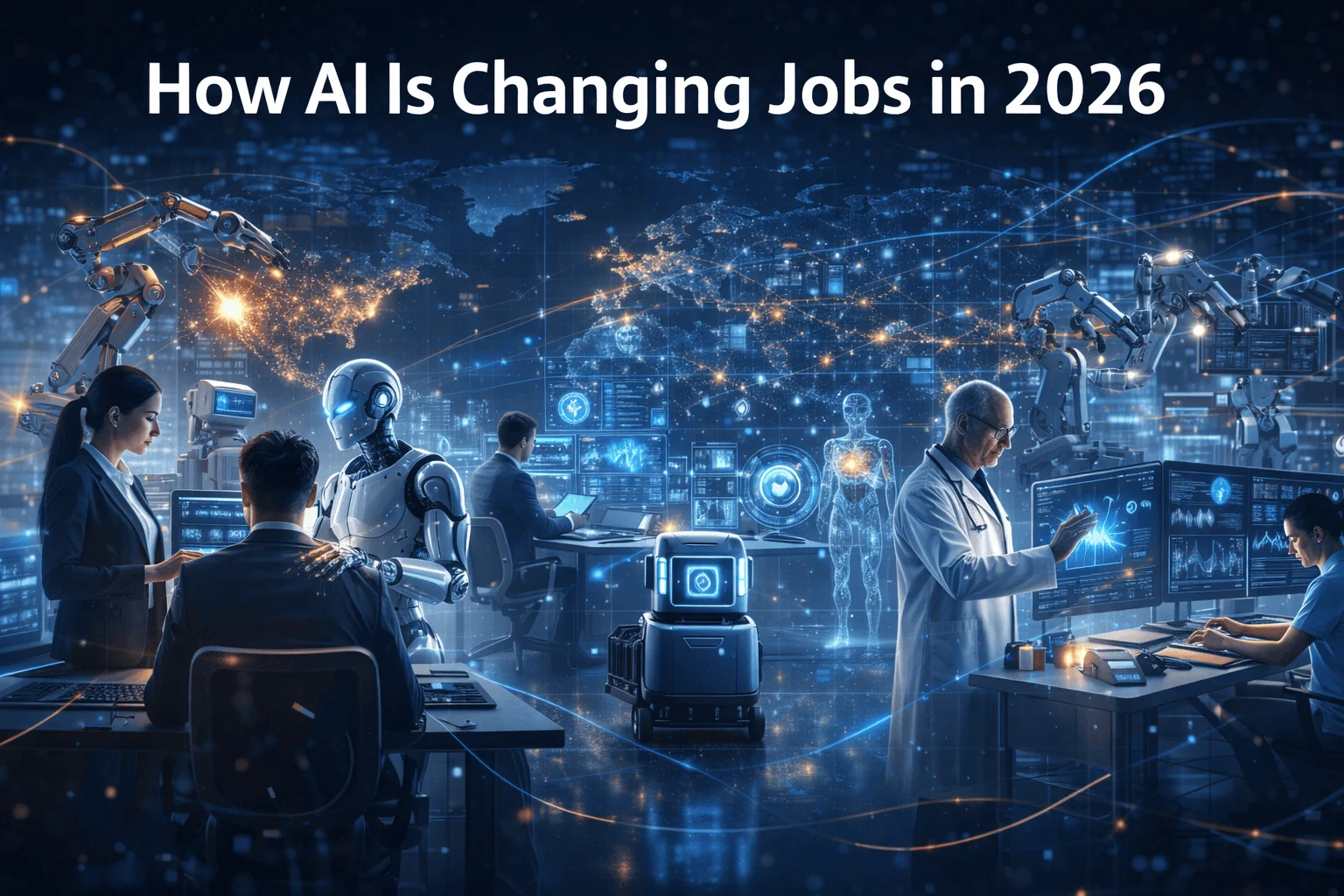
How AI Is Changing Jobs in 2026
Introdution
AI isn’t knocking on the door anymore it’s already inside the building.
In 2026, artificial intelligence isn’t a future trend. It’s infrastructure. It’s embedded in workflows, decision systems, customer service pipelines, hiring processes, finance engines, healthcare diagnostics, and creative production. The global workforce isn’t adapting to AI it’s being reconstructed by it.
This acceleration isn’t subtle. Automation is scaling at enterprise speed. Algorithms are replacing repetitive cognition. Systems are learning faster than organizations can restructure. And the result is a job market in motion not collapsing, not exploding, but reshaping itself in real time.
Here’s the truth most headlines miss:
Yes, jobs are being displaced.
Yes, roles are disappearing.
But jobs are also being created at scale. Entire categories of work didn’t exist five years ago, and now they define career paths, salary bands, and hiring strategies.
The real shift isn’t job loss versus job creation.
It’s job design versus job evolution.
This is where the new model emerges: human–AI collaboration.
Not replacement.
Not resistance.
Not competition.
But partnership.
AI handles speed, scale, pattern recognition, and automation.
Humans handle judgment, ethics, creativity, context, and meaning.
So the real question isn’t:
Is AI killing jobs?
The real question is:
How is AI transforming what a job even means?
This is not extinction.
This is transformation.
The AI Employment Shift — What’s Really Happening in 2026

The workforce isn’t being automated it’s being re-architected.
Automation vs Augmentation
Automation replaces tasks.
Augmentation upgrades humans.
And 2026 is the year augmentation overtakes automation as the dominant model. AI isn’t just doing work for people it’s doing work with people. Decision support systems. AI copilots. Predictive tools. Intelligent workflows. This isn’t about removing humans from systems it’s about embedding intelligence into them.
Job Transformation vs Job Elimination
Most roles aren’t vanishing.
They’re splintering.
One job becomes five functions:
- Strategic thinking
- System oversight
- Human judgment
- AI supervision
- Ethical control
What disappears are tasks, not professions.
What evolves are roles, not identities.
Global Workforce Reconfiguration
This shift isn’t local.
It’s not regional.
It’s not industry-specific.
It’s global.
Every economy is restructuring:
- How work is defined
- How skills are valued
- How careers are built
- How productivity is measured
Labor is no longer just physical or cognitive it’s hybrid.
The Idea of “Net Job Growth”
Here’s the paradox of 2026:
Jobs are disappearing.
Jobs are emerging.
And total employment is growing.
This is what net job growth actually means:
Not stability.
Not comfort.
Not security.
But continuous transition.
The workforce is no longer static it’s fluid.
Careers are no longer linear they’re modular.
Employment is no longer permanent it’s adaptive.
The economy isn’t losing workers.
It’s rewriting what work is.
And that’s the real shift of 2026:
Not AI replacing humans
But AI redefining the architecture of labor itself.
Job Displacement Trends in 2026

AI isn’t swinging a wrecking ball through the workforce it’s using a scalpel. Precision over destruction. Tasks over titles. Functions over faces. What’s being removed isn’t “people” it’s patterns of work that no longer make economic sense in an automated world.
Roles Most Vulnerable to Automation
Administrative roles
Scheduling, email drafting, document formatting, internal coordination these aren’t disappearing, but they’re being absorbed by systems. AI handles the mechanics. Humans are left with oversight and judgment.
Customer service
First-line support, scripted responses, ticket sorting, basic troubleshooting increasingly handled by AI agents that operate 24/7, multilingual, zero fatigue, zero delay.
Data processing roles
Data entry, classification, validation, and standard reporting are now machine-native tasks. Speed and scale beat human accuracy in high-volume environments.
Process-driven digital jobs
Any role defined by repetition, templates, fixed workflows, and predictable logic is vulnerable. Not because it lacks value but because it lacks variability.
Functions Being Replaced (Not Entire Professions)
This is the most misunderstood part of the AI shift.
People aren’t being replaced.
Functions are.
Task-level automation
Single actions: scheduling, summarizing, sorting, generating, categorizing.
Workflow automation
Entire sequences: onboarding flows, reporting pipelines, customer journeys, internal operations.
Cognitive task replication
Pattern recognition, prediction, basic decision logic, risk modeling, content generation once human-exclusive, now algorithm-native.
Jobs don’t vanish.
They shed layers.
Global Displacement Projections
Job displacement numbers show massive movement but movement isn’t collapse. It’s redistribution.
What’s happening is structural transformation:
- Old job categories dissolve
- New job categories form
- Skill definitions change
- Career pathways reorganize
This isn’t automation vs humans.
It’s:
Automation reshaping the workforce not replacing it.
Evolution, not extinction.
Reconfiguration, not erasure.
Transition, not termination.
Emerging Job Opportunities Created by AI

While old roles thin out, new ones are exploding into existence and fast. This isn’t replacement economics. It’s creation economics.
AI doesn’t just remove work.
It creates entire ecosystems of work.
New AI-Centered Roles
AI engineering roles
Building, training, optimizing, and scaling intelligent systems.
Prompt engineering
Designing human–machine communication itself turning language into logic.
Data annotation roles
Teaching machines how to see, understand, classify, and learn.
Human–AI collaboration management
Designing workflows where humans and AI operate together, not in parallel.
AI oversight and ethics roles
Governance, bias control, accountability frameworks, model supervision, compliance architecture.
These aren’t support roles.
They’re foundational roles in the new economy.
Sector-Specific Job Creation
Healthcare
AI diagnostic support
Humans interpreting AI outputs, not competing with them.
Medical AI training roles
Teaching systems how to think medically, ethically, and safely.
Digital health coordination
Managing AI-driven care models, telemedicine flows, and data ecosystems.
Healthcare isn’t becoming less human
It’s becoming more human-centered through AI support.
Cybersecurity
AI security roles
Defensive systems built on predictive intelligence.
Threat intelligence expansion
AI-driven detection + human strategic response.
Security becomes hybrid:
Machine speed + human judgment.
Data Infrastructure
Data center growth roles
Physical infrastructure for digital intelligence.
AI infrastructure management
Power, processing, pipelines, and platforms the backbone of the AI economy.
AI runs on steel, silicon, and systems not just software.
Manufacturing & Finance
AI integration roles
Embedding intelligence into production and financial systems.
AI model governance roles
Oversight, compliance, transparency, and accountability structures.
Automation creates complexity
And complexity creates high-value human roles.
This is the paradox of 2026:
AI removes work.
AI creates work.
AI reshapes work.
AI redefines work.
Not fewer humans.
Not obsolete workers.
But a new architecture of labor where intelligence is shared, not owned.
And the future doesn’t belong to those who fight AI.
It belongs to those who learn how to work with it. 🖤🔥
Industry Transformation Map

The AI revolution isn’t uniform it’s sector-specific, asymmetric, and strategic. Different industries are being reshaped in different ways, at different speeds, with different consequences. This isn’t disruption. It’s reengineering.
Administrative Sector
Jobs at risk
Traditional back-office functions scheduling, documentation, reporting, internal coordination are being absorbed by intelligent systems. Not eliminated in concept, but automated in execution.
AI-driven roles emerging
What replaces them isn’t absence it’s evolution. Oversight roles, workflow designers, AI system supervisors, and operational intelligence coordinators are becoming the new backbone of administration.
Administration shifts from execution to orchestration.
Tech & Programming
Entry-level displacement
Junior roles built around repetitive coding, testing, and boilerplate production are thinning out. AI can generate code faster than humans can learn syntax.
AI-specialized roles growth
At the same time, demand for machine learning engineers, AI architects, system integrators, and model trainers is exploding. Programming doesn’t disappear it ascends.
Coding becomes less about writing lines
and more about designing intelligence.
Healthcare
Routine task automation
Scheduling, documentation, diagnostics preprocessing, and administrative medical workflows are being automated at scale.
AI-supported care models
But care itself becomes more human, not less. AI handles data. Humans handle people. Doctors, nurses, and specialists shift from processing information to interpreting meaning.
Healthcare becomes:
Technology-driven.
Human-centered.
Data-powered.
Ethics-led.
Finance
Traditional analysis automation
Basic underwriting, standard risk assessment, and repetitive financial modeling are increasingly algorithmic.
AI risk and ethics roles
New roles emerge around model governance, ethical AI finance, risk oversight, and algorithm accountability. Finance shifts from number-crunching to trust architecture.
Trust becomes the new currency.
Skills and Wage Impact in the AI Economy

The AI economy doesn’t reward effort.
It rewards leverage.
AI Skill Premium
Wage differentials
AI-literate workers command higher compensation not because they work harder but because they amplify output.
Market demand dynamics
Demand concentrates around hybrid professionals those who combine domain knowledge with AI capability.
Skill valuation shift
Credentials matter less. Capability matters more. The market doesn’t ask where you studied it asks what systems you can operate.
Value moves from education → execution.
The New Skill Stack
The most valuable skills of 2026 aren’t technical they’re human.
Judgment
Knowing when not to automate.
Creativity
Seeing possibilities systems can’t generate.
Ethical reasoning
Controlling systems that don’t understand morality.
AI tool mastery
Not coding AI commanding it.
Human decision-making advantage
Context, empathy, interpretation, meaning things machines still can’t replicate.
The future isn’t human vs machine.
It’s human over machine.
Corporate Upskilling Strategies
Employer reskilling initiatives
Organizations aren’t replacing workers they’re retraining them.
Workforce transformation models
Internal mobility, skill migration, and role evolution replace hiring cycles.
Retention through reskilling
Training becomes a retention strategy, not a perk. Companies that invest in skills keep talent. Those that don’t lose it.
In 2026, the smartest companies don’t compete for talent
They build it.
This is the new labor economy:
Not survival of the strongest.
Not replacement of the weakest.
But evolution of the adaptable.
AI doesn’t choose winners.
Adaptation does.
And the future of work belongs to those who learn faster than systems change. 🖤🔥
Human–AI Collaboration: The New Work Model

The future of work isn’t automated.
It’s augmented.
This is the era of augmented intelligence where AI doesn’t replace human capability, it multiplies it. Systems handle speed, scale, memory, and pattern recognition. Humans handle interpretation, ethics, creativity, and meaning. The result isn’t redundancy it’s amplification.
AI as co-worker, not replacement
AI becomes a teammate. A digital colleague. A cognitive partner. It drafts, predicts, analyzes, simulates, and supports but it doesn’t decide what should be done. That authority remains human.
Hybrid decision systems
Decisions are no longer human-only or machine-only. They’re hybrid. AI provides probabilities, forecasts, and scenarios. Humans provide judgment, values, and accountability. Intelligence becomes shared responsibility does not.
Human authority frameworks
The defining structure of this model is simple:
AI informs.
Humans decide.
Humans remain accountable.
This isn’t technological dependence it’s structured collaboration.
Not surrender.
Not resistance.
But partnership by design.
Global Employment Forecasts

The future labor market isn’t shrinking.
It’s restructuring.
Long-term job creation outlook
AI doesn’t compress the workforce it expands the opportunity space. New roles, new sectors, and new categories of work continuously emerge as intelligence systems scale.
Displacement vs creation balance
Jobs disappear. Jobs appear. Careers shift. The balance isn’t static it’s dynamic. Employment becomes a moving system, not a stable state.
Economic restructuring trends
Entire economies are reorganizing around intelligence infrastructure, data systems, automation frameworks, and digital platforms. Traditional labor models give way to intelligence economies.
AI-driven sector growth
Healthcare, cybersecurity, infrastructure, finance, manufacturing, and data ecosystems expand simultaneously powered by AI integration, not human displacement.
Growth doesn’t come from fewer workers.
It comes from smarter systems.
Economic Power Shift in the AI Era

AI doesn’t just change jobs.
It changes who holds power in the economy.
Labor value transformation
Value shifts from physical labor to cognitive leverage. From hours worked to impact created. From effort to amplification.
Skill-based economic mobility
Wealth mobility becomes skill mobility. Those who adapt rise. Those who don’t stagnate. Opportunity becomes tied to learning speed, not starting position.
AI literacy as economic leverage
Understanding AI becomes economic power. Not coding comprehension. Not building commanding. AI literacy becomes a form of capital.
Workforce stratification risks
A divided workforce emerges:
- AI-augmented workers
- AI-excluded workers
This is the real risk not job loss, but opportunity inequality.
The AI economy won’t collapse employment.
But it will separate those who adapt
from those who don’t.
And the future won’t be owned by machines.
It will be owned by humans who know how to use them. 🖤🔥
Ethical, Social, and Structural Challenges

Every technological revolution creates opportunity and tension. AI is no different. The transformation of work doesn’t happen in a vacuum. It reshapes societies, systems, and structures and not always evenly.
Workforce inequality risks
The gap isn’t between employed and unemployed it’s between augmented and non-augmented workers. Those with access to AI tools, training, and infrastructure accelerate. Those without fall behind. Inequality becomes technological, not just economic.
Access to reskilling
Opportunity is no longer defined by talent alone but by access. Access to education. Access to tools. Access to learning ecosystems. Without equitable reskilling pathways, transformation becomes exclusion.
AI governance gaps
Technology is moving faster than regulation. Accountability frameworks, ethical oversight, bias control, and transparency systems lag behind deployment. Power scales faster than policy.
Policy adaptation needs
Labor laws, education systems, welfare models, and economic protections were designed for industrial economies not intelligence economies. Governance must evolve as fast as the systems it regulates.
The risk isn’t AI.
The risk is unmanaged AI.
The Real Question Is Not “Will AI Take Jobs?” — It’s “Who Adapts Fast Enough?”

This isn’t a fear story.
It’s a speed story.
Not about survival.
About velocity.
Not about replacement.
About relevance.
AI doesn’t eliminate people.
It outpaces them.
The winners won’t be the smartest.
They won’t be the strongest.
They won’t be the most educated.
They’ll be the fastest learners.
Adaptation is the new job security.
Learning is the new career insurance.
Flexibility is the new stability.
In the AI era, your degree expires.
Your skills depreciate.
Your mindset compounds.
Future of Work Beyond 2026

The future isn’t a destination it’s a trajectory.
Long-term career evolution
Careers stop being ladders and become systems modular, flexible, adaptive, constantly evolving.
AI-native professions
Entire job categories will exist that have no pre-AI equivalent. Roles designed around intelligence systems, not human labor alone.
Hybrid career models
People won’t have one profession they’ll operate across ecosystems. Human skills + AI systems + digital platforms.
Continuous reskilling economy
Learning becomes permanent. Education becomes lifelong. Reskilling becomes routine. The economy runs on continuous adaptation.
The future of work won’t be defined by technology.
It will be defined by people who evolve with it.
Not machines replacing humans.
But humans redefining themselves.
And that’s not the end of work.
Conclusion
The story of AI in 2026 isn’t destruction it’s design.
Work isn’t disappearing.
It’s transforming.
Restructuring.
Reprogramming itself around intelligence, speed, and scale.
The old economy was built on labor.
The new economy is built on leverage.
This shift demands a new mindset not fear, not resistance, not nostalgia but adaptation. Fear freezes. Adaptation evolves. The future doesn’t punish change; it rewards those who move with it.
This is an opportunity era.
New roles. New careers. New industries. New forms of value.
Not fewer humans but more powerful humans.
In the AI economy, relevance isn’t about being irreplaceable.
It’s about being evolvable.
Human relevance doesn’t disappear it ascends.
Judgment. Ethics. Creativity. Meaning. Context. Responsibility.
These aren’t being automated. They’re becoming more valuable.
The strategic mindset of the future workforce is simple:
Learn continuously.
Adapt rapidly.
Collaborate intelligently.
Think systemically.
Lead ethically.
AI will reshape work.
But humans will shape what it becomes.
The future isn’t machine-led.
It’s human-directed.
And the people who understand that won’t survive the AI era
They’ll define it. 🖤🔥
Follow-Up Content (With Live Source Links)
Jobs Most at Risk in 2026
https://www.iaexplore.com/html/articles/jobs-ai-will-transform-in-2026.html
AI Healthcare Careers
https://www.humai.blog/ai-job-market-2026-how-artificial-intelligence-will-reshape/
AI Skills Roadmap
https://gloat.com/blog/ai-workforce-trends/
Government & Corporate Responses
https://www.weforum.org/publications/the-future-of-jobs-report-2025/
Global AI Job Impact Comparisons
https://www.weforum.org/stories/2026/01/ai-has-already-added-1-3-million-new-jobs-according-to-linkedin-data/
Frequently Asked Questions (FAQ)
1. Is AI really taking jobs in 2026?
AI is automating tasks, not erasing humanity. Some roles are shrinking, but many more are evolving or being created. The shift is structural, not catastrophic.
2. Which types of jobs are most vulnerable to AI? Roles built on repetition, predictability, and process logic are most at risk especially administrative, data processing, routine customer service, and template-based digital work.
3. What new jobs is AI creating?
AI is creating roles in engineering, ethics, governance, healthcare support, cybersecurity, data infrastructure, and human–AI collaboration management.
4. Will AI replace professionals like doctors, developers, and analysts?
No — but it will change how they work. Professionals won’t disappear; their workflows will. AI becomes a tool, not a replacement.
5. What skills will matter most in the AI economy?
Judgment, creativity, ethical reasoning, adaptability, AI tool mastery, and the ability to work alongside intelligent systems.
6. Is learning AI skills necessary for everyone?
Not everyone needs to build AI but everyone will need to understand it. AI literacy will become as fundamental as digital literacy.
7. How will AI affect salaries and wages?
AI-augmented roles command higher value because they amplify productivity, decision quality, and impact. Skills, not titles, will define pay.
8. Will AI increase inequality?
It can if access to tools and reskilling is unequal. The risk isn’t AI itself, but unequal access to learning and opportunity.
9. How can workers prepare for the AI job market?
By learning continuously, developing hybrid skills, embracing AI tools, and focusing on human strengths that machines can’t replace.
10. What does the future of work actually look like?
Fluid careers, hybrid roles, continuous learning, human–AI collaboration, and work defined by adaptability rather than stability.


