

-
- No Comments
- August 17, 2026

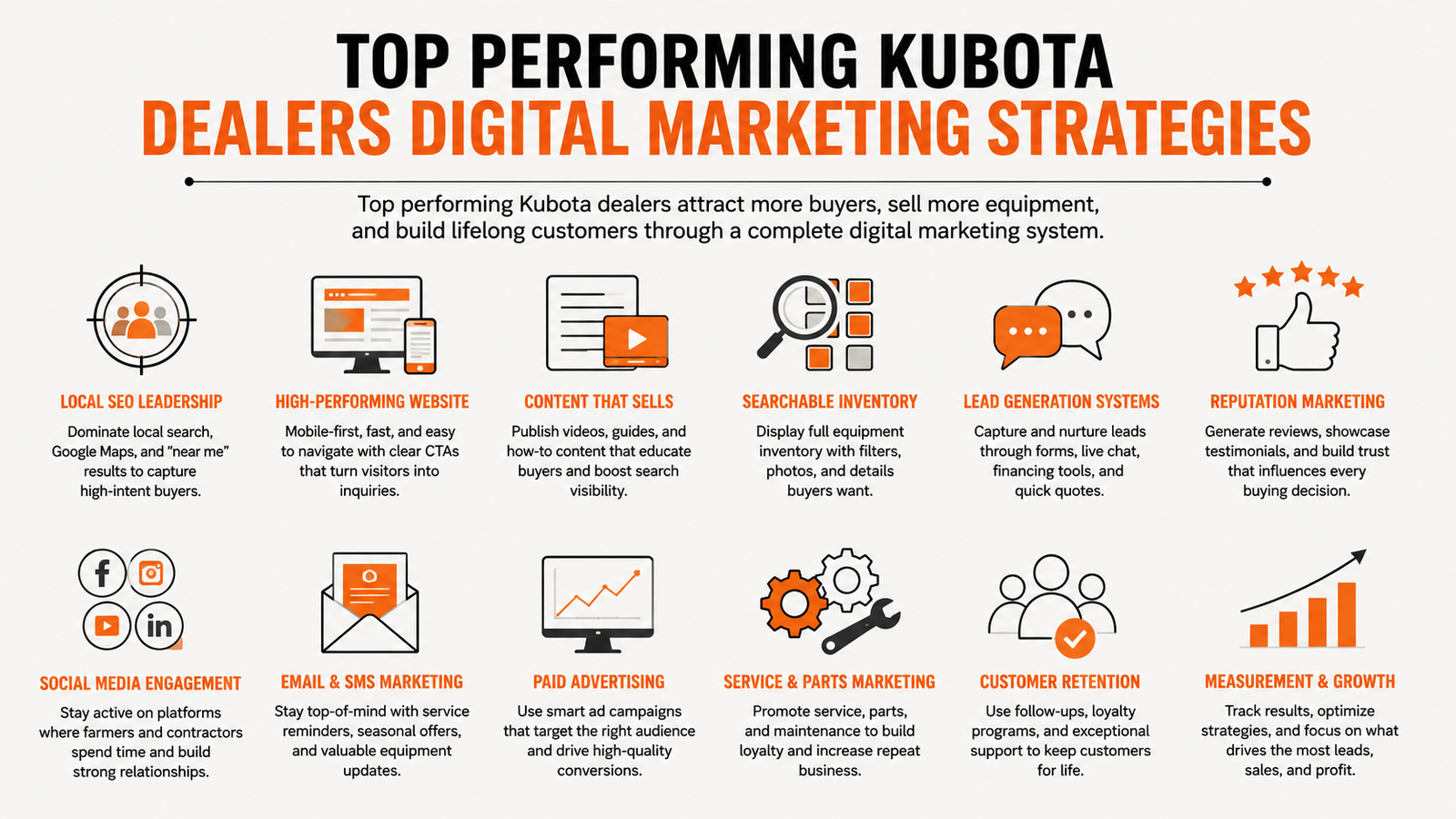
Top Performing Kubota Dealers Digital Marketing Strategies
A Kubota customer rarely walks into a dealership without doing some homework first. They search for nearby dealers, compare tractor models, study financing options, watch equipment demonstrations, examine available inventory, and read customer reviews before speaking with a salesperson.
That means your first interaction with a potential buyer often happens online. If your inventory is outdated, your website is difficult to use, or your team takes too long to respond, the customer may contact another dealer before you even know they were interested.
The top performing kubota dealers digital marketing strategies solve this problem by connecting local visibility, helpful content, accurate inventory, advertising, customer service, and timely follow up. Marketing is not treated as a separate department. It becomes part of the entire customer experience.
There is encouraging evidence that Kubota dealers are already moving in this direction. Kubota ranked highest among compact tractor brands in the 2026 Pied Piper Internet Lead Effectiveness study, which tested responses from 772 dealership websites.
However, the same research found that Kubota customers received no response 16 percent of the time. That was better than the tractor industry average of 27 percent, but it still represents real buyers and potential sales being missed. Read the Pied Piper PSI web lead response findings.
A strong digital strategy is therefore not just about increasing website traffic. It should help you sell equipment, generate parts orders, schedule service appointments, build customer trust, and encourage owners to return when they need their next machine.
Quick Answer: What Are Top Performing Kubota Dealers Digital Marketing Strategies?

The top performing kubota dealers digital marketing strategies include local SEO, accurate inventory pages, helpful buying guides, equipment videos, localized advertising, email marketing, review management, customer surveys, service promotion, and fast personal responses to every enquiry. Leading dealers also track which calls, forms, advertisements, and campaigns produce qualified leads and completed sales.
No individual marketing channel can create lasting growth by itself. The strongest results appear when your website, advertisements, salespeople, service department, parts team, and customer relationship management system work together, giving buyers one clear and dependable experience from their first search to their next purchase.
What Does Top Performing Actually Mean?
A top performing Kubota dealership is not simply the location selling the most machines. Sales volume is important, but it is only one part of a much larger picture.
A genuinely successful dealership attracts the right buyers, answers their questions, keeps equipment running, supplies parts when customers need them, and builds relationships that continue long after the original purchase.
This is why top performing kubota dealers digital marketing strategies should be measured against the entire customer journey. Traffic and leads matter, but customer satisfaction, repeat business, service revenue, reputation, and marketing efficiency reveal whether those strategies are creating lasting growth.
Sales Volume Is Only One Measurement
High sales figures show that a dealership can generate demand and close deals. They do not automatically tell us whether customers received helpful advice, experienced dependable service, or returned for parts and future purchases.
A dealer could sell a large number of tractors during a successful promotion but lose customers later because of slow repairs or poor communication. Another dealer might sell fewer machines while building a loyal customer base that regularly purchases parts, attachments, maintenance, and replacement equipment.
That is why performance should be measured across several areas. These include lead response, customer satisfaction, online reviews, parts availability, service quality, marketing costs, repeat purchases, referral activity, and local reputation.
Mason Tractor reported receiving Kubota’s Top Volume Dealer recognition for an eleventh consecutive year. The company operates multiple Georgia locations and promotes equipment sales alongside financing, parts, and service support. Visit Mason Tractor.
Messick’s Equipment offers another useful example. The Kubota and New Holland dealership was selected as Farm Equipment’s 2026 Dealership of the Year from more than 50 nominated North American dealers.
Its wider business includes equipment sales, a large service operation, educational videos, and an online parts program capable of serving customers outside its immediate local market. Read about Messick’s Equipment recognition.
These examples establish that both companies are respected performers. However, we should not claim that digital marketing alone produced their sales volume or industry recognition.
Strong dealerships usually succeed through a combination of leadership, inventory, trained employees, customer service, operational discipline, local knowledge, and marketing. Digital strategy helps customers discover and engage with those strengths. It cannot replace them.
Kubota Elite Dealer Standards
Kubota Elite recognition provides a broader way to understand dealership performance. The program considers customer experience, financial operations, sales and marketing, building brand value, and service.
This combination matters because each area affects the others. A strong advertising campaign can generate inquiries, but poor lead handling can waste them. A polished website can promise excellent service, but that promise quickly falls apart if customers cannot schedule a repair or obtain the parts they need.
Marketing must therefore reflect what the dealership can genuinely deliver. If your website promotes knowledgeable support, customers should be able to reach someone who understands the equipment. If you advertise fast service, your booking and communication processes should support that claim.
The same principle applies to reviews and social media. Publishing attractive equipment photographs may capture attention, but customers will eventually judge your dealership through response times, employee knowledge, delivery, maintenance, and after sale support.
Kubota Elite criteria reinforce the idea that sales and marketing belong inside a larger dealership system. Visibility gets a customer through the door, but the complete experience determines whether that customer returns. Learn about the Kubota Elite Dealer criteria.
A Note About Marketing Case Studies
Several performance figures discussed in this article come from agencies and technology providers that helped run the campaigns. These studies can offer useful insights into targeting, website management, advertising costs, lead generation, and campaign improvement.
However, reported case study results should not automatically be treated as universal industry benchmarks. The agency may have selected the reporting period, defined the conversions, managed the advertising, and prepared the final study.
Results can also change according to location, budget, competition, inventory, season, staff performance, and local demand. A tactic that works for a large dealer group may require a simpler approach for an independent dealership.
We will therefore present these numbers as reported results. The practical lesson is more valuable than the headline percentage. You should test the strategy using your own leads, appointments, sales, service bookings, and revenue.
Why Kubota Dealership Marketing Requires a Different Approach

Buying a tractor is nothing like purchasing a low cost household product. The price is higher, the decision takes longer, and choosing the wrong model can affect years of work.
A customer may spend weeks comparing horsepower, attachments, financing, warranties, service support, and total ownership costs. They might watch several demonstrations, visit multiple websites, speak with other equipment owners, and contact more than one dealer before making a decision.
The buying journey also changes with the product. Someone shopping for a residential mower will have different priorities from a contractor evaluating an excavator or a farmer selecting a tractor and compatible implements.
Kubota dealers can serve farmers, rural homeowners, landscapers, construction companies, municipalities, property managers, and commercial operators. Each audience has different jobs to complete, different budgets, and different reasons for purchasing equipment.
A rural homeowner may want a compact tractor that can mow, move soil, clear snow, and maintain several acres. A landscaper may care more about speed, reliability, fuel use, and how quickly the dealer can complete repairs.
Contractors may focus on operating capacity, attachments, transport, downtime, and service response. Municipal buyers may need procurement support, maintenance planning, documentation, and dependable fleet service.
This makes generic marketing less effective. Dealers need content, advertisements, inventory pages, and sales conversations that match the customer’s actual use case.
Buyers are also evaluating more than the machine itself. They want to know whether financing is available, whether the equipment can be delivered, whether attachments are in stock, and whether the service team can keep it operating.
For many customers, the dealership relationship may last longer than the original sales process. They could return for maintenance, repairs, parts, additional implements, trade ins, and replacement equipment.
The most effective Kubota marketing strategy must therefore sell confidence as well as equipment. Your message should show that customers will receive knowledgeable support before, during, and after the purchase.
Strategy 1: Dominate Local Search
When someone searches for a Kubota dealer, tractor repair, mower financing, or equipment parts nearby, your dealership should be easy to find and easy to contact.
Local search connects online research with physical dealership visits. It is especially important for Kubota dealers because customers usually need local delivery, demonstrations, repairs, parts, and ongoing technical support.
Optimize Every Google Business Profile
Every dealership location should have its own accurate and properly managed Google Business Profile. The dealership name, address, phone number, website, opening hours, and directions should match the information shown on the location’s website.
Add the services and departments customers actually need. These might include equipment sales, used machinery, parts, repairs, financing assistance, rentals, and maintenance.
Photographs should show the real dealership. Include the storefront, equipment lot, showroom, service department, available machines, and team members who regularly work with customers.
Keep these photographs current. A profile that has not been updated for several years can make an active dealership appear neglected or unreliable.
Seasonal and holiday hours also need attention. Customers checking Google before driving to your store should not arrive to find the dealership closed because the listing displayed outdated information.
Google Business Profile also allows businesses to show products, services, photographs, updates, and customer reviews across Google Search and Maps. These features can help a potential customer understand what you offer before visiting your website. Explore Google Business Profile.
Reviews should never be ignored. Thank customers who share positive experiences, and respond calmly when someone raises a problem.
A thoughtful response shows future customers that your dealership listens and takes responsibility. Silence can leave a negative review telling only one side of the story.
Create Pages for Every Location and Service Area
A dealer with several locations should create an individual website page for every store. Each page should include the correct address, hours, contact details, directions, departments, staff, available services, and local inventory links.
These pages should not repeat the same text with only the city name changed. Customers need information that is genuinely connected to the location they are considering.
One branch may specialize in construction equipment, while another may carry a larger selection of mowers or agricultural tractors. Service capacity, delivery coverage, events, inventory, and employee expertise can also differ between locations.
Dealers can create useful pages for surrounding cities and counties when they genuinely serve those areas. Explain delivery availability, travel distance, relevant equipment categories, and how local customers can arrange a demonstration or service appointment.
Original local content gives visitors a reason to trust the page. It also helps them understand whether the dealership can actually serve their property, farm, business, or job site.
Target Searches with Buying Intent
Broad website traffic can look impressive without producing meaningful business. A smaller number of visitors searching for a specific model, service, or location may be far more valuable.
Useful search phrases could include “Kubota dealer near me,” “Kubota compact tractor in Atlanta,” “Kubota mower financing,” “tractor repair near me,” or “Kubota parts in Harris County.”
Customers may also search by task rather than product name. Examples include tractors for maintaining ten acres, equipment for clearing snow, compact excavators for landscaping, or mowers for commercial properties.
Build pages around these real needs. A person searching for mower financing should reach a page explaining available machines, current offers, eligibility steps, and how to contact the dealership.
Someone searching for tractor repair should not land on a general sales page. Send them to a service page showing supported equipment, booking options, contact information, and the locations providing repairs.
This alignment makes the journey easier. The customer searches for something specific, finds a relevant answer, and sees a clear next step.
Build Local Trust Through Reviews
Customer reviews can influence whether a buyer calls your dealership or chooses another location. For expensive equipment, people want reassurance that the dealer will provide honest guidance and dependable support.
Ask customers for reviews after successful purchases, equipment deliveries, completed repairs, and positive parts experiences. The request should be simple, polite, and free from pressure.
Encourage honest feedback rather than asking only for five star ratings. Genuine reviews often contain the specific details future customers value, such as knowledgeable employees, quick repairs, smooth delivery, or helpful model recommendations.
Respond to positive and critical reviews. Acknowledge what happened, avoid defensive language, and move complicated issues into a private conversation when necessary.
Reviews can also reveal patterns inside the business. If several customers mention slow callbacks, unclear invoices, or parts delays, treat that information as operational feedback rather than only a reputation problem.
Local trust is built through consistent experiences. When your search presence, website promises, employee communication, and customer reviews tell the same story, buyers have a stronger reason to choose your dealership.
Strategy 2: Turn the Dealership Website into a Sales Tool
Your dealership website should do more than display a logo, phone number, and general description of Kubota equipment. It should help visitors find the right machine, understand their options, and take the next step without unnecessary confusion.
Think of the website as your digital showroom. It remains open when your physical dealership is closed, and it may influence a customer before any member of your sales team has spoken with them.
A conversion focused website is one of the most important parts of top performing kubota dealers digital marketing strategies. It connects search visibility and advertising with real actions such as quote requests, phone calls, demonstrations, parts orders, and service appointments.
Make Inventory Easy to Search
Customers should not have to open dozens of pages to find out whether you have the equipment they need. Your inventory system should allow visitors to filter machines by category, model, condition, location, price, and availability.
Categories might include compact tractors, agricultural tractors, zero turn mowers, utility vehicles, excavators, skid steers, attachments, and used equipment. Clear organization makes the search faster for buyers who already understand what they want.
Model filters help customers who are comparing specific machines. Someone researching a Kubota BX Series tractor should be able to view relevant inventory without sorting through commercial mowers and construction equipment.
Condition is equally important. Some buyers want new equipment with financing and warranty coverage, while others are searching for a used machine that fits a smaller budget.
Dealers with multiple branches should allow visitors to search by location. A customer needs to know whether the machine is available nearby, located at another branch, or eligible for transfer or delivery.
Price and availability should be as transparent as your dealership policies allow. If you cannot publish the complete price, explain what is included and provide a simple way to request current pricing.
Inventory information must also remain accurate. Promoting equipment that was sold several weeks ago creates frustration and wastes the time of both the customer and the sales team.
When a machine is no longer available, the page can still help. Show comparable models, upcoming inventory, or an option to receive an availability notification instead of sending visitors to an empty page.
Build Complete Equipment Pages
An equipment page should answer the most important questions a buyer has before contacting your dealership. A model name and a manufacturer description are rarely enough.
Use real photographs whenever possible. Show the actual machine from multiple angles, including the operator area, controls, tires, attachments, engine compartment, and any visible wear on used equipment.
Manufacturer photographs can support the page, but they should not completely replace dealership images. Real photographs reassure the customer that the equipment exists and accurately represent its condition.
Include the specifications that matter to the intended buyer. Depending on the machine, these may include horsepower, operating capacity, transmission, dimensions, lift capacity, cutting width, fuel type, and compatible implements.
Do not simply paste a long specification table and expect the customer to interpret it. Explain what those numbers mean in practical situations.
For example, show how the machine could help maintain a particular property size, lift materials, prepare land, clear snow, mow commercial spaces, or complete light construction work. This turns technical information into something the buyer can understand.
Compatible attachments deserve their own space. Many customers are not purchasing only a tractor or excavator. They are building a working system that might include a loader, backhoe, mower deck, box blade, snowblower, bucket, or grapple.
Financing information should be visible without dominating the entire page. Mention current options, application steps, important eligibility conditions, and where customers can request personalized details.
Clearly state whether the equipment is available, reserved, expected soon, or located at another branch. If delivery is offered, explain the general coverage area and how customers can request a delivery estimate.
Every equipment page should finish with a practical action. Depending on the customer’s intent, that could be requesting a quote, checking availability, applying for financing, scheduling a demonstration, or speaking with a product specialist.
Give Every Page One Clear Next Step
A customer should never reach the end of a page and wonder what to do next. Every important page needs one primary action that matches its purpose.
An inventory page might encourage visitors to request a quote. A service page should make it easy to book an appointment, while a parts page should guide customers toward searching for or ordering the component they need.
Use visible click to call buttons for customers who prefer speaking directly with someone. The phone number should connect them with the correct department or location rather than sending every caller through the same confusing menu.
Keep enquiry forms short. Ask only for the information your team needs to begin the conversation, such as the customer’s name, contact details, equipment of interest, preferred location, and question.
Long forms can feel like paperwork. You can collect additional information after a salesperson establishes contact.
Trade in pages should provide a straightforward request process. Ask for the equipment type, model, year, condition, hours, location, and photographs, then explain what will happen after the information is submitted.
Showroom and demonstration appointments should also be simple to arrange. Let customers select a preferred location, date, and machine without forcing them to exchange several emails first.
The goal is not to place as many buttons as possible on every screen. Too many competing actions can make the customer hesitate.
Choose one main action and support it with one or two alternatives. For example, the primary action could be “Request a Quote,” while the supporting choices allow the visitor to call the dealership or view financing.
Create a Fast Mobile Experience
Many customers will visit your website from a phone. They may be standing on their property, working at a job site, sitting in a truck, or browsing equipment after seeing a social media advertisement.
Your mobile website must be easy to use with one hand. Text should remain readable, buttons should be large enough to tap, and important actions should appear without excessive scrolling.
Inventory filters must work properly on smaller screens. Customers should be able to choose a product category, location, price range, and condition without menus overlapping or disappearing.
Photographs should look sharp without making pages unnecessarily slow. Compress large images and load them efficiently so visitors do not have to wait for every photograph before viewing the equipment details.
Forms should use as few fields as possible. Make phone numbers, email addresses, and location information easy to enter from a mobile keyboard.
Contact buttons should remain visible at useful points throughout the page. A buyer who has just viewed specifications or financing details should not have to scroll back to the top to call your sales team.
Test the website on real phones instead of relying entirely on a desktop preview. Check inventory filters, quote forms, service booking, maps, phone buttons, videos, and financing pages.
If something feels slow or frustrating to you, it will probably feel worse to a customer who is comparing your dealership with several competitors.
Combine Brand Consistency with Local Information
Kubota customers should receive a recognizable and dependable brand experience across dealership websites. Product information, approved imagery, colors, and core messaging should remain consistent.
However, consistency should not remove the dealership’s local identity. Every location needs accurate inventory, employee information, promotions, events, service capabilities, contact details, and customer stories.
This balance becomes especially important for large dealer networks. Without shared standards, websites can become inconsistent, difficult to manage, and confusing for customers moving between national Kubota content and local dealership pages.
Kubota Europe addressed this challenge by coordinating nearly 600 locally branded dealer websites across seven countries through a shared platform. The aim was to create a more consistent customer journey while preserving local dealer information and improving lead tracking.
The technology provider reported 24 percent more captured leads, a 41 percent improvement in campaign click through rate, and an 89 percent reduction in cost per click. These are reported case study results rather than universal benchmarks, but they illustrate the potential value of combining shared technology with local execution. Read the Kubota Europe case study.
For an individual dealer, the lesson is straightforward. Use Kubota’s brand strength to create familiarity, then use local information to give customers a reason to choose your dealership.
Strategy 3: Publish Content That Answers Real Buyer Questions
Customers do not begin every search ready to request a quote. Many are still trying to understand which machine fits their property, workload, budget, or business.
Helpful content allows your dealership to enter that conversation early. Instead of waiting for customers to understand everything on their own, you can guide them with clear, practical information.
The best dealership content feels like advice from an experienced salesperson. It answers the question honestly, explains the tradeoffs, and helps the reader move forward without applying pressure.
Create Kubota Buying Guides
Start with the questions customers ask most frequently in the showroom. These questions are already telling you what potential buyers are searching for online.
A tractor horsepower guide can explain how property size, terrain, attachments, lifting requirements, and expected workload affect the decision. Avoid suggesting that acreage alone determines the correct machine.
Model comparison articles can help readers understand differences in size, power, comfort, transmission, lift capacity, and intended use. Explain which type of customer may benefit from each option.
Attachment guides are particularly valuable because buyers may understand the tractor but remain uncertain about the implements they need. Show how loaders, mower decks, box blades, backhoes, grapples, and snow equipment change what the machine can accomplish.
Financing content should explain the process in plain language. Cover application steps, possible payment structures, promotional offers, credit considerations, and questions customers should ask before committing.
Ownership cost content can examine more than the original purchase price. Help readers consider fuel, maintenance, attachments, insurance, storage, repairs, transportation, and potential resale value.
Good buying guides should be useful even when the reader is not ready to purchase immediately. When the time comes, the dealership that provided the clearest guidance is more likely to be remembered.
Publish Maintenance and Service Content
Equipment owners continue searching for help long after the purchase. Maintenance content keeps your dealership visible during this longer ownership journey.
Publish seasonal checklists covering spring preparation, heavy summer use, harvest demands, and winter storage. Adjust the advice according to the equipment categories your dealership supports.
Mower care content can discuss blade inspection, deck cleaning, belts, tire pressure, filters, lubrication, and warning signs that require professional attention.
Tractor and utility vehicle guides can cover fluids, batteries, tires, hydraulic systems, cooling, and routine inspection. Keep the information general when a procedure should be performed only by a trained technician.
Repair warning guides can help owners recognize unusual sounds, leaks, overheating, reduced performance, starting difficulties, or hydraulic problems. The goal is to help customers understand when they can perform a simple check and when they should contact the service department.
Parts replacement guides can explain how to identify a model, locate the serial number, find the correct component, and avoid ordering an incompatible part.
Every maintenance article can include a natural path toward relevant help. Link readers to service booking, parts ordering, maintenance packages, or the appropriate dealership location.
Avoid turning each guide into a long advertisement. Solve the reader’s problem first, then make professional support easy to access.
Target Every Stage of the Buying Journey
Content should support people at different levels of purchase readiness. A customer researching tractor horsepower needs different information from someone checking whether a specific machine is available today.
Early research content can explain equipment categories, common uses, ownership costs, and important buying considerations. This content introduces the dealership before the reader has chosen a model.
Comparison content supports customers who are narrowing their options. Model comparisons, attachment guides, financing explanations, and equipment demonstrations can help them make a shortlist.
Decision stage content should connect directly with inventory, current availability, quotations, demonstrations, trade ins, financing, and delivery. At this point, the next step must be clear and convenient.
Ownership content supports customers after the sale. Maintenance guides, service reminders, parts information, and attachment recommendations can encourage repeat business while helping owners get more value from their equipment.
Use internal links to connect these stages naturally. A buying guide can lead to a model comparison, the comparison can lead to available inventory, and the inventory page can lead to a quote or demonstration.
The reader should feel guided rather than pushed. When each page answers a real question and introduces the next useful resource, content becomes part of the sales process without sounding like a constant sales pitch.
Strategy 4: Use Video to Demonstrate Knowledge
Equipment buyers want to see what a machine can actually do. Photographs and specification tables are useful, but video can demonstrate size, sound, movement, controls, attachments, and operating conditions more clearly.
Video also lets potential customers experience your dealership’s knowledge before speaking with a salesperson. A clear and honest demonstration can create more trust than a polished advertisement that says very little.
You do not need an expensive production studio. A knowledgeable employee, a modern phone, clear audio, and a useful topic are enough to begin.
Record Walkaround and Comparison Videos
A walkaround video should help the viewer understand the machine, not simply show it from several angles. Introduce the model, explain who it is designed for, and describe the jobs it can handle.
Show the engine area, operator station, controls, tires, access points, storage, safety features, and attachment connections. Give the viewer a realistic sense of the machine’s physical size.
Explain technical specifications in practical language. Instead of only stating horsepower or lift capacity, describe what those numbers mean for mowing, loading, landscaping, property maintenance, farming, or construction work.
Model comparison videos are particularly useful for buyers who have narrowed their search to two or three options. Compare size, power, comfort, attachments, maneuverability, lifting ability, and intended workload.
Be honest about the differences. The goal is not to declare that the most expensive model is always better. It is to help the customer choose the equipment that matches their work.
Attachment tutorials can demonstrate how a loader, backhoe, grapple, mower deck, box blade, snowblower, or bucket changes the machine’s capabilities. Show how the attachment connects, what it is designed to do, and which machine models support it.
Maintenance videos can cover inspections, cleaning, fluid checks, filter access, battery care, and seasonal preparation. Make it clear when a task should be handled by a trained technician.
Delivery videos can also perform well, especially when customers agree to participate. Showing a machine arriving at a local farm, property, landscaping company, or job site creates proof that your dealership serves real customers in the area.
Operator tips can help owners use their equipment more confidently. Focus on practical advice while reminding viewers to follow the official operator manual and appropriate safety procedures.
Every video should finish with one useful next step. Invite the viewer to explore available inventory, request a demonstration, contact a product specialist, order parts, or schedule service.
Answer Questions Salespeople Hear Every Day
Your salespeople already have a list of content ideas. They hear the same questions about horsepower, attachments, financing, maintenance, warranties, delivery, and model differences every week.
Write down those questions. If one customer asks something in the showroom, many more people may be searching for the same answer online.
A question such as “How much tractor horsepower do I need?” can become a detailed YouTube video. The same topic can then become a website article, several short social clips, an email feature, and a simple sales resource.
One comparison video can produce several smaller pieces of content. A ten minute discussion about two compact tractors might contain separate clips about lift capacity, operator comfort, attachment compatibility, and property size.
This approach saves time because your team does not need to invent an entirely new idea for every platform. One useful answer becomes a collection of content designed for different audiences.
Keep the language natural. Ask the salesperson to explain the answer as if a customer were standing beside the machine.
Avoid reading manufacturer descriptions word for word. Customers can find those descriptions elsewhere. They need your team’s practical knowledge, local experience, and honest explanation.
Showroom questions can also reveal weaknesses on the dealership website. If customers repeatedly ask whether a particular model is available, the inventory page may need clearer availability information.
If buyers are confused about financing, attachments, or delivery, create content that answers those questions before they become obstacles. Useful content can reduce repetitive enquiries while preparing customers for a more productive sales conversation.
Learn from Messick’s Equipment
Messick’s Equipment shows how educational video and online customer support can work together. Its YouTube channel contains more than one thousand equipment videos covering operation, comparisons, maintenance, technical questions, and practical ownership advice. Explore the Messick’s Equipment YouTube channel.
The videos do more than generate views. They demonstrate the dealership’s knowledge and introduce the business to customers who may live far beyond its physical locations.
Someone may discover Messick’s while searching for help with a Kubota tractor. That viewer can then visit the website, search for equipment information, locate a part, or contact the dealership.
Messick’s has also invested heavily in online parts support. Customers can search for parts and place orders from across the country, allowing educational content to connect with a service that solves a practical problem.
Farm Equipment identified the online parts program as an important contributor to the dealership’s wider success. The program allows customers to find and order parts from home, whether they are in Pennsylvania or another part of the country. Read about Messick’s online parts program.
The lesson is not that every Kubota dealer must create one thousand videos or build a national parts operation. The lesson is that helpful content becomes more valuable when the website gives viewers somewhere useful to go next.
Start with the knowledge your team already has. Answer one important customer question each week, publish consistently, and connect every video with the correct inventory, parts, or service page.
Strategy 5: Capture High Intent Customers with Paid Search
Paid search helps your dealership appear when someone is actively looking for equipment, financing, parts, or service. These customers may be closer to taking action than people casually scrolling through social media.
The advantage is speed. SEO can build valuable visibility over time, while paid search can place a relevant dealership page in front of local buyers as soon as a campaign begins.
The risk is wasted spending. Broad targeting, weak landing pages, and poor conversion tracking can consume the budget without producing qualified inquiries.
Separate Campaigns by Department
Do not place every dealership product and service inside one general advertising campaign. New equipment buyers, used equipment shoppers, parts customers, and service customers have different intentions.
Create separate campaigns for new equipment, used equipment, parts, service, financing, rentals, and trade ins. This gives each department its own budget, keywords, advertisements, landing pages, and performance measurements.
New equipment campaigns can target specific models and categories. Used equipment campaigns can focus on current inventory, condition, pricing, hours, and availability.
Service campaigns should target repair, inspection, maintenance, and seasonal preparation searches. Parts campaigns can focus on model numbers, replacement components, filters, blades, belts, and attachments.
Financing campaigns should explain the offer clearly and direct customers toward current equipment or an application page. Avoid writing advertisements that promise approval or terms the dealership cannot guarantee.
Rental campaigns may need different geographic targeting because customers usually want equipment close to their project. Trade in campaigns should make it easy for owners to provide machine details and photographs.
Separating departments also helps you understand what is actually working. You may discover that service campaigns produce consistent appointments while a broad equipment campaign attracts expensive but unqualified clicks.
Target Models and Local Markets
Paid search works best when the advertisement closely matches what the customer wants. Someone searching for a specific Kubota model should see an advertisement and landing page related to that model.
Combine model names with equipment categories and local terms. Useful searches may include “Kubota compact tractor near me,” “Kubota excavator in Dallas,” “Kubota mower financing,” or “tractor repair in Lancaster County.”
Your geographic settings should reflect the dealership’s realistic territory. A customer may travel farther to purchase an expensive tractor or excavator, but they are less likely to travel the same distance for routine maintenance or a small part.
Adjust targeting by campaign. Equipment sales may support a wider area, while service, rental, and local delivery campaigns may need a tighter radius.
Review the actual searches triggering your advertisements. Add irrelevant phrases as negative keywords so your budget is not spent on toys, manuals, unrelated jobs, free downloads, or equipment your dealership does not sell.
Seasonality should also influence campaign planning. Mower demand, planting preparation, harvest work, snow removal, and construction activity may rise at different times.
Increase visibility when buyers are most likely to search, but do not disappear completely during quieter periods. Customers often begin researching well before they are ready to purchase.
Connect National and Local Campaigns
Kubota’s national marketing can create awareness and interest, but a customer still needs a nearby dealership to complete the journey. National and local campaigns should support each other rather than compete for the same searches.
National advertising can introduce products, strengthen brand recognition, and educate broader audiences. Local campaigns can then show available inventory, dealership locations, financing, demonstrations, delivery, and service support.
Goodway Group reported using coordinated national and local search strategies for Kubota. The campaigns were adjusted using regional demand and performance information so local dealer activity supported the wider brand campaign.
The provider reported an 8.12 percent increase in national click through rate and a 13 percent reduction in national cost per action. At the local level, it reported a 68 percent reduction in cost per click and a 53 percent reduction in cost per action.
These results come from the agency involved in the campaign, so they should not be treated as guaranteed outcomes for every dealer. They still demonstrate why shared planning, consistent measurement, and local customization can improve advertising efficiency. Read the Goodway national and local search case study.
If your dealership participates in Kubota advertising programs, understand which searches and locations are already covered. Coordinate messaging, keywords, timing, and landing pages so national advertising creates demand and local advertising converts it.
Build Dedicated Landing Pages
Do not send every paid search visitor to the dealership homepage. A homepage has to serve many audiences, which often makes it too general for someone with a specific need.
A person searching for a Kubota compact tractor should land on a page showing relevant models, available inventory, specifications, attachments, financing information, and a quote request.
Someone searching for mower repair should reach a service page. That page should explain supported equipment, service locations, booking options, hours, and how to contact the department.
Keep the message consistent from the search to the advertisement and landing page. If the advertisement promotes used Kubota tractors, the page should immediately show used Kubota tractor inventory.
Remove unnecessary distractions. The visitor should be able to understand the offer, confirm that the dealership serves their area, and take action without searching through several menus.
Track calls, forms, financing requests, service bookings, and demonstrations from each page. Clicks show that an advertisement attracted attention, but completed actions reveal whether it attracted the right customer.
Strategy 6: Target Customers by Location and Equipment Use
Kubota dealers do not serve one single type of customer. The same dealership may sell equipment to farmers, homeowners, landscapers, contractors, municipalities, and commercial operators.
A general message such as “quality equipment at a great price” does little to address their different priorities. More specific advertising can connect each audience with the machine, service, and benefit that matters to them.
Segment the Dealer Audience
Farmers may care about reliability, attachment compatibility, operating costs, service response, and keeping equipment running during critical periods. Marketing should acknowledge the work they need to complete rather than focusing only on appearance.
Rural homeowners may need help understanding equipment size, horsepower, ease of operation, storage, and property maintenance. Show how a compact tractor, mower, or utility vehicle can support real work around their land.
Landscapers may focus on productivity, maneuverability, transport, durability, fuel use, and quick repairs. Content can demonstrate how equipment performs across repeated commercial jobs.
Contractors may be interested in excavators, loaders, attachments, lifting ability, job site performance, and downtime. Their advertisements should lead to construction equipment pages rather than a general agricultural inventory page.
Commercial and municipal buyers may need fleet support, procurement assistance, scheduled maintenance, employee training, and reliable parts access. Give these customers a direct route to someone who understands larger accounts.
Existing Kubota owners form another valuable audience. They may need service, parts, additional attachments, trade in opportunities, or a second machine.
Use customer and lead information responsibly. Segment only with appropriate permission, protect personal data, and make email or advertising preferences easy to manage.
Use Geographic Targeting Carefully
Digital advertising allows dealers to target specific counties, ZIP codes, cities, and distance ranges. This can reduce spending on people who live outside the dealership’s realistic sales or service territory.
Begin with the areas your dealership genuinely serves. Use delivery records, customer addresses, service history, sales data, and employee knowledge to identify strong and developing markets.
Do not assume every campaign needs the same geographic boundary. A buyer may travel a significant distance for a high value machine but choose a much closer provider for repairs, rentals, or small parts.
Local demand also varies. Farming communities, expanding suburbs, landscaping markets, and construction areas may respond to completely different equipment messages.
A rural county may need agricultural tractors, hay equipment, and utility vehicles. A growing suburban area may produce stronger demand for compact tractors, zero turn mowers, and property maintenance attachments.
Review sales and lead quality by area. A ZIP code producing many clicks but no qualified inquiries may need a different message, a smaller budget, or removal from the campaign.
Geographic targeting should make advertising more relevant, not unnecessarily restrictive. Test nearby markets carefully and expand when lead quality, delivery ability, and service capacity support the decision.
Coordinate Multiple Advertising Channels
Customers may encounter your dealership several times before making contact. They might see a video, search for a model, visit an inventory page, receive a retargeting advertisement, and later open an email.
Each channel should have a clear purpose. Search captures existing demand, while social media introduces products and builds familiarity.
Video demonstrates equipment and answers complicated questions. Connected television and digital audio can build awareness across selected local markets.
Display advertising can remind previous website visitors about equipment they viewed. Email can continue the conversation with known customers and leads who have given permission to receive updates.
Coordination does not mean placing the same advertisement everywhere. Adapt the format and message while maintaining a consistent offer, audience, and destination.
A Kubota multi location advertising program reportedly used search, social media, connected television, display, and digital audio with targeting at the ZIP code level. The campaigns were designed around the different audiences served by local dealers.
During the measured 2024 period, participating dealers reportedly sold 22 percent more units. Participating dealers recorded a 0.5 percent increase in sales, while nonparticipating dealers experienced a 4 percent decline and the wider market declined by 2 percent.
These figures were reported by the agency responsible for the program and should be treated as case study results. They nevertheless show how coordinated channels and precise local targeting can support dealerships during a difficult market. Read the Kubota multi location campaign case study.
Strategy 7: Test Social Media Instead of Guessing
Social media can help a Kubota dealership reach local buyers, explain equipment, promote events, and remain visible between purchases. However, simply posting photographs whenever someone remembers will not produce a reliable marketing system.
Every post should have a purpose. You might want to build local awareness, answer a customer question, promote inventory, generate an enquiry, advertise an event, or remind existing owners about service.
Dealers should test content and use real performance information to decide what deserves more time and money. Your customers will show you what interests them through views, comments, website visits, enquiries, and purchases.
Match Content to the Platform
Facebook works well for local community building. Dealerships can publish customer deliveries, employee stories, event announcements, service reminders, used equipment, local partnerships, and photographs from agricultural or construction projects.
Facebook Groups may also help your team understand the questions equipment owners are asking. Participate carefully and provide useful answers instead of entering every conversation with an immediate sales message.
Instagram is more visual. Use strong photographs, short videos, Stories, and Reels to show equipment operating in real environments.
A short Instagram video could show a compact tractor moving material, a mower working across a large property, or an excavator using a particular attachment. The caption can explain the job, equipment model, and where interested customers can learn more.
YouTube is better suited to detailed demonstrations and searchable educational content. Publish walkarounds, model comparisons, maintenance explanations, attachment tutorials, and operator tips that remain useful after the day they are uploaded.
Short YouTube videos can introduce a quick feature, while longer videos can answer complicated buying questions. Both formats should guide viewers toward the relevant dealership page.
Do not publish the same piece of content everywhere without adapting it. A detailed YouTube demonstration may become several shorter Instagram clips, a Facebook post, an email feature, and a supporting website article.
The subject can remain consistent while the presentation matches the platform. This saves production time without making every channel feel identical.
Use Retargeting for Interested Visitors
Most people will not contact your dealership during their first website visit. They may be comparing models, checking prices, studying financing, or waiting until they are closer to purchasing.
Retargeting allows you to reach people who have already shown interest. This can include visitors who viewed an equipment page, opened a quote form, watched a video, explored financing, or checked a dealership location without completing an enquiry.
The follow up advertisement should reflect the action the visitor took. Someone who viewed compact tractors should not receive an unrelated advertisement for commercial mowers.
Show them relevant equipment, a helpful comparison, financing information, or an invitation to schedule a demonstration. The message should help them continue their research rather than simply repeating the dealership name.
People who opened a lead form but did not submit it may need reassurance. A retargeting advertisement could emphasize knowledgeable support, simple quote requests, local delivery, or the ability to speak directly with a product specialist.
Video viewers can be grouped according to engagement when the platform supports it. Someone who watched most of a detailed demonstration may have stronger interest than someone who watched only a few seconds.
Avoid showing the same advertisement so frequently that it becomes irritating. Monitor frequency, refresh creative, and exclude customers who have already completed the intended action.
Retargeting must also respect privacy requirements and advertising platform rules. Use properly collected data, provide clear privacy information, and avoid messaging that makes people feel personally tracked.
Test One Creative Element at a Time
Dealers often change the photograph, headline, audience, offer, and call to action simultaneously. If performance improves, nobody knows which change caused the difference.
Test one major element at a time. Keep the rest of the advertisement consistent so the result is easier to understand.
Begin with photographs. Compare a clean product image against a photograph of the same equipment working on a farm, property, or job site.
You can also compare static photographs with short demonstration videos. Video may explain movement and capability more clearly, while a strong photograph may communicate the offer faster.
Financing messages can be tested against productivity or ownership messages. One customer may respond to an affordable payment, while another cares more about completing work efficiently.
Customer stories are another useful option. A local owner explaining how a machine solved a practical problem may feel more credible than a general promotional claim.
Calls to action can also influence results. Compare “View Inventory,” “Check Availability,” “Request a Quote,” and “Schedule a Demonstration” to see which action matches the audience’s readiness.
Run each test long enough to collect meaningful information. Avoid declaring a winner after a small number of clicks or one unusually successful day.
Record what you learn. Over time, the dealership can build a clear understanding of which products, messages, formats, and offers attract qualified customers.
Measure Qualified Enquiries
An inexpensive click may look impressive in an advertising report. It has little value if the visitor leaves immediately and never contacts the dealership.
Social media performance should connect with real customer actions. Measure phone calls, quote requests, trade in forms, financing enquiries, demonstration bookings, service appointments, and showroom visits.
Then follow those enquiries through the sales process. Determine how many were contacted, qualified, assigned an appointment, quoted, and converted into customers.
A campaign generating ten serious enquiries may be more valuable than one producing one hundred cheap clicks. Lead quality matters more than the size of the traffic report.
Compare results by platform, audience, product, location, and creative. This helps you identify whether Facebook is driving event attendance, Instagram is generating product interest, or YouTube is helping buyers make decisions.
Revenue should remain the final reference point. Social media is working when it contributes to sales, parts orders, service bookings, stronger customer relationships, or measurable local awareness.
Strategy 8: Respond to Every Digital Lead Quickly
A digital enquiry is not a completed sale. It is an invitation to begin a conversation, and that opportunity can disappear when the dealership responds slowly.
Equipment buyers may contact several dealers while comparing availability, pricing, financing, and service. The dealership providing the clearest and most helpful response can gain an early advantage.
Speed matters, but speed without a useful answer is not enough. Customers need a personal response that addresses their question and explains what happens next.
Route Enquiries to the Correct Person
Every website form should have a defined destination. Sales enquiries should reach the appropriate salesperson, while parts, service, financing, rental, and trade in requests should go to employees who can actually help.
Dealers with multiple locations need another layer of routing. An enquiry should reach the branch serving the customer’s location or holding the relevant equipment.
Do not allow important leads to disappear inside a general inbox that several employees assume someone else is checking. Assign ownership and create a backup process for holidays, absences, and busy periods.
The employee receiving the lead should see the customer’s name, contact details, location, equipment of interest, original question, and marketing source. This information makes the first response more relevant.
Set internal notifications for new enquiries. A sales manager or department leader should be able to see when a lead has not been opened, assigned, or contacted.
Test the complete process regularly. Submit sample forms from a phone and desktop computer, then confirm that notifications arrive and the correct employee receives the information.
Combine Phone, Email, and Text
Customers have different communication preferences. Some answer phone calls, while others respond more quickly through email or text.
Use the contact information and permission the customer has provided. When appropriate, combine methods instead of relying on one unanswered email.
The 2026 Pied Piper Internet Lead Effectiveness study tested enquiries submitted through 772 compact tractor dealership websites. Kubota ranked highest among the brands measured, with an average score of 37 compared with an industry average of 29.
Kubota dealers answered customer questions through email or text 49 percent of the time. They also combined an email or text answer with a phone call 23 percent of the time, almost twice the overall industry rate.
Kubota dealers failed to respond 16 percent of the time, compared with 27 percent across the industry. This was the best result among the brands measured, but it still shows how many opportunities can be lost through incomplete lead handling. Read the Kubota web lead response results.
A useful first response should answer the customer’s question whenever possible. If the information is not yet available, acknowledge the enquiry, explain what you are checking, and state when the customer can expect an answer.
Avoid sending only a generic template that says someone will respond soon. Automated confirmations are helpful, but they should support personal communication rather than replace it.
Create a Consistent Follow Up Process
Send an immediate confirmation after a customer submits a form. Let them know the enquiry was received and provide the dealership’s contact information.
Assign the lead to a specific employee. That person should review the question, check inventory or department information, and begin a personal conversation.
If the customer does not respond, continue with a reasonable reminder sequence. A second email, text, or phone call may reach them at a more convenient time.
Follow up should add value rather than repeat the same message. Share an equipment comparison, answer a likely question, provide current availability, or offer to schedule a demonstration.
When a quote is sent, record the date and next action. Do not assume the customer will contact you if they want to continue.
Ask whether they have questions about the model, attachments, financing, delivery, trade in, or service support. This can reveal what is preventing the decision.
Older leads should not be forgotten. A customer who was not ready three months ago may be ready when inventory changes, a financing offer appears, or a new season begins.
Create reactivation campaigns for older enquiries, but keep the message relevant. Mention the product they considered, updated availability, useful content, or a genuine reason to reconnect.
Track every stage inside the dealership’s customer relationship management system. Managers should be able to see lead source, response time, assigned employee, contact attempts, appointments, quotes, and final outcomes.
Consistency prevents good leads from depending entirely on an individual employee’s memory. It also helps the dealership identify where potential customers are being lost.
Strategy 9: Use Email Marketing Across the Customer Lifecycle
Email marketing keeps your dealership connected with people who are not ready to purchase today. It can also bring existing customers back for service, parts, attachments, trade ins, and replacement equipment.
The strongest email programs do not send the same promotion to every person. They deliver useful messages based on what the customer owns, wants, or may need next.
Email should support the entire customer lifecycle. That journey begins with early research and can continue through purchase, maintenance, upgrades, and future replacement.
Grow the Email List Properly
Build the email list through genuine customer interactions. Quote forms, dealership events, service appointments, parts purchases, financing enquiries, and useful downloadable guides can create appropriate opportunities to request a subscription.
Make the choice clear. A customer submitting a service request or buying a part should not automatically be placed into promotional campaigns without appropriate permission.
Explain what subscribers will receive. This might include equipment advice, maintenance reminders, local events, inventory updates, and occasional offers.
A useful guide can encourage subscriptions without relying on a discount. Examples include a compact tractor buying checklist, seasonal maintenance calendar, attachment guide, or equipment inspection sheet.
Dealership events can also grow the list. Ask attendees whether they want updates about future demonstrations, clinics, promotions, or equipment arrivals.
Keep the list clean. Remove invalid addresses, process unsubscribe requests, and monitor subscribers who have stopped opening messages.
A smaller list of interested customers is more valuable than a large collection of unengaged or improperly added contacts. List quality supports stronger engagement and protects the dealership’s reputation with email providers.
Segment Customers by Need
Segmentation helps you send messages that reflect the customer’s actual situation. A commercial landscaper should not receive the same campaign as a rural homeowner maintaining a small property.
Group customers by equipment owned, product interest, purchase date, location, service history, and attachment opportunities. Use only the information your dealership has collected appropriately.
Equipment ownership is particularly useful. A compact tractor owner may need maintenance, compatible attachments, replacement parts, or a future trade in.
Product interest can guide sales follow up. Someone who requested information about an excavator should receive relevant inventory and demonstrations rather than general mower promotions.
Purchase date helps dealers plan ownership communications. New customers may benefit from operating tips, while longer term owners may need service reminders or replacement information.
Location allows campaigns to reflect local inventory, weather, events, delivery, and dealership hours. Customers should receive information connected to the branch that serves them.
Service history can support timely maintenance reminders. Avoid making assumptions when records are incomplete, and always provide a simple way for the customer to update preferences.
Segmentation does not need to become complicated immediately. Begin with a few useful groups and improve them as your customer information becomes more reliable.
Send Useful Seasonal Campaigns
Kubota equipment demand often follows the seasons. Your email calendar should reflect what customers are preparing to do next.
Before planting or intensive farm work, send inspection reminders, service booking information, parts availability, and equipment preparation advice. Help customers reduce the risk of downtime during critical periods.
Mowing campaigns can introduce relevant mowers, maintenance packages, blades, belts, filters, and operating advice. Time them before customers urgently need the equipment.
Harvest related emails can focus on reliability, service support, attachments, and parts access. Keep the message practical because customers may be working under significant time pressure.
Winter campaigns can cover storage, battery care, fluids, snow equipment, cold weather attachments, and professional maintenance. A simple checklist may be more useful than a broad sales message.
Financing and promotional emails should explain the offer clearly. Include the relevant equipment, important conditions, availability period, and one direct next step.
Trade in campaigns can reach owners whose equipment age, hours, or service history suggest they may be considering a replacement. Invite them to request an evaluation without assuming they are ready to sell.
Service reminders should make booking easy. Link directly to the correct service page and include the relevant dealership location and contact details.
Local event emails can promote demonstration days, open houses, training clinics, agricultural shows, and community activities. Send an initial invitation and a shorter reminder closer to the date.
Every seasonal email should answer one question: why is this message useful to the customer right now? If there is no clear answer, the campaign probably needs a stronger purpose.
Strategy 10: Increase Retention with Customer Feedback
Selling a machine is only the beginning of the customer relationship. The experience that follows can determine whether the buyer returns for service, parts, attachments, and future equipment.
Customers do not always complain directly when something goes wrong. Some simply stop calling and choose another dealer.
Customer feedback gives your dealership an opportunity to identify problems before they become permanent losses. It can also reveal which employees, services, and processes customers value most.
Run Customer Satisfaction Surveys
Send short satisfaction surveys after important interactions. Useful moments include equipment purchases, deliveries, repairs, parts orders, demonstrations, and warranty work.
Keep the survey focused on the experience the customer recently completed. Someone who visited the service department should receive questions about booking, communication, repair quality, timing, and invoice clarity.
Sales surveys can ask whether the employee understood the customer’s needs, explained the equipment clearly, and provided accurate information about pricing, financing, attachments, and delivery.
Delivery surveys can uncover problems that the sales team may never hear about. Ask whether the machine arrived on time, matched the promised condition, included the expected attachments, and came with a clear operating explanation.
Service surveys should examine more than whether the equipment was repaired. Customers may also care about appointment availability, status updates, completion time, employee communication, and the final invoice.
Parts customers can provide valuable information about stock availability, ordering, compatibility, shipping, and collection. Repeated complaints about one issue may point to a wider process problem.
Avoid making the survey unnecessarily long. A few focused questions and one open response field will often produce more useful answers than several pages of rating scales.
Give customers space to describe what happened in their own words. Their language can reveal details that a fixed response option would miss.
Track feedback by location and department, but do not use surveys only to punish individual employees. Look for patterns in the process, training, communication, staffing, and systems.
Act on the Feedback
Collecting feedback creates an expectation that somebody is listening. If customers report the same problem repeatedly and nothing changes, the survey can make the dealership appear less trustworthy.
Create a clear process for reviewing responses. Assign someone to monitor urgent complaints, identify repeated issues, and share relevant information with department managers.
Separate individual incidents from recurring problems. One delayed repair may be unusual, but several complaints about missing updates could indicate that the service communication process needs attention.
Give each important issue an owner and a practical next step. That might involve changing an invoice, improving status updates, training employees, adjusting delivery checks, or revising parts ordering procedures.
Contact customers when a serious concern requires a personal response. Acknowledge what happened, explain what you can do, and avoid making promises the dealership cannot keep.
When appropriate, tell the customer how the problem was addressed. Closing the loop shows that their feedback produced an outcome rather than disappearing into a report.
Share positive feedback with employees as well. Teams need to know which behaviors customers appreciate so those strengths can be repeated.
Review survey trends regularly. Monthly or quarterly discussions can help managers see whether changes are improving the customer experience.
Feedback should influence operations, not sit inside the marketing department. Many reputation problems begin as service, communication, or process problems that marketing alone cannot repair.
Turn Positive Experiences into Referrals
A satisfied customer can become one of your dealership’s most credible advocates. Their recommendation carries weight because it comes from real experience rather than an advertisement.
When a customer shares positive feedback, thank them. If the timing is appropriate, invite them to leave an honest public review.
Make the process simple by providing a direct link to the dealership’s review page. Do not pressure customers or tell them exactly what to write.
Strong feedback may also become a testimonial, but always request permission before publishing the customer’s name, company, photograph, or comments.
A detailed testimonial is more useful than a vague statement. Ask the customer what work they needed to complete, why they selected the equipment, and how the dealership helped.
Referral campaigns can reward existing relationships without making the recommendation feel purchased. Keep the terms clear and ensure the program follows applicable policies and regulations.
Local customer stories can become website articles, videos, social posts, and email features. A farmer, landscaper, contractor, or property owner using Kubota equipment gives potential buyers a practical example they can understand.
Do not treat positive stories as an excuse to ignore criticism. Honest reputation building includes celebrating great experiences while taking negative feedback seriously.
Strategy 11: Market Parts, Service, Attachments, and Used Equipment
New equipment sales often receive the most marketing attention because they are visible and valuable. However, parts, service, attachments, and used equipment can keep customers returning throughout the ownership cycle.
Top dealerships continue communicating after the sale. They help customers maintain their machines, find the correct parts, add useful capabilities, and decide when it is time to trade or upgrade.
Promote Revenue Beyond New Equipment Sales
A customer who purchases one tractor may need years of parts, maintenance, repairs, and attachments. They may later purchase another machine or recommend the dealership to someone else.
Introduce after sale support during the original buying process. Explain how customers can schedule service, order parts, understand warranty coverage, and contact the dealership when they need help.
Create dedicated website pages and campaigns for each department. Customers searching for a repair or replacement part should not have to navigate through pages focused entirely on new equipment sales.
Promote seasonal service packages, common replacement parts, inspections, and attachment opportunities. Keep the message connected to what owners are likely to need at that moment.
Service and parts content can also attract customers who purchased equipment elsewhere. A positive repair or parts experience may introduce them to your dealership before their next major purchase.
Track revenue across the complete customer relationship. The original equipment sale is important, but lifetime customer value provides a more complete picture.
Build Automated Service Reminders
Customers may understand that maintenance is important but still forget when it is due. Timely reminders can help owners protect their equipment while creating regular service opportunities.
Use equipment model, purchase date, recorded service history, and relevant maintenance intervals to schedule communications. Avoid sending reminders that do not match the customer’s machine.
Messages can cover routine maintenance, fluid and filter replacement, seasonal inspections, mower preparation, winter storage, battery care, and hydraulic checks.
Warranty reminders should be accurate and helpful. Explain any relevant deadlines, covered services, inspection needs, and where customers can ask questions about their specific coverage.
Winter preparation campaigns can remind owners about storage, fluids, batteries, snow attachments, tires, and cold weather operation. Send the message early enough for customers to schedule service before demand increases.
Each reminder should make booking easy. Link directly to the correct service page, location, phone number, or appointment form.
Do not overwhelm customers with repeated messages. Build a useful schedule based on equipment needs rather than sending the same service promotion every month.
Automated reminders should still feel personal. Include the customer’s location, equipment category, and a clear reason the service may be relevant.
Use Purchase History to Recommend Attachments
Purchase history can help your dealership suggest attachments that expand what a customer’s equipment can do. The recommendation should solve a real problem rather than feel like a random attempt to increase the order.
A compact tractor owner may benefit from a loader, mower deck, box blade, grapple, backhoe, or snowblower. The right suggestion depends on the property, workload, machine model, and attachments already owned.
Timing matters. A customer preparing for winter may be interested in snow equipment, while someone beginning landscaping work may need material handling or ground preparation attachments.
Explain compatibility clearly. Customers need to know whether the attachment works with their exact machine and whether additional components are required.
Use practical content to support the recommendation. A demonstration video or customer story can show how the attachment performs in a real situation.
Train sales and service employees to notice genuine opportunities. A customer mentioning a recurring job may benefit from an attachment they did not know was available.
Respect the customer’s communication preferences. Use purchase data responsibly and avoid sending constant promotions that have no connection to their needs.
Create a Used Equipment Remarketing System
Used equipment should enter a consistent marketing process as soon as it is ready for sale. Delays between intake, inspection, photography, and listing can leave valuable inventory invisible.
Begin with an inspection and accurate condition report. Record the model, year, operating hours, attachments, service information, known wear, repairs, and location.
Use current photographs of the actual machine. Show several angles, the operator area, tires, attachments, controls, hour meter, and visible signs of use.
Do not hide obvious wear. Accurate information helps buyers decide whether the machine fits their expectations and reduces unproductive enquiries.
Each listing should explain availability, price or pricing process, financing options, delivery possibilities, and how to request an inspection or demonstration.
Promote used inventory through the dealership website, email campaigns, paid search, social media, and retargeting. Match the audience with the equipment category and realistic geographic market.
Customers who viewed similar new machines may also be interested in a used option. Present it as an alternative based on budget and availability rather than assuming every buyer wants the lowest price.
Update advertisements whenever availability changes. Sold machines should be removed from active campaigns quickly so the dealership does not continue paying for irrelevant clicks.
A sold page can recommend similar equipment or allow visitors to request notification when another suitable machine arrives. This keeps the customer journey moving instead of ending with an unavailable listing.
Review used inventory regularly. Machines that receive traffic but no enquiries may need better photographs, clearer details, a different price, or stronger promotion.
Strategy 12: Connect Marketing with the Local Community
Kubota dealerships operate inside real communities. Their customers attend local events, run nearby businesses, maintain regional properties, and often know other equipment owners.
Local marketing should reflect those relationships. Showing genuine people, work, and events can make the dealership feel more trustworthy than generic content created for a national audience.
Promote Demonstration Days and Dealership Events
Field demonstrations give customers an opportunity to see equipment working under realistic conditions. Digital promotion can increase attendance and help the dealership attract people beyond its existing customer list.
Create a clear event page with the date, location, schedule, featured equipment, activities, parking information, and registration form. Explain what attendees will learn or experience.
Promote the event through email, social media, Google Business Profile updates, website banners, and local advertising. Use geographic targeting to reach people within a reasonable travel distance.
Segment invitations when possible. Contractors may be interested in excavator demonstrations, while rural homeowners may prefer compact tractors, mowers, and property maintenance attachments.
Send an initial invitation and a reminder closer to the date. Registered attendees should receive practical details without being flooded with messages.
Open houses can introduce customers to the complete dealership. Include sales, parts, service, financing, and technical employees so visitors can ask different questions.
Equipment clinics can focus on operation, maintenance, attachments, or seasonal preparation. Educational events provide value even when attendees are not ready to buy immediately.
Local agricultural shows and community events also create useful content opportunities. Publish previews before the event and photographs, videos, or key lessons afterward.
Follow up with attendees after the event. Thank them, share relevant resources, and provide an easy way to request a quote, schedule a demonstration, or ask additional questions.
Feature Real Local Customers
Local customer stories show how equipment performs in familiar environments. They help potential buyers picture how the same machine could support their farm, property, company, or project.
Feature farmers using tractors and attachments, landscapers operating commercial mowers, contractors working with excavators, and property owners maintaining acreage.
Focus on the problem and outcome. Explain what the customer needed to accomplish, why they considered a particular machine, and how the equipment supported the work.
Avoid turning every story into exaggerated praise. Honest details about the decision, application, and learning process make the content more believable.
Use real photographs and video when the customer agrees. The equipment should appear in its working environment rather than only posed outside the dealership.
Always obtain clear permission before publishing a customer’s name, business, location, photograph, or project details. Some customers may prefer limited identification or no public appearance.
One local story can support several channels. It may become a website article, YouTube video, social post, email feature, and short dealership advertisement.
Local stories can also highlight different audiences. Showing farmers, homeowners, landscapers, and contractors prevents the dealership from appearing relevant to only one type of buyer.
Show the People Behind the Dealership
Customers want to know who will answer their questions, repair their equipment, find their parts, and deliver their machines. Introducing employees makes the dealership feel more approachable.
Create short profiles featuring sales specialists, technicians, parts experts, delivery teams, and service advisers. Explain their experience, responsibilities, and the questions they commonly help customers solve.
Sales employees can introduce equipment categories they understand well. Technicians can share maintenance advice, while parts employees can explain how customers can identify and order the correct component.
Delivery team content can show what happens before a machine reaches the customer. This may include preparation, inspection, attachment checks, loading, and operating guidance.
Employee videos do not need to be heavily scripted. A natural explanation from someone who understands the work will often feel more credible.
Celebrate training, certifications, anniversaries, and employee achievements when appropriate. This shows customers that the dealership invests in knowledge and retains experienced people.
Respect employees who do not want to appear publicly. Participation should be comfortable and voluntary.
When customers recognize the people behind the business, digital marketing becomes more personal. They are no longer contacting an anonymous dealership. They are contacting a team they have already started to know.
How the Complete Kubota Customer Journey Works

The customer journey often begins before the buyer searches for a dealership. They may discover a tractor demonstration on YouTube, see a mower in a Facebook post, or encounter an advertisement while researching property maintenance.
That first interaction creates awareness. The customer may not be ready to purchase, but your dealership has entered their mind.
When the need becomes more serious, the customer turns to local search. They may look for a Kubota dealer nearby, compare dealership reviews, check driving distance, and examine opening hours.
The buyer then begins researching equipment. They read buying guides, watch model comparisons, explore attachments, study financing, and decide which machine may fit their work.
Next, the customer visits your inventory. Accurate photographs, specifications, pricing information, location details, and availability help them decide whether contacting the dealership is worthwhile.
The buyer submits a quote request, sends an email, or calls the dealership. This is where marketing hands the relationship to your sales process.
A knowledgeable salesperson responds, answers the original question, confirms availability, and discusses the customer’s work, property, budget, and equipment needs.
The customer may then schedule a demonstration or visit the showroom. The digital information they received should match the machine, offer, and experience they find in person.
After the purchase, the relationship continues through delivery, operator guidance, maintenance reminders, parts support, repairs, and attachment recommendations.
A positive ownership experience may lead to a review, referral, trade in, additional attachment, or future equipment purchase. The customer can move through the journey again while already trusting your dealership.
The top performing kubota dealers digital marketing strategies remove friction from every stage of this journey. They do not concentrate only on generating website traffic. They make it easier for customers to research, enquire, purchase, receive support, and return.
How to Measure Kubota Dealer Marketing Performance
Marketing reports can contain hundreds of numbers. The challenge is identifying which measurements help you make better business decisions.
A useful reporting system connects early visibility with customer actions and final revenue. It shows how people discover the dealership, what they do next, and whether those interactions create business.
Awareness Measurements
Local search visibility shows how often your dealership appears when people search for Kubota equipment, parts, repairs, and dealers in your area.
Track visibility for every dealership location. A group level report can hide weak performance at an individual branch.
Reach estimates how many people saw your advertisements or social content. It helps you understand exposure, but it does not prove that people paid attention or intended to purchase.
Video views can show whether customers are interested in demonstrations, comparisons, and maintenance advice. Watch time and completion rate usually reveal more than the initial view count.
Branded searches indicate how often people search directly for your dealership or brand name. Growth may suggest that advertising, community activity, video content, or word of mouth is increasing recognition.
New website visitors show whether your dealership is reaching people who have not visited recently. Compare these visitors by source, location, and the pages they view.
Awareness measurements matter because customers cannot consider a dealership they never discover. However, these numbers should eventually connect with deeper actions.
Consideration Measurements
Equipment page views show which machines are attracting attention. Compare categories, models, locations, and new versus used inventory.
Inventory searches reveal what visitors actively want. Search and filter data may show demand for a particular model, price range, condition, or dealership location.
Financing page visits can indicate purchase consideration. Track whether these visitors continue to inventory, open an application, request information, or leave without taking another step.
Repeat visits may suggest that a customer is comparing options or moving closer to a decision. Someone returning several times to the same equipment page may deserve a different retargeting message from a first time visitor.
Phone calls remain important for equipment dealerships. Use call tracking where appropriate so you can identify which pages, advertisements, and campaigns generated the conversation.
Quote forms provide another clear signal. Track the equipment requested, location, marketing source, response time, lead quality, and final outcome.
Do not measure only how many forms were submitted. A smaller number of complete, relevant enquiries may be more valuable than a large collection of spam or low intent requests.
Sales Measurements
Qualified leads show how many enquiries came from people with a realistic need, budget, location, and purchase timeline. Your dealership should define qualification consistently.
Demonstrations and appointments indicate that leads are progressing. Track how many were scheduled, attended, rescheduled, or missed.
Closed sales provide the clearest equipment result. Connect each sale with its original marketing source when the data is available.
Cost per sale helps you compare campaign efficiency. Include advertising spending and any important campaign costs so the number reflects the real investment.
Service bookings should be measured separately from equipment leads. Track appointment value, repeat visits, seasonal demand, and the campaigns that generated them.
Parts revenue can reveal the value of search content, email reminders, online ordering, and existing customer campaigns. It can also show which equipment categories create continued demand.
Advertising return compares the revenue associated with a campaign against its cost. Use profit and lead quality alongside revenue whenever possible, especially when product margins differ.
The goal is not to give every sale complete credit to one advertisement. Equipment buyers may interact with search, video, email, social media, and dealership employees before purchasing.
Use the available evidence to understand the journey. Then invest more in the activities consistently producing qualified opportunities and revenue.
Use Bounce Rate as a Diagnostic Signal
Bounce rate can help identify pages that need attention, but it should never be interpreted without context.
A visitor may leave because the page loaded slowly, displayed outdated inventory, failed to answer their question, or did not provide a clear next step. In those situations, a high bounce rate may indicate a genuine problem.
Another visitor may leave after finding the dealership’s phone number and calling immediately. That session could still create business even though the person did not open another page.
Compare bounce rate with page purpose, traffic source, call activity, form submissions, and time spent on the page. A service contact page should not be judged in the same way as a detailed tractor buying guide.
If you need help locating this information, read Eadoz’s guide on how to find bounce rate on Google Analytics.
A 90 Day Kubota Dealer Marketing Plan

A 90 day plan gives your dealership enough time to repair major weaknesses, launch focused campaigns, and begin learning from the results.
Do not try to rebuild every part of marketing during the first week. Work in stages so mistakes are easier to identify and improvements can be measured.
Days 1 to 30: Repair the Foundation
Begin by auditing every Google Business Profile. Confirm dealership names, addresses, phone numbers, hours, website links, categories, photographs, and review responses.
Check website speed and mobile usability. Test inventory filters, quote forms, click to call buttons, service booking, parts ordering, maps, and financing pages on real phones.
Review inventory accuracy. Remove sold machines from active listings and advertisements, then correct missing photographs, prices, locations, specifications, and availability.
Confirm that website analytics and conversion tracking work properly. Calls, forms, appointments, financing enquiries, and important page actions should be recorded.
Submit test leads through every form. Make sure the correct employee receives each enquiry and that managers can identify requests that have not been answered.
Create a simple review request process for sales, service, delivery, and parts customers. Decide when requests will be sent and who will monitor responses.
At the end of the first month, the dealership should have a reliable digital foundation. Advertising a broken customer journey only sends more people toward the problem.
Days 31 to 60: Generate Demand
Launch localized paid search campaigns around your strongest equipment, service, parts, and financing opportunities.
Separate campaigns by department and location. Send visitors to pages matching the exact product or service they searched for.
Publish practical buying guides based on real customer questions. Begin with topics that support current inventory and seasonal demand.
Record demonstration and comparison videos featuring knowledgeable employees. Connect each video with a relevant inventory, service, or parts page.
Start retargeting visitors who viewed important equipment or financing pages without submitting an enquiry. Keep the message useful and avoid excessive repetition.
Promote current inventory through email and social media. Use accurate photographs, clear availability, local information, and one direct next step.
Monitor results closely during the launch period. Check search terms, form quality, page behavior, calls, and lead routing before increasing the budget.
Days 61 to 90: Improve Sales Results
Review lead quality by campaign, keyword, equipment category, and location. Identify which activities generated serious buyers rather than inexpensive traffic.
Test one advertising element at a time. Compare photographs, videos, messages, offers, and calls to action without changing everything simultaneously.
Remove weak keywords and geographic areas that repeatedly produce irrelevant clicks. Shift spending toward campaigns creating qualified calls, appointments, and sales.
Examine response time and follow up quality. Leads should receive personal answers, clear next steps, and appropriate reminders.
Compare performance across dealership locations. A strong branch may reveal practices that can be adapted by another location.
Connect marketing reports with appointments, quotes, sales, service bookings, and parts revenue. Traffic becomes valuable only when it supports measurable business outcomes.
Finish the 90 days with a written review. Record what worked, what failed, what needs further testing, and where the next budget should go.
Common Kubota Dealer Marketing Mistakes
Stale inventory is one of the fastest ways to disappoint a serious buyer. If customers repeatedly enquire about machines that were already sold, they may stop trusting the website.
Generic location pages are another common problem. Repeating identical text while changing only the city name gives customers little useful information about the actual branch.
Each location page should include its real inventory, employees, departments, service capabilities, events, delivery coverage, and contact details.
Slow lead responses waste marketing spending. The dealership may pay to generate an enquiry and then lose it because nobody answered the customer’s question.
Sending every advertisement to the homepage creates unnecessary work for visitors. Paid traffic should reach the equipment, service, financing, parts, or trade in page promised by the advertisement.
Some dealers concentrate so heavily on new equipment that they overlook parts and service revenue. Existing customers often need maintenance, repairs, attachments, and replacement components for years after the original purchase.
Buying irrelevant traffic can make website numbers rise without improving sales. Geographic targeting, negative keywords, relevant audiences, and dedicated landing pages help protect the budget.
Failing to track phone calls creates an incomplete marketing report. Customers purchasing expensive equipment may prefer calling rather than completing a form.
Likes and views can indicate attention, but they are not the final business result. Measure qualified enquiries, appointments, demonstrations, sales, service bookings, and revenue.
Copying the same manufacturer description across every equipment page provides little additional value. Customers can find basic specifications on many websites.
Add original photographs, local availability, practical explanations, compatible attachments, employee insight, financing details, delivery information, and clear actions. Give buyers a reason to use your dealership’s page rather than another copy of the same description.
Frequently Asked Questions
What Digital Marketing Strategy Works Best for Kubota Dealers?
The strongest starting point is a combination of local SEO, accurate inventory, useful equipment content, and fast lead response. These elements help local customers find the dealership, evaluate available machines, and receive personal assistance.
Paid search can generate immediate visibility, while video, email, reviews, and customer retention campaigns build value over time. The best mix depends on your local market, inventory, departments, and growth goals.
How Can a Kubota Dealer Rank Higher in Local Search?
Keep every Google Business Profile complete and accurate. Update hours, photographs, services, contact information, and review responses regularly.
Create useful pages for every dealership location, equipment category, and major service. Publish original local information and keep inventory accurate.
Local visibility improves through consistent work rather than adding a city name to duplicated pages. Your website, listings, reviews, and customer experience should all support the same location.
How Often Should a Kubota Dealer Publish Content?
Choose a schedule your team can maintain. One or two useful articles and demonstration videos each month can be more valuable than daily content with little substance.
Social media may require more frequent activity because posts move quickly. Use dealership events, deliveries, employee knowledge, customer questions, maintenance advice, and inventory updates to create a consistent flow.
Quality and relevance matter more than filling a calendar. Every piece should answer a question, show expertise, support a customer, or promote a genuine opportunity.
Should Kubota Dealers Use YouTube and Social Media?
Yes, but every platform should have a clear role. YouTube is useful for demonstrations, comparisons, maintenance guidance, and searchable educational videos.
Facebook can support local community relationships, events, reviews, and customer stories. Instagram can showcase equipment visually through photographs, Stories, and short videos.
Dealers do not need to dominate every platform. Focus on the channels your customers use and connect the content with useful dealership pages.
How Quickly Should a Dealer Respond to an Online Enquiry?
Respond as quickly as your team can provide a useful and personal answer. The internal target should be measured in minutes during business hours rather than days.
Send an immediate confirmation, assign the enquiry to the correct employee, and answer the customer’s question through their preferred communication method.
If the complete answer requires additional research, acknowledge the request and explain when the customer can expect an update. Silence is more damaging than admitting that you need time to check.
Which Marketing Measurements Matter Most?
Qualified leads, appointments, demonstrations, sales, cost per sale, service bookings, parts revenue, and advertising return are the most important business measurements.
Awareness and consideration numbers still matter. Local visibility, video views, inventory searches, financing visits, calls, and forms help explain how customers reach the final outcome.
Avoid judging success through one measurement. Use several stages to understand where customers are progressing and where they are leaving.
Can a Small Kubota Dealer Compete with a Multi Location Dealer?
A small dealership can compete through local knowledge, personal service, quick communication, useful content, and a strong reputation.
You may not match the advertising budget or inventory of a large dealer group. You can still provide clearer answers, more relevant local information, faster follow up, and stronger customer relationships.
Concentrate on a realistic territory and the equipment categories your team understands best. Local depth can be more persuasive than broad but generic marketing.
How Much Should a Kubota Dealer Spend on Digital Marketing?
There is no single budget that fits every dealership. Spending depends on revenue goals, margins, local competition, available inventory, service capacity, geographic coverage, and manufacturer support.
Begin with clear conversion tracking and a controlled test budget. Measure qualified enquiries, appointments, and sales before expanding.
Do not increase advertising simply because a campaign produces clicks. Increase investment when the dealership can show that the campaign attracts the right customers and the team can follow up effectively.
Conclusion
Successful Kubota dealer marketing is built around convenience, useful information, local credibility, personal communication, and measurable results. Customers should be able to discover your dealership, research equipment, view accurate inventory, ask questions, arrange a demonstration, and receive dependable support without unnecessary friction.
The most effective top performing kubota dealers digital marketing strategies connect marketing with sales, parts, service, and long term customer retention. They generate attention, but they also ensure that attention leads somewhere useful.
Before spending more money on advertising, audit your website, inventory, local listings, lead routing, response process, and mobile experience. Fixing those foundations can help every future campaign produce stronger results.
Explore the Latest Eadoz Guides
For more practical answers across travel, technology, finance, and online business, explore which item is a benefit of using the travel card, how do I connect my Shark robot to WiFi, and how do I transfer money from Cash App to Chime.
You can also read how much do you have to reinvest in a 1031 exchange, how much money do you need to never work again, and how to sell my domain on GoDaddy.


