
-
- No Comments
- November 27, 2026

Video Ads for Roofing Companies: 7 Ad Types That Get Homeowners to Call
Most roofing ads look the same. A drone shot of a finished roof, a logo, a phone number and a line about “quality you can trust”. Homeowners scroll straight past them because nothing in the first three seconds tells them why they should care.
Roofing is a high-trust, high-ticket purchase. People don’t buy a new roof on impulse; they buy it when they’re worried about a leak, a storm or an insurance claim, and they choose the company that feels the most honest and the easiest to deal with. Good video ads speak to that worry and build that trust before the homeowner ever picks up the phone.
We produce video ads for roofing and fencing companies every week for a US agency, and the same handful of ad types keep doing the heavy lifting. Below are seven of them, with what to film, how to edit them and where each one fits in your Facebook and Instagram campaigns.
Why video works so well for roofing
A roof is hard to judge from the ground. Most homeowners have never been up there, don’t know what damage looks like and can’t tell a good contractor from a bad one. Video closes that gap in a way a static image can’t:
- It shows the problem. Lifted shingles, cracked flashing and soft decking become real when someone points a camera at them.
- It puts a face on the company. Homeowners are letting a crew onto their property. Seeing the owner or project manager speak calmly on camera lowers that anxiety.
- It proves the work. Before-and-after footage and customer reactions are far more convincing than a claim in a caption.
- It fits the feed. Short vertical video is what people watch on Facebook and Instagram, so it gets more attention per dollar than a banner-style creative.
7 video ad types for roofing companies
You don’t need all seven at once. Start with two or three, test them against each other, and add more as you learn what your local market responds to.
1. The roof inspection walkthrough
A roofer on a real roof, phone in hand, showing what they look for during an inspection. “This is what hail damage looks like up close. From the ground you’d never notice it.” It’s educational, it’s honest and it naturally leads to the offer: a free inspection.
What to film: close-ups of damage, a hand pointing to the problem, a wide shot of the house for context, and the roofer speaking to camera. Keep it to 30–45 seconds.
2. Before and after transformation
The simplest ad that works. Old, tired roof on one side, clean new roof on the other. It can be a split screen, a swipe transition or a quick time-lapse of the crew tearing off and re-roofing.
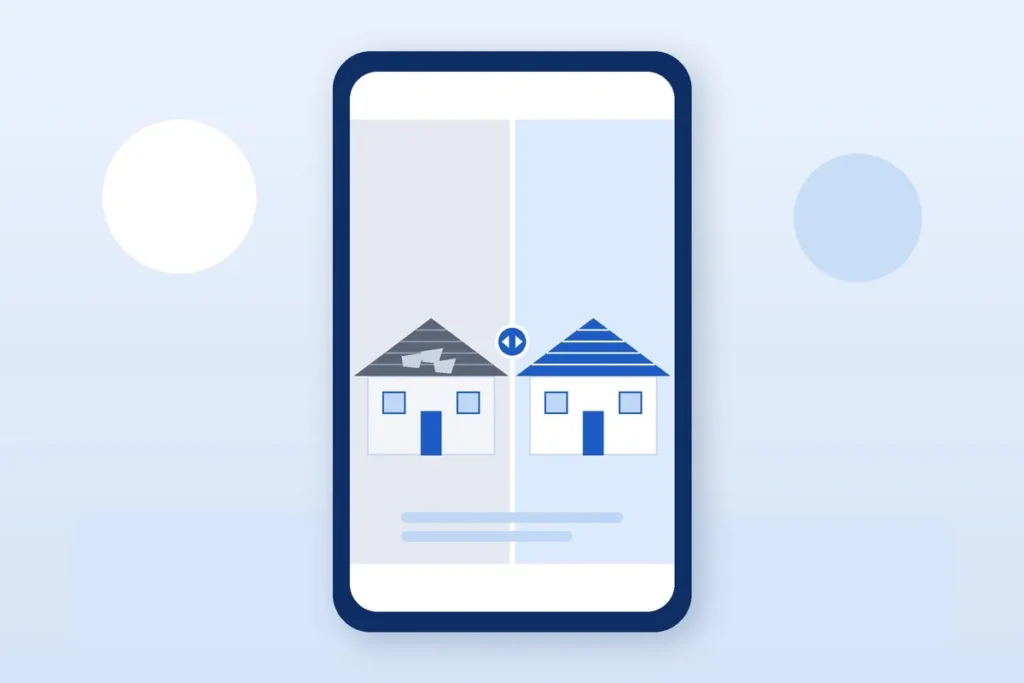
Editing tip: show the “after” by the second or third second. Then go back and show the journey. If you make people wait until the end for the reveal, most of them will be gone before it arrives.
3. The owner talking to camera
The owner, standing in front of a job site or the company truck, talking directly to the homeowner. Who they are, how long they’ve been working in the area, what makes their process different and what happens when you call. This ad builds trust faster than almost anything else because people want to know who they’re hiring.
It doesn’t need to be polished. A steady phone, clean audio from a clip-on mic and a decent edit with captions is enough. Our guide to talking-head video editing techniques covers how to keep these videos moving without making them look over-produced.
4. Customer testimonial in front of the house
A real homeowner, standing in front of their new roof, explaining what happened: the leak they found, how quickly the crew showed up, how clean the yard was afterwards. Neighbours trust neighbours more than they trust any company.
How to get them: ask at the end of a job when the customer is happiest. Give them two or three simple prompts (“What made you call us?”, “What surprised you?”) instead of a script. Natural pauses and imperfect wording make it feel genuine. Always get the homeowner’s permission to use the video in ads.
5. UGC-style “I just got my roof done” video
This looks like something a homeowner would post on their own feed: selfie-style, handheld, talking quickly about their experience. User-generated content blends into the feed instead of looking like an ad, which is exactly why it gets watched. If you want the full breakdown of how to brief creators, see our complete guide to UGC ads for Facebook and Instagram.
Be honest with this format. Use real customers or clearly use creators as presenters. Don’t invent experiences or present an actor as a past customer.
6. Storm and seasonal response ad
After a hail storm or heavy winds, homeowners are actively wondering whether their roof is okay. A short, timely video (“Had hail in [area] last week? Here’s what to check”) meets them at the exact moment of concern. Keep one of these ready to edit so you can launch quickly when weather hits your service area.
Stay factual. Show what damage can look like and invite people to book an inspection, without scare tactics or promises about insurance outcomes.
7. “What to expect” process explainer
Many homeowners delay calling because they don’t know what the process looks like. A 30-second video that walks through the steps (free inspection, clear quote, scheduling, install day, cleanup, final walkthrough) removes that uncertainty. This works especially well for retargeting people who already watched one of your other ads.
How to structure a roofing video ad
Whatever type you choose, the same three-part structure keeps people watching and moves them to act.
The hook (0–3 seconds)
Open with the problem, the result or a direct question. Examples that work in this niche:
- “If your roof is over 15 years old, watch this.”
- “This is what a leak looks like before it reaches your ceiling.”
- “We found this on a roof in [neighbourhood] yesterday.”
- A visual hook: the dramatic “after” shot first, then the story.
The proof (3–25 seconds)
Show the damage, the crew working, the finished roof, the happy customer. Every shot should either build trust or make the problem feel more real. Cut anything that doesn’t do one of those two jobs.
The call to action (last 3–5 seconds)
One clear next step. “Tap below to book your free inspection” is better than listing your phone number, website and social handles at once. For more on pacing, captions and cuts, read how to edit short-form video ads that convert.
Filming tips for roofers (no film crew needed)
- Shoot vertical. 9:16 fills the screen on Reels and Stories. You can crop to 4:5 for the feed.
- Sound matters more than picture. A cheap wireless clip-on mic will do more for your ad than a new camera. Wind on a roof ruins audio fast.
- Safety first, always. Never film in a way that encourages unsafe work. Show harnesses and proper gear; it also signals professionalism.
- Get lots of B-roll. Nail guns, shingles being laid, the crew carrying materials, the clean-up magnet sweeping the lawn. Editors need these clips to keep the video moving.
- Film in good light. Morning or late afternoon light makes roofs look better and avoids harsh shadows.
- Capture every job. Make it a habit for the crew lead to grab 60 seconds of before and after footage on every project. That library becomes months of ad content.
Where these ads fit in your Meta campaigns
Think of your ads in two groups. Cold audiences (people who have never heard of you) respond best to hooks, education and transformations: the inspection walkthrough, before and after, and storm ads. Warm audiences (people who watched a video, visited your site or engaged with your page) respond to trust and process: testimonials, owner videos and the “what to expect” explainer.
Where the click goes matters as much as the video. If you use instant forms, follow the setup in our post on Facebook lead ads for roofing and home service companies so you get leads who actually pick up. If you send people to your website, make sure the page matches the ad; our guide to landing pages for Facebook ads shows how. And when you have several videos running, use a simple process for testing hooks and creatives without wasting budget.
A practical example
Picture a small roofing company running one ad: a 30-second drone flyover of a finished roof with music and a logo at the end. It looks nice, but it says nothing about the viewer’s problem and gives no reason to call this week.
Now picture the same company with three new videos built from footage they already had on their phones:
- A 35-second inspection walkthrough opening with “This roof looked fine from the street. Here’s what we found.”
- A 20-second before and after that shows the finished roof in the first two seconds, then the tear-off.
- A 40-second testimonial from a homeowner standing on her driveway, with captions and a “Book your free inspection” ending.
Videos one and two go to cold audiences in their service area. Video three retargets everyone who watched at least half of the first two. Each video speaks to a different stage of the homeowner’s decision, so the campaign does more than just look good. It moves people towards a booked inspection.
Common mistakes to avoid
- Starting with the logo. Nobody stops scrolling for a logo. Put it at the end, or leave it as a small corner watermark.
- No captions. Many people watch with the sound off. Burned-in captions keep them following along.
- Stock footage. Generic stock roofs feel fake. Your own jobs, even filmed on a phone, are more convincing.
- Too many messages. Repairs, replacements, gutters, solar and financing in one 30-second video is too much. One video, one message.
- Running one ad forever. Creative fatigue is real. Refresh your hooks and footage regularly so your audience keeps seeing something new.
- Over-promising. Avoid claims you can’t back up, especially around insurance or “free roofs”. It damages trust and can get ads rejected.
Quick checklist before you launch
- Does the first three seconds show a problem, a result or ask a direct question?
- Is the video vertical (9:16 or 4:5) with burned-in captions?
- Is the audio clear, without wind noise?
- Does it feature your real jobs, crew or customers?
- Do you have written permission from any homeowner who appears?
- Is there a single, clear call to action at the end?
- Does the landing page or form match what the ad promised?
- Do you have at least two or three versions ready to test against each other?
Frequently asked questions
How long should a roofing video ad be?
For cold audiences, 15–45 seconds is a good range. Testimonials and process videos for warm audiences can run a little longer, because those viewers already know who you are.
Can I film roofing ads on my phone?
Yes. Modern phones shoot more than enough quality for social ads. What makes the difference is clear audio, steady shots, good light and a sharp edit.
How many video ads should I run at once?
Start with two to four for cold audiences and one or two for retargeting. That gives you enough variety to see what works without spreading a small budget too thin.
Do these ideas work for fencing and other home services?
Yes. Fencing, gutters, siding, concrete and landscaping all benefit from the same formats: before and after, owner videos, testimonials and process explainers. Only the footage changes.
Get roofing video ads made for you
Eadoz scripts and edits video ads and UGC for roofing, fencing and other home-service companies, built for Facebook and Instagram. Send us your raw job-site footage and we’ll turn it into ads that stop the scroll and bring in inspection requests. Book a free meeting with Eadoz or chat with us on WhatsApp and tell us about your next campaign.