

-
- No Comments
- August 26, 2026

How to Write a Theatre Tech Resume
How to Write a Theatre Tech Resume: Complete U.S. Guide for Theatre Technicians
Learning how to write a theatre tech resume for the U.S. market means thinking beyond a normal corporate resume. In technical theatre, employers are not only interested in where you worked. They also want to know which productions you worked on and what technical position you held on each show.
That matters whether you are applying to a regional theatre, performing arts center, university, touring company, concert venue, production company, or live event organization.
A hiring manager may want to see your production credits, lighting or sound experience, consoles you can operate, software you know, equipment you have worked with, safety training, and your ability to stay useful when a live production gets busy.
The University of Maine technical theatre guidance makes this distinction clear. It explains that technical theatre resumes differ from conventional resumes because employers may look at individual shows and the positions held on those shows, not simply a list of workplaces.
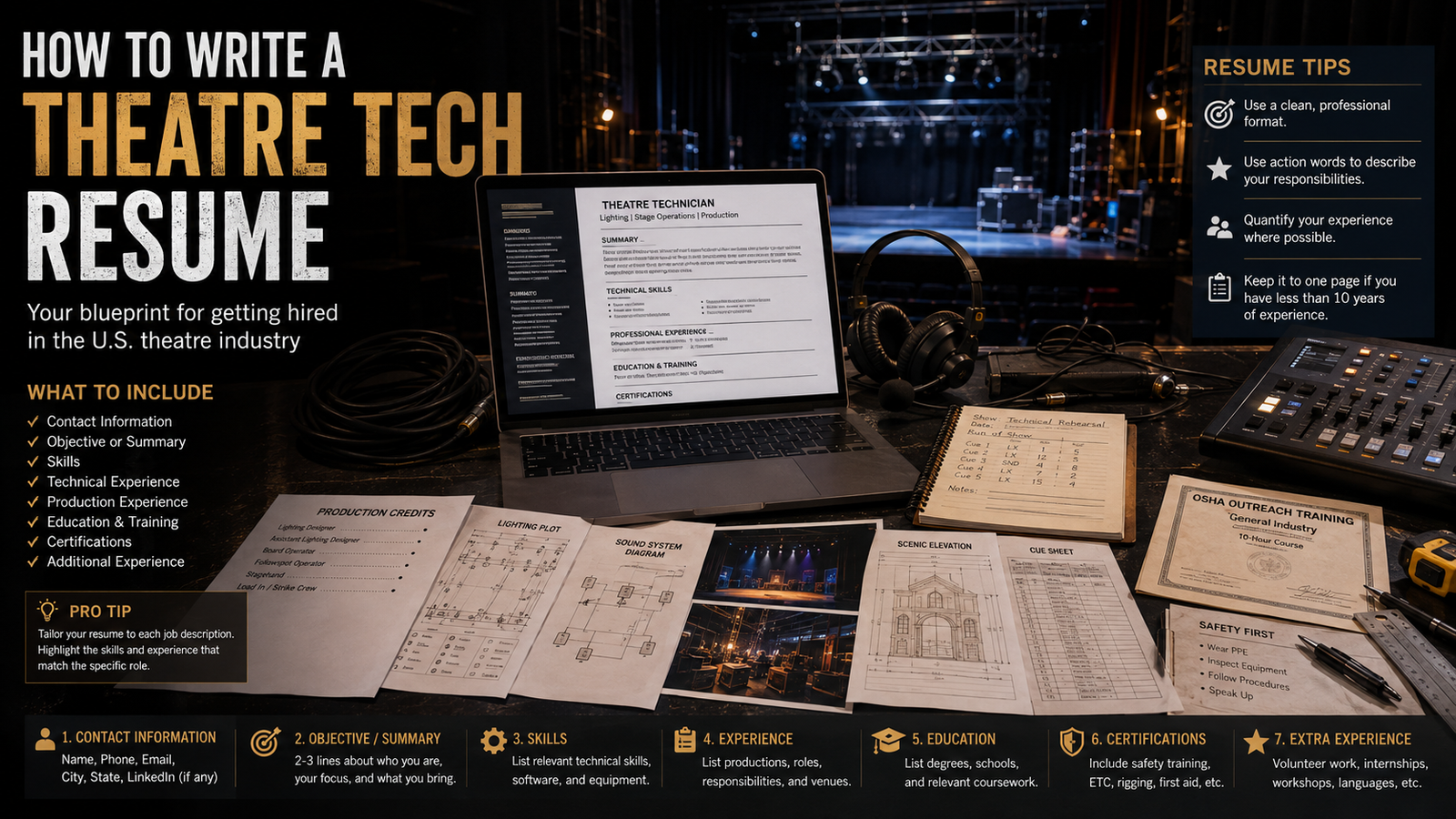
In this guide, I will walk you through the resume from top to bottom. We will cover contact information, technical skills, production credits, experience, education, training, certifications, portfolio work, and the final checks before you apply.
Quick Answer: How to Write a Theatre Tech Resume
A strong U.S. theatre tech resume should quickly show what kind of technician you are and what you can actually do backstage.
Start with your name, professional contact information, and target technical specialty. Then add a short professional summary when it helps explain your background.
Your resume should also include technical skills, selected production credits, relevant employment or internships, education, technical training, safety credentials, professional certifications when applicable, and a portfolio link if your work benefits from examples.
The order matters.
Put the information most closely connected to the job where the employer can see it quickly. General U.S. resume guidance from the University of Maine also recommends beginning with the categories most relevant to the opportunity and tailoring the resume to each position.
So if you are applying for lighting work, your lighting credits, console knowledge, electrics experience, and lighting skills should be easy to find.
If you are applying for sound, the employer should quickly see your mixing, microphone, signal flow, playback, and audio experience.
A scenic technician should bring construction, fabrication, drafting, painting, and shop work forward.
A stagehand should emphasize load in, load out, backstage operations, changeovers, equipment handling, and crew communication.
A rigger should prioritize genuine rigging experience, relevant safety training, systems used, and professional credentials when actually held.
You should not send exactly the same resume to all five jobs.
The strongest resume feels like it was written for the position in front of you.
What Is a Theatre Tech Resume?

A theatre tech resume is a professional resume for people who help create and operate productions from behind the scenes.
Instead of focusing on acting roles or performance experience, it focuses on the technical work that allows a show, concert, event, or production to happen safely and smoothly.
That can include building scenery, hanging lights, programming cues, running sound, setting microphones, operating stage systems, maintaining equipment, moving scenery, troubleshooting problems, supporting rehearsals, or coordinating technical work.
In the U.S., you may see job titles such as theatre technician, theater technician, stagehand, lighting technician, theatre electrician, sound technician, audio technician, video technician, scenic carpenter, scenic painter, props technician, rigger, automation technician, production technician, and technical director.
Your supplied research covers the same wide range of technical roles, including lighting, sound, video, scenic, props, rigging, automation, stage support, and technical direction.
The exact resume should depend on your specialty.
For example, a lighting technician may need to show consoles, DMX, hang and focus work, fixture maintenance, programming, and lighting production credits.
A scenic carpenter may need to show carpentry, fabrication, tools, drafting, construction, installation, and safe shop experience.
That is why a theatre tech resume is not simply a general resume with the word “theatre” added to the top.
It should show the technical side of your career clearly.
Theatre vs Theater: Which Spelling Should You Use in the U.S.?
You will see both theatre and theater in the United States.
Neither spelling needs to become a problem for your resume.
For job applications, the simplest approach is to pay attention to the language the employer uses.
If the listing says Theater Technician, it makes sense to use Theater Technician as your target title when that accurately matches the job.
If the organization is officially called something like Crescent Theatre Company, keep its official spelling exactly as the organization uses it.
The same rule applies to production credits.
Do not change an official company or venue name just to make every spelling on your resume identical.
For SEO, this guide uses how to write a theatre tech resume as the primary phrase, but using related wording such as theater technician naturally can also help U.S. readers who are familiar with that spelling.
You do not need to force both versions into every paragraph.
Write naturally.
On your actual resume, matching the employer’s terminology can also make the document feel more relevant to the position you are applying for.
The important thing is consistency where consistency matters and accuracy where official names are involved.
Why a Theatre Tech Resume Is Different From a Regular U.S. Resume

A conventional U.S. resume usually centers on a familiar pattern: employer, job title, dates, responsibilities, and achievements.
Technical theatre works a little differently.
A hiring manager may care just as much about the individual productions you worked on, the technical position you held, the systems you operated, and the people who supervised your work.
For example, saying that you worked for a performing arts center is useful.
But saying that you worked as a Lighting Electrician on three musicals, operated an ETC console, completed hang and focus work, and supported live performances tells the employer much more about what you can actually do.
That practical detail matters because theatre work happens in real time.
Employers need technicians who can function during rehearsals, performances, load ins, changeovers, strikes, maintenance periods, and technical rehearsals without becoming lost when the pace increases.
They may want to know whether you can communicate with a stage manager, follow a cue, troubleshoot equipment, move safely around backstage spaces, and work with other departments.
Production credits help answer those questions.
So do specific skills, equipment names, software knowledge, training, and accurate descriptions of your backstage responsibilities.
The University of Maine technical theatre guidance makes the same distinction. It notes that employers may look at individual productions and positions held, not only the places where a technician has worked.
That is the idea to keep in mind throughout this guide.
A theatre tech resume should show practical production ability, not simply employment history.
How to Write a Theatre Tech Resume Step by Step

Now we can get into the practical side of how to write a theatre tech resume for the U.S. market.
I recommend building it from the top of the page downward.
First, understand the position.
Then decide what information deserves the most attention.
After that, you can build your header, summary, production credits, experience, skills, education, training, and supporting information around what that employer actually needs.
The goal is simple.
When someone opens your resume, they should quickly understand where you fit backstage.
1. Research the U.S. Theatre Tech Job Before Writing
Read the job posting before you start editing your resume.
The posting should tell you what deserves space near the top.
Start with the exact job title.
A U.S. employer might advertise for a Lighting Technician, Lighting Electrician, Audio Technician, Stage Technician, Stagehand, Production Technician, Entertainment Technician, Scenic Technician, or another closely related position.
The responsibilities can overlap, but the title tells you how the employer thinks about the role.
Next, look at the venue and production environment.
A regional theatre may need someone supporting plays and musicals across a season.
A university theatre may combine production work with student support, equipment maintenance, or shop responsibilities.
Touring productions can place more emphasis on setup, breakdown, travel, speed, consistency, and working with changing venues.
Concert venues and event production companies may care heavily about load ins, audio, lighting, video, rigging, changeovers, and equipment handling.
A performing arts center may support theatre, music, dance, touring shows, speakers, and community events under one roof.
Community theatre roles may involve smaller teams where one technician helps across several departments.
Now look at the technical details.
Identify the consoles, software, tools, equipment, and systems mentioned in the posting.
Check physical responsibilities too.
The job may involve lifting equipment, climbing ladders, working at height, moving scenery, working long calls, operating lifts, handling cables, or completing setup and strike.
Pay attention to safety requirements and requested credentials.
Also notice schedule expectations.
Evening work, weekends, technical rehearsal weeks, touring schedules, short changeovers, and irregular performance calls can all be part of live production work.
Use the employer’s real terminology when it accurately describes your experience.
Do not rewrite your background just to copy the posting.
Match where the match is real.
Match Your Resume to the Technical Department
Your strongest department should be obvious.
If you are applying for lighting, bring your lighting credits, console experience, programming, electrics work, fixture knowledge, maintenance, and troubleshooting forward.
If you are applying for sound, make mixing consoles, microphones, wireless systems, playback, signal flow, QLab, and audio troubleshooting easier to find.
For scenic work, prioritize carpentry, fabrication, scenic painting, drafting, props, construction, installation, and shop experience.
For rigging, prioritize genuine rigging work, systems used, formal training, safety knowledge, and applicable credentials.
Do not bury the information the employer wants under unrelated experience.
The University of Maine technical theatre guide specifically recommends tailoring separate versions when applying across different technical theatre specialties.
You might still have one master resume containing everything.
But the version you submit should feel specific to the department hiring you.
2. Choose a Clean U.S. Theatre Tech Resume Format
Technical theatre is creative work.
Your resume does not need to look like a theatre poster.
Simple usually works better.
Use a light background with dark text, clear section headings, readable fonts, sensible margins, and consistent spacing.
The person reviewing the document should be able to move quickly from your name to your skills, credits, experience, education, and training.
For students and early career technicians, one focused page is usually a good target.
Do not force every production you have ever worked on into that page.
Choose the credits that make your application stronger.
An experienced technician with years of professional productions, touring work, supervisory responsibility, or specialized technical experience may reasonably need more space.
Even then, every section should earn its place.
Avoid tiny fonts.
Do not squeeze the text until the page becomes uncomfortable to read.
Also avoid decorative theatre masks, curtains, spotlights, heavy backgrounds, excessive colors, and complicated layouts.
Those details may look creative, but they can distract from the technical information an employer actually needs.
The University of Maine technical resume guidance recommends simple presentation and emphasizes readability rather than decorative design.
When the resume is finished, submit it as a PDF unless the employer specifically asks for another format.
A PDF helps preserve your spacing and layout when the document is opened on another computer.
Use a Professional U.S. File Name
The filename is a very small detail, but employers can see it.
Use something clear, such as:
Jordan_Miller_Lighting_Technician_Resume.pdf
That tells the employer exactly what the file contains.
A filename such as:
resume_final2.pdf
looks less organized.
It can also become confusing when a hiring manager has downloaded resumes from dozens of applicants.
Your name and target role are enough.
3. Add Your Name and U.S. Contact Information
Your contact section should sit at the top of the page.
Start with your full name.
Directly underneath, add your target technical specialty.
That could be Lighting Technician, Theatre Electrician, Audio Technician, Scenic Technician, Stagehand, Production Technician, or another title that accurately matches your experience.
Then include your phone number and professional email address.
Add your city and state.
For most applications, you do not need to publish your complete street address unless the employer specifically requests it.
Include a portfolio website if you have relevant work to show.
LinkedIn can also be included when the profile is current and adds useful professional information.
Keep this area compact.
It should help someone contact you, not take up a quarter of the page.
Theatre Tech Resume Header Example
A simple U.S. header could look like this:
Jordan Miller
Lighting Technician | Theatre Electrician
Chicago, Illinois
(312) 555 0184 | jordan.miller@example.com
jordanmillerportfolio.example | LinkedIn
Putting the specialty directly beneath the name gives the employer immediate context.
They do not have to read halfway through your resume to understand that you work primarily in lighting.
That becomes especially helpful when a production company is hiring for several departments at the same time.
4. Write a Focused Theatre Tech Resume Summary
A professional summary can be useful when the employer needs a little context before looking at your credits.
Students and early career technicians often benefit from one.
It can also help if you are moving from one technical specialty into another or if your experience covers several departments.
Keep it to two or three short lines.
Your summary should communicate your main technical area, experience level, strongest production abilities, important systems or software, and the kind of production environment you have supported.
Avoid turning it into a personality statement.
Words such as hardworking, passionate, motivated, and dedicated are easy to write.
They are much harder for an employer to verify.
Specific experience is more useful.
Weak Theatre Tech Resume Summary
“Hardworking and motivated theatre professional looking for an exciting opportunity where I can use my skills and grow my career.”
The problem is not that the statement sounds bad.
The problem is that almost anyone could write it.
Nothing tells me what this technician actually knows.
Strong Theatre Tech Resume Summary
“Lighting technician with hands on experience supporting plays, musicals, and live events through fixture setup, hang and focus, ETC Eos operation, equipment checks, and backstage troubleshooting. Working knowledge of QLab, DMX systems, and general stage operations.”
Now the employer knows something useful.
They can see the specialty.
They can see production experience.
They can see tools and systems.
They can also see the type of work the applicant is prepared to perform.
Concrete technical information beats broad personality adjectives.
5. Put Selected Theatre Production Credits Where Employers Can Find Them
Production credits can be one of the strongest parts of a technical theatre resume.
A production credit shows a specific show you worked on and the position you held during that production.
Think of it as evidence.
If you say you have lighting experience, production credits show where that lighting experience came from.
They are particularly useful because theatre careers do not always fit neatly into one employer at a time.
You may have worked for a regional theatre, helped on university productions, completed summer stock work, supported touring shows, volunteered with community theatre, and freelanced for event companies.
Your credits allow those experiences to make sense together.
A useful production credit can include your Position, Production, Theatre or Company, and Supervisor or Designer where appropriate.
Your supplied research recommends this same type of organization, especially Position, Show, Theatre or Company, and Supervisor or Contact.
Keep the format consistent.
Employers should be able to scan multiple credits quickly.
Theatre Production Credit Format
For example:
Lighting Electrician
Into the Woods
Riverfront Theatre Company
Lighting Supervisor: Maria Bennett
Or:
Sound Board Operator
The Crucible
Lakeside University Theatre
Sound Designer: Andrew Collins
You do not need a full paragraph beneath every show.
Save detailed descriptions for formal employment, internships, apprenticeships, or particularly important experience where more explanation adds value.
Should Theatre Credits Include Dates?
They can, but dates do not always need to appear beside every production.
Formal employment should normally include clear dates.
If you worked as a Theatre Technician for a performing arts center from August 2024 through May 2026, that timeline is useful.
Production credits can be handled more flexibly.
Your supplied research notes that dates are not always necessary for individual show credits.
If dates help explain your career progression, include them.
If they make a clean production credit section crowded, you may decide to leave them off individual shows.
Whatever you choose, stay consistent.
How to Order Theatre Credits by Relevance
You do not always need to organize production credits purely by date.
Relevance can be more useful.
Imagine that you are applying for a lighting job.
You have worked as a Lighting Electrician, Lighting Board Operator, Follow Spot Operator, Scenic Crew Member, Sound Assistant, and Stagehand.
Your lighting work should appear first.
A sensible order might begin with Lighting Electrician, Board Operator, Programmer, and Follow Spot credits.
General crew work can come later.
Now imagine you are applying for scenic work.
The order changes.
Scenic Carpenter, Scenic Painter, Props Technician, Fabricator, and Set Construction credits become much more important.
Your lighting work can move lower.
Nothing has been hidden.
You have simply organized the resume around what this particular employer needs.
That is exactly why one master resume can turn into several stronger application versions.
6. Write Strong Theatre Experience Descriptions
Production credits tell the employer where you worked.
Experience descriptions can explain what you actually did.
Use them for formal employment, internships, apprenticeships, staff positions, and substantial crew experience where a little detail helps.
Keep the descriptions short.
You do not need a corporate paragraph filled with buzzwords.
A useful formula is:
Action + technical task + equipment or production context + useful result
Start with what you did.
Then explain the technical context.
Add a result when there is a genuine result worth mentioning.
Weak Theatre Experience Example
“Responsible for lighting equipment.”
This could mean almost anything.
Did you hang fixtures?
Clean them?
Program cues?
Move cases?
Operate the board?
We do not know.
Strong Theatre Experience Example
“Installed and focused lighting fixtures for plays and musicals, supported ETC console operation during technical rehearsals, and completed equipment checks before performances.”
That is immediately clearer.
Another example could be:
“Tested cables and fixtures, completed routine lighting maintenance, and helped troubleshoot equipment problems during rehearsals and live performances.”
These descriptions sound practical because they describe practical work.
The current O*NET profile for U.S. Lighting Technicians includes duties such as installing cables, operating lighting control systems, programming consoles, focusing fixtures, maintaining equipment, testing systems, and checking electrical safety.
Those are the kinds of real technical actions employers can understand.
Use the same principle for sound, scenic, stage operations, video, and other departments.
7. Use Real Numbers When They Add Context
Numbers can make experience easier to understand.
The key word is real.
You might mention the number of productions you supported, performances you worked, crew members you supervised, cues you operated, fixtures you maintained, channels you worked with, or the capacity of a venue.
For example:
“Supported lighting setup and performance operation for eight productions during the 2025 season.”
Or:
“Operated sound playback across 14 performances while coordinating cue timing with the stage manager.”
Or:
“Completed pre show lighting checks for a 750 seat performing arts venue.”
Numbers give the employer scale.
They can help a hiring manager understand whether your experience came from one student project or a busy season of live performances.
But do not force numbers into every description.
If you do not know how many fixtures you maintained, do not guess.
If you cannot remember the exact crew size, leave it out.
Accurate experience is stronger than impressive looking statistics you cannot defend.
8. Build a Technical Skills Section for U.S. Theatre Employers
A technical skills section should be easy to scan.
Do not put lighting consoles, carpentry, QLab, microphones, rigging, Photoshop, scenic painting, and Microsoft Office into one long sentence.
Group related skills.
This allows an employer to find the department that matters to them quickly.
Lighting Skills
Lighting skills can include ETC Eos or other consoles you have genuinely used, DMX, patching, conventional fixtures, intelligent fixtures, hang and focus, cue operation, programming, follow spot operation, cable work, fixture maintenance, and basic electrical awareness.
Specificity helps.
If you know ETC Eos, say ETC Eos.
If you have only worked with a console once during a class exercise, describe that level honestly instead of presenting yourself as an experienced programmer.
Sound Skills
Sound skills may include digital and analog mixing consoles, microphone placement, wireless microphone systems, QLab, playback, signal flow, PA systems, live mixing, cable testing, patching, and troubleshooting.
If you have worked with specific consoles or systems, name them when they matter to the job.
Sound departments often care about both technical setup and what happens once the audience enters.
Live mixing, cue execution, wireless management, and fast troubleshooting can all be valuable.
Scenic and Props Skills
Scenic and props experience can include carpentry, scenic painting, fabrication, drafting, props construction, set dressing, installation, shop tools, load in, and strike.
Welding can also be useful when you are genuinely qualified to perform it.
Do not treat tool names like keywords.
An employer needs to know what you can use safely and competently.
If you have AutoCAD or Vectorworks experience connected to scenic work, place those skills where they make sense.
Rigging and Stage Operations Skills
This area needs especially careful wording.
Relevant skills may include counterweight systems, fly systems, stage machinery, chain motors when properly trained, backstage operations, load in, load out, equipment handling, production changeovers, cue execution, and stage crew work.
Safety comes first.
Do not claim rigging competence because you helped move equipment during one production.
If your experience was supervised, describe it as supervised.
If you assisted with a system rather than operating it independently, say that.
The goal is not to sound advanced.
The goal is to make your actual level clear.
Video and Projection Skills
Some theatre and event jobs include significant video work.
Relevant skills can include projection systems, playback, video switching, signal routing, displays, media servers, basic signal distribution, and production video setup.
Again, name specific systems only when you have actually used them.
Video technicians working across theatre, concerts, events, and performing arts venues may need to show both setup knowledge and live operation experience.
Theatre Software and Digital Tools
Software deserves its own group when you use several technical programs.
Depending on your work, you may include ETC Eos, QLab, Vectorworks, AutoCAD, Lightwright, Pro Tools, and Dante related tools.
General tools such as Microsoft Office or Google Workspace can also be worth including when the job involves schedules, documentation, inventory, communication, or production paperwork.
Your supplied research likewise identifies tools such as ETC Eos, QLab, Vectorworks, AutoCAD, Lightwright, Pro Tools, and audio networking software as relevant examples for technical theatre resumes.
Do not try to impress the reader with a huge software list.
Choose the tools that support the position you want.
9. Be Precise About Your Skill Level
One small wording change can make your resume much more trustworthy.
There is a difference between:
Experienced with
Working knowledge of
Familiar with
Assisted with
Use them intentionally.
“Experienced with ETC Eos” suggests that you have used the system enough to work with it confidently.
“Working knowledge of ETC Eos” suggests useful practical understanding, but perhaps not advanced mastery.
“Familiar with ETC Eos” communicates basic exposure.
“Assisted with ETC Eos programming” tells the employer that you participated but were not necessarily the primary programmer.
None of those descriptions is automatically better than the others.
The correct one is the one that matches your actual experience.
This becomes especially important around rigging, electrical systems, aerial lifts, automation, powered equipment, and other safety critical work.
Do not upgrade basic exposure into professional competence just because stronger wording sounds better.
Theatre employers can ask detailed technical questions very quickly.
Honest wording protects your credibility and helps the employer understand where you can work independently and where you may need additional training.
10. Add Education and Theatre Training
Education matters on a theatre tech resume, but the amount of space it deserves depends on where you are in your career.
If you are still studying, education can help explain where your technical knowledge comes from.
If you already have years of professional production experience, your credits and practical work will usually deserve more attention.
The goal is not to make the education section large.
It is to include the training that helps an employer understand your preparation for technical theatre work.
For Current Students
If you are currently studying, include your degree, diploma, certificate, or technical theatre program.
Add the institution, city and state, your expected graduation date, and your concentration when relevant.
For example:
BFA in Theatre Design and Technology
Example State University
Chicago, Illinois
Expected May 2027
Concentration in Lighting Technology
If your professional experience is still limited, relevant coursework can also help.
You might mention stage lighting, sound production, stagecraft, scenic construction, technical direction, production management, CAD drafting, theatre safety, live event production, or audio engineering.
Choose courses that support the position you want.
A lighting applicant does not need to fill half the page with unrelated classes.
Your supplied research also recommends using relevant coursework when practical experience is still developing.
For Recent Graduates
After graduation, keep your degree visible, but start allowing your production credits and real technical experience to carry more weight.
If you have worked on several university productions, completed internships, supported summer theatre, or worked in your department’s scene shop, those experiences can tell an employer more about your practical ability than a long coursework list.
You can gradually remove individual classes as your professional credits grow.
For example, someone with two years of lighting work after college probably does not need to list Introduction to Stage Lighting anymore.
The degree can stay.
The beginner level coursework can move out.
For Experienced Technicians
Experienced technicians can usually keep education concise.
List the degree, certificate, apprenticeship, or technical program when it remains relevant.
You do not need to describe every class you took years ago when your professional credits already demonstrate the same skills.
There are exceptions.
A specialized technical program, respected apprenticeship, engineering background, electrical training, advanced drafting education, or other directly relevant study may still deserve attention.
Think about whether the education strengthens the job application today.
If it does, keep it visible.
Relevant U.S. Theatre Training
Not all useful theatre training happens in a college classroom.
Apprenticeships and internships can be particularly valuable because they combine instruction with production work.
You can also include workshops, supervised scene shop experience, technical theatre programs, equipment training, professional development courses, and specialized instruction in areas such as lighting, audio, rigging, fabrication, drafting, or production management.
Union training may also be relevant where applicable.
If you completed training through an employer, union, venue, school, manufacturer, professional organization, or recognized training provider, use the exact name of the program.
Do not turn the section into a collection of every workshop you have ever attended.
Keep the training that supports the technical work you want to do next.
11. Include U.S. Safety Training and Credentials Correctly
Technical theatre can put you around real hazards.
Depending on your department, you may work with electrical systems, ladders, rigging, heavy scenery, powered lifts, shop tools, moving equipment, elevated work areas, and tightly controlled backstage spaces.
That makes safety training worth showing when it is relevant.
But terminology matters.
Do not turn every safety course into a certification.
Use the exact name of what you completed and the organization that issued it.
OSHA 10 and OSHA 30
OSHA 10 and OSHA 30 are commonly misunderstood on resumes.
If you completed an OSHA Outreach Training Program 10 hour or 30 hour course, you can list the appropriate course completion card.
But do not call yourself “OSHA certified.”
OSHA states clearly that its Outreach 10 hour and 30 hour courses are voluntary training programs and that the cards are not certifications or licenses. Some employers, unions, states, municipalities, or other jurisdictions may still require the training.
The 10 hour program is primarily intended to introduce workers to common workplace hazards.
The 30 hour program provides greater depth and is intended more for supervisors or workers who have some safety responsibilities.
On your resume, write the actual course completed.
For example:
OSHA Outreach Training Program, General Industry, 10 Hour Course Completion Card
That is more accurate than writing “OSHA 10 Certification.”
Accuracy makes your resume look more professional.
First Aid and CPR
Current First Aid, CPR, and AED training can be useful in theatres, shops, event venues, touring environments, and other live production settings.
List the exact credential and provider.
If the credential has an expiration date, check that it is still current before presenting it as active.
For example:
Adult First Aid, CPR and AED
American Red Cross
Current through May 2027
Use your real provider and dates.
Never copy an example credential into your resume unless you actually hold it.
MEWP and Aerial Lift Training
Lighting, rigging, scenic, and venue technicians may work with powered access equipment.
If you have received training for a mobile elevating work platform, aerial lift, boom lift, or similar equipment, include it when the job involves that equipment.
Use the exact training title and provider.
Do not simply write “lift certified” if that is not the formal credential you received.
Different employers and training providers may use different terminology.
Your resume should reflect the training you actually completed.
Forklift Training
Forklift training can be relevant for technicians working in production shops, warehouses, large venues, touring operations, scenery facilities, or equipment storage environments.
Include it when it genuinely supports the position.
Again, use the exact name of the training and provider.
Do not imply that previous exposure to a forklift is the same as having completed formal operator training.
Electrical Safety Training
Lighting technicians, electricians, and portable power technicians may have electrical safety training that is directly relevant to their work.
Include legitimate training in electrical safety, power distribution, lockout procedures, temporary entertainment power, or related areas when appropriate.
But be careful with your wording.
Knowing basic electrical safety does not automatically make someone a qualified electrician.
A theatre tech resume should never create a larger claim than the training actually supports.
Rigging Training
Rigging experience deserves the same level of care.
You can include formal rigging courses, supervised training, manufacturer instruction, professional workshops, apprenticeships, or legitimate experience under qualified supervision.
Describe the level accurately.
If you attended an introductory rigging workshop, say that.
Do not turn one introductory class into “advanced theatrical rigger” on your resume.
Rigging can affect performers, technicians, scenery, equipment, and audiences.
Employers need an honest picture of what you know and what you are qualified to perform.
12. Understand ETCP Certifications
Experienced U.S. entertainment technicians may also encounter ETCP.
ETCP stands for the Entertainment Technician Certification Program.
It is an industry program built around professional technical disciplines that directly affect the health and safety of crews, performers, and audiences.
ETCP is different from a beginner training workshop.
Its certifications are designed for experienced entertainment technicians.
Current ETCP certification areas include Rigger Theatre, Rigger Arena, Entertainment Electrician, and Portable Power Distribution Technician.
If you hold one of these credentials, use its correct title on your resume.
For example:
ETCP Certified Rigger Theatre
Or:
ETCP Certified Entertainment Electrician
Do not shorten or modify the title in a way that creates confusion.
ETCP eligibility is strongly tied to professional experience, so these credentials should not be treated as something every beginner is expected to have.
If you are a student or entry level technician learning how to write a theatre tech resume, do not think your resume is incomplete simply because you do not have ETCP certification.
Your production credits, practical skills, training, safety awareness, education, and supervised experience can still create a strong application.
Professional certifications become relevant as your career and responsibilities develop.
13. Add a Theatre Tech Portfolio Link
Some technical theatre skills are easier to understand when an employer can see the work.
That is where a portfolio helps.
A portfolio can be valuable for lighting, scenic work, props, technical direction, stage management, sound, video, drafting, programming, and other areas where you have useful work samples.
The resume tells the employer what you did.
The portfolio can show how you approached it.
You might include lighting plots, cue sheets, sound plots, CAD drawings, scenic drawings, construction photographs, production photographs, programming examples, technical paperwork, schedules, system diagrams, or selected production documentation.
Do not upload everything.
A smaller collection of strong, relevant work is usually easier to understand than a huge archive with no direction.
Your supplied research also recommends keeping portfolio material organized and clearly identifying your contribution.
What Should Go in a Theatre Tech Portfolio?
Your portfolio should reflect your actual specialty.
A lighting technician and scenic carpenter should not build identical portfolios.
Choose material that helps someone understand both your technical ability and your role in the project.
Lighting Portfolio
A lighting portfolio might include lighting plots, channel information, cue documentation, research, production photographs, and selected paperwork.
You can also show parts of your process.
For example, a plot followed by a production photograph can help an employer see how planning turned into the finished stage picture.
If you programmed cues, explain that.
If you only assisted with focus, do not present yourself as the lighting designer.
Sound Portfolio
Sound technicians can include system diagrams, sound plots, microphone plans, QLab documentation, cue information, playback setups, and carefully selected audio examples when useful.
You might also show how you organized a complicated wireless microphone setup or solved a playback problem.
Keep the documentation understandable.
The employer should not need ten minutes to figure out what they are looking at.
Scenic and Props Portfolio
Scenic and props portfolios can be highly visual.
You might include CAD drawings, drafting, research, sketches, fabrication photographs, construction stages, scenic painting, finished props, shop work, and final production photographs.
Process photographs are particularly useful when they show what you personally built.
A photograph of a completed set may look impressive.
A sequence showing your drawing, construction work, and final result can explain your contribution much more clearly.
Technical Direction Portfolio
Technical direction portfolios can show planning as well as execution.
Useful examples may include drafting, construction documentation, technical schedules, planning documents, selected budgets where sharing is permitted, shop coordination, technical problem solving, and production photographs.
The strongest examples show how you moved from a technical problem to a workable production solution.
Stage Management Portfolio
Stage management portfolios require careful selection because production paperwork may contain private information.
Useful examples can include properly sanitized schedules, cue documentation, organizational systems, rehearsal paperwork, or other materials that demonstrate communication and organization.
Only use documents you are allowed to share.
Remove private phone numbers, email addresses, personal schedules, and other sensitive information.
Show Your Own Contribution
Every project should answer one question:
What did you do?
Do not make an employer guess.
Include the production title, organization, your role, and a short explanation of your contribution when needed.
For example:
The Tempest
Assistant Lighting Designer
Created instrument paperwork, assisted with focus, programmed selected cue sequences, and supported performance operation.
That is much clearer than simply uploading four production photographs.
The portfolio should demonstrate your work, not accidentally take credit for everyone else’s.
Protect Confidential Material
A portfolio does not give you permission to publish everything you touched at work.
Do not upload confidential internal documents, employee contact information, private schedules, unreleased designs, restricted budgets, security information, or material that belongs to another person or organization without permission.
The same applies to another designer’s drawings or photographs.
When in doubt, ask before publishing.
Professional judgment is part of technical theatre too.
14. Handle U.S. References Properly
References usually do not need to take up valuable space on the main resume unless the employer specifically requests them there.
Keep a separate reference document instead.
That document can match the visual style of your resume and include the person’s name, title, organization, professional contact information, and relationship to your work.
Good references might include technical directors, production managers, lighting or sound designers, stage managers, venue managers, faculty supervisors, shop supervisors, internship supervisors, or other people who directly observed your technical work.
Choose people who can actually discuss your performance.
A famous designer who barely remembers you may not be as useful as a technical director who supervised you across six productions.
Your supplied research recommends asking permission before using someone as a reference and choosing people who can be connected to the work shown on your resume.
Always contact the person first.
Tell them what kind of job you are applying for.
That gives them context if an employer reaches out.
A strong reference should be able to discuss things such as your technical ability, reliability, communication, safety habits, problem solving, and how you behave when a production gets busy.
How to Write a Theatre Tech Resume With No Experience

If you have never had a paid theatre job, you can still have relevant theatre experience.
This distinction is important.
A student who helped run lighting for four school productions may have no formal employment history, but they have still worked with cues, equipment, rehearsals, performers, directors, and backstage schedules.
That experience belongs on the resume when it is described honestly.
Start with school productions, university shows, community theatre, volunteer crew work, stagecraft classes, scene shop experience, workshops, technical projects, and supervised production work.
Think about actual tasks.
Did you hang or focus lights?
Run QLab?
Set microphones?
Help build scenery?
Paint a set?
Organize props?
Assist with load in?
Run scene changes?
Test cables?
Work a follow spot?
Those actions give you resume material.
Your supplied research also recommends using academic productions, volunteer work, community theatre, and transferable technical experience when professional employment is still limited.
The important thing is not to pretend the work was something it was not.
If it was volunteer experience, call it volunteer experience.
If it was a university production, say university production.
If you worked under supervision, mention that when it gives useful context.
You are not trying to make beginner experience sound senior.
You are showing that you have already started doing the work.
Theatre Tech Resume for High School Students
High school students can often find more technical experience than they initially realize.
Start with school musicals, plays, concerts, auditorium events, drama club productions, assemblies, community theatre, and supervised technical projects.
Then identify your actual crew position.
Perhaps you worked on lighting crew, sound crew, stage crew, scenery, props, backstage operations, or auditorium support.
Describe the tasks rather than relying only on the title.
For example:
Lighting Crew, Spring Musical
Assisted with fixture setup, cable organization, basic focus work, equipment checks, and backstage lighting support under the technical director.
That is much stronger than writing:
“Helped with school musical.”
Workshops and stagecraft classes can also help.
If you received practical training in lighting, QLab, scenery, sound, basic carpentry, safe tool use, or backstage operations, include the relevant experience.
Teachers, theatre directors, technical directors, auditorium managers, and community theatre supervisors may also make useful references when they directly observed your work.
At this stage, an employer is unlikely to expect a long professional credit history.
They are looking for signs that you can learn, follow instructions, work safely, communicate with a crew, and take technical responsibilities seriously.
Theatre Tech Resume for College Students
College students can usually build a much fuller technical theatre resume.
University productions count when you describe them accurately.
If you worked as a Lighting Electrician, Sound Board Operator, Scenic Carpenter, Props Technician, Stage Manager, Assistant Technical Director, or crew member on a department production, that work can appear in your production credits.
Department employment can also be valuable.
Maybe you have a work study position in the scene shop.
Perhaps you maintain lighting equipment, help prepare rehearsal spaces, support events, work in costume or props storage, or assist visiting designers.
Those responsibilities can show consistent practical experience beyond individual shows.
Internships deserve strong visibility as well.
Describe the department, equipment, systems, and production responsibilities you actually handled.
Summer theatre work can be especially useful because it often involves a concentrated production schedule and repeated practical work.
Relevant coursework can still appear, but it should support your credits rather than compete with them.
Portfolio projects can also help show design, drafting, programming, construction, or production planning skills.
Finally, include your degree, institution, city and state, and expected graduation date.
Do not apologize for academic credits.
A university production is not the same as a Broadway production, and you should never imply that it is.
But it can still provide genuine experience with technical systems, deadlines, crews, rehearsals, and live performances.
Describe it accurately, and let the work speak for itself.
Theatre Tech Resume for Community Theatre Experience

Community theatre can be a very useful starting point when you are building technical experience in the U.S.
The fact that the position was unpaid does not make the technical work meaningless.
If you operated a lighting board, set microphones, built scenery, organized props, worked scene changes, helped with load in, or supported performances backstage, you gained experience that can belong on your resume.
The important part is describing it honestly.
Do not turn a volunteer role into paid employment.
Instead, label it clearly and then describe the actual technical responsibilities professionally.
For example:
Volunteer Lighting Technician
Cedar Grove Community Theatre, Columbus, Ohio
Supported lighting hang and focus, assisted with fixture checks, operated performance cues, and helped complete strike after the production.
That sounds professional because the work itself is described professionally.
You do not need to hide the word volunteer.
Community theatre can also give beginners something that classes alone cannot always provide: experience working through an entire production process.
You may see how rehearsals change, how departments communicate, how cues are called, how equipment problems are handled, and how backstage work changes once an audience enters the building.
Those experiences can strengthen a beginner resume.
As you gain professional credits, you can gradually replace weaker community theatre entries with stronger paid work.
Until then, relevant community credits can show employers that you already understand what it feels like to work inside a live production.
How to Tailor a Theatre Tech Resume for Different U.S. Jobs

Part of understanding how to write a theatre tech resume is knowing that there is no single perfect version for every backstage job.
The strongest information changes with the department.
Your master resume might contain lighting, sound, scenic, stage operations, and event experience.
The version you actually send should bring the most relevant part of that experience forward.
You are not rewriting your career.
You are changing the order so the employer can quickly see why you fit their position.
Lighting Technician Resume
A lighting technician resume should make lighting experience impossible to miss.
Start with your strongest lighting production credits.
If you have worked as a Lighting Electrician, Board Operator, Programmer, Follow Spot Operator, or Lighting Technician, bring those credits toward the top.
Then show the equipment and systems you actually know.
That might include ETC Eos, other consoles you have genuinely operated, DMX, patching, conventional fixtures, moving lights, hang and focus, cue operation, programming, cable work, and equipment maintenance.
Troubleshooting belongs here too.
If you have tested cables, identified fixture faults, completed pre show checks, replaced damaged equipment, or helped solve problems during technical rehearsals, describe that experience.
Electrical and safety knowledge should be represented accurately.
Do not describe yourself as an electrician simply because you have plugged in stage equipment.
Use job titles and skill claims that match your real training and responsibility.
A good lighting resume tells an employer whether you can help prepare the system, operate it, maintain it, and respond when something stops working.
Sound Technician Resume
For a sound job, audio experience should move to the front.
Show sound production credits first.
Then highlight the consoles, microphones, wireless systems, playback tools, and audio workflows you genuinely understand.
Useful skills may include digital mixing consoles, analog consoles, microphone placement, wireless microphone setup, signal flow, QLab, playback, PA systems, patching, live mixing, cable testing, and troubleshooting.
If you have worked with Dante or another audio networking environment, include it when that experience is real and relevant.
Live performance experience is particularly useful.
Setting up an audio system is one skill.
Running that system while performers are onstage and cues are moving in real time is another.
You might describe experience such as:
“Operated QLab playback and supported wireless microphone coordination for 16 performances while following cue calls from stage management.”
That gives the employer production context.
Avoid simply writing “audio experience.”
Tell them what kind.
Scenic Technician Resume
A scenic technician resume should show practical building ability.
Bring carpentry, fabrication, scenic painting, props, drafting, construction, installation, and shop work into focus.
If you use AutoCAD or Vectorworks for technical drawings, mention that where appropriate.
If you can interpret drafting and then help construct the resulting scenery, make that connection clear.
You may also include experience with hand tools, power tools, set installation, strike, hardware, scenic finishing, and material handling.
Welding can be valuable in some scenic positions, but only include it if you have genuine training and practical experience.
Safe shop habits matter just as much as technical ability.
A production shop does not benefit from someone who can build quickly but ignores safety procedures.
Your experience descriptions can show both.
For example:
“Built and installed flats, platforms, and scenic units from technical drawings while following shop safety and tool handling procedures.”
Simple.
Specific.
Useful.
Stagehand Resume
A stagehand resume should communicate that you can work as part of a fast moving crew.
Focus on load in, load out, backstage operations, equipment handling, changeovers, strike, cue execution, and communication.
If you have venue experience, show it.
A stagehand working in a performing arts center may support theatre, concerts, dance, corporate events, touring productions, and community programming.
That variety can be valuable.
Mention the departments you have supported when useful.
Perhaps you assisted lighting with cable runs, audio with speaker placement, scenic with stage setup, or touring crews with equipment movement.
Crew communication matters too.
Stagehands often work from instructions given by department heads, production managers, touring staff, stage managers, or lead technicians.
Show that you can follow those instructions without making the resume sound passive.
Instead of:
“Helped during events.”
Try:
“Supported load in, equipment placement, backstage changeovers, and strike for theatre and live event productions while coordinating with lighting, audio, and stage operations crews.”
That gives the work shape.
Rigging Technician Resume
Rigging experience should be described with extra care.
An employer needs to know what you have actually been trained to do.
Prioritize legitimate rigging credits, systems used, formal education, supervised experience, inspections, equipment knowledge, and applicable credentials.
Depending on your background, you may have experience with counterweight systems, chain hoists, truss, fly systems, mechanical systems, rigging hardware, or other entertainment rigging equipment.
Do not automatically group all of those together.
Theatre rigging and arena rigging can involve different systems and working environments.
ETCP, for example, maintains separate Rigger Theatre and Rigger Arena certifications. Its Theatre credential focuses on systems commonly associated with permanent theatrical facilities, while Arena certification covers work involving chain hoists and truss systems used to temporarily suspend equipment.
If you hold an ETCP certification, list the correct credential.
If you do not, do not imply that you do.
If your experience was supervised, say that.
If you completed introductory training, describe it as introductory training.
A resume should never make a beginner rigger sound like an independent advanced technician.
The risk is too high.
Production Technician Resume
Some U.S. production roles are intentionally broad.
A Production Technician may work across lighting, audio, video, stage operations, event setup, equipment maintenance, and general production support.
The challenge is showing range without creating a resume that feels random.
Start by identifying the areas where you are strongest.
For example, you might present yourself as:
Production Technician | Lighting and Stage Operations
That gives the employer a clear center.
Then group your broader technical skills underneath.
You might have lighting console experience, basic audio setup, projection support, stage crew experience, equipment maintenance, and event changeover work.
All of that can fit.
The resume simply needs structure.
Do not list forty unrelated tools and expect the employer to figure out your strengths.
Lead with your strongest departments, then show your flexibility.
A broad production technician resume should say:
“I can support several departments.”
It should not say:
“I have touched everything once.”
Technical Director Resume
A Technical Director resume is usually for someone further along in their career.
At this level, technical ability alone is not enough.
Employers may also want evidence that you can plan, coordinate, supervise, and solve larger production problems.
Useful areas can include construction oversight, technical planning, drafting, scheduling, budgeting, crew supervision, shop operations, safety, equipment coordination, and communication between departments.
Your experience descriptions can show scope.
For example:
“Coordinated scenic construction, production schedules, crew assignments, and technical deadlines across a six show season.”
Or:
“Reviewed technical drawings, supervised shop work, coordinated load ins, and worked with design and production teams to resolve construction and scheduling issues.”
Technical directors often connect artistic ideas with practical reality.
A strong resume should show that balance.
You may understand drafting, carpentry, rigging, stage systems, budgeting, scheduling, and production workflows.
But the real value is often your ability to make all those pieces work together safely.
How to Use Theatre Tech Resume Keywords Naturally
Keywords matter most when they accurately describe your experience.
Start with the job description.
Look at the terminology the employer repeats.
You may see phrases such as lighting console operation, ETC Eos, QLab, load in, load out, scenic construction, sound mixing, signal flow, troubleshooting, rigging, stage operations, cue execution, equipment maintenance, or backstage communication.
If those terms match your background, use them.
For example, imagine the employer asks for QLab experience.
If you have used QLab for theatrical playback, you might write:
“Programmed and operated basic QLab playback cues for student and community theatre productions.”
That naturally includes the relevant term.
Now imagine the posting asks for load in and load out experience.
You could write:
“Supported lighting and stage equipment during load in, performance setup, and load out for touring and local productions.”
Again, the keyword appears because the work is real.
Do not copy every technical phrase from the posting.
If the employer wants AutoCAD and you only use Vectorworks, do not add AutoCAD simply because you think a computer system wants to see it.
Keywords should help the resume describe your actual fit.
They should never create a fake one.
Should You Optimize a Theatre Tech Resume for ATS?
Some U.S. employers use online application platforms that may process resumes before a hiring manager reads them.
That makes clear formatting useful.
You do not need to turn your theatre resume into an ATS experiment.
Use recognizable section headings.
For example:
Technical Skills
Selected Theatre Credits
Professional Experience
Education
Training and Safety Credentials
Certifications
Simple headings help both software and human readers understand the document.
Use technical terminology from the job posting when it accurately matches your background.
Also make sure important information appears as normal text rather than being hidden inside complicated graphics.
Your first goal should still be clarity.
A resume that reaches a human reader but exaggerates your technical background is not a successful resume.
Think of ATS friendly formatting as basic organization, not a trick for beating a system.
Theatre Tech Resume Template for U.S. Jobs

Here is a practical template you can copy and adapt.
Do not keep every section automatically.
Remove anything that does not apply to your experience.
Name and Contact Information
JORDAN MILLER
Lighting Technician | Theatre Electrician
Chicago, Illinois
(312) 555 0184
jordan.miller@example.com
jordanmillerportfolio.example
LinkedIn profile if useful
Professional Summary
Write two or three short lines explaining your primary technical specialty, experience level, strongest production skills, important equipment or software, and the type of production environments you have supported.
Example:
Lighting technician with experience supporting plays, musicals, and live events through lighting setup, ETC Eos operation, hang and focus, equipment checks, and backstage cue execution. Working knowledge of QLab, DMX systems, and general stage operations.
Technical Skills
Lighting
ETC Eos, DMX, patching, conventional fixtures, moving lights, hang and focus, cue operation, follow spot, equipment maintenance
Stage Operations
Load in, load out, backstage communication, cue execution, scene changes, equipment handling
Sound
QLab playback, wireless microphones, basic signal flow, cable testing
Software
ETC Eos, QLab, Vectorworks, Google Workspace
Only include the departments and tools that genuinely apply to you.
Selected Theatre Credits
Lighting Electrician
Production Title
Theatre or Company
Lighting Supervisor: Name
Board Operator
Production Title
Theatre or Company
Lighting Designer: Name
Stage Crew
Production Title
Theatre or Company
Technical Director: Name
Professional and Relevant Experience
Job Title
Organization
City, State
Month Year to Month Year
Describe the technical work you performed.
Mention important equipment or systems.
Include relevant production responsibilities.
Show troubleshooting, safety, collaboration, or live operation experience when useful.
Add real numbers only when you know they are accurate.
Education
Degree or Certificate
Institution
City, State
Graduation Date or Expected Graduation Date
Concentration or relevant coursework when useful
Training and Safety Credentials
Use the exact credential or training title.
Include the provider.
Include the completion or expiration date when relevant.
Do not describe an OSHA Outreach course completion card as a certification.
Portfolio
Portfolio URL
Briefly describe what the portfolio contains if the link alone does not make that obvious.
References
Maintain a separate reference sheet and provide it when requested.
Complete U.S. Theatre Tech Resume Example
The following example is fictional.
The applicant is based in Chicago and focuses mainly on lighting and stage operations.
JORDAN MILLER
Lighting Technician | Theatre Electrician | Stage Operations
Chicago, Illinois
(312) 555 0184
jordan.miller@example.com
jordanmillertech.example
Professional Summary
Lighting technician with hands on experience supporting plays, musicals, university productions, and live events through fixture setup, ETC Eos operation, hang and focus, equipment maintenance, and backstage cue execution. Working knowledge of QLab, DMX systems, Vectorworks, and general stage operations.
Technical Skills
Lighting
ETC Eos, DMX patching, conventional fixtures, moving fixtures, hang and focus, cue playback, follow spot operation, cable testing, basic fixture maintenance
Stage Operations
Load in, load out, backstage crew support, cue execution, scene changes, equipment handling, strike
Sound
QLab playback, wireless microphone setup, basic signal flow, cable testing
Software
ETC Eos, QLab, Vectorworks, Google Workspace
Selected Theatre Credits
Lighting Electrician
Into the Woods
Northbridge Theatre Company, Chicago, Illinois
Lighting Supervisor: Elena Carter
Lighting Board Operator
The Crucible
Lakefront University Theatre, Chicago, Illinois
Lighting Designer: Marcus Reed
Follow Spot Operator
Chicago Nights
West Avenue Performing Arts Center, Chicago, Illinois
Lighting Supervisor: Hannah Brooks
Stage Crew
A Midsummer Night’s Dream
Oak Street Community Theatre, Evanston, Illinois
Technical Director: Daniel Foster
Relevant Experience
Theatre Technician Intern
Northbridge Theatre Company
Chicago, Illinois
June 2025 to August 2025
Assisted with lighting hang and focus for four summer productions using conventional and moving fixtures.
Tested lighting cables, fixtures, and connections during pre show equipment checks.
Supported ETC Eos operation during technical rehearsals and completed selected cue playback duties during performances.
Worked with lighting, scenic, audio, and stage management teams during load ins and strikes.
Helped organize and maintain lighting inventory between productions.
Education
BFA in Theatre Design and Technology
Midwest College of Performing Arts
Chicago, Illinois
Expected May 2027
Concentration in Lighting Technology
Relevant study includes stage lighting, stagecraft, technical production, Vectorworks drafting, and theatre safety.
Training and Safety
OSHA Outreach Training Program, General Industry, 10 Hour Course Completion Card
Completed 2026
Adult First Aid, CPR and AED Training
Fictional Safety Training Center
Current through 2027
Portfolio
jordanmillertech.example
Selected lighting plots, cue documentation, production photographs, drafting examples, and technical projects.
References
Professional references available separately upon request.
This resume works because the information has a clear center.
Jordan has some experience outside lighting, but lighting remains the strongest story.
The stage operations and basic audio skills support that story instead of competing with it.
Common Theatre Tech Resume Mistakes to Avoid
One of the biggest mistakes is sending one generic resume to every department.
If the employer is hiring a lighting technician, your strongest lighting experience should not be buried underneath unrelated scenic and audio work.
Another problem is hiding production credits too far down the page.
If your production history is one of your biggest strengths, make it easy to find.
Be careful with equipment names.
Do not list ETC Eos, QLab, Vectorworks, AutoCAD, Pro Tools, chain motors, mixing consoles, or other systems simply because you know what they are.
List what you have genuinely used.
Rigging and electrical claims deserve even more care.
Never describe introductory exposure as advanced technical competence.
The same applies to powered lifts and other safety critical equipment.
OSHA wording is another common problem.
An OSHA Outreach 10 hour or 30 hour student card is a course completion card, not an OSHA certification or license. OSHA explicitly states that none of its Outreach Training Program courses is considered a certification.
Avoid vague experience descriptions.
“Responsible for stage equipment” is weaker than explaining what you installed, operated, maintained, tested, moved, or repaired.
Do not overdesign the page.
Technical theatre may be creative, but a resume covered in graphics, curtains, spotlights, or decorative backgrounds can become difficult to scan.
Tiny text creates another problem.
If the only way to fit everything is to make the page uncomfortable to read, remove weaker information.
Check production titles carefully.
Misspelling a show, employer, designer, supervisor, or venue can make an otherwise careful resume look rushed.
Keep dates consistent too.
Do not present expired credentials as current.
Test your portfolio link.
A beautiful portfolio does nothing if the employer reaches a permission screen or broken page.
Explain unusual abbreviations.
The nickname your university department uses for a shop, console, crew, or venue may mean nothing outside that campus.
Do not include twenty weak production credits when eight strong ones tell a better story.
Finally, remember that this is a technical resume.
Unless the application specifically calls for something different, it should not look like a performer’s resume filled with acting information or a headshot.
Your backstage work is the focus.
Final U.S. Theatre Tech Resume Checklist
Before you submit your resume, read it once as if you were the person hiring.
Target role
Can you tell within a few seconds whether the applicant is a lighting technician, sound technician, scenic technician, stagehand, rigger, production technician, or technical director?
Production credits
Are the strongest and most relevant credits easy to find?
Equipment and software
Are console names, software names, tools, and systems written correctly?
Skill accuracy
Can you genuinely perform every skill you claim?
Dates
Are employment, internship, education, and production dates accurate and consistent where included?
Safety credentials
Are your safety training records described using their real names?
OSHA wording
If you list OSHA Outreach training, have you described it as course completion rather than certification?
OSHA states that the Outreach program is voluntary at the federal level, although particular employers, unions, states, municipalities, or other jurisdictions may require it. The student card is not a certification or license.
ETCP
If you list ETCP, is the credential current and named correctly?
ETCP currently certifies experienced entertainment technicians in Rigger Arena, Rigger Theatre, Entertainment Electrician, and Portable Power Distribution Technician disciplines.
Education
Is your degree, certificate, institution, and expected or completed graduation information accurate?
Contact information
Does your phone number work?
Is the email professional?
Is your city and state current?
References
Have your references agreed to be contacted?
Portfolio
Does the link open without requiring an employer to request access?
Names
Have you checked every production title, theatre name, company name, designer, and supervisor?
Does the document remain readable when opened as a PDF?
Filename
Does the filename clearly identify you and the resume?
For example:
Jordan_Miller_Lighting_Technician_Resume.pdf
Job match
Finally, read the original job posting again.
Does your resume actually respond to it?
The core principle from your supplied research is relevance. A strong technical theatre resume should quickly reveal what you can do backstage, which systems you can use, and how your work supports an organized and successful production.
Frequently Asked Questions About How to Write a Theatre Tech Resume
How Long Should a Theatre Tech Resume Be in the U.S.?
For students and many early career technicians, one focused page is a good target.
You do not need a second page simply because you think a longer resume looks more professional.
Choose the strongest credits and most relevant experience.
Experienced technicians may need more room.
Someone with years of touring productions, professional theatre credits, technical leadership, or several specialized roles can reasonably use additional space when the information is relevant.
Length should follow useful experience.
Not ego.
Should I Write Theatre or Theater on My Resume?
Both spellings appear in the U.S.
The simplest approach is to respect official names and match the employer’s language when appropriate.
If the posting says “Theater Technician,” you can use that title when it accurately describes the position.
If the organization is officially named “Riverfront Theatre Company,” keep Theatre in its official name.
Do not change company names simply to make the spelling uniform.
Should a Theatre Tech Resume Include Every Production?
Usually not.
Early in your career, you may have only a few productions, so including most or all of them can make sense.
As your credit list grows, start selecting.
Choose productions that demonstrate the skills required for the position.
A lighting employer will learn more from your strongest lighting credits than from fifteen unrelated productions.
Relevance beats volume.
Should I Include Dates for Every Production?
Not necessarily.
Formal employment, internships, and education should usually have clear dates.
Individual production credits can be more flexible.
The University of Maine technical theatre guidance specifically notes that dates do not have to be included for every show credit.
If you include dates, keep the format consistent.
If leaving them out makes the production credit section cleaner, that can also work.
Do I Need a Professional Summary?
Not always.
Students, early career technicians, career changers, and people with mixed technical backgrounds often benefit from a short summary.
It gives the employer context before they reach the credits.
A highly experienced technician with a very clear specialty and strong professional credits may choose a more direct layout.
If you include a summary, keep it short.
Two or three useful lines are better than a paragraph of personality adjectives.
Should a U.S. Theatre Technician Include a Headshot?
Usually no.
A headshot is closely associated with performer resumes because casting involves appearance.
A technical theatre resume serves another purpose.
The employer needs to understand your production experience, technical skills, equipment knowledge, training, safety awareness, and reliability backstage.
Unless the application specifically requests a photograph for some separate reason, use the space for technical information.
What Skills Should I Put on a Theatre Tech Resume?
Start with the department you are targeting.
Lighting skills might include ETC Eos, DMX, fixtures, patching, hang and focus, programming, cue operation, and maintenance.
Sound skills can include consoles, microphones, wireless systems, QLab, signal flow, PA systems, mixing, and troubleshooting.
Scenic skills may include carpentry, scenic painting, fabrication, props, drafting, AutoCAD, Vectorworks, and safe shop practices.
Stage operations can include load in, load out, backstage communication, cue execution, changeovers, and equipment handling.
Rigging skills should only be listed at the level you are genuinely trained to perform.
Software, technical troubleshooting, communication, and safety training can also strengthen the skills section.
Can High School Theatre Experience Go on My Resume?
Yes.
For a beginner, supervised high school production work can be useful evidence of technical experience.
School musicals, plays, auditorium events, lighting crew, sound crew, stage crew, scenery, props, and stagecraft projects can all provide material.
Describe what you actually did.
Do not simply write “Drama Club.”
Explain the technical role.
As professional credits grow, older school experience can gradually move off the resume.
Can College Theatre Productions Count as Experience?
Yes, when they are represented accurately.
Academic productions can demonstrate real work with lighting systems, sound equipment, scenic construction, rehearsals, cues, crews, deadlines, and live performances.
Do not present a student production as professional employment if it was not.
But do not dismiss it either.
A Lighting Electrician credit on a university production can still show useful technical experience.
Can Community Theatre Go on a Professional Resume?
Yes.
Community theatre experience can be particularly useful early in your career.
A volunteer lighting technician who actually operated cues and completed equipment checks has real experience to discuss.
A volunteer scenic carpenter who built and installed scenery has real construction experience.
Label volunteer work honestly.
Then describe the technical tasks professionally.
As your paid professional work expands, you can decide which community credits still deserve space.
Is OSHA 10 a Certification?
No.
The OSHA Outreach Training Program provides 10 hour and 30 hour course completion cards.
OSHA states clearly that these cards are not certifications or licenses. The Outreach program is voluntary under federal OSHA, although states, employers, unions, municipalities, and other organizations may require the training in certain situations.
On your resume, use wording that accurately identifies the course and card you completed.
Avoid “OSHA certified” when you mean an Outreach student course completion card.
What Is ETCP Certification?
ETCP is the Entertainment Technician Certification Program.
It provides professional certification for entertainment technicians in disciplines that can directly affect the safety of workers, performers, and audiences.
Current certification areas include Rigger Theatre, Rigger Arena, Entertainment Electrician, and Portable Power Distribution Technician.
These are competency based professional credentials rather than basic introductory theatre certificates.
Do I Need ETCP Certification for an Entry Level Theatre Job?
Not generally as a universal requirement.
ETCP specifically targets experienced entertainment technicians.
Its eligibility system emphasizes professional work experience, although formal education, apprenticeships, and internships can also contribute toward eligibility.
For example, ETCP currently requires 30 eligibility points for its rigging and Entertainment Electrician examinations, while the Portable Power Distribution Technician examination requires 20 points.
A beginner should focus on honest production experience, practical skills, appropriate training, safe work habits, and the requirements of the specific job.
Do not feel that your first theatre resume is incomplete because you do not hold ETCP credentials.
Should I Include a Portfolio?
A portfolio can be very useful when your work benefits from visual or technical evidence.
Lighting, scenic work, props, technical direction, drafting, video, and stage management often provide obvious portfolio material.
Sound technicians may also show system diagrams, cue documentation, playback work, or carefully selected audio examples.
The best portfolio does not contain everything.
It contains the strongest material.
Show your contribution clearly and make sure you have permission to share every project.
Should References Be on the Resume?
Usually they can remain separate unless the employer specifically asks for them on the main document.
Keeping a separate reference sheet gives your resume more room for credits, technical skills, and experience.
Choose references who actually supervised or observed your work.
Technical directors, production managers, designers, stage managers, venue managers, shop supervisors, faculty supervisors, and internship supervisors can all be good options.
Ask permission first.
Then give your reference some context about the position you are applying for.
Conclusion: How to Write a Theatre Tech Resume for the U.S. Market
The real lesson in how to write a theatre tech resume is not learning how to squeeze as much information as possible onto one page.
It is learning what deserves attention.
A strong U.S. theatre tech resume makes your backstage value easy to understand.
It shows relevant production credits.
It names equipment and software accurately.
It describes real technical work.
It represents safety training and professional credentials correctly.
It gives employers useful evidence through your experience and portfolio.
And it stays clean enough that someone can find the important information quickly.
Most importantly, tailor it.
A lighting employer should immediately see your lighting strengths.
A sound employer should see audio.
A scenic shop should see construction and fabrication.
A stagehand position should bring crew and stage operations forward.
A rigging job should show genuine rigging experience and proper safety preparation.
You do not need to look experienced in everything.
You need to make the right employer understand what you are genuinely ready to do.
That is what turns a theatre tech resume from a list of credits into a useful job application.


