

-
- No Comments
- August 31, 2026

Marketing Mix Modeling Providers
Marketing Mix Modeling Providers: How to Compare and Choose the Right Partner
Open your advertising dashboards and you may find several versions of the truth. Paid search claims one set of conversions. Social media reports another. Your CRM shows something different again.
Then the harder questions arrive. What did television contribute? Did the promotion generate new demand or simply reduce the price customers paid? Was the sales increase caused by advertising, better distribution, seasonal demand, or all three?
Finance does not want another colourful chart. It wants credible evidence that marketing is creating business value.
Marketing mix modeling providers help companies find that evidence. These providers use historical business and marketing data to estimate what is influencing sales, revenue, leads, subscriptions, profit, or another important outcome.
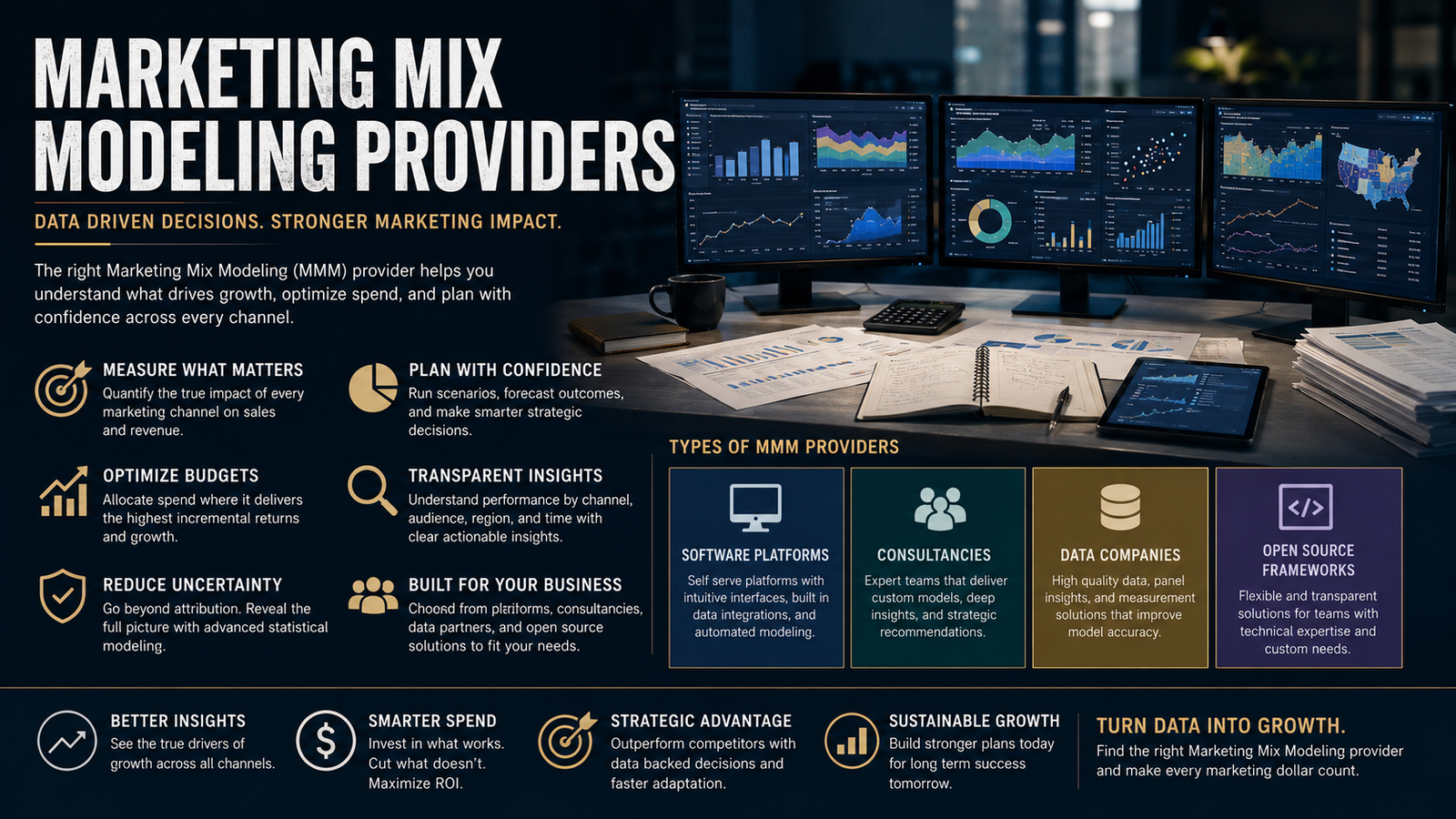
The word provider can mean several things. It may describe a consultancy that manages the complete process, a software platform operated by an internal analytics team, a measurement company with proprietary market data, or a specialist that implements an open source framework.
That difference matters. A global retailer managing television, retail media, pricing, promotions, and hundreds of stores does not need the same solution as a digital subscription company with five acquisition channels.
This guide compares the main provider types, leading companies, data requirements, modeling approaches, validation standards, costs, and questions you should ask before signing a contract. The goal is not to crown one provider. It is to help you understand which kind of provider can answer your business questions reliably.
Quick Answer: Which Marketing Mix Modeling Providers Should You Consider?
For large and complex enterprise programs, Analytic Partners, NielsenIQ, Kantar, Circana, Ekimetrics, Ipsos MMA, and Gain Theory are important names to evaluate.
These businesses generally suit organizations working across several markets, product lines, media channels, and commercial variables. They can provide experienced consultants, custom modeling, executive reporting, and support for difficult data environments. Several of these companies have also appeared in major industry evaluations of the MMM market. (www.gartner.com)
For teams that want a more technology led approach, Adobe Mix Modeler, Measured, Recast, Mutinex, Keen Decision Systems, and SegmentStream deserve consideration.
These options are generally designed around software access, recurring model updates, dashboards, simulations, and budget planning. Some are closer to self service tools. Others combine technology with statisticians, consultants, or managed implementation.
Businesses with experienced data scientists and engineers can also consider Google Meridian, Meta Robyn, and PyMC Marketing.
These open source options provide more control over the model and its assumptions. However, the company must still handle data preparation, infrastructure, model validation, interpretation, and maintenance.
There is no universal winner among marketing mix modeling providers. Your shortlist should depend on company size, industry, data quality, media mix, internal expertise, budget, required update frequency, and how much support your team needs.
What Is Marketing Mix Modeling?

Marketing mix modeling, usually shortened to MMM, is a statistical method that studies historical, aggregated data.
It attempts to estimate how marketing activities and wider business conditions affected a chosen result. That result might be revenue, sales volume, subscriptions, qualified leads, store visits, or profit.
Imagine that sales increased in November. A basic report may simply show that advertising spend also increased.
An MMM model goes further. It may estimate how much of the sales increase came from paid search, television, a seasonal shopping period, a temporary discount, wider product availability, or improving economic conditions.
The model does not need to follow every individual customer from advertisement to purchase. Instead, it studies patterns across time, markets, regions, products, or channels.
This makes MMM useful when customer journeys are incomplete, offline sales matter, or individual tracking cannot show the whole commercial picture. Gartner describes MMM solutions as tools and services that normalize data, build statistical models, measure past performance, and recommend how future spending could be improved. (www.gartner.com)
MMM still has limitations. It produces estimates, not perfect answers. Its value depends heavily on the quality of the data, the design of the model, and the way its findings are validated.
What Can an MMM Model Measure?
An MMM model can study digital advertising, paid search, paid social, television, radio, outdoor advertising, online video, retail media, email, affiliates, print, direct mail, and sponsorships.
It can also include factors that are not media channels. These may include pricing, discounts, promotions, product launches, distribution, store availability, competitor activity, weather, public holidays, inflation, and broader economic conditions.
For a retailer, distribution and promotional timing may be critical. For a subscription company, the model may need to examine trials, cancellations, product changes, and organic demand. For a business selling through partners, channel availability may matter as much as advertising spend.
The exact variables should follow the business question and available data. Adding every possible variable does not automatically create a better model. A good provider selects factors that have a defensible relationship with the outcome being measured.
Why Is MMM Different From Platform Reporting?
An advertising platform mainly reports activity that happened within its own environment.
It can show impressions, clicks, conversions, and attributed revenue. The difficulty is that customers rarely live inside one platform. They may see a television advertisement, search for the brand, read a review, visit a store, and purchase several days later.
Several platforms may claim influence over the same sale. Offline channels may receive little credit because they do not create an easily tracked click.
MMM looks at the wider business result. It studies how several channels, commercial decisions, and external conditions moved together over time.
That broader view helps answer strategic questions. How much should the business invest in television compared with paid social? Is a channel generating incremental demand or collecting credit for demand that already existed? What might happen if the total media budget changes?
Platform reporting remains useful for daily campaign management. MMM works at a broader level, helping marketing and finance make planning and budget decisions across the complete mix.
What Do Marketing Mix Modeling Providers Actually Do?
A serious provider should do much more than create a polished dashboard.
The work usually begins with the business question. The provider needs to understand what decision the model will support, which outcome matters, and how the company currently plans its marketing budget.
Next comes data collection. The provider may gather sales, revenue, media spend, impressions, pricing, promotions, distribution, calendar events, and external market information.
That data rarely arrives in perfect condition. Channel names change. Campaigns are grouped differently across platforms. Revenue definitions conflict. Historical records contain gaps. A large part of the project may involve cleaning, organizing, and reconciling these inputs.
The provider then develops the model. This involves selecting variables, estimating channel effects, accounting for seasonality, measuring delayed advertising effects, and representing diminishing returns.
Validation should follow. The provider may test the model against unseen periods, known business events, geographic experiments, incrementality studies, or other evidence.
The next task is interpretation. A model can produce hundreds of numbers, but executives need clear answers. They need to know which findings are reliable, which remain uncertain, and what decisions the results support.
Many providers also offer scenario planning. This allows the business to explore what might happen if it increases the budget, reduces spending in a channel, enters a new market, or reallocates investment.
Some providers continue refreshing the model and monitoring actual performance. Others deliver a project, presentation, and set of recommendations before handing responsibility back to the client.
This is one of the first distinctions you should clarify. Are you buying a managed measurement program, software your analysts must operate, or a combination of both?
The Main Types of Marketing Mix Modeling Providers

Before comparing company names, understand the type of relationship each provider offers.
A strong platform can still be the wrong choice if your team cannot operate it. A respected consultancy may also be unnecessary if you already employ experienced modelers and data engineers.
Full Service Consultancies
Full service consultancies manage most or all of the MMM process.
They may help define the business question, collect and clean data, construct the model, test results, create scenarios, and present recommendations to marketing, finance, and senior leadership.
This approach can work well for large organizations with several markets, products, sales channels, and offline media investments. It can also help when internal teams lack econometric or statistical experience.
The benefit is access to specialists who have handled similar commercial problems. The client also receives help translating complicated results into decisions that executives can understand.
The tradeoff is cost and control. A custom enterprise engagement can require considerable time, internal coordination, and investment.
The client may also become dependent on the consultancy for model updates or interpretation. Before choosing this route, ask what knowledge, data, assumptions, and tools will remain inside your organization.
MMM Software Platforms
Commercial MMM platforms provide an interface for running models, reviewing results, building scenarios, and refreshing analysis.
They can be attractive to marketing teams that want answers more frequently than a traditional annual study can provide. Some platforms automate data ingestion and much of the modeling process.
Software does not remove the need for judgment. Someone must still decide which business outcome matters, confirm that the data is accurate, evaluate model assumptions, and interpret uncertainty.
When comparing platforms, examine usability, customization, integrations, support, export options, and access to the model’s assumptions.
Also determine who the intended user is. A tool built for data scientists may frustrate a marketing manager. A simplified interface may feel accessible but provide too little control for an experienced analytics team.
Data and Measurement Companies
Data and measurement companies bring another advantage to MMM: information that the client may not already possess.
This can include store sales, consumer panels, category trends, brand research, media exposure, pricing intelligence, distribution, and competitor activity.
That data can be especially valuable for retailers and consumer packaged goods brands. Their performance is influenced by far more than media spend. Shelf availability, store coverage, promotions, price movements, and competitor behavior can all shape sales.
The important question is relevance. Proprietary data is valuable only when it reflects the markets, products, retailers, and customer behavior connected to your business.
Ask exactly which datasets are included, how frequently they are updated, and whether you can continue using the model if the provider relationship ends.
Open Source Frameworks and Implementation Partners
Open source MMM frameworks give companies access to modeling code and methodology without requiring a traditional software licence.
Google Meridian is an open source framework designed around transparent methodology, experiment calibration, reach and frequency analysis, and budget optimization. (developers.google.com)
Meta Robyn is another open source option. It includes automated model selection, advertising carryover, saturation analysis, experiment calibration, and budget allocation. It also works with aggregated data rather than requiring personal customer information. (facebookexperimental.github.io)
The code may be free, but the complete program is not.
Your business still needs clean historical data, technical infrastructure, statistical knowledge, quality control, dashboards, documentation, and people who can explain results.
Some businesses solve this problem by working with an implementation partner. The partner configures the framework, builds the data pipeline, validates results, and trains the internal team.
This route can offer transparency and control. It can also create a serious internal workload. Ask who will maintain the model after the initial implementation and what happens when channels, tracking systems, or business conditions change.
Hybrid Providers
Hybrid providers combine software with human expertise.
The client may receive a platform for recurring analysis alongside support from statisticians, data engineers, consultants, or measurement specialists.
This arrangement can be useful when a business wants the speed and accessibility of software but does not want to manage every technical decision internally.
Some hybrid providers also combine MMM with attribution, incrementality testing, brand research, or commercial planning.
The balance varies considerably. One provider may offer a highly managed service with a supporting dashboard. Another may provide software and limited technical assistance.
Ask how much work the provider performs after launch. You should know who checks data quality, investigates unusual results, recalibrates the model, and helps executives act on the findings.
Leading Marketing Mix Modeling Providers to Compare

The companies below are not arranged as a universal ranking.
Each serves a different type of organization and brings a different combination of data, software, consulting, research, and statistical expertise.
Compare every provider using the same questions. What is its delivery model? Who is the ideal customer? What is its strongest advantage? Where might the fit become weaker? What must the provider prove during the sales process?
Analytic Partners

Analytic Partners combines enterprise consulting with technology and a broader commercial analytics approach.
Its MMM work examines media alongside factors such as pricing, promotions, and other commercial drivers. The company also emphasizes forecasting and scenario planning, helping clients move from historical measurement into future budget decisions. (Analytic Partners)
This approach can suit large brands operating across multiple markets, products, and channels. It may also appeal to companies that want senior strategic support rather than a dashboard alone.
Its main strength is breadth. Marketing is studied as part of the wider business system instead of being isolated from pricing, sales, and market conditions.
That breadth may also create a more involved engagement. Buyers should clarify implementation responsibilities, model update frequency, software access, and the total cost of expanding into new markets or business units.
The key question is simple: how much of the model, methodology, cleaned data, and scenario planning process will your internal team be able to inspect and control?
NielsenIQ

NielsenIQ, usually branded as NIQ, combines MMM with consumer intelligence and granular retail information.
Its solution uses proprietary store level data alongside media and commercial information. NIQ also provides consultants, data integration, dashboards, and simulation tools designed to help clients measure and optimize marketing investment. (NIQ)
This can be valuable for consumer packaged goods, retail, technology, and durable goods companies. These businesses often need to understand sales through stores, categories, retailers, and geographic markets.
NIQ’s main strength is the connection between marketing analysis and commercial data. Media results can be studied alongside what actually happened at the store and category level.
A smaller digital business may not receive the same value from this data foundation. The fit becomes strongest when retail sales, promotions, distribution, and category behavior are central to the decision.
Ask which NIQ datasets will enter your model, whether they cover your actual sales environment, and how much value comes from the provider’s data compared with the MMM methodology itself.
Kantar

Kantar connects marketing mix modeling with media measurement, brand equity, creative quality, consumer research, and commercial outcomes.
Its measurement approach can include paid, owned, earned, online, and offline activity. Kantar also describes tools that connect sales information with brand and creative data while supporting recurring model updates and scenario planning. (Kantar)
This can make Kantar attractive to established brands that care about more than immediate conversions.
A performance campaign may affect this month’s sales. Brand advertising may influence awareness, consideration, and future demand over a longer period. A company measuring both effects needs a provider capable of separating them without pretending the answer is perfectly precise.
Kantar’s strength is its wider view of marketing effectiveness. The possible limitation is scope. Research, brand measurement, media analysis, and MMM may be sold as connected services but not always as one simple package.
Ask which services are included in the proposed engagement, how brand effects enter the model, and how short term results are separated from longer term influence.
Circana

Circana is particularly relevant to businesses where retail performance, consumer behavior, pricing, promotions, and category movement matter.
Its analytics capabilities include pricing and promotional scenario planning across products, brands, portfolios, and categories. This commercial context can help marketers understand results that advertising data alone cannot explain. (Circana)
Circana may be a natural option for consumer packaged goods, food, beverage, beauty, retail, and ecommerce brands selling through several channels.
Its central advantage is commercial context. A campaign can look weak when a product is unavailable in stores. A discount can increase units while reducing profit. A competitor promotion can shift category demand even when your media plan does not change.
The value of Circana will depend heavily on its data coverage within your category, markets, and retail partners.
Ask what proprietary data will be used, how direct sales and retailer sales will be combined, and whether the model can separate the effects of media, pricing, promotion, and distribution.
Ekimetrics

Ekimetrics is a data science and consulting provider suited to custom and complex marketing measurement programs.
Its MMM approach examines advertising alongside pricing, promotions, distribution, and external factors to estimate what is creating incremental business growth. (ekimetrics.com)
This can suit international companies with several brands, countries, product categories, and sales channels. Ekimetrics has also described scaling MMM across more than 120 brand and market combinations for Haleon, illustrating the kind of enterprise complexity it is equipped to address. (ekimetrics.com)
Its strength is customization. The engagement can be shaped around the company’s operating model instead of forcing every market into an identical template.
Custom work requires coordination. Data definitions, business rules, and market conditions may differ across regions. The client needs internal owners who can resolve those differences and keep the program connected to real decisions.
Ask who owns the model, how much of the methodology is documented, whether internal analysts can review assumptions, and what happens when the consultancy is no longer managing the work.
Ipsos MMA

Ipsos MMA combines marketing mix modeling with attribution, market testing, commercial analytics, technology, and strategic consulting.
Its approach studies marketing alongside pricing, competition, operations, economic conditions, and brand effects. The company also provides scenario planning and ongoing optimization through its Activate platform. (Ipsos MMA)
This can suit large advertisers that want marketing, finance, and operations to work from a shared measurement system.
A notable strength is the connection between different measurement methods. MMM can provide a strategic view, while attribution and market testing can offer more focused evidence about specific campaigns or decisions.
The buyer should still examine how these methods work together in practice. More measurement tools do not automatically create a stronger answer if their findings conflict or remain poorly explained.
Ask how experimental results calibrate the MMM model, how disagreements between methods are handled, and how uncertainty is communicated to executives making major budget decisions.
Gain Theory

Gain Theory provides marketing mix modeling, commercial analytics, optimization, and growth consulting.
Its MMM work measures the historical effect of advertising and nonmedia factors such as pricing, product launches, and promotions. Those findings can then support future simulations and budget decisions. (Understand what’s impacting your KPIs)
This can appeal to large brands looking for custom analysis and strategic planning support across markets and channels.
The main strength is the connection between measurement and future decision making. The model is not useful merely because it describes last year. It becomes valuable when it helps the business test practical investment choices.
Prospective clients should clarify how much of the engagement is consulting, how much is delivered through software, and how frequently the model can be refreshed.
Ask whether your team will receive ongoing platform access or mainly periodic reports and recommendations from the provider’s consultants.
Adobe Mix Modeler

Adobe Mix Modeler has been renamed Adobe Marketing Campaign Analytics. It now forms part of Adobe CX Analytics, although many buyers may still search for it under the original Mix Modeler name. (Adobe)
The platform brings together marketing mix modeling and multitouch attribution. It can combine marketing performance, spend, conversion data, and wider business factors while measuring paid, owned, and earned channels across online and offline activity.
It also supports scenario planning, campaign measurement, data ingestion, and budget optimization. The system is designed to help teams move from understanding past performance to comparing possible future investments.
Its most natural fit may be an enterprise already using Adobe Experience Platform, Customer Journey Analytics, or related Adobe products. Shared data and connected workflows can reduce the distance between measurement, analysis, and campaign action.
Adobe states that the solution can also use third party information, so companies do not need to rely exclusively on Adobe data. However, organizations outside the Adobe ecosystem should examine the additional integration work and determine whether they will receive the same practical value. (Adobe UK)
Its main strength is ecosystem connection. Measurement can sit closer to customer analytics, campaign planning, and marketing execution.
The central buying question is whether that integration improves your actual decision process or simply adds another expensive platform to an already crowded technology stack.
Ask how easily your existing data can be imported, which outputs can be exported, how model quality is reported, and how much control your analysts will have over assumptions and configuration.
Measured

Measured combines marketing mix modeling, incrementality testing, platform data, and media optimization within one measurement system.
Its central argument is that no single method tells the complete story. MMM provides broad channel coverage, while experiments can test whether a specific marketing activity caused additional sales. Platform data then supplies faster campaign information.
Measured says its MMM can use incrementality test results as causal priors. Its models can also be refreshed weekly, monthly, or quarterly, depending on the client’s planning needs. (Media Effectiveness Platform)
This combination may appeal to enterprise brands that want to connect measurement with actual media planning. The Media Plan Optimizer allows teams to compare scenarios and allocate spending around goals such as incremental revenue, profit, or marginal return.
The attractive phrase here is triangulated measurement. The difficult part is understanding what happens when its signals disagree.
Imagine that the MMM model shows strong paid social performance, but a geographic experiment finds limited incremental lift. The provider should explain which result receives more weight, why it receives that weight, and whether the model will be recalibrated.
Buyers should also examine channel coverage. Ask which channels can be tested directly, which rely mainly on MMM, and which depend on platform reporting.
Data requirements deserve equal attention. Confirm how much historical information is needed, which sales outcomes can be measured, and how retail, marketplace, offline, and direct revenue will be combined.
The most important question is not whether Measured uses several methods. It is how clearly those methods resolve conflicting evidence and produce one budget decision your marketing and finance teams can defend.
Recast

Recast is a technology led MMM option designed around measurement, forecasting, experiment analysis, and marketing planning.
Its proprietary Bayesian model can account for changing channel performance, promotions, funnel stages, interactions, and other business conditions. The platform also supports geographic lift testing and uses experimental findings to improve model estimates. (Recast)
Recast may suit modern marketing teams, subscription companies, consumer brands, financial technology businesses, and ecommerce organizations that need recurring measurement rather than an occasional consultancy report.
Its planning tools help teams forecast revenue, compare scenarios, and optimize budgets while applying realistic spending limits. Models can be refreshed as new information becomes available.
The Bayesian approach is valuable because it can incorporate previous knowledge and express uncertainty. However, the word Bayesian should never be treated as an automatic quality guarantee.
Buyers should ask how priors are selected, how sensitive the results are to those priors, and whether internal analysts can inspect the model configuration.
Offline coverage must also be tested against your actual business. Recast presents customer examples involving retail and direct consumer sales, but every buyer should confirm support for television, retail media, wholesale revenue, store sales, radio, outdoor advertising, and other relevant channels.
Transparency is another important issue. Recast reports checking models against real outcomes with out of sample performance scorecards. Buyers should ask to see those validation reports and understand exactly what the accuracy measure represents.
The key question is whether Recast gives your team enough visibility to challenge the model, or whether you receive recommendations from an engine that remains difficult to inspect.
Mutinex

Mutinex positions GrowthOS as a commercial mix modeling and marketing decision platform.
Its focus extends beyond reporting historical channel performance. The platform is designed to help marketing teams measure contribution, forecast outcomes, test budget scenarios, and explain investment decisions to leadership.
GrowthOS includes recurring measurement, scenario planning, granular campaign analysis, and optimization. Mutinex also promotes confidence intervals within budget scenarios, which can help users see that a recommendation is an estimate rather than a guaranteed result. (Mutinex)
This may appeal to organizations that want a faster and more accessible alternative to a traditional consultancy project.
Mutinex has also introduced an automated option designed to move from uploaded business data to a working model quickly. Speed can be useful, but it should never replace careful data review and validation. (Mutinex)
Buyers should ask how models are tested before recommendations appear in GrowthOS. That includes statistical validation, comparison with experiments, performance against unseen data, and checks against known business events.
Uncertainty reporting also deserves close inspection. A confidence range should help the buyer understand risk. It should not become a decorative addition that disappears when the platform recommends moving millions of dollars.
The final test is action. Ask how Mutinex tracks whether recommended budget changes were implemented and whether the resulting performance matched the original scenario.
A budget recommendation becomes more credible when the platform can compare the forecast with the result and use that evidence to improve the next decision.
Keen Decision Systems

Keen Decision Systems focuses on connecting marketing measurement with planning, forecasting, and budget allocation.
Its platform evaluates investment opportunities across channels, brands, and time periods. It can measure incremental revenue and profit, create scenario based plans, and send approved plans toward the systems where spending is executed. (Keen)
This makes Keen relevant to businesses that want MMM to become part of an ongoing planning process rather than a separate analytics exercise.
Its approach may be particularly useful when marketing decisions must consider brand activity, performance media, promotions, seasonal demand, and long term commercial goals.
The important question is whether the platform matches the way your business actually plans.
Some companies allocate budgets annually. Others adjust them monthly or weekly. Some plan by brand and country. Others work by product, retailer, customer segment, or acquisition target.
Ask whether Keen can reflect your real budget rules, minimum commitments, seasonal limits, agency contracts, and channel restrictions.
Buyers should also examine forecasting. Request examples showing how previous forecasts compared with actual business outcomes. A planning tool should show where it was wrong, not merely celebrate the scenarios that looked accurate.
The platform must also fit the internal decision process. Confirm who will operate it, who approves recommendations, and whether finance, marketing, brand teams, and media agencies can work from the same assumptions.
SegmentStream

SegmentStream is positioned around automated marketing measurement, cross channel attribution, incrementality testing, marginal analysis, scenario planning, and budget allocation.
Its current platform connects with advertising systems, analytics tools, CRM platforms, and data warehouses. It can analyze performance across channels and recommend where additional spending may continue to produce value. (segmentstream.com)
SegmentStream sits closer to a marketing measurement engine than a traditional consulting led MMM engagement.
That difference should be discussed clearly. Buyers need to know which conclusions come from marketing mix modeling, which come from attribution, and which are produced through marginal performance analysis or experiments.
Its automation may appeal to digital teams that want measurement and budget decisions to operate more frequently.
However, frequent optimization is useful only when the system is working at the correct level of detail. Ask whether it can model separate countries, regions, brands, products, customer groups, and campaigns.
A company operating in one country with a single product has a different measurement problem from a global business managing dozens of brands and currencies.
Buyers should also confirm support for offline revenue, retail media, television, radio, outdoor advertising, distributors, and marketplace sales.
The key question is whether SegmentStream can represent your complete commercial reality or mainly the part of marketing that already lives inside connected digital systems.
Other Providers Worth Evaluating
OptiMine offers agile marketing measurement and optimization across digital and traditional channels. Its platform emphasizes privacy safe measurement, detailed campaign analysis, scenario planning, and specialist support. (OptiMine – OptiMine)
Sellforte combines Bayesian MMM, incrementality testing, attribution, validation, and recurring optimization. Its strongest positioning is around retail, ecommerce, and direct consumer businesses. (Sellforte)
Marketing Evolution approaches the problem through unified measurement and marketing data infrastructure. Buyers considering it should clarify how much of the proposed solution is MMM, attribution, journey modeling, data preparation, or wider measurement architecture. (Marketing Evolution)
MASS Analytics combines MMM software, data preparation, optimization, consulting, and training. It may suit organizations that want to build more modeling capability inside their own analytics team. (Always-On Marketing Analytics Platform)
C5i combines marketing data infrastructure, analytics, MMM, pricing, promotions, incrementality, and scenario planning. It may be relevant to enterprises looking for a broader analytics partner rather than a single purpose tool. (C5i)
Fractal Analytics can also be considered for custom analytics and data science engagements where MMM forms part of a larger business transformation program.
Specialist implementation partners deserve a place on the shortlist as well. They can build models using Meridian, Robyn, or PyMC Marketing while helping with data engineering, validation, dashboards, and internal training.
The point is not to evaluate every name in the market. It is to create a focused shortlist of providers that match your delivery model, industry, data maturity, and decision process.
Are Google Meridian and Meta Robyn Really Providers?
Google Meridian and Meta Robyn frequently appear beside commercial marketing mix modeling providers.
That can be confusing because they are not full service providers. They are open source modeling frameworks.
A framework gives your team code, methodology, documentation, and modeling features. It does not automatically provide clean data, a complete data pipeline, business interpretation, executive reports, or someone accountable for maintaining the system.
Your company may still need data engineers, statisticians, cloud infrastructure, visualization tools, consultants, testing programs, and internal model governance.
This does not make open source a weak option. It simply means the buying decision changes.
Instead of paying primarily for software or consulting, the company invests in people, implementation, computing, maintenance, and internal ownership.
Google Meridian
Google Meridian is an open source Bayesian MMM framework.
It is designed to model marketing performance using aggregated data while supporting geographic analysis, experiment calibration, reach and frequency inputs, and budget optimization.
Its Bayesian structure allows modelers to include prior knowledge. Results from previous experiments can be introduced through prior distributions when the evidence is suitable.
Meridian also supports geographic modeling. This can help a company use variation across markets instead of relying only on national changes over time.
Reach and frequency features can be useful for video and other channels where total spend alone does not explain performance. Two campaigns with the same budget may produce different results because one reaches more people while the other repeatedly reaches the same audience.
Google’s documentation includes fixed budget and flexible budget optimization.
A fixed budget scenario searches for a stronger allocation without changing the total amount. A flexible scenario can explore how much the business could spend while maintaining an ROI or marginal ROI target. (developers.google.com)
The central advantage is control. The code and methodology are open, so a capable team can inspect assumptions, customize inputs, and build its own reporting environment.
The cost is technical responsibility. Meridian requires Python skills, statistical judgment, computing resources, data preparation, model checking, and ongoing maintenance.
Your team must also remember that Meridian is created by Google, a major advertising seller. Open code improves transparency, but companies should still validate results across all channels and use independent business evidence where possible.
Meta Robyn
Meta Robyn is an open source MMM package designed to automate several difficult stages of model development.
It uses ridge regression, automated hyperparameter optimization, time series decomposition, and model selection processes to produce candidate models.
Robyn accounts for adstock, which represents the effect of advertising continuing after the original exposure.
It also models saturation. This reflects the reality that the next dollar invested in a channel may produce less value than earlier spending.
Robyn can use experiment results to calibrate the model. It also includes a budget allocator that can search for an improved channel mix under a fixed budget or a target efficiency goal. (facebookexperimental.github.io)
Automation makes model development faster, but it does not remove the need for statistical judgment.
A technically acceptable model can still produce a commercially implausible story. Your team must examine variable selection, data quality, channel relationships, experiment quality, and the stability of results.
Robyn can work well for companies with analysts comfortable using its technical environment and interpreting model output.
It is less suitable for a marketing team expecting to upload a spreadsheet and immediately receive a final budget answer without technical review.
PyMC Marketing
PyMC Marketing is an open source Python library for Bayesian marketing analytics.
It gives advanced data science teams considerable control over model design. Users can customize priors, likelihoods, adstock functions, saturation functions, time varying effects, and other elements. (pymc-marketing.io)
This flexibility can be valuable when a business has unusual sales patterns, specialist channels, complex prior evidence, or experienced statisticians who do not want to work inside a fixed commercial platform.
Bayesian uncertainty quantification is another important advantage. Instead of returning only one apparently exact ROI number, the model can show a distribution of plausible outcomes.
The tradeoff is technical burden.
Your company must design the model, test the code, manage the computing environment, document assumptions, create reporting, and explain the results to decision makers.
PyMC Marketing is powerful in the right hands. It is not a shortcut around the work required to build a trustworthy measurement program.
How to Compare Marketing Mix Modeling Providers

The best marketing mix modeling providers do not simply explain what happened. They help your business make a decision and show why that decision is credible.
That means the buying process should begin with your commercial problem, not a vendor demonstration.
Start With the Business Decision
Write down the decision before speaking with providers.
You may need to reallocate next quarter’s advertising budget. You may want to compare brand and performance media. You may need to understand whether promotions are creating incremental demand or merely lowering margins.
Other businesses may want to compare regional growth, justify television investment, measure retail media, or decide whether the total marketing budget should increase.
The provider should design the model around that decision.
If you cannot name the action the model will support, the project may become an expensive reporting exercise. You will receive polished contribution charts but no clear reason to change the plan.
A useful question is: what will we do differently if the model produces a credible answer?
Check Online and Offline Channel Coverage
Do not assume that every provider can measure every channel equally well.
Confirm support for paid search, paid social, display, video, affiliates, email, retail media, television, radio, print, outdoor advertising, sponsorships, and direct mail.
Then examine the commercial factors surrounding those channels. Can the model include pricing, promotions, distribution, store availability, competitor actions, product launches, and economic conditions?
Ask how offline exposure is measured. Television spend, audience ratings, reach, and frequency tell different stories. Radio, outdoor advertising, and sponsorships may require different data structures again.
A platform built mainly for digital acquisition may be excellent for ecommerce and weak for a consumer brand with large retail and television investments.
Channel coverage should match your actual media mix, not the mix featured in the provider’s best case study.
Examine the Modeling Method
Ask the provider to explain its modeling method in plain language.
It may use Bayesian modeling, frequentist statistics, machine learning, causal methods, or a hybrid design. None of these labels proves quality by itself.
Ask how the model handles adstock. Advertising can continue influencing demand after the original campaign exposure.
Ask how it models saturation and diminishing returns. Spending twice as much in a channel rarely creates exactly twice the outcome.
The provider should also explain seasonality, trends, holidays, control variables, economic conditions, promotions, and competitor activity.
Listen carefully to the explanation. If the provider cannot explain the model without hiding behind technical vocabulary, your marketing and finance teams may struggle to trust its recommendations.
Demand Proper Validation
A model should be tested against evidence it did not simply memorize.
Holdout testing can examine how the model performs on a period excluded from model development.
Time based validation can test whether the model explains later business results using earlier information.
Geographic experiments can compare areas where marketing activity changed with suitable control areas.
Incrementality tests can estimate whether a campaign caused additional sales, conversions, or another outcome.
Known business events provide another useful check. If stores were closed, a product was unavailable, or a major promotion occurred, the model should produce an explanation consistent with that reality.
Ask to see validation results, not a general statement that validation occurs.
A clean dashboard can display an unreliable model beautifully. Visual quality and statistical credibility are different things.
Look for Uncertainty, Not False Precision
MMM produces estimates.
A channel may have an estimated ROI of 3.2, but that does not mean the true answer is exactly 3.2 under every future condition.
A responsible provider should show a credible range, explain uncertainty, and identify channels the model cannot measure confidently.
This information helps the business understand risk. A channel with an estimated ROI between 2.8 and 3.4 presents a different decision from one with a range between 0.8 and 5.6.
Be cautious when every channel receives a highly precise number and every recommendation sounds certain.
Honest uncertainty is not a weakness. It is evidence that the provider understands the limits of observational data.
Review Model Transparency
Ask what your team will be allowed to inspect.
This should include source data, cleaning rules, channel definitions, transformations, prior assumptions, control variables, model specifications, validation results, and uncertainty ranges.
You should understand how channels were grouped and how missing information was handled.
Documentation also matters. A model can become impossible to maintain when its original builders leave and nobody understands the decisions made during implementation.
Transparency becomes even more important when the output will influence millions in marketing investment.
Your executives should not be asked to trust a recommendation simply because the software looks sophisticated.
Confirm Data and Model Ownership
Ownership should be settled before the contract begins.
Ask who owns the original data, cleaned data, model configuration, source code, reports, dashboards, historical results, and experiment records.
Confirm whether you can export information in a usable format.
Find out what happens if the contract ends. Can your team continue using previous results? Can another provider rebuild or refresh the model? Will important data transformations disappear with your account?
A business should not discover after cancellation that years of measurement work are trapped inside a closed platform.
Compare Refresh Frequency Carefully
Weekly and monthly refreshes can help businesses respond faster.
They may capture changing channel performance, new campaigns, promotions, economic shifts, and changes in customer demand.
However, frequent updates do not automatically improve accuracy.
A weak model refreshed every week remains a weak model. New data can also create unstable results if the provider changes estimates without explaining why.
Ask whether each refresh rebuilds the model, updates selected parameters, or simply adds new reporting data.
The provider should show whether conclusions remain stable and explain meaningful changes.
Refresh frequency should follow the speed of your decisions. A company that reallocates spending quarterly may not need daily modeling. A digital business changing budgets every week may need faster evidence.
Examine Scenario Planning
Scenario planning should answer practical questions.
What might happen if the total budget increases by 15 percent? Which channels appear saturated? What if television spending falls while retail media increases? How much investment may be required to reach a revenue target?
The provider should allow realistic limits.
A recommendation is useless if it suggests doubling spending in a channel that cannot absorb the money, reducing a contracted television commitment, or entering a market where the product is unavailable.
Good scenarios should include minimum spending, maximum spending, timing, channel capacity, business targets, and diminishing returns.
They should also show uncertainty. The output is a modeled possibility, not a promise about future revenue.
Assess Integrations and Data Pipelines
MMM depends on the quality of its inputs.
Review connections with advertising platforms, CRM systems, ecommerce platforms, retailers, marketplaces, financial systems, data warehouses, and business intelligence tools.
Ask how the provider handles changing campaign names, currency differences, duplicated spending, missing records, attribution changes, and tracking interruptions.
Data definitions must remain consistent. Revenue cannot mean gross sales in one system and net sales in another without adjustment.
Automated connectors can reduce manual work, but they still require monitoring. An incorrect connection can move bad data into the model faster.
Poor preparation can weaken the most sophisticated statistical method. Data engineering is not background administration. It is part of measurement quality.
Compare Support and Internal Workload
Clarify who performs every part of the project.
Who collects the data? Who fixes inconsistencies? Who selects model variables? Who reviews unusual outputs? Who runs scenarios? Who presents findings to finance?
Also ask who trains your internal team and who supports the model after launch.
A lower software fee may look attractive until your company must hire data engineers, analysts, statisticians, and consultants to keep the system operating.
The right option depends on your existing team.
A company with experienced analysts may value control and flexibility. A lean marketing department may need a managed service that provides interpretation as well as technology.
Calculate the Total Cost
Do not compare providers using the headline fee alone.
Include implementation, data engineering, integrations, cloud computing, experiments, custom dashboards, consultant support, training, maintenance, and model refreshes.
Ask about charges for additional countries, brands, products, outcomes, channels, users, and data sources.
Open source options have no traditional software licence, but they still require people, infrastructure, validation, and maintenance.
Commercial platforms may reduce internal development work but introduce annual contracts and expansion fees.
Consultancies may provide deeper support but require a larger initial investment.
The real question is not which provider has the lowest price. It is which option can produce credible, usable decisions at the lowest complete cost to your organization.
How Much Data Do You Need for MMM?

There is no reliable universal answer to how much data a marketing mix model needs.
Some providers suggest specific periods, but time alone does not determine data quality. Two years of weak, repetitive information may reveal less than one year containing meaningful changes across markets, channels, promotions, and business conditions.
The right amount depends on the number of channels, geographic detail, sales frequency, campaign patterns, seasonality, and complexity of the model.
A national model based on monthly data has different requirements from a regional model using weekly sales across dozens of locations. Google’s Meridian documentation also explains that data requirements can vary between national and geographic models. (developers.google.com)
Sufficient history matters because the model needs to observe repeated patterns. It must see how outcomes behaved during busy periods, quiet periods, promotional events, and changes in advertising activity.
Regular time intervals are equally important. Weekly data is common because it provides more detail than monthly totals without introducing the noise that can appear in daily results.
The model also needs variation. If a company spends almost the same amount in every channel every week, it becomes difficult to estimate what each channel contributed.
Consistent KPI definitions are essential. Revenue cannot mean gross sales during one period and net sales during another. Leads cannot include unqualified form submissions one year and sales accepted opportunities the next.
Control variables help separate marketing from other forces. Without pricing, promotions, distribution, holidays, competitor activity, and economic conditions, the model may give advertising credit for growth caused elsewhere.
The honest answer is that data should be evaluated before a provider promises a dependable model. Any company offering a guaranteed result after hearing only the number of months available is moving too quickly.
Essential Data Categories
The model needs a clearly defined business outcome. This may be revenue, units sold, profit, subscriptions, qualified leads, pipeline value, store visits, or another meaningful KPI.
Media investment data should show how much was spent in each channel over consistent periods. Greater detail may be needed by market, product, campaign, audience, or business unit.
Exposure metrics can add context. Impressions, reach, frequency, clicks, video views, audience ratings, and other measures may help explain what the media investment actually delivered.
Promotional data should include discounts, coupons, sales events, bundles, and retailer promotions. These activities can increase demand while changing margin, so they should not be confused with advertising impact.
Pricing data is important when prices changed during the modeling period. A product sold at a lower price may generate more units even if marketing performance remains unchanged.
Distribution and availability should also be included. Advertising cannot create a sale when the product is unavailable, a store is closed, or distribution has not reached the market.
Product launches, packaging changes, major website updates, supply problems, and service changes can all influence results.
Geographic information may allow the model to study variation between countries, regions, cities, stores, or sales territories.
Holidays and seasonal events help explain predictable demand patterns. The model may also need weather data when temperature, rainfall, or extreme conditions influence customer behavior.
Competitor launches, promotions, advertising activity, and price changes may provide valuable context when that information is available.
Economic variables can include inflation, unemployment, consumer confidence, interest rates, and industry growth. The most relevant variables depend on what the business sells and who buys it.
More data is not automatically better. Each category should have a clear reason for entering the model.
What If Your Data Is Incomplete?
Incomplete data does not always end an MMM project, but it changes what the model can credibly answer.
A provider may fill small gaps using statistical methods, related business information, or carefully documented assumptions. Larger gaps may require the affected channel or period to be excluded.
Campaign naming changes are common. One platform may rename a channel, agency, campaign type, or conversion event halfway through the historical period.
The provider may create a consistent classification system that maps old and new names into the same structure. That mapping should be documented and reviewed by someone who understands the campaigns.
Tracking interruptions create a different problem. Missing clicks may be manageable if spending and sales information remain available, but missing revenue or media investment can weaken the model considerably.
Duplicated spend can make a channel appear more expensive and less efficient than it was. Data pipelines should identify whether agency records, advertising platforms, and financial systems are reporting the same investment.
Inconsistent revenue definitions must be resolved before modeling begins. Gross sales, net revenue, booked revenue, recognized revenue, and marketplace sales cannot be combined casually.
A provider should explain which problems can be corrected, which require assumptions, and which create genuine limitations.
Be cautious if the sales team promises accurate ROI before the technical team has reviewed your data. A trustworthy provider discusses gaps, risks, and compromises before promising results.
Best Provider Type for Different Businesses

The right provider depends on how your company operates.
A provider that works beautifully for a global retailer may be unnecessarily expensive for an ecommerce business. A flexible open source framework may suit an experienced data science team and overwhelm a small marketing department.
Large Enterprise Brands
Large enterprise brands should consider full service consultancies, enterprise software platforms, data rich measurement companies, and hybrid providers.
Analytic Partners, Kantar, Ekimetrics, Ipsos MMA, Gain Theory, NielsenIQ, Circana, Adobe Marketing Campaign Analytics, Measured, and similar providers may support complex programs.
These organizations often need modeling across several countries, products, currencies, retailers, and business units.
They may also require executive reporting, formal governance, offline media measurement, scenario planning, and coordination between marketing, finance, sales, and operations.
The provider should demonstrate that its methodology can scale without forcing every market into assumptions that do not reflect local conditions.
Midmarket Ecommerce Companies
Midmarket ecommerce companies may prefer accessible commercial platforms with recurring updates and faster data integration.
Recast, Mutinex, SegmentStream, Sellforte, Measured, and other technology led providers may deserve consideration, depending on budget and complexity.
Useful capabilities include connections with advertising platforms, ecommerce systems, marketplaces, CRM tools, and data warehouses.
Scenario planning is particularly valuable. Ecommerce teams often need to decide whether the next dollar should go toward paid search, social advertising, affiliates, influencers, video, or another channel.
The provider should still account for promotions, pricing, organic demand, inventory, and seasonal events. Digital businesses are not protected from wider commercial influences simply because their sales happen online.
Retail and Consumer Brands
Retail and consumer brands should look for providers with experience in store sales, pricing, promotions, distribution, category behavior, and retail media.
NielsenIQ, Circana, Kantar, Analytic Partners, Ekimetrics, Ipsos MMA, and Sellforte may be relevant options.
The value often comes from connecting advertising activity with what happened across stores, retailers, products, and markets.
A provider should understand that sales may fall because a product was unavailable, not because the media stopped working.
Ask whether it can separate the effects of advertising, price changes, promotions, distribution, competitor actions, and category demand.
B2B Companies
MMM is not limited to consumer brands.
It can work for B2B companies when they have enough marketing activity, consistent outcome data, and a meaningful KPI.
That KPI might be qualified leads, sales accepted opportunities, pipeline value, booked revenue, or completed contracts.
The challenge is timing. A B2B sale may take months, and several people may influence the purchase. The model must represent the delay between marketing activity and commercial outcome.
B2B companies should ask whether the provider can handle long sales cycles, low conversion volumes, account based programs, events, content, partner channels, and sales team activity.
If the company has only a small number of deals, limited spending variation, and inconsistent CRM records, MMM may struggle to produce stable estimates.
Businesses With Internal Data Science Teams
Companies with capable data scientists and engineers can consider Google Meridian, Meta Robyn, and PyMC Marketing.
These frameworks offer greater control over model design, data preparation, assumptions, validation, and reporting.
Meridian may appeal to Python teams interested in Bayesian modeling, geographic analysis, experiment calibration, and budget optimization.
Robyn may suit teams comfortable with its technical environment and automated model selection process.
PyMC Marketing offers extensive flexibility for advanced Python users who want to customize priors, adstock, saturation, and uncertainty analysis.
An implementation partner can help the internal team configure the framework, build pipelines, review methodology, and establish governance.
The company should still assign clear ownership. Open code will not maintain itself when channels, data definitions, or business conditions change.
Smaller Businesses With Limited Data
MMM may not yet be the right investment for a smaller business.
If marketing spend is low, channels rarely change, conversions are limited, or sales records are inconsistent, the model may not have enough information to separate channel effects.
A sophisticated platform cannot manufacture evidence that the data does not contain.
The business may receive greater value from improving conversion tracking, cleaning CRM records, standardizing revenue definitions, and connecting advertising data with actual sales.
Carefully designed experiments can also be more useful. A business might pause a channel in selected locations, test a promotion with a control group, or compare similar markets under different spending levels.
MMM becomes more valuable when the company has enough scale, history, variation, and decision complexity to justify it.
Marketing Mix Modeling Versus Attribution
Marketing mix modeling and attribution answer related but different questions.
MMM uses aggregated information to estimate how marketing, commercial decisions, and external factors affected an overall business outcome.
Attribution uses tracked customer journeys or events to assign conversion credit to particular touchpoints.
Attribution can provide useful campaign, keyword, advertisement, audience, and placement detail. It can help marketers manage daily digital activity.
Its weakness is that the journey may be incomplete. Cookies disappear. Customers change devices. Offline exposure is missed. Several platforms may claim the same conversion.
MMM offers broader channel coverage and does not require every customer to be tracked individually.
Its weakness is granularity. It may provide strong guidance about a channel while offering less certainty about an individual advertisement or audience.
Neither method should be declared universally superior. The right choice depends on the decision being made.
Adobe, for example, describes MMM as aggregate measurement and multitouch attribution as event level analysis. Its measurement platform combines the two approaches rather than treating one as a complete replacement for the other. (business.adobe.com)
Where Incrementality Testing Fits
Incrementality testing asks a sharper question: what additional outcome was caused by the marketing activity?
A controlled experiment may expose one group or region to a campaign while keeping a suitable comparison group unexposed.
The difference between the groups can provide stronger causal evidence when the test is designed and executed properly.
Experiments are powerful, but they cannot answer every question. Testing television, nationwide sponsorships, or several interacting channels can be difficult and expensive.
Results may also apply only to the tested period, audience, spending level, or market.
This is why mature measurement programs often combine methods.
MMM provides the wider commercial view. Attribution offers campaign and journey detail. Experiments supply causal evidence for selected questions. Brand research helps measure awareness, consideration, and preference.
Measured, Sellforte, Recast, and other providers use experiment results to calibrate or challenge model estimates. The important part is understanding how conflicting evidence is resolved. (www.measured.com)
How MMM Connects With Marketing Automation
MMM helps a business decide where marketing money may work hardest.
Marketing automation helps the team execute campaigns, connect systems, manage workflows, and respond to customer behavior.
These are connected jobs, but they are not the same job.
An MMM model may recommend increasing email investment because the channel appears to generate strong incremental value.
The automation platform handles what happens next. It may segment customers, trigger messages, manage lead nurturing, recover abandoned carts, or move information between marketing and sales systems.
MMM looks across historical patterns and commercial outcomes. Automation performs repeatable actions according to defined rules, customer signals, or campaign schedules.
The connection becomes valuable when information flows in both directions. Automation systems create campaign and customer data that can support measurement. MMM findings can guide where automation resources and budgets should be concentrated.
If you are building the execution side of that system, the Eadoz guide to digital marketing automation tools explains how different platforms can support campaigns, workflows, reporting, and customer journeys.
Common Mistakes When Choosing a Provider
One common mistake is choosing a provider because its case study reports an impressive ROI improvement.
A vendor case study shows what happened for one client under specific conditions. It does not prove that your data, market, channels, and implementation will produce the same result.
Another mistake is ignoring data quality. Even a sophisticated model will struggle with duplicated spend, missing sales records, inconsistent campaign names, and changing KPI definitions.
Some buyers confuse attribution with MMM. They purchase a detailed digital reporting tool and later discover that it cannot measure television, retail, pricing, promotions, or wider business conditions.
Unexplained methodology is another warning sign. You do not need to become a statistician, but the provider should explain how the model handles carryover, diminishing returns, seasonality, controls, and uncertainty.
Businesses also overlook offline channels. A digital dashboard may appear complete while ignoring stores, call centers, distributors, radio, outdoor advertising, sponsorships, and other revenue sources.
Failing to validate results is especially dangerous. A model can fit historical data while producing unreliable budget recommendations.
Some companies buy software without enough internal expertise. They expect the platform to clean data, make modeling decisions, challenge strange outputs, and explain results automatically.
Finally, do not let the dashboard choose the provider.
The best interface in the sales demonstration may hide weak assumptions underneath. Choose the provider that can answer your business question, explain its limitations, and show how its recommendations were tested.
Questions to Ask During an MMM Provider Demo

A provider demonstration should reveal how the system works with real decisions, not simply display polished charts.
Ask these questions before moving forward:
- What historical data do you require, and why is that amount appropriate for our business?
- How do you handle missing records, changing campaign names, duplicated spend, and inconsistent KPI definitions?
- Which modeling method do you use, and how do you represent adstock, saturation, seasonality, and external factors?
- Can experiments or previous business evidence calibrate the model?
- How do you validate the model using holdouts, geographic tests, later periods, or known business events?
- How do you report uncertainty, and what happens when a channel cannot be measured confidently?
- Which online and offline channels can you genuinely support?
- How frequently is the model refreshed, and what changes during each refresh?
- Can we inspect assumptions, transformations, model specifications, and validation results?
- Who owns the cleaned data, model, code, reports, and historical outputs?
- Can we export the data and results into our warehouse or business intelligence tools?
- Which advertising, CRM, ecommerce, retail, and financial systems can you connect?
- What work must our internal team complete before and after launch?
- How much customization is available across countries, products, brands, and business units?
- How long will implementation take after the data is ready?
- What is the complete cost, including integrations, support, training, refreshes, and additional markets?
- What happens to our data, model, and reports if the contract ends?
Before the demonstration finishes, ask the provider to trace one recommendation from the original data through the model and into the budget decision.
If the team cannot explain that path clearly, the recommendation may be difficult to defend once finance begins asking questions.
Frequently Asked Questions About Marketing Mix Modeling Providers
Which Marketing Mix Modeling Provider Is Best?
There is no single best provider for every company.
Large global brands may need enterprise consultancies or data rich measurement companies. Ecommerce teams may prefer recurring commercial platforms. Technical organizations may choose Meridian, Robyn, or PyMC Marketing.
The best fit depends on your business model, media mix, data maturity, budget, internal expertise, and required level of support.
How Much Do MMM Providers Cost?
Pricing varies widely because the delivery models are different.
A software platform may charge an annual subscription. A managed provider may combine licensing with implementation and consulting fees. An enterprise consultancy may price a custom engagement around countries, brands, channels, and complexity.
The quoted fee may not include data engineering, integrations, experiments, dashboards, training, model refreshes, or additional markets.
Compare total cost rather than the opening proposal.
How Long Does MMM Implementation Take?
Implementation may take weeks or months.
The biggest variable is often data readiness. A company with organized weekly sales, media, pricing, and promotional information can move faster than one with fragmented records across agencies and regions.
The number of markets, brands, outcomes, channels, and integrations also affects timing.
Automated platforms may launch faster, but speed should not remove the need for data review, validation, and stakeholder agreement.
Can MMM Measure Both Digital and Offline Marketing?
Yes, MMM can measure digital and offline activity.
The model may include paid search, social media, television, radio, outdoor advertising, retail media, print, email, affiliates, and other channels.
Actual coverage depends on the provider and available data.
Ask how each channel is represented and whether the provider has relevant experience with your media mix.
How Often Should an MMM Model Be Updated?
The right frequency depends on how quickly your business makes decisions and receives dependable data.
A digital business adjusting budgets weekly may benefit from frequent updates. A company planning major media commitments quarterly may not need the same cadence.
Frequent refreshes are helpful only when new data improves the model. Updating a weak model every week does not make it trustworthy.
Is Open Source MMM Really Free?
The framework may be free to access, but implementation is not free.
The company still needs data engineering, statistical expertise, computing infrastructure, dashboards, documentation, validation, and maintenance.
Open source can reduce licensing costs and increase control. It also transfers more responsibility to the internal team.
Can Small Businesses Use Marketing Mix Modeling?
A small business can use MMM when it has enough historical data, marketing variation, conversions, and decision complexity.
However, many smaller companies will gain more from improving basic tracking and running focused experiments first.
If the business uses only a few channels and has limited sales volume, a complex model may create more confidence than evidence.
How Can You Tell Whether an MMM Model Is Accurate?
No single metric proves that a model is accurate.
Look for holdout testing, later period performance, experiment calibration, geographic tests, uncertainty ranges, and comparison with known business events.
Results should also make commercial sense. If a model gives enormous credit to a channel that barely changed while ignoring a major price promotion, the provider should investigate.
Transparency matters. You should know which data entered the model, which assumptions were used, and where uncertainty remains.
Final Answer: Choosing Between Marketing Mix Modeling Providers
Start by shortlisting marketing mix modeling providers according to delivery model.
Decide whether your company needs a full service consultancy, commercial software platform, data and measurement partner, hybrid solution, or open source implementation.
Then compare data requirements, methodology, validation, transparency, channel coverage, scenario planning, integrations, internal workload, ownership, and total cost.
Do not choose a provider because it presents the longest feature list or the most attractive dashboard.
Choose the one that can produce credible evidence, explain what the model cannot know, and help your business make better marketing investment decisions.
The strongest provider is not the one promising perfect certainty. It is the one prepared to show its work.
Continue Reading
Better measurement tells you where to invest. Better execution helps you act on that knowledge.
Explore the Eadoz guide to digital marketing automation tools to learn how automation can improve campaign execution, data movement, reporting, and customer workflows.


