-
- No Comments
- March 19, 2026

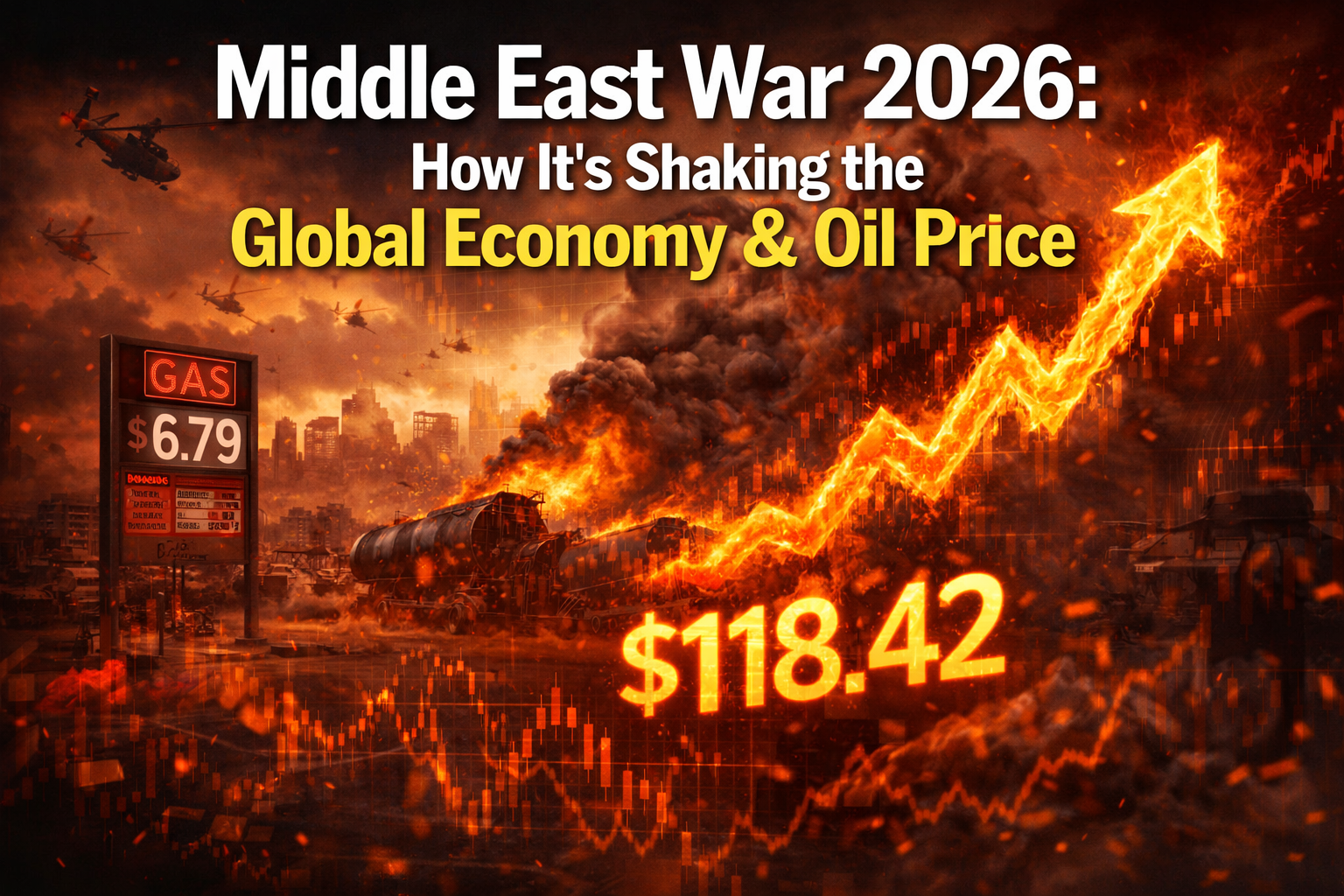
Middle East War 2026: How It’s Shaking the Global Economy & Oil Price
1. A War That Hit Your Wallet
It didn’t start at the petrol pump. But that’s where you felt it first.
Fuel prices ticking upward. Grocery bills creeping higher week by week. Flights getting expensive. Markets swinging like they’ve lost their footing. What looks like everyday inflation is, in reality, the aftershock of something far bigger.
The Middle East war of 2026 isn’t just another geopolitical headline buried between politics and policy. It’s a global economic event one that has quietly slipped into supply chains, energy markets, and household budgets across continents.
Because when oil moves, everything moves.
And right now, oil isn’t just moving it’s surging.
So the real question isn’t what’s happening in the Middle East.
It’s this:
How did a regional conflict trigger a worldwide economic shock that’s now hitting your wallet?
2. The Trigger: How the Middle East War Started in 2026
2.1 The February 2026 Escalation
The spark came fast and hit hard.
In late February 2026, a coordinated U.S.–Israeli military campaign against Iran reshaped the geopolitical landscape overnight. The operation resulted in the killing of Iran’s Supreme Leader, a move that didn’t just escalate tensions it detonated them.
Tehran’s response was immediate and aggressive.
Missile strikes and military actions rippled across the Gulf, targeting strategic positions and signaling that this would not remain a contained conflict. Within days, the region shifted from uneasy tension to active confrontation.
And the world started paying attention not just politically, but economically.
2.2 From Regional Conflict to Global Crisis
What turned this from a regional war into a global economic shock wasn’t just the fighting it was where the fighting happened.
Key oil infrastructure became a target.
Shipping routes turned unstable.
Airspace disruptions began affecting international travel.
But the real pressure point?
The Strait of Hormuz.
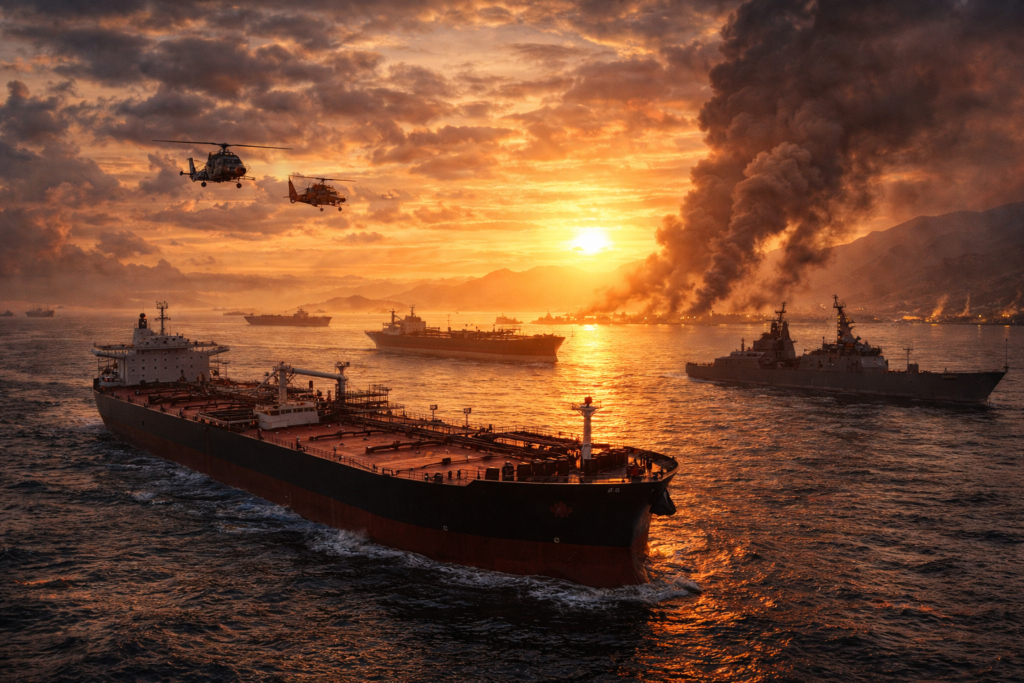
This narrow waterway one of the most critical arteries of global energy supply suddenly became a chokehold. With attacks, threats, and temporary shutdowns, the flow of oil and gas through the region was no longer guaranteed.
And once that certainty disappeared, markets reacted instantly.
Because global economies don’t wait for wars to end.
They react the moment supply is at risk.
3. The Oil Shock: Why Energy Markets Reacted Instantly
3.1 Brent Crude Price Explosion
Before the conflict, oil markets were relatively stable.
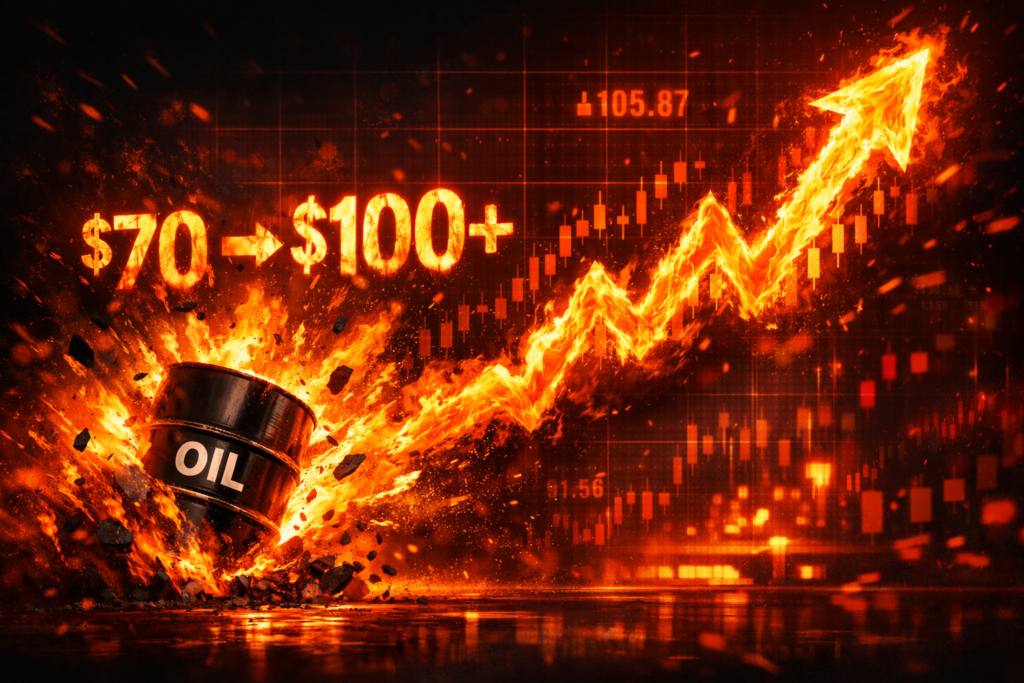
Brent crude hovered around $70–72 per barrel a level that, while not cheap, was predictable. Businesses could plan. Governments could forecast. Markets could breathe.
Then the war hit.
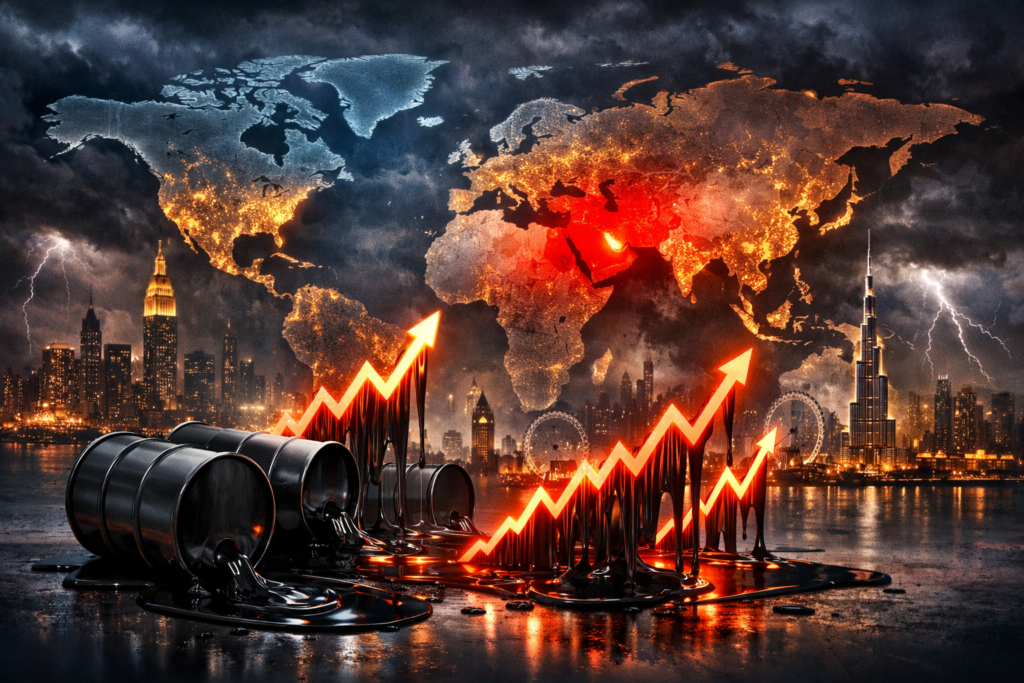
Within weeks, prices surged past $100, even touching $106 per barrel. Not a gradual climb a sharp, aggressive spike driven by fear, uncertainty, and the looming threat of supply disruption.
This wasn’t just a price increase.
It was a shockwave.
3.2 Natural Gas and LNG Spike
Oil wasn’t the only casualty.
Liquefied natural gas (LNG) a critical energy source for many countries saw prices jump by nearly 60% compared to pre-war levels.
Why? Because energy markets are deeply interconnected.
When oil supply tightens, countries scramble for alternatives. Demand for gas rises. Prices follow. And suddenly, the ripple effect spreads across power generation, heating costs, and industrial production.
What started as an oil issue quickly became a full-scale energy crisis.
3.3 The Strait of Hormuz Bottleneck
At the center of it all sits a narrow stretch of water with outsized global importance.
Roughly 20% of the world’s daily oil and LNG flows pass through the Strait of Hormuz. When that flow is disrupted even temporarily it sends a signal louder than any official statement: supply is no longer secure.
And markets hate uncertainty more than anything.
Partial shutdowns, rerouted tankers, and rising security risks created a bottleneck that squeezed global supply. The result? Panic buying, speculative trading, and rapidly escalating prices.
It wasn’t just about what was lost.
It was about what could be lost next.
3.4 Future Price Scenarios
Now, the market is split between two futures.
If the conflict de-escalates, analysts expect prices to stabilize potentially easing back toward the $70–71 range by late 2026. A return to relative normalcy, though not without scars.
But if the war drags on?
The ceiling breaks.
Forecasts suggest oil could spike toward $120–130 per barrel, a level that would amplify inflation, strain economies, and push vulnerable countries closer to crisis.
In other words, the trajectory of oil prices now depends less on economics and more on geopolitics.
And that’s what makes this moment so volatile.
4. The Domino Effect: How Oil Prices Hit the Global Economy
Oil doesn’t stay in barrels. It seeps into everything.
From the trucks that move your food to the factories that produce it, energy is the invisible backbone of the global economy. So when oil prices spike, the impact doesn’t trickle it cascades.
What begins as an energy shock quickly turns into an economic chain reaction.
4.1 Inflation Surge Worldwide
The first hit lands where it always does: costs.
Transport becomes more expensive. Manufacturing margins shrink. Energy bills climb. And businesses, squeezed from all sides, do what they’ve always done they pass those costs on.
That’s how oil turns into inflation.
Groceries edge higher. Utility bills stretch further. Everyday essentials quietly become less affordable. It’s not one dramatic jump it’s a steady, persistent rise that chips away at purchasing power.
And because energy feeds into nearly every industry, this isn’t isolated inflation.
It’s systemic.
4.2 Interest Rates Under Pressure
Central banks were already walking a tightrope.
Before the war, many were preparing to cut interest rates an attempt to stimulate growth after a period of tight monetary policy. But the oil shock changes that equation completely.
Rising inflation forces a pause.
Instead of easing, central banks may delay rate cuts or in some cases, tighten policy even further. Higher interest rates mean more expensive loans, slower investment, and reduced spending across the board.
For households, it means costlier mortgages and credit.
For businesses, it means harder decisions and delayed expansion.
The result? An economy caught between rising prices and restricted growth.
5. Growth Shock: Recession and Stagflation Risks
If inflation is the immediate consequence, growth is the longer-term casualty.
And right now, the global economy is balancing on a knife’s edge.
5.1 Short-Term vs Long-Term Impact
If the conflict is contained and short-lived, the damage while real remains manageable.
Growth slows. Markets wobble. But recovery stays within reach.
However, if the war drags on, the outlook darkens fast.
Prolonged high energy prices act like a tax on the global economy. Businesses cut back. Consumers spend less. Trade slows. And what starts as a shock begins to harden into something more structural.
That’s when slowdown turns into something more serious.
5.2 The Return of Stagflation Fears
There’s a word economists don’t like to use unless they have to.
Stagflation.
It’s the worst of both worlds: slower growth paired with higher inflation. No easy fixes. No quick policy wins.
And it’s exactly the scenario this crisis is starting to echo.
The parallels to past oil shocks particularly those of the 1970s are hard to ignore. Back then, surging energy prices triggered years of economic pain, forcing governments into difficult trade-offs between controlling inflation and supporting growth.
Now, the same pattern is beginning to emerge.
Growth is weakening.
Prices are rising.
And policymakers are running out of easy options.
That’s what makes this moment different.
This isn’t just volatility it’s the early shape of a deeper economic shift.
6. Trade Chaos: Shipping, Supply Chains, and Global Flow Disruptions

If oil is the bloodstream of the global economy, trade is its nervous system.
And right now, that system is glitching.
The war hasn’t just pushed prices up it’s disrupted the physical movement of goods across the world. Routes are no longer reliable. Timelines are no longer predictable. And in global trade, uncertainty is expensive.
6.1 Disrupted Shipping Routes
The Gulf one of the world’s most critical trade corridors is under pressure.
Shipping lanes that once moved freely are now operating under risk. Tankers hesitate. Routes are reassessed. Some vessels are rerouted entirely to avoid conflict zones, adding time and complexity to every journey.
The result?
Delays stack up. Delivery schedules slip. And what used to take days now takes longer with higher risk attached to every shipment.
6.2 Rising Freight Costs
When routes get longer and risk gets higher, costs follow.
Shipping companies adjust prices to reflect fuel spikes, insurance premiums, and operational uncertainty. Logistics becomes more expensive at every stage from port handling to final delivery.
And just like with energy, those costs don’t stay contained.
They flow downstream into global trade.
Imported goods become pricier. Margins tighten. Businesses are forced to either absorb the hit or pass it on. Either way, the end consumer feels it quietly, consistently, and everywhere.
6.3 Supply Chain Instability Returns
For a moment, it felt like the world had recovered from supply chain chaos.
That moment didn’t last.
The war has reintroduced instability into a system that was already fragile. Previous trade tensions, tariff disputes, and post-pandemic disruptions had weakened the foundation. This conflict simply exposed it again.
Now, delays are back. Bottlenecks are forming. And businesses are once again dealing with uncertainty in sourcing, pricing, and delivery.
For consumers, it shows up as higher prices and inconsistent availability.
For companies, it’s a return to reactive decision-making instead of strategic planning.
7. Financial Markets: Fear, Volatility, and Safe Havens
Markets don’t like surprises.
They hate uncertainty.
And war delivers both in excess.
The result is a financial landscape defined by sharp swings, cautious investors, and a clear shift in where money flows.
7.1 Stock Market Instability
Global stock markets have turned volatile.
Prices rise and fall not just on economic data, but on headlines military developments, political statements, and shifts in the conflict. Stability takes a back seat to speculation.
Energy stocks, in particular, react sharply.
As oil prices surge, energy companies see rapid gains, driven by higher revenues and investor optimism. But even those gains come with volatility, as markets try to price in an uncertain future.
Across the board, confidence feels fragile.
7.2 Investor Behavior Shift
When risk rises, investors don’t disappear they reposition.
Capital begins to flow toward safety.
Gold regains its appeal as a traditional safe haven. U.S. Treasuries attract investors looking for stability and predictable returns. The focus shifts from growth to preservation.
But not all markets benefit equally.
Emerging economies, already vulnerable to external shocks, face increased pressure. Capital outflows, weaker currencies, and higher borrowing costs create a tougher environment for growth.
It’s a classic risk-off scenario.
Money moves to safety.
Uncertainty spreads.
And the global financial system tightens under pressure.
8. Winners and Losers: Which Regions Are Hit the Hardest
Every global shock redraws the map. Not geographically but economically.
This war isn’t hitting everyone equally. Some regions are absorbing the impact. Others are briefly benefiting. And a few are caught in the uncomfortable middle gaining in one area, losing in another.
8.1 Oil-Importing Economies
For countries that rely heavily on imported energy, this is a direct hit.
Across Europe, South Asia, and parts of Africa, rising oil and gas prices translate into higher national bills almost overnight. Governments pay more for energy. Trade deficits widen. Currencies come under pressure.
And that strain trickles down.
Public spending gets tighter. Inflation rises faster. Growth slows sooner. For developing economies in particular, the margin for error shrinks dramatically.
It’s not just an energy problem.
It’s a full-scale economic squeeze.
8.2 Gulf Economies
At first glance, higher oil prices look like a win.
For Gulf nations, surging energy prices bring immediate revenue gains. Budgets strengthen. Export earnings rise. There’s a short-term financial upside that’s hard to ignore.
But beneath that surface, the risks are building.
Airspace disruptions, shipping instability, and the proximity to conflict create long-term uncertainty. Infrastructure becomes vulnerable. Investor confidence becomes fragile. And the region’s economic future becomes more tied to geopolitical outcomes than market fundamentals.
In other words, the gains are real but so is the risk.
8.3 The United States
The United States finds itself in a complex position.
On one hand, it’s a major energy producer. On the other, it’s deeply exposed to global economic shifts. The result is a mixed impact that leans increasingly toward pressure.
Inflation, already persistent, gets another push upward from rising energy costs. At the same time, growth begins to slow as higher interest rates and global uncertainty weigh on businesses and consumers.
Employment softens. Confidence dips. And policymakers face a narrowing path between controlling inflation and supporting growth.
It’s not a crisis but it’s far from comfortable.
9. The Bigger Picture: Why This Crisis Matters Beyond 2026
This isn’t just a moment. It’s a signal.
Because shocks like this don’t disappear when the conflict ends they reshape the system long after the headlines fade.
Structural Impact on Global Energy Markets
The war has exposed a fundamental vulnerability: how dependent the world still is on a few critical energy chokepoints.
Expect shifts.
Countries will accelerate diversification looking toward alternative suppliers, renewable energy, and strategic reserves. Energy security will move from a policy discussion to a national priority.
The ripple effects will redefine how energy markets operate for years to come.
Long-Term Geopolitical Uncertainty
Trust, once broken, doesn’t reset overnight.
This conflict adds another layer of instability to an already tense geopolitical landscape. Alliances will be tested. Rivalries may deepen. And the risk of future disruptions becomes more embedded in global expectations.
Markets will start pricing in not just current risk but persistent risk.
Potential Reshaping of Trade and Economic Alliances
Trade doesn’t exist in a vacuum it follows stability.
As uncertainty rises in one region, countries begin looking elsewhere. New partnerships form. Old ones weaken. Supply chains shift not just for efficiency, but for security.
What we may be witnessing is the early stage of a broader realignment where economic alliances are reshaped by geopolitical risk rather than pure market logic.
And that’s the real story here.
This isn’t just about oil prices or inflation in 2026.
It’s about how a single conflict can quietly redraw the blueprint of the global economy.
10. Conclusion: A War That Reshaped the Global Economy
What began as a military escalation has unfolded into something far bigger a global economic shock with consequences reaching far beyond the battlefield.
At its core, this crisis rests on three defining pillars.
First, the trigger: a sudden and aggressive escalation in February 2026, where a U.S.–Israeli campaign against Iran ignited a chain reaction across the Middle East. What could have remained regional quickly spilled into global relevance because of where it struck energy infrastructure and critical trade routes.
Second, the oil shock: prices didn’t just rise they surged. Brent crude leaped from stable pre-war levels into triple digits, while LNG markets followed with sharp increases. The disruption of the Strait of Hormuz turned supply fears into market reality, injecting volatility into every corner of the energy system.
And third, the economic ripple effect: inflation climbed, central banks hesitated, trade routes faltered, and financial markets swung under pressure. What started as an energy issue evolved into a full-spectrum economic disturbance touching households, businesses, and governments alike.
But the real story isn’t just what has happened.
It’s what comes next.
Because the trajectory of this crisis now depends less on economics and more on geopolitics. Whether the conflict de-escalates or drags on will determine if this remains a temporary shock or hardens into a longer-term structural shift in the global economy.
And in a world this interconnected, uncertainty isn’t contained.
It spreads.
11. Sources / References (Detailed)
- CNN (https://edition.cnn.com/2026/03/05/economy/economy-impact-middle-east-war-intl)
Title: How the Middle East war could hurt the global economy
Date: March 5, 2026
Overview: Explores how the conflict is driving energy prices higher, fueling global inflation, and threatening economic growth. It also highlights the pressure on central banks and the broader risks to financial stability.
- Al Jazeera (https://www.aljazeera.com/news/2026/3/16/the-tell-tale-signs-how-bad-has-the-iran-war-hit-the-global-economy)
Title: How badly has the Iran war hit the global economy?
Date: March 16, 2026
Overview: Provides detailed data on the oil price surge (Brent rising from ~$72 to $106+) and LNG increases (~60%). Includes expert analysis from Capital Economics on recession and stagflation risks.
- OilPrice.com (https://oilprice.com/Latest-Energy-News/World-News/Goldman-Sachs-Raises-Oil-Price-Forecast-as-Middle-East-Conflict-Escalates.htm)
Title: Goldman Sachs Raises Oil Price Forecast as Middle East Conflict Escalates
Date: March 11, 2026
Overview: Covers Goldman Sachs’ revised oil forecasts, explaining how geopolitical risk premiums are pushing expected prices higher and outlining potential scenarios if the conflict continues.
- World Economic Forum (https://www.weforum.org/stories/2026/03/us-trade-deficit-international-trade-stories-march-2026/)
Title: Middle East conflict hits shipping, oil prices and other indicators
Date: March 2, 2026
Overview: Highlights early signs of disruption in global trade, including shipping delays, rising freight costs, and the initial spike in oil prices following the escalation.
- Wikipedia (https://en.wikipedia.org/wiki/Economic_impact_of_the_2026_Iran_war)
Title: Economic impact of the 2026 Iran war
Date: Updated March 2026
Overview: A high-level summary of the war’s economic consequences, including disruptions in the Strait of Hormuz, oil price volatility, and the increasing risk of global recession or stagflation.
- The New York Times (https://www.nytimes.com/2026/03/12/business/economy/iran-oil-shock-economy-global-impact.html)
Title: Oil Shock Sends Tremors Through World Economy
Date: March 12, 2026
Overview: Connects developments on the ground to real-world economic effects, including rising fuel costs, pressure on households, and reactions from global energy leaders and policymakers.
- Bernstein (https://www.bernstein.com/our-insights/insights/2026/articles/what-middle-east-conflict-could-mean-for-the-global-economy.html)
Title: What Middle East Conflict Could Mean for the Global Economy
Date: March 2026
Overview: Provides a research-driven explanation of how oil shocks transmit through the economy impacting inflation, growth, and financial markets using historical comparisons and forward-looking analysis.
- Trend Research (https://trendsresearch.org/insight/conflict-in-the-middle-east-and-the-impact-on-the-global-economy/)
Title: Conflict in the Middle East and the Impact on the Global Economy
Date: 2026
Overview: Offers a broader macroeconomic perspective, examining how Middle East conflicts historically affect global trade, inflation trends, and long-term economic stability.
FAQs: Middle East War 2026 & Global Economic Impact
1. Why did the Middle East war in 2026 affect global oil prices so quickly?
Because a large portion of the world’s oil supply flows through the Strait of Hormuz. Once that route was disrupted, markets reacted instantly to the risk of shortages, pushing prices sharply higher.
2. How does rising oil price affect everyday people?
Higher oil prices increase transport, electricity, and production costs. Businesses pass these costs to consumers, leading to more expensive fuel, groceries, and daily essentials.
3. Could this war cause a global recession?
Yes, especially if the conflict continues. Prolonged high energy prices can slow economic growth while increasing inflation, raising the risk of recession or even stagflation.
4. Which countries are most affected by this crisis?
Oil-importing countries in Europe, South Asia, and parts of Africa are hit hardest due to rising energy costs. Meanwhile, oil-exporting nations may benefit short term but still face long-term risks.
5. Will oil prices go down again in 2026?
It depends on the conflict. If tensions ease, prices may stabilize. But if the war continues, oil could rise further, potentially reaching $120–130 per barrel.