

-
- No Comments
- August 13, 2026

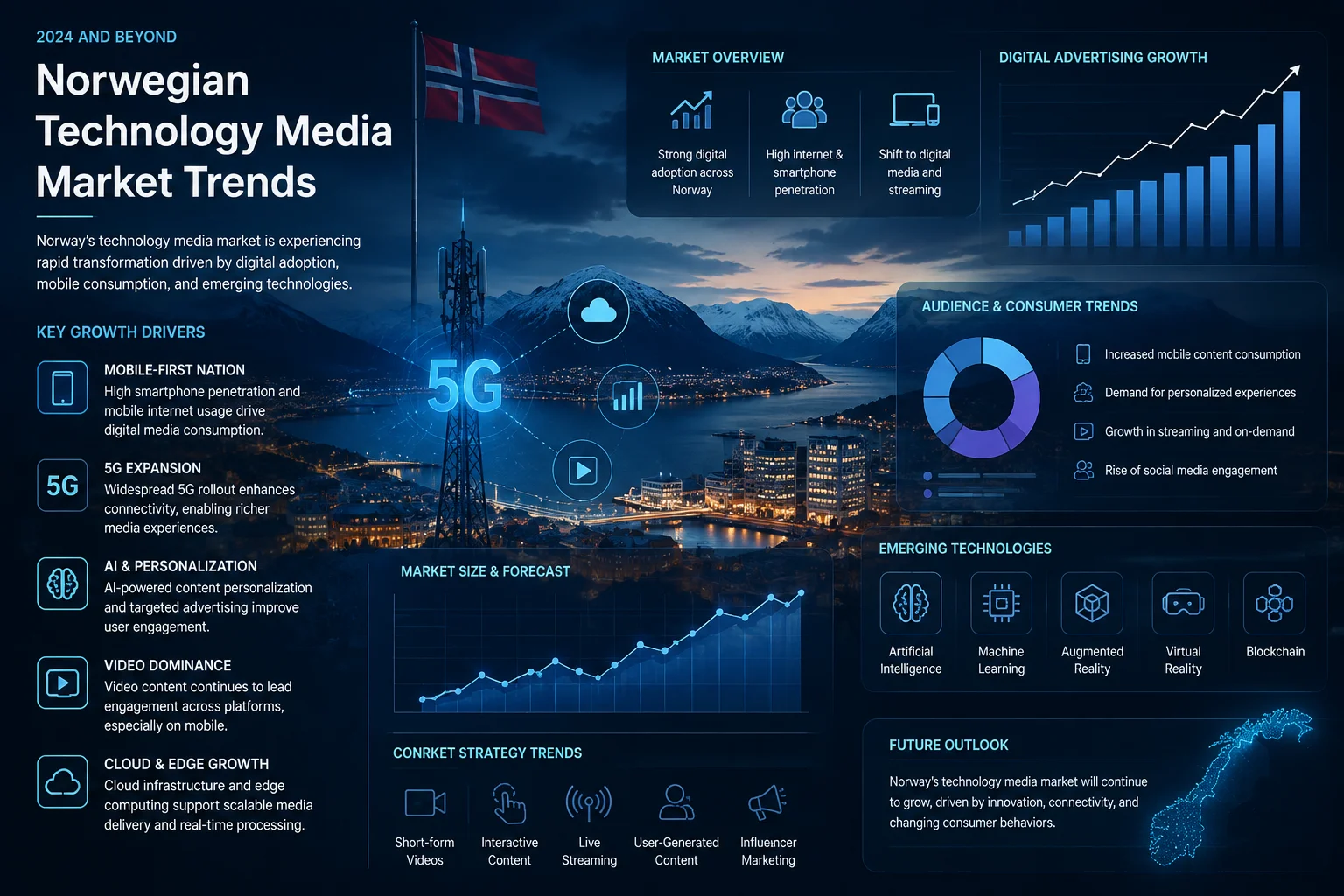
Norwegian Technology Media Market Trends
Norway may not have the enormous media economy of the United States, but size tells only part of the story. When looking at norwegian technology media market trends, what stands out is how quickly technology has become part of everyday media consumption. High internet access, strong digital journalism, widespread streaming, mobile usage, social platforms, and trusted public media have created one of Europe’s most digitally mature media environments.
For businesses, advertisers, publishers, technology companies, and investors, Norway offers an interesting picture of what a highly connected media market can become. Traditional television and print remain part of the landscape, but digital channels increasingly decide where audiences spend their time and where media companies generate revenue.
Market Size and Structure

Norway’s media industry is relatively small compared with the massive media market in the United States, but it operates within one of the world’s most connected economies. The industry generates roughly NOK 65 billion in annual revenue and supports around 32,000 jobs across broadcasting, publishing, advertising, digital media, streaming, journalism, and related technology services.
One of the most important norwegian technology media market trends is the balance between established public media and fast moving commercial digital businesses. NRK remains a central part of Norwegian media life and receives substantial public funding. At the same time, commercial broadcasters, streaming platforms, publishers, and independent digital outlets compete aggressively for audience attention.
This creates a media structure that feels different from the largely commercial model familiar to American audiences. Public service broadcasting has considerable influence in Norway, yet that has not prevented commercial innovation. Instead, traditional broadcasters and publishers have been pushed to improve digital products, streaming services, mobile experiences, subscription models, and audience engagement.
Digital advertising has become a major source of revenue within this structure. Research estimates digital advertising revenue at around NOK 22 billion in 2023, representing growth of approximately 12 percent compared with the previous year. Digital advertising is also estimated to represent around 60 percent of total media advertising spending.
Subscriptions are another important part of the market. Norwegian consumers have shown a strong willingness to pay for digital news, entertainment, and streaming access. Digital subscription revenue has been estimated at around NOK 15 billion, showing how the market is gradually moving away from depending entirely on advertising.
For companies studying norwegian technology media market trends, the important lesson is that Norway combines public investment, commercial competition, digital subscriptions, advertising, and technology adoption within the same ecosystem. It is a relatively compact market, but its digital maturity makes it a useful example of where media consumption in other developed markets may be heading.
Digital Consumption and Audience Trends

Digital media is deeply integrated into daily life in Norway. Internet access reaches almost the entire population, giving media companies an enormous potential digital audience despite the country’s relatively small population.
Norwegians spend several hours online every day, moving between streaming platforms, news websites, social media networks, mobile applications, podcasts, video services, and other forms of digital entertainment. This widespread digital behavior is one of the clearest norwegian technology media market trends shaping the industry.
Streaming has become particularly important. Around 90 percent of the population has access to at least one paid streaming service, including international platforms and domestic services such as TV 2 Play. Around half of the population watches streamed video on an average day.
Traditional television still attracts a meaningful audience, but its position is gradually weakening. Daily linear television viewing sits below streaming access levels, showing how viewers increasingly expect entertainment to be available whenever and wherever they want it.
The result is a clear movement toward a streaming first media environment. Viewers no longer need to organize their evenings around television schedules. They can open an application, select a program, switch devices, pause content, and continue watching later.
This behavior has major consequences for broadcasters and advertisers. Media companies must now compete for attention across television screens, smartphones, tablets, laptops, connected televisions, social feeds, and streaming applications rather than relying on a single traditional channel.
Social media adds another layer to the change. A large majority of Norwegians use social platforms regularly, with YouTube, Facebook, Instagram, Snapchat, and TikTok attracting significant audiences. Different age groups naturally favor different platforms, but video has become an especially powerful format for entertainment, information, discovery, and brand communication.
Mobile devices are equally important. Smartphones have become one of the main gateways to news, social media, video, messaging, and entertainment. A substantial percentage of Norwegians access online news through phones or tablets, forcing publishers to think about smaller screens first when designing digital experiences.
For American readers, the pattern will look familiar. Consumers are cutting back on traditional television, spending more time with streaming services, and discovering content through mobile applications and social feeds. The difference is that these habits operate within a smaller, highly connected population where digital adoption can spread extremely quickly.
Digital News and Public Service Media

Digital transformation has not reduced Norwegian interest in journalism. Instead, news consumption has increasingly moved from printed newspapers and scheduled broadcasts toward websites, applications, notifications, subscriptions, podcasts, and social platforms.
Recent media research suggests that around six in ten Norwegians read online newspapers on an average day. That level of digital readership helps explain why news remains an important part of norwegian technology media market trends.
A major reason the Norwegian news environment stands out is the continuing strength of public service media. NRK remains one of the country’s most important media organizations and has successfully built a strong presence across television, radio, mobile, streaming, and digital news.
Trust is another important factor. Norwegian audiences continue to show relatively strong confidence in established news organizations, particularly public service media. This provides NRK and other established publishers with an advantage at a time when many media markets are struggling with declining confidence in journalism.
Norway also has an unusually strong culture of paying for digital news. Research from the Reuters Institute has consistently placed Norway among the leading markets for paid online news. Around four in ten consumers have paid for digital news access in recent studies.
That willingness to pay changes the economics of publishing. Instead of depending only on advertising impressions, publishers can build relationships around subscriptions, memberships, premium journalism, applications, and specialized digital products.
It also encourages media companies to focus on reader loyalty. A paying subscriber expects useful reporting, a smooth digital experience, trustworthy information, and enough value to justify continuing the subscription month after month.
Artificial intelligence is now becoming part of this newsroom transformation. Norwegian publishers are experimenting with AI for tasks such as content assistance, recommendations, moderation, data processing, transcription, summaries, and workflow automation.
AI can help publishers work faster and personalize content for different audiences, but it introduces new risks as well. Incorrect automated information, weak oversight, bias, and unclear sourcing can quickly damage trust. Norwegian news organizations therefore face the same challenge as publishers elsewhere: gaining efficiency from AI without weakening editorial standards.
The wider digital news market remains diverse. Large public and commercial organizations compete alongside local publications, independent digital outlets, membership based publishers, and emerging journalism projects. Government support for journalism and local media also gives smaller organizations opportunities that may be harder to find in a purely commercial system.
For readers studying norwegian technology media market trends, this combination is particularly important. Norway has not simply replaced old media with new technology. It has taken established journalism, public service broadcasting, subscriptions, mobile distribution, streaming, and AI and placed them inside the same evolving digital ecosystem.
That combination could offer useful lessons for other countries. Technology may determine how journalism reaches people, but trust, useful reporting, strong brands, and a willingness to pay still determine whether a news organization can build a lasting relationship with its audience.
Streaming Video and Audio Trends

Streaming has become one of the strongest forces shaping norwegian technology media market trends. Norwegian viewers increasingly expect entertainment to be available instantly, across televisions, smartphones, tablets, and computers, rather than waiting for a scheduled broadcast.
Streaming service revenue reached about NOK 7 billion in 2023, representing growth of roughly 20 percent compared with the previous year. Revenue from on demand video services, including subscription and advertising supported models, reached around NOK 3.2 billion. These figures show how quickly streaming has moved from an alternative form of entertainment into a central part of Norway’s media economy.
Viewer habits support that shift. Norwegians spend more than two hours per day watching long form video content, while high quality viewing has become increasingly common. Around 85 percent of streaming subscribers have access to 4K or ultra high definition content, showing how strong broadband infrastructure is influencing expectations around picture quality and streaming performance.
The direction is similar to what has happened in the United States. Subscription streaming remains important, but advertising supported streaming is becoming more attractive as consumers manage multiple subscriptions and media companies search for additional revenue. For advertisers, this creates more opportunities to reach audiences inside premium digital video rather than depending entirely on traditional television commercials.
Local programming remains another important part of the Norwegian streaming market. International platforms such as Netflix compete alongside domestic services and broadcasters, but Norwegian language productions and locally relevant entertainment continue to attract viewers. Public service requirements and the wider emphasis on Norwegian and European content also help domestic productions maintain visibility.
This local content strength is important when examining norwegian technology media market trends. Global platforms can bring enormous libraries and production budgets, but Norwegian viewers still want stories, personalities, news, drama, and entertainment that feel connected to their own culture.
Audio consumption is changing at the same time. Podcast listening has become a regular habit, with Norwegians spending roughly 3.2 hours per week listening to podcasts. News, entertainment, interviews, culture, business, sports, education, and true crime are all helping the format build a broader audience.
Podcast advertising is also becoming more commercially important. Advertising revenue reached approximately NOK 350 million in 2023, giving publishers, broadcasters, creators, and advertisers another way to monetize digital audiences.
Podcasting offers something different from visual media. Listeners can consume content while commuting, exercising, cooking, or working, which gives audio access to moments when video would be inconvenient. That makes podcasts particularly valuable for advertisers interested in reaching highly engaged audiences for longer periods.
The wider picture is clear. Norway’s video and audio market is moving toward greater consumer choice, stronger streaming competition, more advertising supported services, better viewing quality, and growing podcast monetization. The basic direction resembles the American market, but Norway adds its own emphasis on strong local content and public service media.
Advertising and Monetization
Advertising money is following Norwegian audiences online. As people spend more time with smartphones, streaming platforms, social networks, digital publications, and online video, brands are directing larger portions of their budgets toward the same channels.
Digital advertising now represents around 60 percent of total media advertising spending in Norway. This makes digital channels central to modern norwegian technology media market trends, not simply an additional option beside television, radio, and print.
Social media advertising has become especially important. Spending in the category is estimated at roughly USD 620 million, with platforms such as Instagram playing a major role in brand awareness, product discovery, audience engagement, and performance campaigns.
The attraction is easy to understand. Social platforms allow advertisers to reach specific audiences based on interests, location, behavior, demographics, and previous interactions. Campaigns can also be measured quickly, giving marketers a clearer picture of clicks, views, conversions, engagement, and return on advertising spending.
Video is taking an increasingly large share of those budgets. Around 78 percent of digital advertising spending is connected to video according to industry estimates, while consumption of short form video has risen sharply.
Platforms built around fast visual content have changed what audiences expect from advertising. Instead of relying only on polished thirty second television commercials, brands can publish brief product demonstrations, educational clips, creator partnerships, behind the scenes content, customer stories, and interactive videos designed specifically for mobile screens.
Short form video is especially useful for reaching younger consumers who often discover brands while scrolling through social feeds rather than actively searching for them. This creates a media environment where entertainment, discovery, advertising, and shopping increasingly overlap.
Mobile advertising is growing for the same reason. Norwegian consumers spend a large share of their digital time on smartphones, so advertisers are designing campaigns around smaller screens, faster interactions, vertical video, mobile landing pages, and simple conversion journeys.
Programmatic advertising has also become part of normal media buying. Automated platforms allow advertisers to purchase digital advertising space based on audience data and campaign goals instead of negotiating every placement manually.
This makes campaigns easier to adjust while they are running. Advertisers can move budgets toward stronger audiences, placements, creative formats, or devices when performance data shows where the best results are coming from.
The change also affects publishers and broadcasters. Traditional media companies can no longer depend on conventional advertising models alone. Many are combining subscriptions, digital advertising, streaming advertising, branded content, sponsorships, memberships, and other revenue streams.
For companies studying norwegian technology media market trends, the message is straightforward. Norway’s advertising market has become increasingly performance focused, mobile focused, and video focused. The same tactics familiar to American digital marketers are now deeply embedded in the Norwegian market, but they operate within a smaller and highly connected audience where digital behavior is already mature.
The brands most likely to perform well are those that understand where people actually spend their attention. In Norway today, that increasingly means social platforms, streaming environments, mobile screens, digital publications, and video rather than traditional media alone.
Technology and Infrastructure Adoption
Technology infrastructure is one of the biggest reasons norwegian technology media market trends are developing so quickly. Norway has built a highly connected digital environment where fast internet, modern mobile networks, cloud technology, artificial intelligence, and advanced streaming systems can reach almost the entire population.
Internet access is close to universal, with about 99 percent of people connected. Roughly 90 percent of households also have access to broadband speeds of 100 Mbps or higher. That level of connectivity gives media companies a strong foundation for delivering high quality video, digital news, podcasts, interactive experiences, and other data intensive content without many of the infrastructure barriers found in less connected markets.
Fast broadband has become especially important as consumers move toward streaming. Watching 4K video, using multiple connected devices, joining live broadcasts, and accessing cloud based media all require reliable connections. Norway’s broadband infrastructure allows households to consume these services smoothly, which in turn encourages broadcasters and technology companies to keep investing in more advanced digital products.
5G is another important development. Norwegian broadcasters are experimenting with and using 5G networks for live coverage, giving production teams more flexibility when reporting from sports events, concerts, public gatherings, and breaking news locations. Instead of relying entirely on traditional broadcast equipment and fixed connections, journalists and production teams can transmit high quality content through faster mobile networks.
This could make live media production more flexible and efficient. It also creates opportunities for smaller production teams that may not have access to the expensive infrastructure traditionally required for television broadcasting.
Edge computing is helping streaming services solve another important problem: speed. Instead of sending every request to a distant data center, edge technology can process and deliver content closer to the viewer. The result can be faster loading, less buffering, and lower latency.
That matters increasingly as live streaming becomes more popular. Sports, gaming, interactive entertainment, live news, and digital events all become frustrating when there is a noticeable delay. Edge computing helps media companies deliver the faster experiences audiences increasingly expect.
Artificial intelligence is also becoming more closely connected with Norway’s media infrastructure. Publishers and broadcasters can use AI to organize content, understand audience behavior, improve recommendations, assist newsroom workflows, moderate content, and personalize digital experiences.
Virtual reality and augmented reality remain earlier stage technologies, but Norway’s strong digital infrastructure creates an ideal environment for experimentation. Media companies, advertisers, entertainment brands, and technology developers can test immersive experiences without being held back by poor connectivity.
Cybersecurity has naturally become more important as the media market becomes more digital. Norwegian media companies reportedly invested around NOK 1.2 billion in digital security during 2023.
That spending reflects a simple reality. More digital services mean more valuable data, more connected systems, and more potential targets for cybercrime. Media organizations need to protect customer information, subscription accounts, payment systems, unpublished journalism, digital archives, advertising systems, and streaming infrastructure.
Privacy protection matters just as much. Norwegian audiences operate within a European regulatory environment where organizations face considerable responsibilities regarding personal information and how that data is collected, stored, and used.
Taken together, these developments place Norway near the digital frontier. Strong connectivity makes streaming easier. Fast mobile networks improve live production. Edge computing reduces delays. AI improves digital workflows. Emerging immersive technologies create new possibilities, while cybersecurity investment helps protect the entire system.
For anyone examining norwegian technology media market trends, infrastructure is therefore not simply another market category. It is the foundation supporting nearly every major change taking place across streaming, digital journalism, social media, advertising, mobile consumption, and audience personalization.
Regulation and Policy Environment
Technology may be moving Norway’s media industry forward, but government policy plays an equally important role in determining how that market develops.
Norway generally takes a more active approach to media regulation than the United States. Public funding, privacy protections, support for journalism, competition rules, transparency requirements, and European digital regulation all influence how publishers, broadcasters, advertisers, and technology platforms operate.
That active policy environment is an important part of norwegian technology media market trends because Norway does not leave every aspect of the media economy entirely to commercial competition.
Public support for journalism is one of the clearest examples. Norway has a long history of supporting media diversity, particularly local and regional journalism. Financial support can help smaller publishers continue reporting in communities where advertising and subscription revenue alone may not be enough to support a newsroom.
The goal is not simply to protect traditional media companies. It is also to maintain access to reliable local information and prevent the national media landscape from becoming controlled by only a handful of large organizations.
Media ownership and competition are therefore closely watched. Norwegian policy has historically placed considerable emphasis on preventing excessive concentration of media power and maintaining a diverse range of editorial voices.
Political advertising is another area receiving greater attention. Transparency rules increasingly focus on helping audiences understand who is paying for political messages and where those campaigns originate. Foreign sponsored political advertising can face additional disclosure requirements, particularly as policymakers become more concerned about online influence and election interference.
Digital platforms are also facing growing responsibility for their role in the news economy. Across Europe, policymakers have been debating how large technology companies should compensate publishers when journalism generates traffic, engagement, or commercial value on their platforms.
For Norwegian publishers, these developments could change the relationship between journalism and major technology platforms. News companies want fair value for the content they produce, while platforms remain important channels for discovery and audience reach.
Local and regional content is another priority. Norway’s wider media policy encourages the production and availability of journalism and programming that represents communities beyond the largest cities.
This approach becomes particularly significant as global streaming services and social platforms take a larger share of audience attention. Without support for domestic production, smaller language markets can find themselves overwhelmed by international content.
Privacy regulation adds another major responsibility. As part of the European Economic Area, Norway follows the General Data Protection Regulation framework. Media companies, advertisers, publishers, and technology businesses must therefore think carefully about how personal information is collected and used.
Compliance can require investment in consent systems, data storage, privacy controls, advertising technology, staff training, legal processes, and cybersecurity. Research estimates suggest Norway’s media sector has spent hundreds of millions of kroner adapting to stricter privacy requirements.
This has a direct effect on digital advertising. Advertisers increasingly have to balance personalization with privacy. Publishers must find ways to understand their audiences without depending on unrestricted tracking.
That challenge is becoming even more important as browsers, regulators, and technology companies reduce reliance on traditional tracking methods.
Compared with the United States, Norway’s approach gives government and public institutions a more visible role in shaping media competition and supporting journalism. The Norwegian model attempts to balance commercial innovation with public interest goals such as media diversity, privacy, transparency, local journalism, and access to trustworthy information.
These policies can create additional costs and complexity for media companies, but they can also help preserve competition and public confidence.
As a result, regulation is not separate from norwegian technology media market trends. It actively influences which business models succeed, how advertising works, how platforms handle data, how journalism is funded, and how global media businesses operate inside Norway.
Looking Ahead 2025 to 2031
The next several years are likely to push Norway even further toward digital media. Streaming will continue competing with traditional television, artificial intelligence will become more deeply integrated into content production, and advertisers will look for new ways to reach audiences across connected screens.
One of the clearest norwegian technology media market trends through 2031 will likely be the continued decline of traditional linear television.
This does not mean television content itself will disappear. Instead, the way people access it will continue changing. More viewing will move toward subscription streaming services, advertising supported platforms, broadcaster applications, and connected televisions.
SVOD will remain important, particularly for consumers who value premium entertainment without traditional advertising. At the same time, AVOD could become increasingly attractive as viewers become more careful about how many subscriptions they are willing to maintain.
Connected television advertising is another area with strong potential. It combines the visual impact of traditional television advertising with some of the targeting and measurement advantages normally associated with digital marketing.
Advertisers can potentially reach specific audience groups while they watch professionally produced streaming content on large screens. For brands, this creates a useful middle ground between traditional television campaigns and mobile advertising.
Artificial intelligence will probably have an even larger influence on the media industry.
Publishers can use AI to analyze large amounts of information, organize archives, assist with transcription, create summaries, improve search, recommend stories, and automate repetitive production tasks. Streaming platforms can use similar technology to understand viewing preferences and recommend content.
Advertisers will also use AI to improve targeting, campaign optimization, creative testing, audience segmentation, and performance analysis.
The opportunity is substantial, but media companies will need strong editorial and human oversight. A faster production process has little value if incorrect information damages audience trust.
That makes responsible AI use one of the most important issues to watch across future norwegian technology media market trends.
Local journalism could also become more digitally sophisticated. Regional publishers are likely to invest further in subscription products, applications, newsletters, podcasts, video, personalized content, and membership programs.
Public support may continue helping smaller journalism organizations operate while digital tools allow them to reach audiences more efficiently.
Immersive media could become another interesting growth area. Augmented reality, virtual reality, and interactive storytelling give brands and publishers ways to create experiences that traditional articles or videos cannot easily reproduce.
A travel company could allow potential visitors to explore a destination virtually. A retailer could let customers visualize products through augmented reality. A news organization could create an interactive explanation of a major event instead of relying entirely on text and photographs.
These formats are unlikely to replace conventional media, but they can become valuable additions as technology improves and production costs fall.
Advertising will become more interactive as well. Short form video, connected television, creator partnerships, shoppable content, personalized advertising, and immersive formats could all compete for a larger share of marketing budgets.
The strongest media businesses will probably be those that combine several revenue streams rather than depending on only one. Subscriptions, advertising, memberships, sponsorships, licensing, events, branded content, and premium digital products can work together to create a more stable business model.
Norway therefore offers a useful glimpse at where highly connected media markets may be heading. The future is unlikely to belong exclusively to broadcasters, newspapers, social platforms, or streaming companies.
Instead, these categories will continue overlapping.
Publishers will create video. Broadcasters will build digital subscription products. Streaming companies will sell advertising. Social platforms will compete for entertainment time. Advertisers will become content producers. Artificial intelligence will operate behind many of these experiences.
The broader direction of norwegian technology media market trends is clear. Norway is moving toward a media environment that is more digital, more personalized, more interactive, and increasingly powered by advanced technology.
Yet one thing makes its trajectory particularly interesting. Norway is pursuing that technological transformation while continuing to place considerable importance on public service journalism, local content, privacy, and media diversity.
That combination of technological ambition and public service tradition could make Norway one of the most interesting media markets to watch between 2025 and 2031.


