
-
- No Comments
- December 29, 2025

NVIDIA provides strong revenue outlook on demand for computer chips
1. Introduction
In the rapidly evolving world of artificial intelligence, NVIDIA has become a name that commands attention. Its AI-focused chips, especially the cutting-edge Blackwell platform, are fueling some of the most powerful data centers and supercomputers across the globe. From cloud computing giants to enterprises adopting AI at scale, NVIDIA’s technology is now at the heart of the AI revolution.
The surge in demand for AI and high-performance computing infrastructure has driven NVIDIA into uncharted territory. Companies are racing to deploy AI models, train massive datasets, and enhance cloud capabilities, creating unprecedented demand for top-tier GPUs. As AI adoption accelerates, NVIDIA stands at the intersection of innovation and opportunity.
This blog aims to unpack NVIDIA’s remarkable financial performance in Q3 FY2026, its confident outlook for Q4, and the key drivers behind the skyrocketing demand for its chips. By understanding the numbers, the technology, and the market dynamics, readers will gain insight into why NVIDIA is not just riding the AI wave it’s shaping it.
2. NVIDIA’s Record Q3 FY2026 Financial Performance

Revenue Highlights
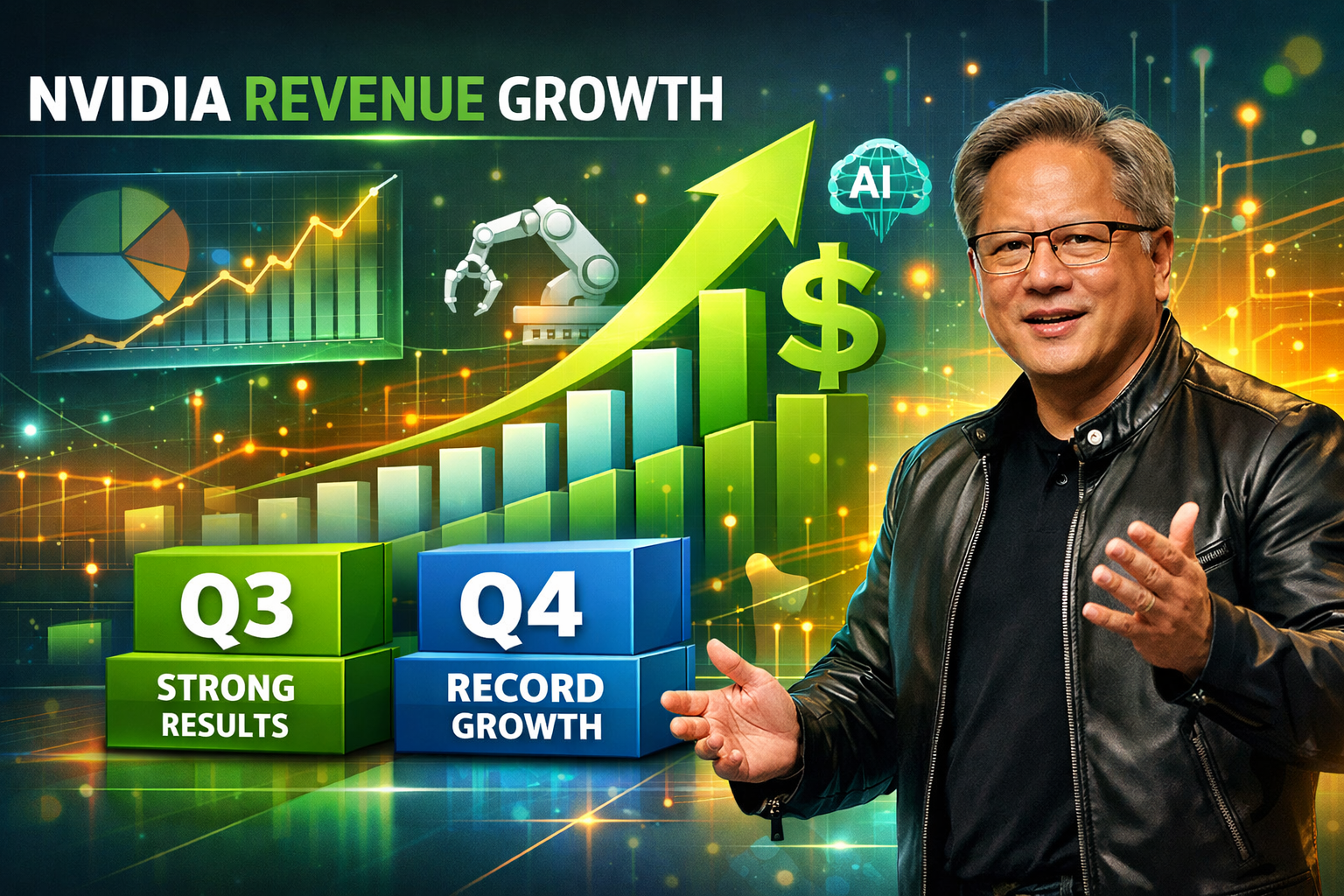
NVIDIA’s Q3 FY2026 results showcase a company firing on all cylinders. Total revenue hit $57.0 billion, marking a 22% increase from the previous quarter and a 62% year-over-year surge. At the core of this growth is NVIDIA’s Data Center segment, which posted a record $51.2 billion, up 25% quarter-over-quarter. Such performance underscores the insatiable demand for AI infrastructure and high-performance computing.
Gross margins remained robust at 73.6% non-GAAP, reflecting NVIDIA’s strong pricing power amid a competitive market for AI chips. The numbers signal not only growth in revenue but also efficiency in delivering high-value, high-demand products to the market.
CEO Commentary
CEO Jensen Huang emphasized the extraordinary market response to the Blackwell platform, stating that sales are “off the charts.” Demand for cloud GPUs has skyrocketed, with many data center customers experiencing sell-outs due to exponential compute requirements for AI training and inference. Huang’s commentary reinforces that NVIDIA is not merely meeting market expectations it’s exceeding them by a significant margin.
Supporting Citations
- NVIDIA Q3 FY2026 Earnings: link
3. Strong Q4 FY2026 Revenue Guidance
Forecast Details
Looking ahead, NVIDIA projects Q4 FY2026 revenue of $65.0 billion ±2%, surpassing analyst expectations of roughly $61.66 billion. This guidance reflects the company’s confidence in sustained demand for its AI-focused GPUs across hyperscalers, enterprises, and cloud providers.
Non-GAAP gross margins are expected to reach 75.0% ±50 basis points, demonstrating continued pricing strength and operational efficiency. Meanwhile, operating expenses are projected at $5.0 billion non-GAAP, signaling disciplined spending even amid aggressive growth.
Implications
NVIDIA’s guidance underscores its belief that the AI-driven chip market is far from peaking. CEO Jensen Huang highlighted $500 billion in secured orders through 2026, signaling robust demand and long-term adoption from major customers. The outlook also counters fears of an AI bubble, showing that NVIDIA’s growth is grounded in real infrastructure needs rather than speculative hype.
Sources
4. Key Drivers of AI Chip Demand

Blackwell GPU Platform
At the heart of NVIDIA’s success is the Blackwell GPU platform, which has set new industry benchmarks. These chips offer 10x throughput per megawatt compared to previous generations, making them the go-to solution for both AI training and inference. This performance leap drives adoption among cloud providers and enterprises seeking the fastest, most efficient AI compute solutions available.
Enterprise & Cloud Adoption
NVIDIA’s AI ecosystem is expanding rapidly through strategic partnerships. For instance, OpenAI has deployed 10 gigawatts of NVIDIA systems, while cutting-edge supercomputers now feature over 100,000 Blackwell GPUs, fueling massive-scale AI workloads. The combination of enterprise adoption and cloud partnerships positions NVIDIA as the backbone of global AI infrastructure.
Other Industry Segments
While Data Center revenue dominates (~90% of total revenue), NVIDIA is seeing growth across other sectors:
- Automotive: $592 million revenue, up 32% YoY
- Gaming: $4.3 billion revenue
- Professional visualization: Steady growth supporting creative and industrial applications
These segments, while smaller than Data Center, diversify NVIDIA’s revenue streams and demonstrate broader market adoption of its high-performance chips.
Sources
- Investors.com (source)
5. Comparison with Previous GPU Generations
NVIDIA’s Blackwell GPU platform represents a significant leap over its predecessors, the Ampere and Hopper series. Benchmark tests show that Blackwell delivers 10x higher throughput per megawatt, offering unmatched efficiency for large-scale AI training and inference workloads.
In addition to raw performance, Blackwell chips are designed with enhanced energy efficiency, allowing data centers to scale operations without proportionally increasing power consumption. This combination of speed and efficiency has accelerated adoption among cloud providers and enterprise AI infrastructures, enabling organizations to deploy massive AI models faster, more cost-effectively, and with a smaller environmental footprint.
The performance edge of Blackwell GPUs is a key reason why NVIDIA continues to dominate the AI compute market, setting the standard for both hyperscale and enterprise computing.
6. Major Customers and Orders Driving Growth

NVIDIA’s growth is underpinned by strong relationships with major hyperscalers such as Microsoft, Google, and Oracle, who rely on Blackwell GPUs to power their AI services and cloud offerings.
The company has also secured AI orders valued at $500 billion through 2026, reflecting long-term commitments from both cloud providers and enterprise clients. These orders are not only driving revenue but also fueling the expansion of AI factories and supercomputing initiatives globally.
Strategic partnerships with AI leaders ensure NVIDIA remains at the core of the AI ecosystem, supplying the hardware backbone for everything from generative AI research to large-scale model training. These collaborations highlight NVIDIA’s central role in powering the next wave of AI innovation.
7. Implications for NVIDIA and the Market
NVIDIA’s record-breaking revenue and robust Q4 guidance send a clear signal: the company remains confident amid AI bubble concerns. Unlike speculative hype, NVIDIA’s growth is grounded in tangible infrastructure demand, long-term contracts, and adoption by major hyperscalers and enterprises.
The company’s pricing power and strong gross margin sustainability further reinforce its financial resilience. Even with rising demand for AI chips, NVIDIA maintains healthy margins, reflecting both the premium value of its products and its leadership in delivering cutting-edge performance.
From a market perspective, NVIDIA’s technological edge with Blackwell GPUs cements its competitive positioning in the global AI chip industry. Its dominance in data centers, coupled with expanding presence in gaming, automotive, and professional visualization, ensures that NVIDIA remains the go-to supplier for high-performance AI compute needs worldwide.
8. Conclusion
NVIDIA’s Q3 FY2026 results, highlighted by $57.0 billion in revenue and record Data Center growth, combined with a strong Q4 guidance of $65.0 billion, underscore its dominant position in the AI chip market.
With Blackwell GPUs setting new benchmarks for performance and efficiency, and long-term partnerships driving sustained demand, NVIDIA continues to lead the charge in AI infrastructure.
Looking forward, the company is well-positioned to meet the growing needs of data centers and enterprises, ensuring that NVIDIA remains at the heart of the global AI revolution for years to come.
9. References / Further Reading
- NVIDIA Q3 FY2026 Earnings: https://nvidianews.nvidia.com/news/nvidia-announces-financial-results-for-third-quarter-fiscal-2026
- NVIDIA Q4 FY2025 Earnings: https://nvidianews.nvidia.com/news/nvidia-announces-financial-results-for-fourth-quarter-and-fiscal-2025
- Al Jazeera on Q4 Forecast: https://www.aljazeera.com/economy/2025/11/19/nvidia-forecasts-q4-revenue-above-estimates-despite-ai-bubble-concerns
- CNBC Coverage: https://www.cnbc.com/2025/11/19/nvidia-nvda-earnings-report-q3-2026.html
- Investors.com Analysis: https://www.investors.com/research/nvidia-nvda-stock-ai-chip-2/
Frequently Asked Questions (FAQ)
1. Why is NVIDIA’s revenue growing so rapidly in FY2026?
NVIDIA’s revenue surge is primarily driven by skyrocketing demand for its AI-focused Blackwell GPUs, which power data centers, cloud computing, and AI infrastructure. Record Data Center sales and premium pricing also contribute to this growth.
2. What makes the Blackwell GPU platform different from previous generations?
Blackwell GPUs deliver 10x higher throughput per megawatt compared to Ampere and Hopper series, offering superior performance and energy efficiency for AI training and inference workloads. This has fueled widespread adoption among cloud providers and enterprises.
3. Who are NVIDIA’s major customers driving demand?
Key customers include hyperscalers like Microsoft, Google, and Oracle, as well as AI-focused enterprises and research organizations. Long-term contracts and secured orders through 2026 further support sustained growth.
4. How does NVIDIA’s Q4 FY2026 revenue guidance compare to analyst expectations?
NVIDIA projects $65.0 billion in Q4 revenue, exceeding analyst estimates of roughly $61.66 billion. This optimistic forecast reflects confidence in continued AI chip demand and long-term secured orders.
5. Are other industries besides Data Centers contributing to NVIDIA’s growth?
Yes. While Data Centers remain the primary revenue driver (~90%), other sectors like gaming ($4.3 billion), automotive ($592 million, +32% YoY), and professional visualization are also contributing to overall growth and diversifying NVIDIA’s revenue streams.