

-
- No Comments
- August 9, 2026

What is a Binder in Cooking
Intro:what Is a Binder in Cooking?
If you have ever wondered what is a binder in cooking, the answer is surprisingly simple. A binder is an ingredient that helps other ingredients stick together so the food keeps its shape during preparation and cooking. Depending on the recipe, a binder can also improve moisture, structure, firmness, and texture.
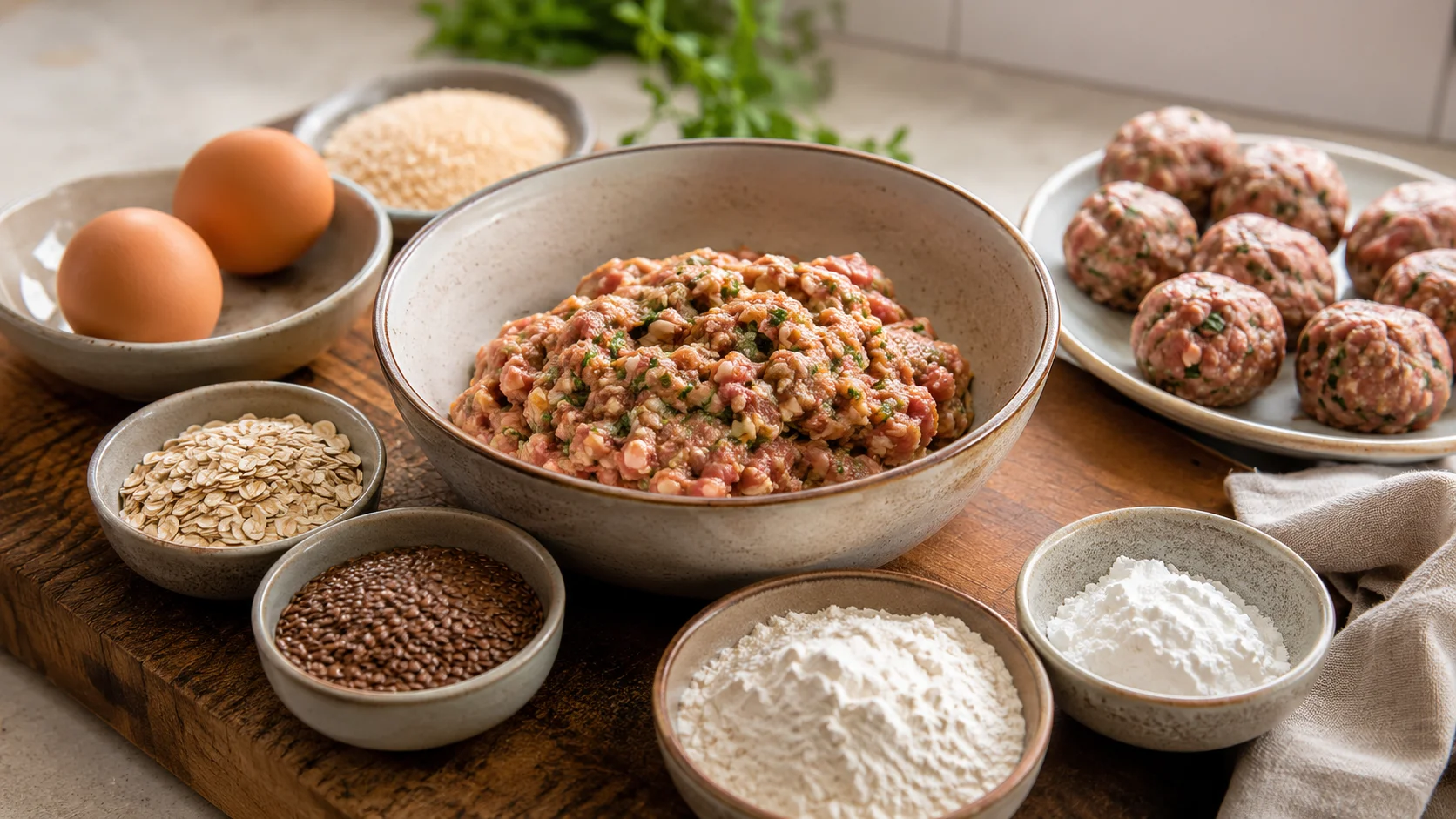
Think about a tray of homemade meatballs. You mix ground meat with seasoning, herbs, onions, and other ingredients, shape everything into balls, then place them in a hot pan. Without enough binding power, those neat little meatballs can quickly turn into loose pieces of meat. Eggs, breadcrumbs, flour, oatmeal, or another suitable binder help the mixture stay together from the mixing bowl to the plate.
The same idea appears across everyday cooking. Meatloaf needs enough structure to slice cleanly instead of crumbling. Vegetable fritters need something that keeps chopped vegetables together while they cook. Croquettes and patties need a binder so they can be shaped and flipped without falling apart. Even cakes and other baked foods depend on ingredients that help create a stable structure as they bake.
Understanding what is a binder in cooking becomes easier when you stop thinking of a binder as one specific ingredient. It is really a job that many different ingredients can perform.
Eggs are probably the most familiar example. When heated, the proteins in eggs set and help hold other ingredients together. Flour and starches can absorb moisture and create structure. Breadcrumbs, cracker crumbs, oatmeal, and rice can help bring loose mixtures together while also affecting texture. Ground flaxseed and psyllium husk are useful plant based options, especially when eggs are not suitable.
Other binders may be less common in everyday home cooking but are still important in food preparation. Gelatin can help ingredients set and hold their form. Ingredients such as guar gum and xanthan gum are often used to improve consistency and structure in certain foods. Commercial food production may also use ingredients such as food starch, whey protein concentrate, carrageenan, and cellulose for binding purposes.
What matters most is that these ingredients do not all behave in exactly the same way. A binder that works beautifully in meatballs may not be the right choice for a cake. Coconut flour absorbs moisture very differently from regular flour. Flaxseed behaves differently from an egg. Breadcrumbs can create a softer meat mixture, while too much flour may make the same dish dense.
That is why knowing what is a binder in cooking is more useful than simply memorizing a list of binder ingredients. Once you understand the purpose, you can look at a recipe and ask a much better question: what does this mixture need in order to stay together without ruining its texture?
In most cases, that is exactly what the binder is there to solve.
What Does a Binder Do in Cooking?

A binder has one main job in the kitchen: helping ingredients stay together.
That sounds simple, but the effect can completely change the way a dish cooks and feels when you eat it. A good binder can help a mixture keep its shape, hold onto moisture, develop the right firmness, and create a more pleasant texture.
Think about meatballs. Ground meat, herbs, onions, spices, and other ingredients do not always want to stay together on their own. Once you start shaping the mixture or cooking it in a hot pan, it can crack, crumble, or break apart. A binder helps turn those separate ingredients into one stable mixture that can survive shaping, flipping, frying, baking, or simmering.
The same thing happens with veggie patties. Beans, lentils, vegetables, grains, and seasonings may taste great together, but without enough binding power they can behave like several ingredients sitting next to each other instead of one proper patty. Eggs, flour, breadcrumbs, oats, flaxseed, or another suitable binder can give that mixture enough structure to hold together.
Baking relies on binding too. Cakes, muffins, cookies, and similar foods need ingredients that help create structure as they cook. Without enough structure, the finished food may crumble too easily, collapse, or feel wrong in the mouth.
This is one reason understanding what is a binder in cooking is so useful. A binder does more than prevent food from falling apart. Depending on the ingredient, it can also affect how soft, firm, moist, chewy, tender, or dense the finished dish becomes.
Some binders absorb extra moisture. Others trap moisture inside the food. Certain binders become firmer when heated. Others swell after absorbing liquid and help create a more stable mixture.
The amount matters too. Too little binder and your food may fall apart. Too much and the opposite problem can happen. Meatballs may become dense. Fritters can turn heavy. Baked foods may lose the light texture you wanted.
Binder Versus Thickener Versus Emulsifier
Binders are sometimes confused with thickeners and emulsifiers because the same ingredient can occasionally perform more than one job. The easiest way to understand the difference is to think about what problem you are trying to solve.
A binder mainly helps ingredients or the structure of a food stay together.
A thickener mainly makes a liquid or mixture less runny. Flour or cornstarch added to gravy is a familiar example. You are not necessarily trying to hold separate ingredients together. You are trying to make the liquid thicker.
An emulsifier helps ingredients that normally separate stay mixed. Oil and water are the classic example. They naturally pull apart, but an emulsifier can help create a more stable mixture.
Some ingredients blur these lines. Eggs, starches, gums, and other ingredients can perform different functions depending on how they are used. That is why a recipe may use the same ingredient for binding in one dish and for thickening or stabilizing in another.
The practical question is simple. If your meatball is falling apart, you probably need better binding. If your sauce is too watery, you probably need thickening. If your oil based mixture keeps separating, emulsification may be the real issue.
Once you understand that difference, choosing ingredients becomes much easier.
Common Types of Binders Used in Cooking

There is no single ingredient that deserves the title of best binder for every recipe. Cooking would be much easier if there were, but different foods need different kinds of structure.
Some binders are excellent for meat mixtures. Others shine in baking. Some are especially useful for vegan or gluten free recipes. The best approach is to understand the major families of binders and what each one brings to the kitchen.
Eggs
Eggs are among the most familiar and versatile binders used in cooking.
When egg proteins are heated, they firm up and help create structure. That makes eggs useful in everything from meatballs and meatloaf to cakes, patties, casseroles, croquettes, and baked dishes.
In a meatball mixture, egg can help the meat, breadcrumbs, herbs, and seasonings stay together. In baking, eggs can contribute structure while also affecting moisture, richness, and texture.
That versatility is why eggs appear in so many recipes.
However, more egg does not automatically mean better binding. Adding too much can change the texture of the food and sometimes make a mixture firmer or more rubbery than intended.
The goal is enough binding power to support the recipe without overpowering its texture.
Flour and Starch Based Binders
Flour is another classic answer when people ask what is a binder in cooking.
White flour and wheat flour can help absorb moisture and bring ingredients together. They are commonly used in baking, fritters, batters, patties, croquettes, dumplings, and many other dishes.
White flour is popular because it has a relatively neutral flavor and is easy to find. Wheat flour can perform a similar binding role while changing the flavor and texture slightly depending on the recipe.
Oat flour is made from finely ground oats and can work particularly well in patties, baking, and other mixtures that benefit from extra absorption and a slightly heartier texture.
Almond flour can also provide structure, especially in recipes designed around nut based or gluten free ingredients. It behaves differently from wheat flour, however, so simply replacing regular flour with the exact same amount of almond flour may not always produce the same result.
Coconut flour is even more absorbent. A relatively small amount can soak up a surprising amount of liquid. That can be useful when a mixture feels too wet, but adding too much may leave the finished food dry or dense.
Potato starch and tapioca are useful when a recipe needs binding or structure without relying on traditional wheat flour. They are especially common in gluten free cooking and baking.
The important point is that flour and starch based binders are not identical. They absorb moisture differently, create different textures, and interact with other ingredients in different ways.
Choose them according to the food rather than assuming every flour can be swapped freely.
Breadcrumbs, Cracker Crumbs and Oatmeal
Sometimes the most useful binder is already sitting in your pantry.
Breadcrumbs and cracker crumbs are especially useful in meatballs, meatloaf, croquettes, patties, and similar mixtures. They absorb some of the available moisture while helping create a mixture that is easier to shape and cook.
Breadcrumbs can be particularly useful because they help with structure without necessarily making the mixture feel as heavy as adding a large amount of flour.
Oatmeal can perform a similar job.
Rolled oats or finely processed oats can absorb moisture inside meatloaf, burgers, bean patties, vegetable patties, and other mixtures. As they soften, they help bring the ingredients together while contributing body.
Rice can also play a binding role in certain recipes. Cooked rice contains starch and has a natural tendency to cling together, making it useful in patties, stuffed dishes, croquettes, rice balls, and other foods where you need individual ingredients to behave like one mixture.
These ingredients are especially useful when you want structure without reaching immediately for flour.
Plant Based Binders
Plant based cooking has made ingredients such as flaxseed and psyllium much more familiar to home cooks.
Ground flaxseed is one of the most useful examples.
When ground flaxseed is mixed with water and allowed to sit, it develops a thicker consistency that can help ingredients stick together. This makes it useful in certain baked foods, veggie burgers, patties, pancakes, and other recipes where an egg may normally provide some of the binding.
Flaxseed does not behave exactly like an egg, so it should not be treated as a perfect replacement in every recipe. It works best when the recipe can tolerate the slight change in texture and flavor.
Psyllium husk is another powerful plant based binder. It absorbs water and can help create structure in mixtures that otherwise feel loose or fragile.
It is especially useful in certain gluten free recipes because it can help create some of the cohesion that gluten would normally provide.
A little can go a long way. Psyllium absorbs considerable moisture, so using too much can quickly change the texture of the dish.
These ingredients are valuable because they give cooks more options when eggs, gluten, or traditional flour are not suitable.
Gelatin and Specialized Binders
Not every binder looks like something you would use in everyday meatballs or baking.
Gelatin is a good example. When dissolved and cooled properly, it forms a gel that can help food set and maintain its shape. This makes it useful in desserts, molded dishes, fillings, aspics, and other foods where the final structure develops as the mixture cools.
Guar gum and xanthan gum are more specialized ingredients, but they appear frequently in commercial foods and modern home cooking.
Xanthan gum is particularly common in gluten free baking because it can help improve structure and reduce crumbling. A very small amount can have a noticeable effect, which means it should usually be measured carefully.
Guar gum can also help with texture, viscosity, and stability. Like xanthan gum, it is generally used in much smaller amounts than traditional ingredients such as flour or breadcrumbs.
These specialized binders may sound more technical, but their purpose is still easy to understand. They help create the structure, consistency, or stability a particular food needs.
The important thing is choosing the binder for the problem in front of you.
If your veggie burger falls apart, you need enough cohesion to hold the patty together.
If your meatloaf crumbles when sliced, the mixture may need better binding or a better balance between wet and dry ingredients.
If your gluten free bread feels fragile, an ingredient such as psyllium or xanthan gum may help improve its structure.
That practical thinking is far more useful than memorizing a giant list of binders. Once you know what each family does, you can choose the ingredient that actually makes sense for the dish you are cooking.
How to Choose the Right Binder for Different Recipes

Knowing what is a binder in cooking is useful, but knowing which binder to choose is where things become much more practical.
The right choice depends on what you are cooking, how wet or dry the mixture already is, what texture you want at the end, and whether you need to work around ingredients such as eggs, wheat, dairy, or nuts.
There is no single best binder for food because meatballs, cakes, veggie patties, and croquettes are solving very different cooking problems.
Choosing a Binder for Meatballs and Meatloaf
For meatballs and meatloaf, the goal is usually simple. You want the mixture to hold together without becoming hard, dry, or heavy.
Egg is one of the most common choices because it helps create structure as the food cooks. Breadcrumbs, cracker crumbs, oatmeal, or similar ingredients can also absorb some of the moisture in the mixture and help everything stay together.
The balance matters.
If the mixture is very wet, a dry ingredient such as breadcrumbs or oats can help bring it under control. If you add too much dry binder, though, the finished meatballs may feel dense rather than tender.
A good binder for meatballs should help the mixture survive shaping, cooking, and serving while still allowing the meat to remain soft and juicy.
Meatloaf works in much the same way. It needs enough cohesion to stay together when sliced, but not so much binder that every bite feels packed and dry.
Choosing a Binder for Burgers and Patties
A binder for burgers is not always necessary.
A traditional ground beef burger can often hold together through the natural proteins in the meat, especially when it is handled properly. Once you start adding vegetables, sauces, cheese, grains, or other ingredients, however, the mixture may become looser and need help.
That is when an egg, breadcrumbs, oats, flour, or another suitable binding agent in cooking can become useful.
Vegetable patties usually need more help than plain meat burgers.
Beans, lentils, chopped vegetables, rice, corn, and other plant ingredients can taste fantastic together while still refusing to remain in patty form. A combination of moisture and dry binder often works well here.
Flaxseed, breadcrumbs, oats, flour, mashed beans, or starches can all contribute to the structure depending on the recipe.
The easiest test is to shape a small amount in your hand. If the patty immediately cracks and falls apart, it probably needs more binding. If it feels sticky, dense, and heavy before it even reaches the pan, you may already have too much.
Choosing a Binder for Croquettes and Fritters
Croquettes and vegetable fritters present another challenge because many of their ingredients naturally contain water.
Potatoes, vegetables, cheese, cooked grains, and similar ingredients can create a mixture that feels perfect in the bowl but begins falling apart as soon as it reaches hot oil.
Flour, starch, breadcrumbs, or egg can help create the cohesion you need.
For vegetable fritters in particular, pay attention to moisture before adding more binder. Watery vegetables can sometimes be squeezed or drained first. Otherwise, you may keep adding flour to solve a moisture problem and end up with a fritter that feels more like dough than vegetables.
The best cooking binder should support the main ingredients rather than bury them.
Choosing a Binder for Baking
Choosing a binder for baking requires a little more care because the binder can influence much more than whether the ingredients stay together.
In cakes, muffins, cookies, breads, and similar foods, ingredients may affect structure, moisture, tenderness, richness, rise, and even flavor.
Eggs are a good example. They can help bind ingredients, but they can also add moisture and richness while contributing to the structure that develops during baking.
Replace the egg with another ingredient and you may solve the binding problem while creating a completely different texture.
That is why baking substitutions should rarely be treated as simple one for one swaps unless the recipe has been designed for them.
Applesauce may add moisture.
Banana may add moisture and noticeable sweetness.
Flaxseed may create useful binding but will not behave exactly like an egg.
Psyllium can add significant structure and absorb plenty of water.
The right answer depends on what the original binder was doing in that particular recipe.
Choosing Between White Flour, Oat Flour, Almond Flour and Coconut Flour
Flour based binders can look interchangeable on the shelf, but they behave very differently once they enter a recipe.
White flour is one of the easiest options to work with. Its relatively neutral flavor makes it useful in many savory and sweet recipes where you need structure without introducing a strong taste.
Oat flour has a slightly heartier character and can work nicely in baked goods, patties, fritters, and recipes where oats already suit the flavor.
Almond flour behaves differently because it comes from ground almonds rather than grain. It can work well in certain baked foods and savory mixtures, but it does not reproduce the behavior of wheat flour exactly.
Coconut flour needs even more caution.
It absorbs a significant amount of moisture, which means a small quantity can dramatically change the consistency of a mixture. Using it as though it were ordinary white flour can leave food dry, thick, or crumbly.
This is why the phrase food binder describes a function rather than a guarantee that every binder can replace every other binder.
Choosing a Plant Based Binder
A plant based binder can be especially useful for vegan cooking or recipes designed without eggs.
Ground flaxseed is a common option because it thickens after being mixed with water and can help bring ingredients together. It can work well in veggie patties, pancakes, muffins, cookies, and other foods where strong egg structure is not essential.
Psyllium is another useful choice when more structure is needed. Because it absorbs a considerable amount of moisture, it can be particularly helpful in certain gluten free recipes and mixtures that would otherwise feel fragile.
Oats, flour, starches, mashed beans, and cooked grains can also provide binding in plant based cooking depending on the dish.
Again, think about the problem first.
Do you need to absorb extra water?
Do you need ingredients to stick together?
Do you need the finished food to stay soft?
Do you need enough structure to slice or flip it?
Answer those questions and the right binder becomes much easier to choose.
A Simple Rule for Choosing the Best Binder
When you are unsure which binder to use, think about four things.
Consider the food you are making, how much moisture is already present, the texture you want when it is cooked, and any dietary restrictions you need to accommodate.
A wet vegetable mixture may need something absorbent.
A tender meatball may need gentle binding without too much dry material.
A cake may need a binder that also supports its final structure and moisture.
A vegan patty may need a plant based option such as flaxseed, oats, flour, or psyllium.
Once you start thinking this way, choosing a binder becomes less about memorizing ingredients and more about understanding what the recipe actually needs.
What Can You Use Instead of Eggs as a Binder?

Eggs are extremely useful binders, but they are certainly not your only option.
You may need an alternative because of an egg allergy, a vegan diet, a personal preference, or the very ordinary problem of opening the refrigerator halfway through a recipe and realizing there are no eggs left.
Fortunately, several ingredients can provide useful binding.
The important part is choosing one that suits the recipe.
Ground Flaxseed
Ground flaxseed is one of the most popular answers to the question, what can I use as a binder instead of eggs?
When ground flaxseed is mixed with warm water and allowed to rest, it thickens into a gel like mixture that can help ingredients stick together.
A commonly used starting point is about one tablespoon of ground flaxseed mixed with three tablespoons of water to replace one egg in recipes where flax is suitable.
This works particularly well in foods such as pancakes, muffins, cookies, veggie patties, and some breads.
Flax also has a fairly mild flavor compared with fruit based substitutes, which can make it more comfortable in recipes where you do not want added sweetness.
It is not identical to egg, however. In recipes that rely heavily on eggs for lift, richness, or a very specific structure, flax may produce a noticeably different result.
Mashed Banana
Mashed banana can help bind ingredients while adding moisture.
About half of a medium mashed banana is often used as a starting substitute for one egg in certain baked recipes.
It works best when banana flavor makes sense.
Think muffins, pancakes, quick breads, cookies, or cakes where a little extra fruitiness will not ruin the recipe.
The obvious limitation is taste.
Banana is not shy. Put it into a delicate vanilla cake and you may end up with something that tastes much more like banana cake than you planned.
It is also much better suited to sweet baking than to something like a savory meatless burger.
Applesauce and Other Fruit Purees
Applesauce is another useful egg alternative in some baked foods.
Roughly one quarter cup is commonly used in place of an egg in recipes where the substitution works.
It adds moisture and can help ingredients come together, making it useful in muffins, cakes, brownies, and similar baked dishes.
Unsweetened applesauce is usually the easier option because it gives you more control over the sweetness of the finished food.
Other fruit purees can perform similar roles, but the same rule applies. They bring their own moisture, sweetness, acidity, and flavor.
That may be perfect for one recipe and completely wrong for another.
Psyllium Husk
Psyllium is useful when you need a binder without eggs and want something with strong moisture absorbing ability.
Once mixed with liquid, psyllium thickens quickly and can help strengthen recipes that would otherwise crumble.
It is particularly useful in some gluten free breads, baked foods, patties, and other recipes where structure matters.
Because it absorbs so much liquid, psyllium is an ingredient where a little restraint matters. Adding too much may turn a soft mixture into something unpleasantly thick.
Gelatin
Gelatin can also function as a binder or setting ingredient in certain recipes.
It behaves very differently from flaxseed, banana, or applesauce because its strength becomes especially noticeable as a mixture cools and sets.
That makes it useful in certain desserts, fillings, molded foods, and recipes where a firm finished structure is desirable.
Gelatin is not vegan, so it will not work for readers specifically looking for a vegan binder in cooking.
What Is a Vegan Binder in Cooking?
If you need a vegan binder, ground flaxseed is one of the easiest places to start.
Psyllium husk, oats, flour, starches, mashed beans, and certain fruit purees can also provide binding depending on the recipe.
There is no single vegan ingredient that replaces eggs perfectly in every situation.
For veggie burgers and savory patties, flax, oats, flour, starches, or psyllium may make more sense.
For sweet baking, applesauce, banana, or flaxseed might be more suitable.
For gluten free baking, psyllium or carefully used gums may sometimes be required to create stronger structure.
What Binder Works Without Flour?
You also have plenty of options if you need a binder that does not rely on flour.
Eggs, ground flaxseed, psyllium, gelatin, breadcrumbs made from suitable ingredients, oats, mashed vegetables, rice, and certain starches can all provide binding in the right recipe.
Which one you choose depends on what you are making.
A meatball has different needs from a muffin.
A veggie burger has different needs from gluten free bread.
That is the biggest thing to remember about egg substitutes.
There is no universal replacement that behaves exactly like an egg in every recipe.
Banana and applesauce bring extra moisture and flavor. Flaxseed provides useful plant based binding but does not recreate every property of an egg. Psyllium provides strong structure and moisture absorption. Gelatin can help foods set but is unsuitable for vegan cooking.
Instead of asking which egg substitute is best in general, ask which substitute performs the job your specific recipe needs.
That small change in thinking can save you from a lot of crumbling patties, dense cakes, and disappointing experiments.
Common Questions About What Is a Binder in Cooking

Once you understand what is a binder in cooking, the basic idea is simple: different binders solve different problems. Still, a few practical questions come up again and again when you are actually standing in the kitchen.
What Is the Most Common Binder in Cooking?
Eggs and flour are two of the most common binders used in home cooking.
Eggs are especially useful in meatballs, meatloaf, patties, casseroles, and baking because their proteins firm up as they cook and help create structure. Flour is another familiar option because it can absorb moisture and help ingredients come together in both savory dishes and baked foods.
Neither is automatically the best choice for every recipe. The right binder depends on what you are making and the texture you want.
Is Flour a Binder in Cooking?
Yes, flour can work as a binder in cooking.
It helps absorb moisture and gives mixtures more structure, which is why it appears in foods such as fritters, croquettes, patties, batters, cakes, cookies, and other baked dishes.
Different flours behave differently, though. Regular wheat flour, oat flour, almond flour, and coconut flour do not absorb liquid or create texture in exactly the same way.
So while flour is a useful food binder, the type of flour still matters.
Can Breadcrumbs Be Used as a Binder?
Yes. Breadcrumbs are one of the easiest and most practical crumb based binders.
They are commonly added to meatballs, meatloaf, croquettes, burgers, and patties because they absorb moisture and help loose ingredients hold together.
Cracker crumbs can perform a similar role.
The trick is not to add more than the recipe needs. Too many breadcrumbs can absorb too much moisture and leave food dense or dry. The goal is enough structure to hold everything together while keeping the finished dish tender.
What Is a Good Binder Without Eggs?
There are plenty of good binders that do not require eggs.
Ground flaxseed mixed with water is a popular plant based choice. Psyllium husk can provide strong binding and structure, especially in certain gluten free recipes. Flour, potato starch, tapioca, oats, breadcrumbs, and other ingredients can also work depending on the dish.
The best option changes with the recipe.
Flaxseed might work beautifully in a veggie patty or muffin, while flour or starch may make more sense in a fritter. Psyllium can be useful when a gluten free mixture needs more structure.
Instead of searching for one universal egg replacement, choose the binder according to the food you are making.
What Is a Binder for Meatballs or Meatloaf?
A binder for meatballs or meatloaf is an ingredient that helps the meat and other ingredients stay together during shaping and cooking.
Eggs and breadcrumbs are common choices. Oats, cracker crumbs, flour, or certain plant based binders can also work in suitable recipes.
A good binder should provide enough structure for a meatball to stay round or a meatloaf to slice cleanly without making the food tough.
If your meatballs keep breaking apart in the pan, the problem may be insufficient binding, too much moisture, or an imbalance between the wet and dry ingredients.
Are Binders and Thickeners the Same Thing?
Not exactly.
A binder mainly helps ingredients stay together or helps a food maintain its structure.
A thickener mainly makes a liquid or mixture thicker. Cornstarch in gravy is a familiar example because its main purpose is to reduce the runny consistency of the sauce.
There can be some overlap. Flour, starches, gums, and other ingredients may provide binding in one recipe and thickening in another.
The easiest way to tell the difference is to look at the problem being solved. If the food is falling apart, you are usually thinking about binding. If the sauce is too thin, you are thinking about thickening.
What Is a Binder in Cooking? Final Takeaway
So, what is a binder in cooking? It is simply an ingredient that helps a recipe come together and maintain the structure and texture you want. Eggs and flour may be the familiar choices, but they are only the beginning. Breadcrumbs, oats, rice, starches, flaxseed, psyllium, gelatin, and specialized gums can all provide useful binding in the right recipe. The secret is not finding one perfect binder. It is choosing the ingredient that suits the food, moisture level, texture, and dietary needs in front of you.
Ready to keep sharpening your kitchen knowledge? Read our latest guide on how to make cold foam and discover another simple technique you can easily master at home.


