

-
- No Comments
- August 9, 2026

What is Coursera Plus Subscription
Intro:What is Coursera Plus Subscription?
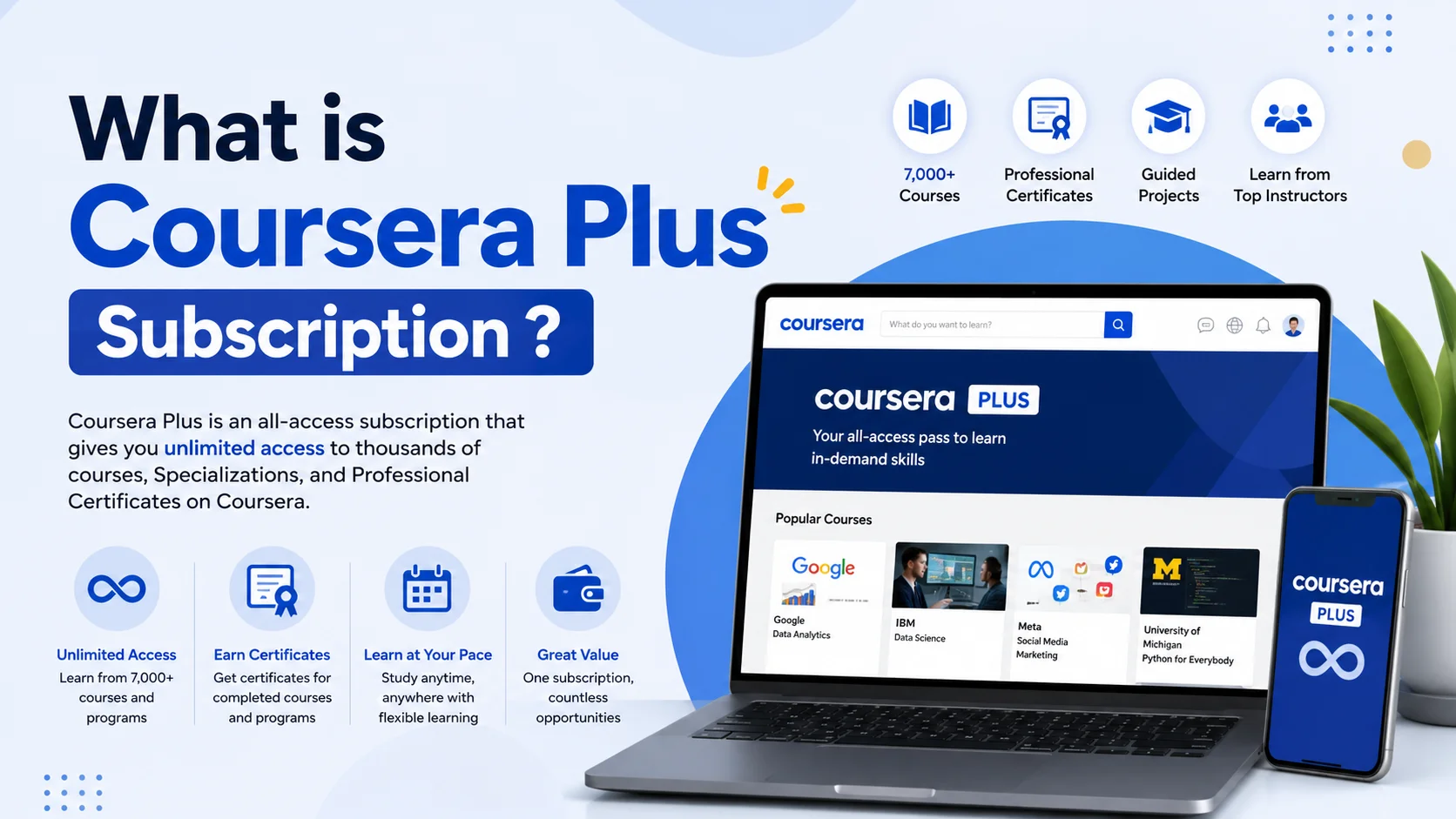
What is Coursera Plus Subscription? Coursera Plus is a subscription plan for individual learners that gives access to thousands of eligible online courses, Specializations, Guided Projects, and Professional Certificates through one recurring payment. Instead of paying for every eligible course separately, learners can use one subscription to explore different subjects and complete multiple learning programs while their membership is active.
Coursera Plus is mainly designed for people who want to learn more than one skill or complete several courses over time. This can include students, working professionals, job seekers, career changers, freelancers, and anyone interested in building practical knowledge in areas such as artificial intelligence, data science, business, cybersecurity, programming, digital marketing, project management, cloud computing, and information technology.
According to the research provided, Coursera advertises access to more than 10,000 eligible courses and programs through Coursera Plus. These programs come from universities and companies including Google, IBM, Microsoft, Meta, Yale, Stanford, and the University of Michigan. The exact catalog can change, so learners should always check whether a specific course is included before subscribing.
The main reason someone may choose Coursera Plus instead of paying for courses individually is flexibility. If you only want one course, paying for that course separately may be enough. But if you plan to complete several courses, Professional Certificates, or Specializations, a Coursera Plus subscription can make it easier to manage your learning under one payment.
Another benefit is variety. You are not limited to studying only one topic. A learner might begin with Python, move into data analytics, complete a project management course, and then explore artificial intelligence without needing to make a separate purchase each time, as long as those programs are included in Coursera Plus.
It is important to understand that Coursera Plus does not include everything available on Coursera. Some degrees, university programs, exclusive courses, and other products may require separate payment. This distinction matters when answering What is Coursera Plus Subscription, because the subscription offers broad access, but that access only applies to eligible Coursera Plus content.
What is Coursera Plus Subscription and How Does It Work?

To understand What is Coursera Plus Subscription and how it works, think of it as a membership for online learning. You pay a recurring subscription fee and, while the subscription remains active, you can enroll in multiple eligible Coursera courses and learning programs without paying a separate enrollment fee for each one.
After subscribing, learners can search through the Coursera Plus catalog and choose courses that match their goals. You might study a single subject in depth or move between several areas depending on what you want to learn. For example, someone interested in a digital career could study digital marketing, analytics, project management, artificial intelligence, and business skills through different eligible programs.
The subscription can include individual courses, Specializations, Professional Certificates, Guided Projects, assessments, and completion certificates for eligible content. Learners can watch lessons, complete readings, work through assignments, take assessments, and progress through structured programs at their own pace.
One useful part of Coursera Plus is that it gives learners freedom to explore. You do not necessarily have to decide on one course and stay with it simply because you already paid for it separately. If another eligible program becomes more useful for your goals, you can enroll in that program while your subscription is active.
Learners can also earn certificates for eligible courses and programs after completing the required work. These certificates can be useful for showing completed learning on a résumé, LinkedIn profile, personal website, or professional portfolio. However, a Coursera certificate should not automatically be treated as a university degree, professional license, or academic credit.
The phrase unlimited access can sometimes cause confusion. Coursera Plus gives unlimited access to eligible content included within the subscription. It does not mean that every course, degree, or program on the Coursera platform is automatically available. Some products remain outside Coursera Plus and may have their own enrollment fees.
Before starting a particular course, it is therefore useful to check whether that course or program is marked as included with Coursera Plus. This simple step can prevent confusion and help you understand exactly what your subscription covers.
How Coursera Plus Access Works
Once you subscribe to Coursera Plus, you can start browsing the eligible catalog and enrolling in the programs that interest you. You do not have to pay separately each time you find another included course.
For example, imagine that you subscribe because you want to improve your technology skills. You could begin with an introductory Python course, continue with a data science Specialization, explore a Guided Project, and later start an eligible Professional Certificate. If all of those programs are included with Coursera Plus, they can be accessed through the same active subscription.
This makes Coursera Plus especially useful for learners whose goals involve several connected skills. Someone preparing for a career change may need more than one course. They may need technical knowledge, practical projects, business skills, and a structured Professional Certificate. Coursera Plus allows them to move between eligible learning experiences without making a new purchase for every program.
Access normally continues while the membership remains active. During that time, learners can work through lessons and assessments and complete eligible programs according to their own schedule.
The key point is simple. What is Coursera Plus Subscription? It is a way to access a large collection of eligible Coursera learning programs through one subscription instead of paying separately for each included course. For learners who plan to study several subjects or complete multiple programs, that can make online learning more flexible and easier to organize.
What Does Unlimited Access Actually Mean?
The phrase unlimited access sounds simple, but it is one of the easiest parts of Coursera Plus to misunderstand. When Coursera says that learners get unlimited access, it means unlimited access to the courses and programs that are specifically included in the Coursera Plus catalog.
It does not mean that every course, degree, certificate, or university program on Coursera is automatically included.
With an active Coursera Plus subscription, learners can enroll in multiple eligible courses, Specializations, Guided Projects, and Professional Certificates without paying a separate fee for each one. This gives users a lot of freedom to explore different subjects and complete several learning programs under one subscription.
However, certain products may still require separate payment. Degree programs, some university certificate programs, MasterTrack programs, certain exclusive degree courses, and other content that is not marked as part of Coursera Plus can sit outside the subscription.
This distinction is important when understanding What is Coursera Plus Subscription because the value of the plan depends heavily on whether the courses you actually want are included.
For example, a learner may find several artificial intelligence, business, programming, or digital marketing courses within Coursera Plus, but a particular university degree or specialized academic program may still have its own separate price.
The safest approach is to check the individual course or program page before enrolling. If the course is included, Coursera should indicate that it is available through Coursera Plus. If it is not included, the page may show a separate payment or enrollment requirement.
In simple terms, unlimited access means you can take as many eligible Coursera Plus programs as you want while your membership is active. It does not mean unlimited access to the entire Coursera platform.
What Is Included in a Coursera Plus Subscription?

A Coursera Plus subscription includes access to a large collection of eligible learning experiences across professional, technical, academic, and personal development subjects.
The main attraction is variety. Instead of subscribing for only one topic, learners can explore several fields under the same membership. Someone might begin with data analytics, move into project management, explore digital marketing, and then take a course in artificial intelligence without paying separately for each eligible program.
Coursera Plus can include individual online courses, Professional Certificates, Specializations, Guided Projects, assessments, and certificates of completion for eligible content.
This makes the subscription appealing to people who want to build more than one skill or follow a broader learning plan over time.
Online Courses
One of the biggest parts of Coursera Plus is its selection of online courses.
Eligible courses are available across a wide range of subjects, which means the subscription can support different career goals, academic interests, and personal learning plans.
Learners can explore topics such as artificial intelligence and generative AI, machine learning, data science, Python, programming, software development, cybersecurity, and information technology.
There are also courses related to business, finance, leadership, digital marketing, ecommerce, project management, UX design, graphic design, cloud computing, communication, and personal development.
This variety is useful for learners who do not want to stay within one narrow field.
For example, someone working toward a career in digital business might study digital marketing first, then learn data analytics, project management, communication, and artificial intelligence. Coursera Plus can make this type of multi subject learning easier because eligible courses are available through the same subscription.
The exact catalog can change over time as Coursera and its content partners add, remove, modify, or restrict programs. For that reason, learners should always confirm that a specific course is still included before starting it.
Professional Certificates
Professional Certificates are another important part of Coursera Plus.
Many of these programs are designed to help learners build practical skills connected to specific jobs, industries, or career paths. They can be especially useful for people who are preparing for an entry level role, changing careers, or developing new professional skills.
Eligible Professional Certificates may include programs associated with well known companies and institutions such as Google, IBM, Meta, Microsoft, and others.
Unlike a single short course, a Professional Certificate often follows a more structured learning path. Learners may work through several connected courses that focus on a particular field or job related skill set.
For example, someone interested in technology might follow a certificate focused on data analytics, cybersecurity, or another technical area. Another learner may choose a program related to digital marketing, business, or project management.
Professional Certificates can also give learners something tangible to show after completing the required work. Eligible certificates can generally be added to a résumé, LinkedIn profile, portfolio, or professional website.
However, learners should understand the limits. A Professional Certificate is not automatically the same as a college degree, professional license, or government certification. Its value can depend on the employer, industry, job role, and the practical skills the learner can demonstrate.
Specializations
Specializations are designed for learners who want to study one subject in greater depth.
Instead of taking several unrelated courses, a Specialization brings related courses together into a structured sequence built around one skill, topic, or career goal.
For example, a learner might complete a Specialization in data analytics, digital marketing, Python, or project management. Each course builds on the wider learning path and helps the learner develop a more complete understanding of the subject.
This structure can make learning easier for people who are not sure which course to take next. Rather than creating a study plan from scratch, learners can follow the order of courses within the Specialization.
With Coursera Plus, eligible Specializations can be accessed while the subscription remains active. This can be particularly useful for people who want to complete more than one structured program during their membership.
For someone asking What is Coursera Plus Subscription, Specializations are one of the features that make the subscription more useful than simply buying random individual courses. They give learners a clearer path from basic concepts toward more advanced knowledge in the same area.
Guided Projects
Guided Projects provide a different type of learning experience.
Instead of focusing mainly on longer lectures or multi course programs, Guided Projects are shorter and more practical. They are designed to help learners practice a specific task or skill through hands on activity.
These projects can be especially helpful for beginners who want to apply what they are learning instead of only watching videos or reading course material.
A learner may work through a practical task in a browser based environment and follow guided instructions as they complete it.
This makes Guided Projects useful for developing confidence with a particular tool, process, or skill in a relatively short amount of time.
They can also complement longer courses and Specializations. For example, a learner studying data analysis or digital marketing may use a Guided Project to practice a specific task before continuing with a larger program.
The availability of individual Guided Projects can vary by region and subscription type, so users should check whether the project they want is included with their Coursera Plus access.
Course Assessments and Learning Activities
Coursera Plus is not only about watching video lessons. Eligible courses and programs can also include assessments and other learning activities that help learners test what they understand and apply what they have studied.
Depending on the course, these activities may include quizzes, graded assignments, practical exercises, projects, and other forms of assessment. These features can make the learning experience more structured because learners are not simply consuming information. They are also checking their progress and completing work that forms part of the course requirements.
This is one of the important differences between Coursera Plus and some forms of basic free access. Free auditing may allow learners to view certain videos and readings, but it commonly does not include graded assignments, instructor feedback, or certificates.
With an eligible Coursera Plus course, learners can usually take part in the fuller learning experience available within that program. This can be useful for people who want to do more than casually explore a topic and instead want to complete a structured course from beginning to end.
For someone researching What is Coursera Plus Subscription, these learning activities are worth paying attention to because they help turn the subscription into a more active learning experience. Instead of only reading or watching lessons, learners can complete required work, measure their progress, and move toward earning a certificate where the course supports one.
The exact assessments and activities will depend on the individual course or program, so learners should review the course page to understand what is included before enrolling.
Certificates of Completion
One of the main reasons many people consider Coursera Plus is the ability to earn certificates for eligible courses and programs.
A learner can generally receive a certificate after completing the required coursework, assignments, and assessments for an eligible program. The certificate acts as proof that the learner completed that particular Coursera learning experience.
These certificates can be useful when presenting newly developed skills professionally. Learners may choose to add them to a résumé, LinkedIn profile, personal website, online portfolio, or Coursera profile.
For example, someone completing a Professional Certificate in data analytics, digital marketing, cybersecurity, or another career focused subject may use the certificate to show employers that they have completed structured training in that area.
However, it is important to understand what a Coursera certificate represents.
A certificate of completion is not automatically the same as an accredited university degree, academic credit, professional license, or government recognized qualification. Its value can depend on the employer, industry, position, and the skills the learner is able to demonstrate.
There are also some restrictions learners should know about. According to the provided research, certificates generally cannot be earned during a Coursera Plus free trial. A learner may need to allow the trial to convert to a paid subscription or end the trial early and consent to payment before receiving the applicable certificate.
So when answering What is Coursera Plus Subscription, certificates are an important part of the value, but they should be viewed as evidence of completed learning rather than a guaranteed academic or professional credential.
Which Universities and Companies Are Available on Coursera Plus?

One of the features that makes Coursera Plus attractive is the range of universities, technology companies, and other organizations that provide courses and learning programs on the platform.
The Coursera Plus catalog can include eligible content associated with recognizable companies such as Google, IBM, Microsoft, and Meta. These organizations provide learning programs in areas that can include technology, data, digital skills, business, and career development.
Learners can also find eligible content connected with universities such as Yale, Stanford, and the University of Michigan, along with programs from other academic institutions.
This combination allows learners to explore both academically focused subjects and practical career related skills within the same subscription.
For example, one learner might take a university course focused on communication, psychology, or business and then move into a Professional Certificate developed by a major technology company. Another learner might combine programming, artificial intelligence, project management, and digital marketing courses into one wider learning plan.
This variety is one reason What is Coursera Plus Subscription is often an important question for people who want to learn several different skills. The subscription can provide access to content from multiple organizations without requiring the learner to purchase every eligible course separately.
However, the presence of a university or company on Coursera does not mean that every course or program from that organization is included in Coursera Plus.
The Coursera Plus catalog can change over time. Coursera and its content partners may add, remove, modify, or restrict courses and programs. A program that is available through Coursera Plus today may not necessarily remain included permanently.
Learners should therefore check the individual course or program page before subscribing or beginning a specific learning path. Looking for the Coursera Plus label is one of the easiest ways to confirm whether the program is currently included.
The important takeaway is that Coursera Plus can provide access to learning from well known universities and companies, but availability depends on the specific course and the current Coursera Plus catalog.
What Subjects Can You Learn With Coursera Plus?
Coursera Plus covers a broad mix of technical, business, creative, and personal development subjects. This variety is one reason the subscription can appeal to learners who want to build several skills instead of focusing on only one topic.
When people ask What is Coursera Plus Subscription, the range of available subjects is an important part of the answer. A learner may use the same subscription to study artificial intelligence, programming, business, digital marketing, project management, design, cloud computing, and other eligible subjects.
The exact selection can change over time, but the main categories give learners a good idea of whether Coursera Plus matches their goals.
Artificial Intelligence and Machine Learning
Artificial intelligence is one of the major subject areas available through eligible Coursera Plus courses.
Learners can explore topics related to artificial intelligence, generative AI, machine learning, and other modern technologies. These subjects may appeal to people who want to understand how AI works, develop technical skills, or learn how artificial intelligence is being used in business and technology.
Someone new to the field may begin with introductory concepts before moving into more advanced machine learning topics through eligible courses and structured learning programs.
This makes Coursera Plus useful for learners who want to explore AI from different angles rather than purchasing a separate course every time they want to move into a new topic.
Data Science and Analytics
Data science and analytics are also widely represented in the Coursera Plus catalog.
These subjects can help learners understand how data is collected, organized, analyzed, and used to support decisions. Depending on the eligible course or program, learners may explore data analysis, data science concepts, analytical thinking, and related technical skills.
This area can be particularly useful for professionals, students, and career changers who want to develop skills connected with data driven work.
A learner may also combine data science with related subjects such as Python, machine learning, business, or artificial intelligence to create a broader learning path.
Python and Software Development
Learners interested in coding can explore eligible courses related to Python, programming, and software development.
Python is commonly studied by beginners because it is used across areas such as data science, artificial intelligence, automation, and software development. Coursera Plus can allow learners to begin with basic programming concepts and then continue into related technical topics.
Software development courses may also help learners understand programming processes, technical problem solving, and other skills connected with building digital products.
For someone researching What is Coursera Plus Subscription because they want to learn coding, this category can be one of the more useful parts of the catalog.
Cybersecurity and Information Technology
Coursera Plus also includes eligible learning options in cybersecurity and information technology.
These subjects can help learners understand the technologies businesses use to operate, protect information, manage systems, and respond to digital security challenges.
Cybersecurity may appeal to people exploring technical careers or professionals who want to strengthen their understanding of digital security. Information technology courses can provide broader knowledge related to computers, systems, networks, and technical support.
Learners interested in technology careers may choose to combine cybersecurity or IT courses with cloud computing, programming, and other related topics.
Business, Finance, and Leadership
Not every Coursera Plus learner is looking for technical training.
Eligible courses are also available in business, finance, and leadership. These subjects can help learners improve their understanding of how organizations operate, how decisions are made, and how teams and resources are managed.
Business courses may be useful for professionals who want to strengthen their workplace skills, entrepreneurs who want to understand business fundamentals, or students looking to build practical knowledge beyond their formal education.
Leadership topics can also support people who are moving into management roles or want to improve how they communicate and work with teams.
Digital Marketing and Ecommerce
Digital marketing and ecommerce are useful subject areas for people interested in online business, advertising, customer acquisition, and digital growth.
Eligible courses may help learners build knowledge related to marketing strategy, online promotion, ecommerce, and other digital business skills.
These subjects can be particularly relevant for freelancers, entrepreneurs, marketing professionals, small business owners, and people preparing for careers in digital marketing.
A learner may also combine digital marketing with analytics, business, communication, artificial intelligence, or project management to develop a wider set of professional skills.
Project Management
Project management is another popular area available through eligible Coursera Plus programs.
These courses can help learners understand how projects are planned, organized, managed, and completed.
Project management skills can be useful across many industries because businesses often need people who can coordinate work, manage priorities, and help teams reach specific goals.
Learners may study project management as a standalone skill or combine it with business, technology, marketing, or leadership courses.
This flexibility is part of what makes What is Coursera Plus Subscription relevant to people who want a subscription that supports more than one career skill.
UX and Graphic Design
Coursera Plus also includes eligible courses in UX and graphic design.
UX learning can help students understand how digital products and experiences are designed around the needs of users. Graphic design courses may focus more on visual communication, creative thinking, and design related skills.
These areas can appeal to learners interested in creative careers, digital products, websites, apps, marketing, or visual communication.
Someone working in digital marketing or software development may also study design to better understand how visual presentation and user experience connect with their main field.
Cloud Computing
Cloud computing is another technical subject learners can explore through eligible Coursera Plus content.
Cloud technologies play an important role in modern IT systems, software, data storage, and online services. Learning about cloud computing may therefore be useful for people preparing for careers in technology or professionals who want to expand their technical knowledge.
Cloud computing can also connect naturally with cybersecurity, information technology, programming, and software development.
For learners building a broader technical skill set, access to several connected subjects through one subscription can be particularly useful.
Communication and Personal Development
Coursera Plus is not limited to technical or career specific subjects. Learners can also find eligible courses focused on communication and personal development.
Communication skills can be useful in almost every profession. They can support better teamwork, leadership, presentations, workplace relationships, and professional confidence.
Personal development courses may appeal to people who want to improve skills that support both their career and everyday life.
This range gives learners the option to combine technical or business training with softer skills instead of treating them as completely separate areas of development.
What Is Not Included in Coursera Plus?
Understanding what is excluded is just as important as understanding what is included.
Coursera Plus gives learners access to thousands of eligible courses and programs, but it does not unlock every product available on Coursera.
This is an important point when answering What is Coursera Plus Subscription because the word unlimited can easily create the impression that every course and academic program is included. In reality, the subscription applies only to eligible Coursera Plus content.
Possible exclusions include degree programs, some university certificate programs, MasterTrack programs, certain exclusive degree courses, and other content that is not marked as included in Coursera Plus.
There can also be separate costs associated with certain exams, degrees, or specialized programs.
Learners should therefore check the individual program page before assuming that their desired course is covered by the subscription.
Degree Programs
Full degree programs are generally separate from a standard Coursera Plus subscription.
Coursera hosts degree programs from universities, but these programs normally have their own admissions process, tuition, academic requirements, and enrollment conditions.
A Coursera Plus subscription should therefore not be viewed as a way to gain unlimited access to university degrees.
Someone who wants to complete individual courses or Professional Certificates may find Coursera Plus useful, but a learner specifically looking for a bachelor’s or master’s degree should review the pricing and enrollment information for that degree separately.
This distinction also helps readers understand that Coursera Plus is primarily a learning subscription rather than a substitute for formal university enrollment.
MasterTrack Programs
MasterTrack programs are another type of learning that is generally not included in normal Coursera Plus access.
These programs are separate educational offerings and may have their own pricing and enrollment requirements.
For this reason, learners interested in a specific MasterTrack program should not assume that purchasing Coursera Plus will automatically provide access.
The program page should be checked carefully before subscribing so the learner can see whether separate payment is required.
Certain University Programs
Some university programs and certificates can also fall outside Coursera Plus.
A university may offer several courses on Coursera, but that does not necessarily mean every program from that university is included in the subscription.
Certain university certificate programs, exclusive academic courses, and other specialized offerings may require separate enrollment or payment.
This is why learners should focus on the individual program rather than simply looking at the name of the university.
For example, seeing that a university offers Coursera Plus eligible courses does not mean its degree programs or every certificate from that institution are also included.
Checking for the Coursera Plus label on the specific course or program page is the easiest way to confirm access.
Academic Credit
Completing a normal Coursera Plus course does not automatically give a learner college or university credit.
Coursera states that completing ordinary content offerings does not itself grant academic credit unless a separate credit granting institution specifically recognizes or awards that credit.
This distinction matters because a course certificate and academic credit are not the same thing.
A learner may complete an eligible Coursera Plus course and receive a certificate showing that they finished the required learning experience. That certificate can be useful for demonstrating learning, but it should not automatically be described as university credit.
If earning academic credit is the main goal, learners should check the specific program details and confirm whether a university or other institution explicitly awards credit for that particular learning experience.
So when asking What is Coursera Plus Subscription, it is best to think of it as broad access to eligible online learning rather than automatic enrollment in accredited degree programs or college credit.
How to Check Whether a Course Is Included
Before assuming that a course is covered by Coursera Plus, learners should check the individual course or program page.
Coursera Plus gives access to thousands of eligible courses and programs, but not every item on Coursera is included. Some degrees, university programs, specialized certificates, and other learning products may require separate payment.
The easiest way to check is to look for the Coursera Plus label on the course or program page. If the program is included, Coursera should indicate that it is available as part of the subscription.
If the Coursera Plus label is not shown, the course may require a separate payment or may have different enrollment conditions.
This is especially important for learners who are thinking about subscribing because of one specific course or Professional Certificate. Paying for Coursera Plus first and discovering later that the program you wanted is excluded can make the subscription less valuable.
Anyone researching What is Coursera Plus Subscription should therefore check their preferred courses before purchasing. Make a short list of the programs you want to complete, open each program page, and confirm that Coursera Plus access is available.
The catalog can also change over time. A course that is included at one point may later be modified, removed, or placed under different enrollment conditions. Checking the current course page gives you the most reliable picture of what your subscription will actually cover.
How Much Does Coursera Plus Cost?

The cost of Coursera Plus depends mainly on whether you choose the monthly or annual subscription.
According to the research provided, the standard U.S. prices are generally $59 per month for the monthly option and $399 per year for the annual option.
These prices should be treated as standard reference prices rather than a guarantee of what every learner will see.
Coursera sometimes offers promotional discounts, and the final price can also be affected by location, applicable taxes, the purchase channel, and the specific offer shown during checkout.
This means that someone asking What is Coursera Plus Subscription and how much does it cost should always check the current checkout page before subscribing.
The monthly plan is more flexible for shorter learning periods, while the annual plan can provide better value for people who plan to study regularly for much of the year.
Coursera Plus Monthly Price
The standard U.S. price for Coursera Plus Monthly is generally $59 per month according to the research provided.
This option is designed for learners who want more flexibility and do not necessarily plan to use Coursera Plus throughout the entire year.
For example, someone might subscribe for a few months to complete a Professional Certificate, finish a Specialization, or work through several courses connected to a particular career goal.
The monthly plan can make sense when you are unsure how long you will need the subscription. Instead of paying for a full year in advance, you pay month by month and can cancel before the next renewal when you no longer need access.
This flexibility can also be useful for learners with a clear short term study plan.
Suppose you want to spend three months completing courses in artificial intelligence, data analytics, and project management. At the standard price, three months would cost $177.
However, monthly access becomes more expensive when used for a long period. Someone who keeps the $59 monthly plan for 12 months would pay $708 before taxes or discounts.
For this reason, the monthly plan is usually better suited to shorter or uncertain learning periods rather than a full year of regular study.
Coursera Plus Annual Price
The standard Coursera Plus Annual price in the research provided is $399 per year.
Unlike the monthly option, the annual subscription requires a larger payment at the beginning, but the effective monthly cost is much lower if the learner uses the subscription throughout the year.
Dividing $399 across 12 months gives an effective cost of about $33.25 per month.
This can make the annual plan attractive to learners who already know they want to complete several courses, Specializations, or Professional Certificates over a longer period.
For example, someone planning to spend the year learning Python, data analytics, artificial intelligence, digital marketing, and project management may receive more value from annual access than repeatedly paying the monthly fee.
The annual option may also encourage learners to create a longer learning plan instead of rushing through courses to avoid another monthly payment.
However, paying annually only makes sense if you are likely to use the subscription consistently. Someone who buys a full year but stops studying after a few weeks may not receive enough value to justify the upfront cost.
Monthly vs Annual Coursera Plus Cost
The biggest difference between the monthly and annual Coursera Plus plans is the balance between flexibility and long term savings.
The standard monthly plan costs $59 each month, while the standard annual plan costs $399 for the year.
If someone paid $59 every month for 12 months, the total would be $708.
The annual plan would cost $399 for the same 12 month period.
That creates a difference of $309 before taxes, promotional discounts, or other price adjustments.
The research also shows that the annual option begins to make financial sense at around seven months when using these standard prices.
Six months on the monthly plan would cost $354.
Seven months would cost $413.
The annual plan costs $399.
This means someone expecting to use Coursera Plus for around seven months or longer may spend less with the annual plan than by continuing to pay the standard monthly price.
The monthly option still has an advantage for people who value flexibility. If you only need two, three, or four months to complete your goals, paying monthly may be more practical.
When deciding between the two, think about how many programs you realistically expect to complete and how much time you can consistently dedicate to learning.
Coursera Plus Discounts and Promotions
Coursera sometimes offers temporary promotions that reduce the normal cost of Coursera Plus.
These offers can make the annual or monthly plan cheaper than the standard prices, but promotional pricing should not be treated as the permanent cost of the subscription.
A discount may only be available to new subscribers, learners in certain locations, or people who subscribe during a specific promotional period.
Coursera may also advertise an annual subscription below the regular $399 price for a limited time.
This is why articles explaining What is Coursera Plus Subscription should avoid presenting a temporary sale price as though it applies to every learner at all times.
If you see a discount, check the conditions carefully. Look at who qualifies, how long the promotion lasts, what price will apply when the subscription renews, and whether the offer is for the monthly plan or annual plan.
The price displayed at checkout is more important than an old promotion mentioned elsewhere because Coursera can change its offers over time.
Taxes and Final Checkout Price
The amount shown in an article or pricing guide may not be exactly the same as the amount every learner pays.
Coursera states that fees can vary based on location and other factors, and applicable taxes may also be charged.
The final Coursera Plus price can therefore depend on your location, the subscription option you choose, the purchase channel, applicable taxes, and any promotion available when you subscribe.
For example, two learners may see different final totals if they are purchasing from different locations or if one learner qualifies for a temporary offer.
The payment channel can also matter, so learners should review the final price and billing information carefully before confirming their purchase.
The safest approach is simple. Use the standard prices as a guide, but treat the Coursera checkout page as the place to confirm the actual amount you will be charged.
Before subscribing, check the initial payment, renewal price, billing frequency, applicable taxes, and whether a promotional rate will later return to the normal subscription price.
Does Coursera Plus Have a Free Trial?
Coursera Plus may offer a free trial, but the exact trial period and eligibility can depend on the subscription and the checkout page shown to the learner.
According to the research provided, Coursera describes a seven day free trial for certain Coursera Plus subscriptions. However, readers should not assume that every account, plan, or location will always receive the same trial offer.
Before starting, check the checkout page carefully. Confirm how long the trial lasts, when the paid subscription begins, how much you will be charged after the trial, and whether the subscription will renew automatically.
This matters because the free trial is designed to let learners explore the service before committing to the paid plan, but the rules attached to the trial can affect billing and certificate eligibility.
For anyone trying to understand What is Coursera Plus Subscription, the free trial can be a useful way to test the platform, but it should be treated as a real subscription offer with a billing date attached to it.
What Can You Access During the Free Trial?
During an eligible Coursera Plus free trial, learners may be able to explore included courses and programs before the paid subscription begins.
This can give users time to look through the Coursera Plus catalog, start eligible learning content, and decide whether the subscription fits their goals.
For example, a learner may use the trial to explore an artificial intelligence course, begin a Professional Certificate, review a Specialization, or test the general learning experience before paying for continued access.
The trial can also help learners answer practical questions.
Is the course difficulty appropriate?
Does the teaching style work for you?
Is the program relevant to your career goal?
Will you realistically use the subscription enough to justify the cost?
These are useful things to consider before the first paid billing date.
However, access during the free trial does not necessarily mean that every benefit of the paid subscription is available without restriction. Learners should check the specific trial terms shown on their account because availability and rules can vary.
Can You Earn a Certificate During the Free Trial?
This is an important limitation.
According to Coursera’s terms cited in the research, learners generally cannot earn a certificate during the free trial.
You may be able to begin the course and work through learning material, but receiving the certificate can require the subscription to become paid.
The research explains that a learner who wants the certificate may need to end the free trial early and agree to payment, or allow the trial period to expire without canceling so that the subscription converts into a paid plan.
This means a learner should not start a free trial expecting to complete a course quickly and receive a certificate without paying.
For someone researching What is Coursera Plus Subscription, this is an important detail because certificates are one of the main benefits of eligible paid Coursera Plus learning.
If the certificate matters to you, check the trial conditions before you begin the course. That way, you understand when payment is required and avoid confusion at the end of the program.
What Happens After the Free Trial Ends?
If the trial is connected to an automatically renewing subscription and you do not cancel before the trial deadline, the plan may convert into a paid Coursera Plus subscription.
At that point, the payment method connected to the account may be charged according to the plan and price shown during checkout.
This is why the billing date matters.
Before starting a trial, note the exact day when the free period ends and the paid subscription begins. Also check whether you are starting a monthly or annual subscription because the amount charged can be very different.
For example, someone beginning a trial connected to an annual plan should understand that the annual subscription may be charged in full once the applicable paid period begins.
If you decide Coursera Plus is not right for you, cancel before the applicable deadline shown in your account to avoid an unwanted charge.
The safest approach is to review the trial length, paid price, renewal terms, cancellation deadline, and payment date before clicking the final subscription button.
What Is the Coursera Plus Refund Policy?
The Coursera Plus refund policy is not exactly the same for every type of subscription.
Refund eligibility can depend on whether you purchased an annual or monthly plan, whether you were using a free trial, when the payment was made, and whether you have already earned a certificate.
Because of these differences, learners should review the refund rules that apply to their specific subscription instead of assuming that every Coursera Plus payment can be refunded in the same way.
This is especially important when answering What is Coursera Plus Subscription because the subscription involves recurring billing, and the timing of cancellation can affect whether another payment is charged.
The research provided makes a clear distinction between annual and monthly subscription considerations.
Annual Subscription Refunds
According to the research provided, Coursera’s terms state that customers with an annual Coursera Plus subscription generally have a 14 day refund period.
The annual subscription is paid in full at the time of purchase, so learners should review the plan carefully soon after subscribing if they are unsure whether they want to keep it.
If a learner decides the annual plan is not suitable, the timing of the refund request can be important.
The research also notes that annual renewal charges are generally not refundable under the stated policy. This means users should pay close attention to their renewal date instead of assuming that they can simply request a refund after the annual plan renews.
Anyone using the annual subscription should therefore keep track of three dates: the original purchase date, the applicable refund window, and the next annual renewal date.
It is also sensible to review the current refund terms inside Coursera before making a purchase because subscription policies can change.
Monthly Subscription Refunds
Monthly Coursera Plus subscriptions require closer attention to free trial deadlines and recurring renewal dates.
If a monthly subscription begins with a free trial, learners generally need to cancel before the trial ends if they do not want the first paid charge.
Once the subscription becomes paid, refund eligibility can depend on the payment, subscription type, trial status, and whether a certificate has already been earned.
This makes timing especially important.
A user who simply stops taking courses is not necessarily canceling the subscription. The monthly plan can continue renewing until the user cancels it through the appropriate account or subscription settings.
For that reason, monthly subscribers should check the next billing date and cancel before renewal if they no longer want the service.
They should also review the applicable Coursera refund information before requesting money back rather than assuming that every monthly payment will qualify.
The practical rule is simple. Know when your trial ends, know when your subscription renews, and check the refund terms that apply to your specific plan before waiting until after a charge appears.
How to Cancel Coursera Plus
Canceling Coursera Plus is generally straightforward. If you no longer want the subscription, you can manage it through your Coursera account and stop the next automatic renewal.
The important thing to understand is that canceling Coursera Plus usually does not remove your paid access immediately. Instead, cancellation normally stops the subscription from renewing again when your current billing period ends.
A simple cancellation process generally looks like this:
Sign in to your Coursera account.
Open your account or subscription settings.
Find your Coursera Plus subscription.
Choose the cancellation option.
Follow the instructions shown on the screen.
Save the confirmation email or take a screenshot for your records.
If you are researching What is Coursera Plus Subscription before signing up, it is worth understanding this process in advance. Knowing how renewal and cancellation work can help you avoid paying for another month or year when you no longer need the subscription.
Deleting the Coursera app or simply stopping your courses does not necessarily cancel Coursera Plus. The subscription needs to be canceled through the appropriate account or subscription settings.
Where to Cancel Coursera Plus
Coursera Plus is generally canceled through the subscription or payment section of your Coursera account.
After signing in, open your account settings and look for the area that manages subscriptions or payments. From there, select Coursera Plus and follow the available cancellation instructions.
The exact wording or layout of the account page may change over time, but the subscription settings are the main place to manage the plan.
Once the cancellation is complete, keep the confirmation for your records. This can be useful if you later need to check when the subscription was canceled or whether another renewal should occur.
What Happens After You Cancel?
Canceling Coursera Plus normally stops the next renewal rather than immediately ending access you have already paid for.
For example, if you have a monthly subscription and cancel halfway through your paid month, you can generally continue using eligible Coursera Plus content until that billing period ends.
The same basic idea applies to paid annual access. Canceling normally prevents the next annual renewal while allowing you to continue using the current paid period.
After the paid subscription period ends, access to Coursera Plus content is generally removed unless you purchase another eligible subscription.
This means you do not necessarily need to wait until the final day to cancel. If you already know that you do not want another renewal, you can cancel earlier and continue using the remaining paid access.
When Should You Cancel?
If you do not want Coursera Plus to charge you again, cancel before your next renewal date.
Waiting until the last moment can create unnecessary risk, especially if you forget the exact billing date.
Check your account settings to find your next renewal date and decide whether you still plan to use the subscription. If not, cancel before that date.
This matters even more with an annual plan because the next payment can be much larger than a monthly renewal.
Learners using a free trial should also pay attention to the trial deadline. If the trial automatically converts into a paid subscription, failing to cancel in time may result in the first charge.
A useful habit is to check your subscription dates as soon as you sign up. Know when the trial ends, when your paid period begins, and when the next renewal will occur.
Is Coursera Plus Worth It?
For many learners, the answer depends less on how large the Coursera Plus catalog is and more on how much of it they will actually use.
Coursera Plus can be worth the money if you plan to complete several eligible courses, Specializations, or Professional Certificates and are willing to study regularly.
It can offer less value if you subscribe with no clear learning plan and then rarely use the platform.
When deciding whether Coursera Plus is worth it, focus on three questions.
How many eligible courses or programs do you realistically plan to complete?
How often will you actually study?
Are the specific programs you want included in Coursera Plus?
If the answers point toward regular learning across several programs, the subscription can make sense. If you only need one short course or your target program is excluded, paying for Coursera Plus may be unnecessary.
This is why understanding What is Coursera Plus Subscription is not enough on its own. You also need to compare the subscription with your personal learning goals.
When Coursera Plus Is Worth the Money
Coursera Plus can provide strong value for learners who want to complete several programs rather than one isolated course.
For example, someone changing careers may want to complete a Professional Certificate, study additional technical skills, take a communication course, and explore another related Specialization.
Buying access separately for several programs can become less convenient than using one subscription when those programs are included with Coursera Plus.
The subscription may be particularly useful for professionals developing new skills, job seekers building a more structured learning plan, students supplementing their education, freelancers expanding their abilities, and career changers exploring several connected subjects.
It can also make sense for people who enjoy continuous learning.
Someone interested in artificial intelligence might begin with an introductory AI course, move into Python, study data analytics, and later explore cloud computing or project management. Coursera Plus allows eligible programs to be accessed under one active subscription.
The key is consistent use.
A subscription offers value when you actually complete courses and build useful skills from them. Paying every month while barely opening the platform can quickly reduce that value.
Before subscribing, create a short list of the programs you want to complete and confirm that each one is included. This gives you a clearer idea of whether Coursera Plus will save money or simply become another unused subscription.
When Coursera Plus May Not Be Worth It
Coursera Plus is not automatically the best choice for every learner.
If you only want one short course, individual enrollment may be simpler. There may be little reason to pay for access to thousands of other programs if you have no intention of using them.
The subscription may also offer poor value for someone who does not study regularly.
For example, paying for several months but completing only a few lessons can make the effective cost of your learning much higher.
Coursera Plus may also be the wrong choice if your main goal is to earn a full university degree. Degree programs are generally separate from the normal Coursera Plus subscription and can require their own enrollment and payment.
The same issue applies if the particular course or university program you want is excluded from Coursera Plus.
Learners who are mainly interested in watching free course videos or reading available materials may also decide that a paid subscription is unnecessary. Some Coursera courses can be audited for free, although free access may not include graded work or certificates.
So, is Coursera Plus worth it?
It can be, but only if the subscription matches the way you actually plan to learn.
How Many Months Make the Annual Plan Worth It?
The monthly versus annual decision becomes easier when you compare the numbers.
Using the standard prices from the provided research, Coursera Plus Monthly costs $59 per month, while the annual plan costs $399.
Six months of monthly payments would cost:
$59 multiplied by 6 equals $354.
Seven months would cost:
$59 multiplied by 7 equals $413.
The annual plan costs $399.
This means that once you reach about seven months of monthly payments, you would have spent more than the standard annual subscription price.
At these prices, someone expecting to use Coursera Plus for seven months or longer may find the annual plan financially stronger.
The difference becomes even larger over a full year.
Twelve months at $59 per month would cost $708.
The standard annual subscription would cost $399.
That is a difference of $309 before taxes or promotional discounts.
However, the annual plan is only a better deal if you actually use it.
Someone who pays $399 for a year but stops studying after one month has not necessarily saved money in practical terms. Meanwhile, a learner who only needs three months may prefer the monthly plan because it provides more flexibility.
Before choosing, estimate how long your learning plan will take.
If you want to complete one intensive program over a few months, monthly access may be enough. If you are planning several Professional Certificates, Specializations, or courses across most of the year, the annual option may offer better value.
That makes the best answer to What is Coursera Plus Subscription worth to me? highly personal. The subscription delivers the strongest value when you have a clear plan, your preferred programs are included, and you use the platform consistently.
Advantages of Coursera Plus Subscription
One of the biggest advantages of Coursera Plus is the amount of eligible learning available under one subscription.
Instead of choosing only one course, learners can explore thousands of eligible courses, Specializations, Guided Projects, and Professional Certificates across different subjects. This can be useful for people who want to build several connected skills rather than study only one topic.
For example, someone interested in a technology career could study Python, data analytics, artificial intelligence, cloud computing, cybersecurity, and project management through different eligible programs.
This broad access is an important part of understanding What is Coursera Plus Subscription because the plan is designed for learners who want more freedom to move between subjects.
Another advantage is potential cost savings.
If you plan to complete several eligible programs, paying one recurring subscription fee may be more practical than paying separately for each course. The savings become more noticeable for people who study regularly and complete multiple programs during their subscription period.
Coursera Plus also includes certificates for eligible completed courses and programs. These certificates can be added to a résumé, LinkedIn profile, portfolio, personal website, or other professional profile to show completed learning.
Flexible learning is another major benefit.
Many Coursera programs are designed for self paced online study. This means learners can often organize their coursework around jobs, university schedules, freelance work, family commitments, or other responsibilities.
The platform also features content associated with recognizable universities and companies. Eligible programs may come from organizations such as Google, IBM, Microsoft, Meta, Yale, Stanford, the University of Michigan, and other institutions.
For professionals, Coursera Plus can support career development and reskilling.
A person who wants to move into a different industry may use several courses to develop a new combination of skills. Someone already working in a particular field may use the subscription to stay current, strengthen weak areas, or explore new technologies.
The ability to explore is also valuable.
You may subscribe because you want to study data science and later discover that project management, communication, or digital marketing would also help your career. With Coursera Plus, eligible programs in these subjects can be explored without making a separate purchase every time.
For learners with curiosity and a clear study plan, this variety can make Coursera Plus much more useful than a subscription focused on only one narrow topic.
Disadvantages of Coursera Plus Subscription
Coursera Plus offers broad access, but it also has limitations that learners should understand before paying.
The first disadvantage is that not everything on Coursera is included.
Degree programs, certain university programs, MasterTrack programs, exclusive degree courses, and other specialized content may require separate payment. This means learners should not assume that every course they find on Coursera will be available through their subscription.
The catalog can also change.
Coursera and its content partners may add, remove, modify, or restrict courses and programs over time. A learner should therefore check whether the specific programs they want are currently included before subscribing.
Another disadvantage is automatic renewal.
Coursera Plus subscriptions generally renew according to their billing schedule unless canceled. Someone who forgets about the renewal date could be charged for another month or year even if they are no longer actively studying.
There is also the risk of paying for access without using it enough.
Coursera Plus may look valuable because thousands of courses are available, but that number matters very little if you only complete one short course.
A learner who pays for several months and rarely logs in may receive much less value than someone who follows a regular study schedule and completes several programs.
Certificates also have limits.
A Coursera certificate can show that you completed an eligible learning experience, but it does not automatically equal a university degree, academic credit, professional license, or government certification.
Completing a Coursera course also does not guarantee a job, promotion, higher salary, or career change.
The practical value of a certificate can depend on the employer, industry, role, and your ability to demonstrate the skills you learned.
This is why someone asking What is Coursera Plus Subscription should consider more than the size of the catalog. The real question is whether the available courses match your goals and whether you will use the subscription consistently enough to justify the cost.
Coursera Plus vs Paying for Individual Courses
The difference between Coursera Plus and paying for individual courses mainly comes down to how much you plan to learn.
Coursera Plus uses a subscription model. While your membership is active, you can access multiple eligible courses and programs without paying separately for each one.
Individual enrollment is more focused. You pay for the specific course or program you want rather than paying for access to a wider collection.
Neither option is automatically better for everyone.
A learner who wants one specific course may prefer individual enrollment. A learner planning several courses across different subjects may find Coursera Plus more practical.
Which Option Costs Less?
The cheaper option depends on how many programs you intend to complete.
If you only want one course, paying for that individual course may be more economical than subscribing to Coursera Plus for several months.
However, the calculation can change quickly if you want several courses, Specializations, or Professional Certificates.
Imagine that your learning plan includes Python, data analytics, project management, and artificial intelligence. If all of those programs are eligible for Coursera Plus, one subscription may provide better value than paying separately for multiple programs.
The subscription works best financially when you actually use it.
Paying for broad access but completing almost nothing can make Coursera Plus expensive. Completing several meaningful programs during the same subscription period can make the cost easier to justify.
Before choosing, compare the cost of the specific courses you want with the subscription price and estimate how long you expect to study.
Which Option Gives More Flexibility?
Coursera Plus generally offers more flexibility for learners who want to explore multiple subjects.
You can start one eligible course, move into another topic, begin a Specialization, or explore a Professional Certificate while your membership remains active.
This can be useful when your learning goals change.
For example, you may begin with digital marketing and later realize that data analytics and project management would make your skill set stronger. Coursera Plus gives you the freedom to explore those eligible areas without purchasing each one separately.
Individual enrollment can be more suitable when your goal is very specific.
If there is only one course you want and you have no interest in exploring additional subjects, broad subscription access may not provide much extra value.
The better option therefore depends on whether you prefer focused learning or wider exploration.
Which Option Is Better for Frequent Learners?
Coursera Plus can make more sense for frequent learners because the subscription is designed around continued access to multiple eligible programs.
Someone who studies regularly may complete several courses during a few months or follow multiple learning paths across the year.
In that situation, repeatedly purchasing individual programs can become less convenient.
Coursera Plus allows the learner to move between eligible courses through one membership.
It can be particularly useful for people who enjoy continuous learning, professionals developing several workplace skills, or career changers who need to build knowledge across more than one subject.
Individual courses can still work well for occasional learners.
If you only take one course every now and then, paying for broad access throughout the year may not be necessary.
Coursera Plus vs Free Coursera Courses
Coursera also allows some courses to be audited for free, so paying for Coursera Plus is not the only way to learn on the platform.
The main difference is the level of access.
Free auditing may provide enough material for someone who simply wants to explore a subject, while Coursera Plus is designed to provide a fuller learning experience for eligible programs.
For someone researching What is Coursera Plus Subscription, this comparison is important because not every learner needs a paid plan.
What Can You Learn for Free?
Some Coursera courses can be audited without paying.
Free auditing may provide access to course videos and readings, allowing learners to explore the subject and learn basic concepts without purchasing the full course experience.
This can be a good option for someone who is curious about a topic but does not need a certificate or graded coursework.
For example, a learner who simply wants an introduction to business, programming, psychology, or another subject may find that free access provides enough information for their needs.
However, free auditing commonly has limitations.
Graded assignments, instructor feedback, certificates, and other parts of the full learning experience may not be available.
The exact free access also depends on the individual course.
What Do You Get With Coursera Plus?
Coursera Plus is designed for learners who want more than basic access to videos and readings.
Eligible programs can include graded assignments, assessments, practical learning activities, and certificates after completing the required work.
Learners can also access multiple eligible courses under the same subscription instead of auditing one free course at a time.
This creates a more structured learning experience.
A person can follow a complete Specialization, work toward a Professional Certificate, complete assessments, and then move into another eligible subject while the subscription remains active.
That difference matters for learners who are studying for career development, structured skill building, or professional improvement.
Free auditing can be useful for exploration.
Coursera Plus can be more suitable when you want to complete courses, demonstrate your learning through certificates, and follow several structured programs.
Who Should Get a Coursera Plus Subscription?
Coursera Plus can work well for many different learners, but it is particularly useful for people who expect to use the platform regularly.
The strongest candidates are usually those with several learning goals rather than someone interested in only one short course.
If your plan includes multiple eligible courses, career development, reskilling, or continuous learning throughout the year, Coursera Plus may be worth considering.
Professionals Developing New Skills
Working professionals may use Coursera Plus to strengthen skills that are useful in their current jobs or prepare for new responsibilities.
Someone working in marketing might study analytics, artificial intelligence, project management, communication, and ecommerce.
A technology professional might explore cloud computing, cybersecurity, programming, or machine learning.
Because eligible courses can be accessed through one subscription, professionals can create a learning plan that covers several areas instead of limiting themselves to one topic.
Students Supplementing Their Education
Students may also use Coursera Plus to learn subjects beyond their formal classes.
A university student studying business could explore digital marketing, data analytics, leadership, or project management.
A computer science student might use eligible courses to strengthen Python, artificial intelligence, cloud computing, or cybersecurity skills.
Coursera Plus does not automatically replace formal university education or provide academic credit, but it can supplement classroom learning with additional subjects and practical skills.
Job Seekers
Job seekers may benefit from Coursera Plus when they need to improve several skills before applying for new roles.
Instead of completing random courses, they can create a structured learning plan around the types of jobs they want.
For example, someone interested in data related roles might combine data analytics, Python, artificial intelligence, communication, and project management.
Eligible Professional Certificates can also give job seekers a structured way to work through career focused material.
The certificate itself does not guarantee employment, but the skills developed during the program can become part of a wider job search strategy.
Career Changers
Career changers are another group that may receive strong value from Coursera Plus.
Moving into a new field often requires more than one skill.
Someone entering digital marketing may need to understand marketing strategy, analytics, ecommerce, communication, and artificial intelligence.
Someone moving toward a technology career may need programming, cloud computing, cybersecurity, or data related knowledge.
Coursera Plus can make it easier to combine several eligible learning programs while building a new skill set over time.
Freelancers and Entrepreneurs
Freelancers and entrepreneurs often need knowledge across several areas rather than deep expertise in only one subject.
A freelancer may need technical skills as well as marketing, communication, project management, and business knowledge.
An entrepreneur may want to understand finance, leadership, ecommerce, digital marketing, analytics, and artificial intelligence.
Coursera Plus can support this type of broad learning because learners can move between eligible topics under the same subscription.
This can be useful for people who regularly need to learn new skills as their work or business changes.
Technology and Digital Skills Learners
Learners focused on technology and digital skills may find Coursera Plus particularly attractive because the catalog covers several connected technical subjects.
Eligible learning can include artificial intelligence, machine learning, data science, Python, programming, cybersecurity, information technology, cloud computing, digital marketing, and related areas.
Someone can start with one technical subject and gradually build a wider set of skills.
For example, a learner may begin with Python, continue into data analytics, explore machine learning, and then study cloud computing.
This ability to connect several subjects is one of the strongest reasons technology focused learners may consider Coursera Plus.
People Planning Several Courses Per Year
Coursera Plus is generally better suited to people who expect to complete several eligible programs rather than someone who only wants occasional access.
A learner with a clear yearly plan may use the subscription for multiple courses, Professional Certificates, Specializations, and Guided Projects.
This is where the subscription model can become particularly useful.
Instead of asking only What is Coursera Plus Subscription, learners should ask a second question: how much learning will I realistically complete?
If you already have several eligible courses in mind and plan to study consistently, Coursera Plus may provide both convenience and potential savings.
If you have no clear study plan and are unlikely to use the platform regularly, the subscription may be harder to justify.
Who Should Not Get Coursera Plus?
Coursera Plus can be useful for regular learners, but it is not the right choice for everyone.
If you are interested in only one short course, you may not need a subscription that provides access to thousands of other eligible programs. Paying for an individual course, where available, may make more sense depending on its price and enrollment options.
Coursera Plus may also be a poor fit if your main goal is earning a formal university degree. Degree programs are generally separate from Coursera Plus and usually have their own enrollment requirements and costs.
Irregular learners should think carefully as well. A subscription only provides good value when you actually use it. If you study for a few days and then stop for several months, you may continue paying without gaining enough from the membership.
The subscription is also unlikely to make sense when the specific programs you want are excluded. Before subscribing, check each course, Specialization, or Professional Certificate you plan to take and confirm that it carries the Coursera Plus label.
Finally, some learners may be satisfied with free course materials. Coursera allows certain courses to be audited for free, which may provide videos and readings without requiring a paid subscription. If you only want to explore a subject and do not need graded assessments or certificates, free access may be enough.
When considering What is Coursera Plus Subscription, the best decision comes from matching the plan with your actual learning habits rather than choosing it simply because the catalog is large.
How to Get the Most Value From Coursera Plus
Getting value from Coursera Plus is not about enrolling in as many courses as possible. It is about choosing useful programs, completing them, and making sure the subscription supports a clear learning goal.
A little planning before you subscribe can make a big difference.
Choose Your Learning Goal First
Start by deciding what you actually want to achieve.
Do you want to improve your current career skills? Move into a new industry? Learn artificial intelligence? Build digital marketing knowledge? Develop programming skills?
A clear goal makes it easier to choose courses that work together.
For example, someone preparing for a data focused career might combine data analytics, Python, artificial intelligence, and communication rather than enrolling in unrelated courses simply because they are available.
This approach turns Coursera Plus into a learning plan instead of an endless library that becomes difficult to navigate.
Check Whether Your Courses Are Included
Before paying for Coursera Plus, make a list of the courses and programs you want to complete.
Then open each program page and look for the Coursera Plus label.
This simple check is important because not everything on Coursera is included. Certain degrees, university programs, MasterTrack programs, and other content may require separate payment.
If most of the programs on your list are included, Coursera Plus may provide stronger value.
If your main course is excluded, subscribing may not make sense.
Build a Realistic Learning Schedule
Do not build a study plan around how much you hope to learn. Build it around how much time you realistically have.
Someone working full time may have only a few hours each week. A student may have more time during breaks and less time during exams.
Choose a schedule you can maintain.
You might study for a few hours each week, complete lessons during weekends, or dedicate specific evenings to coursework.
Consistency matters more than trying to finish everything quickly.
A realistic schedule can also help you decide whether the monthly or annual subscription makes more sense.
Complete One Program Before Starting Too Many
Having access to thousands of courses can create temptation.
You may start Python on Monday, artificial intelligence on Tuesday, digital marketing on Wednesday, and project management by the weekend.
Soon, you have several unfinished courses and very little completed learning.
A better approach is to focus on one main program at a time.
Complete a course or make substantial progress before adding another major program. This helps you retain what you learn and gives you a clearer sense of achievement.
You can still explore different subjects, but avoid turning unlimited access into unlimited unfinished courses.
Track Your Subscription Renewal Date
Coursera Plus generally renews according to its billing schedule unless you cancel.
Keep track of your next renewal date from the beginning.
If you are using the monthly plan, review your progress before the next monthly payment. If you have an annual subscription, make a note of the annual renewal date well in advance.
This gives you time to decide whether you are still receiving enough value from the subscription.
Stopping your studies or deleting the Coursera app does not necessarily stop billing. If you no longer want Coursera Plus, cancel the subscription through the appropriate account settings before the next renewal.
Add Completed Certificates to Your Professional Profile
If you complete an eligible course or program and earn a certificate, do not simply leave it sitting inside your Coursera account.
You can add relevant certificates to your LinkedIn profile, résumé, professional portfolio, personal website, or other career materials.
Be selective.
A certificate related to the position or career path you are pursuing is generally more useful than listing every short course you have completed.
You should also be clear about what the certificate represents. A Coursera certificate shows that you completed a particular learning experience. It is not automatically an accredited degree, professional license, or academic credit.
The strongest value comes from combining the certificate with skills you can actually demonstrate.
Frequently Asked Questions About What is Coursera Plus Subscription
Does Coursera Plus Include Certificates?
Yes. Coursera Plus includes certificates for eligible courses and programs after learners complete the required coursework and assessments.
These certificates can generally be added to LinkedIn, a résumé, portfolio, personal website, or Coursera profile.
However, certificates generally cannot be earned during a free trial. According to the supplied research, a learner may need to allow the trial to become paid or end the trial early and consent to payment before receiving the applicable certificate.
Does Coursera Plus Include Degrees?
No. Full degree programs are generally not included in Coursera Plus.
Coursera hosts degree programs and other university offerings, but these normally have separate enrollment requirements, pricing, and academic conditions.
Coursera Plus should therefore be viewed as a subscription for eligible online courses and learning programs rather than an all access university degree service.
Can I Take Unlimited Courses With Coursera Plus?
You can enroll in multiple eligible courses and programs while your Coursera Plus subscription remains active.
The important word is eligible.
Unlimited access does not mean that every course, degree, certificate, or program on Coursera is included.
Some content sits outside Coursera Plus and may require separate payment.
Does Coursera Plus Give Academic Credit?
Not automatically.
Completing a normal Coursera Plus course does not by itself provide college or university credit.
Academic credit would need to be separately recognized or awarded by an appropriate institution.
A Coursera certificate and university academic credit are therefore not the same thing.
Does Coursera Plus Renew Automatically?
Coursera Plus subscriptions generally renew according to their billing schedule unless they are canceled.
A monthly subscription may continue renewing each month, while an annual subscription may renew for another annual period.
Always check the renewal date and price shown in your account because subscription terms and pricing can change.
Can I Share My Coursera Plus Account?
No.
According to the Coursera terms referenced in the supplied research, account access is personal and non transferable. Users should not share their Coursera account access with other people.
If another person wants to use Coursera Plus, they should use their own eligible account and subscription.
Can I Cancel Coursera Plus at Any Time?
You can generally cancel Coursera Plus before your next renewal.
Cancellation normally prevents the next subscription charge rather than immediately removing access you have already paid for.
If you cancel during an active paid billing period, you can generally continue using included content until that period ends.
Afterward, Coursera Plus access is normally removed unless you purchase another eligible subscription.
Does Coursera Plus Work for Learners in the United States?
Yes. Coursera Plus is available to learners in the United States.
The research provided lists standard United States prices of $59 per month or $399 per year, although actual pricing can change.
Promotional offers, taxes, payment methods, purchase channels, and other factors may affect the final amount displayed at checkout.
United States learners should therefore confirm the current price directly before subscribing.
Can I Use Coursera Plus for Career Development?
Yes. Career development is one of the stronger use cases for Coursera Plus.
Learners can explore eligible programs in subjects such as artificial intelligence, data analytics, cybersecurity, programming, business, digital marketing, project management, cloud computing, and communication.
Professional Certificates and Specializations can also provide structured paths for developing job related skills.
However, completing courses or earning certificates does not guarantee a job, promotion, or salary increase.
The strongest career value comes from combining what you learn with practical experience and skills you can demonstrate.
Is Coursera Plus Good for Beginners?
Coursera Plus can be useful for beginners because eligible content covers both introductory and more structured learning experiences.
Someone completely new to programming, artificial intelligence, business, digital marketing, data analytics, or another subject can look for beginner appropriate courses and then progress into more advanced material.
Guided Projects may also be useful for learners who prefer shorter practical exercises alongside traditional course material.
Beginners should check the recommended experience level of each course before enrolling so they can choose programs that match their current knowledge.
Is Coursera Plus Better Monthly or Annually?
Neither option is better for everyone.
The monthly plan can be more suitable for learners who need Coursera Plus for a short period or want greater flexibility.
The annual plan can provide better value for people who expect to study regularly for much of the year.
Using the standard prices in the supplied research, six months at $59 per month would cost $354, while seven months would cost $413. The standard annual plan costs $399.
At those prices, learners expecting to use Coursera Plus for around seven months or longer may find the annual option financially stronger.
Prices and promotions can change, so check the current offer before deciding.
Are All Professional Certificates Included in Coursera Plus?
No. You should not assume that every Professional Certificate available on Coursera is included.
Coursera Plus provides access to many eligible Professional Certificates, including programs associated with major companies and institutions, but the exact catalog can change.
Always open the Professional Certificate page and check whether it is specifically marked as included with Coursera Plus.
What is Coursera Plus Subscription? Final Verdict
So, What is Coursera Plus Subscription?
Coursera Plus is an individual learning subscription that gives users access to thousands of eligible online courses, Guided Projects, Specializations, and Professional Certificates through one recurring payment.
It is designed mainly for people who want to complete several learning programs rather than purchase each eligible course separately.
Learners can explore subjects ranging from artificial intelligence, data science, Python, cybersecurity, and cloud computing to business, finance, digital marketing, project management, design, communication, and personal development.
Eligible programs can also include assessments and certificates of completion.
But Coursera Plus does not include everything on Coursera.
Full degree programs, MasterTrack programs, some university certificate programs, exclusive degree courses, and other specialized content may require separate enrollment or payment. Completing ordinary Coursera Plus courses also does not automatically provide university credit or a professional license.
For United States learners, the supplied research lists standard prices of $59 per month and $399 per year. The monthly option gives learners more short term flexibility, while the annual plan can offer better value for people planning to use Coursera Plus for much of the year.
Those prices should not be treated as permanent. Coursera can offer promotions, and the final amount can be affected by taxes, location, purchase channel, and the offer shown during checkout.
Coursera Plus is likely to provide the most value to professionals, students, job seekers, career changers, freelancers, entrepreneurs, and continuous learners who already have several eligible courses or programs they want to complete.
It may provide less value if you only want one short course, rarely study, mainly use free course materials, need a formal degree, or discover that your preferred programs are not included.
The smartest approach is to have a real learning plan before subscribing.
Choose the skills you want to develop. Check that your preferred courses are included. Compare monthly and annual pricing based on how long you expect to study. Review the free trial carefully. Understand the refund conditions. Check the next renewal date.
Coursera Plus can offer strong value when you actually use the access it provides. The size of the catalog is less important than whether the right programs are included and whether you have enough time and motivation to complete them.
Before purchasing, confirm the current subscription price, Coursera Plus eligibility of your chosen programs, renewal terms, trial conditions, cancellation rules, and applicable refund policy directly at checkout.
Looking for more practical guides and useful insights? Explore our latest articles on the Eadoz blog.


