

-
- No Comments
- May 17, 2026

why oil prices are rising in 2026 ?
Introduction
Millions of people across the world are suddenly paying more for fuel, transport, electricity, flights, and everyday goods because oil prices are rising in 2026. From the United States to Europe and Asia, the impact is spreading through nearly every part of the global economy. Drivers are watching gasoline prices climb week after week, businesses are facing higher shipping costs, and governments are once again being forced to deal with inflation fears linked directly to energy markets. As oil surged past the psychological $100 per barrel level for the first time in years, one question started dominating headlines everywhere: why oil prices are rising in 2026 ?
The answer is far more complicated than a simple supply shortage. The oil market in 2026 is being driven by war, global politics, sanctions, military conflict, supply disruptions, and extreme fear inside financial markets. The growing conflict between the United States and Iran has created one of the biggest geopolitical shocks the energy sector has seen in years. At the same time, attacks on shipping routes, uncertainty around the Strait of Hormuz, sanctions on major oil producers, and instability across multiple regions have created panic throughout global trading markets.
What makes this situation even more unusual is that many analysts believe the world technically still has enough oil supply overall. In other words, the current crisis is not only about physical shortages. It is also about fear. Investors, governments, and traders are reacting to the possibility of future disruptions before they fully happen. That contrast between geopolitical panic and actual oil market fundamentals is one of the biggest reasons why oil prices are rising in 2026 and why the situation has become so unpredictable.
Why Oil Prices Are Rising in 2026 ? The Short Answer

The short answer to why oil prices are rising in 2026 ? is that global energy markets are being shaken by geopolitical conflict and fears of massive supply disruption. Oil prices are not rising because of a normal increase in demand alone. Instead, the market is reacting to war risks, blocked shipping routes, sanctions, and uncertainty surrounding the future of global oil supply.
One of the biggest drivers behind why oil prices are rising in 2026 ? is the growing US Iran conflict. Military escalation in the Middle East triggered fears that millions of barrels of oil could disappear from global markets almost overnight. This fear intensified further when tensions around the Strait of Hormuz increased. Since nearly 20 percent of the world’s oil supply moves through that narrow route, even the possibility of disruption caused panic in energy markets.
At the same time, supply disruptions across major oil producing regions added more pressure. Severe weather conditions, refinery outages, and production interruptions in different parts of the world tightened supply expectations. New sanctions on oil producing countries like Iran and Venezuela also reduced confidence in future exports and increased concerns about long term market stability.
Another major reason why oil prices are rising in 2026 ? is the rapid rise in geopolitical tensions worldwide. Investors and traders are now reacting emotionally to every military headline, naval movement, or threat involving critical energy infrastructure. Fear driven trading has become a powerful force in the market, pushing prices higher even faster than actual physical shortages.
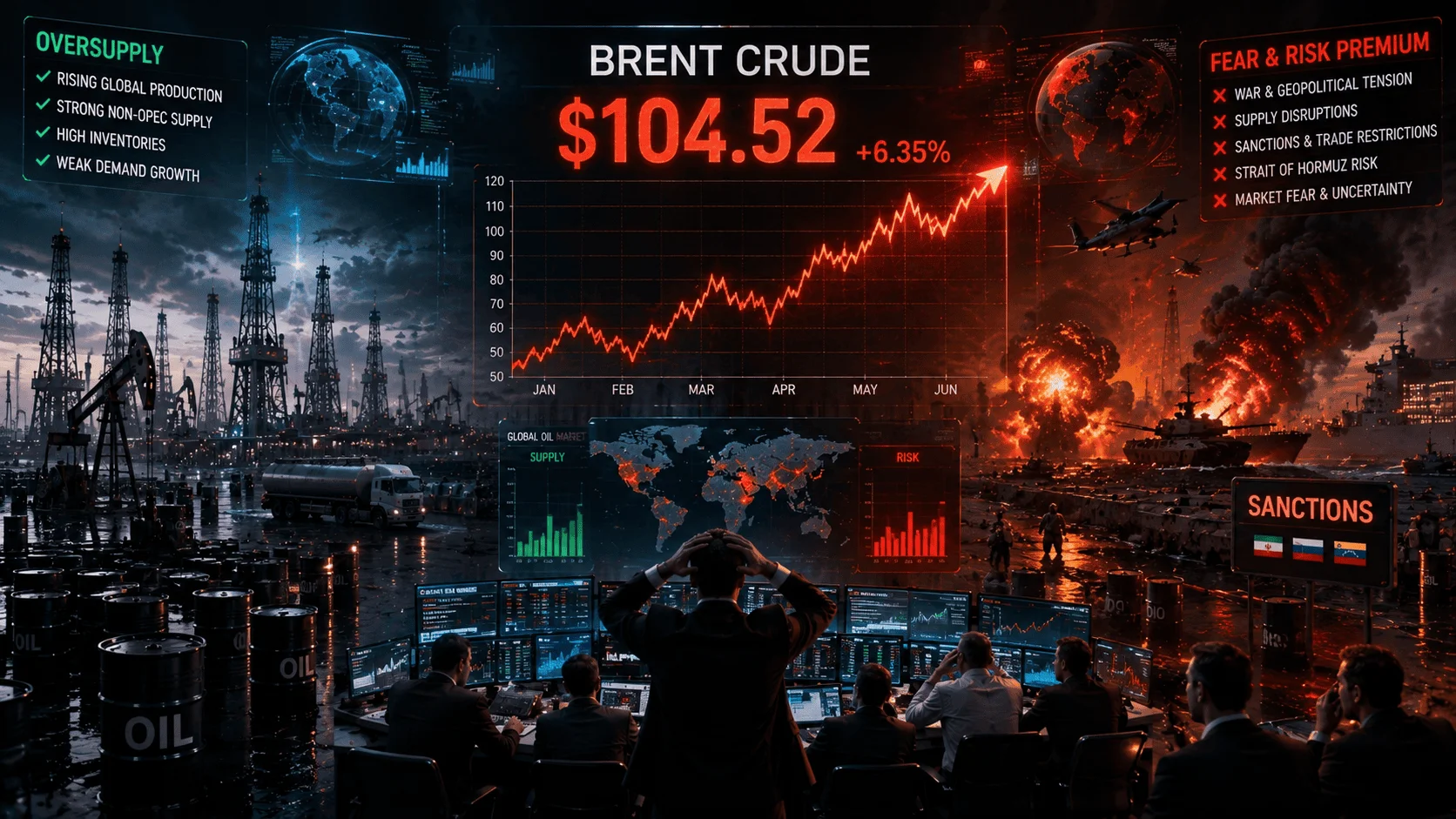
Together, these factors pushed Brent crude oil above $100 per barrel for the first time since 2022, signaling the beginning of a new global energy shock that could affect inflation, economic growth, and fuel prices across the world.
The US Iran War and Why Oil Prices Are Rising in 2026
One of the biggest reasons why oil prices are rising in 2026 is the sudden military escalation between the United States and Iran. What initially started as rising political tension quickly transformed into direct confrontation, shaking global energy markets almost overnight. As news of US strikes on Iranian targets spread across international media, traders immediately understood that the world was facing a potential oil supply crisis capable of disrupting the entire global economy.
The United States targeted multiple Iranian military and strategic infrastructure locations in early 2026, triggering fears that the conflict could spread across the Middle East. Iran responded aggressively through threats against regional shipping routes, energy infrastructure, and international oil transit corridors. Within hours, global markets entered panic mode. Investors rushed into oil futures expecting severe disruptions in supply, while governments began preparing for possible energy shortages and inflation shocks.
The situation became even more dangerous because the conflict threatened nearly 20 million barrels of oil per day connected directly or indirectly to Middle Eastern export routes. That amount represents close to one fifth of global oil supply. Even though not all production disappeared instantly, the possibility that such a massive volume could be interrupted was enough to send shockwaves through financial markets.
This is exactly why traders reacted so aggressively. Oil markets are not driven only by what is happening today. They are heavily influenced by what traders fear could happen tomorrow. The moment investors believed the war might expand into shipping lanes and regional energy infrastructure, billions of dollars flooded into oil markets. Panic buying accelerated rapidly as hedge funds, energy firms, and governments attempted to secure supply before prices climbed even higher.
As fear intensified, Brent crude surged above $108 per barrel and later approached the $114 range during peak market panic. For millions of ordinary people around the world, those numbers quickly translated into rising fuel prices, higher transportation costs, expensive airline tickets, and growing inflation pressure. Suddenly, the question of why oil prices are rising in 2026 was no longer just an economic discussion for analysts and traders. It became a real life financial burden affecting households, businesses, and entire economies globally.
What makes this crisis especially powerful is the emotional side of the market. Investors are reacting not only to actual oil shortages but also to uncertainty, fear, and the possibility of wider war. In modern energy markets, fear itself can move prices almost as strongly as physical disruptions. That emotional reaction is one of the main reasons why oil prices are rising in 2026 at such an explosive pace.
Strait of Hormuz Crisis Explained

To fully understand why oil prices are rising in 2026, it is impossible to ignore the Strait of Hormuz crisis. This narrow waterway has become the center of global energy fears because it is one of the most important oil chokepoints on Earth. Whenever conflict threatens the Strait of Hormuz, global oil markets immediately react with panic because so much of the world’s energy supply depends on that single route remaining open.
The Strait of Hormuz is a narrow passage located between Iran and Oman that connects the Persian Gulf to the open ocean. Despite its relatively small size, it plays an enormous role in global energy transportation. Roughly 20 percent of the world’s oil supply passes through the Strait of Hormuz every single day, including exports from major oil producing countries like Saudi Arabia, Iraq, Kuwait, the United Arab Emirates, and Iran itself.
Because such a huge percentage of global oil moves through this one corridor, even small military incidents can create massive fear inside financial markets. In 2026, rising tensions between the United States and Iran transformed the strait into one of the most dangerous locations in the world. Naval blockades, military patrols, threats against commercial tankers, and attacks on shipping routes created fears that the entire passage could become inaccessible.
The market reaction was immediate and brutal. Oil prices surged sharply after reports emerged about potential blockades and military operations near the strait. Traders understood that if the Strait of Hormuz became fully closed, millions of barrels of oil could be trapped inside the Gulf region, creating one of the largest supply shocks in modern history.
What makes the situation even more intense is that oil markets react emotionally long before actual shortages happen. In reality, global supply may not disappear instantly, but traders price in the risk ahead of time. Even rumors about attacks on tankers or possible naval escalation are enough to trigger aggressive buying and rapid price increases. That psychological reaction is one of the strongest forces behind why oil prices are rising in 2026.
Fear spreads faster than physical disruption in modern markets. The moment investors hear words like blockade, tanker attack, missile strike, or shipping disruption connected to the Strait of Hormuz, oil prices immediately jump because nobody wants to be caught unprepared during a global energy crisis. This combination of military risk, uncertainty, and emotional trading has turned the Strait of Hormuz into one of the biggest reasons why oil prices are rising in 2026.
Geopolitical Risk Premium and Why Oil Prices Are Rising in 2026
One of the most important concepts behind why oil prices are rising in 2026 is something called the geopolitical risk premium. In simple terms, geopolitical risk premium means extra cost added to oil prices because traders fear war, political instability, terrorism, sanctions, or disruptions to global energy supply. Even when actual oil production has not fully collapsed, markets begin pricing in future danger before it happens.
This fear based pricing has become one of the biggest forces driving oil markets in 2026. Investors are no longer looking only at supply and demand numbers. They are watching military movements, missile strikes, sanctions, drone attacks, naval operations, and political threats across major energy regions. Every new headline creates more uncertainty, and uncertainty itself pushes oil prices higher.
The situation became especially intense after Ukraine Russia attacks on energy infrastructure continued disrupting parts of global energy logistics and refining systems. Drone strikes targeting oil facilities, storage infrastructure, and transport networks increased fears that energy supply chains were becoming more vulnerable worldwide. At the same time, instability in the Middle East added even more pressure to already nervous markets.
The conflict involving the United States and Iran transformed the energy market into a psychological battlefield. Traders feared that attacks on shipping lanes, oil terminals, pipelines, and export routes could remove massive amounts of supply from global markets with very little warning. Even countries not directly involved in the conflict began feeling the impact because oil is connected to the entire global economy.
Another major reason why oil prices are rising in 2026 is uncertainty surrounding sanctioned oil exports. Markets are struggling to predict how much oil from Iran, Venezuela, and even Russia will remain available in the coming months. Governments continue imposing restrictions while buyers search for alternative suppliers, creating instability throughout global trade networks.
This uncertainty is exactly why investors rush into oil during periods of conflict. Oil becomes both a necessity and a financial protection asset during geopolitical crises. Traders believe prices may continue rising if tensions worsen, so they aggressively buy futures contracts and energy stocks before supply conditions deteriorate further. That rush of speculative money amplifies market panic and accelerates price increases even faster.
In reality, modern oil markets are heavily emotional. Fear spreads through markets faster than physical shortages themselves. The possibility of disruption often matters almost as much as actual disruption. That psychological effect is one of the clearest reasons why oil prices are rising in 2026 and why volatility has become extreme across global energy markets.
Sanctions and Oil Supply Restrictions in 2026

Another major reason why oil prices are rising in 2026 is the growing wave of sanctions and oil supply restrictions affecting multiple producing countries. Governments are using energy sanctions as geopolitical weapons, but those restrictions are also tightening global supply chains and making oil markets far more unstable.
The United States expanded sanctions on Venezuela’s oil sector in 2026, placing additional pressure on one of the world’s largest crude reserves. Venezuelan exports were already struggling because of infrastructure problems and economic collapse, but tighter restrictions reduced confidence in future shipments even more. Buyers became cautious, shipping routes became more complicated, and uncertainty increased across global energy trading markets.
At the same time, Iranian export restrictions intensified following the escalation of conflict in the Middle East. Concerns grew that Iranian crude exports could collapse further if military confrontation expanded or if additional sanctions targeted shipping and financial networks connected to Iran’s oil industry. Since Iran remains one of the world’s major oil producers, even partial export disruption created panic throughout the market.
These sanctions triggered wider global trade disruptions that extended far beyond the countries being targeted directly. Oil buyers were suddenly forced to search for alternative suppliers, reroute cargo shipments, and renegotiate long term contracts under highly unstable conditions. Global energy logistics became slower, more expensive, and increasingly unpredictable.
Shipping insurance also became a major problem in 2026. Insurance companies began raising premiums dramatically for tankers traveling near conflict zones like the Strait of Hormuz and other risky maritime corridors. Some insurers refused coverage entirely for certain routes because of fears involving missile attacks, naval conflict, and tanker seizures.
As a result, oil transportation itself became significantly more expensive. Tanker operators faced higher insurance costs, security expenses, rerouting delays, and rising operational risks. Those added costs eventually flowed directly into global oil prices, increasing the price consumers pay for fuel, transportation, and energy worldwide.
This is why sanctions have become such a powerful reason behind why oil prices are rising in 2026. Even if enough oil technically exists underground, sanctions make it harder, slower, riskier, and more expensive to move that oil into global markets. In energy markets, restricted access can create almost as much pressure as actual shortages, especially during periods of geopolitical conflict and financial panic.
Why Gasoline Prices Are Increasing for Consumers
For ordinary people, the biggest sign that oil prices are rising in 2026 is visible every time they stop at a gas station. Across the United States and many other countries, fuel prices have climbed sharply as crude oil surged above $100 per barrel. Families that were already struggling with inflation are now paying significantly more just to commute to work, transport goods, or travel long distances. What began as a geopolitical crisis in energy markets has quickly turned into a daily financial burden for millions of consumers.
In the United States, gasoline prices jumped rapidly as tensions in the Middle East intensified and oil traders anticipated supply disruptions. Drivers suddenly saw prices at the pump rising week after week, with average gasoline costs moving far above earlier expectations. For many households, this increase immediately reduced spending power because transportation is one of the most unavoidable monthly expenses.
The impact is not limited to fuel stations alone. Rising oil prices in 2026 are also increasing transportation costs across the entire global economy. Trucks, cargo ships, trains, delivery networks, and industrial logistics systems all depend heavily on fuel. When crude oil becomes more expensive, companies spend more money moving products from factories to stores, and those extra costs are usually passed directly to consumers.
This is one of the main reasons food inflation is becoming worse in 2026. Modern food systems rely on transportation at every stage, from farming equipment and fertilizer production to shipping goods across countries and continents. As fuel prices rise, grocery prices often rise alongside them. Consumers may not immediately connect expensive vegetables, meat, or packaged goods with global oil markets, but the relationship is deeply connected.
Airline ticket prices are also increasing because aviation fuel costs rise alongside crude oil prices. Airlines facing higher operational expenses often respond by increasing fares, adding fuel surcharges, or reducing routes. This means vacations, business travel, and international flights become significantly more expensive during periods when oil prices are rising in 2026.
One reason consumers feel oil shocks so quickly is because oil sits at the center of the global economy. Crude oil is refined into gasoline, diesel, jet fuel, heating fuel, and countless industrial products. When crude prices rise sharply, energy companies and fuel distributors begin adjusting prices almost immediately. In many cases, the fear of future shortages alone is enough to push fuel prices upward before actual supply problems fully appear.
The connection between crude oil and petrol prices is direct and powerful. When Brent crude or WTI crude increases, refining costs and wholesale fuel prices rise alongside them. Gas stations then pass those higher costs onto drivers. This chain reaction explains why consumers around the world immediately feel the effects whenever oil prices are rising in 2026.
Supply Disruptions Outside the Middle East
Although the Middle East conflict is one of the biggest reasons why oil prices are rising in 2026, the crisis is not only about war. Multiple supply disruptions outside the Middle East have also tightened energy markets and increased global uncertainty. These problems exposed just how fragile the global oil system has become even beyond geopolitical conflict zones.
Extreme weather in North America became one of the first major disruptions early in 2026. Severe winter storms and freezing conditions interrupted oil production, transportation, and refining operations across key energy producing regions. Snowstorms affected pipelines, drilling sites, storage facilities, and fuel distribution networks, reducing output during a period when markets were already highly sensitive to supply risks.
Snowstorms impacting oil production created additional panic because traders feared that temporary disruptions could become longer lasting if infrastructure damage expanded. Even short term production losses matter during periods of geopolitical tension because markets are already operating under fear and uncertainty. In highly emotional trading environments, weather events can rapidly amplify existing market stress.
Kazakhstan production outages also contributed to rising concerns across energy markets. Kazakhstan plays an important role in global oil exports, especially for European and Asian markets. Production interruptions and export complications from the region created further anxiety about tightening global supply availability. Investors began seeing multiple supply threats emerging simultaneously across different regions of the world.
Global refinery disruptions added even more pressure to the market. Refineries are critical because they convert crude oil into usable fuels like gasoline, diesel, and jet fuel. When refinery operations slow down because of maintenance problems, weather disruptions, or logistical challenges, fuel shortages can appear even if crude oil itself remains available. This imbalance can cause gasoline and diesel prices to rise even faster than crude oil prices.
All of these problems revealed how fragile modern energy supply chains have become. The global oil system depends on constant coordination between producers, shipping companies, pipelines, refineries, insurers, ports, and governments. When multiple disruptions happen at the same time, even relatively small problems can create large market reactions.
This is another major reason why oil prices are rising in 2026. The crisis is not driven by one single event alone. Instead, it is the combination of war, sanctions, weather disruptions, refinery issues, and fragile supply chains all colliding at the same time. That combination has created one of the most unstable energy market environments the world has seen in years.
Why Oil Prices Are Rising in 2026 Even Though There Is Oversupply

One of the most surprising parts of the 2026 energy crisis is that oil prices are rising sharply even though many analysts believe the world is not actually running out of oil. At first glance, this sounds completely contradictory. If global supply is still relatively strong and production continues growing in several countries, then why oil prices are rising in 2026 ? The answer reveals how modern oil markets are driven not only by physical supply and demand but also by fear, expectations, and geopolitical uncertainty.
According to forecasts from the International Energy Agency, the world could still face a global oil surplus during 2026. Some estimates suggest the market may have an excess of roughly 0.73 million barrels per day despite the ongoing conflict and supply disruptions. Under normal market conditions, that kind of oversupply would usually push prices downward rather than upward. However, 2026 is far from a normal market environment.
One major reason behind the surplus is weak global demand growth. Economic uncertainty, slowing industrial activity in some regions, inflation pressure, and high energy costs themselves are reducing how quickly oil consumption is growing worldwide. Consumers and businesses are becoming more cautious with spending, while higher fuel prices are discouraging demand in certain sectors. Normally, slower demand growth would help stabilize or lower oil prices.
At the same time, non OPEC oil production continues expanding rapidly. Countries outside OPEC Plus are increasing output aggressively in order to capture market share and benefit from high prices. The United States remains one of the largest contributors to global production growth through shale oil expansion and advanced drilling technologies. Canada continues increasing exports from oil sands projects, while Brazil and Guyana are both emerging as major growth centers for offshore oil production. Together, these countries are adding substantial new supply into global energy markets.
On paper, these fundamentals suggest oil prices should not be exploding upward the way they are in 2026. Yet prices continue climbing because markets are reacting less to present supply levels and more to future fears. Traders are worried that war, sanctions, shipping disruptions, or attacks on infrastructure could suddenly remove millions of barrels from circulation without warning. In other words, the market is pricing in risk before actual shortages fully appear.
This is the clearest example of fear versus fundamentals in oil markets. Fundamentals refer to the actual balance between production and demand. Fear refers to investor psychology and expectations about what could happen next. In 2026, fear is overpowering fundamentals. Traders are willing to pay significantly higher prices today because they fear the market could become dramatically tighter tomorrow.
This emotional side of the market explains why oil prices are rising in 2026 even though oversupply technically still exists. Oil markets are not always rational in the short term. Panic, uncertainty, and geopolitical instability can create price spikes that move far beyond what supply and demand numbers alone would normally justify. That contradiction is what makes the 2026 oil crisis so unusual and so dangerous for the global economy.
How OPEC Plus Is Responding to Rising Oil Prices in 2026
As oil prices continue climbing in 2026, OPEC Plus has found itself under enormous pressure to stabilize markets without losing control of pricing power. The alliance, led primarily by Saudi Arabia and Russia, is now balancing one of the most difficult energy situations in years. On one side, higher oil prices generate massive revenues for producing nations. On the other side, prices rising too aggressively could damage the global economy and eventually reduce demand.
OPEC Plus production strategy in 2026 has remained cautious and highly calculated. Instead of rapidly flooding the market with new supply, the group has largely focused on controlling production carefully while monitoring geopolitical developments. Members understand that the current market is being driven heavily by fear and uncertainty, meaning sudden production decisions could create even more volatility.
Saudi Arabia remains the most influential voice inside OPEC Plus. As one of the world’s largest oil exporters and the de facto leader of the alliance, Saudi Arabia has been trying to balance market stability with long term revenue goals. Higher prices benefit the kingdom financially and support large scale economic projects connected to its national transformation plans. However, Saudi leaders also understand that extremely high oil prices can create political pressure from major consuming countries and increase fears of global recession.
This balancing act is one of the biggest challenges facing OPEC Plus in 2026. If the alliance increases production too aggressively, prices could fall sharply and weaken revenues. But if the group keeps supply too tight during a geopolitical crisis, oil could surge far above sustainable levels and trigger economic instability worldwide.
Many analysts believe OPEC Plus does not necessarily want oil prices permanently above $100 per barrel. While high prices create strong short term profits, they can also accelerate inflation, damage consumer demand, and encourage faster investment into alternative energy sources. Extremely expensive oil may also push governments to release emergency reserves or increase political pressure against producers.
At the same time, OPEC Plus cannot fully control the market during a geopolitical crisis. Even if additional barrels are added, fear surrounding war, sanctions, and shipping disruptions may continue driving prices higher. This means the alliance must constantly adjust its strategy based not only on supply levels but also on investor psychology and global political developments.
Future production adjustments will likely depend on how the Middle East conflict evolves during the rest of 2026. If tensions ease, OPEC Plus could gradually increase output to stabilize prices and calm markets. However, if conflict expands or supply disruptions worsen, the alliance may continue prioritizing controlled production while allowing higher prices to persist. That uncertainty is another major reason why oil prices are rising in 2026 and why energy markets remain extremely volatile.
Global Economic Impact of Rising Oil Prices in 2026
The effects of rising oil prices in 2026 are spreading far beyond gas stations and energy markets. What started as a geopolitical crisis is now becoming a major global economic threat affecting inflation, trade, investment, government policy, and consumer confidence worldwide. As crude oil prices remain elevated above critical levels, economists and financial institutions are warning that the world could face another period of severe economic instability if the situation continues escalating.
One of the biggest concerns is inflation. Oil is deeply connected to nearly every part of the modern economy, from transportation and manufacturing to agriculture and electricity generation. When oil prices rise sharply, companies face higher operating costs across supply chains. Businesses then pass those costs onto consumers through more expensive products and services. This creates broad inflation pressure that affects food, transportation, housing, logistics, and everyday consumer goods simultaneously.
The longer oil prices remain elevated, the greater the risk of recession becomes. High energy prices reduce consumer spending power because households must spend more money on fuel, electricity, and basic necessities. Businesses also become more cautious with hiring and investment when operational costs rise unpredictably. If energy prices continue climbing throughout 2026, many analysts fear the global economy could slow significantly or even enter recession in certain regions.
Stock markets have already shown signs of stress as oil volatility increases. Investors are becoming increasingly nervous about inflation, geopolitical conflict, and slowing economic growth happening at the same time. Energy stocks may benefit from higher crude prices, but sectors like airlines, manufacturing, retail, and transportation often suffer during periods of expensive oil. Global financial markets are now reacting almost instantly to every new headline connected to Middle East tensions or energy infrastructure attacks.
Developing countries are facing some of the harshest consequences from rising oil prices in 2026. Many poorer nations rely heavily on imported fuel and already struggle with inflation, debt pressure, and weak currencies. As oil prices rise, governments in these countries must spend significantly more money securing energy supplies, often creating deeper economic instability. In some regions, rising fuel and food prices can even trigger political unrest and social tension.
Central banks are also under enormous pressure because of the oil crisis. Institutions like the Federal Reserve, European Central Bank, and others are trying to control inflation without crushing economic growth. Higher oil prices make that task much harder because energy driven inflation spreads rapidly throughout the economy. If inflation remains high, central banks may keep interest rates elevated for longer, which could slow investment, borrowing, and economic expansion even further.
Another growing concern is the return of energy crisis fears that many believed were fading after earlier market disruptions earlier in the decade. Governments are once again discussing emergency fuel reserves, energy security strategies, and long term dependence on unstable oil supply regions. The fear that the world could face another large scale energy shock is becoming a major factor shaping both economic policy and investor behavior in 2026.
What Could Happen Next in the Oil Market
The future of the oil market in 2026 remains highly uncertain, and that uncertainty itself is one of the biggest reasons why prices continue staying elevated. Traders, governments, and businesses are all trying to predict whether the current crisis will stabilize or spiral into something even larger. The next few months could determine whether oil markets calm down or enter a much deeper global energy shock.
One of the biggest questions is whether oil could reach $120 per barrel or even move beyond that level if geopolitical tensions continue worsening. Many analysts believe that if the Strait of Hormuz faces major disruption or if conflict between the United States and Iran expands further, oil prices could spike dramatically within a very short period of time. Markets are currently operating under extreme sensitivity, meaning even relatively small escalations could trigger large price movements.
At the same time, possible de escalation scenarios still exist. Diplomatic negotiations, ceasefire agreements, reduced military activity, or international mediation efforts could eventually calm energy markets. If tensions ease and shipping routes remain open, some of the geopolitical risk premium currently embedded in oil prices may begin fading. In that situation, markets could gradually return focus toward actual supply and demand fundamentals instead of fear driven trading.
The future of the Strait of Hormuz will likely remain one of the most important factors influencing oil prices for the rest of 2026. As long as traders believe this critical chokepoint remains vulnerable to military conflict or shipping disruptions, oil markets will probably continue experiencing high volatility. Even temporary stability may not fully remove market anxiety because investors now understand how quickly the situation can escalate.
Governments may also increase usage of Strategic Petroleum Reserves if prices continue climbing aggressively. Countries like the United States maintain emergency oil reserves designed specifically for major supply disruptions and energy crises. Releasing reserve barrels into the market could help stabilize prices temporarily and reduce panic. However, reserve releases are usually viewed as short term solutions rather than permanent fixes to geopolitical instability.
China and India will also play critical roles in shaping oil demand and global pricing trends. Both countries are among the world’s largest energy consumers, and their buying strategies can significantly influence markets. China may continue building strategic stockpiles while taking advantage of discounted oil from sanctioned producers. India could also increase imports from alternative suppliers depending on price conditions and geopolitical developments. Their decisions will affect global supply flows throughout the remainder of 2026.
Predictions for late 2026 remain deeply divided. Some analysts believe prices could eventually stabilize if geopolitical tensions ease and oversupply fundamentals regain influence. Others warn that prolonged conflict, shipping disruptions, sanctions, and investor panic could keep oil prices elevated for much longer than expected. What makes the current situation especially dangerous is that markets are no longer reacting only to economics. They are reacting to fear, uncertainty, and the possibility of sudden geopolitical escalation at any moment.
Conclusion Why Oil Prices Are Rising in 2026
The question of why oil prices are rising in 2026 can no longer be explained through simple supply and demand charts alone. The global energy market has entered a new era where war, geopolitical conflict, sanctions, military strategy, financial panic, and investor psychology are influencing prices just as much as physical oil production itself. What the world is witnessing in 2026 is not only an energy crisis but also a global power struggle unfolding through oil markets.
The conflict between the United States and Iran, instability surrounding the Strait of Hormuz, sanctions on major oil producers, attacks on energy infrastructure, and uncertainty across international trade routes have combined to create one of the most volatile oil environments in years. Every new military headline, shipping disruption, or political escalation now has the power to move billions of dollars across global markets within minutes.
What makes the situation even more unusual is that the world technically still has enough oil supply overall. Production continues growing in countries like the United States, Canada, Brazil, and Guyana, while some analysts still forecast a market surplus. Yet prices continue rising because fear itself has become one of the strongest forces driving the market. Investors are not only reacting to what is happening today. They are reacting to what they believe could happen tomorrow.
That is the real reason why oil prices are rising in 2026. The modern oil market is no longer controlled only by barrels, pipelines, and production numbers. It is increasingly controlled by uncertainty, geopolitical tension, and the psychological fear of sudden disruption. Until those fears begin fading, volatility is likely to remain a defining force in the global energy market.
FAQs
Why oil prices are rising in 2026 ?
Oil prices are rising in 2026 mainly because of geopolitical tensions, especially the conflict between the United States and Iran, fears surrounding the Strait of Hormuz, sanctions on oil producing countries, supply disruptions, and panic driven trading in energy markets. Investors fear future shortages, which is pushing prices higher even before actual supply collapses occur.
Why did oil cross $100 per barrel in 2026 ?
Oil crossed $100 per barrel in 2026 because markets feared that military conflict in the Middle East could disrupt a major portion of global oil supply. Concerns about blocked shipping routes, attacks on energy infrastructure, and sanctions on key exporters caused traders to aggressively buy oil futures, driving prices sharply upward.
What role does the Strait of Hormuz play in oil prices ?
The Strait of Hormuz is one of the most important oil shipping routes in the world because nearly 20 percent of global oil passes through it. Any threat to the strait immediately creates fear in energy markets because disruption there could impact global supply and trigger major price spikes.
Are oil prices expected to keep rising in 2026 ?
Oil prices could continue rising in 2026 if geopolitical tensions worsen or supply disruptions expand further. However, prices may stabilize if diplomatic solutions reduce conflict and shipping routes remain secure. The market remains highly unpredictable because fear and uncertainty are playing major roles in pricing.
Is the 2026 oil crisis caused by supply shortages or war ?
The 2026 oil crisis is being driven more by geopolitical conflict and fear than by pure supply shortages alone. While some disruptions exist, many analysts still believe global supply is technically sufficient. The biggest driver behind rising prices is concern that war and sanctions could create much larger shortages in the future.
How are rising oil prices affecting consumers globally ?
Rising oil prices are increasing gasoline prices, transportation costs, airline ticket prices, food costs, and overall inflation worldwide. Consumers feel the impact quickly because oil affects nearly every part of the global economy, from shipping and manufacturing to electricity generation and daily transportation.
Sources
Reuters
Title: Global oil demand to rise by less than expected in 2026, IEA says
Source Link: Reuters Oil Market Report 2026
Key Information Used:
This report explained that the International Energy Agency expects a global oil surplus in 2026 despite rising prices. It also discussed weak demand growth, non OPEC production increases, and geopolitical tensions connected to Iran and supply disruptions.
Axios
Title: Oil tops $100 per barrel as Iran war escalates
Source Link: Axios Iran Oil Crisis Report
Key Information Used:
This article covered how the Iran conflict disrupted nearly 20 percent of global oil supply and pushed Brent crude above $108 per barrel. It also discussed rising gasoline prices in the United States.
Al Jazeera
Title: Oil prices surge past $103 a barrel after US announces blockade of Iran
Source Link: Al Jazeera Oil Price Surge Report
Key Information Used:
This source explained how oil prices surged more than 8 percent after the United States announced a naval blockade connected to Iran. It highlighted fears surrounding the Strait of Hormuz and global shipping disruptions.
The Guardian
Title: Iran war drives oil price above $100 a barrel for first time since 2022
Source Link: The Guardian Iran Oil Crisis Analysis
Key Information Used:
This article detailed how military escalation removed nearly 20 million barrels per day from expected supply and caused one of the sharpest oil price increases since 2022.
OilPrice.com
Title: Oil Prices Open 2026 Higher as Geopolitical Risk Rises
Source Link: OilPrice.com Geopolitical Oil Report
Key Information Used:
This report discussed geopolitical risk premium, Ukraine Russia energy infrastructure attacks, and sanctions affecting Venezuela and global oil sentiment at the beginning of 2026.
Petroleum Economist
Title: Oil in 2026 Five Factors to Watch
Source Link: Petroleum Economist Oil Outlook 2026
Key Information Used:
This source provided insight into OPEC Plus strategy, global production growth, Middle East instability, China oil buying activity, and future market uncertainty.
BBC
Title: What on earth is going on with the oil price?
Source Link: BBC Oil Price Crisis Explained
Key Information Used:
This article explained the global economic impact of rising oil prices, Strait of Hormuz tensions, and how energy markets reacted emotionally to geopolitical conflict.
Al Jazeera
Title: Why oil prices are not what you think and what it means for global supply
Source Link: Al Jazeera Global Oil Supply Analysis
Key Information Used:
This report explored the gap between physical oil supply and fear driven market pricing, showing why prices continued rising despite oversupply forecasts.
Research references used throughout the article structure and analysis.
Internal Links
Related articles you can add at the end:
What Is Project Freedom Strait of Hormuz
https://eadoz.com/what-is-project-freedom-strait-of-hormuz/
Canada US Ties Weakness 2026
https://eadoz.com/canada-us-ties-weakness-2026/
UK Warns of Russia War Risk What It Means for the World Economy
https://eadoz.com/uk-warns-of-russia-war-risk-what-it-means-for-the-world-economy/
You can place this disclaimer at the end of your article:
Disclaimer:
This article is published for informational, educational, and journalistic purposes only. The content is based on publicly available reports, media sources, market analysis, and ongoing global developments at the time of writing. The views expressed in this article are not intended to target, offend, disrespect, defame, or harm any religion, country, community, organization, government, or individual in any manner.We respect all faiths, cultures, and beliefs worldwide. Any references to geopolitical conflicts, governments, or international events are purely part of news analysis and global economic discussion. Readers are encouraged to conduct their own research and consult official sources for updated information.
The publisher and author are not responsible for any financial, investment, political, or personal decisions made based on this content. All trademarks, logos, and referenced third party materials belong to their respective owners.


