

-
- No Comments
- May 17, 2026

Why are U.S. allies exploring ties with China?
Introduction
Why are U.S. allies exploring ties with China in 2026
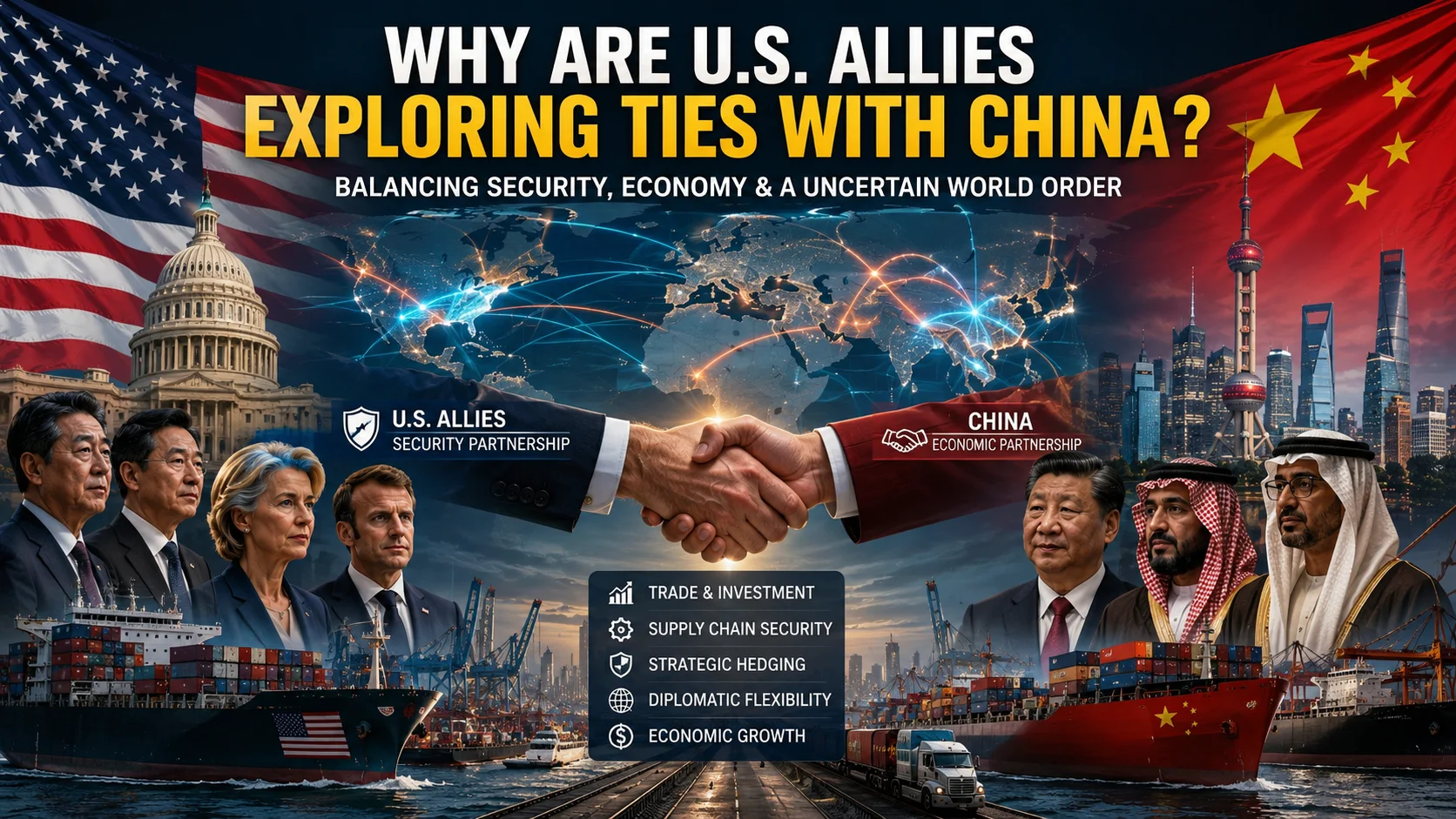
Why are U.S. allies exploring ties with China? That question is becoming one of the biggest geopolitical discussions of 2026 as countries across Europe, Asia, and the Middle East increase diplomatic and economic engagement with Beijing. From trade agreements and investment talks to high level diplomatic visits, many traditional American partners are actively expanding communication and cooperation with China at a time when the global balance of power feels more unstable than it has in decades.
At first glance, this shift may look like a direct rejection of Washington. However, the reality is far more complex. Most U.S. allies are not abandoning America or suddenly placing complete trust in China. Instead, they are trying to reduce strategic risk in a world shaped by trade wars, supply chain disruptions, sanctions, political uncertainty, and rising geopolitical rivalry between major powers.
The central answer to “Why are U.S. allies exploring ties with China?” is not simply that countries trust Beijing more. It is that many governments trust global uncertainty less. In an international system where economic shocks can spread overnight and political leadership changes can alter foreign policy rapidly, allies increasingly want backup options, diversified partnerships, and stronger leverage on the global stage.
European governments are pursuing broader economic engagement with China while still maintaining deep security ties with the United States. Asian allies are balancing military cooperation with Washington against the economic reality that China remains one of their largest trading partners. Middle Eastern powers are also expanding investment and energy partnerships with Beijing as they seek more flexible relationships in a rapidly changing global order.
This growing diplomatic diversification reflects a larger transformation happening across international politics. Countries no longer want to rely too heavily on a single superpower. Instead, they are building strategies designed around flexibility, economic survival, and long term geopolitical balance.
Why are U.S. allies exploring ties with China for economic reasons

Trade pressure is reshaping global alliances
One of the biggest reasons why U.S. allies are exploring ties with China is economic pressure. Over the last several years, tariffs, sanctions, export restrictions, and supply chain disruptions have forced governments and businesses to rethink how dependent they should be on any one market or political partner. The old era of highly predictable globalization is fading, and countries are now searching for more stable economic pathways in an increasingly fragmented world economy.
Trade tensions between Washington and Beijing have created uncertainty for allies caught between the two largest economies on Earth. Many countries depend heavily on exports, international manufacturing, and open shipping routes to keep their economies growing. When global trade becomes unpredictable, governments naturally begin looking for alternative partnerships that can reduce economic risk and protect long term growth.
Why are U.S. allies exploring ties with China for trade stability
China remains one of the world’s biggest consumer markets, and that alone makes it impossible for many U.S. allies to ignore. European manufacturers, Asian technology companies, and Middle Eastern energy exporters all see China as a critical destination for trade, investment, and future economic opportunities. Even countries that disagree with Beijing politically still recognize the importance of maintaining access to the Chinese market.
Another major factor is supply chain stability. Businesses across the world want reliable manufacturing networks, stable shipping systems, and consistent commercial relationships after years of disruption caused by pandemics, sanctions, inflation, and geopolitical conflict. China continues to play a central role in global manufacturing, making it economically difficult for allies to completely separate themselves from Chinese production systems.
Many governments are also worried about losing access to Chinese demand during periods of global economic slowdown. In difficult financial conditions, maintaining trade with one of the world’s largest economies becomes even more important. This is one reason Europe has continued increasing economic engagement with China despite growing political tensions between Beijing and Western governments.
Asian allies are also carefully balancing trade relationships between Washington and Beijing. Countries such as Japan and South Korea rely heavily on American security partnerships, but they also depend on trade and industrial connections linked to the Chinese economy. Instead of choosing one side completely, many Asian governments are pursuing a strategy built around economic balance and strategic flexibility.
In the Middle East, countries are expanding Chinese investment partnerships in sectors such as energy, infrastructure, logistics, and technology. Gulf powers increasingly see China as both a major customer and a long term economic partner capable of supporting national development goals beyond oil exports.
All of these trends help explain why U.S. allies are exploring ties with China. The shift is not only political. It is deeply connected to economic survival, trade security, and the growing fear that relying too heavily on one global power could become dangerous in an unpredictable international economy.
Why are U.S. allies exploring ties with China because of U.S. unpredictability

Allies are worried about changing American foreign policy
Another major reason why U.S. allies are exploring ties with China is growing uncertainty surrounding American foreign policy itself. For decades, many countries viewed the United States as the most stable pillar of the global order. Today, however, allies increasingly worry that Washington’s policies can shift dramatically depending on elections, domestic political divisions, or sudden geopolitical priorities.
This fear is reshaping how governments think about diplomacy, trade, and long term security planning. Countries that once relied almost entirely on the United States are now searching for additional partnerships that can protect them if American policy changes direction again in the future.
Political instability inside the United States has amplified these concerns. Sharp divisions between administrations have created major reversals in trade policy, climate agreements, alliance commitments, and international negotiations. For allies trying to plan decades ahead, this unpredictability creates strategic anxiety.
Why uncertainty in Washington is pushing allies toward diversification
One of the biggest frustrations among allies has been sudden tariff decisions and aggressive trade measures that directly affected friendly nations alongside rivals. Governments in Europe and Asia have repeatedly found themselves caught between economic cooperation with the United States and protectionist policies that disrupted industries, exports, and manufacturing networks.
At the same time, alliance commitments have sometimes appeared less predictable than they once were. Debates over military spending, defense responsibilities, and the value of long standing alliances have caused some partners to question whether future U.S. administrations will maintain the same level of global engagement.
There are also growing concerns about long term American leadership consistency. Allies understand that U.S. elections can dramatically reshape foreign policy priorities within just a few years. One administration may emphasize global cooperation and multilateral diplomacy, while another may favor economic nationalism, reduced overseas commitments, or more confrontational trade strategies.
Fear of future isolationist policies is another major factor driving diversification. Many governments worry that future political movements inside the United States could focus more heavily on domestic priorities while reducing international obligations. If that happens, allies could suddenly find themselves exposed economically or strategically.
As a result, many countries are building backup diplomatic channels and broader international relationships. Exploring ties with China has become part of a wider strategy designed to reduce dependence on any single power center. Even allies that remain deeply aligned with Washington are quietly preparing for a future where global leadership may become less centralized and less predictable than before.
This explains why U.S. allies are exploring ties with China even while maintaining strong partnerships with America. The goal is not necessarily replacement. It is protection against uncertainty in an increasingly unstable geopolitical environment.
Why are U.S. allies exploring ties with China for security and strategic autonomy

Countries want more independent foreign policies
The rise of strategic autonomy is becoming one of the defining geopolitical trends of the modern era. Around the world, many U.S. allies are seeking more independent foreign policies that allow them to balance relationships with multiple global powers instead of relying almost entirely on Washington.
This shift is helping explain why U.S. allies are exploring ties with China while still remaining connected to American security networks. Governments increasingly want flexibility, diplomatic room to maneuver, and the ability to protect national interests without becoming fully dependent on one superpower.
Strategic autonomy does not necessarily mean abandoning alliances with the United States. Instead, it reflects a broader desire for greater independence in economic policy, defense planning, and international diplomacy. Countries are recognizing that the global order is becoming more competitive, fragmented, and unpredictable, which makes diversification increasingly valuable.
Why allies no longer want total dependence on one superpower
Debates inside NATO over defense spending and burden sharing have intensified concerns about long term security arrangements. European governments have faced repeated pressure to strengthen their own military capabilities rather than relying heavily on American defense guarantees. This has encouraged many leaders to think more seriously about independent strategic planning.
In the Indo Pacific region, military tensions surrounding Taiwan, the South China Sea, and regional power competition have also complicated alliance politics. Countries such as Japan and South Korea rely heavily on American military protection, yet they also understand that economic stability in Asia remains closely tied to China’s economy. Balancing these realities has become one of the biggest diplomatic challenges in the region.
Concerns over future U.S. military commitments are adding to this uncertainty. Allies want reassurance that American support will remain consistent during future crises, but changing political priorities inside Washington have made some governments hesitant to place complete trust in long term guarantees.
At the same time, regional powers increasingly want independent influence in global affairs. Many countries no longer want a world dominated entirely by one geopolitical center. Instead, they are trying to build flexible networks that allow them to cooperate with multiple powers simultaneously.
France has become one of the strongest voices pushing strategic autonomy inside Europe. French leaders have repeatedly argued that Europe should strengthen its own geopolitical identity, defense capabilities, and diplomatic independence while still remaining aligned with the West.
Japan represents another example of strategic balancing. Tokyo continues strengthening security cooperation with Washington because of regional military threats, but it also maintains deep economic engagement with China due to trade realities and supply chain dependence. This balancing act reflects the broader dilemma facing many Asian allies.
In the Gulf region, countries such as Saudi Arabia and the United Arab Emirates are expanding relationships with both Washington and Beijing simultaneously. These governments still value American military partnerships, but they are also increasing Chinese investment cooperation in infrastructure, energy, technology, and trade. Rather than choosing one side, Gulf nations are building multi direction foreign policies designed for a multipolar world.
All of these developments help explain why U.S. allies are exploring ties with China. The modern geopolitical environment is no longer defined by simple Cold War style alignment. Instead, countries are pursuing flexibility, strategic autonomy, and broader diplomatic options in a world where power is becoming increasingly divided across multiple global centers.
Why are U.S. allies exploring ties with China through diplomacy

China is presenting itself as a stable global partner
Another major reason why U.S. allies are exploring ties with China is Beijing’s aggressive diplomatic outreach campaign. Over the past decade, China has invested enormous resources into building trade relationships, infrastructure partnerships, and long term diplomatic networks across Europe, Asia, Africa, and the Middle East. At a time when many countries feel nervous about geopolitical instability, China is increasingly presenting itself as a predictable partner focused on continuity, economic cooperation, and global connectivity.
Beijing understands that influence in the modern world is not built through military power alone. Economic relationships, infrastructure financing, trade agreements, and diplomatic engagement now play a massive role in shaping global alliances. As a result, China has been positioning itself as a country willing to invest for the long term while avoiding the sudden policy swings that many governments fear in other parts of the world.
This strategy has become especially attractive to countries looking for stability during a period defined by inflation, trade disruptions, sanctions, military tensions, and weakening confidence in traditional globalization.
China’s global outreach strategy is attracting U.S. allies
One of the clearest examples of China’s diplomatic expansion is Belt and Road related diplomacy. Through large infrastructure projects involving ports, railways, highways, logistics corridors, and energy systems, Beijing has built deeper economic relationships with countries across multiple continents. These projects often create long term commercial ties that extend China’s influence far beyond traditional trade.
Long term infrastructure deals are especially appealing for developing economies and regional powers seeking rapid modernization. Many governments see Chinese investment as faster, more flexible, and less politically restrictive compared to some Western financing structures. This has allowed Beijing to strengthen relationships even with countries that remain politically close to Washington.
China has also emphasized multilateral cooperation messaging in its diplomatic strategy. Chinese officials frequently promote ideas centered around global connectivity, open trade, economic development, and mutual cooperation. Whether or not countries fully believe this messaging, it appeals to governments worried about rising geopolitical fragmentation and economic nationalism.
Another important factor is China’s focus on economic continuity rather than direct political confrontation in many diplomatic engagements. Beijing often frames itself as a pragmatic economic partner willing to maintain stable commercial relationships regardless of political disagreements. For countries heavily dependent on exports, manufacturing, shipping, or energy markets, that message can be extremely attractive during periods of international uncertainty.
This helps explain why U.S. allies are exploring ties with China despite ongoing tensions between Beijing and Western governments. China is actively presenting itself as a stable force in a volatile global environment. In contrast to growing geopolitical unpredictability, Beijing attempts to project consistency, long term planning, and economic reliability.
Whether that image fully reflects reality is still heavily debated around the world. However, from a strategic perspective, many allies see value in maintaining strong diplomatic channels with a country that plays such a central role in global trade and economic growth.
Why are U.S. allies exploring ties with China without abandoning America

Strategic hedging is replacing traditional alignment
One of the biggest misunderstandings surrounding modern geopolitics is the assumption that countries must fully choose either Washington or Beijing. In reality, many governments are trying to avoid exactly that kind of binary decision. This is why strategic hedging is becoming one of the defining foreign policy strategies of the twenty first century.
Why are U.S. allies exploring ties with China while remaining close to Washington? Because countries increasingly believe that relying too heavily on one global power creates long term risk. Instead of abandoning old alliances, they are expanding diplomatic flexibility in order to survive in a more fragmented and competitive international system.
Strategic hedging allows governments to maintain military partnerships with the United States while also strengthening trade, investment, and diplomatic engagement with China. Rather than complete alignment with one side, countries are building balanced relationships that protect economic interests, national security, and political leverage simultaneously.
This approach reflects a world where economic interdependence and geopolitical rivalry now exist side by side. Nations no longer see global politics as a simple Cold War style division. Instead, they are adapting to a multipolar environment where cooperation and competition happen at the same time.
Most allies are not choosing China over the United States
Despite increasing engagement with Beijing, most U.S. allies still rely heavily on American security partnerships. NATO members continue depending on U.S. military power for collective defense, Asian allies rely on American deterrence against regional threats, and Gulf states still view Washington as a critical strategic partner in security and defense cooperation.
At the same time, many governments still distrust China politically. Concerns surrounding human rights, military expansion, cyber security, regional territorial disputes, and political influence operations remain major sources of tension between Beijing and many Western democracies. This is one reason why stronger economic engagement with China does not automatically translate into deeper political alignment.
The goal for most allies is balance rather than replacement. Governments want access to Chinese markets and investment opportunities without losing the protection and strategic benefits that come from close ties with the United States. They are trying to maximize flexibility instead of becoming trapped inside a rigid geopolitical bloc.
Another important reason why U.S. allies are exploring ties with China is leverage. Maintaining relationships with both powers gives countries greater negotiating strength in trade agreements, diplomatic disputes, security discussions, and economic partnerships. By avoiding total dependence on one side, governments gain more room to protect their own national interests.
This explains why strategic hedging is replacing traditional alignment across much of the world. Countries increasingly believe the future global order will not be dominated entirely by one superpower. Instead, they expect a more competitive and decentralized international system where survival depends on diversification, flexibility, and the ability to work with multiple global powers at once.
In many ways, the modern answer to “Why are U.S. allies exploring ties with China?” is not about switching sides at all. It is about preparing for a future where geopolitical certainty no longer exists.
The global economy is becoming more fragmented

A multipolar world is changing international alliances
The global order that emerged after the Cold War is rapidly evolving. For decades, the international system was largely shaped around overwhelming American economic influence, military power, and political leadership. Globalization expanded under a structure where many countries believed the United States would remain the dominant center of global stability for the foreseeable future. Today, however, that certainty is fading.
The modern world is becoming increasingly multipolar, meaning power is now spread across several major geopolitical and economic centers rather than concentrated primarily in one country. China’s rise as an economic superpower, the growing influence of regional powers, and rising competition between global blocs are transforming how countries build alliances and protect national interests.
This shift is one of the biggest reasons why U.S. allies are exploring ties with China. Governments are adapting to a new reality where flexibility may matter more than permanent alignment. In a fragmented international system, countries want stronger backup options, diversified economic relationships, and the ability to work with multiple major powers simultaneously.
Why are U.S. allies exploring ties with China in a fragmented global order
One major factor driving this change is the rise of multipolar geopolitics. Countries increasingly believe the future global economy will not revolve around a single dominant power. Instead, they expect a world where influence is divided between the United States, China, Europe, regional alliances, and emerging economic blocs. This naturally encourages governments to strengthen relationships across multiple centers of power rather than depending entirely on Washington.
Economic nationalism is also reshaping international alliances. Governments across the world are prioritizing domestic industries, supply chain protection, strategic manufacturing, and national economic resilience. This has weakened some of the assumptions that once supported highly interconnected globalization. As countries become more protective of economic interests, allies are searching for new partnerships that can help reduce vulnerability during future crises.
Regional trade blocs are becoming increasingly important as well. Nations are strengthening ties through regional economic agreements, infrastructure projects, and localized supply chain systems. In many cases, China plays a major role in these regional networks due to its manufacturing capacity, investment power, and trade influence.
At the same time, competition between major powers is intensifying. The rivalry between Washington and Beijing now shapes trade, technology, energy markets, military planning, and international diplomacy. U.S. allies often find themselves caught between economic dependence on China and strategic cooperation with America. Rather than choosing one side completely, many countries are attempting to maintain balanced relationships with both powers.
Another critical issue is the declining certainty surrounding global leadership structures. The post Cold War assumption that one country would permanently dominate the international system no longer feels guaranteed. Economic shocks, military conflicts, political polarization, and shifting alliances have all contributed to growing instability across global politics.
This environment helps explain why U.S. allies are exploring ties with China. Governments are not simply reacting to one issue. They are responding to a much larger transformation in the structure of the global economy itself.
Country examples of allies exploring China ties

European allies increasing engagement with China
Across Europe, governments are attempting to balance security cooperation with Washington against the economic reality that China remains one of the world’s largest markets. While tensions over technology, trade practices, and human rights continue to create friction with Beijing, major European economies still see value in maintaining strong commercial relationships with China.
European leaders increasingly understand that cutting economic ties completely would create major financial consequences for manufacturing, exports, and industrial growth. As a result, many European countries are pursuing a strategy of cautious engagement rather than total economic separation.
Germany and France expanding economic diplomacy
Germany remains one of the clearest examples of this balancing strategy. The German economy relies heavily on exports, and China continues to be an essential market for industries such as automobiles, engineering, chemicals, and manufacturing technology. Even as Berlin strengthens cooperation with NATO and the United States, German businesses continue pushing for stable trade relations with Beijing.
France has also expanded diplomatic and economic engagement with China while promoting the idea of European strategic autonomy. French leadership has repeatedly argued that Europe should maintain independent diplomatic flexibility instead of becoming completely locked into U.S. China confrontation. This approach reflects a broader European desire for balance in an increasingly divided global environment.
Asian allies balancing relations carefully
In Asia, the balancing act becomes even more complicated because security and economics are deeply intertwined. Many American allies in the region depend heavily on U.S. military protection while simultaneously relying on China as a major trade partner.
This creates one of the most difficult geopolitical dilemmas in the modern world. Countries want protection against regional instability while also preserving economic growth connected to Chinese trade and manufacturing networks.
South Korea and Japan managing trade realities
South Korea and Japan both represent prime examples of strategic hedging in Asia. Both countries maintain strong military alliances with the United States because of regional security concerns involving North Korea and broader Indo Pacific tensions. However, China also remains one of their most important trading partners.
Japanese and South Korean industries rely heavily on exports, technology supply chains, and regional manufacturing systems connected to the Chinese economy. Because of this, neither country can realistically afford a complete economic separation from Beijing even while strengthening security cooperation with Washington.
This balancing strategy shows why U.S. allies are exploring ties with China without necessarily moving away from America. Economic survival and national security now require managing relationships with both global powers at the same time.
Gulf countries deepening Chinese investment partnerships
In the Middle East, Gulf nations are increasingly strengthening ties with China as part of long term economic transformation strategies. Energy exports, infrastructure development, logistics projects, and technology investments are driving deeper cooperation between Beijing and major Gulf economies.
These countries still maintain strong military and security relationships with the United States, but they are also seeking broader partnerships that reduce dependence on any single external power.
Saudi Arabia and UAE building dual power relationships
Saudi Arabia and the United Arab Emirates are both pursuing dual power relationships with Washington and Beijing simultaneously. The United States remains a key defense and security partner, yet China has become an increasingly important economic player through energy purchases, infrastructure projects, investment agreements, and technology cooperation.
Both Gulf nations are trying to position themselves strategically inside a multipolar world where economic opportunity and geopolitical influence may increasingly depend on maintaining strong ties with multiple major powers rather than choosing only one side.
These country examples help demonstrate the broader answer to “Why are U.S. allies exploring ties with China?” The shift is not driven by a single event or simple political loyalty change. It is the result of a global transformation where economic interdependence, strategic uncertainty, and multipolar competition are reshaping international alliances across every major region of the world.
Conclusion
Why are U.S. allies exploring ties with China in the modern world
The modern geopolitical landscape is no longer defined by simple alliance structures or permanent loyalty to a single global power. Instead, countries are navigating an increasingly fragmented world shaped by economic competition, geopolitical instability, technological rivalry, supply chain disruptions, and shifting diplomatic priorities. This changing environment explains why U.S. allies are exploring ties with China at a pace that would have seemed unlikely only a decade ago.
However, the most important reality is that these countries are not necessarily abandoning the United States. Most American allies still rely heavily on Washington for military protection, intelligence cooperation, financial stability, and strategic influence. What is changing is not the existence of those alliances, but the way governments manage risk inside an uncertain global order.
Economic security has become just as important as military security. Countries now understand that overdependence on any single market, supply chain, or geopolitical partner can create dangerous vulnerabilities during periods of crisis. As a result, governments are pursuing broader trade relationships, stronger regional partnerships, and more flexible diplomatic strategies designed to protect national interests in multiple scenarios.
Supply chain resilience is also driving this transformation. After years of trade wars, sanctions, inflation shocks, pandemics, and geopolitical tension, nations are trying to build systems that can survive disruption. China’s central role in manufacturing, trade, infrastructure investment, and global commerce makes it impossible for many allies to completely isolate themselves from Beijing even while political disagreements continue.
At the same time, diplomatic flexibility has become one of the most valuable strategic assets in modern international politics. Countries want the ability to negotiate with multiple powers, reduce exposure to political uncertainty, and maintain leverage in a rapidly evolving global system.
The real story behind “Why are U.S. allies exploring ties with China?” is not loyalty shifting overnight. It is the rise of strategic hedging in a fractured and unpredictable global order.
FAQs
Why are U.S. allies exploring ties with China right now
U.S. allies are exploring ties with China because governments want to reduce economic and geopolitical risk during a period of global uncertainty. Trade tensions, supply chain disruptions, political instability, and fears surrounding future international conflicts are encouraging countries to diversify their partnerships instead of relying too heavily on one global power.
Are U.S. allies abandoning America for China
Most U.S. allies are not abandoning America for China. Many countries still depend heavily on American military partnerships and strategic cooperation. Instead of replacing the United States, governments are trying to balance relationships with both Washington and Beijing to protect economic interests and increase diplomatic flexibility.
Which countries are strengthening ties with China
Several countries across Europe, Asia, and the Middle East are strengthening ties with China. Germany and France continue expanding economic diplomacy with Beijing, while Japan and South Korea balance security cooperation with Washington against trade realities connected to China. Gulf nations such as Saudi Arabia and the UAE are also increasing Chinese investment partnerships in infrastructure, technology, and energy sectors.
Why is China attractive to U.S. allies economically
China remains one of the world’s largest consumer markets and manufacturing centers. Many countries depend on exports, industrial supply chains, infrastructure investment, and access to Chinese demand for economic growth. Beijing’s focus on long term trade relationships and infrastructure financing also makes China attractive to governments seeking economic stability and development opportunities.
How is global uncertainty changing international alliances
Global uncertainty is pushing countries toward more flexible foreign policies and diversified partnerships. Instead of relying entirely on one superpower, many governments are adopting strategic hedging strategies that involve maintaining ties with multiple major powers simultaneously. This reflects the rise of a more fragmented and multipolar global order.
Internals
Also read: Why Oil Prices Are Rising in 2026
Related analysis: U.S. and Iran Agree to 2 Week Ceasefire as Trump Pulls Back on Threats
More coverage: Trump Iran War Address 2026 Explained
Sources and References
Reuters
Reuters covered growing tensions between the United States and China while also highlighting concerns among allies about economic dependence, trade risks, and geopolitical instability. The reporting explains how many countries are trying to balance security ties with Washington against economic realities connected to Beijing.
Source Link:
Reuters Official Website
Example Reuters Coverage on U.S. China Relations:
https://www.reuters.com/world/
Semafor
Semafor reported on the increasing diplomatic activity between China and traditional U.S. allies. The publication explained how countries across Europe and Asia are expanding communication with Beijing as part of broader strategic diversification efforts.
Source Link:
Semafor Official Website
Geopolitics Section:
https://www.semafor.com/hub/china
NPR
NPR discussed how U.S. allies are searching for alternative trade partnerships and more flexible economic relationships because of supply chain disruption, tariffs, and fears surrounding global instability.
Source Link:
NPR Official Website
International Affairs Section:
https://www.npr.org/sections/world/
Al Jazeera
Al Jazeera analyzed how several U.S. allies are pursuing more independent security and foreign policies. The reporting focused on strategic autonomy, regional diplomacy, and changing alliance structures in Europe and the Middle East.
Source Link:
Al Jazeera Official Website
World News Section:
https://www.aljazeera.com/news/
South China Morning Post
The South China Morning Post published opinion and analysis pieces about diplomatic diversification, China’s global outreach strategy, and how countries are balancing ties between Washington and Beijing.
Source Link:
South China Morning Post Official Website
China Diplomacy Section:
https://www.scmp.com/topics/china-diplomacy
The Washington Post
The Washington Post explored how U.S. allies are hedging against uncertainty in American foreign policy. Coverage focused on fears surrounding policy reversals, alliance unpredictability, and geopolitical fragmentation.
Source Link:
The Washington Post Official Website
Global Affairs Section:
https://www.washingtonpost.com/world/
Disclaimer:
This article is published for informational, educational, and journalistic discussion purposes only. The views, geopolitical analysis, and opinions discussed in this content are based on publicly available reporting, international news coverage, and independent research at the time of writing. This website does not promote hatred, discrimination, violence, political extremism, or hostility toward any country, religion, government, community, or belief system. We fully respect all nations, cultures, religions, and faiths around the world. Any references to political events, global powers, diplomatic relations, or international conflicts are intended solely for analytical and informational purposes. Readers are encouraged to conduct their own research and refer to official sources for verified updates and policy decisions.


