

-
- No Comments
- August 18, 2026

What is the Pax Silica AI coalition
Introduction:What Is the Pax Silica AI Coalition?
If you are asking what is the Pax Silica AI coalition, start with one simple fact. Artificial intelligence depends on much more than clever software and powerful algorithms.
Every AI model requires physical resources. It needs critical minerals, electricity, advanced semiconductors, manufacturing equipment, data centers, cooling systems, fiber networks, cloud platforms, and secure transportation.
A disruption in any one of these areas can slow everything else. A shortage of processed minerals can affect chip production. Limited electricity can delay a data center. Problems at an important port can prevent expensive equipment from reaching a new factory.
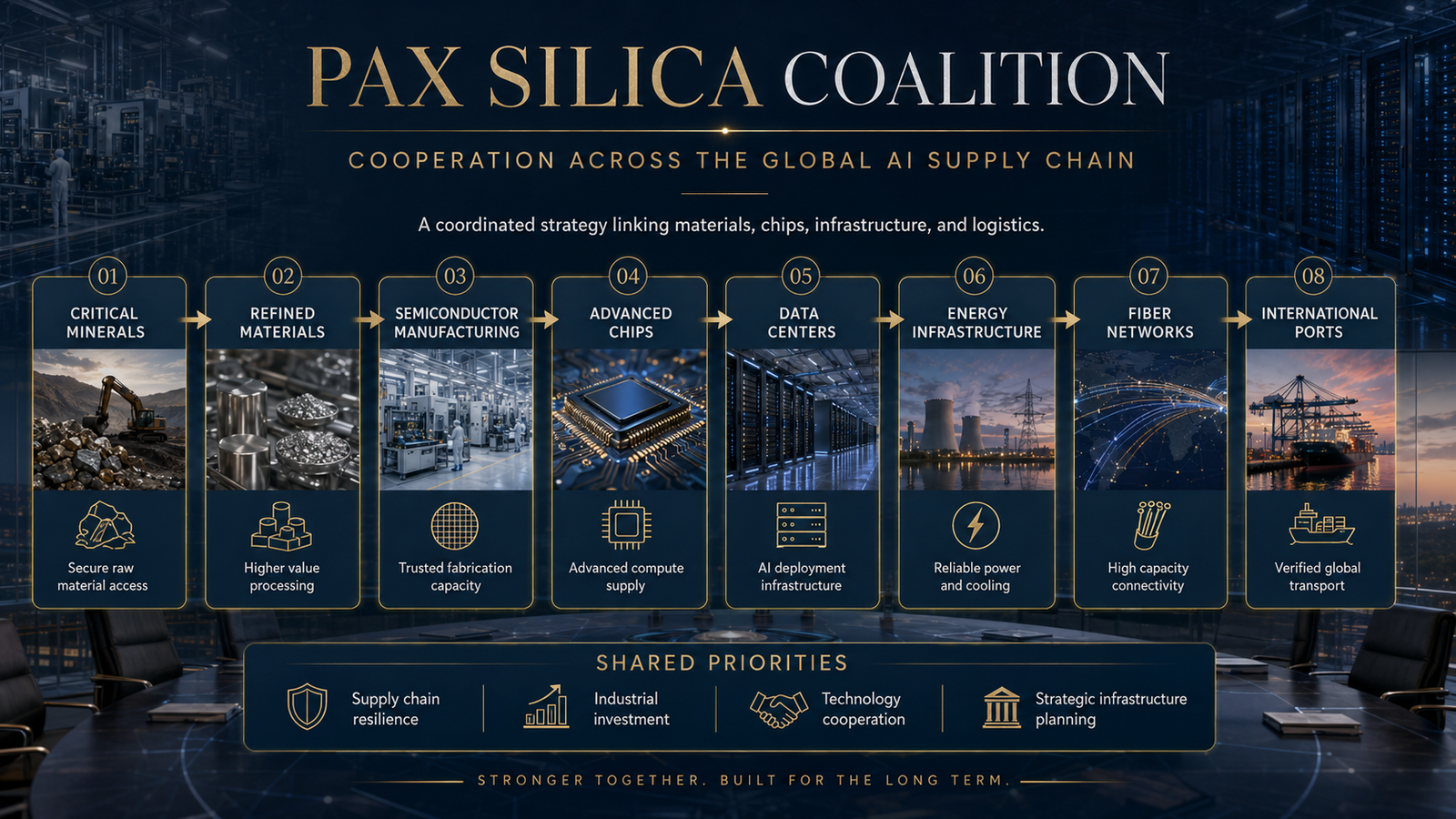
Pax Silica was created to bring these connected pieces into one international strategy. Led by the United States, the coalition works with trusted partners to strengthen the complete technology supply chain that supports artificial intelligence.
That makes Pax Silica more than another diplomatic announcement. It sits where technology, trade, energy, infrastructure, investment, and national security meet.
In this article, you and I will look closely at what Pax Silica is, why it was created, which countries have joined, and how the coalition plans to work. We will also examine its possible benefits, its geopolitical importance, and the concerns surrounding its growing influence.
Quick Answer: What Is the Pax Silica AI Coalition?
Pax Silica is a United States led international economic security coalition launched in December 2025. It brings trusted governments together to strengthen the supply chains that make modern artificial intelligence possible and reduce dependence on vulnerable or potentially coercive sources. Rather than concentrating only on AI software, it covers critical minerals, energy, advanced manufacturing, semiconductors, data centers, fiber networks, cloud infrastructure, secure logistics, and AI models. The State Department describes Pax Silica as its flagship effort on AI and supply chain security.
The main idea is resilience. If one country, supplier, factory, or shipping route becomes unavailable, coalition members want dependable alternatives.
Pax Silica also aims to encourage investment among participating countries. That could include mineral processing facilities, chip factories, power projects, secure digital networks, data centers, transport corridors, and research partnerships.
The coalition is still developing. Its eventual influence will depend on whether governments turn shared declarations into funded projects and functioning infrastructure. The official Pax Silica overview provides its current objectives and membership information.
What Does the Name Pax Silica Mean?

The name sounds grand because it is meant to.
“Pax” is a Latin word associated with peace, order, and stability. It is often used to describe a period in which an influential power helps maintain a wider political or economic order.
“Silica” connects the name with silicon. Silica contains silicon, the element that sits at the heart of the semiconductor industry and the computer chips used in phones, servers, vehicles, data centers, and AI systems.
The name is symbolic rather than a complete technical description. Pax Silica is not concerned only with silica or silicon production.
It represents an effort to create stability across the entire technology ecosystem. That includes everything from raw materials and electricity to factories, digital infrastructure, logistics, and advanced AI models.
In simple words, the name suggests peace and order built around silicon. It presents secure technology supply chains as a foundation for economic stability in the AI era.
There is also a strategic message beneath the name. The countries that can reliably obtain minerals, manufacture chips, power data centers, and operate advanced AI systems will hold considerable economic and political influence.
Pax Silica is an attempt to organize that influence among countries the United States considers dependable partners.
When Was Pax Silica Created?
Pax Silica was formally launched in December 2025 through the United States Department of State.
The initiative began with a summit that brought participating governments together to discuss artificial intelligence, semiconductor security, critical materials, digital infrastructure, and economic cooperation.
The signing of the Pax Silica Declaration marked the coalition’s formal beginning. Through that declaration, participants expressed a shared commitment to building more secure and resilient technology supply chains.
The launch did not create a permanent international government or a legally binding global institution. It established a framework that countries could join and develop through additional agreements, investments, summits, and practical projects.
The original initiative began with a relatively small group of technology partners. More countries joined during the following months as AI infrastructure and supply chain security became larger diplomatic priorities.
The second Pax Silica Summit took place in June 2026. Ten additional partners signed the declaration during that summit, bringing the official total to 24 signatories at that point. The State Department’s summit report documented that expansion.
The coalition continued growing after the second summit. This rapid development helps explain why membership figures can differ between reports published only weeks apart.
Pax Silica is therefore a young initiative. Its political reach has expanded quickly, but many of its physical projects, investment plans, and coordination systems are still being designed or developed.
Why Was the Pax Silica AI Coalition Created?
The Pax Silica AI coalition was created because the technologies behind artificial intelligence are powerful but surprisingly vulnerable.
AI may feel like something that lives entirely inside a computer. In reality, it relies on an enormous physical network spread across different countries.
Minerals may be extracted in one place, refined somewhere else, turned into components in another country, and assembled into advanced chips thousands of miles away. Those chips must then travel through ports and logistics networks before reaching data centers that require electricity, cooling, fiber connections, and cloud infrastructure.
This arrangement can work efficiently during stable periods. It becomes much riskier during a trade dispute, military conflict, natural disaster, energy shortage, factory shutdown, export restriction, or shipping disruption.
Governments increasingly see those risks as matters of economic and national security. Pax Silica is meant to help participating countries understand these vulnerabilities and develop more dependable alternatives.
AI Depends on a Complex Global Supply Chain
No single country controls every resource, tool, skill, and facility required to build modern AI systems.
Some countries hold major mineral reserves. Others dominate mineral refining or chemical processing. A smaller group produces advanced semiconductor manufacturing equipment, memory chips, processors, packaging technology, or cloud infrastructure.
Even the most powerful technology companies depend on this international network. A company may design an advanced AI chip but rely on an overseas manufacturer to produce it. That manufacturer may depend on specialized equipment, materials, and software supplied by businesses in several other countries.
The chain continues after the chip leaves the factory.
AI processors must be installed inside servers. Those servers need data centers, reliable power, cooling equipment, fast networking, security systems, and trained workers.
A disruption near the beginning of the chain can create problems much further along. If a critical material becomes scarce, chip production may slow. If advanced equipment cannot be delivered, a factory expansion may be delayed. If electricity is unavailable, completed servers may sit unused.
Pax Silica treats these areas as parts of one connected system. Its goal is to help partners identify weak points before a crisis exposes them.
Governments Want Fewer Coercive Dependencies
A dependency becomes coercive when another country can use control over an important product, material, technology, or transportation route to apply pressure.
Imagine that one country controls a large share of a mineral processing market. If political relations worsen, it could restrict exports, delay licenses, raise costs, or give preferred access to selected buyers.
The same risk can exist in semiconductor manufacturing, industrial equipment, cloud systems, communications networks, and shipping infrastructure.
Pax Silica aims to reduce these vulnerabilities by encouraging coalition members to develop alternative suppliers, coordinate investment, and protect sensitive technologies.
This does not necessarily mean every product must be manufactured inside the United States. The broader idea is to spread essential capabilities among countries that view one another as dependable partners.
The coalition uses cooperation as a form of protection. If members can obtain important resources and technologies from several trusted sources, one government or supplier will have less power to interrupt the entire system.
Still, removing a dependency is rarely quick or cheap. A new mine, processing facility, semiconductor factory, power plant, or data center can take years to build.
Pax Silica can create political direction and encourage investment. It cannot instantly reproduce specialized industrial capabilities that took decades to develop.
AI Has Become an Economic Security Issue
Governments once treated artificial intelligence mainly as a research or software topic. That view has changed.
AI now affects military planning, healthcare, education, finance, manufacturing, transportation, communication, scientific discovery, and public services. It can improve productivity, influence employment, and reshape the competitiveness of entire industries.
That gives AI an economic value far beyond the technology sector.
Countries that control advanced chips and computing infrastructure can develop stronger AI systems. Countries without dependable access may struggle to attract investment, support local companies, or build competitive digital services.
Energy has also become part of the equation. Large data centers consume substantial electricity, making power generation and grid capacity important to AI strategy.
Infrastructure matters just as much. A country may have access to advanced chips, but those chips cannot deliver much value without secure facilities, cooling systems, cloud platforms, fiber networks, and skilled workers.
Pax Silica connects these practical requirements with economic security. It encourages governments to consider where their technology comes from, who controls its production, and how easily access could be disrupted.
The coalition also reflects a wider competition over international influence. The countries that establish the infrastructure, standards, supply relationships, and AI platforms of the next decade may shape how the global digital economy develops.
Is Pax Silica a Treaty or a Military Alliance?
Pax Silica is best understood as a declaration based economic security coalition.
It is not a military alliance. Members do not promise to defend one another if another country is attacked, and the declaration does not create a mutual defense commitment.
It is also not a traditional trade agreement. Signing Pax Silica does not automatically remove tariffs, guarantee market access, or establish a common customs system.
The declaration instead creates a framework for political and economic cooperation. Participating countries can coordinate policies, identify supply chain risks, discuss investment, protect sensitive technologies, and support shared infrastructure projects.
Its influence comes from the governments and industries involved. Members include countries with important positions in semiconductor manufacturing, minerals, energy, finance, logistics, research, and digital infrastructure.
Pax Silica may therefore shape decisions even without operating as a binding treaty. Governments can align investment rules, export policies, security standards, and infrastructure priorities through separate domestic actions and bilateral agreements.
However, membership does not mean every country will adopt identical laws. Each participant still has its own commercial interests, political relationships, legal system, and economic priorities.
That difference matters. Cooperation may be strongest where members share an obvious concern, but more difficult when export restrictions or investment rules could hurt an important domestic industry.
Pax Silica currently provides direction rather than automatic enforcement. Its real power will come from the projects, financing, policies, and supply relationships that participating countries choose to build around it.
What Does Pax Silica Cover?

Pax Silica covers what officials describe as the complete silicon and AI stack. That means the coalition looks far beyond semiconductor factories or the companies developing popular AI tools.
Modern artificial intelligence begins with physical resources. Minerals must be extracted and processed. Electricity must be generated. Specialized factories must produce chips, memory, servers, and networking equipment.
Those products must then travel safely to data centers where they can be installed, connected, cooled, and operated. Only after this physical foundation exists can companies train AI models, run cloud platforms, and provide useful applications.
This connected view is central to Pax Silica. The official Pax Silica framework spans critical minerals, energy, advanced manufacturing, semiconductors, AI infrastructure, and logistics.
A weakness in one layer can slow every layer above it. That is why the coalition treats mines, power systems, ports, factories, networks, data centers, and AI models as parts of the same strategic system.
Critical Minerals and Material Processing
Artificial intelligence begins in the ground.
Advanced chips, electronics, batteries, communication equipment, power systems, and industrial machinery require a wide range of minerals. These can include rare earth elements, lithium, nickel, cobalt, copper, gallium, germanium, and other specialized materials.
Different minerals perform different jobs. Some support energy storage, while others are used in magnets, processors, memory, networking equipment, cooling systems, or advanced manufacturing tools.
Finding a mineral deposit is only the beginning. The raw material must be extracted, separated, refined, processed, and converted into a form that manufacturers can use.
This is where many supply chains become concentrated. One country may have large mineral reserves, while another controls most of the processing capacity.
That distinction matters because a mineral sitting underground cannot power an AI system. A country also needs machinery, technical knowledge, investment, environmental approvals, transport connections, and customers before that resource becomes commercially useful.
Pax Silica aims to encourage cooperation across this complete process. Members may support new mines, but they may also invest in refining plants, processing facilities, recycling systems, research, and secure transportation.
Dependable access is equally important. A company building chips or batteries cannot plan production around deliveries that may be interrupted without warning.
The coalition therefore looks at where materials come from, where they are processed, how they are transported, and whether alternative suppliers are available.
This strategy could help participating countries reduce risky concentrations. However, building new mineral and processing capacity takes time, money, technical expertise, and careful environmental management.
Energy for AI and Advanced Manufacturing
AI needs enormous amounts of electricity.
Semiconductor factories use power for advanced manufacturing equipment, controlled environments, water treatment, testing, and round the clock operations. Even a brief interruption can damage production or delay expensive batches of chips.
Data centers create another challenge. Thousands of processors may operate together for training and running advanced AI models.
Those processors consume electricity and create intense heat. Data centers therefore need power for computing, cooling, storage, networking, security systems, and backup equipment.
A country can have access to advanced chips and still struggle to grow its AI economy if it cannot provide enough reliable electricity. Power availability can determine whether a new data center is built, delayed, reduced in size, or moved somewhere else.
This is why energy sits near the center of Pax Silica’s strategy. Secure AI infrastructure requires dependable generation, transmission lines, substations, grid connections, and realistic plans for rising demand.
Eadoz’s analysis of why Nvidia is investing in SB Energy shows how closely chips and power are becoming connected.
Nvidia can design highly advanced computing systems, but customers still need powered buildings in which to operate them. Without sufficient electricity, cooling, and transmission capacity, even the most powerful processors cannot create commercial value.
The reported Nvidia and SB Energy discussions illustrate a larger shift. Technology companies are becoming more involved in the energy, construction, and financing systems around their products.
For Pax Silica members, this means an AI strategy cannot stop at buying chips. It must consider where new power will come from, how it will reach industrial sites, and whether the grid can support demand over the long term.
Energy choices also bring difficult questions. Governments must consider price, reliability, construction time, emissions, water use, local communities, and the stability of fuel supplies.
Pax Silica can encourage coordination and investment, but each member will still need an energy plan that fits its resources, laws, and economic priorities.
Semiconductor Manufacturing and Advanced Packaging
Semiconductors are the most visible part of the silicon stack, but even this layer contains several connected industries.
A chip begins with design. Specialized companies create the architecture that determines how the processor will perform, what software it can run, and how efficiently it uses power.
The design must then be turned into a physical product. This requires fabrication facilities containing some of the most expensive and precise manufacturing equipment in the world.
These factories depend on specialized chemicals, gases, wafers, optical systems, software, clean rooms, and highly trained workers. Many of these inputs come from a small number of suppliers.
Memory is another essential part of AI computing. Powerful processors need fast access to enormous amounts of data, which makes advanced memory technology central to training and operating modern models.
Manufacturing the processor is still not the final step. Individual components must be tested, connected, and placed into advanced packages that allow them to work together.
Advanced packaging has become particularly important as companies combine processors, memory, and other components inside increasingly complex computing systems. A shortage in packaging capacity can limit the number of usable AI chips even when fabrication capacity is available.
Testing is equally important. Manufacturers must confirm that completed chips meet performance, safety, reliability, and power requirements before those products can enter commercial systems.
This creates a long chain of dependencies. A chip designer may be ready. The fabrication factory may have capacity. Yet production can still be delayed by missing equipment, restricted materials, memory shortages, packaging limits, or testing problems.
Pax Silica aims to help participating countries understand and address these weak points. That may involve new factories, research partnerships, workforce training, equipment protection, investment coordination, and alternative suppliers.
The goal is not simply to produce more chips. It is to create a dependable system in which design, fabrication, memory, packaging, testing, equipment, and materials can support one another.
Data Centers, Cloud Systems, and Fiber Networks
A completed AI chip has potential, but it cannot do much while sitting inside a box.
The processor must be installed in a server and placed inside a secure computing facility. That facility needs electricity, cooling, storage, networking equipment, backup systems, physical security, and trained technicians.
Data centers provide this environment. Large campuses may contain enormous groups of processors working together to train AI models, answer user requests, analyze data, or operate cloud services.
Building these facilities is expensive. Developers must acquire land, secure power, install cooling systems, build network connections, purchase equipment, obtain permits, and arrange billions of dollars in financing.
The discussion surrounding the possible Vantage Data Centers IPO helps reveal the financial scale behind this infrastructure.
Vantage operates large data center campuses for cloud providers, major technology companies, and enterprises. Reports that it could explore a huge public offering show how much capital may be required to meet rising demand for AI computing.
An IPO is only one financing method, and Vantage had not formally launched one at the time of Eadoz’s report. Still, the possibility illustrates how valuable and capital intensive data center infrastructure has become.
Cloud systems form the next layer. They allow businesses, researchers, and public agencies to use computing resources without building their own data centers.
A secure cloud platform can provide processing power, data storage, software tools, and AI services across several locations. However, the cloud still depends on physical servers and buildings.
Fiber networks connect those facilities with users, businesses, other data centers, and international markets. Slow or unreliable connections can limit how effectively computing resources are shared.
Pax Silica therefore treats data centers, cloud systems, and fiber networks as strategic infrastructure. The coalition wants participating countries to develop facilities that are dependable, secure, connected, and protected from unnecessary risk.
This includes more than preventing physical damage. Operators must also consider cybersecurity, unauthorized access, data protection, hardware integrity, service continuity, and the ownership of sensitive systems.
AI Models, Software, and Applications
Pax Silica does not stop at physical infrastructure. It also reaches the upper layers where computing power becomes useful.
AI models are trained using processors, memory, data, software, electricity, and large computing facilities. Remove any one of these elements, and the model cannot be developed or operated at the expected scale.
Software frameworks help developers train models and connect them with hardware. Cloud platforms allow businesses to access those models. Applications then turn the technology into services people can use.
These applications may support healthcare, finance, manufacturing, education, transportation, agriculture, cybersecurity, scientific research, and public administration.
The upper layers depend entirely on the lower ones. A company may create excellent AI software, but it still needs secure hardware and dependable computing capacity.
The relationship also works in the opposite direction. A country gains little from building expensive data centers if businesses, researchers, and public agencies cannot use that capacity productively.
Pax Silica therefore connects infrastructure with economic opportunity. Its members want access to the physical systems behind AI, but they also want companies and institutions that can turn computing power into valuable products and services.
This creates a complete chain. Minerals support manufacturing. Manufacturing creates chips. Energy powers data centers. Networks connect cloud platforms. Models run on those platforms. Applications deliver the final value.
Understanding this chain helps answer what is the Pax Silica AI coalition at a deeper level. It is an attempt to coordinate the resources, infrastructure, technology, and partnerships needed across the entire AI economy.
Transportation and Secure Logistics
Technology supply chains do not move by themselves.
Minerals must travel from mines to processing facilities. Manufacturing equipment must reach semiconductor factories. Completed chips, servers, and networking systems must be delivered to data centers.
Many of these products are extremely valuable, sensitive, or difficult to replace. Some also require controlled conditions, secure handling, accurate documentation, and careful customs processing.
Ports, airports, railways, roads, and logistics centers are therefore important parts of the AI supply chain. A delay at one transport point can hold up a factory or data center project thousands of miles away.
Pax Silica looks at how high value technology products move between participating countries. That includes shipping routes, customs procedures, cargo tracking, product verification, and the security of important transit locations.
Tracking systems can help confirm where a product came from, where it has traveled, and whether it has been handled by approved organizations. This may reduce fraud, tampering, diversion, and unnecessary delays.
Customs coordination can also matter. Semiconductor equipment and AI infrastructure often include components from several countries, creating complicated documentation and inspection requirements.
Faster movement should not mean weaker security. The challenge is to create systems that identify trustworthy cargo quickly while giving authorities the information needed to examine genuine risks.
This is why ports and logistics corridors appear in Pax Silica projects. The coalition understands that secure manufacturing capacity has limited value if important products cannot move reliably between trusted partners.
What Are the Main Goals of Pax Silica?

Pax Silica has several connected goals. Together, they aim to make the technology economy more secure, competitive, and capable of supporting continued AI growth.
The initiative focuses on reducing dangerous concentrations without cutting international cooperation entirely. Its members want stronger alternatives, trusted infrastructure, protected technology, and more coordinated investment.
Build More Resilient Technology Supply Chains
Resilience means having another path when the usual one becomes unavailable.
If one factory closes, buyers should have access to another supplier. If a port becomes blocked, cargo should have another route. If a country restricts exports, manufacturers should not lose every source of an essential material.
No supply chain can eliminate all risk. Natural disasters, political conflicts, accidents, cyberattacks, market changes, and transportation problems can still occur.
The practical goal is to stop one disruption from shutting down the entire system.
Pax Silica can support resilience by encouraging members to identify concentrated dependencies. Governments and companies can then decide where alternative mines, processing facilities, factories, power systems, data centers, ports, or suppliers are needed.
Having alternatives may cost more at first. Businesses often choose one supplier because it offers the lowest price or the greatest technical capability.
Resilience asks a different question. It asks what happens if that supplier becomes unavailable tomorrow.
The coalition attempts to balance efficiency with security. A supply chain should remain commercially sensible, but it should not be so concentrated that one decision can stop an entire industry.
Protect Sensitive Technologies
Advanced technology can create enormous commercial and strategic advantages.
Governments therefore want to protect research, intellectual property, manufacturing knowledge, infrastructure, and specialized equipment from theft, sabotage, unauthorized transfer, or misuse.
Pax Silica gives participating countries a framework for discussing these concerns. Cooperation may involve research security, infrastructure protection, investment review, cybersecurity, and controls around access to particularly sensitive technologies.
Research security can help universities, laboratories, and companies protect valuable discoveries while continuing legitimate international cooperation.
Infrastructure protection covers physical and digital risks. Data centers, semiconductor factories, energy systems, fiber networks, and ports can all become targets for disruption or unauthorized access.
Investment rules are another part of the conversation. Governments may examine whether foreign ownership of a sensitive company, facility, or technology could create a national security risk.
The difficult part is finding balance. Controls that are too weak may expose important technologies. Controls that are too broad may discourage research, investment, competition, and useful commercial partnerships.
Pax Silica does not remove that tension. It gives members a place to coordinate their thinking and decide where shared protections may be useful.
Encourage Joint Investment
Securing an AI supply chain requires more than policy statements. It requires money.
Mineral processing plants, semiconductor factories, power projects, data centers, ports, fiber networks, and research facilities can cost billions of dollars.
Governments may identify strategic needs, provide financing support, improve permitting, fund research, or reduce particular investment risks. Private companies will still need a commercial reason to build and operate the projects.
Pax Silica can help connect these two sides.
Members may identify a missing capability that affects several countries. They can then explore whether public support and private investment could make a new project commercially realistic.
Joint investment can also spread risk. A single country may find a major processing facility or technology hub too expensive to support alone.
Several governments, development institutions, investors, and companies may be able to finance it together. Each participant can contribute capital, technical knowledge, customers, land, infrastructure, or access to resources.
The coalition can create introductions and political momentum. It cannot guarantee that every proposed project will be profitable.
Investors will still examine demand, construction costs, electricity availability, supply contracts, skilled workers, regulations, and expected returns before committing money.
Create Trusted Digital Infrastructure
Artificial intelligence increasingly depends on infrastructure that stores, processes, and moves sensitive information.
That includes data centers, cloud platforms, fiber networks, communication systems, servers, and cybersecurity tools.
Countries want confidence that these systems will remain available during a crisis. They also want to know who operates them, where data is stored, how access is controlled, and whether equipment contains serious security risks.
Pax Silica promotes infrastructure built through trusted commercial and political relationships.
Trust does not mean assuming that every system is safe. It means using clear security standards, verified equipment, controlled access, reliable operators, and meaningful accountability.
A secure data center needs physical protection and cybersecurity. A trusted cloud platform needs access controls, data protection, monitoring, and clear rules about who can reach sensitive systems.
Fiber networks also matter because information moving between facilities can be intercepted, disrupted, or redirected. Reliable connections need protection across their complete routes.
The coalition’s challenge is to strengthen security without making infrastructure unnecessarily closed or expensive. AI systems often depend on international data flows, research cooperation, and global customers.
Trusted infrastructure must therefore protect sensitive information while still allowing legitimate innovation and commerce.
Respond to Unfair Market Practices
Pax Silica also addresses concerns about market practices that participating governments believe can damage competition.
These concerns may include large state subsidies, excess production, dumping, forced technology transfers, intellectual property theft, restricted market access, and advantages provided to selected domestic companies.
A government may support an industry for strategic reasons. The disagreement begins when other countries believe that support allows companies to sell products below a sustainable market price or overwhelm foreign competitors.
Excess capacity can make products cheaper in the short term. It may also push competitors out of business, leaving buyers dependent on a smaller number of suppliers later.
Dumping claims are equally complicated. Governments must examine prices, production costs, subsidies, and market conditions before deciding whether an unfair practice has occurred.
Pax Silica gives members a way to discuss these risks and consider coordinated responses. Those responses could involve investment support, trade measures, procurement rules, or stronger protection of intellectual property.
The coalition’s official position should not be treated as independent proof that every accused company or country has acted unfairly.
Each allegation needs evidence. Readers should distinguish between concerns stated by governments, findings made through formal investigations, and interpretations offered by analysts or industry groups.
How Does the Pax Silica AI Coalition Work?
The Pax Silica AI coalition does not operate like a single international government agency.
It does not control the domestic laws, budgets, or industries of its members. It also does not have the authority to order a country to build a factory, block an investment, or change an export rule.
Instead, Pax Silica creates a framework for cooperation.
Members work through declarations, summits, bilateral agreements, policy discussions, investment meetings, assistance programs, and physical infrastructure projects.
The declaration establishes shared priorities. Summits allow governments to review progress and attract new participants. Bilateral additions let individual members develop cooperation suited to their resources and economic goals.
Practical projects then test whether these political commitments can produce real results.
This flexible structure may help the coalition grow quickly. It can also make success harder to measure because different members may implement the declaration in different ways.
Policy Coordination
Policy coordination allows members to compare laws, identify shared risks, and decide where similar rules could improve security.
Export controls are one possible area. Governments may coordinate restrictions on the sale of advanced chips, manufacturing equipment, software, or other sensitive technologies.
Investment screening is another. Members may examine whether an investment gives a potentially risky buyer control over an important company, facility, resource, or technology.
Research security can help protect universities, laboratories, and companies from theft or undisclosed influence. Infrastructure rules can establish expectations for cybersecurity, physical protection, equipment, and trusted operators.
Technology standards may also become important. Shared standards can make systems easier to connect and help companies understand what they must do to operate across participating markets.
Coordination does not mean every country will adopt identical laws.
Members have different economies, legal systems, industries, security concerns, and relationships with countries outside the coalition. A rule that works for one member may create serious costs for another.
The Netherlands, for example, may view semiconductor equipment through the interests of its own technology industry. A mineral producing country may focus more heavily on processing investment and market access.
Pax Silica can encourage alignment, but national governments will continue making their own decisions.
Supply Chain Mapping
A government cannot reduce a dependency it does not understand.
Supply chain mapping examines where important materials, components, technologies, infrastructure, and transport routes are located. It also considers who owns them and how difficult they would be to replace.
Members may study where critical minerals are extracted and processed. They can examine which factories produce specialized chips, memory, manufacturing equipment, packaging, servers, and networking systems.
The same process can cover electricity, data centers, ports, fiber routes, and cloud capacity.
Mapping can reveal surprising concentrations. A product may appear to come from several suppliers while all of those suppliers depend on the same processing facility or specialized manufacturer.
It can also show where an alternative exists on paper but cannot produce enough volume, meet technical standards, or deliver products quickly.
This information helps governments and companies decide where investment is most urgent. A missing processing plant, port connection, power line, packaging facility, or fiber route may represent both a vulnerability and a commercial opportunity.
Supply chain maps can contain sensitive information. Members must decide what can be shared publicly and what should remain protected.
Incomplete information is another problem. Private companies may not disclose every supplier, contract, inventory level, or technical dependency.
Mapping is therefore not a one time exercise. Supply chains change as businesses open facilities, adopt new technology, enter partnerships, or respond to political and economic pressure.
Government and Private Investment
Governments can create the conditions for investment, but private businesses will build and operate much of the infrastructure Pax Silica wants to encourage.
Public institutions may provide grants, loans, guarantees, tax support, research funding, land, roads, energy connections, or faster permitting.
These tools can reduce risk and make a strategic project more attractive to investors. They cannot turn a weak commercial idea into a sustainable business by themselves.
Private companies will consider whether enough customers exist. They will examine construction costs, electricity prices, supply contracts, available workers, local rules, financing, and expected profits.
A semiconductor facility needs specialized employees and dependable suppliers. A mineral processing plant needs raw material and long term buyers.
A data center requires land, electricity, cooling, fiber, permits, equipment, and customers willing to sign major contracts.
This is why government and private investment must work together. Public policy can identify a strategic need, while commercial expertise determines how the project can operate in practice.
Long term profitability matters because these facilities must continue operating after political attention moves elsewhere.
Pax Silica may be most effective when it helps governments remove genuine obstacles without placing every financial risk on taxpayers.
Clear contracts and public accountability will be important. Citizens should be able to understand what support a company received, what it promised to build, and whether the project delivered the expected benefits.
Bilateral Additions and Regional Partnerships
Not every Pax Silica member brings the same resources to the coalition.
One country may have mineral reserves. Another may have chip design expertise, manufacturing capacity, research institutions, energy, capital, or an important port.
Bilateral agreements allow two members to focus on the areas where their strengths and needs match.
India provides a useful example. On February 20, 2026, India joined Pax Silica and signed the India United States AI Opportunity Partnership as a bilateral addition connected with the wider declaration. India’s Ministry of External Affairs announced the agreement.
The partnership allows India and the United States to pursue cooperation suited to their relationship. India brings a large digital economy, a substantial technology workforce, manufacturing ambitions, research capabilities, and an important position in the Indo Pacific region.
Other members can develop their own additions. A mineral producing country may focus on processing and responsible sourcing.
A country with abundant energy may pursue data center investment. A logistics hub may concentrate on ports, customs systems, and secure transport.
Regional partnerships can connect several members around a shared corridor or infrastructure project. This may be more practical than asking every coalition member to participate in every initiative.
The flexible approach gives Pax Silica room to expand. It also creates a risk that activity becomes fragmented across many announcements and agreements.
The real test will be whether these partnerships produce completed facilities, dependable trade routes, useful research, secure technology, and measurable economic value.
Which Countries Have Joined Pax Silica?
Pax Silica has expanded rapidly since its launch in December 2025. That speed makes it important to attach a date to every membership figure.
As of August 18, 2026, the official State Department page lists 25 signatories. This is one more than the 24 reported immediately after the second Pax Silica Summit in June 2026.
The current list includes individual countries and the European Union. It does not automatically include every government, organization, or economy that has attended a summit, supported selected principles, or joined a related AI statement.
Current Signatories
The current signatories are Argentina, Australia, Chile, Costa Rica, El Salvador, the European Union, Finland, Germany, Greece, India, Israel, Italy, Japan, and Kazakhstan.
The list continues with the Netherlands, Norway, Panama, the Philippines, Qatar, the Republic of Korea, Singapore, Sweden, the United Arab Emirates, the United Kingdom, and the United States.
That produces a total of 25 signatories as of August 18, 2026.
The inclusion of the European Union is worth noticing. It shows that Pax Silica membership is not limited to sovereign countries. A regional political and economic institution can also sign the declaration.
European Union participation may help connect the coalition with wider European policy on semiconductors, digital infrastructure, critical minerals, investment, competition, and technology security.
However, European Union membership does not erase the role of individual European countries. Finland, Germany, Greece, Italy, the Netherlands, Norway, and Sweden appear separately on the official list.
Each participating country brings its own laws, industries, resources, and political priorities. Signing the same declaration does not mean every member will approach technology security in exactly the same way.
The membership list also reaches across several regions. It includes countries in North America, Europe, Asia, the Gulf, Latin America, and the Pacific.
This geographical spread is important because the AI supply chain is global. Minerals, energy, manufacturing, chip design, packaging, data centers, finance, ports, and research are not concentrated in a single part of the world.
Non Signatory Participants
Signing the Pax Silica Declaration is only one way a country or organization can become connected with the initiative.
Some participants may endorse the declaration’s principles without formally becoming signatories. Others may attend meetings, contribute to discussions, observe summits, or support a particular project.
The official Pax Silica page identifies Taiwan as a non signatory participant. Taiwan endorsed the principles of the declaration through a separate statement on economic security cooperation with the United States. The joint statement was announced in January 2026.
This distinction is especially important because Taiwan has an enormous role in global semiconductor manufacturing. Its involvement matters to the coalition’s goals, even though its official status is different from that of a declaration signatory.
Endorsing principles means supporting the general direction of the initiative. It does not necessarily mean accepting every commitment or joining through the same diplomatic process as a signatory.
Attending a summit is another separate category. Governments regularly send representatives to international events to learn, negotiate, or explore cooperation without formally joining the initiative being discussed.
Observer participation is also different. An observer may follow meetings, provide expertise, or communicate with members while remaining outside the formal declaration.
Related statements can create further confusion. The AI Opportunity Statement has a wider group of supporting countries, but that group should not be treated as the official Pax Silica membership list.
A country can support AI cooperation with the United States without appearing as a Pax Silica signatory. Readers should therefore check the official list instead of combining every connected initiative into one membership total.
What Membership Actually Means
Signing Pax Silica expresses political support for the coalition’s principles.
A signatory is indicating that it wants to cooperate on secure AI supply chains, economic security, critical technology, infrastructure, investment, and reduced exposure to coercive dependencies.
Membership can also open the door to closer discussions with other participants. Governments may explore research partnerships, mineral agreements, industrial projects, infrastructure investment, export rules, and technology security.
The declaration gives those discussions a shared framework. It helps members identify common goals before negotiating the details of individual projects.
However, signing does not automatically create a new factory, mine, power project, port connection, or data center.
A proposed project still needs land, financing, electricity, permits, workers, equipment, customers, environmental reviews, and commercial agreements. Those requirements can take years to complete.
Membership also does not mean that a government has funded every initiative announced under the Pax Silica name.
Some projects may receive public support. Others may rely mainly on private investment. Many will require a combination of government assistance, commercial financing, and commitments from future customers.
A signing ceremony should therefore be treated as the start of a process, not proof that the process has finished.
The same caution applies to investment figures. A government may announce a target, study, partnership, or area for development before the final financing has been secured.
Pax Silica membership shows political intention. Its real value will be measured through completed facilities, secure trade routes, useful research, stronger supply options, skilled employment, and lasting commercial activity.
What Different Pax Silica Members Contribute
Pax Silica works because its members bring different strengths.
No country controls every part of the modern AI stack. Even the United States depends on international partners for minerals, semiconductor manufacturing, chipmaking equipment, memory, packaging, energy, and logistics.
Some coalition members have valuable natural resources. Others have research institutions, advanced factories, global investors, cloud companies, ports, or highly skilled technology workers.
The coalition attempts to connect these strengths. The goal is not to make every member perform every task.
A country may be most valuable as a mineral supplier, processing location, manufacturing center, financing hub, research partner, data center market, or transportation gateway.
The United States, Japan, and South Korea
The United States provides much of the political direction behind Pax Silica.
It also brings powerful technology companies, leading AI laboratories, cloud platforms, chip designers, universities, investors, and a large market for advanced computing.
American companies play major roles in AI processors, networking systems, data center design, cloud services, software, and AI models.
The United States also has extensive public research capabilities. National laboratories, universities, government agencies, and private companies contribute to semiconductor research, energy technology, cybersecurity, and advanced manufacturing.
Yet American leadership does not mean independence. Many United States technology companies rely on manufacturing, materials, memory, and equipment supplied by international partners.
Japan brings a different set of strengths.
Japanese companies are important in semiconductor materials, industrial machinery, manufacturing equipment, electronics, robotics, chemicals, sensors, and precision engineering.
These capabilities may not attract as much public attention as famous AI chatbots, but they are essential to producing reliable chips and electronic systems.
Japan also has deep investment capacity and strong research institutions. Its companies have decades of experience building advanced technology across international markets.
The Republic of Korea is another critical semiconductor economy.
South Korean companies have leading positions in memory chips, storage, electronics, displays, manufacturing, and advanced technology research. High performance memory has become especially important as AI models demand faster access to enormous amounts of data.
South Korea also has large industrial groups capable of making major long term investments. Its experience in semiconductor fabrication and electronics gives the coalition additional production depth.
Together, the United States, Japan, and South Korea cover several connected layers. The United States is strong in chip design, AI models, cloud systems, and capital. Japan supplies materials, equipment, and precision technology. South Korea contributes memory, manufacturing, and large industrial capacity.
Their cooperation does not eliminate competition between their companies. It creates an opportunity to reduce shared risks while those companies continue competing for customers and investment.
India and Singapore
India brings scale.
It has a large digital economy, a deep technology workforce, growing cloud demand, major software expertise, research institutions, and an enormous domestic market.
India also wants a larger role in electronics and semiconductor manufacturing. Government programs have attempted to attract chip factories, packaging facilities, component producers, and global technology investment.
Skilled workers are another major advantage. India has a substantial base of engineers, software developers, researchers, data specialists, and technology service companies.
The country’s location also matters. India sits between important markets in the Gulf, Europe, Southeast Asia, and the wider Indo Pacific region.
India joined Pax Silica in February 2026 and signed a bilateral AI Opportunity Partnership with the United States. That additional statement creates space for cooperation shaped around India’s particular capabilities and ambitions.
Singapore contributes something different.
It is a major center for finance, trade, shipping, cloud services, data centers, semiconductor activity, and regional company headquarters.
Singapore’s port and aviation connections make it an important logistics hub. Technology products, equipment, capital, and business services can move through the country efficiently.
Its financial sector can help connect infrastructure projects with international investors. Its legal and commercial environment also gives global companies a familiar base for operating across Southeast Asia.
Singapore already has a highly connected digital economy. Strong telecommunications, cloud infrastructure, research institutions, and skilled workers support both domestic technology businesses and multinational companies.
Land and electricity are limited, however. That means Singapore must be careful about which data center and industrial projects it supports.
This constraint can encourage efficiency. Singapore has strong reasons to focus on high value activities, secure infrastructure, advanced research, and projects that use limited resources productively.
India offers scale, workforce depth, and manufacturing potential. Singapore offers finance, logistics, connectivity, and a trusted regional business environment.
Together, they give Pax Silica two very different but complementary positions within Asia.
The United Arab Emirates and Qatar
The United Arab Emirates and Qatar connect the AI economy with energy, capital, and geography.
Both countries have substantial financial resources built through energy exports. They are now investing heavily in technology, cloud infrastructure, data centers, research, and economic diversification.
Reliable energy can make the Gulf attractive for certain kinds of digital and industrial development. AI data centers require large amounts of electricity, while advanced manufacturing needs dependable power and infrastructure.
Investment capital may be even more important.
Building AI infrastructure can require billions of dollars before a facility earns meaningful revenue. Gulf investors can support data centers, energy systems, technology companies, industrial projects, and international partnerships.
The United Arab Emirates has developed an especially visible position in artificial intelligence. It has invested in AI companies, research institutions, cloud capacity, and international technology partnerships.
Qatar also brings energy, capital, communications infrastructure, and growing digital ambitions. Its investment institutions have experience supporting large projects across international markets.
Geography gives both countries another advantage.
The Gulf sits between Asia, Europe, and Africa. This position can support data connections, aviation, shipping, finance, and access to several fast growing markets.
Participation also carries challenges. Gulf members must manage international concerns around technology access, data security, export controls, and relationships with both Western and Chinese companies.
Their value to Pax Silica is therefore not limited to money. The United Arab Emirates and Qatar could become important bridges connecting energy, infrastructure, investment, and international markets.
Norway and Other European Participants
Norway brings energy, industrial knowledge, mineral interests, strong institutions, and access to European markets.
Its electricity system benefits from extensive hydropower. Reliable renewable electricity can support energy intensive industries and selected digital infrastructure projects.
Norway also has deep experience in offshore engineering, energy systems, maritime industries, resource management, and industrial technology.
Critical minerals create another possible role. Norway wants stronger access to advanced technology supply chains while supporting European efforts to secure minerals and semiconductor capacity.
When Norway joined in May 2026, its government said Pax Silica could improve market access for Norwegian businesses and strengthen cooperation on AI, semiconductors, and critical raw materials. Norway’s official accession announcement presented participation as both an economic and security opportunity.
Norway’s digital maturity also matters. Strong connectivity, cloud adoption, modern communications, and technology use give the country a foundation for participating in the wider AI economy.
Readers interested in that environment can explore Eadoz’s analysis of Norwegian technology and media market trends. It shows how strong broadband, mobile networks, digital services, AI adoption, and active regulation shape Norway’s technology market.
Other European signatories contribute their own strengths.
The Netherlands is important because of its semiconductor equipment industry. Dutch technology is essential to the production of advanced chips, making the country influential in discussions about equipment access and export controls.
Germany contributes industrial engineering, manufacturing, chemicals, automotive technology, research, and a large European market.
Finland has strengths in telecommunications, software, research, cybersecurity, and advanced digital infrastructure. Sweden brings mining interests, engineering, telecommunications, investment, and technology businesses.
Italy contributes manufacturing, industrial design, research, energy infrastructure, and access to Mediterranean markets. Greece offers ports, shipping connections, energy routes, and a strategic location between Europe, Asia, and the Middle East.
The European Union can connect these national strengths with regional policy. Its rules affect competition, digital markets, data, investment, critical minerals, chips, and artificial intelligence across a large economic area.
European participation will not always produce complete agreement with the United States. Countries may share security concerns while disagreeing about export controls, regulation, industrial subsidies, privacy, or commercial relationships with China.
That tension is not a sign that participation is meaningless. It shows that Pax Silica is a coalition of countries with overlapping interests rather than identical policies.
Latin American Members
Latin American members give Pax Silica access to minerals, energy, ports, transport routes, growing digital markets, and connections between the Atlantic and Pacific.
Argentina and Chile are particularly important to mineral supply discussions.
Both countries are connected with major lithium resources. Chile is also one of the world’s leading copper producers, while Argentina is seeking greater investment in mining and energy.
These resources matter because AI infrastructure depends on much more than processors. Power networks, batteries, cooling systems, electronics, construction, and data centers require large quantities of industrial materials.
Mining alone will not guarantee long term economic value.
Latin American members will have stronger opportunities if they can attract processing, manufacturing, research, infrastructure, and skilled employment alongside mineral extraction.
Panama contributes through logistics.
Its ports and location make it a natural connection point for trade moving between the Atlantic and Pacific. The country is also central to the new Pax Silica assistance pilot focused on secure movement of AI related cargo.
Costa Rica has experience in advanced manufacturing, electronics, medical technology, education, and international business services. These capabilities may support more specialized roles in trusted supply chains.
El Salvador brings a smaller economy, but participation may create opportunities around digital services, energy, logistics, workforce development, and regional investment.
Latin American members should not be viewed only as sources of raw materials.
They also represent growing markets, transport networks, energy resources, workers, universities, and possible locations for higher value industrial development.
The central question is how much value stays inside participating countries. New mining activity may improve supply security, but local economies will gain more if projects also support processing, skills, infrastructure, responsible environmental management, and long term industry.
Major Pax Silica Projects and Developments

Declarations explain what governments want. Projects show whether those ambitions can survive contact with the real world.
Pax Silica is still new, so its projects sit at different stages. Some involve formal partnerships and planning. Others remain proposals, pilots, studies, or funding opportunities.
Readers should not treat every announced project as completed infrastructure.
The New Clark City hub is being developed, not fully built. The Panama assistance project is proposed as a pilot. The Port of Subic Bay already operates, but its specialized role within the Pax Silica network is still being planned and expanded.
These distinctions matter because the coalition’s success will depend on delivery, not the size of its announcements.
New Clark City AI and Industrial Hub
New Clark City in the Philippines is intended to become one of the most visible physical expressions of Pax Silica.
Philippine authorities have identified an approximately 4,000 acre area in Tarlac for a planned industrial hub connected with artificial intelligence, advanced manufacturing, investment, and secure supply chains.
The proposal includes a Pax Silica Coordination Office. This office is intended to connect technology companies, researchers, government institutions, investors, and infrastructure planners.
That coordinating role matters because a technology hub requires many systems to develop together.
A semiconductor or data center project may need electricity, water, transport, telecommunications, skilled workers, suppliers, permits, financing, and customers. If those pieces are planned separately, delays can multiply.
New Clark City is positioned inside the wider Luzon Economic Corridor. That location could connect it with Subic, Clark, Manila, Batangas, airports, ports, roads, and industrial areas.
The hub could eventually support advanced manufacturing, research, digital infrastructure, logistics, and technology businesses.
However, the complete 4,000 acre area is not currently a finished AI campus.
It should not be described as one enormous operating data center. It is a wider proposed industrial and economic development area that may contain different types of facilities over time.
Some parts may support manufacturing. Others may support research, utilities, logistics, offices, energy systems, commercial services, or future data center development.
The official BCDA announcement uses forward looking language. It describes what the property is set to become rather than claiming the entire project is already operating.
That is the accurate way to present it.
The project has clear potential, but major questions remain around financing, construction schedules, environmental review, infrastructure, tenants, local benefits, and the exact activities that will occupy the site.
Progress should be measured through signed investors, completed utilities, operational facilities, created jobs, and transparent development milestones.
Panama AI Supply Chain Pilot
The Pax Silica AI Assistance Project was announced in August 2026.
The project is designed to begin as a pilot. Its proposed focus is the secure movement of semiconductors, AI infrastructure, critical minerals, and related technology products through participating countries.
Panama has a natural role because of its ports, customs authorities, and position between major international shipping routes.
The proposal includes an AI supply chain credentialing platform. In simple terms, the system would help approved companies and authorities confirm information about high value cargo.
That information could include where a product originated, who handled it, whether it meets required standards, and whether the organizations involved have been verified.
A trustworthy credential could help customs officials identify lower risk shipments more quickly. This may reduce delays without removing necessary security checks.
The system could also improve product tracking.
Semiconductors, servers, manufacturing tools, mineral shipments, and networking equipment can be valuable and strategically sensitive. Better records may help reduce fraud, diversion, tampering, and uncertainty about origin.
The official announcement describes the initiative as a pilot, not a completed international system. It still needs funding, implementation, technical development, participation, testing, and cooperation with Panama’s port and customs authorities. The State Department project notice explains the proposed approach.
If the pilot works, similar systems could potentially be used at other important transit points.
If it struggles, members will need to examine whether the problem came from technology, incompatible customs procedures, incomplete data, business participation, cost, or security concerns.
The project is important because it moves Pax Silica into a practical area. It tests whether digital tools can make physical technology trade faster and more secure.
Subic Bay and Regional Logistics
The Port of Subic Bay is planned as a major maritime gateway for Pax Silica supply chains in the Philippines.
In August 2026, the Bases Conversion and Development Authority and the Subic Bay Metropolitan Authority signed a partnership agreement positioning the port as the preferred gateway for Pax Silica related cargo.
The agreement covers imports, exports, cargo handling, storage, transport, data sharing, and supply chain requirements.
Subic Bay could help move raw materials, equipment, components, and finished products between international markets and the New Clark City development.
The port is already an operating facility. What remains under development is its specialized role within the Pax Silica network.
The two authorities plan to conduct studies, share data, and assess what improvements may be needed. That could include cargo capacity, storage, security, customs processes, roads, rail connections, digital systems, and links with industrial areas.
The official partnership places Subic inside the wider Luzon Economic Corridor. That corridor connects Subic, Clark, Manila, and Batangas. The BCDA and SBMA agreement describes the port as a bridge for technology trade and supply chain resilience.
Ports may seem distant from AI models, but the connection is direct.
Factories need manufacturing equipment. Data centers need servers, processors, cooling systems, generators, networking equipment, and construction materials.
Those products must enter the country somewhere. If ports cannot handle specialized or valuable cargo efficiently, an ambitious industrial project can be delayed before construction even begins.
Subic Bay therefore represents the physical side of AI policy. It shows that a secure technology coalition needs cranes, warehouses, customs systems, roads, shipping connections, and reliable cargo records as much as it needs software.
Is Pax Silica Designed to Counter China?
The honest answer is that China is central to the strategic logic around Pax Silica, even when official documents use broader language.
The coalition is publicly presented as a positive program for secure supply chains, shared prosperity, investment, and technological progress.
At the same time, reducing coercive dependencies and moving sensitive supply chains toward trusted partners naturally connects Pax Silica with the wider competition between the United States and China.
These two explanations can be true at once.
Pax Silica can support real infrastructure and investment while also strengthening a technology bloc that is less dependent on China.
What the Official Documents Say
Official Pax Silica material emphasizes resilience, prosperity, innovation, secure supply chains, trusted infrastructure, and protection of sensitive technology.
The declaration discusses reducing coercive dependencies. It also calls for cooperation across minerals, energy, manufacturing, semiconductors, digital infrastructure, and logistics.
This language focuses on risk rather than naming one country in every section.
That is diplomatically useful. Pax Silica members have different economic relationships with China, and many continue trading heavily with Chinese companies.
A country may want alternative mineral or chip suppliers without seeking a complete economic separation from China.
Official statements also present the coalition as an investment opportunity. Members are encouraged to build new infrastructure and commercial relationships rather than thinking only about restrictions.
Readers should therefore avoid claiming that every Pax Silica document explicitly attacks China.
The more accurate interpretation is that the official framework speaks broadly about concentrated supply risk and coercive dependency, while its political context is strongly shaped by competition with Beijing.
Why China Is Central to the Discussion
China has a major position in global manufacturing, technology supply chains, mineral processing, electronics, batteries, industrial equipment, and international trade.
Its role in mineral refining is especially important.
The International Energy Agency reported that China was the leading refiner for 19 of 20 important strategic minerals, with an average market share of approximately 70 percent. The IEA analysis shows why governments view processing concentration as a serious vulnerability.
This does not mean every critical mineral is mined in China.
Minerals may be extracted in Africa, Latin America, Australia, or other regions and then sent to China for refining or processing. That middle stage can give China considerable influence even when the raw resource comes from somewhere else.
China is also deeply connected with electronics manufacturing and global industrial supply chains. Many Western, Japanese, Korean, and European companies manufacture products or purchase components there.
Replacing these relationships would be difficult, expensive, and slow.
That is why Pax Silica focuses on building alternatives rather than expecting instant independence. New processing facilities, factories, energy projects, and trade routes take years to develop.
China is also a major market. Coalition members may want to reduce strategic dependency while continuing to sell products to Chinese customers.
This creates a difficult balance.
Security officials may want tighter controls. Businesses may want continued market access. Governments must decide how much economic cost they are prepared to accept in exchange for greater strategic protection.
Friendshoring and Trusted Partners
Friendshoring means moving more important production, sourcing, processing, and infrastructure into countries viewed as dependable partners.
It does not require every product to be produced inside one country.
Instead, a group of governments tries to divide essential work among partners that share enough political trust, security standards, and economic interests to cooperate over the long term.
One country may provide minerals. Another may process them. A third may manufacture equipment. A fourth may produce chips, while another supplies energy or operates ports.
Pax Silica follows this logic.
The coalition brings together countries with complementary strengths so the complete supply chain does not depend too heavily on a potential rival or one vulnerable location.
Friendshoring can improve resilience, but it also has costs.
A trusted supplier may charge more than the cheapest supplier. New facilities may need public support. Businesses may have to change contracts, qualify new producers, or redesign products.
Trust can also change. Governments change, political relationships weaken, and commercial disputes appear even between allies.
For that reason, friendshoring should not mean replacing one dangerous dependency with another. The strongest approach usually involves several qualified suppliers across different locations.
Pax Silica will need to prove that its definition of trusted partnership can produce reliable commerce, not simply political agreement.
Could Members Face Pressure to Choose Sides?
Yes, members could face growing pressure to align more clearly with either the United States or China.
On August 14, 2026, Reuters reported that the United States was preparing to tell partner countries that joining both American and Chinese AI cooperation frameworks could be incompatible.
The report was based on a United States official and an internal draft. It should therefore be presented as a developing policy proposal rather than a final rule that has already been applied. Reuters reported the proposed position.
This pressure could create difficult choices.
Some Pax Silica members have large trade relationships with China. Others depend on Chinese manufacturing, investment, mineral processing, customers, or infrastructure.
Closer alignment with United States export controls could limit what local companies are allowed to sell to Chinese buyers.
Tighter investment rules could also affect Chinese participation in mines, factories, energy projects, ports, cloud systems, and telecommunications.
At the same time, joining a Chinese led technology framework could raise concerns in Washington about sensitive information, technology access, and the reliability of shared supply chains.
Countries may try to maintain relationships with both sides. That position could become harder if the United States treats participation in rival frameworks as evidence that a partner cannot meet Pax Silica trust requirements.
Not every member will respond in the same way.
Some may align closely with Washington. Others may seek exceptions, delay decisions, or limit their participation to less sensitive areas such as energy, logistics, or general infrastructure.
European governments may support technology security while resisting rules they consider harmful to commercial autonomy. Mineral producing countries may seek investment from several partners rather than choosing one exclusive bloc.
India may also protect its tradition of strategic independence even while strengthening technology cooperation with the United States.
The pressure to choose sides is therefore real, but the final shape of that choice remains unsettled.
Pax Silica could become a more exclusive United States aligned technology bloc. It could also remain a flexible coalition whose members cooperate on selected risks while maintaining broader global trade.
The direction will depend on future export rules, investment requirements, membership conditions, and how governments respond to the reported United States position.
How Pax Silica Could Affect the Technology Industry
Pax Silica could affect technology companies long before ordinary consumers notice any difference.
Government policy can influence where factories are built, which investors receive support, how sensitive equipment moves between countries, and who can purchase advanced technology.
The coalition may also shape decisions about energy, mineral processing, data center locations, cloud infrastructure, research, and transportation.
These effects will not appear at the same speed in every industry. A policy announcement can happen in one day, while a semiconductor factory or mineral processing plant may take years to complete.
Semiconductor Companies
Semiconductor companies could gain access to new investment, research partnerships, customers, and manufacturing locations.
Pax Silica members may support new fabrication plants, memory facilities, advanced packaging centers, testing operations, and suppliers of specialized materials.
Advanced packaging deserves particular attention. AI processors increasingly combine computing components, memory, and networking technology inside complex packages.
A country may attract chip fabrication but still face production limits if it lacks packaging and testing capacity. Investment across the complete chain can therefore be more useful than financing one large factory in isolation.
Equipment partnerships may also expand.
Semiconductor factories depend on precise tools, chemicals, software, optical systems, gases, and clean room equipment. Many of these products come from a small group of specialized companies.
Coalition members could encourage those suppliers to open facilities, service centers, research operations, or training programs in trusted markets.
Shared research may help companies improve chip efficiency, manufacturing techniques, memory, materials, cooling, and packaging.
Universities and public laboratories could work with private businesses, while governments support expensive research that may take years to become commercially useful.
The more restrictive side of Pax Silica is access control.
Governments may limit sales of advanced chips, manufacturing tools, software, or technical knowledge to countries or companies considered security risks.
These restrictions could protect sensitive technology. They could also reduce revenue, complicate international contracts, and force semiconductor businesses to manage different rules across different markets.
Companies may need stronger systems for checking customers, tracking equipment, documenting product origins, and proving compliance.
Smaller businesses could struggle with these requirements because they have fewer legal and administrative resources than global corporations.
Pax Silica could therefore create opportunity and complexity at the same time. New investment may support expansion, but tighter controls may narrow the markets companies can serve.
Critical Mineral Producers
Critical mineral producers could become some of the earliest commercial beneficiaries of Pax Silica.
Coalition members want more dependable sources of minerals used in semiconductors, electronics, energy systems, batteries, data centers, and advanced manufacturing.
That demand could attract investment into exploration, mining, refining, processing, recycling, and transportation.
Government support may reduce the risk of projects that would otherwise struggle to secure financing. Public institutions could provide loans, guarantees, infrastructure, research funding, or agreements to purchase future production.
Long term customer commitments may be especially valuable.
A mine or processing facility can take years to develop. Investors need confidence that manufacturers will still want its products after construction is complete.
Pax Silica could help connect mineral producers with technology companies seeking secure supplies.
However, mining countries face a familiar risk. They may export raw materials while the most profitable processing, manufacturing, research, and product development happen somewhere else.
Extracting a mineral creates economic activity, but refining and advanced manufacturing can generate more technical knowledge, skilled employment, and lasting industrial value.
A country that supplies lithium, copper, rare earth elements, or another critical resource may reasonably ask what it receives beyond mining revenue.
Will the project train local workers? Will it build processing capacity? Will domestic companies enter the supply chain? Will universities participate in research?
These questions will determine whether Pax Silica creates broad development or simply rearranges where technology companies purchase raw materials.
Environmental management will matter as well.
A rushed mining expansion could damage water, land, ecosystems, and community trust. Strong standards may increase initial costs, but poorly managed projects can create much larger costs later.
The strongest mineral partnerships would combine secure supply with local processing, responsible development, transparent contracts, and meaningful economic benefits.
Data Center Operators
Data center operators may gain from growing demand for secure computing infrastructure.
Pax Silica members want trusted facilities capable of supporting cloud platforms, AI models, research, government services, and commercial applications.
Yet choosing a data center location is complicated.
Operators need access to advanced chips, reliable electricity, suitable land, water or alternative cooling systems, fiber connections, equipment, workers, financing, and government approvals.
A location with cheap land may lack electricity. A country with abundant power may have weak fiber connections. A major city may offer customers and workers but face expensive property and difficult permitting.
Water can become another sensitive issue.
Some cooling systems use substantial quantities of water. In dry regions or communities already facing shortages, a large data center may create public concern even when it promises investment and jobs.
Operators are therefore exploring different cooling methods and facility designs. The right approach depends on climate, power costs, available water, computing density, and local regulation.
Government support can help data center projects secure land, grid connections, permits, and transport infrastructure.
However, public support should come with clear expectations. Governments need to understand how many permanent jobs a facility will create, how much energy and water it will use, and what economic value will remain locally.
Access to secure chips may also influence location decisions.
If advanced processors can be supplied only to approved markets or facilities, operators may prioritize countries that have strong relationships with the United States and other Pax Silica members.
Financing will be decisive. Large AI campuses can require billions of dollars before becoming operational.
Investors will examine customer contracts, electricity agreements, construction schedules, technology risks, and expected demand.
Pax Silica can create confidence around policy and security. It cannot remove the commercial discipline required to build a profitable data center.
Cloud and AI Companies
Cloud and AI companies need computing capacity in several markets.
A more coordinated Pax Silica network could give them access to secure data centers, trusted chips, reliable energy, and fast international connections across participating countries.
This may make regional expansion easier.
Instead of building every part of the infrastructure alone, a company could use approved cloud facilities, networks, and local partners that meet shared security expectations.
Common standards could reduce some technical and administrative friction. Companies may find it easier to move workloads, connect data centers, verify hardware, and demonstrate compliance.
Regional infrastructure could also reduce delays.
AI services perform better when computing resources are located closer to users. Local or regional facilities can improve speed and help companies meet requirements about where sensitive information is stored.
Smaller markets may benefit if coalition projects bring new cloud capacity and fiber connections.
Businesses, universities, and public agencies could gain access to computing resources that were previously too expensive or distant.
However, closer coordination may also create new restrictions.
Cloud and AI companies could face rules about who may use advanced computing, where models can be deployed, how data must be protected, and which international partners are permitted.
Different legal systems will remain a challenge. Pax Silica membership does not create one shared law for privacy, data, cybersecurity, competition, or artificial intelligence.
Companies will still need to understand the requirements of every market in which they operate.
The coalition could make infrastructure more connected without making regulation completely uniform.
Ports and Logistics Businesses
Ports and logistics companies may become unexpected but important participants in the AI economy.
Advanced chips, servers, manufacturing equipment, minerals, cooling systems, and networking products must move between factories, ports, warehouses, and data centers.
Much of this cargo is valuable. Some products are also sensitive because they can support advanced computing, military systems, surveillance, or industrial research.
That creates demand for secure shipping, verified storage, careful handling, and accurate customs documentation.
Ports may need specialized facilities for valuable or delicate equipment. Logistics companies may require stronger security procedures, trained workers, tracking systems, and insurance.
Product origins could receive more attention.
Governments and businesses may want evidence showing where a mineral was processed, where a component was manufactured, who handled it, and whether it passed through an approved supplier.
Digital credentials could help customs authorities check that information more efficiently.
The proposed Panama pilot is an early example. It aims to test a credentialing platform for semiconductors, AI infrastructure, critical minerals, and related products moving through ports and customs systems. The State Department announced the pilot in August 2026.
Faster customs processing could reduce expensive delays. Stronger tracking could help prevent theft, diversion, counterfeiting, and unauthorized delivery.
The challenge will be creating systems that businesses can actually use.
A tracking platform may fail if it demands too much manual work, stores inaccurate information, exposes commercial secrets, or cannot communicate with existing customs systems.
Ports and logistics businesses will need practical standards, not simply ambitious language.
What Could Pax Silica Mean for Consumers?
Pax Silica will not instantly change the phone in your pocket, the laptop on your desk, or the AI service you use at work.
Its effects are likely to appear slowly through investment, production, infrastructure, and regulation.
A more diverse supply chain could make technology products easier to obtain during a crisis. If one factory, country, or transport route becomes unavailable, manufacturers may have alternative suppliers.
That could reduce severe shortages and long delivery delays.
Consumers may also benefit from stronger infrastructure security. Trusted cloud systems, secure data centers, verified equipment, and better protected networks could reduce certain risks to services and sensitive information.
New investment may bring advanced technology into more countries.
Local data centers can improve service speed. New factories may increase production capacity. Better fiber networks can give businesses and communities stronger digital access.
However, resilience costs money.
Building alternative factories, mineral processing plants, power projects, and transport systems may be more expensive than buying everything from the lowest cost supplier.
Companies may also face higher compliance costs. They may need to document suppliers, check customers, meet security standards, and follow new export rules.
Some of those expenses may eventually reach consumers through higher product or service prices.
Trade restrictions can create another cost. If companies lose access to efficient suppliers or large markets, they may produce fewer units and spend more on each one.
Pax Silica could therefore make technology more dependable without automatically making it cheaper.
Prices will still depend on demand, competition, energy, manufacturing yields, financing, labor, regulation, and the availability of materials.
The best outcome for consumers would be a supply chain that becomes more secure while remaining competitive.
Possible Benefits of the Pax Silica Coalition
The strongest argument for Pax Silica is that modern technology has become too important to depend on a small number of vulnerable suppliers.
More diverse supply chains could reduce the damage caused by one factory closure, export restriction, natural disaster, cyberattack, or blocked shipping route.
The practical benefit is continuity. Technology companies could keep manufacturing products, while hospitals, businesses, governments, and consumers continue receiving essential services.
Greater investment is another possible benefit.
Coalition projects may attract money into mineral processing, semiconductor factories, energy systems, data centers, fiber networks, ports, and research institutions.
That investment can create construction work, engineering roles, technical careers, supplier opportunities, and tax revenue.
The quality of those jobs matters more than the headline number. A project creates stronger long term value when it develops local skills and supports businesses that can continue growing after construction ends.
Shared research could help members solve expensive technical problems.
Countries may cooperate on semiconductor materials, efficient computing, advanced packaging, mineral recycling, cybersecurity, energy, and data center cooling.
Pooling expertise can reduce duplicated work and help smaller members participate in research they could not finance alone.
Secure infrastructure could improve confidence.
Businesses may be more willing to store data, operate cloud services, or build facilities when they understand who controls the infrastructure and what protections are in place.
Improved logistics may reduce delays for important cargo.
Better tracking, verified origins, and coordinated customs procedures could help legitimate shipments move more quickly while giving authorities stronger information about risky products.
Pax Silica may also create useful connections between countries that have complementary strengths.
A mineral producer can work with a processing specialist. A country with abundant energy can attract a data center. A semiconductor manufacturer can partner with an equipment supplier.
This is more practical than expecting every member to build the complete AI stack alone.
Closer cooperation could also give smaller countries greater influence.
Rather than negotiating separately with enormous technology companies, several governments may be able to establish shared expectations around investment, security, skills, and local economic value.
These benefits are possible, not guaranteed.
They will depend on careful project selection, private investment, honest reporting, environmental protection, and whether participating countries share the resulting value fairly.
Criticisms and Concerns Around Pax Silica
Pax Silica is ambitious, but ambition does not remove difficult questions.
Official announcements focus on resilience, investment, and shared prosperity. Readers should also examine the costs, tradeoffs, and groups that may carry the risks.
A project can strengthen a technology supply chain while creating environmental damage. A security rule can protect sensitive equipment while limiting legitimate trade.
The coalition should be judged by how well it manages these tensions.
Environmental and Land Concerns
The physical AI economy uses land, minerals, energy, water, and construction materials.
Mining can disturb ecosystems, create waste, affect water sources, and change local communities. Mineral processing may use chemicals and large amounts of energy.
Semiconductor factories require water, electricity, industrial chemicals, and specialized waste management.
Data centers can consume significant electricity and may use water for cooling. Roads, ports, power lines, pipelines, and industrial zones create additional effects.
The proposed New Clark City development shows why plans need careful explanation.
Philippine authorities have identified an approximately 4,000 acre area for a wider industrial hub. The documented proposal involves a coordination office and a future ecosystem for technology, manufacturing, infrastructure, research, and investment. The official BCDA announcement describes a planned development rather than a completed complex.
That does not mean every acre will become a data center. It also does not prove that every environmental concern is unfounded.
Specific claims about displacement, water use, emissions, or ecological damage should be checked against project designs, environmental studies, land records, and construction plans.
Those details may change as the project develops.
The right response is transparency. Authorities should explain what will be built, where it will be located, which resources it will use, and how communities can participate in decisions.
Environmental review should happen before major commitments make changes difficult to reverse.
Sovereignty and Regulatory Independence
Pax Silica encourages policy coordination, but countries may disagree about how far that coordination should go.
A government may support secure supply chains while resisting pressure to copy another country’s export controls or investment restrictions.
National industries can have different interests.
A country with a large market in China may view tighter export rules differently from a country with little exposure there.
Technology regulation creates similar tension. European participants may favor stronger privacy and competition rules, while the United States may prioritize faster commercial deployment.
Mineral producing countries may want investment from several partners rather than limiting themselves to one political bloc.
If membership becomes tied to strict alignment, governments may feel that their independent choices are narrowing.
The challenge is to create enough coordination for security without turning the coalition into a system where one member sets rules for everyone else.
Clear decision making and genuine consultation will matter.
Unequal Distribution of Value
Pax Silica could create a new map of technology production without changing who receives the greatest profits.
Mineral producing countries may remain near the bottom of the value chain. They could export raw materials while processing, manufacturing, research, software, and financing stay in wealthier economies.
This outcome would improve supply security for technology companies without creating enough development for the countries providing the resources.
The same concern applies to land and energy.
A country may host a large data center that consumes substantial electricity while creating fewer permanent jobs than expected.
Local communities may carry environmental and infrastructure costs while most revenue goes to international investors.
Fairer projects would include local processing, supplier development, workforce training, research partnerships, and transparent revenue arrangements.
Host countries should be able to negotiate from a clear understanding of the resources they provide.
Success should not be measured only by how much investment enters a country. It should also consider how much knowledge, income, ownership, and long term capability remain there.
Technology Bloc Fragmentation
Pax Silica may strengthen cooperation among trusted partners, but it could also contribute to a more divided technology world.
The United States and China are developing competing approaches to AI, infrastructure, standards, and international cooperation.
If countries are pushed into separate blocs, companies may need different products, supply chains, software, standards, and compliance systems for each group.
That duplication can increase costs.
A manufacturer may need separate factories or product designs. A cloud company may need different infrastructure. Researchers may find it harder to share data, equipment, or expertise.
Scientific cooperation could also suffer.
Researchers often make progress by working across borders. Broad restrictions may block legitimate collaboration alongside genuinely sensitive activity.
Fragmentation can create resilience inside each bloc while making the global system less efficient.
It may also leave countries outside both groups with fewer technology choices or more expensive access.
Pax Silica members must decide whether security requires broad separation or carefully targeted protection.
Accountability and Transparency
Large infrastructure projects can become difficult for the public to evaluate.
Financing may include grants, loans, guarantees, tax support, private capital, and commitments from several governments.
Citizens need to know who is paying, who owns the project, which risks the public carries, and what companies have promised in return.
Land use should be equally clear.
Governments should publish maps, lease terms, environmental reviews, community consultation records, and relevant contracts when the law allows.
Project claims need measurable targets.
If officials promise jobs, the public should know how many will be temporary construction roles and how many will be permanent skilled positions.
If a project promises supply security, governments should explain which dependency it reduces and how progress will be measured.
Transparency also protects the coalition itself. Credible information can reduce rumors, expose weak projects early, and make successful projects easier to recognize.
What Has Pax Silica Achieved So Far?
Pax Silica has achieved rapid diplomatic expansion.
As of August 18, 2026, the official Pax Silica page lists 25 signatories, including countries across several regions and the European Union.
The second Pax Silica Summit in June 2026 added ten partners and brought membership to 24 at that time. The State Department’s summit report recorded that stage of expansion.
The coalition has also produced bilateral additions.
India joined in February 2026 and signed an India United States AI Opportunity Partnership linked with the wider declaration. India’s Ministry of External Affairs presented it as a step toward secure and resilient technology supply chains.
Physical planning has begun in the Philippines.
New Clark City has been identified for a proposed AI and advanced manufacturing hub, while a Pax Silica Coordination Office is intended to bring government, investors, researchers, and companies together.
The Port of Subic Bay has been designated as a preferred maritime gateway for related supply chains.
The BCDA and SBMA agreement covers studies, data sharing, cargo handling, imports, exports, storage, and transport. It is a developing logistics partnership rather than a completed new supply network.
The Panama AI Assistance Project adds another practical direction.
Announced in August 2026, the proposed pilot would test credentialing technology for valuable AI related cargo moving through ports and customs systems.
These are meaningful developments, but most remain at an early stage.
Membership growth is complete as a diplomatic fact. A declaration has been signed. Partnerships have been announced. Planning and pilot design have begun.
Many physical outcomes are not complete.
New industrial facilities still need investment and construction. The Panama system must be funded, built, tested, and adopted. Regional transport connections require studies and implementation.
Pax Silica has therefore achieved political organization and early project formation.
Its larger economic promise remains unproven. That will depend on whether these plans become working infrastructure, secure trade routes, profitable businesses, and measurable public benefits.
How Should Pax Silica’s Success Be Measured?
The number of signatories is the easiest measurement, but it is not the most important one.
A more useful test is whether supply chains become genuinely more diverse.
Members should be able to show that important minerals, chips, equipment, energy systems, or logistics services no longer depend on one vulnerable source.
New suppliers must also be commercially usable. A name on a supplier list means little if that company cannot meet technical standards, production volume, delivery times, or competitive pricing.
Private capital provides another test.
Government announcements are more convincing when independent investors, customers, and technology companies are willing to commit their own money.
Public support may still be necessary, especially for infrastructure. The goal should be to attract productive investment rather than keep weak projects alive indefinitely.
Operational facilities matter more than proposed ones.
Readers should watch whether mineral plants begin processing, semiconductor facilities start production, data centers receive power, and ports handle actual coalition cargo.
Timelines should be published and updated.
Logistics improvements should be measured through real performance. Useful indicators include customs processing time, shipment reliability, security incidents, cargo tracking accuracy, and transport costs.
Jobs also need careful measurement.
Governments should report permanent roles, temporary construction work, wages, training, local hiring, and supplier participation.
A project that creates skilled employment and research capacity provides more lasting value than one that depends almost entirely on imported workers and technology.
Environmental commitments must be checked against outcomes.
Projects should report electricity use, water consumption, emissions, waste management, land effects, and compliance with environmental reviews.
Community concerns should be documented and addressed rather than treated as an obstacle to public relations.
Cost is another important standard.
A more resilient supply chain may reasonably cost more, but the additional expense should match a meaningful reduction in risk.
Finally, cooperation should reduce vulnerability without creating unnecessary political division.
If the coalition improves security but severely damages scientific cooperation, competition, or access for developing economies, those costs should be included in the evaluation.
What Could Happen Next?
Pax Silica may continue adding signatories, but new membership will become more politically sensitive.
Governments will examine whether joining improves access to investment, technology, infrastructure, and markets. They will also consider how it affects relationships with China and other partners.
New infrastructure hubs could be announced.
Members may propose industrial zones, mineral processing centers, semiconductor facilities, data center campuses, research networks, and transport corridors.
Announcements should be judged by land access, permits, financing, customers, energy, and construction progress.
Critical mineral agreements are likely to receive continued attention.
These may cover exploration, processing, recycling, responsible sourcing, long term purchasing, and transport.
The strongest agreements will go beyond extraction and create more local industrial value.
Energy investment will become increasingly central.
AI facilities need electricity, and grid constraints are already influencing where data centers can be built. Members may pursue new generation, transmission lines, substations, storage, and alternative cooling systems.
Semiconductor cooperation may expand into packaging, memory, materials, equipment, and workforce training.
A complete supply chain requires all of these capabilities, not only headline factories.
Common security standards may also develop.
Members could coordinate expectations for data centers, cloud platforms, cargo tracking, research, equipment, suppliers, and cybersecurity.
Export policy will be one of the most difficult areas.
Closer alignment may strengthen controls around sensitive technology, but it could also create commercial disputes among members.
Private sector funding will determine how quickly many plans move.
Governments can set priorities, but companies and investors must believe that projects have customers, manageable risks, and realistic returns.
Membership announcements will continue attracting attention. Completed projects should matter more.
The next stage of Pax Silica will be defined by execution.
Why the Pax Silica AI Coalition Matters
To understand what is the Pax Silica AI coalition, look beyond meetings, declarations, and diplomatic photographs.
The initiative represents a major change in how governments understand artificial intelligence.
The AI race is no longer only about who can build the smartest model.
It is also about who controls minerals, processing, chipmaking equipment, semiconductor production, memory, packaging, electricity, land, water, data centers, fiber networks, cloud systems, capital, and transportation.
An AI model may appear weightless on a screen, but everything behind it is physical.
It runs on processors manufactured inside expensive factories. Those processors sit inside buildings powered by electrical grids. The buildings connect through cables, ports, roads, and international supply chains.
Pax Silica brings those dependencies into one political framework.
That matters because a country can lead in software while remaining vulnerable in minerals, manufacturing, energy, or logistics.
The coalition also shows how closely economic policy and national security have moved together.
Governments are increasingly asking whether the cheapest supplier is also a dependable supplier. They are examining who controls infrastructure and how quickly access could disappear during a crisis.
Pax Silica may help countries build useful alternatives.
It may also deepen technology rivalry and create new costs.
Its importance comes from this tension. The coalition is trying to make the AI economy more secure while preserving enough investment, trade, and cooperation for that economy to keep growing.
Frequently Asked Questions
What Is the Pax Silica AI Coalition in Simple Words?
Pax Silica is a United States led coalition that brings trusted partners together to secure the supply chains behind artificial intelligence.
It covers minerals, energy, manufacturing, chips, data centers, cloud infrastructure, AI models, and logistics.
When Was Pax Silica Launched?
Pax Silica was launched in December 2025 through the United States Department of State.
The first summit and declaration signing established the initiative as an international framework for AI supply chain and economic security cooperation.
Is Pax Silica a Treaty?
Pax Silica is a declaration based coalition rather than a conventional legally binding treaty.
It is not a military alliance and does not create a mutual defense obligation. Its influence comes from political commitments, policy coordination, investment, and practical projects.
Which Countries Are Members of Pax Silica?
As of August 18, 2026, the official State Department page lists 25 signatories.
The list includes individual countries and the European Union. Readers can check the current official membership list because the coalition continues to expand.
Is Pax Silica Directed Against China?
Official Pax Silica material focuses on resilience, trusted partners, secure supply chains, prosperity, and reduced coercive dependencies.
However, the initiative is widely understood within the larger technology competition between the United States and China, particularly because China has a major role in mineral processing and manufacturing.
What Industries Does Pax Silica Cover?
Pax Silica covers critical minerals, energy, advanced manufacturing, semiconductors, memory, packaging, data centers, cloud infrastructure, fiber networks, AI models, software, ports, and logistics.
Its scope reflects the complete physical and digital system required to build and operate modern AI technology.
What Is the Difference Between Pax Silica and the AI Opportunity Statement?
Pax Silica and the AI Opportunity Statement are connected with the broader United States strategy for international AI cooperation.
They are separate documents with different participant lists. A country supporting the AI Opportunity Statement should not automatically be counted as a Pax Silica signatory.
Will Pax Silica Make AI Technology Cheaper?
Pax Silica will not automatically make chips, devices, or AI services cheaper.
More diverse supply chains may reduce shortages and improve long term reliability. New factories, trade restrictions, energy expenses, security requirements, and compliance costs could also raise prices.
Why Are Data Centers Important to Pax Silica?
AI chips need secure facilities where they can receive electricity, cooling, storage, networking, cloud software, and physical protection.
Data centers turn processors into usable computing capacity. Without enough powered and connected facilities, companies cannot operate advanced AI systems at scale.
What Should Readers Watch Next?
Watch for completed projects rather than announcements alone.
Important signals include confirmed investors, construction progress, operating factories, working logistics pilots, membership changes, export rules, environmental reviews, skilled jobs, and measurable supply chain improvements.
Conclusion
So, what is the Pax Silica AI coalition?
It is an ambitious United States led effort to organize trusted countries around the complete physical and digital supply chain behind artificial intelligence.
Pax Silica connects minerals with manufacturing, manufacturing with chips, chips with data centers, and data centers with energy, cloud systems, networks, software, and secure transportation.
Its goals are significant. The coalition wants to reduce vulnerable dependencies, protect sensitive technology, attract investment, and create infrastructure capable of supporting the next stage of AI growth.
Its challenges are equally serious.
Members must manage environmental effects, political pressure, commercial costs, unequal economic value, regulatory differences, and the risk of dividing global technology into competing blocs.
Pax Silica’s influence will depend less on summit language and more on what happens after officials leave the room.
Do factories begin producing? Do supply sources become more diverse? Do ports move cargo more securely? Do host countries gain skilled jobs, research, and lasting industrial value?
Those outcomes will tell us whether Pax Silica becomes an important economic security system or remains an impressive collection of declarations and proposed projects.
The future of AI will not be shaped by algorithms alone. It will also be shaped by miners, engineers, power workers, researchers, factory teams, port operators, investors, regulators, and the communities living beside the infrastructure that makes modern computing possible.
Continue Reading
Young people will eventually inherit and operate many of these emerging systems. Explore Eadoz’s latest guide to technology based volunteering opportunities for high school students in Austin to see how students can begin developing practical technology skills while contributing to their communities.
what is the Pax Silica AI coalition
Important Research Note
As of August 18, 2026, the official Pax Silica page lists 25 signatories. However, the State Department recorded 24 signatories in its June 2026 summit announcement.
The difference reflects the coalition’s continued expansion. It also shows why any membership total should include a clear date.
The AI Opportunity Statement has a separate and broader group of supporters. Those countries should not automatically be counted as Pax Silica signatories.


