

-
- No Comments
- August 15, 2026

Microsoft China offices closure
Microsoft China Offices Closure: Why Microsoft Is Pulling Back From China
The Microsoft China offices closure story sounds dramatic at first. Headlines can make it seem as if Microsoft is packing up, closing every office, and walking away from China. That is not what is happening.
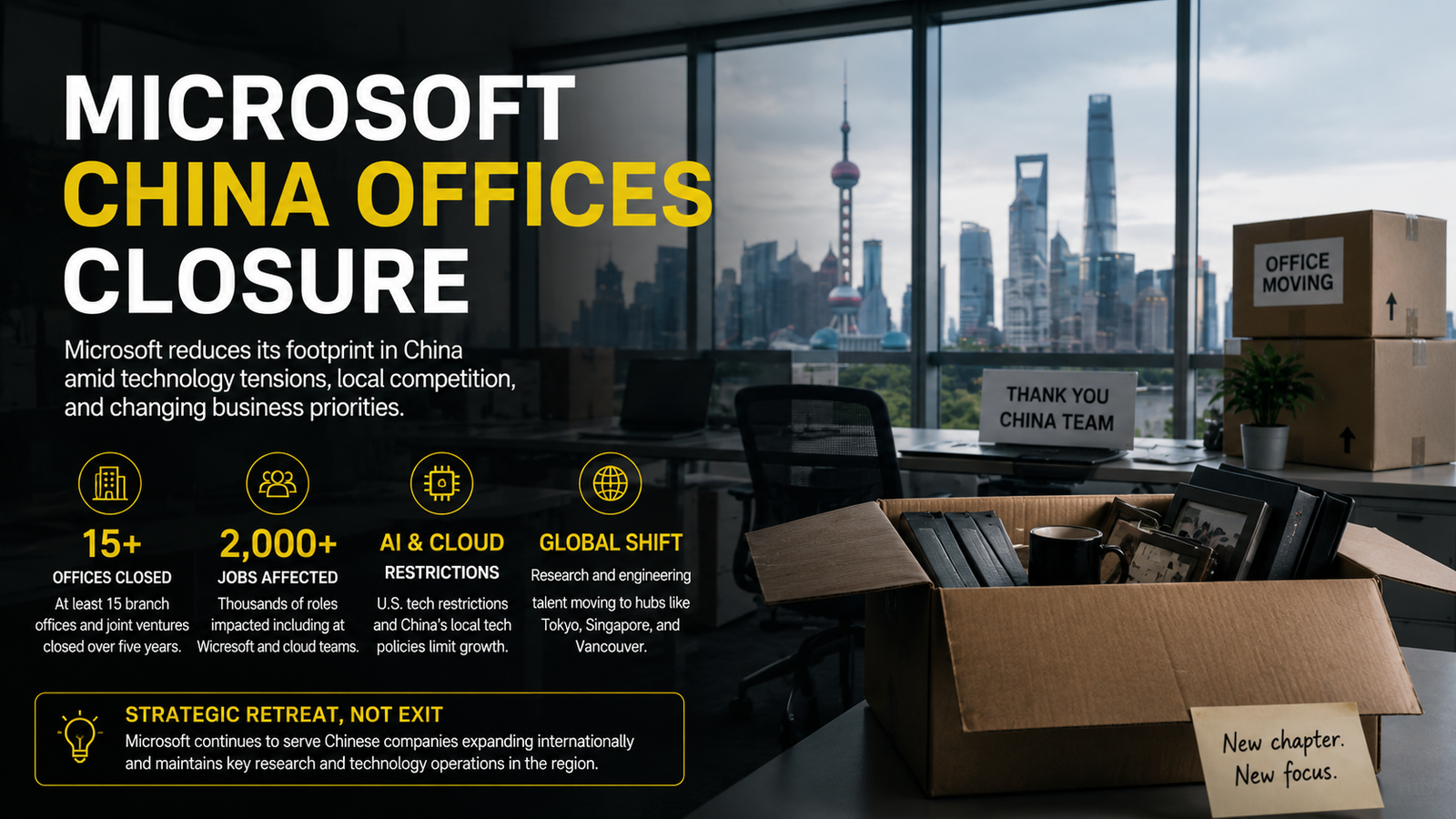
Microsoft has been quietly reducing parts of its business in China over several years. According to Reuters reporting cited in the research, at least 15 Microsoft branch offices and joint ventures have closed during the past five years. The changes have happened gradually and are part of a much wider shift in how Microsoft manages political risk, technology restrictions, local competition, and its future AI strategy in China.
The bigger story behind the Microsoft China offices closure is not simply about buildings shutting their doors. Microsoft is deciding which parts of its China business are still worth keeping and which parts have become too difficult or too risky to operate.
Relations between the United States and China have become more complicated for technology companies. At the same time, China has been encouraging government agencies and businesses to use more locally developed software. United States restrictions on advanced chips and AI technology have also made it harder for American companies to operate some of their most valuable services in China.
Still, Microsoft has reasons to remain in the country. China continues to provide access to skilled engineers, major companies, and businesses that want to expand into international markets. Microsoft can still earn money by helping Chinese companies use Azure and other global technology services outside mainland China.
That is why the Microsoft China offices closure should be viewed as a strategic retreat rather than a complete exit. Microsoft is reducing exposure where the risks are growing while keeping the parts of the business that still have long term value.
What Is Happening With the Microsoft China Offices Closure?

The Microsoft China offices closure refers to a gradual reduction of Microsoft’s physical offices, joint ventures, employees, and selected technology operations in mainland China.
There has not been one announcement saying Microsoft is shutting down its entire Chinese business. Instead, changes have taken place across several years and in different parts of the company.
Reuters found through corporate filings that Microsoft closed at least 15 branch offices and joint ventures in China over a five year period. Other parts of the company’s China operation have also faced staff cuts, restructuring, research changes, and reductions in cloud related roles.
This distinction is important because the phrase Microsoft China offices closure can easily create the wrong impression.
Microsoft is not turning off Windows, closing every research operation, removing all employees, or ending every business relationship in China. Instead, the company appears to be making its China presence smaller and more selective.
Some locations or business units may no longer make financial or strategic sense. Others may be affected by political pressure, technology restrictions, or China’s preference for domestic software companies.
Microsoft therefore seems to be keeping the operations that still offer value while reducing areas where growth has become harder.
For readers, the easiest way to understand the Microsoft China offices closure is this: Microsoft is shrinking its footprint, not disappearing from China.
That difference changes the entire meaning of the story.
Is Microsoft Leaving China Completely?
No. Based on the information currently available, Microsoft is not completely leaving China.
The company has reduced operations and closed multiple offices and ventures, but Microsoft has publicly said that it remains committed to the Chinese market and has no current plan for a total exit.
That does not mean a full exit was never discussed.
According to Reuters reporting included in the research, Microsoft executives considered whether the company should leave China completely in 2023. The concern was that geopolitical risk was becoming increasingly difficult to justify when compared with the financial return Microsoft was receiving from the country.
Microsoft ultimately decided to stay.
One reason is that China still offers business opportunities that Microsoft does not want to give up. Chinese companies expanding into Europe, the United States, and other international markets often need global cloud services, enterprise software, and access to technology ecosystems that Microsoft can provide.
Microsoft can serve some of these companies through Azure and its wider international infrastructure. That gives the company a reason to maintain a smaller but strategically useful China presence.
Microsoft Research Asia also continues to operate, although its role has changed and some advanced research activity has moved to locations outside mainland China. Consumer and enterprise products such as Windows and Microsoft 365 also continue to have a presence in the market.
So when people read about the Microsoft China offices closure, they should not assume Microsoft has decided that China no longer matters.
The more accurate conclusion is simple: Microsoft is retreating in China, but it is not completely leaving China.
How Many Microsoft Offices in China Have Closed?

At least 15 Microsoft branch offices and joint ventures in mainland China have closed over the previous five years, according to corporate filings reviewed by Reuters.
That figure gives us a useful picture of the scale of the Microsoft China offices closure, but it needs some context.
The 15 closures do not mean Microsoft suddenly closed 15 major headquarters at the same time.
The number covers different branch offices, joint ventures, and operating structures that were closed gradually. Some were connected to regional business operations. Others were linked to partnerships, research, cloud services, or technology development.
One important example mentioned in the research is Wicresoft, Microsoft’s original China joint venture established in 2002. Its China operations began winding down in April 2025, with an estimated 2,000 jobs affected.
The research also points to the closure of Microsoft’s IoT and AI Insider Lab in Shanghai in early 2025 and later reductions involving Azure cloud employees in Beijing and Shanghai.
These developments show that the Microsoft China offices closure is broader than simply ending leases on office buildings.
Microsoft is also changing the size and purpose of its China business.
Some operations are being closed. Some teams are being reduced. Some employees have been offered relocation opportunities. Some advanced research work has shifted to other countries. At the same time, selected Microsoft operations continue to function inside China.
That is why the number 15 should be treated as part of a larger restructuring story.
Microsoft is not carrying out one nationwide shutdown. It is gradually reducing its exposure to China while deciding which operations remain important enough to keep.
Which Microsoft China Operations Have Been Affected?
The Microsoft China offices closure has affected more than ordinary branch offices. The pullback reaches into joint ventures, research facilities, cloud teams, and other parts of Microsoft’s technology presence in mainland China.
One of the clearest examples is Wicresoft, the joint venture Microsoft helped establish in China in 2002. According to the supplied research, Wicresoft began winding down its China operations in April 2025, with an estimated 2,000 jobs affected.
That matters because Wicresoft was not a minor, recently created operation. It had been connected with Microsoft’s presence in China for more than two decades. Its winding down therefore illustrates how deeply Microsoft’s current restructuring reaches.
Another important change involved Microsoft’s IoT and AI Insider Lab in Shanghai. The research says the facility closed in early 2025, with equipment removed and Microsoft branding taken down.
The closure is especially notable because artificial intelligence and advanced computing are central to Microsoft’s global growth strategy. Rather than continuing every advanced technology operation inside China, Microsoft appears to be becoming more selective about where sensitive research and development work takes place.
Cloud operations have also been affected.
The supplied research points to Azure workforce reductions in Beijing and Shanghai during 2026, with roughly 200 to 400 jobs reportedly affected in that round of downsizing.
These reductions show that the Microsoft China offices closure is not limited to older business units. Even Azure, one of Microsoft’s most important global businesses, has faced adjustments inside China.
Research activities have changed as well. Microsoft Research Asia continues to operate, but some advanced work has increasingly been moved or expanded outside mainland China. The research notes that Microsoft has developed research operations in places such as Vancouver, Singapore, and Tokyo, while sensitive areas including quantum computing are no longer being conducted in China.
Taken together, these changes reveal a clear pattern.
Microsoft is not simply closing a few underused offices. It is reducing selected parts of its China operation across business, cloud, research, and technology development.
At the same time, it is not removing everything. Microsoft still has reasons to keep certain operations in China, particularly where they support existing customers, research talent, or Chinese companies expanding into international markets.
That makes the Microsoft China offices closure a selective restructuring rather than a complete shutdown.
Why Is Microsoft Closing Offices in China?

There is no single reason behind the Microsoft China offices closure.
Microsoft is facing several pressures at once. Relations between the United States and China have become more difficult. Chinese government policies increasingly favor domestic technology. United States restrictions limit access to some advanced chips and AI technology. Local competitors are becoming stronger. Government procurement opportunities for foreign software companies have also weakened.
All of these factors make maintaining a large China operation harder to justify.
For Microsoft, the question is no longer simply whether China is a large and important market. China clearly is. The more difficult question is whether Microsoft can operate there with enough freedom, growth potential, and financial return to justify the political and business risk.
The company’s own internal discussions show how serious that question became.
According to the supplied research, Microsoft executives discussed the possibility of a complete China exit in 2023 because some believed the company faced too much geopolitical risk for the economic return it was receiving.
Microsoft eventually chose not to leave completely. Instead, the company appears to have taken a middle path.
It is reducing operations where the risk is high or the business opportunity is weakening while keeping areas that still provide strategic value.
China’s changing technology policy is one major reason.
Since 2017, Beijing has increasingly encouraged government organizations to use domestic software and technology. That creates a difficult environment for foreign companies such as Microsoft, especially when government customers are important to enterprise software growth.
The supplied research says Reuters reviewed six Chinese government procurement guides published between 2023 and 2026. Five did not recommend Microsoft products, while the remaining guide included a version of Windows only with additional management requirements.
That is a significant problem for Microsoft.
A company can maintain offices, employees, and sales teams in a country, but those investments become harder to defend if large customers are being encouraged to choose domestic alternatives.
United States technology controls create another layer of difficulty.
Restrictions involving advanced semiconductors, AI systems, and other sensitive technologies can limit what an American technology company is able to offer or develop inside China. The research notes that these restrictions have affected Microsoft’s ability to expand high value Azure AI services and other advanced technology operations in the country.
Competition is also changing the calculation.
Chinese technology companies have continued developing their own cloud platforms, software products, AI models, and enterprise tools. That means Microsoft is not only dealing with government restrictions. It also has to compete with domestic companies that may have stronger local relationships and fewer regulatory barriers.
The result is a business environment where growth can require more effort while offering less certainty.
That is why the Microsoft China offices closure should be understood as a broader risk reduction strategy.
Microsoft is narrowing its footprint in areas where political pressure, technology restrictions, competition, and limited financial return make expansion less attractive. At the same time, it is protecting the parts of its China business that still connect with its larger global cloud and AI strategy.
Growing United States and China Technology Tensions
The relationship between the United States and China has become one of the biggest challenges facing global technology companies.
For Microsoft, these tensions affect much more than politics.
They influence where the company can invest, which technology it can move across borders, what its engineers can work on, which customers it can serve, and how confidently it can plan long term operations in China.
A technology company normally wants stability before making major investments in offices, laboratories, cloud infrastructure, and research teams. When rules can change because of national security concerns or new government restrictions, those investments become more difficult to justify.
Microsoft has experienced exactly that problem.
The supplied research says Microsoft executives discussed a possible China exit because they believed geopolitical risk was increasing while the financial return from the market remained relatively limited.
That risk also affects research.
Advanced fields such as artificial intelligence, quantum computing, semiconductors, and cloud infrastructure are increasingly connected to national security debates. As a result, Microsoft has to think carefully about which projects can be developed inside China and which should be moved elsewhere.
The company has responded partly by expanding research activity outside mainland China. According to the research, Microsoft Research Asia has developed additional operations in locations including Vancouver, Singapore, and Tokyo, while some sensitive research areas are no longer carried out inside China.
Talent decisions become more complicated too.
If Microsoft cannot guarantee that its China based researchers will have access to the same advanced technology, computing resources, or global projects as teams elsewhere, keeping top engineers becomes harder.
The research notes that Microsoft offered relocation opportunities to around 1,000 leading China based engineers in 2024. Only about one third reportedly accepted, while some employees instead moved to Chinese technology companies or universities.
That creates another challenge for Microsoft.
Reducing operations can protect the company from geopolitical risk, but it can also make it easier to lose experienced employees.
For readers, the important point is that the Microsoft China offices closure is not simply the result of poor office performance.
Microsoft is operating in an environment where business decisions are increasingly shaped by government policy, national security concerns, technology controls, and the wider relationship between Washington and Beijing.
Those pressures make a smaller and more flexible China operation easier for Microsoft to manage than the much larger presence it maintained in the past.
China Is Favoring Domestic Technology
One of the biggest pressures behind the Microsoft China offices closure is China’s growing preference for homegrown technology.
For years, Beijing has been encouraging government departments and other public organizations to use more software and hardware developed by Chinese companies. Reuters reports that this push toward domestic software has been building since 2017.
For Microsoft, that creates a serious business problem.
Windows, Microsoft 365, Azure, and other Microsoft products may be among the most recognized technology products in the world, but brand recognition only goes so far. If major government buyers are encouraged to choose local alternatives, Microsoft has fewer opportunities to win large contracts.
Reuters reviewed six Chinese government computer system procurement guides published between December 2023 and May 2026. Five did not recommend Microsoft products. The sixth included Windows 10 China Government Edition, but its use came with additional management requirements.
That tells us why the Microsoft China offices closure is about more than political tension.
Microsoft can keep offices open, employ sales teams, and invest in local operations, but the value of those investments falls if important customers are increasingly pushed toward Chinese alternatives.
Local companies also have advantages that Microsoft does not always enjoy. They operate within the domestic regulatory system, often have closer relationships with local customers, and may face fewer restrictions when selling to government organizations.
Over time, that changes the economics of Microsoft’s China business.
Maintaining a large network of offices makes more sense when there is strong room for growth. If access to government customers becomes more limited while domestic competitors continue to improve, Microsoft has to ask whether the cost of maintaining that footprint is still justified.
The answer appears to be increasingly selective.
Microsoft has not abandoned the market, but it is reducing operations where the business opportunity has become weaker. China’s preference for domestic technology is therefore one important reason why the Microsoft China offices closure has unfolded gradually over several years.
United States Restrictions on Advanced AI and Chips
Pressure is also coming from the other side of the relationship.
United States restrictions on advanced chips, artificial intelligence technology, and other sensitive computing systems have made Microsoft’s China strategy more complicated.
These restrictions matter because Microsoft’s future growth depends heavily on AI and cloud computing.
Azure is not simply a traditional cloud storage business anymore. Microsoft is investing heavily in AI infrastructure, advanced computing, machine learning, and services that require powerful chips and large amounts of computing capacity.
Reuters reports that United States export controls on advanced technology have made it harder for Microsoft to expand some of its more profitable AI and cloud businesses inside China.
That puts Microsoft in an awkward position.
China remains an enormous technology market with skilled engineers and ambitious companies. At the same time, Microsoft cannot always give its China operations the same access to advanced technology that teams in other countries may receive.
That affects Azure.
If Microsoft faces restrictions on the hardware, AI systems, or computing resources it can use in China, building the same kind of high value cloud and AI business there becomes more difficult.
It also affects research.
Modern AI development depends on access to powerful computing systems, advanced chips, large models, and international research collaboration. When access to those resources becomes more restricted, China based Microsoft researchers can face limits that colleagues elsewhere may not face.
The result is a difficult business equation.
Microsoft could continue investing heavily inside China, but some of the technologies driving its strongest global growth are also the technologies facing the greatest political and regulatory scrutiny.
This helps explain why the Microsoft China offices closure has reached beyond traditional sales offices.
Microsoft is reconsidering where its advanced engineering teams should work, where research should take place, and which markets provide the easiest environment for expanding Azure and AI services.
For Microsoft, reducing exposure in China can lower regulatory risk while allowing the company to direct more resources toward countries where its latest AI technology can be developed and commercialized with fewer restrictions.
Microsoft Is Moving Some Research Beyond China
Microsoft is not simply reducing research. It is changing where some of that research happens.
Microsoft Research Asia has long been an important part of the company’s international research network, with a strong presence in Beijing and access to highly skilled engineering and computer science talent.
That presence has not disappeared. Microsoft’s own research site continues to describe Microsoft Research Asia as operating in Beijing and lists research positions connected with Beijing, Shanghai, Singapore, and Tokyo.
What has changed is the geographic spread of Microsoft’s research activity.
As political and technology restrictions have become more complicated, Microsoft has expanded Microsoft Research Asia beyond mainland China.
One of the clearest examples is Japan.
Microsoft officially announced the opening of Microsoft Research Asia Tokyo on November 18, 2024. The company said the lab would work on areas including embodied AI, societal AI, neuroscience, wellbeing, and industry innovation.
That expansion matters when looking at the wider Microsoft China offices closure.
It shows that Microsoft is not simply cutting advanced research to reduce costs. Instead, the company is spreading research teams and capabilities across more locations.
Some sensitive or advanced projects can be developed in places where Microsoft has easier access to international research networks, computing infrastructure, and advanced technology.
The supplied research also notes that Microsoft Research Asia expanded activity through locations including Vancouver, Singapore, and Tokyo as Microsoft’s China strategy became more cautious.
This gives Microsoft more flexibility.
If geopolitical conditions become more difficult in one country, the company does not have to depend on a single research center. It can distribute engineers, laboratories, and projects across several markets while still keeping part of Microsoft Research Asia operating in China.
That makes the research story more complicated than a simple retreat.
Microsoft still values China’s engineering talent, but it increasingly appears to want its most important research capabilities spread across a wider international network.
What Happened to Microsoft Employees in China?

The Microsoft China offices closure has also created major changes for employees.
Some workers have faced job reductions. Others have been offered opportunities to relocate outside China. Research teams have been reorganized, and some experienced engineers have chosen to leave Microsoft rather than move with the company.
One of the biggest developments came in 2024.
According to Reuters reporting included in the supplied research, Microsoft offered transfer opportunities to around 1,000 top China based engineers. Roughly one third reportedly accepted those offers.
Microsoft publicly confirmed at the time that some China based employees had been given optional internal transfer opportunities while saying the company would continue operating in China. Contemporary reporting also connected some of those offers with employees working in Azure, machine learning, and AI related roles.
The fact that many employees chose not to move created another challenge.
Some experienced developers and researchers reportedly moved to Chinese technology companies or universities instead. That means Microsoft was not simply moving talent from one office to another. In some cases, it risked losing highly trained people altogether.
This matters because Microsoft’s China presence has historically been about more than selling software.
China gave the company access to a deep pool of engineers, researchers, computer scientists, and AI specialists. Reuters notes that access to engineering talent remains one of the reasons Microsoft has not completely left the country.
Talent can therefore be almost as important as office buildings.
A closed office can be replaced somewhere else. Losing researchers who understand complex AI systems, cloud infrastructure, or advanced software development is harder.
That creates a difficult balance for Microsoft.
Moving employees outside China can reduce geopolitical and regulatory risk. It can also give researchers easier access to global technology and advanced computing resources.
But moving too aggressively can push talented employees toward competitors.
The company has already faced exactly that problem. Some employees may have family, professional, or personal reasons for remaining in China. When relocation is not attractive, Microsoft risks losing them to domestic technology companies that are increasingly competing for the same AI and engineering talent.
Staff reductions have also affected other parts of the business.
The supplied research points to workforce reductions involving Azure teams in Beijing and Shanghai during 2026, along with the winding down of Wicresoft operations and changes involving research activities.
These changes show the human side of the Microsoft China offices closure without changing the broader picture.
Microsoft is not removing every employee from China. It is making its workforce smaller, more focused, and more closely aligned with the parts of the China business it still considers strategically useful.
For Microsoft, the challenge is keeping enough top talent to maintain those operations while moving sensitive or strategically important work to places where the company faces fewer restrictions.
Why Microsoft Still Wants to Stay in China
The Microsoft China offices closure may look like a steady retreat, but Microsoft has not decided that China has nothing left to offer.
In fact, there are two important reasons Microsoft still wants a presence in the country. China remains a major source of engineering talent, and Chinese companies expanding overseas can become valuable customers for Microsoft’s global cloud and technology services.
Reuters reports that serving Chinese businesses with international operations was one of the key reasons Microsoft decided against completely leaving China.
This creates an unusual situation.
Microsoft may have fewer opportunities to sell advanced cloud and AI services directly inside mainland China, but Chinese companies doing business in the United States, Europe, Southeast Asia, and other international markets still need technology that works globally.
That is where Microsoft becomes useful.
A Chinese company expanding internationally may need cloud servers in several countries, cybersecurity tools, workplace software, data services, AI infrastructure, and technology that connects teams across different markets. Microsoft already has a global network capable of providing those services.
Azure is particularly important here.
Instead of viewing China only as a market where Microsoft needs to sell technology locally, the company can use its China relationships to win customers as those businesses expand outside the country.
This changes the value of Microsoft’s remaining Chinese operation.
A local relationship in Beijing or Shanghai can eventually lead to cloud spending in Europe, North America, or other markets where Microsoft has more freedom to offer its full technology stack.
The supplied research describes this business of helping Chinese companies expand overseas as Microsoft’s largest China linked business, although it remains small compared with the company’s worldwide operations.
There is also the talent question.
Microsoft has spent decades building relationships with Chinese universities, engineers, researchers, developers, and AI specialists. Walking away completely would mean giving up access to one of the world’s largest technology talent pools.
Microsoft Research Asia remains based in Beijing, and Microsoft continues to describe the lab as a major research operation working with the academic community.
This helps explain the strategy behind the Microsoft China offices closure.
Microsoft is not trying to preserve every office or every old business model. It appears to be keeping the parts that still connect with its global priorities.
That means research talent, international Chinese customers, Azure, AI, and global enterprise services can remain valuable even while Microsoft reduces its overall physical presence in China.
The strategy is smaller, but it is not meaningless.
Microsoft Azure and AI Could Keep the China Business Alive

Artificial intelligence may be one of the strongest reasons Microsoft still sees value in keeping a foothold in China.
The interesting part is that the opportunity does not necessarily come from selling Microsoft’s latest AI services directly inside mainland China.
Much of the opportunity comes from what Chinese businesses want to do outside China.
A company expanding into the United States or Europe may need global cloud infrastructure, data centers, cybersecurity, enterprise software, and AI tools that can support international customers.
Azure can provide that bridge.
Reuters reports that Microsoft’s main China linked revenue increasingly comes from providing cloud and AI services to Chinese private companies with customers or operations overseas.
That gives Microsoft an advantage that is difficult to measure simply by counting how many offices remain open.
Consider a Chinese technology, ecommerce, manufacturing, or consumer company entering several international markets.
It may need computing capacity close to customers. It may need global identity management. It may need business analytics, security tools, AI services, and software that works across dozens of countries.
Microsoft can sell those services through its international infrastructure even when some technology is difficult to provide within mainland China.
This is one reason Azure matters so much to the wider Microsoft China offices closure story.
The China operation does not need to become a huge domestic cloud business to remain useful. It can act as a relationship point that connects Chinese companies with Microsoft’s global cloud network.
Artificial intelligence makes that relationship even more valuable.
Companies everywhere are experimenting with AI assistants, generative AI, automation, coding systems, customer service tools, and large language models. Chinese companies expanding abroad are part of that same trend.
Microsoft has invested heavily in building the infrastructure needed to support those workloads.
The scale of Azure shows why the company has a reason to protect promising international customer relationships. Microsoft reported that Azure generated more than $100 billion in annual revenue for the first time during fiscal 2026. Azure and other cloud services revenue grew 43 percent in the fourth quarter.
China, however, is not an easy opportunity.
Chinese AI companies are improving quickly, and domestic models can sometimes compete on price as well as performance. Reuters notes that Microsoft’s China strategy faces growing competition from local AI models.
That could reduce the appeal of Western AI services.
If Chinese companies can get capable AI models from domestic providers at lower prices, they may have less reason to depend on Microsoft or other American technology companies.
The competition becomes especially important when customers are mainly interested in the model itself.
Microsoft’s larger advantage may therefore be the entire global package rather than AI alone.
A customer might be able to find a cheaper model from a Chinese provider, but operating an international business also requires cloud infrastructure, security, identity systems, enterprise software, compliance tools, and data services across many regions.
Microsoft can bundle those needs into a much larger technology ecosystem.
That is why AI could help keep Microsoft’s China business alive without reversing the Microsoft China offices closure.
Microsoft does not need to rebuild the large China presence it once had. It needs the remaining operation to connect valuable Chinese customers with the much larger Azure and AI businesses Microsoft runs around the world.
How Important Is China to Microsoft Revenue?
China is strategically important to Microsoft, but financially it is much smaller than many readers might expect.
Microsoft said in 2024 that China represented about 1.5 percent of its global revenue, according to Reuters.
That number changes how the Microsoft China offices closure should be viewed.
China is one of the world’s biggest economies and technology markets, so Microsoft’s retreat naturally attracts attention. But Microsoft’s financial future does not depend heavily on revenue generated inside China.
The wider company is operating on an entirely different scale.
Microsoft reported revenue of $331.8 billion for fiscal 2026, an increase of 18 percent from the previous year. Operating income reached $155.2 billion, while net income reached $133.7 billion.
Azure has also become an enormous business in its own right.
Microsoft said annual Azure revenue surpassed $100 billion during fiscal 2026, while Microsoft Cloud revenue exceeded $214 billion.
Against those numbers, China’s direct revenue contribution looks relatively limited.
This does not mean China is irrelevant.
The market still matters because of research talent, global Chinese companies, international cloud customers, and the wider competition between American and Chinese technology ecosystems.
But there is an important difference between strategic importance and financial dependence.
Microsoft can close offices, reduce employees, and move some research outside China without threatening the financial foundation of the company.
The supplied research makes the same point. It identifies China as roughly 1.5 percent of Microsoft’s worldwide revenue and notes that Microsoft’s broader growth is being driven primarily by cloud and AI demand elsewhere.
That gives Microsoft room to be selective.
If a China operation creates too much political risk or offers too little return, Microsoft can reduce it without sacrificing one of its largest revenue engines.
This is why the Microsoft China offices closure looks more like risk management than financial distress.
Should Microsoft Investors Worry About the China Office Closures?
For Microsoft investors, the China closures are worth watching, but they are probably not the biggest issue facing the company.
The Microsoft China offices closure matters because it tells investors something about geopolitical risk, international competition, and the changing relationship between the world’s two largest technology ecosystems.
But office closures alone are unlikely to determine Microsoft’s financial performance.
China represented about 1.5 percent of Microsoft’s worldwide revenue based on the figure the company disclosed in 2024.
Meanwhile, Microsoft’s cloud business has become dramatically larger.
For fiscal 2026, Microsoft reported $331.8 billion in total revenue. Azure annual revenue passed $100 billion, and Azure and other cloud services grew 43 percent in the fiscal fourth quarter.
Those are the numbers investors are more likely to focus on.
The bigger questions are whether Azure can continue growing quickly, whether AI demand remains strong, how much Microsoft must spend on data centers and computing infrastructure, and whether those investments eventually produce attractive margins.
AI infrastructure is expensive.
Microsoft has to spend heavily on servers, chips, networking equipment, data centers, energy capacity, and other infrastructure before much of the future AI revenue arrives.
Microsoft itself has acknowledged the pressure created by that investment. Its fiscal 2026 results show that AI infrastructure spending affects cloud margins even as Azure demand continues to grow.
For shareholders, that may matter far more than whether another Microsoft branch office closes in China.
There are still risks connected with the China pullback.
Microsoft could lose talented researchers to Chinese competitors. It could lose relationships with companies that eventually become major international businesses. A sharper political conflict between Washington and Beijing could also make Microsoft’s remaining operations more difficult.
At the same time, maintaining too much exposure creates risks of its own.
That is why a smaller China operation can make sense financially.
Microsoft can keep access to selected customers and talent without depending heavily on a market where government policy and technology restrictions can change the business environment quickly.
Investors therefore should not ignore the Microsoft China offices closure, but they should keep it in proportion.
Microsoft’s valuation is much more closely tied to Azure, AI adoption, enterprise software demand, infrastructure costs, and the company’s ability to turn enormous AI spending into sustainable profit.
China is part of that story.
It is not the whole story.
What Microsoft Still Operates in China

The Microsoft China offices closure does not mean Microsoft has disappeared from China.
That is an important point because the closure numbers can easily create the impression that the company has almost completely left the country.
Microsoft’s own websites show otherwise.
Microsoft’s Greater China careers page currently says the company has seven locations across the region: Beijing, Hong Kong, Shanghai, Shenzhen, Suzhou, Taipei, and Wuxi. It describes work ranging from research and product development to cloud services, technical support, devices, and business solutions.
Research also remains part of Microsoft’s presence.
Microsoft Research Asia continues to describe itself as a research laboratory based in Beijing that works with academic institutions on computer science and advanced technology.
Microsoft’s broader research careers information also identifies Microsoft Research Asia as operating from Beijing and Shanghai.
That does not mean Microsoft’s China operation looks the same as it did several years ago.
Its footprint has clearly become smaller.
At least 15 branch offices and joint ventures have closed over five years, according to Reuters. Microsoft has reduced some cloud roles, offered engineers opportunities to move abroad, closed selected technology facilities, and shifted parts of its research network to other countries.
But a smaller footprint is different from no footprint.
Microsoft still has employees, research activity, customer relationships, technology operations, and physical locations connected with the Greater China region.
The remaining business also serves a different purpose than Microsoft’s older China strategy.
Microsoft once had stronger ambitions to sell Windows, enterprise software, and technology directly into government and domestic markets. Today, a growing part of the value comes from research talent and helping Chinese companies operate internationally.
That shift explains why the company can close offices while still insisting it has no current plan to abandon China.
The Microsoft China offices closure is therefore best understood as a reshaping of the business.
Microsoft is removing operations that have become difficult to justify while keeping a narrower group of activities that still support its global cloud, AI, research, and enterprise strategy.
Microsoft China Offices Closure Timeline
The Microsoft China offices closure did not begin with one sudden decision. Microsoft spent decades building one of the deepest relationships between an American technology company and China before geopolitical pressure, domestic competition, and technology restrictions gradually changed the calculation.
Early 1990s: Microsoft Builds Its China Presence
Microsoft’s relationship with China stretches back more than three decades. Reuters reports that Microsoft began building connections with the Chinese government in the early 1990s. Bill Gates made his first visit to China in 1994, and the company gradually expanded its software, research, engineering, and enterprise operations in the country.
Microsoft later developed a substantial research presence and worked closely with universities, technology companies, government agencies, and enterprise customers.
For many years, China was viewed as a market where Microsoft wanted to stay even when other American technology companies faced difficulties.
2010: Microsoft Chooses to Stay as Google Leaves
An important moment came in 2010 when Google decided to pull its search operation out of mainland China following disputes involving censorship and cyberattacks.
Microsoft took a different position.
Reuters reports that Bill Gates and Microsoft’s then CEO Steve Ballmer considered Google’s decision an overreaction. Microsoft continued operating in China and worked to strengthen its relationships with government and business customers.
The contrast is important because it shows how dramatically Microsoft’s position has changed. A company that once strongly defended staying in China is now deliberately reducing parts of its presence.
2017: China Pushes Harder for Domestic Technology
The environment began changing more clearly around 2017.
China introduced procurement rules focused on technology considered safe and reliable. Reuters reports that foreign operating systems, including Windows, were not regarded by the Chinese government as compliant with those policies.
Microsoft attempted to adapt.
The company developed Windows 10 China Government Edition and worked to maintain government relationships, but adoption did not grow as strongly as Microsoft had hoped.
China’s growing preference for domestic software would eventually become one of the forces behind the Microsoft China offices closure.
2021 to 2023: Microsoft Questions Its Future in China
By the early 2020s, Microsoft’s strategy had become more difficult to maintain.
Relations between Washington and Beijing were deteriorating. United States technology controls were expanding, while China continued encouraging government organizations to use domestic alternatives.
Reuters reports that Microsoft considered leaving China completely in 2023. Some executives believed the company was accepting too much geopolitical risk for too little financial return.
Microsoft ultimately chose not to leave.
The company had developed a profitable business serving Chinese companies with overseas operations and still valued access to China’s engineering talent. Those advantages were strong enough to keep part of the business alive.
This decision created the strategy that readers see today. Instead of a complete exit, Microsoft began moving toward a smaller and more selective presence.
2024: Microsoft Offers Engineers International Transfers
Employees became an important part of the restructuring in 2024.
Reuters reports that Microsoft offered relocation opportunities to around 1,000 top engineers working in China. The transfers included opportunities in the United States and other Western countries. Only about one third of those employees accepted, according to Reuters sources.
Many experienced engineers reportedly chose to remain in China, with some moving to Chinese universities and technology companies instead.
This showed one of Microsoft’s biggest problems.
The company wanted to reduce the risks surrounding advanced research in China without losing access to the engineers who had helped make its China research operation valuable.
2025: The Retreat Becomes More Visible
During 2025, the Microsoft China offices closure became easier to see through specific operational changes.
The supplied research identifies the winding down of Wicresoft’s China operations beginning in April 2025, with an estimated 2,000 jobs affected. It also identifies the closure of Microsoft’s IoT and AI Insider Lab in Shanghai during the same period.
These developments were significant because they showed that Microsoft’s reduction was moving beyond small administrative offices.
Parts of its technology, joint venture, and innovation infrastructure were also being reconsidered.
At the same time, Microsoft was expanding parts of its research network elsewhere. Microsoft officially opened Microsoft Research Asia Tokyo in November 2024, part of a broader effort to spread advanced research activity across more locations in the Asia Pacific region.
2026: Cloud and Office Reductions Continue
By 2026, the pattern had become difficult to ignore.
The supplied research points to additional workforce reductions involving Azure teams in Beijing and Shanghai during 2026.
Corporate filings reviewed by Reuters showed that at least 15 Microsoft branch offices and joint ventures had closed in China over the previous five years.
Yet Microsoft had still not abandoned the country.
Its current Greater China careers page lists seven locations across the region, including Beijing, Hong Kong, Shanghai, Shenzhen, Suzhou, Taipei, and Wuxi. Microsoft says those operations include research, product development, cloud services, solutions, technical support, and other functions.
August 2026: Reuters Reveals Microsoft’s Strategy of Retreat
On August 13, 2026, Reuters published a detailed investigation describing Microsoft’s approach as a strategy of retreat.
The report revealed the scale of the closures, Microsoft’s earlier discussions about a possible full exit, the difficulty of retaining engineers, growing Chinese preference for domestic software, and the role Azure and AI still play in keeping Microsoft connected to Chinese companies expanding overseas.
That report helps put the Microsoft China offices closure into context.
Microsoft has moved from decades of expansion to a far more selective strategy. It is reducing operations where the risks and costs have grown while keeping businesses that still provide access to talent, international customers, and future cloud opportunities.
What the Microsoft China Offices Closure Says About United States Technology Companies
The Microsoft China offices closure is bigger than Microsoft.
It shows the difficult position American technology companies increasingly face when trying to operate between the United States and China.
For years, technology companies could think of China mainly as a huge market with millions of customers, skilled workers, manufacturing capacity, and growing demand.
That calculation is becoming much more complicated.
Today, an American technology company operating in China has to think about which AI systems can cross borders, which advanced chips can be exported, where sensitive research can happen, how data is stored, which software government agencies are allowed to purchase, and whether employees can access the same technology as colleagues in other countries.
Microsoft’s experience brings all of those problems together.
United States export restrictions have limited access to advanced chips and AI technology for Microsoft engineers based in China. China, meanwhile, has strengthened policies favoring domestic software and technology providers.
The company therefore faces pressure from both directions.
Washington wants to limit China’s access to technologies that could have national security implications. Beijing wants greater control over its own technology ecosystem and less dependence on American companies.
Microsoft sits in the middle.
That means decisions about an office in Beijing or Shanghai are no longer simply decisions about rent, salaries, or local sales.
They can involve national security, artificial intelligence, data rules, research access, cloud infrastructure, government contracts, and international politics.
The same challenge affects other American technology companies.
Reuters notes that other large United States technology businesses have also been reconsidering their China exposure as geopolitical tensions increase.
This does not necessarily mean American technology companies will leave China.
China remains too important in manufacturing, engineering talent, supply chains, research, and consumer demand to dismiss easily.
But companies may become more selective about what they keep there.
Sensitive research can move elsewhere. Supply chains can become more diversified. Cloud operations can focus on international Chinese customers. Engineering teams can be distributed across several countries instead of being concentrated in one market.
That is one of the larger lessons from the Microsoft China offices closure.
The global technology industry is becoming less unified.
American and Chinese companies increasingly operate inside different regulatory systems, use different technology suppliers, face different rules, and compete to build their own AI and cloud ecosystems.
Microsoft is trying to remain connected to both sides without becoming too dependent on either one.
That may become one of the defining challenges for global technology companies during the next several years.
Could Microsoft Eventually Leave China Completely?
A complete Microsoft exit from China is possible in theory, but there is no evidence that the company has currently decided to take that step.
Reuters reported on August 13, 2026 that Microsoft has no current plans to exit China, even though the company considered the possibility in 2023. Microsoft has also said it remains committed to the Chinese market.
For that position to change, several parts of the business environment would probably have to become less attractive at the same time.
Worsening relations between the United States and China would be one factor.
If new restrictions made it substantially harder for Microsoft to operate cloud services, move technology between countries, conduct research, or employ China based engineers, maintaining even a reduced operation could become difficult.
Technology restrictions would also matter.
Microsoft’s strongest growth opportunities are increasingly connected with Azure, artificial intelligence, and advanced computing. If United States rules prevented Microsoft from providing enough of those technologies to Chinese customers or researchers, the commercial value of staying could decline.
Chinese competition is another factor.
Domestic operating systems, enterprise software, cloud services, and AI models continue to improve. Reuters notes that Chinese AI models can already be significantly cheaper than Western alternatives in some cases, potentially reducing the need for Chinese companies to access Western models through Azure.
Microsoft would also have to reconsider its position if its international China business weakened.
One of the main reasons Microsoft stayed was its ability to serve Chinese companies expanding overseas. By the middle of the 2020s, that had become Microsoft’s largest China linked business, although Reuters sources said it remained small compared with Microsoft’s global operations.
If Chinese companies eventually stopped needing Microsoft’s global cloud and AI ecosystem, another major reason for maintaining a presence would disappear.
Talent could affect the calculation too.
Microsoft values access to China’s engineering community. If the company became unable to retain researchers or give them access to competitive technology, that advantage could become less meaningful.
None of these factors means a complete exit is coming.
For now, the evidence points toward continued selective retreat rather than abandonment.
Microsoft appears to believe that a smaller operation gives it the best balance. It can reduce geopolitical exposure while keeping access to engineering talent and Chinese companies that need Microsoft technology outside China.
The future of the Microsoft China offices closure will therefore depend less on how many buildings Microsoft still occupies and more on whether the remaining business continues to provide strategic value.
Frequently Asked Questions About Microsoft China Offices Closure
Why is Microsoft closing offices in China?
Microsoft is reducing its China presence because several pressures have made operating there more difficult.
These include worsening United States and China relations, Chinese policies favoring domestic technology, United States restrictions on advanced chips and AI, stronger Chinese competitors, reduced government procurement opportunities, and concerns about whether the financial return justifies the geopolitical risk. Reuters reports that these pressures contributed to Microsoft’s decision to pursue a smaller presence rather than continue expanding as it once did.
How many Microsoft offices have closed in China?
At least 15 Microsoft branch offices and joint ventures in China have closed over the past five years, according to corporate filings reviewed by Reuters.
The number does not represent one nationwide closure event. It reflects a gradual restructuring involving different offices and business entities.
Is Microsoft completely leaving China?
No.
Microsoft has reduced its operations considerably, but it currently has no plan for a complete China exit. Reuters reports that Microsoft considered leaving in 2023 but ultimately chose to remain because of its business serving Chinese companies internationally and its desire to retain access to China’s engineering talent.
Does Microsoft still operate in China?
Yes.
Microsoft continues to operate research, engineering, cloud, enterprise, and other technology related activities connected with China.
Microsoft Research Asia remains based in Beijing.
Microsoft’s Greater China careers page also currently lists seven locations across the region: Beijing, Hong Kong, Shanghai, Shenzhen, Suzhou, Taipei, and Wuxi.
The Microsoft China offices closure therefore represents a smaller presence rather than the disappearance of Microsoft from China.
Why does Microsoft still need China?
China still gives Microsoft access to highly skilled engineers and relationships with major Chinese businesses.
It also creates an important international cloud opportunity.
Chinese companies expanding into Europe, the United States, and other markets may need Azure, AI services, data infrastructure, security tools, and enterprise software that can operate globally.
Reuters reports that serving these internationally focused Chinese businesses became Microsoft’s largest China linked business by the middle of the 2020s.
That gives Microsoft a reason to maintain a strategic foothold even while reducing other operations.
Will Microsoft China offices closure affect Microsoft stock?
The Microsoft China offices closure could influence investor views about geopolitical risk, but the closures alone are unlikely to determine Microsoft’s stock performance.
China represented only around 1.5 percent of Microsoft’s worldwide revenue when the company disclosed the figure in 2024.
Investors are therefore likely to pay much more attention to Azure growth, AI demand, data center spending, profit margins, enterprise software sales, and Microsoft’s ability to generate returns from its enormous AI investments.
China remains strategically important, but Microsoft’s global financial performance depends on a much larger set of businesses and markets.
Final Thoughts on Microsoft China Offices Closure
The Microsoft China offices closure is not the story of Microsoft suddenly walking away from one of the world’s largest technology markets.
It is the story of a company becoming much more selective.
Microsoft spent decades expanding its presence in China, building relationships with government agencies, businesses, researchers, and engineers. That strategy worked in a period when the United States and China were becoming more economically connected.
The environment today is very different.
China is pushing harder for domestic technology. The United States is restricting access to advanced chips and AI systems. Chinese software and AI competitors are becoming stronger. Microsoft also has to decide whether operating every office, research program, and business unit is worth the political and financial risk.
The response has been a gradual retreat.
At least 15 branch offices and joint ventures have closed over five years. Research has become more internationally distributed. Some engineers have been offered transfers abroad. Parts of Microsoft’s cloud workforce have been reduced.
Yet Microsoft is still there.
It continues to value China’s engineering talent, maintains research and business operations, and sees an opportunity in helping Chinese companies use Azure and other Microsoft technologies as they expand internationally. Microsoft’s current careers information still shows an active Greater China presence across seven locations.
That is the clearest way to understand the Microsoft China offices closure.
Microsoft is cutting areas where geopolitical risk, restrictions, competition, and limited returns make expansion difficult. At the same time, it is protecting the pieces of its China business that still connect with its larger global cloud, AI, research, and enterprise strategy.
For now, this is a strategic reduction, not a final goodbye.
Continue reading the latest technology and digital business coverage on the Eadoz Blog.
For readers following the wider technology industry, explore the reported Anthropic Decart AI acquisition, the potential Vantage Data Centers IPO, and emerging Norwegian technology media market trends. You can also read our coverage of Blue Hill Technology and why AI transformation is a problem of governance as companies rethink how they manage technology, infrastructure, and artificial intelligence.


