

-
- No Comments
- August 28, 2026

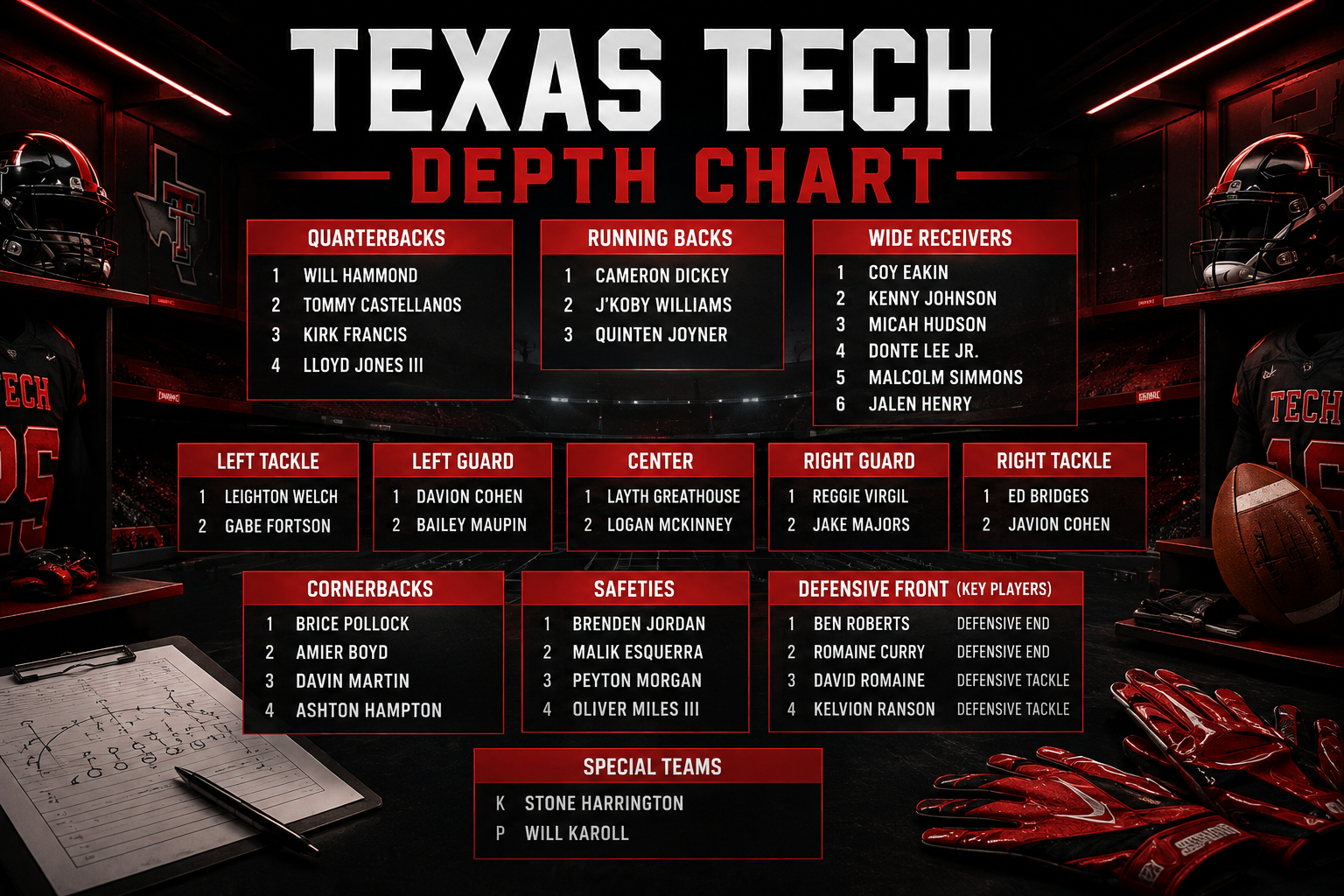
Texas Tech Depth Chart
Texas Tech Depth Chart 2026: Projected Starters, Backups, and Key Position Battles
The texas tech depth chart for 2026 features proven starters, exciting transfers, and several position battles that could continue into the opening weeks. Texas Tech has impressive depth in the backfield and secondary, but quarterback health and changes along the defensive front create important questions.
In this guide, I will take you through the projected offense, defense, and special teams. You will also see which jobs remain open, which backups could earn meaningful playing time, and where the lineup may change before the season begins.
Quick Answer: What Does the Texas Tech Depth Chart Look Like in 2026?
Will Hammond is expected to start the season opener at quarterback. However, the late arrival of experienced quarterback Tommy Castellanos gives Texas Tech another option and makes the order behind Hammond less certain. (www.reuters.com)
Cameron Dickey leads a talented running back room that also includes J’Koby Williams and Quinten Joyner. Texas Tech can rotate all three backs without dramatically weakening the offense.
On defense, Brice Pollock anchors the cornerback group, Ben Roberts provides experience at middle linebacker, and Brenden Jordan returns as an established safety. The biggest defensive questions sit along the rebuilt front and beside Jordan at the other safety position.
This is a projected texas tech depth chart, not a final weekly lineup. Injuries, late roster additions, practice performances, and coaching decisions could still change the order.
Is This an Official Texas Tech Depth Chart?

An official roster and a depth chart are not the same thing.
Texas Tech has published its 2026 football roster. That roster confirms the players currently associated with the program, along with details such as their positions, classes, heights, weights, and jersey numbers. (texastech.com)
A depth chart goes further. It attempts to show who is expected to start, who sits behind each starter, and which players may share a position.
Texas Tech had not published a complete official weekly chart when this article was prepared. The projections below combine the official roster with preseason analysis, practice reports, position competition updates, and established depth chart sources.
Last Updated: August 27, 2026
Texas Tech Depth Chart 2026 at a Glance
These three tables provide a quick view of the projected offense, defense, and special teams.
A player listed first should not automatically be expected to play every snap. Texas Tech may rotate running backs, receivers, defensive linemen, and defensive backs based on formation, opponent, health, and game situation.
Projected Offensive Depth Chart
| Position | Projected Starter | Main Backup or Rotation Player | Current Status |
| Quarterback | Will Hammond | Tommy Castellanos, Kirk Francis, Lloyd Jones III | Projected starter, injury watch, late addition |
| Running back | Cameron Dickey | J’Koby Williams, Quinten Joyner | Deep rotation |
| X receiver | Micah Hudson | Donte Lee Jr. | Projected starter |
| Z receiver | Kenny Johnson | Malcolm Simmons | Projected starter |
| Slot receiver | Coy Eakin | Jalen Jones | Returning starter |
| Tight end | Terrance Carter Jr. | Jett Carpenter, Matt Ludwig | Returning starter |
| Left tackle | Howard Sampson | Felix Ojo | Returning starter |
| Left guard | Hunter Zambrano | D’Anthis Upshaw Jr., Cash Cleveland | Open competition |
| Center | Sheridan Wilson | Cash Cleveland | Returning starter |
| Right guard | Jordan Church | Holton Hendrix, D’Anthis Upshaw Jr. | Projected starter |
| Right tackle | Jacob Ponton | Ellis Davis, Felix Ojo | Returning starter |
Projected Defensive Depth Chart
| Position | Projected Starter | Main Backup or Rotation Player | Current Status |
| Field edge | Adam Trick | Ansel Nedore, Charles Anderson Jr. | Projected starter |
| Boundary edge | Trey White | Jamond Mathis, LaDamian Guyton | Projected starter |
| Defensive tackle | A.J. Holmes Jr. | Bryce Butler, Julien Laventure | Projected rotation |
| Nose tackle | Mateen Ibirogba | Bryce Butler, Jojo Johnson | Projected starter |
| Weakside linebacker | Austin Romaine | Corey Platt Jr. | Projected starter |
| Middle linebacker | Ben Roberts | Brock Golwas | Returning starter |
| Star | John Curry | Marcus Ramon Edwards | Returning starter |
| Left cornerback | Brice Pollock | Davin Martin, Ashton Hampton | Returning starter |
| Right cornerback | Amier Boyd | Davin Martin, Ashton Hampton | Returning starter |
| Field safety | Brenden Jordan | Peyton Morgan | Returning starter |
| Boundary safety | Malik Esquerra | Oliver Miles III, Peyton Morgan | Open competition |
Projected Special Teams Depth Chart
| Position | Projected Starter | Main Backup or Rotation Player | Current Status |
| Placekicker | Stone Harrington | Jacob Hand | Returning starter |
| Punter | Will Karoll | Ian Hershey | Projected starter |
| Kickoff specialist | Stone Harrington | Jacob Hand | Returning specialist |
| Long snapper | Rylan Vagana | Jason Llewellyn | Projected starter |
| Kick returner | J’Koby Williams | Kenny Johnson, Micah Hudson | Open rotation |
| Punt returner | Kenny Johnson | Malcolm Simmons, J’Koby Williams | Open rotation |
Projected Texas Tech Offensive Depth Chart

The offensive chart looks settled in several places, but the names alone do not tell the complete story. Texas Tech has enough talent at running back and receiver to rotate players regularly, while the offensive line includes flexible backups who can cover more than one position.
Quarterback is more complicated. Hammond remains the expected starter, but his recovery must be monitored. Castellanos arrived late, while Francis and Jones were already competing for backup work. That makes the quarterback order behind Hammond one of the most fluid parts of the entire texas tech depth chart.
Quarterback: Will Hammond Leads a Changing Room
Will Hammond remains the expected opening starter because he already understands the offense and has shown that he can move the ball with both his arm and his legs. His recovery from the ACL injury is the major concern, but preseason reporting indicated that he was progressing toward starting the opener.
Texas Tech does not need Hammond to prove everything again in one game. It needs him healthy, comfortable, and confident. If he reaches those points, the starting job should remain his.
Tommy Castellanos changed the conversation when he committed to Texas Tech on August 26. He brings considerable college experience as a passer and runner, but he joined the team after many preseason depth charts had already been published.
That timing matters. Castellanos should not immediately be placed second, third, or fourth on the texas tech depth chart without clearer information from the coaching staff. He must learn the offense, build timing with the receivers, and show how quickly he can become game ready.
Reuters reported the commitment while still identifying Hammond as the expected starter against Abilene Christian. For now, the most accurate description is that Castellanos has entered the competition behind Hammond rather than replaced him. (www.reuters.com)
Kirk Francis and Lloyd Jones III remain part of the quarterback room. Francis arrived from Tulsa with useful college experience, while Jones is a younger player who saw limited action during the previous season.
Earlier preseason reporting placed Francis in the competition for the main backup role. Castellanos arrived after that assessment, so the order behind Hammond may now require a fresh evaluation. (247sports.com)
Running Backs: More Than One Player Can Lead the Backfield
Cameron Dickey enters 2026 as the leading projected starter after rushing for 1,124 yards and 14 touchdowns last season. He has already shown that he can handle a serious workload and finish drives near the goal line.
J’Koby Williams gives the offense something slightly different. He rushed for 868 yards and six touchdowns while adding 35 receptions, making him valuable on passing downs and in open space.
Quinten Joyner returns after missing the previous season with a knee injury. Before that setback, he was expected to compete for a starting role. His return gives Texas Tech another explosive runner without forcing him to carry the entire backfield immediately.
Calling Dickey the projected starter makes sense, but treating the other two backs like ordinary reserves would be misleading. Williams can change games as both a runner and receiver, while Joyner can earn a larger role as his confidence and sharpness return.
Texas Tech can also keep the group fresher by rotating all three players. Dickey may lead the rushing work one week, while Williams or Joyner becomes more important when a particular matchup suits their skills.
Wide Receivers: Experience Meets New Opportunity
Coy Eakin, Kenny Johnson, and Micah Hudson form the projected starting receiver group. Each player arrives at this point through a different path, which gives the offense an interesting mixture of stability, experience, and potential.
Eakin is the familiar option from the slot. He caught 48 passes for 637 yards and six touchdowns in 2025, giving Hammond a receiver who already understands how Texas Tech wants to attack the middle of the field.
Johnson brings experience from Pittsburgh, where he recorded 48 catches for 695 yards and five touchdowns. He can provide an immediate outside target while the rest of the rotation takes shape.
Hudson remains one of the most talented players in the room. His previous production was limited, but 2026 gives him a clearer opportunity to turn that ability into consistent catches, yards, and touchdowns.
The starting three will not own every snap. Liberty transfer Donte Lee Jr. offers size and experience, Malcolm Simmons brings another proven transfer option, and Jalen Jones arrives after producing major numbers at Alabama State.
That competition is important because Texas Tech lost Caleb Douglas and Reggie Virgil after the 2025 season. Together, they accounted for 111 receptions, 1,501 yards, and 13 touchdowns.
One receiver does not need to replace all of that production. The smarter approach is to spread the responsibility across Eakin, Johnson, Hudson, Lee, Simmons, and Jones. That depth gives the coaching staff more freedom to follow form and matchup rather than reputation.
Tight Ends: Terrance Carter Jr. Remains a Central Target
Terrance Carter Jr. is one of the safest names on the projected offensive chart. He caught 55 passes for 624 yards and five touchdowns last season, proving that he is much more than an occasional short yardage option.
Carter can work in the middle of the field, give the quarterback a reliable target under pressure, and create difficult matchups against linebackers. His experience should be especially valuable while the quarterback situation settles.
Jett Carpenter is the leading experienced backup after transferring from Nevada. He gives Texas Tech another mature option who can enter the rotation without forcing Carter to handle every tight end snap.
Freshman Matt Ludwig adds younger depth. He may need time to adjust to college football, but his size gives the coaching staff an interesting player to develop for blocking and receiving situations.
The tight ends can help the running game by sealing edges and giving the offense heavier formations. They can then release into passing routes from similar looks, making it harder for a defense to predict what is coming.
Offensive Line: Returning Pieces Bring Stability
The projected line begins with Howard Sampson at left tackle. His experience on the quarterback’s blind side will be valuable, particularly while Hammond returns from injury and the backup order remains unsettled.
Hunter Zambrano is the leading option at left guard, although that position still carries genuine competition. D’Anthis Upshaw Jr. has a chance to challenge for the job and should remain part of the interior rotation even if Zambrano starts.
Sheridan Wilson is projected to return at center. That continuity matters because the center communicates protection calls, works closely with the quarterback, and helps organize the entire line before the snap.
Florida Atlantic transfer Jordan Church is projected at right guard. He brings experience into the group and gives Texas Tech a strong option beside returning right tackle Jacob Ponton.
That creates a projected line of Sampson, Zambrano, Wilson, Church, and Ponton from left to right. Three returning starters provide the foundation, while Church adds an experienced new piece.
Cash Cleveland gives the unit valuable flexibility because he can cover multiple interior positions. If an injury or performance issue appears at guard or center, Cleveland can enter without forcing the coaches to rebuild the complete line.
Felix Ojo is the long term name to remember at tackle. The highly regarded freshman may not need to start immediately, but his talent could make him difficult to keep off the field as the season develops.
What the Offensive Depth Chart Tells Us
The offense has enough running back depth to make life easier for whichever quarterback is playing. Dickey, Williams, and Joyner can keep the ground game moving, support play action, and prevent the quarterback from carrying every important drive.
The line also has useful continuity, while the receiver and tight end rooms offer several different targets. Texas Tech can run through Dickey, use Williams in space, attack outside with Johnson and Hudson, or find Eakin and Carter through the middle.
The biggest concern remains quarterback stability. Hammond is expected to start, but his health must hold up. Castellanos has arrived late, and the order involving Francis and Jones may change. The talent is present, but the offense may need time before every role feels settled.
Projected Texas Tech Defensive Depth Chart

The projected defense has two very different stories. The secondary returns several trusted players, while the defensive front has been rebuilt with transfers and rotational pieces.
That does not automatically make the front weak. It simply means the coaches have more questions to answer there. The defensive backs already understand the system, but the linemen and edge defenders must prove how effectively their individual talent fits together.
Defensive Line and Edge: A Transfer Heavy Rebuild
Trey White and Adam Trick are the projected edge starters. Both bring proven pass rush ability from previous programs and will be expected to help replace the pressure Texas Tech lost after 2025.
White arrives from San Diego State with a strong record of reaching quarterbacks. Trick earned first team conference recognition at Miami of Ohio and gives the defense another active edge player who can attack from different alignments.
A.J. Holmes Jr. provides an important returning presence inside. His familiarity with the defense matters because many of the players around him are new to the program.
Mateen Ibirogba brings size and experience from Wake Forest. Bryce Butler, Julien Laventure, Jamond Mathis, and Ansel Nedore add further options across the front.
This is unlikely to be a unit built around four defenders playing nearly every snap. Texas Tech can rotate bodies, keep the group fresh, and use different combinations for running and passing situations.
The defense may also manufacture pressure through stunts and twists. Those movements allow linemen to cross paths after the snap and create confusion for blockers.
Blitz packages can bring linebackers or defensive backs into the rush as well. The goal is not to ask one player to replace every departed sack. It is to build pressure through depth, movement, and unpredictability.
Linebackers and Star Position: Experience Through the Middle
Austin Romaine and Ben Roberts are the projected starting linebackers. Romaine arrives from Kansas State with Big 12 experience, while Roberts returns as one of the most trusted players in the Texas Tech defense.
Roberts can help organize the unit from the middle. He understands the system, reads the offense, and provides stability behind a defensive line that includes several new faces.
John Curry is expected to play the Star position. In simple terms, Star is a flexible defensive role that sits between linebacker and defensive back.
Curry may line up near the box to defend the run, cover a receiver from the slot, rush the quarterback, or drop into space. His versatility allows Texas Tech to change its defensive look without replacing several players.
Marcus Ramon Edwards provides another physical and flexible option. Brock Golwas adds depth behind Roberts, while Houston transfer Corey Platt Jr. can support the linebacker rotation and contribute as a pass rusher.
This group gives Texas Tech experience where it matters most. The defensive front may still be learning how to play together, but Romaine, Roberts, and Curry can help keep the middle organized while that development takes place.
Cornerbacks: One of the Most Settled Groups
Brice Pollock and Amier Boyd return as the projected starting cornerbacks. Their experience gives Texas Tech something every defense wants: two players who already understand the scheme, the communication, and the speed of Big 12 football.
Pollock is especially valuable because of the confidence he gives the defense in coverage. He can stay close to receivers, challenge passes, and punish quarterbacks who become careless with the ball.
His playmaking also gives the defensive coordinator more freedom. When a corner can handle difficult coverage assignments, the defense can send extra pressure or move help toward another part of the field.
Boyd provides experience on the opposite side. He may not receive the same attention as Pollock, but his return keeps Texas Tech from having to rebuild both starting cornerback positions at once.
Davin Martin arrives from UTSA with valuable experience and could push for meaningful snaps quickly. Ashton Hampton gives the group another developing option who already understands the program.
Martin and Hampton make the rotation stronger because Texas Tech will need more than two cornerbacks. Injuries, spread formations, and different coverage packages can bring three or four corners onto the field during the same game.
Safeties: One Starter Is Set and One Job Is Open
Brenden Jordan is the established starter in the safety room. He has played several defensive roles during his Texas Tech career, giving the coaching staff a reliable defender who can adjust when the formation changes.
His versatility also makes the second safety competition easier to manage. Jordan can move between alignments when a particular game situation requires a different type of defender beside him.
Malik Esquerra enters the conversation as a leading projected option. His size and previous experience behind the starters make him a natural candidate to take the open job.
However, Peyton Morgan and Oliver Miles III remain firmly involved. Camp reporting described the position as a three player competition rather than a settled decision. (sports.yahoo.com)
Morgan offers another option in deeper coverage, while Miles gives the coaches useful flexibility and effort. Esquerra may appear first on several projected charts, but that should not be confused with an official announcement.
Texas Tech may even use more than one winner. One safety could start in the base defense while another receives snaps in passing situations, special packages, or certain matchups.
What the Defensive Depth Chart Tells Us
The secondary gives Texas Tech a stable foundation. Pollock, Boyd, Curry, and Jordan already know their responsibilities, while Martin, Hampton, Esquerra, Morgan, and Miles create useful depth behind them.
That continuity could help the rebuilt defensive front. Strong cornerback coverage forces the quarterback to hold the ball longer, giving White, Trick, Holmes, Ibirogba, and the rest of the pass rush more time to reach the pocket.
Ben Roberts and Austin Romaine will be important in the middle. Roberts understands the defense, Romaine brings Big 12 experience, and John Curry can move between linebacker and defensive back responsibilities.
Jordan completes that experienced spine from the middle to the secondary. These players will need to communicate clearly while the new defensive front develops its timing, rotation, and identity.
Texas Tech Special Teams Depth Chart

Special teams may not attract the same attention as quarterback or the defensive front, but it could become one of the most dependable parts of the texas tech depth chart.
Texas Tech has proven kicking production, an experienced punter, and several athletic return options. That combination can protect field position and prevent the offense or defense from beginning every possession under pressure.
Kicker and Punter
Stone Harrington is the projected placekicker after making 22 of 28 field goal attempts in 2025. His return gives Texas Tech a trusted option on scoring drives that stall before reaching the end zone.
Harrington can also help the coaching staff make clearer decisions late in games. A dependable kicker expands the distance from which Texas Tech can reasonably attempt points.
Will Karoll is projected to handle the punting duties after transferring from UCLA. He averaged 43.5 yards per punt during the previous season, bringing valuable college experience into the role.
Together, Harrington and Karoll can make special teams one of the steadier units on the roster. One returns with proven production, while the other arrives with experience handling the job at another major program.
Kick and Punt Return Options
J’Koby Williams is a natural kick return candidate because of his vision and ability in open space. His experience as a receiver also helps him track the ball and make quick decisions after the catch.
Kenny Johnson, Micah Hudson, and Malcolm Simmons provide additional options. Each player has the athletic ability to create yards when coverage breaks down.
The return jobs may not belong to one player for the entire season. Texas Tech can change the assignment based on health, ball security, offensive workload, and the type of return opportunity an opponent allows.
The coaches must also balance explosiveness with protection. A starting receiver or running back may be the most dangerous returner, but using that player on every special teams snap can create extra physical wear.
Biggest Texas Tech Depth Chart Questions

Several positions look strong on paper, but the final days of camp can still change the order. These are the questions that matter most before Texas Tech begins the season.
Where Will Tommy Castellanos Fit?
Tommy Castellanos brings extensive college experience as both a passer and runner. That background makes him too important to ignore, even though he arrived much later than the other quarterbacks.
His first challenge will be learning the terminology, protections, route timing, and communication used in the offense. Experience helps, but it does not remove the work required to become comfortable in a new system.
Texas Tech must evaluate how quickly he can become game ready before assigning him a fixed position. He could eventually challenge for the main backup job, but placing him there immediately would be speculation.
For now, Hammond remains the expected starter. Castellanos joins Francis and Jones in a backup situation that could change as the coaches see more from him in practice. (www.reuters.com)
Is Will Hammond Fully Ready?
Will Hammond is expected to start after recovering from the ACL injury that ended his previous season. The encouraging part is that preseason reporting continued to place him at the top of the quarterback room.
The real test will come when he faces live pressure, takes contact, and has to make repeated movements outside the pocket. That does not mean there is a confirmed problem. It simply means practice recovery and game action are different challenges.
Texas Tech can help him by leaning on the running backs and experienced offensive line. Quick throws, a balanced attack, and sensible protection can reduce the number of difficult situations he faces early.
Any health conclusion should come from confirmed team updates and reliable reporting. There is no value in guessing about setbacks that have not been reported.
Who Will Win the Second Safety Job?
Malik Esquerra appears to have a genuine opportunity because he has experience in the system and spent time behind the previous starters. His size makes him an interesting option closer to the boundary and against the run.
Peyton Morgan can challenge through his coverage ability and development in the deeper part of the secondary. He does not need to copy Esquerra’s game if his own strengths fit a particular defensive package better.
Oliver Miles III brings another athletic and flexible option. His willingness to take on different responsibilities gives the coaches more ways to use him, even if he is not listed first.
The decision may depend on communication, tackling, coverage discipline, and performance in specific situations. Until Texas Tech names a starter, the most accurate answer is that Esquerra, Morgan, and Miles are still competing.
Can the New Defensive Front Replace the Lost Pass Rush?
Replacing the previous pass rush will require more than finding one defender with impressive sack numbers. Texas Tech lost several disruptive players, and their combined impact cannot be placed on one newcomer.
White and Trick can create pressure from the edge. Holmes and Ibirogba can work inside, while Butler, Laventure, Mathis, and Nedore give the defense fresh options throughout the game.
A deeper rotation may become the solution. Fresh defenders can maintain their speed later in drives, while different combinations make blocking assignments more difficult to predict.
Texas Tech can also create pressure through movement and blitzes. The new front does not need one player to become the complete answer if the group consistently works together.
How Will Texas Tech Divide the Running Back Work?
Cameron Dickey deserves to appear first after his productive 2025 season. He has already shown that he can carry the ball regularly and finish drives.
J’Koby Williams brings value as a runner and receiver. That versatility could place him on the field during passing situations, hurry up possessions, and plays designed to create space.
Quinten Joyner adds another explosive option as he returns from injury. Texas Tech can gradually increase his workload instead of asking him to handle everything immediately.
The first name on the chart may receive the opening carry, but that does not guarantee the largest workload every week. Form, health, opponent, and game flow can determine which back receives the most touches.
Players Who Could Rise Up the Texas Tech Depth Chart
Felix Ojo has the talent to challenge for tackle snaps even if Texas Tech does not need him to start immediately. Watch how quickly he adjusts to college pass rushers and whether the coaches trust him in important protection situations.
Cash Cleveland could rise because of his positional flexibility. A backup who can play center and guard often becomes essential once injuries or performance changes affect the starting line.
Donte Lee Jr. gives the receiver room useful size and experience. He could earn a larger role if he becomes a dependable outside target and builds quick chemistry with the quarterbacks.
Malcolm Simmons has already produced against major college competition. His speed and playmaking could push him beyond a simple backup role, especially when Texas Tech uses four receiver formations.
Jalen Jones arrives after a highly productive season at Alabama State. The step into Big 12 football is significant, but his previous production suggests he can compete for slot snaps rather than spending the entire season waiting.
Davin Martin strengthens the cornerback group with experience from UTSA. He could become the first corner off the sideline or earn a major role when Texas Tech uses additional defensive backs.
Esquerra, Morgan, and Miles have the clearest path to a starting promotion. Their competition is not about receiving a ceremonial second team label. One of them could begin the season beside Jordan, while the others remain involved through rotation and special packages.
How to Read a College Football Depth Chart
The first name at a position is usually the expected starter, but it does not tell you how every snap will be divided.
Running backs and receivers rotate to stay fresh. Defensive linemen enter and leave based on the situation. Extra defensive backs appear when the opponent spreads the field, while additional tight ends may enter when the offense wants more blocking power.
Formation also changes the meaning of the chart. Texas Tech may list one base offense and one base defense even though the team uses several personnel combinations during a game.
Some players share responsibilities rather than competing for one permanent job. Williams may line up at running back or move into a receiving role. Curry can function like a linebacker, nickel defender, or extra defensive back.
Injuries can change the order quickly, but they are not the only reason backups play. Matchups, fatigue, special packages, and coaching strategy can all move a second listed player onto the field.
When Will the Texas Tech Depth Chart Change?
The chart can change whenever new information becomes available. Injuries, late additions, eligibility decisions, practice performances, and coach evaluations can all affect the order.
Castellanos joining the quarterback room is a clear example. Several preseason charts were created before his commitment, so those projections cannot fully represent the current competition.
Official game notes may provide a clearer weekly lineup once the season begins. Even then, an official listing may include shared positions or several players separated by the word or.
This article will be updated when Texas Tech publishes a confirmed weekly chart or announces a meaningful position change. Readers should check the updated date before treating any projection as final.
Texas Tech Depth Chart Frequently Asked Questions
Who Is Texas Tech’s Starting Quarterback in 2026?
Will Hammond is expected to start the 2026 season opener. His recovery remains important, while the arrival of Tommy Castellanos makes the backup order more competitive.
Did Tommy Castellanos Join Texas Tech?
Yes. Castellanos committed to Texas Tech on August 26, 2026. His exact position remains uncertain because he arrived late and must first learn the offense.
Who Is Texas Tech’s Starting Running Back?
Cameron Dickey is the leading projected starter after rushing for 1,124 yards and 14 touchdowns in 2025. J’Koby Williams and Quinten Joyner should also receive meaningful opportunities.
Who Are the Starting Texas Tech Wide Receivers?
Coy Eakin, Kenny Johnson, and Micah Hudson are the projected starting receivers. Donte Lee Jr., Malcolm Simmons, and Jalen Jones lead a strong group competing for rotational snaps.
Which Texas Tech Defensive Position Is Still Open?
The second safety job remains the clearest open defensive position. Malik Esquerra, Peyton Morgan, and Oliver Miles III are competing to start beside Brenden Jordan.
On offense, left guard also deserves attention because Hunter Zambrano and D’Anthis Upshaw Jr. are competing for the leading role.
Who Are Texas Tech’s Kicker and Punter?
Stone Harrington is the projected kicker, while UCLA transfer Will Karoll is expected to handle the punting duties.
Is the Texas Tech Depth Chart Official?
No complete official weekly chart was available when this article was updated. The current version is a researched projection based on the official roster, preseason reporting, camp updates, and established depth chart sources.
Final Thoughts on the Texas Tech Depth Chart
The texas tech depth chart shows a roster with deep running back talent, experienced receivers, returning defensive backs, and reliable special teams options. Those strengths give the Red Raiders a stable foundation even while several roles continue to develop.
Quarterback health, the arrival of Castellanos, the rebuilt defensive front, and the open safety job remain the biggest areas to follow. Check the updated date when you return because one injury, announcement, or coaching decision can change the chart quickly.
More From Eadoz
For more reporting connected to education leadership and public information, read the Greene County Career and Technology Center Superintendent Performance Review.
Read Our Latest Blog: How to Write a Theatre Tech Resume


