

-
- No Comments
- August 9, 2026

What is a Truffle
Introduction: What Is a Truffle and Why Is It So Special?
If you have ever seen paper thin slices of an unusual looking ingredient shaved over pasta, risotto, eggs, or another elegant dish, you may have wondered, what is a truffle and why does such a small ingredient attract so much attention?
A truffle is a type of fungus that develops underground, usually in close association with the roots of certain trees. Unlike the familiar mushrooms that push through the soil and form visible caps and stems, truffles remain hidden beneath the ground. This underground lifestyle is one of the things that makes them so unusual. Truffles form close relationships with tree roots, exchanging nutrients in a natural partnership that helps both organisms survive.
What makes truffles especially famous, however, is their aroma. Fresh truffles can produce a powerful scent that is earthy, musky, savory, and sometimes slightly garlicky. Their aroma can influence an entire dish even when only a small amount is used.
For chefs and food lovers, a fresh truffle is much more than another mushroom. Its distinctive aroma, limited availability, unusual growing conditions, and difficult harvesting process have helped turn truffles into one of the most celebrated ingredients in fine cooking.
Truffle hunters see them differently again. Because truffles grow beneath the soil, they cannot simply be spotted during a walk through the forest. Finding them often requires knowledge of suitable trees, soil, seasons, and the help of animals with an excellent sense of smell.
So, what is a truffle in the simplest possible terms? It is a rare underground fungus that grows closely connected to certain trees and is prized in cooking because of its intense aroma and distinctive flavor.
What Is a Truffle?

A truffle is the underground fruiting body of a fungus. Many of the best known edible truffles belong to the genus Tuber, although the word truffle can also be used for several other types of underground fungi.
Think of the truffle itself as the reproductive part of a much larger organism hidden in the soil. The piece that eventually reaches a restaurant or kitchen is only part of the complete fungus.
Below ground, the fungus develops a network of extremely fine threads known collectively as mycelium. This network grows through the soil and around suitable tree roots. Over time, when environmental conditions are right, the fungus can produce the underground fruiting body that we recognize as a truffle.
This is why answering what is a truffle requires looking beyond the small lump placed on a plate. A truffle is part of a much larger underground biological system involving fungus, soil, tree roots, nutrients, moisture, temperature, and time.
Is a Truffle a Mushroom?
Yes. In everyday language, a truffle can be considered a type of mushroom or fungus, but it grows very differently from the mushrooms most people recognize.
A typical mushroom grows above the soil. It often develops a stem with a cap on top, making it easy to see in a forest, field, or garden.
A truffle takes another approach. Its fruiting body develops underground, often close to the roots of trees. It normally has no visible stem or traditional mushroom cap. Instead, a fresh truffle can look like a rough, irregular ball or a small, strangely shaped potato.
Despite the visual difference, both familiar mushrooms and truffles are fungal fruiting bodies. The important distinction is where and how they develop.
The underground lifestyle also changes the way truffles reproduce. Because their fruiting bodies cannot simply release spores into the wind like many above ground mushrooms, truffles rely heavily on animals to help move their spores through the environment. The strong aroma produced by mature truffles can attract animals, which then contribute to spore dispersal.
So when someone asks, what is a truffle compared with a mushroom, the easiest answer is that a truffle is a fungus with a mushroom like reproductive role, but its valuable fruiting body develops beneath the soil instead of above it.
Is a Truffle a Tuber?
No. A truffle is not a tuber like a potato.
This can be confusing because many famous culinary truffles belong to the fungal genus Tuber. In this case, Tuber is a scientific genus name. It does not mean that the truffle is the same kind of plant structure as a potato.
A potato is a plant tuber. It is a swollen underground part of a plant that stores nutrients.
A truffle is completely different. It belongs to the fungi kingdom. It develops as part of an underground fungal network and forms relationships with the roots of suitable trees.
The confusion is understandable because truffles can also look a little like small potatoes. Their rounded, uneven shapes and earthy surfaces do not resemble the classic cap and stem appearance people normally associate with mushrooms.
Still, biologically there is a clear answer. If you are trying to understand what is a truffle, remember this simple distinction: a truffle is a fungus, not a vegetable and not a potato like tuber.
What Part of the Truffle Do We Eat?
The part people eat is the fruiting body of the fungus.
This is the compact underground structure that truffle hunters locate, chefs purchase, and diners eventually see shaved or grated over food. The fruiting body contains the reproductive material of the fungus, including spores that help it continue its lifecycle.
But the edible truffle is only one part of a much larger organism.
Most of the fungus exists underground as mycelium. Mycelium is a network made from tiny fungal threads called hyphae. These threads spread through the soil and interact closely with the roots of host trees.
When the fungal threads reach suitable roots, they can form a close partnership with the plant. The fungus receives carbohydrates from its host while helping the plant access important nutrients from the surrounding soil.
You can think of the mycelium as the hidden working network and the truffle as the valuable fruit it eventually produces.
That distinction makes what is a truffle much easier to understand. The truffle on your plate is not the entire fungus. It is the underground fruiting body produced by a much larger fungal network living quietly beneath the soil.
What Does a Truffle Look Like?

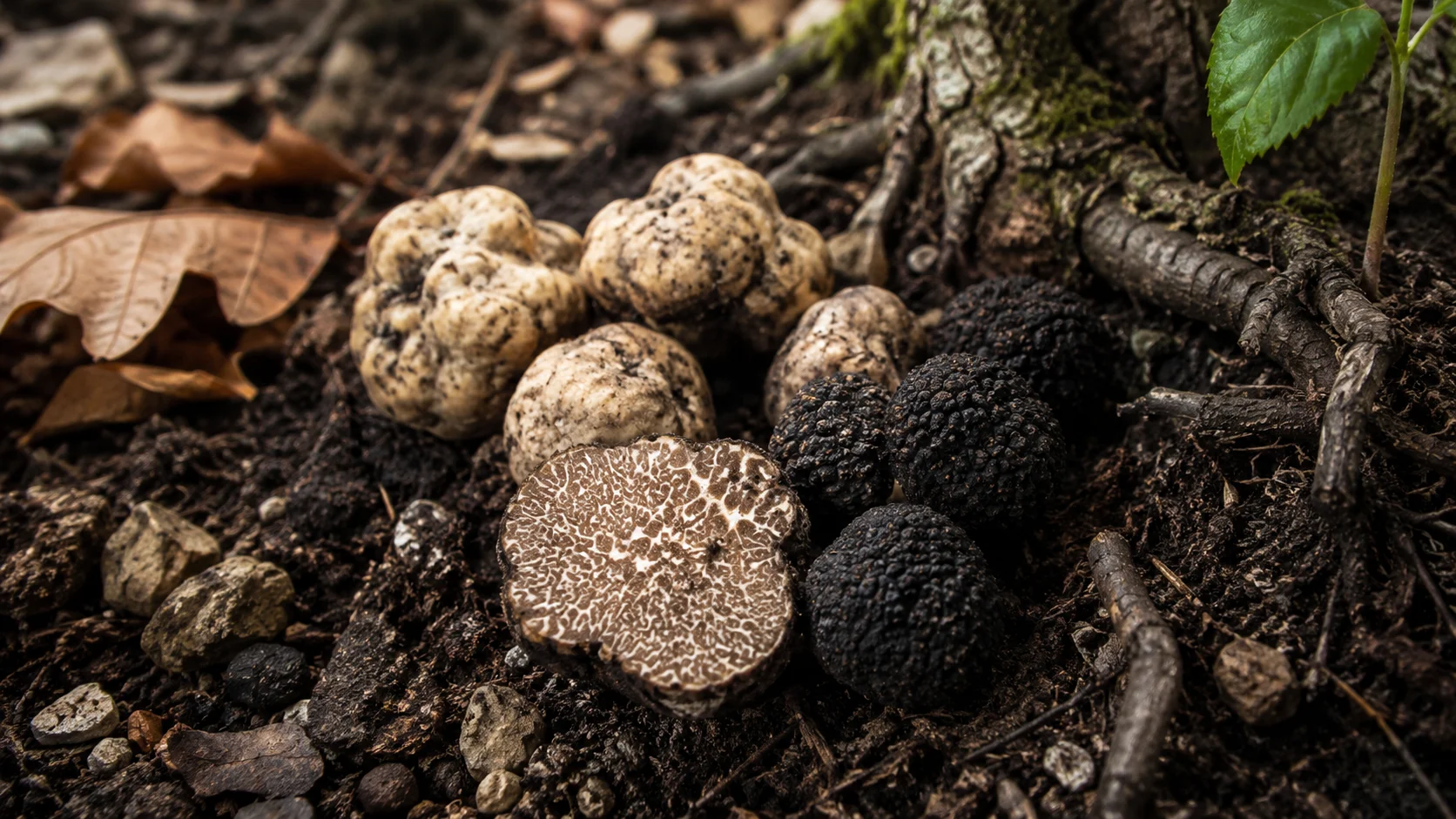
At first glance, a fresh truffle may not look like one of the world’s most prized foods. Most truffles have an irregular, rounded shape with bumps, folds, or rough areas across the surface. Some are fairly smooth, while others have a deeply textured exterior that can make them look more like a small stone than something destined for a restaurant plate.
Their appearance varies considerably depending on the species, growing conditions, soil, age, and size. A truffle may be as small as a marble or grow much larger. Many fall somewhere between the size of a walnut and a small potato, although exceptional specimens can become considerably bigger.
Color is another useful clue. Some varieties have dark brown or nearly black outer skin, while others may appear pale brown, beige, yellowish, or cream colored. Since they develop beneath the ground, freshly harvested truffles are often covered with soil when they are first removed.
This is one reason people learning what is a truffle are sometimes surprised when they finally see one. Truffles do not have the neat stem and cap associated with ordinary mushrooms. Their uneven shapes, earthy colors, and rough surfaces can make them resemble potatoes, stones, or simply lumps of compact soil.
Their modest appearance, however, hides the part that makes them famous. Once a mature truffle is cleaned and cut open, its internal color, pattern, texture, and aroma reveal much more about the variety.
What Does a Truffle Look Like Inside?
The inside of a truffle is usually firm and dense rather than soft and spongy like many familiar mushrooms. When sliced open, many varieties reveal an attractive marbled pattern made up of lighter veins running through darker or paler flesh.
The exact appearance depends heavily on the type of truffle.
White truffles such as Tuber magnatum usually have pale flesh that can range from cream and beige to light brown. Fine white veins often run through the interior, creating a delicate marbled appearance. White truffles are especially associated with areas of northern Italy, including Piedmont.
Black truffles are noticeably darker. A mature black Périgord truffle, known scientifically as Tuber melanosporum, typically has dark flesh marked by fine pale veins. The contrast becomes especially visible when the truffle is sliced thinly. Black Périgord truffles are closely associated with trees including oak and hazelnut.
Summer truffles generally have a lighter interior than some premium winter black varieties. Their flesh may range from pale beige to brown depending on maturity. Burgundy truffles, which are closely related to summer truffles, tend to develop darker and more aromatic flesh as they mature.
Other truffle species can have their own combinations of cream, brown, grey, black, and white coloring. Size, maturity, environment, and species all influence what you see after cutting one open.
The marbled interior is an important part of understanding what is a truffle because it shows how different this underground fungus is from the vegetables or ordinary mushrooms it may resemble from the outside.
How Do Truffles Grow?

To fully understand what is a truffle, you have to look beneath the surface. Literally.
Truffles do not grow independently like potatoes buried in the ground. They are part of a living fungal system connected to the roots of certain trees and plants. This relationship is essential to their development.
The main fungal network exists in the soil as mycelium. This network consists of extremely fine threads called hyphae. These threads spread through the surrounding soil and interact with suitable tree roots. Under the right combination of soil, moisture, climate, tree health, and biological conditions, the fungus can eventually form the underground fruiting body we call a truffle.
This process is one reason truffles can be difficult to cultivate consistently. A grower cannot simply place a truffle in ordinary soil and expect more truffles to appear. The fungus needs a suitable host tree and the right underground environment for the relationship to become established.
Different truffle species also prefer different environments. Members of the genus Tuber often favor well drained soils that are neutral or alkaline, while the exact growing requirements can vary between species.
Understanding how truffles grow makes their rarity much easier to appreciate. What eventually appears on a restaurant plate begins as part of a complicated relationship between fungus, roots, soil, water, nutrients, temperature, and time.
Why Do Truffles Grow Underground?
One of the defining features of a truffle is that its fruiting body develops below the surface of the soil.
Many familiar mushrooms send their fruiting bodies above ground, where their spores can be carried away by air or water. Truffles follow a different strategy. Their reproductive structures remain underground.
The fungus itself spreads through the soil as mycelium. When conditions are suitable and enough resources have accumulated, the fungal network can begin producing a compact fruiting body beneath the ground. That fruiting body gradually develops and matures into what we recognize as a truffle. Research described in the supplied source explains that fungal hyphae colonize suitable roots and, over time, the fungus can accumulate enough resources to form underground fruiting bodies.
Growing underground creates an obvious challenge. The spores inside the truffle cannot simply be released into the wind.
Nature has developed another solution.
As many truffles mature, they produce powerful volatile aromas. These scents can attract animals that are able to locate the hidden fungus. When animals dig up and consume truffles, they can help move fungal spores into new areas. The supplied research notes that animals play an important role in the dispersal of spores from underground truffle fruiting bodies.
This unusual underground lifecycle is central to answering what is a truffle. Its location beneath the soil affects how it grows, how it reproduces, how humans find it, and even why its aroma is so important.
How Truffles Grow With Tree Roots
Truffles and trees have a remarkably close relationship.
The fungus does not simply happen to grow beside a tree. Many truffle fungi depend on compatible plants for their survival and development. Their underground fungal threads establish themselves around the fine roots of suitable host trees.
Common host trees can include oak, hazel, beech, birch, hornbeam, pine, and poplar. Different truffle species may prefer different hosts, which is why experienced growers and hunters pay close attention to the trees growing in an area.
The relationship works because both sides can benefit.
The tree produces carbohydrates through photosynthesis. Some of these resources become available to the fungus. In return, the extensive fungal network can help the tree obtain nutrients from the surrounding soil.
Imagine the tree roots and fungal network as two systems working together underground. The tree provides an energy source, while the fungus extends into areas of soil that the roots alone may not reach as efficiently.
This cooperation helps explain why truffle cultivation is so closely tied to host trees. When people establish truffle orchards, they focus not only on the fungus but also on creating the right conditions for the tree and fungus to form this partnership.
So when asking what is a truffle and how does it grow, the tree cannot be left out of the answer. The underground relationship between fungus and plant is one of the foundations of the truffle lifecycle.
What Is Mycorrhiza?
The scientific name for the close relationship between a fungus and plant roots is mycorrhiza.
The word may sound complicated, but the idea is simple.
Tiny fungal threads called hyphae grow around and interact with the fine roots of a host plant. Together, the fungus and plant create a system through which resources can be exchanged.
The tree provides carbohydrates produced through photosynthesis. These carbohydrates give the fungus an important source of energy. The fungus, meanwhile, helps move nutrients from the soil toward the plant. The supplied research describes this exchange as involving both major nutrients and trace nutrients, with the fungal network playing an important role in accessing material from the surrounding soil.
The relationship is therefore not simply a fungus feeding on a tree. Both organisms can gain something from the partnership.
This underground connection can spread across numerous root tips. As fungal hyphae colonize the root system, the network develops and the fungus continues gathering resources. Eventually, when the biological and environmental conditions are suitable, that network may produce the underground fruiting body known as a truffle.
Mycorrhiza is therefore one of the most important concepts for anyone trying to understand what is a truffle. The valuable fungus that appears in kitchens around the world begins with a far less glamorous but fascinating partnership taking place silently around the roots of a tree.
Which Trees Grow Truffles?
Truffles do not grow successfully with just any tree. They form close underground relationships with particular host species, and the right tree can make a major difference to whether a truffle fungus survives and eventually produces fruiting bodies.
Oak is one of the best known truffle host trees. Several valuable truffle species are strongly associated with oak roots, which is why oak woodland and planted oak orchards are so important in traditional truffle regions.
Hazelnut is another major host. Hazelnut trees are commonly used in managed truffle orchards because their roots can support the fungal partnership needed for truffle development. Black truffles in particular are often associated with oak and hazelnut trees.
Other suitable trees include beech, hornbeam, poplar, birch, pine, and several related woodland species. The source material notes that truffle mycelia can form mycorrhizal relationships with beech, birch, hazel, hornbeam, oak, pine, and poplar.
Not every truffle species prefers exactly the same host. Some perform better with certain trees, while others can associate with a wider range of plants. Climate, soil, and regional conditions also influence which combinations are most successful.
This is important when understanding what is a truffle because a truffle is not simply an isolated fungus sitting underground. Its life is closely connected to the roots of a host tree, and that partnership supports the fungal network that eventually produces the edible fruiting body.
What Soil Do Truffles Need?
Truffles are demanding about where they grow.
Many important culinary truffles prefer soil that drains well, contains suitable minerals, and allows enough air to reach the root zone. Waterlogged soil can create poor conditions for both the tree roots and the fungal network, while soil that is too dry may prevent the fungus from developing properly.
Species within the genus Tuber are commonly associated with calcareous or clay influenced soils that are well drained and tend to be neutral or alkaline.
The mineral balance of the soil matters because the fungus and its host tree depend on the surrounding environment for nutrients. Calcium rich conditions are particularly associated with several famous European truffle producing areas.
Moisture is equally important. Truffles need enough water to support both the fungal network and the host tree, but excessive moisture can be harmful. A successful growing area usually has a balance between rainfall, drainage, soil structure, and seasonal temperature.
Temperature also affects development. Different truffle species prefer different climates, which is one reason certain regions become known for particular varieties. The right combination of warm and cool periods can influence root activity, fungal growth, and the development of the fruiting body.
This helps explain why truffles are not found equally everywhere. A forest may contain suitable trees but still produce few or no truffles if the soil chemistry, moisture, temperature, or drainage is unsuitable.
When asking what is a truffle and where does it grow, the answer always involves more than the fungus itself. The surrounding soil, tree roots, water, temperature, and local environment all work together.
How Long Does It Take for Truffles to Grow?
Truffle development is slow.
There is no single exact amount of time that applies to every truffle because growth depends on the species, the strength of the fungal network, the health of the host tree, the soil, rainfall, temperature, and other environmental conditions.
Before a truffle fruiting body can develop, the fungus first needs to establish itself around suitable tree roots. Its hyphae spread through the soil and begin forming the underground partnership that allows the fungus and tree to exchange resources.
As this network becomes established, the fungus continues gathering energy and nutrients. The source material explains that, over time, the truffle fungus can accumulate enough resources to produce fruiting bodies beneath the soil.
In a cultivated truffle orchard, the wait can be especially long. The research material notes that several years may be required for a strong mycorrhizal network to develop before host trees begin producing truffles.
Even after a productive orchard is established, every season can be different. Rainfall, drought, temperature changes, soil moisture, and tree health may all influence how many truffles form and how well they mature.
This slow and uncertain process is part of the reason truffles are considered valuable. Understanding what is a truffle also means understanding that it is the result of years of biological development rather than a crop that can be produced quickly.
How Do Truffles Reproduce?

Truffles have an unusual reproductive strategy because their fruiting bodies stay underground.
Many ordinary mushrooms release spores into the air from structures above the soil. Wind and rain can then help spread those spores into new areas.
Truffles cannot rely on that system in the same way.
Their fruiting bodies mature beneath the surface, so the spores remain enclosed underground. To overcome this problem, truffles have evolved a relationship with animals that are attracted to their aroma.
As the truffle matures, aromatic compounds become stronger. These scents can travel through the soil and attract animals capable of locating the hidden fungus. Once an animal digs up and eats a truffle, the spores can be moved away from the original location.
This reproduction strategy is one of the most interesting parts of answering what is a truffle. Its famous aroma is not only valuable to chefs and diners. In nature, that smell also plays a role in helping the fungus reproduce.
What Are Truffle Spores?
Truffle spores are tiny reproductive cells that allow the fungus to begin a new stage of its lifecycle.
They are contained inside the underground fruiting body. As a truffle matures, its spores develop and become capable of producing new fungal growth when they eventually reach suitable conditions.
After spores are dispersed, they may remain inactive until the right biological signals and environmental conditions encourage germination. Once germination begins, new fungal threads called hyphae can develop.
Those hyphae search through the soil for suitable host roots. When they reach compatible roots, they can begin forming the mycorrhizal relationship that supports the growing fungal network.
The source material describes spores remaining dormant until conditions associated with suitable host roots trigger germination. From there, hyphae can spread around the root system and eventually contribute to the formation of future fruiting bodies.
This means the spores inside a truffle are not just a minor biological detail. They are essential to the continuation of the fungus.
When people ask what is a truffle, they are looking at the part of the fungus that carries the reproductive material needed to begin another generation.
How Animals Help Truffles Spread
Animals play a surprisingly important role in the truffle lifecycle.
Because truffles develop underground, their spores cannot easily travel on the wind. Instead, mature truffles release strong volatile aromas that can attract animals searching for food.
Rodents, squirrels, deer, and other animals may detect these scents, dig into the soil, and eat the truffle. The source material identifies animals such as squirrels, chipmunks, voles, birds, and deer as possible participants in truffle spore dispersal.
When an animal consumes the fruiting body, spores can pass through its digestive system and later be deposited somewhere else. This gives the fungus an opportunity to spread beyond the area where the original truffle developed.
Some spores may also be moved around while the animal is digging or feeding.
This relationship creates an unusual natural cycle. The truffle produces an aroma strong enough to reveal its hidden location. The animal follows that scent and finds the underground food. In return, the animal helps transport the fungus to new areas.
The thick structure of truffle spores can also help them survive the journey through an animal’s digestive system before they are released back into the environment.
So the strong aroma associated with what is a truffle has a purpose far beyond making pasta or risotto smell incredible. In the wild, scent is part of the reproductive strategy that helps truffles survive and spread from one generation to the next.
Why Do Truffles Smell So Strong?

Aroma is one of the first things people notice when they discover what is a truffle. Fresh truffles can smell surprisingly powerful for such a small ingredient. Their scent may fill a kitchen within minutes of being opened, sliced, or shaved.
That intensity comes from volatile compounds naturally produced by the truffle and the microorganisms associated with it. These compounds move easily through the air, which is why the aroma can reach your nose before you even taste the truffle. Different species contain different combinations of aromatic compounds, so there is no single smell that describes every truffle.
The strong aroma also has an important purpose in nature.
Truffles develop underground, which creates a challenge when it is time to spread their spores. Unlike many mushrooms growing above the ground, truffles cannot rely mainly on wind to carry reproductive material away.
Instead, a mature truffle produces a scent that can attract animals. Rodents, squirrels, deer, and other animals may detect the aroma beneath the soil, dig up the truffle, and eat it. The spores can then be carried away and deposited somewhere else, helping the fungus spread.
In other words, the powerful smell that makes truffles so attractive in a restaurant also helps them survive in the wild.
Understanding this relationship adds another layer to the question what is a truffle. Its aroma is not simply a luxury characteristic created for our enjoyment. It is part of the fungus’s natural reproductive strategy.
What Does a Truffle Smell Like?
Describing the smell of a truffle is difficult because it combines several aromas at once.
People commonly describe fresh truffles as earthy, musky, garlicky, savory, nutty, woody, and forest like. Some varieties can have hints that remind people of damp soil, fallen leaves, mushrooms, garlic, cheese, nuts, or even something slightly sweet.
That may sound like an unusual combination, and it is. Truffle aroma is complex rather than clean and simple.
A good way to imagine it is to think about walking through a damp forest after rain. There is the smell of soil, leaves, wood, moisture, and mushrooms all mixing together. A truffle can have some of those deep earthy qualities, but usually with additional savory and aromatic notes that make it much more intense.
Not every truffle smells the same.
White truffles are generally known for an especially powerful and penetrating aroma. Their scent can include garlicky, musky, earthy, and slightly sharp characteristics.
Black truffles usually have a deeper and more rounded fragrance. Depending on the species and maturity, the aroma may seem earthy, woody, nutty, chocolaty, or pleasantly musky.
Summer truffles generally have a softer aroma compared with highly prized winter varieties.
Location, species, maturity, soil, climate, and storage can all influence what a truffle smells like. The source material also explains that different truffle species have different combinations of sulfur compounds, alcohols, and other volatile substances that contribute to their individual aroma profiles.
So if someone asks what is a truffle supposed to smell like, there is no single perfect description. The experience is usually a combination of earthiness, muskiness, savory depth, and an unmistakable aroma that separates fresh truffles from ordinary mushrooms.
What Do Truffles Taste Like?

Truffles taste earthy, savory, rich, and deeply aromatic, but their flavor is difficult to describe with one word.
This is because much of what people experience as truffle flavor actually comes from aroma. When you eat a fresh truffle, its volatile compounds reach your nose while you chew. The combination of taste and smell creates the distinctive experience people associate with truffles.
Some people describe the flavor as earthy and mushroom like. Others notice garlic, nuts, wood, cheese, or deep savory notes. Depending on the variety, a truffle may taste delicate and elegant or much stronger and more intense.
What makes truffle flavor particularly interesting is how much impact a small amount can have. A few thin slices over warm pasta, eggs, potatoes, or risotto can add a noticeable aroma to the entire dish.
This is why chefs rarely treat fresh truffle like an ordinary ingredient. Instead of adding large quantities, they often use a small amount to finish a simple dish.
When learning what is a truffle, it helps to understand that its reputation comes from the combination of taste and scent. The aroma is often more powerful than the flavor you experience directly on the tongue.
Are Truffles Earthy?
Yes, earthiness is one of the most common characteristics associated with truffles.
Fresh truffles grow completely underground, surrounded by soil, roots, moisture, and organic material. Their aroma and flavor often seem to reflect that environment.
But calling a truffle simply earthy does not fully describe it.
An ordinary mushroom may also taste earthy, yet fresh truffle can have several additional layers. Depending on the variety, you might notice savory, nutty, woody, garlicky, musky, or slightly sweet qualities.
That complexity is important.
Someone trying a fresh truffle for the first time may expect something that tastes like a stronger version of a supermarket mushroom. The actual experience can be very different. Truffles can be more aromatic, more concentrated, and sometimes much stranger than expected.
The earthy quality works particularly well with mild foods because those dishes allow the aroma to remain noticeable rather than competing with it.
So while earthiness is certainly part of what is a truffle from a culinary perspective, it is only the beginning of the flavor story.
Are Truffles Umami?
Truffles are widely appreciated for their deep savory character, which is why people often associate them with umami.
Umami is the satisfying savory taste commonly experienced in foods such as mushrooms, aged cheese, meat, and certain fermented ingredients. Truffles can contribute a similar sense of richness to food, especially when their strong aroma combines with naturally savory ingredients.
This is one reason truffles work beautifully with relatively simple dishes.
Eggs are a classic example. Their mild richness creates a neutral background that allows truffle aroma to stand out.
Pasta works for the same reason. Butter, cheese, and warm pasta provide richness without overwhelming the truffle.
Risotto, potatoes, cream, and mild cheeses can also carry truffle flavor extremely well.
Fat is particularly useful because many aromatic compounds associated with truffles interact well with ingredients such as butter, cream, and cheese. The supplied source notes that truffle compounds pair effectively with fatty foods and that fresh truffles are often shaved over warm, simple dishes such as pasta and eggs.
That combination creates a powerful effect. The truffle contributes aroma and savory depth while the food underneath gives those flavors somewhere to settle.
This is why understanding what is a truffle also means understanding how it is used. Truffles do not always need complicated recipes. In many cases, simpler food gives them more room to shine.
Do White and Black Truffles Taste Different?
Yes. White and black truffles can offer noticeably different experiences.
White truffles are generally valued for an extremely intense aroma. Their fragrance may seem sharp, garlicky, earthy, musky, and deeply savory. Because their aroma is so delicate and volatile, they are commonly shaved raw over warm food rather than subjected to prolonged cooking.
Their flavor can seem almost secondary to their fragrance. As the thin slices warm over pasta, risotto, eggs, or another dish, the aroma becomes a major part of what you experience.
Black truffles tend to have a deeper, darker, and more rounded character. Depending on the species, maturity, and growing conditions, people may notice earthy, woody, nutty, mushroom like, and savory qualities.
Black truffles can also work differently in cooking because their aroma is often treated as slightly more robust than that of premium white truffles.
The important point is that neither variety has one fixed flavor.
Species, maturity, location, freshness, and preparation all affect the final experience. Even two truffles of the same general type can have differences in aroma and intensity.
So when exploring what is a truffle, it is better to think of truffles as a family of distinctive underground fungi rather than one ingredient with one predictable taste. White and black varieties share the unmistakable depth that makes truffles famous, but each can bring a very different personality to the plate.
What Are the Main Types of Truffles?
Once you understand what is a truffle, the next thing to know is that truffles are not one single ingredient. There are many species of underground fungi called truffles, and each can differ in color, aroma, flavor, growing region, season, and culinary value.
Some varieties are famous around the world and command extremely high prices. Others are more accessible and have gentler flavors that work well in everyday cooking.
White truffles and Black Périgord truffles are among the most celebrated varieties in European cuisine, while summer and Burgundy truffles offer different seasonal characteristics. There are also whitish truffles and several commercially important species native to North America.
The type matters because a strong white truffle and a mild summer truffle can create very different experiences on the plate. Understanding these varieties gives a much clearer answer to what is a truffle and why chefs treat different species differently.
White Truffles
White truffles are among the most prestigious and recognizable truffles in the culinary world.
The famous Italian white truffle is scientifically known as Tuber magnatum. It is strongly associated with northern Italy, particularly the Piedmont region. Important areas include Langhe and Montferrat, with the countryside around Alba and Asti especially famous for white truffles. White truffles are also found in other Italian regions, including Molise.
From the outside, a white truffle does not necessarily look bright white. Its surface may appear cream, beige, yellowish, light brown, or slightly golden depending on the specimen and surrounding soil. Inside, the flesh is generally pale with fine veins that create the familiar marbled truffle pattern.
The real attraction is the aroma.
A mature white truffle can produce an extremely powerful fragrance. Depending on the individual truffle, people may notice earthy, garlicky, musky, savory, and slightly sharp notes. The aroma can become noticeable throughout a room even before the truffle reaches the plate.
Because fragrance is such an important part of its appeal, white truffle is usually treated with care. Rather than being heavily cooked, it is commonly shaved in very thin slices over warm dishes. Pasta, risotto, eggs, and other relatively simple foods provide a gentle base that allows the truffle aroma to remain the main attraction.
White truffles also have an important cultural connection to Italian food. Alba in Piedmont has become particularly famous for its association with premium white truffles, helping turn the ingredient into a symbol of luxury Italian dining.
For someone asking what is a truffle at its most luxurious, the Italian white truffle is often the variety they have in mind.
Black Périgord Truffles
The Black Périgord truffle is another major name in the world of fine food.
Scientifically known as Tuber melanosporum, it takes its common name from the Périgord region of France. The supplied research describes it as one of the most commercially valuable truffle species and notes its close association with trees such as oak, hazelnut, cherry, and other deciduous species. It is generally harvested during late autumn and winter.
Its appearance is noticeably darker than that of the famous Italian white truffle. The exterior can be dark brown to nearly black and often has a rough, textured surface. When cut open, mature specimens typically reveal dark flesh crossed by lighter veins.
Its aroma is strong but different from that of a white truffle.
Black Périgord truffles are commonly associated with deep earthy, woody, savory, and sometimes nutty aromas. Their character can feel richer and rounder than the sharper fragrance associated with premium white truffles.
This makes them extremely useful in cooking. Black truffles can complement eggs, butter, cream, potatoes, poultry, pasta, sauces, and many other dishes without requiring complicated preparation.
They hold an especially important place in French cuisine, although their reputation extends far beyond France. Black Périgord truffles are cultivated and enjoyed across several European regions and have also been successfully grown outside Europe.
If someone asks what is a truffle in classic French cooking, Tuber melanosporum is one of the most important answers.
Summer Truffles
Summer truffles provide a gentler introduction to the truffle world.
The black summer truffle is known scientifically as Tuber aestivum. It occurs across Europe and is valued as an edible culinary truffle.
Its exterior is generally dark and textured, so from the outside it can resemble other black truffles. The interior, however, is often lighter, especially when compared with a fully mature Black Périgord truffle.
The aroma and flavor of summer truffles are usually softer as well.
Instead of delivering the intense fragrance associated with premium white or winter black truffles, summer truffles tend to offer a milder combination of earthy, mushroom like, nutty, and savory qualities.
That softer personality can actually be useful in the kitchen.
Summer truffles can work well for people who want truffle character without an extremely dominant aroma. They can be shaved over pasta, eggs, potatoes, salads, or other dishes where a lighter truffle presence is desirable.
They also help demonstrate why the question what is a truffle does not have one flavor based answer. Two truffle species may look somewhat similar but offer noticeably different levels of aroma and intensity.
Burgundy Truffles
Burgundy truffles are closely connected to summer truffles.
They have traditionally been referred to as Tuber uncinatum, although the supplied research treats Burgundy truffles as the same species as Tuber aestivum. Burgundy truffles are typically harvested during autumn and into December, and their flesh tends to become darker and more aromatic.
This later seasonal development helps give Burgundy truffles a character that can feel richer than the lighter summer form.
Their aroma is still generally less aggressive than the most powerful Italian white truffles, but mature Burgundy truffles can provide a pleasing earthy and savory fragrance with more noticeable depth.
Their interior often shows a beautiful marbled pattern, with darker flesh crossed by pale veins.
In cooking, Burgundy truffles can work with many of the same foods that complement other varieties. Eggs, pasta, potatoes, butter, cream, and mild cheeses are natural partners because they give the truffle aroma space to come through.
The difference between summer and Burgundy truffles also shows how season and maturity can influence the answer to what is a truffle supposed to taste and smell like. Even closely related truffles can develop noticeably different culinary personalities.
Whitish Truffles
The whitish truffle, scientifically known as Tuber borchii, is another edible species associated strongly with Italy.
According to the supplied research, Tuber borchii occurs in Italian regions including Tuscany, Abruzzo, Romagna, Umbria, Marche, and Molise. It resembles other white truffles but is generally considered less aromatic than the celebrated white truffles associated with Piedmont.
Its exterior can range through pale beige, brown, and cream tones. Because it shares some visual characteristics with more expensive white truffles, identifying the exact species can be important when buying fresh truffles.
The aroma can still be distinctive, but it usually does not have the same reputation for overwhelming intensity as Tuber magnatum.
That does not make it uninteresting.
Whitish truffles provide another example of the diversity found within edible truffles. Their fragrance and culinary potential can still make them valuable ingredients, even if they occupy a different place in the market from the famous Alba white truffle.
For readers researching what is a truffle, Tuber borchii is useful because it shows why the words white truffle can sometimes refer to more than one kind of underground fungus. Knowing the scientific species helps distinguish one truffle from another.
Oregon and American Truffles
Europe may dominate the popular image of truffles, but North America also has its own important native varieties.
The Pacific Northwest, particularly Oregon, is home to several truffle species that are harvested for culinary use. These include the Oregon black truffle, Leucangium carthusianum, the Oregon spring white truffle, Tuber gibbosum, and the Oregon winter white truffle, Tuber oregonense. The Oregon brown truffle, Kalapuya brunnea, has also been commercially harvested.
Oregon white truffles have attracted growing culinary interest because of their distinctive aroma and regional identity. Their existence also challenges the common assumption that valuable culinary truffles come only from Italy and France.
Another notable American species is the pecan truffle, Tuber lyonii. It occurs in the southern United States and is commonly associated with pecan trees. It has become a culinary ingredient in its own right rather than simply an underground fungus discovered accidentally around pecan orchards.
European truffles are also cultivated in parts of the United States. For example, the supplied research records commercial attempts to grow Black Périgord truffles in states such as Tennessee, showing that American truffle production includes both native species and imported European varieties.
American truffles therefore add another dimension to what is a truffle. Truffles are not exclusively European delicacies. Different underground fungi occur naturally in North America, and several have developed genuine culinary and commercial importance of their own.
Desert Truffles and Other Truffle Like Fungi
The word truffle is often associated with famous species from the genus Tuber, but not every underground fungus called a truffle belongs to that group.
Several other fungi produce underground fruiting bodies that resemble true truffles in shape, growth habit, or culinary use.
Desert truffles are a good example.
The name is commonly used for underground fungi from genera such as Terfezia and Tirmania. These fungi are especially associated with parts of Africa and the Middle East. They grow beneath the soil and can be collected for food, but they are biologically different from the famous European truffles such as Tuber magnatum and Tuber melanosporum.
There are also other truffle like fungi from genera such as Geopora, Rhizopogon, and others. Some create underground fruiting bodies and form relationships with plant roots in ways that resemble more familiar culinary truffles.
This is why the answer to what is a truffle can become broader depending on whether the word is being used in a culinary or scientific sense.
In fine dining, people usually mean highly valued edible species such as white truffles, black Périgord truffles, summer truffles, or Burgundy truffles. In biology, however, the term can also describe a wider range of underground fungi with similar growth patterns.
White Truffle vs Black Truffle

White and black truffles are both prized ingredients, but they are not simply different colors of the same thing.
They can differ in appearance, aroma, flavor, season, growing region, cooking style, and rarity.
When people search what is a truffle, these two varieties are often the ones they are most curious about because they dominate the luxury food conversation.
White truffles, especially Tuber magnatum, are strongly associated with northern Italy. Piedmont, Alba, Asti, and nearby areas are particularly famous for them. Their outer color can range from cream and pale beige to yellowish or light brown. Inside, the flesh is generally pale with fine veins.
Black Périgord truffles, or Tuber melanosporum, have a much darker appearance. Their exterior is usually dark brown or black with a rough surface, while the interior develops dark flesh crossed by pale veins. They are especially associated with France and the Périgord region.
The aroma is one of the biggest differences.
White truffles are famous for an intense fragrance that can seem garlicky, musky, earthy, sharp, and deeply savory. Their scent can be extremely powerful even when only a small amount is used.
Black truffles generally have a darker and rounder aroma. People often describe them as earthy, woody, nutty, musky, and savory.
Flavor also differs.
White truffles tend to deliver much of their impact through aroma. Their flavor is delicate but highly distinctive, which is why they are often shaved raw over warm food.
Black truffles can have a more robust savory character and are sometimes used in dishes where they are allowed to warm gently with other ingredients.
Season also separates the two.
Premium white truffles are strongly associated with the cooler part of the year, while Black Périgord truffles are generally harvested in late autumn and winter.
Their locations are different as well.
White truffles are especially famous in Italy, particularly Piedmont. Black Périgord truffles have a historic connection with France, although they are also cultivated in other European countries and beyond.
In the kitchen, white truffles are usually treated as a finishing ingredient. Chefs shave them over eggs, risotto, pasta, or other warm foods shortly before serving.
Black truffles can also be shaved fresh, but they are often considered more flexible in cooking and can work in sauces, butter, cream, poultry, pasta, and other rich dishes.
Relative rarity also affects price and reputation.
Both are luxury foods, but top quality white truffles can be especially difficult to source and are among the most celebrated truffles in the world.
So if you are comparing the two while learning what is a truffle, think of white truffles as intensely aromatic and delicate, while black truffles generally offer a deeper and more rounded character.
Where Do Truffles Grow?

Truffles do not grow everywhere that mushrooms grow.
They need particular combinations of soil, climate, moisture, host trees, and underground fungal conditions. This is why some regions become famous for truffles while other places with similar looking forests produce very few.
Many truffles grow in association with trees such as oak, hazelnut, beech, hornbeam, pine, and poplar. The fungus forms a close underground relationship with the roots, and the surrounding soil must also provide suitable drainage, minerals, moisture, and temperature.
This means understanding what is a truffle also involves understanding geography.
Some regions have become internationally recognized because their ecosystems are especially suitable for certain species.
Truffles in Italy
Italy is one of the countries most strongly associated with truffles.
Piedmont in northern Italy is especially famous for white truffles. The region includes important areas such as Langhe and Montferrat, while Alba and Asti have become closely linked with Tuber magnatum.
Alba in particular has built an international reputation around white truffles. The combination of suitable soil, trees, climate, and long local tradition has made the area one of the best known truffle destinations in the world.
Tuscany is also an important Italian truffle region. It produces several types of truffles, including whitish truffles such as Tuber borchii. Other Italian areas associated with this species include Abruzzo, Romagna, Umbria, Marche, and Molise.
Molise is also significant because part of Italy’s white truffle supply comes from the region.
Italy therefore offers much more than one famous truffle.
Different parts of the country produce different species during different seasons, which has helped truffles become deeply connected with Italian regional cuisine.
For someone asking what is a truffle in Italian food, the answer often begins with Piedmont and Alba but quickly expands into a much wider national tradition.
Truffles in France
France has an equally important relationship with truffles, especially black varieties.
The Black Périgord truffle takes its name from the Périgord region of France. Scientifically known as Tuber melanosporum, it has long been associated with French cooking and truffle culture.
Black truffles grow in partnership with suitable trees, especially oak and hazelnut, under the right soil and climate conditions.
France also has a long history of truffle cultivation.
Growers learned that trees associated with truffle producing environments could be planted in suitable soil to encourage future production. Over time, managed truffle orchards became an important part of the French truffle industry.
That long relationship between land, farming, hunting, and cuisine helped make black truffle one of the most famous ingredients in French gastronomy.
Today, when people think about what is a truffle in French cuisine, the Black Périgord truffle is often the first example that comes to mind.
Truffles in Spain
Spain is another major European truffle producing country.
Its suitable climates, limestone rich soils, and large areas of host trees make certain parts of the country well suited to black truffle cultivation.
Black Périgord truffles are especially important in Spanish truffle farming. Managed orchards use host trees and carefully controlled growing conditions to encourage the development of Tuber melanosporum.
Water management can be particularly important.
Research included in the supplied material discusses the relationship between irrigation, host tree growth, and black truffle cultivation in Spain, showing how carefully managed environmental conditions can influence production.
Spain demonstrates that truffle production is not limited to regions that became famous historically.
Modern cultivation techniques have allowed suitable areas to become significant producers when soil, trees, moisture, and climate align.
Truffles in the United States
The United States has both native truffles and cultivated European varieties.
Oregon is particularly important because several native culinary truffle species grow in the Pacific Northwest.
These include the Oregon black truffle, Leucangium carthusianum, Oregon spring white truffle, Tuber gibbosum, Oregon winter white truffle, Tuber oregonense, and Oregon brown truffle, Kalapuya brunnea.
The southern United States is also home to the pecan truffle, Tuber lyonii, which commonly grows in association with pecan trees.
At the same time, growers in the United States have experimented with cultivating famous European species.
Black Périgord truffles have been farmed in states such as Tennessee, while truffle projects have also developed in places including California, North Carolina, Oregon, and Arkansas.
American truffle production therefore includes two different stories.
One is the growing recognition of native truffles. The other is the effort to reproduce suitable European truffle growing conditions in American orchards.
Both are helping expand the meaning of what is a truffle beyond the traditional regions of France and Italy.
Truffles in Australia and New Zealand
Truffle cultivation has also expanded successfully into the Southern Hemisphere.
New Zealand was one of the early countries outside Europe to establish commercially important truffle production. The supplied research notes that the first Black Périgord truffles produced in the Southern Hemisphere were harvested in Gisborne, New Zealand, in 1993.
New Zealand has also produced Burgundy truffles, showing that more than one European truffle type can adapt to carefully managed conditions there.
Australia followed with its own growing truffle industry.
The first Australian truffles were harvested in Tasmania in 1999 after years of work establishing trees inoculated with truffle fungus. Production later expanded into colder areas of Victoria, New South Wales, and Western Australia.
The Australian industry is especially associated with cultivated Black Périgord truffles.
These developments show that geography still matters enormously, but famous truffle species are no longer limited to their traditional European homes.
With the right host trees, suitable soil, careful management, irrigation, and an appropriate climate, truffle cultivation can succeed in other parts of the world.
That makes the answer to what is a truffle and where does it grow far more global than it once was.
How Are Truffles Found?
Finding truffles is very different from picking ordinary mushrooms. A mushroom growing above the soil can be spotted while walking through a forest. A truffle stays hidden underground, often close to the roots of trees, so simply looking at the ground is rarely enough.
This is another reason understanding what is a truffle is so interesting. A mature truffle may be sitting just beneath the soil while giving almost no visible clue that it is there.
Truffle hunters therefore rely on several things at once. They need knowledge of suitable land, the right host trees, soil conditions, the local truffle season, and the scent produced by mature truffles.
The aroma is particularly important. As truffles mature, they release volatile compounds that can travel through the surrounding soil. Animals with a highly developed sense of smell can detect these scents much more effectively than humans.
This is why trained dogs have become such an important part of modern truffle hunting.
How Truffle Hunting Works
A truffle hunt normally begins long before anyone starts digging.
The first step is finding land where truffles are likely to grow. Hunters look for suitable soil, the right climate, and host trees such as oak, hazelnut, beech, hornbeam, or other species known to form relationships with truffle fungi.
Experienced hunters also understand which truffle species occur in their region and when those species are likely to mature.
Once a promising area has been identified, a trained dog is usually brought in to search.
The dog moves through the area smelling the ground around likely host trees. A mature truffle releases aromatic compounds beneath the soil, and a properly trained dog can recognize the scent.
When the dog detects something, it signals the location to the hunter. Depending on its training, the dog may stop, scratch lightly at the soil, or show another learned behavior.
The hunter then examines the spot and begins digging carefully.
This part matters.
The goal is not simply to pull the truffle out as quickly as possible. The surrounding soil contains fungal mycelium and delicate tree roots that are important for future truffle development. Excessive digging can disturb this underground system.
The truffle is therefore uncovered gradually and removed with care. The soil is often returned to the opening afterward to reduce unnecessary disturbance.
Once collected, the truffle can be cleaned of excess soil and inspected for maturity, aroma, firmness, condition, and quality.
The supplied research confirms why scent based searching is so important. Because truffles are subterranean, animals with an excellent sense of smell have traditionally been used to locate them.
This careful process helps explain what is a truffle hunting experience really like. It is not simply wandering into a forest and digging randomly. Successful hunting combines knowledge of fungi, trees, soil, seasons, animal behavior, and the local environment.
Why Dogs Are Used to Find Truffles
Dogs are widely used for truffle hunting because their sense of smell allows them to detect mature truffles hidden beneath the soil.
Humans may be able to smell a fresh truffle once it has been removed from the ground, but identifying exactly where one is buried is much harder.
A trained dog can search a much larger area and focus on the scent released by mature truffles.
Training usually teaches the dog to associate truffle aroma with a reward. Over time, the animal learns to recognize that particular scent and indicate its location to the hunter.
One of the major advantages of dogs is control.
A trained dog can locate the truffle without necessarily trying to eat it. The research provided for this article notes that dogs can be trained to find underground fruiting bodies and are easier to manage because they do not have the same strong desire to consume the truffle once it is found.
Dogs can also work closely with their handlers. Instead of aggressively digging through the soil, a properly trained truffle dog can simply identify the location and allow the human hunter to uncover the truffle carefully.
Different dog breeds can be trained for the job. The Lagotto Romagnolo is particularly famous for truffle hunting, but the most important qualities are usually a strong sense of smell, good training, concentration, and a willingness to work with the handler.
Dogs therefore solve one of the biggest challenges involved in understanding what is a truffle and how people obtain one. The fungus stays invisible underground, but its aroma gives a trained animal a way to find it.
Were Pigs Used to Hunt Truffles?
Yes. Pigs have a long history in traditional truffle hunting.
Their powerful sense of smell allows them to detect truffles beneath the soil, and pigs do not necessarily require the same kind of scent training as dogs to become interested in them.
Female pigs became particularly associated with traditional truffle hunting because they are naturally attracted to certain compounds connected with truffle aroma.
The problem is that pigs are not always satisfied with simply locating the prize.
Once a pig finds a truffle, it may immediately begin digging and trying to eat it. That creates two practical problems.
First, the hunter may have to compete with a strong and enthusiastic animal for an expensive truffle.
Second, aggressive digging can damage the soil, tree roots, and underground fungal network.
The supplied research notes that pigs were traditionally used to locate truffles but that dogs provide a practical advantage because they can be trained to identify the location without having the same strong desire to eat what they find. It also states that pig based truffle hunting has been prohibited in Italy since 1985 because digging could damage truffle mycelium and reduce later production.
That helps explain why the romantic image of a truffle hunter walking through the forest with a pig no longer represents most modern hunting.
Today, dogs are generally the more practical partner.
When Is Truffle Season?
There is no single truffle season that applies to every species.
Different truffles mature during different parts of the year, and harvesting periods can also vary according to country, region, weather, elevation, and local regulations.
This is important when answering what is a truffle because seasonality is part of what makes fresh truffles different from ordinary ingredients that are available almost continuously.
A truffle needs time to mature underground. Harvesting it too early can mean weaker aroma and poorer culinary quality. Hunters therefore pay close attention to the natural cycle of the particular species they are seeking.
White truffles are strongly associated with autumn. Black Périgord truffles are harvested later, mainly from late autumn through winter. Summer truffles appear during the warmer part of the year, while Burgundy truffles are associated with autumn and can continue into December.
The exact calendar should always be treated as regional rather than universal.
White Truffle Season
White truffles, especially Tuber magnatum, are closely associated with the autumn truffle season in Italy.
This is the period when famous regions such as Piedmont become major destinations for truffle hunters, chefs, buyers, and food lovers seeking fresh white truffles.
Alba and the surrounding Piedmont countryside are particularly famous for Tuber magnatum. The supplied research identifies Langhe, Montferrat, Alba, and Asti among the important areas connected with this high value white truffle.
The exact legal harvesting dates can differ according to location, so it is better to think of white truffle season as a regional autumn window rather than one fixed worldwide calendar.
Weather can also influence individual seasons.
Rainfall, soil moisture, temperature, and tree health all affect the underground environment where truffles develop. A season with favorable conditions may produce different quantities and quality from a dry or unusually warm year.
This limited seasonal availability contributes to the excitement surrounding fresh white truffles. Restaurants and markets may have only a relatively short period in which truly fresh specimens are available.
Black Truffle Season
Black Périgord truffles belong more firmly to the colder months.
Tuber melanosporum is generally harvested in late autumn and winter. The supplied research specifically places its harvest during this cooler period and notes its close relationship with trees including oak and hazelnut.
This winter association is one reason black truffles appear so naturally in rich seasonal dishes.
Warm pasta, eggs, potatoes, cream, butter, poultry, and sauces all provide the kind of simple but comforting foundation that works well with the deep aroma of mature black truffle.
Again, exact dates depend on location.
A Black Périgord truffle grown in France will follow the Northern Hemisphere seasonal cycle, while the same species cultivated in Australia develops during the opposite part of the calendar because seasons are reversed in the Southern Hemisphere.
So when people ask what is a truffle season for black truffles, the most useful answer is not one fixed month. It is the mature period of the species within its particular growing region, usually centered on the colder season.
Summer and Burgundy Truffle Seasons
Summer and Burgundy truffles help demonstrate just how much truffle seasons can vary.
The summer truffle, Tuber aestivum, is associated with the warmer portion of the year and is found across Europe. Its aroma is generally gentler than that of highly prized winter black or Italian white truffles.
Burgundy truffles are closely related to the summer form but mature later.
The supplied research identifies Burgundy truffles with Tuber uncinatum, while treating them as the same species as Tuber aestivum. It states that Burgundy truffles are harvested during autumn and can continue until December. Their mature flesh also becomes darker and more aromatic.
This creates a useful seasonal progression.
Summer truffles represent the warmer season. Burgundy truffles extend the Tuber aestivum family into autumn and early winter. Black Périgord truffles become important in the colder months, while prized white truffles have their own concentrated autumn period.
That changing calendar is part of the attraction of learning what is a truffle. There is not one truffle appearing throughout the year. Different species arrive at different moments, each bringing its own aroma, flavor, and place in the cooking season.
Can Truffles Be Farmed?
Yes, truffles can be farmed, but growing them is nothing like planting potatoes, tomatoes, or most other crops.
Wild truffles develop naturally in forests and woodland areas where the right fungus, host trees, soil, moisture, and climate already exist together. Truffle hunters search these areas and use trained dogs to locate mature fruiting bodies beneath the soil.
Cultivated truffles come from specially managed truffle orchards. Instead of waiting for nature to create the right conditions by chance, farmers try to build an environment where truffle fungi can establish a successful relationship with host trees.
That still does not guarantee a harvest.
A farmer may prepare suitable soil, plant carefully selected trees, manage irrigation, protect the orchard, and wait for years before discovering whether the underground fungal network will produce valuable truffles.
Research into truffle cultivation has allowed plantations to develop in countries including France, Italy, Spain, Australia, New Zealand, and the United States. Cultivated orchards now contribute significantly to the supply of some truffle species.
The difference between wild and farmed truffles is therefore mainly about how the growing environment is established and managed. Wild truffles appear within naturally suitable ecosystems. Farmed truffles grow in orchards deliberately designed to reproduce many of those same biological conditions.
For anyone learning what is a truffle, this distinction is important. Humans can encourage truffle production, but they cannot control it as easily as a normal agricultural crop.
How Truffle Farms Work
A truffle farm usually begins with the trees rather than the truffles themselves.
Farmers choose host species that can form the required relationship with the desired truffle fungus. Oak and hazelnut are among the most common choices for Black Périgord truffle cultivation, although other trees may be suitable depending on the species.
Young trees can be inoculated so that their roots become associated with the selected truffle fungus.
The goal is to establish mycorrhiza, the underground partnership between fungal hyphae and tree roots. If that relationship develops successfully, the fungal network can gradually spread through the soil around the tree.
But planting an inoculated tree is only the beginning.
Soil conditions must also be suitable. Many valuable Tuber species prefer well drained soil with the appropriate mineral balance and pH. Farmers may analyze the soil before planting to determine whether it can support the desired fungus.
Water management is another major consideration.
Trees and fungal networks need adequate moisture, especially during important stages of development, but excessive water can create problems. In drier truffle growing regions, controlled irrigation may be used to maintain more favorable conditions.
Research referenced in the supplied material specifically identifies irrigation and orchard management as important parts of emerging black truffle cultivation.
Farmers must also manage competing vegetation, protect trees from disease, watch soil conditions, maintain the orchard, and sometimes protect the land from animals such as wild boars.
Then comes the hardest part.
They wait.
The underground fungal network needs years to establish itself before the orchard may begin producing commercial quantities of truffles.
A successful truffle farm is therefore less like planting an ordinary crop and more like building an ecosystem.
Why Growing Truffles Is Difficult
One of the biggest misconceptions about truffles is that farmers can simply bury pieces of truffle in the ground and wait for more to grow.
It does not work that way.
To understand why, return to the basic question what is a truffle.
The truffle we eat is only the fruiting body of a much larger underground fungus. The important part of the organism is the network of mycelium living throughout the soil and interacting with the roots of suitable trees.
For successful cultivation, the fungus must establish the correct relationship with its host.
That means farmers need suitable trees, compatible fungal material, appropriate soil chemistry, good drainage, adequate moisture, favorable temperatures, and years of successful underground development.
Even when all of those conditions appear correct, other fungi can compete with the desired truffle species.
The quality of inoculated trees therefore matters enormously. The supplied research describes quality control of mycorrhizal plants and careful soil analysis as critical parts of successful truffle cultivation.
Weather creates another layer of uncertainty.
Rainfall may be too low during one part of the growing cycle. Temperatures may become unusually high. Soil moisture can change. Host trees can suffer from disease or stress.
A farmer cannot completely control these conditions.
This explains why growing truffles remains difficult even after centuries of experimentation. Modern growers understand far more about the relationship between fungi, trees, soil, and water, but a truffle orchard is still not guaranteed to produce a profitable harvest.
How Long Does a Truffle Orchard Take to Produce?
Patience is one of the most important ingredients in truffle farming.
A newly planted orchard generally does not begin producing valuable truffles the following year. The trees first need to become established, and the fungus needs time to develop a strong mycorrhizal network around their roots.
The research provided for this article states that roughly seven to ten years may be needed for the truffle fungus to develop its mycorrhizal network before the host plants move into meaningful production.
That is a long wait for any agricultural investment.
During those years, the farmer still has work to do. Trees need care. Soil conditions need monitoring. Irrigation may be required. Competing vegetation and fungi need management. Wildlife may need to be kept away.
And after all that effort, success is still not certain.
Some orchards eventually produce excellent crops. Others produce only small quantities. Some may struggle to establish the intended fungus at all.
Australia offers a useful example of the patience involved. The supplied research notes that Australia’s first truffles were harvested in Tasmania in 1999 after eight years of work establishing inoculated trees and developing the local industry.
This long timeline is another reason the answer to what is a truffle cannot be separated from rarity and price. Years of investment can pass before a grower knows whether the orchard will deliver the valuable underground crop.
Why Are Truffles So Expensive?
Truffles are expensive because almost everything about producing and selling them is difficult.
They grow underground. They depend on specific trees. They require particular soil conditions. They take years to establish. Harvests are seasonal. Mature truffles need to be located individually. Fresh aroma fades with time. Premium species are limited in supply, while restaurants and food lovers around the world compete for the best examples.
No single factor creates the high price.
It is the combination.
That is why understanding what is a truffle also explains why such an unattractive little lump of fungus can become one of the most valuable ingredients in a kitchen.
Historically, truffle supply has also changed significantly. The supplied research describes major declines in traditional French production over time and notes that prices increased as truffles moved from being a more accessible food toward becoming a luxury ingredient.
Modern cultivation has improved supply for some species, but truffles remain difficult enough to produce that truly premium examples still command serious attention and serious money.
Truffles Are Difficult to Grow
Difficulty begins years before a chef receives a fresh truffle.
A farmer needs suitable land, compatible host trees, carefully established mycorrhiza, appropriate soil, enough moisture, suitable temperatures, and consistent orchard management.
Then the farmer may need to wait seven to ten years before significant production begins.
During that period, money is being spent without a guaranteed harvest.
Trees need to be planted and maintained. Irrigation systems may be necessary. Soil needs monitoring. Wildlife protection may be required. Competing fungi can create problems.
Even after production begins, yields can change from one season to another.
That uncertainty is built into the cost of the finished product.
Compare that with an agricultural crop that can be planted, harvested, and replanted within a single year. The economic difference becomes obvious.
A truffle orchard asks for years of investment before it offers the possibility of a return.
Truffles Grow Underground
Finding a valuable ingredient would be much easier if it grew visibly above the ground.
Truffles do the opposite.
A mature truffle may be buried near tree roots with almost nothing visible from the surface. Farmers and hunters therefore cannot simply walk through the orchard and pick every ripe specimen.
They need to search for them.
Trained dogs are commonly used because their sense of smell allows them to detect mature truffles beneath the soil. Once a dog identifies a location, the truffle must be carefully dug out without unnecessarily damaging the surrounding roots and fungal network.
Every truffle can therefore require individual attention.
This makes harvesting slower and more labor intensive than collecting many above ground crops.
Growing underground also means hunters cannot always know exactly how many mature truffles are waiting beneath a particular area.
The mystery that makes truffle hunting exciting also makes commercial harvesting less predictable.
Truffle Harvests Are Seasonal
Fresh truffles are not naturally produced at the same level throughout the year.
Different species have different seasons.
Italian white truffles are strongly associated with autumn. Black Périgord truffles are mainly harvested during late autumn and winter. Summer truffles mature during warmer months, while Burgundy truffles generally belong to the later part of the year.
That seasonality limits supply.
Restaurants may have only a particular window in which they can buy truly fresh specimens of a desired species from a certain region.
Weather can narrow the supply even further.
Too little rain, excessive heat, unsuitable soil moisture, or poor growing conditions can affect production during a particular season.
Demand, however, does not necessarily disappear simply because nature has produced fewer truffles.
When many buyers want a limited seasonal ingredient, the best examples naturally become more valuable.
Fresh Truffles Have a Short Useful Life
Freshness matters enormously with truffles because aroma is the main attraction.
Once a truffle has been harvested, its quality does not remain at its peak indefinitely. The aromatic compounds that create its distinctive smell gradually fade.
Fresh truffles are therefore best treated as highly perishable luxury ingredients.
Restaurants, distributors, and buyers want to move them from the soil to the kitchen quickly so that the aroma remains as impressive as possible.
That creates additional pressure on handling and distribution.
A dried spice can sit on a shelf for months. A premium fresh truffle is much less forgiving.
The supplied research emphasizes how important volatile aromatic compounds are to truffle quality and notes that these aromas can dissipate, which is one reason truffles are handled carefully and commonly used in ways that preserve their fragrance.
For sellers, that means there is a limited period to sell an expensive product at its best.
For restaurants, it means buying an ingredient that may need to be used quickly.
That combination of perishability and high purchase price adds another layer to the economics of truffles.
Some Truffle Species Are Much Rarer Than Others
Not every truffle carries the same value.
Summer truffles, Burgundy truffles, Oregon truffles, whitish truffles, Black Périgord truffles, and Italian white truffles all occupy different places in the market.
Some species grow across relatively wide areas and can be cultivated successfully.
Others are far harder to produce reliably.
The famous Italian white truffle, Tuber magnatum, is especially associated with particular areas of Italy, including Piedmont, Langhe, Montferrat, Alba, Asti, and Molise. Its limited growing environments and extraordinary aroma contribute to its premium reputation.
Black Périgord truffles can be cultivated more deliberately, although growing them still requires years of careful orchard management.
Summer truffles are generally more available and typically command less attention than the most prestigious white varieties.
So asking what is a truffle worth without identifying the species is a little like asking what wine costs without saying which bottle.
Species, origin, quality, size, maturity, freshness, condition, and the strength of the season can all affect value.
Demand From Restaurants and Luxury Food Markets
Truffles would not command extraordinary prices if nobody wanted them.
Demand completes the equation.
For generations, truffles have been associated with Italian and French fine dining. They appear in restaurants, luxury food markets, specialty shops, tasting menus, culinary festivals, and seasonal dishes built specifically around fresh truffle.
The supplied research notes that edible truffles have an established place in Italian, French, and other fine cuisines.
Restaurants can use remarkably small amounts because the aroma is so powerful. Fresh truffles are commonly shaved over simple foods such as pasta or eggs, allowing a few thin slices to transform an otherwise familiar dish.
Their luxury reputation also creates demand beyond flavor alone.
Fresh truffle season has become an event. Diners seek special menus. Buyers search for exceptional specimens. Restaurants compete for high quality seasonal supply. Regions such as Alba and Périgord have built powerful culinary identities around their truffles.
At the same time, supply cannot simply expand overnight to meet that demand.
A new orchard may take years before producing anything. A wild forest offers only what nature produces. A poor season can reduce availability.
That is the final piece of the price puzzle.
When people first ask what is a truffle, the price can seem almost absurd. Once you understand the years of cultivation, underground harvesting, seasonal supply, rapid loss of freshness, differences between species, and global demand for premium examples, the economics begin to make much more sense.
What Is a Truffle Used for in Cooking?
After learning the biology behind what is a truffle, the next question is much more practical: what do people actually do with one in the kitchen?
Fresh truffles are mainly used to add aroma and depth to food. Their fragrance is so distinctive that chefs often design a dish around the truffle rather than treating it like an ordinary ingredient.
The goal is usually not to bury the truffle under complicated sauces, heavy spices, or dozens of competing flavors. Instead, chefs pair it with simple foods that allow its earthy, savory, musky aroma to stay noticeable.
That is why classic truffle dishes often involve pasta, eggs, risotto, butter, potatoes, cream, cheese, poultry, or other mild ingredients.
Fresh truffles can be shaved, sliced, grated, or finely chopped depending on the recipe. They are often added close to serving time because the volatile compounds responsible for their aroma can fade when exposed to too much heat. The supplied research notes that truffles are commonly served raw and shaved over warm foods such as pasta and eggs specifically because their aroma can dissipate during heating.
In many dishes, truffle is therefore the finishing touch rather than the starting point.
Why Chefs Use Truffles Sparingly
Chefs rarely pile large quantities of fresh truffle onto a dish.
There are two obvious reasons.
The first is price. Premium fresh truffles can be expensive, so every gram matters.
The second is even more important from a cooking perspective: truffles are extremely aromatic.
A small amount can influence an entire plate.
Fresh truffle contains volatile aromatic compounds that become noticeable as soon as the fungus is sliced or shaved. When those thin pieces are placed over warm food, the heat can help release their fragrance.
That means a chef may need only a few delicate slices to change the aroma of pasta, eggs, risotto, or another dish.
Using too much can also work against the ingredient.
Truffle should add complexity rather than overwhelm everything else. A well balanced dish lets you taste the butter, pasta, egg, cheese, or meat while the truffle adds its unmistakable earthy and savory character.
The supplied source specifically notes that truffles are used sparingly because of both their high price and strong aroma.
This is part of understanding what is a truffle in culinary terms. It is not an ingredient that needs to dominate by quantity. Its power comes from concentration.
How Fresh Truffles Are Served
Fresh truffles are often served in extremely thin slices.
A special truffle shaver can create almost paper thin pieces that spread the aroma across a wider area of the plate. This is especially common with white truffles, which are prized for their fragrance and are frequently shaved directly over warm food just before serving.
Truffles can also be grated.
Fine grating distributes small particles throughout a dish, allowing the aroma to mix with ingredients such as butter, cheese, eggs, or pasta.
Another option is slicing or finely chopping the truffle.
Thin slices may be used in meat preparations, while small pieces can be incorporated into butter, fillings, sauces, or other dishes where the truffle aroma can spread through fat.
Modern kitchens also usually keep the outer skin rather than peeling it away. The supplied research notes that restaurants commonly brush truffles carefully and shave or dice them with the skin still attached so that as little of the valuable ingredient as possible is wasted.
Timing matters just as much as cutting technique.
Fresh truffle is often added near the end of preparation or directly at the table.
The dish provides warmth. The truffle provides aroma.
That simple combination is one of the most effective ways to experience what is a truffle without losing the qualities that make it special.
Foods That Go Well With Truffles
Truffles usually work best with foods that are rich but not aggressively flavored.
Eggs are one of the classic combinations.
Their mild flavor and natural richness give the truffle space to stand out. Scrambled eggs, omelets, and softly cooked eggs can all work well with a small amount of fresh truffle.
Pasta is another obvious partner.
Simple pasta with butter, cream, cheese, or a light sauce creates a warm base that carries truffle aroma without competing with it.
Risotto works for much the same reason. Its creamy texture can hold the aroma beautifully while remaining simple enough for the truffle to stay at the center of the experience.
Potatoes are another excellent match.
Mashed potatoes, roasted potatoes, or simple potato dishes provide a mild earthy background that pairs naturally with the deeper earthy character of truffle.
Cheese can work especially well, particularly cheeses with enough richness to carry aroma without overpowering it.
Butter and cream are especially useful because many truffle aroma compounds work well with fat. The supplied source specifically notes that truffle compounds infuse effectively with fatty foods such as butter, cream, and cheese.
Meat and poultry can also be paired with truffles. Thin truffle slices may be used with roasted poultry, pâtés, stuffings, or other preparations where the fungus adds savory depth.
Other useful pairings include polenta, mild soups, pizza, soft cheeses, and simple toasted bread.
The basic rule is easy to remember.
If you are learning what is a truffle and want to taste it properly, choose food that supports the aroma instead of fighting it.
Can You Cook Fresh Truffles?
Yes, fresh truffles can be used in cooked dishes, but excessive heat is usually avoided.
The reason is aroma.
Many of the compounds responsible for the characteristic smell of fresh truffles are volatile. When truffles are exposed to high temperatures for too long, some of those aromatic compounds can disappear.
The supplied research directly notes that truffle aromas dissipate more quickly when heated. This is why fresh truffles are often served raw and shaved over warm, simple foods rather than cooked aggressively from the beginning of a recipe.
That does not mean heat is always bad.
Gentle warmth can actually help release fragrance.
Imagine shaving fresh truffle over hot pasta. The truffle itself is not being fried or boiled, but the warmth from the pasta encourages its aroma to rise.
The same principle works with eggs, risotto, potatoes, or butter.
Some black truffles are also used more directly within cooked preparations because their character can work well with gentle heating. They may appear in sauces, poultry preparations, fillings, or dishes where the aroma has time to interact with fat.
White truffles are generally handled more delicately because their famous fragrance is the main reason people seek them out.
So if you have finally discovered what is a truffle and managed to buy a fresh one, the safest cooking principle is simple: avoid unnecessary heat and let the truffle finish the dish.
What Is Truffle Oil?
Truffle oil is a flavored oil designed to provide a truffle like aroma and taste without requiring fresh truffles.
It is usually based on olive oil or another neutral cooking oil and is commonly used as a finishing ingredient on foods such as pasta, pizza, fries, eggs, risotto, potatoes, and vegetables.
But truffle oil and fresh truffle are not the same thing.
Fresh truffle is the actual underground fruiting body of a fungus.
Truffle oil is a manufactured food product intended to reproduce or carry some of the aroma associated with truffles.
That difference is important for anyone researching what is a truffle because people sometimes taste truffle oil first and assume fresh truffles will taste exactly the same.
They may not.
Fresh truffles contain a complicated mixture of naturally occurring aromatic compounds. Truffle oil can deliver a much simpler and often more concentrated truffle style fragrance.
Truffle oil is popular because it is affordable, convenient, easy to store, and easy to use. A few drops can add a recognizable truffle character to a dish without the cost or short useful life of fresh truffles.
Does Truffle Oil Contain Real Truffles?
Sometimes, but not always.
Truffle oil products vary considerably.
Some oils are infused with actual truffle or contain visible pieces of truffle. Others rely mainly on added flavor compounds designed to reproduce the familiar truffle aroma.
The supplied research specifically notes that some products sold as truffle oil contain no truffles at all. It also explains that many commercial versions are flavored using synthetic aromatic compounds such as 2,4 dithiapentane.
This does not automatically mean a truffle oil is useless.
It simply means consumers should understand what they are buying.
A bottle marketed as truffle oil may provide the strong, familiar aroma people associate with truffles while having little connection to the complex fragrance of a freshly harvested white or black truffle.
If you specifically want a product containing real truffle, read the ingredient list rather than relying only on the name or pictures on the packaging.
The supplied research notes that oils containing natural truffles may identify the scientific truffle name in the ingredient information.
Understanding that distinction gives a more accurate answer to what is a truffle product compared with the real fungus itself.
Fresh Truffle vs Truffle Oil
Fresh truffle and truffle oil may appear in some of the same dishes, but the experience can be very different.
Fresh truffle offers the natural aroma of the fungus itself.
Depending on the species, that aroma can be earthy, musky, garlicky, woody, nutty, savory, or surprisingly complex. It can also change according to maturity, growing region, freshness, and individual specimen.
Truffle oil is generally more predictable.
Open a bottle and the aroma is immediately recognizable. That consistency is useful in home cooking and restaurants that want truffle character without purchasing fresh truffles.
Fresh truffle is also far more expensive.
Premium white or black truffles require suitable ecosystems, years of development, seasonal harvesting, careful handling, and fast distribution.
Truffle oil can be produced at a much lower cost and stored for considerably longer.
Convenience is therefore one of its biggest advantages.
Fresh truffles need to be bought at the right time, stored carefully, and used while their aroma remains strong. Truffle oil can sit in the kitchen and be added whenever needed.
Their culinary roles also differ.
Fresh truffles are often shaved or grated directly over food. Their aroma becomes part of the dining experience, and the visible slices can be part of the presentation.
Truffle oil is usually drizzled over food in small quantities near the end of cooking.
It can work well on fries, pizza, pasta, eggs, mashed potatoes, popcorn, or vegetables when a quick truffle style aroma is wanted.
The key difference is authenticity of experience.
Fresh truffle gives you the actual fungus and its naturally complex aroma. Truffle oil gives you a convenient way to introduce a truffle inspired flavor profile.
Both can have a place in cooking, but they should not be treated as interchangeable.
For anyone trying to understand what is a truffle, tasting a fresh seasonal truffle is a very different experience from simply opening a bottle of truffle oil.
What Other Truffle Products Can You Buy?
Fresh truffles may offer the purest experience, but they are not the only way to enjoy truffle flavor. A wide range of products use truffles or truffle inspired flavoring to make the distinctive aroma easier to use at home.
These products can be more affordable and convenient than buying fresh truffles. They also make it possible to add truffle character to everyday foods without worrying about the short useful life of a fresh specimen.
The important thing is to read the ingredients.
Just as truffle oil does not always contain significant amounts of real truffle, other truffle products can vary considerably in how they are made. Some use pieces or extracts of real truffle. Others depend more heavily on added flavoring.
The supplied research confirms that truffles are used in products including specialty cheeses, truffle salt, and truffle honey.
Truffle Butter
Truffle butter combines butter with truffle pieces, truffle flavor, or sometimes both.
It works especially well because butter provides a rich fatty base that carries truffle aroma effectively. The supplied research notes that aromatic truffle compounds combine particularly well with fats such as butter, cream, and cheese.
Truffle butter can be melted over pasta, stirred into mashed potatoes, spread over warm bread, added to eggs, or placed over cooked meat.
It can also be useful for finishing sauces.
Because butter already has a rich but relatively gentle flavor, the truffle aroma can remain noticeable without fighting against too many other ingredients.
When buying truffle butter, check whether the ingredient list names an actual truffle species or relies mostly on added truffle flavor.
Truffle Salt
Truffle salt combines salt with truffle pieces or truffle flavoring.
It is one of the easiest truffle products to use because it can replace ordinary finishing salt in many dishes.
A small amount can work on eggs, fries, roasted potatoes, popcorn, pasta, vegetables, or even a simple piece of toasted bread.
The goal is not to cover the food completely. Truffle salt can have a surprisingly noticeable aroma, so a light finishing sprinkle is usually enough.
Truffle salt is particularly convenient for someone discovering what is a truffle but who does not want to purchase a whole fresh truffle.
The supplied research specifically identifies truffle salt as one of the products made using truffles.
Truffle Cheese
Truffle cheese combines the richness of cheese with the earthy aroma of truffles.
This pairing makes sense because truffle aroma works particularly well with fat. Cheese can capture and carry those aromatic compounds, allowing the truffle character to spread throughout each bite.
The result can range from subtle to very strong depending on the cheese and the amount of truffle used.
Hard cheeses, soft cheeses, and creamy cheeses can all be made with truffle.
Truffle cheese can be eaten on its own, served on a cheese board, grated over pasta, melted into a sandwich, or incorporated into sauces and other dishes.
The supplied research notes that specialty cheeses containing truffles are commercially available.
As with other truffle products, check the ingredients if having real truffle in the product matters to you.
Truffle Honey
Truffle honey combines sweetness with the deep aroma associated with truffles.
At first, honey and truffles may sound like a strange pairing. In practice, the contrast between sweet and earthy flavors can work surprisingly well.
Truffle honey is often paired with cheese because the sweetness, saltiness, richness, and truffle aroma create several layers of flavor at once.
It can also be used sparingly with roasted foods or other dishes where a sweet and savory contrast makes sense.
The supplied research specifically recognizes truffle honey as one of the culinary products made with truffles.
Because truffle honey can be intense, a small drizzle is usually more useful than a large amount.
Truffle Sauces
Truffle sauces offer another convenient way to bring truffle flavor into cooking.
Recipes and commercial products vary considerably. Some may combine truffle with mushrooms, cream, cheese, oil, or other savory ingredients.
They can be used with pasta, meat, potatoes, risotto, bread, or other foods that pair naturally with earthy flavors.
The major advantage is convenience.
A fresh truffle requires careful storage and preparation, while a prepared sauce can usually be incorporated directly into a meal.
But there is an important distinction.
A sauce described as truffle flavored does not necessarily provide the same experience as shaving a fresh white or black truffle over food.
When learning what is a truffle, it helps to treat these products as different ways of experiencing truffle flavor rather than exact replacements for a fresh truffle.
How to Buy Fresh Truffles
Buying fresh truffles can feel intimidating because they are unusual, seasonal, and often expensive.
You do not need to be a professional chef to make a sensible choice, though.
Focus on freshness, aroma, firmness, species, origin, and the reputation of the seller.
The first question should be simple: what truffle are you actually buying?
A white truffle, Black Périgord truffle, summer truffle, and whitish truffle are not interchangeable. They differ in aroma, availability, culinary character, and value.
Ask for the species when possible rather than relying only on broad descriptions such as white truffle or black truffle.
Freshness should be another priority because aroma is one of the qualities that makes truffles valuable in the first place.
What a Good Fresh Truffle Should Smell Like
A good fresh truffle should have a clear and distinctive aroma.
Depending on the species, that fragrance may seem earthy, musky, woody, garlicky, nutty, savory, or slightly sweet.
What matters most is that the aroma seems alive and recognizable rather than weak or unpleasant.
Different varieties naturally smell different, so do not expect every truffle to produce the same fragrance.
A premium white truffle can smell far more penetrating than a mild summer truffle.
Freshness also matters.
Since much of the pleasure of what is a truffle comes from volatile aromatic compounds, a specimen that has lost much of its fragrance has also lost an important part of its culinary appeal.
Be cautious if a truffle has almost no recognizable smell or has an obviously unpleasant smell associated with deterioration.
What a Fresh Truffle Should Feel Like
A fresh truffle should generally feel firm for its size.
It should not feel extremely soft, wet, or obviously collapsing when handled gently.
Remember that truffles are naturally irregular. Bumps, grooves, and unusual shapes are normal and do not automatically indicate poor quality.
A little surface soil can also be normal because truffles are harvested underground.
What you should pay attention to is the overall condition.
A firm truffle with a strong characteristic aroma is generally more appealing than one that feels unusually soft and smells weak.
Appearance alone should not determine your decision. A beautiful looking truffle with little aroma may be less interesting in the kitchen than a strange looking specimen with excellent fragrance.
Things to Check Before Buying Truffles
First, identify the species.
Knowing whether you are buying Tuber magnatum, Tuber melanosporum, Tuber aestivum, Tuber borchii, or another species gives you much more information than a generic label.
Next, ask about origin.
Geographic origin can help you understand what you are purchasing, especially with famous regional products such as Piedmont white truffles or Périgord black truffles.
Check freshness and harvest timing where that information is available.
Then smell the truffle and examine its firmness.
Look for obvious signs of deterioration, excessive softness, unusual wetness, or significant damage.
Consider how you plan to use it as well.
Buying an extremely expensive white truffle for a heavily spiced sauce makes little sense because the delicate aromatic qualities you paid for may disappear underneath stronger flavors.
Finally, buy from a seller that clearly identifies what it is selling.
Because different truffle species can vary dramatically in reputation and value, transparency matters.
How to Store Fresh Truffles
Fresh truffles should be treated as highly perishable ingredients.
Their aroma is one of their most valuable characteristics, and that aroma begins changing after harvest.
For that reason, buying a fresh truffle and then leaving it unused for a long period defeats much of the purpose.
Keep it cool, protect it from excessive moisture, and plan to use it relatively quickly.
The supplied research does not provide a detailed storage protocol or exact shelf life for each species, so storage instructions can vary according to the truffle and seller. The safest practical approach is to follow the specialist seller’s instructions and prioritize freshness.
How Long Do Fresh Truffles Last?
Fresh truffles do not remain at peak quality indefinitely.
The useful storage period depends on species, maturity, condition at purchase, and storage method.
More important than chasing the maximum possible number of storage days is understanding what gradually disappears.
Aroma.
Fresh truffles are purchased for their fragrance, and volatile aromatic compounds become less impressive as the truffle ages.
That means a truffle may still physically exist while no longer offering the same culinary experience it had immediately after harvest.
For the best experience, plan your dish before buying the truffle and use it while its aroma remains strong.
Should You Refrigerate Truffles?
Fresh truffles are generally kept refrigerated rather than left at room temperature for extended periods.
They should also be protected from excessive moisture.
A practical approach is to keep the truffle in a clean container with an absorbent material that helps manage moisture, changing that material regularly if it becomes damp.
Avoid letting condensation build up around the truffle.
At the same time, do not treat refrigeration as a way to preserve a truffle indefinitely.
Cold storage slows deterioration. It does not stop the gradual loss of aroma.
If you buy a fresh truffle, the goal should still be to eat it while it is fresh rather than trying to make it last as long as possible.
Are All Truffles Edible?
No. You should not assume that every underground fungus that resembles a truffle is safe or valuable.
The word truffle covers a surprisingly broad group of underground fungi.
Many famous culinary truffles belong to the genus Tuber, but truffle like fruiting bodies have evolved in other fungal groups as well. The supplied research notes that several underground fungi can resemble true truffles and that some fungi are commonly mistaken for them.
Some species are prized foods.
Others may have little culinary value, while unidentified wild fungi should never be treated as edible simply because they look similar to a truffle.
This is especially important for inexperienced foragers.
Finding a round fungus beneath a tree does not mean you have discovered an expensive white or black truffle.
Correct identification can require knowledge of the species, internal structure, host trees, aroma, spores, habitat, and other characteristics.
If you find an unknown underground fungus in the wild, do not eat it based on appearance alone. Identification should come from someone with appropriate fungal expertise.
Understanding what is a truffle therefore includes knowing that the culinary word truffle does not automatically make every similar underground fungus food.
What Is the Difference Between a Truffle and a Chocolate Truffle?
A real truffle and a chocolate truffle are completely different foods.
The truffle discussed throughout this article is an underground fungal fruiting body. It grows in association with tree roots and includes famous culinary species such as Tuber magnatum and Tuber melanosporum.
A chocolate truffle is a confection.
There is no biological relationship between the two.
So if someone asks what is a truffle while looking at a box of chocolates, the answer depends entirely on which kind of truffle they mean.
What Is a Chocolate Truffle?
A chocolate truffle is a small chocolate confection traditionally built around a rich chocolate center.
The center is often made from chocolate and cream, although modern versions can contain many different fillings and coatings.
Chocolate truffles may be rolled in cocoa powder, covered in chocolate, coated with nuts, or decorated in countless other ways.
They are desserts.
Real culinary truffles, by contrast, are fungi harvested from underground.
They are used mainly in savory cooking and are famous for their earthy aroma.
Despite sharing the same name, one does not contain the other.
Why Are Chocolate Truffles Called Truffles?
Chocolate truffles received their name because traditional versions resemble real underground truffles.
Real truffles are not perfectly round and polished. They tend to have uneven, irregular surfaces and earthy colors.
Early chocolate truffles coated in cocoa powder had a similarly rough, dark appearance.
The resemblance inspired the name.
Today, chocolate truffles can be extremely polished and decorative, but the original comparison remains.
So no, a chocolate truffle is not a mushroom dessert.
The connection is visual, not biological.
Frequently Asked Questions About What Is a Truffle
What is a truffle in simple words?
A truffle is a fungus that produces its fruiting body underground, usually in close association with the roots of certain trees. Some species are prized in cooking because of their powerful aroma and distinctive flavor.
Is a truffle a mushroom?
Yes, in ordinary culinary language a truffle can be thought of as a type of mushroom or fungus. The major difference is that its fruiting body develops underground rather than producing the familiar stem and cap above the soil.
Is a truffle a vegetable?
No. A truffle is a fungus, not a vegetable.
It belongs to the fungi kingdom and develops through an underground fungal network associated with plant roots.
Does a truffle grow underground?
Yes. The edible fruiting body of a truffle develops beneath the soil.
This underground growth is why trained dogs are commonly used to find mature truffles.
What tree does a truffle grow under?
Different species associate with different host trees.
Important examples include oak, hazelnut, beech, birch, hornbeam, pine, and poplar. The relationship between the fungus and the tree roots is essential to truffle development.
What does a truffle taste like?
Truffles are commonly described as earthy, savory, mushroom like, nutty, woody, and deeply aromatic.
The exact flavor depends on the species. White, black, summer, and Burgundy truffles do not taste exactly the same.
What does a truffle smell like?
A fresh truffle can smell earthy, musky, garlicky, woody, savory, nutty, and forest like.
Some species have an extremely intense fragrance, while others are much softer.
Why are truffles so expensive?
Truffles are expensive because they are difficult to grow, take years to establish, develop underground, require specialized harvesting, have limited seasons, lose freshness after harvest, and remain highly desirable in restaurants and luxury food markets.
Certain species are also significantly rarer than others.
Can humans grow truffles?
Yes.
Truffles can be cultivated in specially managed orchards using compatible host trees and suitable soil.
However, cultivation is difficult. The underground fungus needs to establish a successful relationship with tree roots, and orchards can require years before production begins.
Are truffles found in the United States?
Yes.
The United States has several native culinary truffles, particularly in the Pacific Northwest. Oregon black, Oregon white, and other regional truffles are examples.
European species such as the Black Périgord truffle have also been cultivated in parts of the United States.
Are black or white truffles better?
Neither is automatically better.
White truffles are famous for their extremely powerful aroma and are commonly shaved raw over warm food.
Black truffles generally have a deeper, earthier character and can be somewhat more flexible in cooking.
The better choice depends on the dish, season, budget, and flavor you prefer.
Can you eat truffles raw?
Yes. Fresh culinary truffles are commonly eaten raw.
They are often sliced or shaved very thinly over warm pasta, eggs, risotto, or similar foods. The supplied research notes that fresh truffles are frequently served this way because excessive heat can cause their volatile aromas to dissipate.
Is truffle oil made from real truffles?
Sometimes.
Some truffle oils contain or are infused with real truffle, while others depend mainly on added flavor compounds.
Checking the ingredient list is the best way to understand what a particular bottle contains.
Are chocolate truffles made with mushrooms?
No.
Chocolate truffles are chocolate confections and normally have nothing to do with fungal truffles.
They share the name because traditional chocolate truffles resemble the rough, irregular shape of real underground truffles.
Conclusion: What Is a Truffle?
So, what is a truffle?
A truffle is an underground fungal fruiting body that usually develops in a close relationship with the roots of certain trees. Many of the world’s best known culinary truffles belong to the genus Tuber, including Italian white truffles, Black Périgord truffles, summer truffles, and Burgundy truffles.
What makes truffles extraordinary is not their appearance. Fresh from the soil, they can look more like small stones or strangely shaped potatoes than luxury food.
Their real power is aroma.
Earthy, musky, savory, garlicky, woody, and sometimes nutty notes can give a small amount of fresh truffle enough character to transform a plate of eggs, pasta, risotto, potatoes, or another simple dish.
Getting that truffle onto the plate is the difficult part.
The fungus needs suitable trees, soil, moisture, temperature, and time. Cultivated orchards can take years to become productive. Wild truffles remain hidden underground and often require trained dogs to locate them. Once harvested, their prized aroma does not remain at its peak forever.
That combination of biology, rarity, seasonality, difficult harvesting, and unmistakable flavor explains why truffles have held such an unusual place in food culture.
They may not look glamorous when they come out of the earth, but few ingredients can make such a large impression with such a small shaving.
Want to explore more practical cooking basics? Read our guide on what is a binder in cooking to learn how ingredients such as eggs, flour, and breadcrumbs help hold recipes together.


