

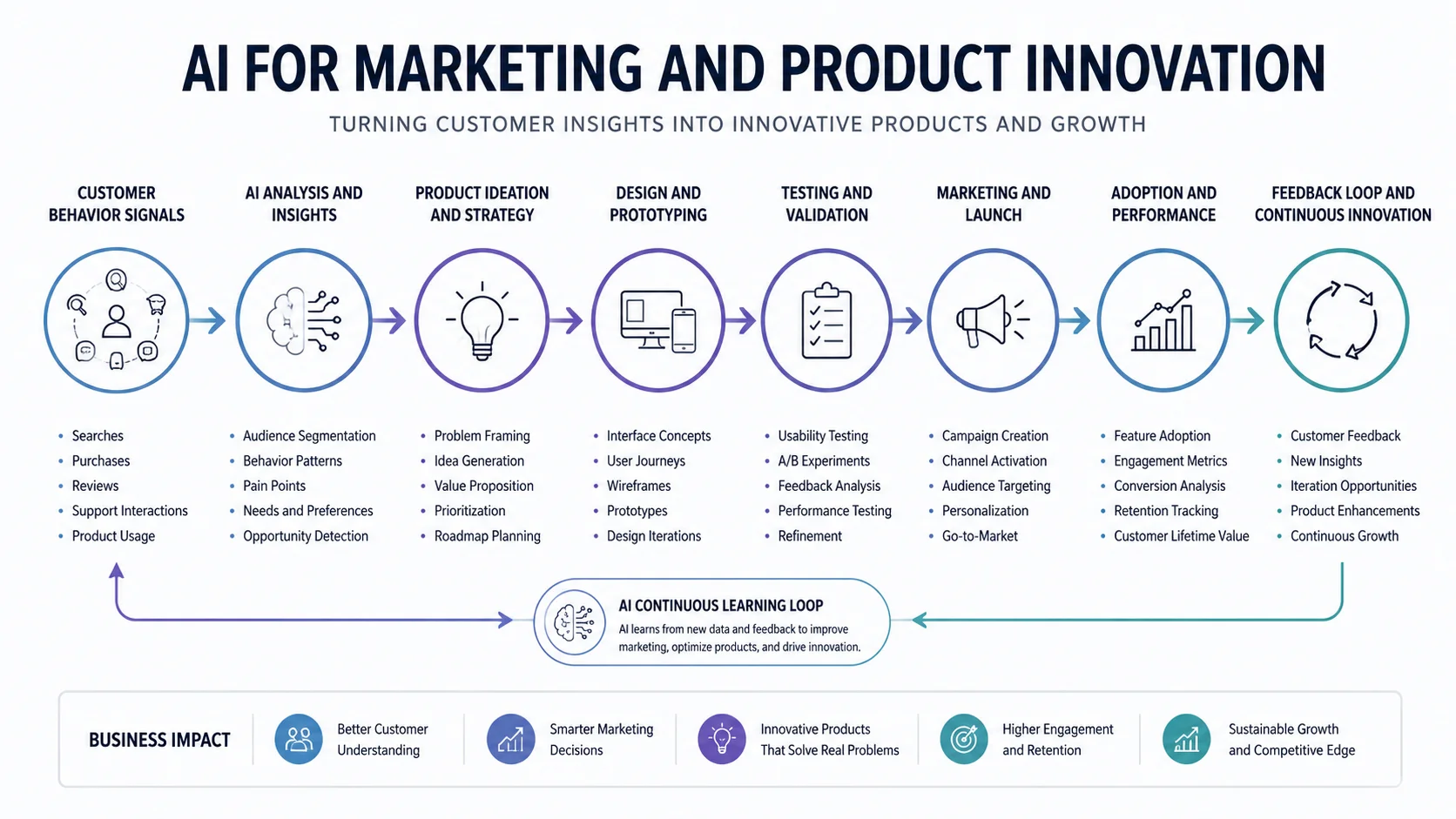
-
- No Comments
- August 10, 2026

Ai for marketing and product innovation
Artificial intelligence is changing the way businesses understand customers, make marketing decisions, develop ideas, and improve products. The real value of ai for marketing and product innovation is not simply that it can produce content faster or process more data. Its bigger advantage is that it can help companies understand what customers want sooner, identify useful patterns in large amounts of information, test ideas before committing major resources, and learn from what happens after a product reaches the market.
Marketing teams already collect valuable signals through customer searches, website activity, purchases, reviews, support conversations, email engagement, campaign performance, and product usage. Product teams work with another side of the same customer story, including feature requests, usability problems, product feedback, adoption patterns, complaints, and changing expectations. When these signals stay separated, businesses can miss opportunities. When AI helps connect and analyze them, both teams can make decisions with a clearer understanding of what customers are actually doing and asking for.
That is where ai for marketing and product innovation becomes especially useful. AI can analyze large datasets, identify patterns, predict possible behavior, generate different ideas, summarize feedback, and automate repetitive tasks at a scale that would be difficult for people to manage manually. Marketing teams can use those capabilities to understand audiences and improve campaigns, while product teams can use the same customer intelligence to discover problems, generate concepts, test solutions, and improve existing products.
But AI is not a replacement for the people making those decisions. A system may identify a pattern without understanding the wider business context. It can generate twenty product concepts without knowing which one fits the brand. It can predict customer behavior without fully understanding why customers behave that way. It can also produce incorrect information or misleading conclusions if the underlying data is poor.
The strongest approach combines machine scale analysis with human creativity, judgment, customer understanding, and accountability. AI can help businesses see more and move faster. People still need to decide what matters, what is useful, what is responsible, and what creates real value for customers.
Executive Summary: Why ai for marketing and product innovation matters

The importance of ai for marketing and product innovation comes from its ability to connect activities that businesses have traditionally managed separately.
Marketing gathers information about demand. It reveals what customers search for, what they click, what they purchase, what they ignore, what they complain about, and what keeps them coming back. Product development turns customer problems and market opportunities into products, features, experiences, and improvements. AI can create a much faster connection between these two areas.
Instead of waiting for occasional surveys or lengthy research projects, businesses can continuously analyze customer reviews, support tickets, sales conversations, website behavior, campaign performance, search activity, product usage, and other signals. Marketing teams can use that information to understand audiences and demand. Product teams can use the same information to identify unmet needs, develop ideas, create prototypes, and test possible solutions.
The process does not stop when a product launches. Customer behavior after launch creates another valuable layer of information. Feature adoption, retention, churn, complaints, purchases, support questions, and campaign responses can show whether the product is actually solving the problem customers expected it to solve.
This creates a continuous cycle. Customer data produces marketing insight. Marketing insight helps identify product opportunities. Product teams build and test solutions. Marketing introduces those solutions to the right audiences. Customers respond. Their response creates new data that can guide the next decision.
Used this way, ai for marketing and product innovation becomes more than a collection of automation tools. It becomes a system for learning from customers and turning that learning into better marketing and better products.
The simple idea behind AI driven growth
The basic idea is straightforward. AI is particularly good at working through large volumes of information faster than a person could realistically review it.
It can search for patterns across customer behavior, identify groups of customers with similar habits, estimate which prospects may be more likely to buy, detect warning signs that a customer may leave, summarize thousands of reviews, compare campaign results, and identify recurring product complaints. Generative AI can also produce different versions of marketing copy, product concepts, layouts, prototypes, descriptions, and ideas that teams can evaluate and test.
AI can also automate repetitive work. Routine customer questions can be handled by virtual assistants. Marketing data can be organized and analyzed automatically. Customer feedback can be categorized. Reports can be summarized. Product teams can use AI to prepare early concepts, specifications, wireframes, test cases, or research summaries.
These capabilities can save time, but speed alone is not the goal.
A business does not become more innovative simply because it generates fifty ideas instead of five. A marketing team does not become more effective simply because it creates hundreds of advertisements. A company does not improve customer experience simply because more interactions are automated.
The useful question is whether AI helps the business solve a meaningful customer or business problem.
That could mean discovering why customers abandon a product, understanding which audience generates the highest long term value, finding a common frustration hidden inside thousands of reviews, testing a product concept sooner, improving personalization, or reducing the amount of manual work required to understand performance.
This is why successful ai for marketing and product innovation should begin with the customer problem and business outcome rather than the technology itself. AI provides the scale, speed, prediction, generation, and automation. Human teams provide the context, creativity, judgment, responsibility, and understanding needed to turn those capabilities into useful decisions.
Where marketing and product innovation meet
Marketing and product innovation become far more valuable when they stop working as separate parts of the business.
Marketing is often the first place where customer demand becomes visible. Search behavior, campaign performance, reviews, support conversations, sales activity, website engagement, and purchase patterns can reveal what customers want, what frustrates them, and what they may be willing to pay for. Those signals can help a business notice an opportunity before it becomes obvious through traditional research.
Product teams can then turn those insights into something useful. They can improve an existing feature, simplify a difficult experience, develop a new service, create a new product concept, or test a different way of solving the customer problem.
Once that solution reaches customers, the cycle begins again.
Customers may buy it, ignore it, use only certain features, ask new questions, complain about specific problems, cancel their subscription, return for another purchase, or recommend the product to someone else. Every response creates fresh information that marketing and product teams can learn from.
This is the feedback loop at the heart of ai for marketing and product innovation.
Marketing helps identify demand and customer pain points. Product teams use that understanding to create or improve solutions. Customers respond to those solutions. AI can then analyze the new behavior and help teams understand what worked, what failed, and what should change next.
Instead of treating product development as something that happens first and marketing as something added later, both teams can learn from the same customer intelligence throughout the entire process.
That makes innovation more continuous. A company does not have to wait for the next large research project or annual product review to understand what customers are telling it. Customer behavior can become an ongoing source of direction for both marketing and product decisions.
What Is ai for marketing and product innovation?
ai for marketing and product innovation refers to using artificial intelligence to improve both the way a business understands and reaches customers and the way it develops, tests, launches, and improves products.
The marketing side focuses on understanding demand and customer behavior. AI can help marketers analyze large amounts of information, identify patterns, predict possible actions, personalize experiences, create content, improve advertising decisions, and understand which activities are contributing to business results.
The product innovation side focuses on turning customer problems and market opportunities into better products and experiences. AI can help product teams analyze feedback, discover recurring needs, generate ideas, compare possible concepts, create early designs, support prototyping, personalize products, and learn from customer behavior after launch.
These two areas are closely connected.
Marketing can reveal that customers are repeatedly searching for a solution, abandoning a certain part of the buying journey, complaining about the same problem, or responding strongly to a particular message. Product teams can use those signals to decide what should be improved or built.
The product then creates more customer behavior. People use certain features, avoid others, request improvements, leave reviews, contact support, renew, cancel, or purchase again. That new information can help marketing understand customer expectations more accurately while also helping product teams decide what to improve next.
This is why ai for marketing and product innovation becomes more powerful when customer intelligence moves freely between teams.
AI is not simply being used to make advertising faster on one side and product development faster on the other. It can help create a connected system in which the business continuously learns from customers, turns those insights into decisions, tests those decisions, and uses real customer response to guide the next move.
What AI means in marketing
In marketing, AI is used to help businesses understand customers, make predictions, create variations, automate repetitive work, and improve decisions using large amounts of data.
Several technologies can contribute to this process.
Machine learning can identify patterns inside customer behavior and historical performance. Predictive analytics can estimate outcomes such as purchase likelihood, churn risk, customer lifetime value, or conversion potential. Natural language processing can help analyze customer reviews, support conversations, survey responses, and other written feedback. Generative AI can help produce content ideas and variations. Automation can handle repetitive tasks and help teams respond more quickly.
The important point is not the technology itself. The value comes from what marketers can do with it.
For customer understanding, AI can examine signals such as website activity, purchase history, shopping frequency, email engagement, customer service interactions, average order value, and repeat purchase behavior. Instead of relying only on broad demographic groups, marketers can identify more meaningful differences based on how customers actually behave.
This supports better audience segmentation.
A first time visitor may need a different message from a loyal customer. Someone who consistently looks for discounts may respond differently from a customer who buys based on convenience or product quality. A user who is becoming less active may need assistance rather than another promotional campaign.
AI can also support personalization by helping businesses choose more relevant products, content, offers, messages, onboarding experiences, and advertisements for different customers. The goal is to make the experience more useful, not to make customers feel that the company is watching every move they make.
Content creation is another common use. Generative AI can help marketers prepare blog outlines, product descriptions, emails, advertising variations, social content, video concepts, FAQ responses, sales materials, SEO titles, and other drafts. Human marketers still need to verify information, protect brand voice, remove weak or unsupported claims, and make sure the final material provides real value.
Advertising can also benefit from AI analysis. Systems can help compare audiences, spending levels, bids, creative variations, placements, timing, and conversion patterns. This can make campaign testing much faster, but businesses still need to judge performance by meaningful outcomes such as profitable conversions, customer quality, and long term customer value rather than clicks alone.
Predictive lead scoring is another area where AI can help. By analyzing CRM information, website behavior, email activity, customer characteristics, and previous sales outcomes, a system can estimate which prospects appear more likely to buy. Sales and marketing teams can then decide where to focus their attention first.
Retention works in a similar way. Declining product usage, failed payments, weaker engagement, or negative customer service interactions can indicate that someone may be preparing to leave. AI can help identify those patterns early so the business can respond with support, useful education, service recovery, or another relevant action.
Recommendations are also part of the marketing role of AI. Businesses can use customer behavior to suggest products, services, content, or experiences that appear more relevant to each individual.
Customer service can benefit from automation as well. Chatbots and virtual agents can answer routine questions, provide basic product information, help customers track orders, and route more complicated situations to human representatives. The strongest systems do not trap customers inside automation. They make it easy for people to reach a human when the situation becomes sensitive or complex.
Finally, AI can improve marketing analytics by helping teams understand which activities may be connected to business outcomes. It can help examine which channels attract valuable customers, where people leave the funnel, which campaigns influence repeat purchases, and which audiences generate stronger long term results.
Used together, these capabilities make AI a decision support system for marketing rather than simply a content generation tool. Within ai for marketing and product innovation, marketing AI becomes most useful when the insights it produces do not remain inside the marketing department. Those insights can also help product teams understand what customers need next.
What AI means in product innovation
In product innovation, AI helps businesses move from customer problems to better products with greater speed and more information behind each decision.
At its core, AI in product innovation means using intelligent systems to discover what customers need, generate product ideas, compare possible solutions, test concepts, design features, build prototypes, personalize experiences, and improve products after launch.
The process often begins with customer information.
Businesses collect reviews, support tickets, surveys, search queries, product ratings, sales conversations, community discussions, and usage data. AI can process these sources at scale and look for recurring patterns that may be difficult to find manually. A product team may discover that customers are repeatedly asking for a particular feature, struggling with the same part of a product, or abandoning an experience at a specific point.
That insight can guide product decisions.
Generative AI can then help teams explore possible solutions. It may create product concepts, feature ideas, specifications, interface options, design variations, technical concepts, or early prototypes. Instead of starting every idea from a blank page, product teams can quickly compare multiple directions and decide which ones deserve deeper testing.
AI can also support concept testing. Teams can create different versions of a product idea, interface, packaging concept, or feature before investing heavily in development. These options can then be tested through customer interviews, surveys, prototype sessions, experiments, and other forms of validation.
The goal is not simply to produce more ideas. It is to discover which ideas solve real customer problems and which ones are worth building.
Product design and prototyping can also become faster. AI can assist with wireframes, interface layouts, product specifications, code prototypes, simulations, technical drawings, three dimensional concepts, and manufacturing alternatives. This can help teams explore more possibilities earlier in the development process.
However, human responsibility remains essential. Engineers, designers, product managers, and other specialists still need to judge feasibility, usability, safety, quality, compliance, cost, and commercial value.
The supplied IBM research also points to developments such as agentic AI and low code or no code platforms as important parts of AI supported product development. These approaches can make it easier for teams to automate connected tasks or create working product experiences without relying entirely on traditional development processes.
Agentic AI can go further than simple content generation. An AI agent may be able to research a market, summarize customer feedback, compare competitors, draft a product brief, create user stories, generate test cases, monitor product performance, and prepare reports across several connected steps.
That capability can save time, but it also creates new responsibilities. Businesses need to define what an AI agent is allowed to access, which actions it can take on its own, which decisions require human approval, and how its activity is recorded.
Low code and no code development can also support faster experimentation by helping teams create prototypes and simple digital experiences with less traditional coding. This can shorten the distance between an idea and something customers can actually test.
AI continues to matter after launch as well.
Product teams can analyze real usage data to understand which features customers use most, which ones they ignore, where problems appear, and which behaviors are connected with satisfaction, retention, or churn. Connected products can also use AI for predictive maintenance by analyzing sensor data and identifying signs of possible failure before a problem becomes more serious.
This makes product innovation less dependent on occasional redesigns. Instead, products can be improved continuously based on real customer behavior.
Within ai for marketing and product innovation, the role of product AI is therefore broader than simply generating ideas. It helps businesses discover problems, explore solutions, validate concepts, build faster, personalize experiences, and learn from what customers actually do once the product is in the market.
Why ai for marketing and product innovation should work together
Marketing and product innovation are trying to answer two sides of the same question.
Marketing asks what customers want, what attracts their attention, what problems influence their buying decisions, and how demand is changing.
Product teams ask how the business can solve those needs in a useful, realistic, and profitable way.
When these teams work with disconnected information, valuable signals can get lost. Marketing may understand why customers are interested in something without passing that knowledge to product teams. Product teams may improve a feature without fully understanding how customers describe the problem or what expectations marketing has created.
ai for marketing and product innovation works best when those insights move freely between both sides.
Marketing data can reveal what people search for, which messages attract attention, where customers leave the buying journey, which complaints appear repeatedly, which audiences convert, and what existing customers value most.
Product teams can use those signals to identify problems worth solving.
They may decide to improve a feature, simplify an experience, develop a new service, create a more personalized product, or test an entirely new concept.
Once that solution is built and launched, customers create another wave of information.
They may purchase the product, reject it, use certain features heavily, ignore others, contact customer support, leave reviews, cancel, renew, or recommend it to someone else.
AI can analyze this fresh behavior and help both teams understand what happened.
That creates a continuous cycle of discovering, building, testing, launching, learning, and improving.
The process begins with customer and market signals. Marketing identifies demand and pain points. Product teams turn those insights into possible solutions. AI helps teams test ideas, compare options, and analyze results. The product reaches customers. Their response creates new evidence that guides the next decision.
This is more useful than treating market research as something that happens only before a product is developed.
With ai for marketing and product innovation, customer understanding can continue throughout the entire product lifecycle.
Before development, AI can help discover unmet needs.
During development, it can support ideas, testing, and prototypes.
During launch, it can help marketing teams understand audiences, improve messaging, and optimize campaigns.
After launch, it can help both marketing and product teams analyze adoption, retention, churn, feedback, and customer behavior.
The advantage is not simply faster marketing or faster product development. It is the ability to create a business that learns continuously from the same customer information.
How Businesses Use ai for marketing and product innovation in Marketing

Once the basic idea is clear, the marketing side of ai for marketing and product innovation becomes much more practical.
The most useful way to think about marketing AI is not by asking how many AI tools a company can use. It is by asking which marketing questions AI can help answer more quickly and accurately.
Who should the business target?
What should it say to different customers?
When is the right time to act?
Which prospects deserve attention first?
How much should be spent on a campaign?
Which customers are likely to leave?
Which marketing activities are actually producing valuable customers?
These are the kinds of decisions where AI can support marketing teams.
For audience targeting, AI can analyze behavior such as browsing activity, purchase history, order value, email engagement, customer service interactions, repeat purchase patterns, and sensitivity to discounts. This can help marketers move beyond broad audience categories and understand meaningful differences between customers.
For messaging, AI can help identify which offers, content, recommendations, or experiences may be more relevant to different people. A new visitor may need education. A loyal customer may respond better to a product recommendation. A customer showing signs of disengagement may need assistance rather than another promotional message.
For lead management, predictive systems can analyze CRM information, website behavior, email engagement, company characteristics, and previous sales results to estimate which prospects may be more likely to buy. This allows marketing and sales teams to focus their time where purchase intent appears stronger.
For advertising, AI can help compare audiences, bids, budgets, creative variations, timing, placements, frequency, and predicted conversions. The purpose is not simply to generate more clicks. The stronger question is whether those decisions produce profitable customers, incremental conversions, higher customer lifetime value, and better overall business results.
AI can also help answer when a business should act.
For example, declining usage, failed payments, weaker engagement, or negative support interactions may indicate that a customer is at risk of leaving. Instead of waiting for cancellation, a business may use those signals to provide support, education, service recovery, a suitable plan change, or another relevant response.
Generative AI adds another layer by helping teams produce marketing variations quickly. It can assist with blog outlines, product descriptions, emails, social content, advertising concepts, video scripts, FAQ responses, sales materials, SEO titles, and meta descriptions.
The value comes from accelerating production, not removing human judgment.
Marketers still need to verify facts, protect the brand voice, review claims, add original value, and make sure the final content is useful rather than simply produced at scale.
Customer service is another practical application. AI chatbots and virtual agents can handle routine questions, order tracking, basic product information, and issue routing. More difficult cases should still move to human representatives, especially when they involve disputes, refunds, sensitive situations, or problems the automated system cannot resolve.
Analytics then ties these activities together.
AI can help marketers examine which channels generate profitable customers, which content assists conversions, where people leave the funnel, which audiences have stronger lifetime value, and how long typical buying journeys take.
That does not mean AI generated attribution should automatically be treated as fact. Marketing teams still need to compare model insights with controlled experiments, incrementality testing, and overall business performance.
The strongest marketing use of ai for marketing and product innovation therefore comes from tying every application to a business question.
AI should help marketers decide who matters, what customers need, what message is useful, when to respond, where to invest, and whether the activity creates genuine value.
When those answers are also shared with product teams, marketing intelligence becomes more than campaign data. It becomes an input for future product decisions.
Customer segmentation based on real behavior
Traditional customer segmentation often starts with broad demographic categories such as age, gender, income, or location. Those details can be useful, but they do not always explain how a customer actually behaves.
Two people in the same age group and city can have completely different buying habits. One may visit a website every week and purchase regularly. Another may only appear when a discount is available. A third may browse often but never complete an order.
This is where AI based behavioral segmentation can provide a clearer picture.
Within ai for marketing and product innovation, AI can analyze signals such as browsing activity, purchase frequency, average order value, email engagement, customer service interactions, repeat purchase likelihood, churn risk, and sensitivity to discounts. These signals allow marketers to group customers according to what they actually do rather than relying only on who they appear to be on paper.
For example, an online retailer may identify one group of loyal customers who purchase frequently without waiting for promotions. Another group may place larger orders but buy less often. Some customers may regularly open emails but rarely purchase, while others may ignore email marketing and respond more strongly to product recommendations on the website.
AI can also help identify customers whose behavior is beginning to change.
A regular customer who suddenly visits less often, reduces spending, or contacts support more frequently may be showing early signs of churn. On the other hand, a new customer who returns several times, views multiple products, and engages with emails may be becoming more valuable.
This gives marketing teams more useful choices.
Instead of sending the same campaign to everyone, businesses can create messages and experiences that match different customer behaviors. Loyal customers may receive relevant recommendations. New visitors may need education or reassurance. Discount sensitive shoppers may respond to carefully timed promotions. Customers at risk of leaving may benefit more from support than another sales message.
The value of behavioral segmentation is not simply creating more audience groups. It is helping the business understand meaningful differences between customers.
When used as part of ai for marketing and product innovation, these insights can also support product decisions. If one segment repeatedly struggles with a feature, asks the same question, or abandons the same step, that behavior may point to a product problem rather than a marketing problem.
Predictive lead scoring and better sales priorities
Most sales teams do not have unlimited time.
When hundreds or thousands of leads enter a business, someone has to decide which prospects deserve immediate attention and which ones are less likely to convert. Predictive lead scoring uses AI to support that decision.
AI can analyze information already available across marketing and sales systems, including CRM records, website activity, email engagement, company characteristics, and previous sales results.
The system then looks for patterns connected with successful conversions.
A prospect who repeatedly visits pricing pages, opens several emails, downloads important information, and matches the characteristics of previous customers may appear more likely to buy than someone who visited once and never returned.
This does not mean the AI knows exactly what a person will do. It estimates purchase intent based on patterns in the available data.
For businesses using ai for marketing and product innovation, that estimate can help marketing and sales teams decide where to focus their time.
High intent leads may receive faster follow up or more personal attention. Leads showing early interest may continue through educational campaigns. Prospects with weak buying signals may remain in a longer nurturing process rather than taking up immediate sales resources.
The potential advantage is better prioritization.
Instead of asking sales representatives to manually review every prospect, AI can help surface the leads that appear more promising based on their behavior and similarity to previous successful customers.
However, predictive lead scoring comes with an important warning.
AI learns from historical information. If past sales data contains bias, unequal treatment, or poor assumptions, the model may reproduce those same patterns.
For example, if certain groups were historically contacted less often or given fewer opportunities, an AI system trained on those outcomes may incorrectly interpret that history as evidence that similar prospects are less valuable.
A confident score does not automatically mean a fair or accurate score.
For that reason, predictive lead scoring should remain subject to human review and ongoing testing. Businesses need to examine how scores are produced, compare predictions with actual outcomes, and look for patterns that may unfairly disadvantage certain groups.
Within ai for marketing and product innovation, predictive systems are most useful when they support human decisions rather than silently replacing them.
AI can help sales teams decide where attention may be most valuable. People still need to apply context, judgment, and accountability before acting on the prediction.
Personalized marketing without becoming intrusive
Personalization is one of the most visible uses of AI in marketing.
Customers increasingly interact with businesses across websites, emails, advertisements, apps, support systems, and digital products. AI can use behavior across those interactions to help businesses make the experience more relevant.
Within ai for marketing and product innovation, personalization may include product recommendations, personalized email content, dynamic landing pages, tailored offers, customized onboarding, relevant articles or videos, and advertising designed for specific audience segments.
The basic idea is simple.
Different customers need different information at different moments.
A first time visitor may need an explanation of how a product works. A returning customer may want recommendations related to an earlier purchase. A new software user may benefit from onboarding that focuses on the features most relevant to their goals. A customer who repeatedly reads information about one service may respond better to related content than to a general promotion.
AI can help businesses recognize those differences and adjust the experience accordingly.
Good personalization saves people time.
Instead of making customers search through dozens of irrelevant products, a business can surface options that fit their interests. Instead of sending the same email to an entire database, marketers can provide information that matches where different customers are in the buying journey.
Dynamic landing pages can emphasize different information depending on the audience. Recommendations can help customers discover useful products or content. Customized onboarding can guide new users toward the features they are most likely to need.
The problem begins when relevance starts to feel like surveillance.
Personalization can become uncomfortable when a company appears to know information that a customer did not expect it to have.
There is a meaningful difference between recommending a product because someone viewed a related item and showing a message that appears to rely on sensitive personal information the customer never knowingly shared for that purpose.
The first may feel helpful. The second may feel invasive.
This distinction matters because more data does not automatically create a better customer experience.
Businesses using ai for marketing and product innovation should focus on personalization that creates clear value for the customer. The aim should be convenience, relevance, and a smoother experience rather than demonstrating how much information the company has collected.
AI can help decide what content, offer, recommendation, or message may be useful. Human teams still need to decide whether using that information is appropriate and whether the experience respects reasonable customer expectations.
The best personalization does not make customers think about the technology behind it.
It simply makes the experience feel easier, more relevant, and better suited to what they are trying to accomplish.
Generative AI for content creation
Generative AI can speed up a large part of the content production process, but its strongest role is as a production assistant rather than an automatic publishing machine.
Within ai for marketing and product innovation, marketing teams can use generative AI to develop blog outlines, product descriptions, social content, email drafts, advertising concepts, video scripts, sales material, FAQ answers, SEO titles, and meta descriptions. It can help teams move faster from an idea to a usable first draft and create multiple versions for testing.
That speed is valuable when marketers need to produce different messages for different audiences or prepare several creative directions for a campaign.
A product team launching a new feature, for example, may need website copy, onboarding messages, email announcements, sales talking points, support answers, and advertising ideas. Generative AI can help create early versions of all of them quickly.
The important point is that speed does not remove the need for editorial judgment.
AI can produce information that sounds convincing even when it is inaccurate. It can repeat weak ideas, create unsupported claims, misunderstand a product feature, or generate content that does not match the brand.
Human marketers therefore remain responsible for checking facts, verifying statistics, reviewing product claims, protecting brand voice, and making sure the final content offers something useful and original.
Originality matters in particular.
Simply generating another version of information that already exists across the internet does not automatically make a strong piece of content. Businesses still need to add their own expertise, examples, analysis, customer understanding, and point of view.
Evidence matters as well.
When content contains statistics, product specifications, legal statements, performance claims, or other factual information, those details should be supported by reliable sources rather than accepted simply because an AI system produced them.
The best use of generative AI is therefore collaborative.
AI helps with speed, variations, organization, and early drafting. People provide context, creativity, fact checking, evidence, brand understanding, and final editorial judgment.
That balance fits the wider idea behind ai for marketing and product innovation. Machines can increase production capacity, but people remain responsible for deciding what deserves to be published.
Google guidance for AI assisted marketing content
Using generative AI does not automatically create a search problem.
The Google guidance included in the supplied research makes an important distinction between using AI to help create useful content and using automation to produce large amounts of low value material simply to influence search rankings.
For businesses using ai for marketing and product innovation, that distinction matters.
A company may use AI to create a first draft, organize research, develop an outline, summarize information, or explore different ways to explain a topic. The presence of AI itself is not the central issue.
The real question is whether the finished content provides value.
Problems can arise when businesses generate large numbers of pages without adding useful information, original thinking, or meaningful human review. The supplied research notes that this kind of activity may conflict with Google policies related to scaled content abuse.
Publishing more pages is therefore not the same as building a stronger search presence.
Good AI assisted marketing content still needs original analysis. Readers should learn something useful rather than receive another generic summary of information they could find anywhere else.
Reliable sources are equally important. Claims should be supported by trustworthy information, especially when the topic involves statistics, business performance, products, regulation, health, finance, or other areas where accuracy matters.
Facts also need to be checked before publication.
An AI model can invent a statistic, confuse one company with another, produce an outdated detail, or create a citation that does not support the claim being made. Human review is necessary to catch those problems.
Clear organization also matters because readers should be able to understand the answer without working through unnecessary repetition or confusing language.
The final article should therefore bring together useful information, reliable sources, accurate facts, original contribution, clear structure, and human editing.
For businesses using ai for marketing and product innovation, the practical lesson is simple. AI can help accelerate content production, but the goal should never be producing the maximum number of pages. The goal should be producing content that deserves a reader’s attention.
Advertising optimization beyond clicks
AI can help advertising teams make decisions across almost every stage of a campaign.
It can support audience targeting by identifying groups that appear more likely to respond. It can help compare budget allocation across campaigns, adjust bidding decisions, test creative variations, estimate conversion likelihood, evaluate placements, manage advertising frequency, and identify stronger campaign timing.
This allows marketers to evaluate many combinations faster than a team could realistically review by hand.
For example, one campaign may involve several audiences, multiple headlines, different images, a range of bids, several placements, and different times of day. AI can help analyze how those variables perform together and surface combinations that appear more promising.
That does not mean the highest click rate is automatically the best result.
Clicks can show interest, but they do not necessarily show business value.
A campaign may generate a large volume of inexpensive clicks while attracting people who rarely purchase. Another campaign may produce fewer clicks but bring customers who spend more, remain with the business longer, and purchase repeatedly.
This is why advertising within ai for marketing and product innovation should be judged against outcomes that matter to the business.
Incremental conversions are one example. Businesses need to understand whether advertising actually created additional sales rather than receiving credit for customers who would have purchased anyway.
Profitability matters as well. A campaign that produces revenue but requires excessive advertising spend may not be as successful as it first appears.
Customer lifetime value gives another important perspective. Acquiring a customer who purchases repeatedly over several years may be more valuable than generating several one time purchases.
Customer quality matters too. Businesses should consider retention, repeat purchasing, support costs, refund behavior, and long term value rather than treating every conversion as identical.
AI can help optimize the mechanics of advertising. Human teams still need to define what successful advertising actually means.
The best campaigns are not simply the ones that collect the most clicks. They are the ones that create valuable customers and stronger business results.
Customer service automation with a human exit
AI chatbots and virtual agents can make customer service faster when they are used for the right problems.
Routine questions are a natural starting point.
Customers may want to know where an order is, how a feature works, how to change an account setting, what a product includes, or which department can solve a particular issue.
AI can handle many of these requests quickly.
A chatbot may provide basic product information, help track an order, answer common questions, collect initial details, or route a customer to the correct support team.
This can reduce repetitive work for employees while giving customers faster answers.
But automation becomes frustrating when it prevents people from reaching a person.
Within ai for marketing and product innovation, customer service should therefore include a clear human exit.
Customers should know when they are interacting with AI. The system should not pretend to be a human representative.
There should also be a simple way to move to a person when the issue becomes more complicated.
Refund requests may require judgment.
Disputes may involve information that an automated system cannot fully understand.
Emergencies and sensitive situations should not be trapped inside a routine chatbot flow.
Complicated product problems may require someone who can investigate the account, understand the history, and make a decision outside the normal script.
Human support is also important when the AI does not know the answer.
A virtual agent should not invent a policy, guess about a product feature, or create false information simply because it is expected to respond.
The most useful model is therefore shared responsibility.
AI handles repetitive and predictable requests. Human representatives handle the situations that require judgment, empathy, authority, investigation, or flexibility.
That approach can make customer service more efficient without making customers feel abandoned by automation.
Churn prediction and smarter retention
Customers rarely leave a business without producing any warning signals.
Their behavior often changes first.
A customer may start using the product less often. Engagement may decline. A payment may fail. Support conversations may become more negative. Someone who previously opened emails regularly may stop responding.
AI can help identify these patterns before the customer finally cancels or disappears.
Within ai for marketing and product innovation, churn prediction allows businesses to move from reacting to lost customers toward identifying possible problems earlier.
The response should depend on what appears to be causing the risk.
If a customer does not understand the product, useful educational content may help.
If the customer is experiencing a technical problem, product assistance may be more valuable than another marketing message.
If a poor service experience has damaged trust, a service recovery conversation may be appropriate.
Some customers may benefit from a different subscription level or plan that fits their actual usage better.
Loyalty offers can also have a place when they provide genuine value.
What businesses should avoid is treating every sign of churn as a reason to send another discount.
Repeated discounts can reduce margins and teach customers that the best time to purchase or renew is only when a promotion appears.
They also fail to address the real reason someone may be considering leaving.
A customer who is frustrated by a difficult product experience will not necessarily become satisfied because the price is temporarily lower.
This is where the connection between marketing and product innovation becomes especially useful.
If AI repeatedly identifies churn around the same feature, workflow, or service issue, the business may have discovered more than a retention problem. It may have found a product problem that needs to be fixed.
That is one of the wider benefits of ai for marketing and product innovation. Customer behavior can inform both the immediate retention response and the longer term product decision.
Marketing analytics and attribution
Marketing leaders usually care less about dashboards themselves than about what the numbers tell them to do next.
AI can help make large marketing datasets easier to analyze, but the useful questions remain practical.
Which channels are attracting profitable customers?
Which pieces of content support conversions?
How long does a typical buying journey take?
Where are customers leaving the funnel?
Which audiences produce the highest customer lifetime value?
Which campaigns influence repeat purchases?
These questions move marketing analytics away from reporting activity and toward understanding business impact.
Within ai for marketing and product innovation, AI can help identify relationships across website behavior, campaign activity, customer acquisition, purchasing, retention, and other business outcomes.
For example, a customer may discover the business through search, read several articles, join an email list, return through an advertisement, speak with sales, and finally make a purchase weeks later.
Looking only at the final click would miss much of that journey.
AI based attribution models can help marketers examine how different interactions may have contributed to the outcome.
They can also help identify where customers tend to disappear.
If large numbers of people arrive through advertising but leave during checkout, the problem may not be the advertisement. It may be the product experience, pricing, payment process, or another point later in the journey.
Analytics can also reveal differences in customer quality.
One marketing channel may generate customers quickly but produce weak retention. Another may take longer to convert while attracting customers with higher lifetime value.
That information can influence future spending and product decisions.
AI attribution still has limits.
A model can find relationships in the data, but those relationships do not automatically prove that a particular marketing activity caused the result.
For that reason, businesses should compare AI generated attribution insights with controlled experiments, incrementality testing, and overall business performance.
If a model says a campaign is highly valuable but total profit does not improve, that difference deserves investigation.
The goal is not to give AI the final word on attribution.
The goal is to use AI to make complex customer journeys easier to understand while checking its conclusions against real business evidence.
Used this way, marketing analytics becomes another important connection inside ai for marketing and product innovation. Marketing data does not simply explain which campaign performed well. It can also reveal what customers value, where experiences fail, and what the business may need to improve next.
How ai for marketing and product innovation Supports Better Products

The value of ai for marketing and product innovation does not stop once a business finds the right audience or improves a campaign. The same customer intelligence that helps marketing teams attract and understand customers can also help product teams build better solutions.
This changes the role of customer data.
Instead of using reviews, support conversations, search behavior, purchases, and product usage only to improve promotion, businesses can use the same information to understand what customers actually need from the product itself.
AI can shorten the distance between feedback and action.
A company may have thousands of customer reviews, support tickets, survey responses, sales conversations, and usage records. Manually reading all of that information can take significant time. AI can help organize those signals, identify repeated themes, surface complaints, and highlight opportunities that deserve attention.
Those findings can then move into idea generation.
Product teams can use AI to explore possible solutions, create multiple concepts, compare alternatives, prepare early prototypes, and test different directions before committing major time and money.
If a concept shows promise, AI can continue supporting the development process through design variations, technical drafts, prototypes, simulations, personalization, and analysis after launch.
The result is a more connected approach to product development.
Customer feedback helps identify the problem. AI helps teams explore possible answers. Real customers help validate those answers. Product usage creates new information. That information then guides the next improvement.
This makes ai for marketing and product innovation useful not only for launching products faster, but also for improving them continuously after they reach the market.
Discovering customer needs hidden inside large datasets
Customers often explain what they need without formally asking for a new product.
They do it through reviews, support tickets, survey responses, community conversations, product ratings, search behavior, sales conversations, usage data, and feedback about competitors.
The challenge is volume.
A growing business may receive thousands of these signals across different channels. Important patterns can easily disappear inside individual conversations or spreadsheets.
AI can help bring those patterns together.
Natural language processing can examine large collections of written feedback and identify recurring complaints, feature requests, common emotions, repeated questions, and points of friction.
For example, a product team may assume customers want more features when the real problem is that an existing workflow is confusing.
Reviews may repeatedly mention the same difficult step.
Support tickets may show customers asking the same question.
Usage data may reveal that people stop using the product at the same point.
Sales conversations may show that prospects hesitate because they do not understand a specific capability.
Viewed separately, each signal may seem small. Analyzed together, they can reveal a clear product problem.
AI can also help examine competitor feedback.
If customers repeatedly complain about the same weakness across competing products, that may reveal an opportunity for differentiation.
Search behavior can add another layer by showing what customers are actively trying to understand or solve.
This is one reason ai for marketing and product innovation can create stronger product decisions. It gives teams a way to listen across many customer signals at once rather than depending only on occasional surveys or internal assumptions.
AI does not decide which problem deserves to be solved.
It helps product teams see the patterns more clearly.
People still need to judge whether the issue is important, how many customers it affects, whether solving it supports business goals, and whether the opportunity is worth pursuing.
Turning customer problems into product ideas
Finding a customer problem is only the beginning.
The next question is what the business should build or change in response.
Generative AI can help product teams explore possible answers by creating and comparing product concepts based on the information already available.
Those inputs may include customer pain points, market trends, competitor weaknesses, technology capabilities, pricing limits, manufacturing constraints, and regulatory requirements.
A team could ask AI to generate several possible solutions to the same customer problem.
One concept may focus on simplicity.
Another may focus on automation.
A third may offer more personalization.
Another may reduce cost or change the way the service is delivered.
This can make early ideation faster because teams are not forced to develop every possibility manually from the beginning.
However, more ideas do not automatically lead to better innovation.
A concept still needs to survive practical questions.
Is the idea genuinely useful to the customer?
Can the business actually build it?
Can it be delivered at an acceptable cost?
Could it generate enough value or revenue?
Does it meet legal and regulatory requirements?
Does it fit the company strategy and brand?
Does it solve the original problem better than existing alternatives?
These questions keep human judgment at the center of ai for marketing and product innovation.
AI can widen the range of options a team considers, but product managers, designers, engineers, legal teams, finance teams, and business leaders still need to decide which ideas deserve investment.
The purpose is not to let AI choose the product roadmap.
It is to give people more useful options to evaluate.
Using AI for concept testing
Before building a complete product, teams need to understand whether the idea makes sense to real customers.
AI can make that early testing process faster.
Teams can use generative systems to create different versions of product concepts, interfaces, packaging designs, feature descriptions, value propositions, or customer experiences.
Instead of testing one idea, teams may be able to compare several directions.
One interface may emphasize simplicity.
Another may emphasize advanced control.
A packaging concept may use different visual positioning.
A product proposition may focus on convenience, performance, affordability, or another customer benefit.
These variations can then be tested through surveys, interviews, prototype sessions, experiments, and other forms of real customer research.
The Deloitte material in the supplied research describes generative AI as useful across product innovation activities such as ideation, design, prototyping, personalization, and distribution. The Clorox example highlighted in that research shows how AI can help companies generate ideas faster, identify trends, rapidly prototype concepts, and evaluate those ideas with consumers.
That speed can reduce the cost of early exploration.
A team does not need to spend weeks creating every possible direction before learning whether customers understand or value the concept.
However, AI generated feedback should not be confused with real customer evidence.
A synthetic persona may produce a useful perspective. An AI model may predict how customers could react. Those outputs can help teams prepare questions or explore possibilities.
They cannot prove that real customers will behave the same way.
Real people may have emotional reactions, habits, priorities, objections, and expectations that a simulated response does not capture.
For that reason, concept testing within ai for marketing and product innovation should still include evidence from the actual target audience.
AI can help teams create and compare concepts faster.
Customers still need to tell the business which concepts actually work.
Faster product design and prototyping
Once a promising concept is identified, AI can help teams move more quickly toward something that can be tested.
Product designers, engineers, and developers can use AI to assist with product specifications, wireframes, interface layouts, design variations, technical concepts, code prototypes, three dimensional concepts, simulations, and manufacturing alternatives.
For digital products, AI can help turn an early idea into a wireframe or working prototype faster.
A team may explore several interface layouts, test different user flows, generate early code, or create variations of a feature before deciding which direction is strongest.
For physical products, AI may support exploration of materials, dimensions, manufacturing approaches, weight, durability, performance, or cost tradeoffs.
This can increase the number of possibilities teams are able to examine before finalizing a design.
The benefit is not that AI removes the difficult work of development.
It reduces some of the effort required to move from idea to experiment.
Human teams still own the decisions that determine whether a product is safe, usable, reliable, compliant, and ready for real customers.
Engineers must validate technical performance.
Designers must test usability.
Product managers must confirm that the solution still addresses the customer problem.
Compliance specialists must review relevant requirements.
Manufacturing and quality teams must make sure the final product can be produced consistently.
This distinction is important in ai for marketing and product innovation.
AI can accelerate exploration.
It does not remove responsibility for the final product.
Product personalization after launch
A product does not have to behave exactly the same way for every customer.
AI can help products adapt to individual users based on preferences, behavior, goals, and previous interactions.
Recommendation systems are one familiar example.
A platform may suggest products, videos, articles, or services based on what a customer has already viewed or used.
The same principle can apply to many other experiences.
A fitness product may create personalized workout programs.
An education platform may adjust lessons based on student progress.
A financial platform may display different information depending on the user’s priorities.
Software may change parts of the interface based on the features a customer uses most often.
An AI assistant may be configured around a user’s specific tasks or preferences.
This can make a product feel more relevant and useful.
Customers spend less time searching for the information or functionality they need, while businesses can create experiences that respond more closely to individual behavior.
But personalization also creates boundaries that businesses need to respect.
A product may technically be able to use a large amount of personal information. That does not automatically mean customers expect or want that information to influence every experience.
If personalization relies on sensitive data or information customers did not expect the business to use, relevance can quickly become discomfort.
Customers should also have meaningful control where appropriate.
They may want to adjust recommendations, change personalization settings, limit data use, or understand why certain experiences are being shown.
The strongest approach to personalization within ai for marketing and product innovation focuses on usefulness rather than maximum data collection.
A personalized experience should make the product easier or more valuable to use.
It should not make the customer feel that the system knows more than it should.
Predictive maintenance and continuous product improvement
For connected physical products, AI can help businesses identify possible problems before a complete failure occurs.
Sensors can produce information about temperature, pressure, vibration, usage, performance, wear, or other operating conditions.
AI can analyze those patterns and detect signals that may indicate an upcoming problem.
This approach can be useful in areas such as manufacturing, transportation, energy, consumer electronics, health equipment, and logistics.
Instead of waiting for a machine or product to fail completely, the business may be able to inspect, service, repair, or replace a component earlier.
That can reduce downtime and create a better customer experience.
Predictive maintenance is only one part of post launch learning.
Digital products and connected services also produce valuable usage information.
Product teams can examine which features customers use most frequently, which ones they rarely touch, where they struggle, and what activities are connected with complaints or cancellations.
A feature that required months of development may receive very little use.
Another small feature may become one of the most important parts of the experience.
Support conversations may show that customers repeatedly misunderstand the same function.
Usage data may show that people abandon a process at a particular step.
These signals can guide the next improvement.
This is where ai for marketing and product innovation becomes continuous rather than project based.
Product development does not finish at launch.
The real product continues to produce evidence about what customers value and where friction remains.
AI helps teams process that evidence faster so improvements can be based on actual behavior rather than assumptions.
AI agents inside product workflows
AI agents represent a more advanced stage of automation because they can carry out a sequence of connected tasks rather than completing only one isolated request.
Inside a product workflow, an AI agent might research a market segment, summarize customer feedback, compare competitors, draft a product brief, create user stories, generate test cases, monitor performance metrics, and prepare a launch or performance report.
Instead of asking the system to complete each task separately, the agent may move through several steps using information from connected systems.
This can make product work faster, particularly when teams spend large amounts of time collecting information, preparing documents, monitoring data, or repeating routine analysis.
However, greater autonomy also creates greater risk.
An agent that can access several systems may be able to read customer information, use internal documents, interact with project tools, generate files, or take actions without someone reviewing every step.
Businesses therefore need clear boundaries.
Teams should define what information an agent is allowed to access.
They should decide which actions it can complete automatically.
Higher impact decisions should require human approval.
Access should be limited to what the agent actually needs.
Actions should also be recorded so teams can understand what happened if a problem occurs.
This becomes especially important when an AI agent can change information, communicate externally, make recommendations that affect customers, or operate across several business systems.
Within ai for marketing and product innovation, agentic AI can reduce repetitive work and connect parts of the product process that were previously handled manually.
But useful autonomy depends on control.
The more an AI system is allowed to do, the more clearly the business needs to define permissions, approvals, accountability, and oversight.
How ai for marketing and product innovation Creates One Customer Feedback Loop
The strongest use of ai for marketing and product innovation is not having one AI tool for content, another for analytics, another for product design, and another for customer service.
The bigger advantage comes from connecting those activities into one shared learning process.
Marketing sees demand, customer behavior, campaign response, and buying patterns. Product teams see feature use, product friction, complaints, requests, and adoption. When both sides work from the same customer intelligence, the business can move from isolated decisions toward continuous learning.
The process starts with market discovery.
Marketing teams look for signs of demand and customer interest. Product teams look for the problem underneath that demand. AI can help combine information from search behavior, reviews, sales activity, support conversations, surveys, and product usage so both teams are working from a clearer picture of what customers are trying to accomplish.
Those insights then move into idea generation.
Marketing considers whether customers are likely to care about a solution. Product teams consider whether that solution can realistically be built and whether it solves the problem well enough to deserve investment.
AI can help teams generate more options, compare possibilities, and rank opportunities.
Then comes validation.
The company tests both the solution and the way it is presented to customers. A product idea may be useful but explained badly. A marketing message may attract attention while the product behind it fails to deliver. AI can help teams study survey results, experiments, prototype tests, and campaign responses so these problems become visible sooner.
During launch, marketing and product teams need to stay aligned.
Marketing may use AI to improve audience selection, timing, channels, and content. Product teams make sure the actual customer experience is ready to support the promise being made.
After launch, the process starts again.
Acquisition, feature adoption, retention, churn, reviews, complaints, support requests, purchases, and product usage all create new information.
That is what makes ai for marketing and product innovation a continuous feedback loop rather than a collection of disconnected AI projects.
Each customer response becomes evidence for the next marketing decision, product improvement, test, or idea.
Market discovery begins with demand and customer problems
Market discovery becomes more useful when a business looks beyond the simple question of whether people are interested.
Marketing teams may be able to see demand through search behavior, website activity, campaign engagement, sales conversations, purchasing patterns, and customer questions.
Product teams need to understand what is creating that demand in the first place.
A customer may be searching for a particular feature because an existing process takes too long.
Another customer may repeatedly contact support because the product is difficult to understand.
A group of users may stop using a service because it does not adapt well enough to their needs.
AI can help bring these signals together.
Search behavior may show what people are looking for.
Sales information may reveal the questions prospects ask before buying.
Customer reviews may show recurring frustrations.
Support conversations may reveal where people become confused.
Usage patterns may show where customers stop, struggle, or abandon the product.
When these sources are viewed together, the business gains a clearer picture of both demand and the customer problem behind it.
This matters because marketing interest alone does not automatically tell a company what to build.
A popular search may reveal demand, but reviews and support conversations may explain the reason that demand exists.
Within ai for marketing and product innovation, market discovery works best when marketing identifies where attention exists while product teams identify the real customer problem worth solving.
Idea generation connects market appeal with product value
Once a customer problem becomes clear, the next question is whether the business should create a solution for it.
Marketing and product teams approach this question from different but connected directions.
Marketing needs to understand whether customers are likely to care about the idea.
Is there enough demand?
Does the problem matter enough for customers to change their behavior?
Can the value be explained clearly?
Would the idea appeal to a meaningful audience?
Product teams need to ask another set of questions.
Can the solution actually be built?
Will it solve the customer problem?
Does the company have the necessary technology, resources, and expertise?
Can it be delivered at the right cost and quality?
AI can help both sides explore these questions faster.
Generative systems can produce possible product concepts, feature ideas, customer experiences, positioning options, and alternative approaches based on market signals and customer problems.
AI can also help compare opportunities using available information.
One idea may appear to have stronger market demand.
Another may be easier to build.
A third may offer stronger differentiation from competitors.
A fourth may be attractive to customers but too expensive or complicated to deliver.
The purpose of AI is not to choose the winner automatically.
Within ai for marketing and product innovation, AI is most useful as a way to widen the range of ideas and organize evidence around them.
People still make the final decision.
Marketing leaders judge likely customer appeal.
Product teams judge feasibility and usefulness.
Business leaders consider cost, strategy, risk, and potential value.
AI helps create and rank options. Human teams decide which opportunity deserves to move forward.
Validation tests both the message and the product
A product idea can fail for more than one reason.
Sometimes the product itself is weak.
Sometimes the product is useful, but customers do not understand why it matters.
Sometimes both the product and the positioning need work.
That is why validation should test more than the product alone.
Product teams may test prototypes, features, workflows, designs, packaging concepts, or early versions of the experience.
Marketing teams may test value propositions, campaign messages, audience responses, offers, landing pages, or different ways of explaining the same solution.
AI can help analyze the results across both sides.
Survey responses can show whether customers understand the idea.
Prototype testing can reveal usability problems.
Experiments can compare different experiences.
Campaign responses can show whether the message attracts the intended audience.
Customer comments can reveal whether people are interested in the promise but disappointed by the actual experience.
This helps teams separate different kinds of problems earlier.
Imagine that an advertisement receives very little interest.
The problem may be weak positioning.
But if customers respond strongly to the advertisement and then abandon the product after trying it, the issue may sit inside the product experience instead.
A different situation may show strong product satisfaction among users who understand the concept, but poor campaign performance because the value is not being communicated clearly.
Within ai for marketing and product innovation, validation becomes a shared process.
Teams test what the product does and what marketing says about it.
That makes it easier to improve both before a full launch increases the cost of getting either one wrong.
Launch connects audiences with the product experience
A strong launch requires more than a good marketing campaign.
The audience, message, timing, and channel need to connect with a product experience that delivers what customers were promised.
Marketing teams can use AI to improve launch decisions.
They may analyze which audiences appear most interested, which messages perform best, which channels generate stronger responses, when customers are most likely to engage, and which content is most relevant to different groups.
Product teams prepare the experience people will receive once they respond to that marketing.
That may include onboarding, product functionality, support resources, recommendations, account setup, performance, and the overall customer journey.
The connection between the two matters.
If an advertisement promises simplicity but the product is difficult to use, the customer immediately experiences a gap between expectation and reality.
If marketing promotes personalization but the product offers a generic experience, customers may feel disappointed even if the product works technically.
If a campaign highlights a particular feature, that feature needs to perform reliably when new customers arrive.
This is why ai for marketing and product innovation should connect launch activity with product readiness.
AI can help marketing teams improve who they reach and how they communicate.
Product teams still need to ensure that the experience supports those promises.
The most effective launch creates consistency between what customers are told and what they actually receive.
Post launch data starts the next innovation cycle
Launch is not the end of the process.
It is the point where a business begins receiving some of its most valuable evidence.
Real customers start interacting with the product at scale.
Some customers convert immediately.
Others leave before completing a purchase.
Some use a feature every day.
Others ignore it completely.
Some customers renew.
Others cancel.
Some ask for help.
Others leave reviews or complaints.
Each of these actions creates new information.
AI can help analyze acquisition patterns, feature adoption, retention, churn, customer complaints, support requests, purchasing behavior, and product usage.
These signals can reveal whether the product is meeting expectations and where the next opportunity may exist.
For example, high acquisition combined with poor retention may indicate that marketing successfully attracted customers but the product experience failed to keep them.
Strong retention but weak acquisition may suggest that existing customers value the product while the company is struggling to communicate that value to new audiences.
Low adoption of a specific feature may mean customers do not need it, do not understand it, or cannot find it easily.
Repeated support requests around the same issue may reveal an opportunity for a product improvement.
This is where ai for marketing and product innovation becomes continuous.
The information created after launch feeds directly into the next cycle of market discovery, idea generation, validation, product improvement, and marketing activity.
The business keeps learning.
Products are not treated as finished simply because they have launched.
Marketing is not treated as finished because a campaign has ended.
Every customer response becomes another signal that can guide what the business does next.
A practical fitness app example
Consider a fitness app where many customers begin a workout program enthusiastically but stop following the plan after the second week.
AI analysis may reveal the pattern through usage data.
Marketing teams may then examine search behavior, customer messages, campaign responses, and feedback to understand why users are losing interest.
The marketing insight may show that many customers expected something closer to personalized coaching rather than a fixed workout schedule.
That changes the product question.
Instead of simply sending more reminders or launching another retention campaign, the product team can consider whether the experience itself needs to become more adaptive.
The team may develop personalized workout plans that adjust according to user progress.
It may introduce reminders based on individual activity.
The product may change recommendations when someone misses several sessions or begins showing signs of disengagement.
Once those improvements are ready, marketing has a more relevant message to communicate.
Rather than promoting the app in general terms, marketing can explain the new personalized coaching experience to customers who appear to need more support.
AI can also help identify users whose behavior suggests they are beginning to disengage and make the improved feature visible at the right moment.
Those customers then create another round of information.
The business can observe whether adaptive plans improve engagement, whether reminders increase workout completion, whether retention improves after the second week, and whether customers respond positively to the new experience.
That new evidence guides the next decision.
This simple example shows the larger value of ai for marketing and product innovation.
Marketing discovers what customers expect.
Product teams build a better response.
Marketing connects that response with the right customers.
Customer behavior shows whether it worked.
Then the cycle begins again.
Benefits, Risks, and U.S. Compliance for ai for marketing and product innovation

The business case for ai for marketing and product innovation can be strong, but AI should not be treated as an automatic growth engine.
Used well, AI can help companies move faster, test more ideas, personalize experiences, reduce repetitive work, and understand customers more clearly. Used poorly, it can create inaccurate claims, privacy problems, biased decisions, weak customer experiences, legal risk, and damage to the brand.
The real question is not whether AI can do more work.
The real question is whether the business can use AI responsibly, measure the outcome, and keep humans accountable for decisions that affect customers.
For U.S. companies, this means thinking about benefits and controls at the same time. Businesses need useful data, reliable systems, skilled employees, clear governance, review processes, customer protections, and a way to measure whether AI is actually improving business results.
Faster execution and more experimentation
One of the clearest advantages of ai for marketing and product innovation is speed.
AI can shorten the time required to analyze information, prepare content drafts, generate product ideas, create prototypes, produce campaign variations, and compare different approaches.
A marketing team that previously created a few advertising concepts may be able to test many more.
A product team that once spent significant time creating early concepts may be able to explore several possible directions before choosing one.
Customer feedback that would take days to review manually may be summarized much faster.
That speed can make experimentation easier.
Businesses can test more messages, product ideas, designs, customer journeys, offers, interfaces, and prototypes without investing the same amount of manual effort in every variation.
But faster output is only useful when it produces better evidence.
Generating fifty product ideas does not matter if none of them solves a real customer problem.
Creating hundreds of advertisements is not useful if the business cannot determine which ones create profitable customers.
Producing several prototypes adds little value if teams do not test them with the right users.
The purpose of speed should therefore be learning.
AI should help businesses reach useful evidence sooner.
That evidence can show which idea deserves more investment, which message customers understand, which product experience causes friction, or which strategy should be abandoned before it becomes expensive.
Better personalization and stronger customer feedback
AI can help businesses make marketing and product experiences more relevant by learning from actual customer behavior.
Browsing activity, purchases, reviews, support conversations, surveys, email engagement, product usage, and other signals can help businesses understand what different customers appear to need.
Marketing teams can use that information to improve recommendations, content, onboarding, offers, and communication.
Product teams can use the same customer intelligence to improve features, personalize experiences, and identify where users are struggling.
The bigger advantage is that the information does not have to flow in only one direction.
Customers continuously create new feedback.
They leave reviews.
They complete surveys.
They contact support.
They purchase products.
They stop purchasing.
They use certain features heavily and ignore others.
They cancel, renew, return, complain, recommend, and ask questions.
AI can help businesses process that information and turn it into new decisions.
This creates a stronger feedback system around ai for marketing and product innovation.
Marketing becomes more relevant because the company understands customer behavior more clearly.
Products can improve because teams are learning from what people actually do after launch.
The strongest personalization is therefore not simply about showing different messages to different people.
It is about using customer feedback to create experiences that become more useful over time.
Lower manual workload and more informed decisions
AI can reduce some of the repetitive work that takes time away from strategy, creativity, customer relationships, and product improvement.
Marketing teams may use AI to assist with reporting, campaign analysis, content drafting, audience research, testing, and routine optimization.
Customer service teams may use automation to handle common questions and route issues.
Product teams may use AI to summarize feedback, compare ideas, prepare early documentation, analyze usage patterns, and monitor performance.
This can reduce manual workload and make large amounts of information easier to review.
AI may also help teams make more informed decisions by identifying patterns that are difficult to find inside separate spreadsheets, systems, or reports.
A company may discover that a certain customer segment has unusually strong lifetime value.
It may find that one product problem appears repeatedly across support tickets and reviews.
It may identify that a marketing channel creates fewer customers but significantly better retention.
These insights can support stronger decisions.
However, cost reduction should not be treated as guaranteed.
The results of ai for marketing and product innovation depend on several factors.
The data must be accurate enough to support useful analysis.
Business systems need to work together.
Employees need the skills to interpret and use AI outputs.
Governance must be strong enough to prevent harmful use.
The company also needs clear measures for determining whether the technology is improving real business outcomes.
If an AI system saves time but creates more errors, customer complaints, or review work, the apparent efficiency may disappear.
The goal should be better decisions and more valuable work, not automation for its own sake.
Inaccurate output and false confidence
Generative AI can be convincing even when it is wrong.
It may invent facts.
It may create citations that do not support the claim.
It may produce inaccurate product information.
It may invent company policies.
It may summarize information incorrectly.
It may create confident statements that appear reliable even when the underlying answer is weak.
That combination of fluent language and inaccurate information creates one of the most important risks in ai for marketing and product innovation.
People can mistake confidence for accuracy.
This becomes especially serious when AI generated content affects customers.
A wrong product specification can create false expectations.
An inaccurate support answer can frustrate or mislead a customer.
A fabricated marketing claim can damage trust.
An incorrect legal statement can create compliance problems.
A weak financial recommendation can influence a decision with real consequences.
For that reason, human verification should remain strongest where the impact of an error is highest.
Customer facing information should be reviewed.
Product specifications should be checked against reliable records.
Legal claims should be reviewed by qualified people.
Financial information should not be accepted simply because an AI system produced it.
Marketing claims should be supported by evidence.
The more important the decision, the less reasonable it is to rely on unchecked AI output.
AI can help prepare information.
People remain responsible for deciding whether that information is accurate enough to use.
Privacy and customer data
AI systems often become more useful when they have access to more information.
That also makes privacy one of the central issues in ai for marketing and product innovation.
Businesses may process customer names, email addresses, purchase histories, location information, website behavior, product usage, support conversations, and other personal data.
Before using that information with AI, companies should be able to answer several basic questions.
What information is being collected?
Why is the company collecting it?
How long will it be stored?
Who can access it?
Will it be used to train an AI system?
Can customers opt out of certain uses?
Can outside vendors reuse the information?
Where is the data stored?
What happens if a customer asks for information to be deleted or corrected?
These questions become more important when a business introduces a new AI use for information it collected in the past.
The FTC material included in the supplied research warns that companies may create problems if they quietly change their terms to allow broader data sharing or AI training uses without properly considering customer expectations and existing commitments.
A business should not assume that because it already has customer data, it automatically has permission to use that information for every future AI purpose.
Transparency matters.
Consent may matter.
Existing promises matter.
Vendor practices matter.
Customer trust matters.
The strongest privacy approach is not to collect everything simply because it may be useful later.
Businesses should understand why they need the data and whether the customer would reasonably expect that use.
Bias and discrimination
AI systems learn from data, and historical data can contain historical problems.
If past decisions were biased, incomplete, or unequal, an AI model may reproduce those patterns.
That can affect areas such as advertising delivery, predictive lead scoring, pricing, recommendations, customer prioritization, and other decisions.
For example, a lead scoring system may learn from previous sales behavior.
If certain customer groups were historically contacted less often, received weaker service, or were given fewer opportunities, the model may interpret those outcomes as evidence that similar customers are less valuable.
The prediction may appear objective because it comes from a model, but the underlying pattern may still be unfair.
This is why ai for marketing and product innovation requires testing beyond average performance.
Businesses should examine how systems behave across relevant customer groups.
They should look for meaningful differences in outcomes.
Testing should continue after deployment because customer behavior and model performance can change.
Higher impact decisions require stronger review.
When AI affects areas with greater legal, financial, or personal consequences, legal and compliance teams may need to review the system before it reaches customers.
AI should support better decisions.
It should not make unfair treatment harder to see.
Copyright, intellectual property, and confidential information
Generative AI can produce text, images, code, product concepts, designs, and other creative material quickly.
That speed creates questions about copyright, licensing, ownership, training data, and similarity to existing work.
A business may need to understand whether generated material can be used commercially.
Teams should consider whether an output resembles existing copyrighted work.
They should review the terms of the AI platform being used.
They may need policies covering third party assets, generated code, product concepts, and creative materials.
These questions are especially important when AI generated work becomes part of a public campaign, commercial product, software release, or brand asset.
Confidential information creates another risk.
Employees may be tempted to place internal information into an AI system because it makes the work easier.
That information could include unreleased product plans, trade secrets, customer records, account credentials, internal financial information, private contracts, technical details, or confidential strategy documents.
Businesses should not assume that every AI service is approved for this kind of material.
Unauthorized systems may store prompts, process information outside approved environments, or have terms that do not match the company’s security requirements.
For ai for marketing and product innovation, clear internal rules are therefore important.
Employees should know which tools are approved.
They should understand what information can be entered.
They should know what material requires additional security or approval.
Convenience should not come at the cost of exposing valuable business or customer information.
Over automation and brand damage
Automation can make customer experiences faster, but too much automation can make a business feel difficult to deal with.
Customers do not always have routine problems.
A person may need a refund that does not fit the normal policy.
A support case may involve several previous interactions.
A customer may be angry, confused, vulnerable, or dealing with an unusual situation.
An automated system may not understand the context.
If customers cannot reach a person, efficiency can quickly become frustration.
This is one reason businesses should avoid using ai for marketing and product innovation as a reason to automate every interaction.
Human service remains important when judgment, empathy, authority, or flexibility is required.
Brand risk goes beyond customer service.
An inaccurate advertisement can create false expectations.
An AI generated image may be inappropriate or insensitive.
A fabricated review can damage trust.
A chatbot may provide an incorrect answer about a product or policy.
A marketing system may produce a claim that the company cannot support.
One mistake may be enough to create screenshots, complaints, negative coverage, or customer distrust.
Businesses therefore need review processes that match the possible impact.
Automation should make the customer experience better.
If it makes the company harder to trust or harder to reach, the business has automated the wrong thing.
FTC rules for AI marketing claims
Adding the word AI to a product does not create a different standard for advertising.
The FTC material in the supplied research makes clear that marketing claims still need to be truthful, supported by evidence, and not deceptive or unfair.
That applies to claims about what an AI system can do.
Businesses should be careful with promises such as saying an AI system is completely unbiased, perfectly accurate, guaranteed to increase profit, always better than human performance, or capable of delivering universal results.
Statements about intelligence can also become misleading when they exaggerate what the system actually does.
The same problem applies to performance claims.
If a company says its AI increases revenue, reduces costs, improves accuracy, or creates better results, it should have reliable evidence supporting that statement.
The strength of the evidence should match the strength of the claim.
A company should not present a limited test as proof of universal performance.
It should not turn an estimate into a guarantee.
It should not describe a system as completely accurate if errors are known to occur.
It should not claim that bias has been eliminated without strong evidence.
Within ai for marketing and product innovation, this matters because AI itself can become part of the marketing message.
Companies may be tempted to make the technology sound more powerful than it really is.
That may attract attention in the short term, but unsupported claims can create legal and reputational risk.
The safer approach is to explain what the system actually does and support important performance claims with reliable evidence.
What U.S. companies should review before deployment
Before an AI system reaches customers, U.S. businesses should review more than the technical performance.
Privacy requirements are one area.
Companies should understand what customer information is being used, whether consent is required, and whether the use matches existing privacy commitments.
Advertising disclosures may also matter when customers need additional information to understand a claim accurately.
Copyright and trademark questions should be reviewed when AI creates text, images, code, designs, or brand materials.
Accessibility should be considered so AI based experiences do not create unnecessary barriers for customers with disabilities.
Children’s privacy may create additional responsibilities when products or services involve younger users.
Automated communications can also be subject to rules that affect how businesses contact customers.
State privacy and AI rules may create different obligations depending on where customers are located.
Sector requirements can add another layer in regulated industries.
Vendor contracts deserve careful attention as well.
Businesses should understand how technology providers handle customer information, data retention, training, ownership, security, and reuse.
The more important the AI system becomes to the customer experience, the more important these reviews become.
Companies should also establish responsibility internally.
Someone needs to own approval.
Someone needs to review customer complaints.
Someone needs to monitor system performance.
Someone needs to decide when a system should be changed, paused, or removed.
Responsible ai for marketing and product innovation requires technical controls, business judgment, customer awareness, and legal review to work together.
This article provides general business information only.
It does not replace advice from qualified legal professionals. Companies operating in regulated industries or using AI for higher impact decisions should obtain legal guidance that reflects their specific products, customers, data, and obligations.
How to Implement ai for marketing and product innovation in Practice

Moving from interest in AI to useful business results requires more than choosing a platform and giving employees access to it.
A practical approach to ai for marketing and product innovation starts with one business problem, then works through data quality, governance, controlled testing, measurement, technology, and gradual expansion.
The goal is not to introduce AI everywhere at once.
The goal is to identify where AI can improve a specific decision, process, customer experience, or product outcome and then prove that improvement with evidence.
A company that follows this approach is more likely to understand what is working, what is creating risk, and where further investment makes sense.
Start with the business problem, not the AI tool
The first question should not be, “Which AI platform should we buy?”
It should be, “What problem are we trying to solve?”
Look for processes that are slow, expensive, repetitive, difficult to analyze, or frustrating for customers.
A marketing team may spend too much time manually reviewing campaign results.
A customer service department may receive thousands of similar requests that employees must categorize by hand.
A product team may struggle to understand recurring themes across customer reviews and support tickets.
A sales team may have more leads than it can evaluate effectively.
A business may also know that an important result needs to improve.
Perhaps customer acquisition cost is rising.
Maybe churn is too high.
Product teams may be taking too long to move from an idea to a prototype.
Customers may be abandoning an important part of the experience.
These are better starting points for ai for marketing and product innovation because they give the business something measurable.
A narrow problem also makes testing easier.
Instead of trying to transform the entire marketing or product operation, the company can focus on one clear objective, establish how the current process performs, introduce AI carefully, and compare the results.
That gives leaders evidence rather than assumptions.
Choose a focused first use case
Early AI projects should usually be narrow enough to understand and controlled enough to manage.
The supplied research identifies several practical starting points.
Marketing teams may begin with email testing, internal content drafting, lead prioritization, search and content research, or product recommendations.
Customer service teams may use AI to classify incoming requests before they reach employees.
Product teams may analyze customer reviews to identify recurring complaints or feature requests.
Customer success teams may experiment with churn alerts that identify changes in engagement before a customer cancels.
These projects can provide useful experience without immediately handing AI control over high impact decisions.
Businesses should be much more cautious about starting with autonomous systems that can spend money freely, change prices, make sensitive eligibility decisions, or communicate externally without meaningful review.
Those uses create more serious consequences when something goes wrong.
An AI system that drafts an internal summary can be checked before anyone acts on it.
An autonomous system that changes thousands of customer prices or sends inaccurate messages can create a problem before a person realizes what happened.
A focused first project allows teams to learn how the system behaves, where it makes mistakes, and what controls are needed before expanding ai for marketing and product innovation into more important workflows.
Audit the data before trusting the model
AI output is only as useful as the information supporting it.
A polished answer can still be wrong if the underlying data is incomplete, inaccurate, duplicated, biased, outdated, or poorly connected.
Before relying on an AI system, businesses should review the data it will use.
Accuracy comes first.
Are customer records correct?
Are product specifications current?
Are campaign results being recorded properly?
Are important fields filled consistently?
Completeness matters too.
Missing information can create misleading patterns.
A model may appear to identify a customer trend when it is actually responding to gaps in the dataset.
Duplicates can create another problem by making certain customers, events, or outcomes appear more common than they really are.
Historical bias should also be examined.
If past decisions treated some customer groups differently, training a predictive model on those outcomes may reproduce the same pattern.
Permissions are equally important.
A company needs to know whether it is allowed to use particular customer, employee, partner, or vendor information for the intended AI purpose.
Security controls should determine who can access the data and which systems are allowed to process it.
Compatibility between systems also matters.
Marketing, CRM, product analytics, support, and sales platforms may record customers differently. If those systems cannot be connected accurately, AI may create conclusions from fragmented information.
The principle is simple.
ai for marketing and product innovation cannot turn bad input into trustworthy business intelligence simply because the output looks professional.
Strong AI begins with information the business understands and can trust.
Build governance before scaling
Governance should not be something a company adds after AI becomes important.
It should be established before the technology spreads across customer facing and business critical processes.
Someone should be responsible for approving AI models and use cases.
Data access needs clear ownership.
Human review requirements should be defined.
The company should know how incidents are reported and investigated.
Vendors should be assessed before their systems receive sensitive information or become part of important workflows.
Performance should be monitored after launch.
Customer complaints related to AI need a clear escalation process.
There should also be a rollback plan.
If a model begins producing unreliable or harmful results, teams need to know who has the authority to pause or remove it.
The NIST AI Risk Management Framework included in the supplied research provides a useful foundation for this approach. It is designed to help organizations consider trustworthiness across the design, development, use, and evaluation of AI systems.
The NIST generative AI profile builds on that foundation by addressing risks that become especially important with generative systems.
For companies implementing ai for marketing and product innovation, the practical lesson is that governance should connect technology decisions with business responsibility.
Who approved the system?
What information can it access?
What decisions can it influence?
Where is human review required?
How is performance measured?
What happens when it fails?
Those questions become more important as AI gains access to more systems and affects more customers.
Run a controlled pilot
A pilot should answer a business question.
It should not exist simply to demonstrate that the company is experimenting with AI.
Start with a limited audience, internal team, customer segment, campaign, or workflow.
Measure how the current process performs.
Then introduce the AI supported version and compare the results using the same meaningful criteria.
If AI is being used to classify support requests, measure whether routing becomes faster and more accurate.
If it is helping with lead prioritization, examine whether sales teams reach more valuable prospects.
If AI is being used for product review analysis, see whether teams identify useful themes faster without losing important customer context.
If generative AI supports marketing content, compare production speed alongside factual accuracy, engagement, conversions, complaints, and editorial workload.
The pilot should also look for risk.
Did the system make errors?
Did it create additional review work?
Were certain customer groups affected differently?
Did employees rely on the system too heavily?
Did customers complain?
The purpose of the pilot is evidence.
A successful ai for marketing and product innovation pilot should show that the system improves a defined outcome while keeping risk at an acceptable level.
If the evidence is weak, scaling the technology will usually scale the weakness as well.
Measure marketing results that matter
Marketing AI should ultimately be judged by business performance rather than activity alone.
Conversion rate can show how effectively marketing turns interest into action.
Customer acquisition cost helps businesses understand how much they are spending to acquire each customer.
Return on advertising spend can show whether paid campaigns are generating enough revenue compared with their cost.
Customer lifetime value adds a longer term perspective by showing how much value different customers may create over the relationship.
Unsubscribe rate can reveal whether communications are becoming irrelevant or excessive.
Complaint rate can show when personalization, automation, messaging, or targeting is creating negative customer reactions.
Incremental revenue is particularly important because it asks whether marketing actually caused additional business rather than simply receiving credit for sales that would have happened anyway.
These measures should be considered together.
A campaign may produce a high conversion rate but attract customers with low lifetime value.
Another may generate strong revenue but also produce unusually high complaints.
A third may look efficient in advertising reports while contributing little incremental profit.
This is why ai for marketing and product innovation should connect marketing measurement with actual customer and financial value.
The objective is not to maximize dashboards.
It is to improve profitable growth and customer outcomes.
Measure product innovation results that matter
Product teams need equally practical measures.
One useful metric is the time from idea to prototype.
If AI genuinely speeds innovation, teams may be able to move promising concepts into testable forms more quickly.
The number of validated concepts can show whether teams are finding more ideas that survive real customer testing.
Prototype success can help reveal whether faster experimentation is producing better concepts or simply more unfinished work.
Feature adoption shows whether customers actually use what the company builds.
Customer satisfaction provides another view of whether the product is meeting expectations.
Defect rates matter because faster development is not useful if quality declines.
Development cost helps teams understand whether AI assisted workflows reduce or increase the resources required to create usable products.
Retention and churn show whether customers continue finding value after adoption.
Together, these measures help answer an important question.
Is AI accelerating useful innovation?
Or is it simply increasing the volume of ideas, drafts, designs, and prototypes?
For ai for marketing and product innovation, more output should never be confused automatically with more progress.
The best evidence is whether customers receive better products and whether the business can create those improvements more effectively.
Scale only after the evidence is strong
AI should expand because the evidence supports expansion.
A successful pilot should demonstrate reliable performance, acceptable risk, and clear business value before the system reaches more customers, teams, or decisions.
Scaling too early can multiply errors.
A weak model used by ten employees may create a manageable problem.
The same system used across an entire organization can create thousands of bad decisions before anyone notices the pattern.
Expansion should therefore happen gradually.
A business may begin with one department, then extend the system to another team after performance is understood.
A model may first operate with mandatory human review before gaining limited automation privileges.
A recommendation system may start with a small customer segment before being introduced more widely.
Monitoring does not stop once the system is deployed.
Models can change.
Data can change.
Customer behavior can change.
Business priorities can change.
Regulations and internal policies can change.
A model that performed well six months ago may not perform the same way today.
Responsible ai for marketing and product innovation therefore requires continuous monitoring rather than a one time approval.
Build a practical AI technology stack
An AI technology stack should be understood as a set of connected capabilities rather than a shopping list of fashionable products.
Customer relationship management provides information about prospects, customers, sales activity, and ongoing relationships.
Unified customer data systems or data warehouses can bring information from different platforms into a more consistent view.
Marketing automation helps manage campaigns, communications, customer journeys, and repetitive processes.
Analytics platforms help teams understand performance.
Experimentation systems make it possible to compare different messages, experiences, designs, and customer journeys.
Generative AI can support drafting, research, ideation, summarization, and other knowledge work.
Product analytics shows how people actually use products after launch.
Customer service systems capture questions, complaints, support histories, and customer problems.
Identity and access controls determine which employees, models, and systems are allowed to reach sensitive information.
Security monitoring helps identify unusual activity and possible data exposure.
Human approval workflows make sure important decisions do not move directly from model output to customer impact without appropriate review.
The value comes from how these capabilities connect.
For ai for marketing and product innovation, marketing insight should be able to inform product decisions, product usage should inform future marketing, customer service should contribute to product understanding, and analytics should help the business evaluate the entire cycle.
Technology is useful when it improves the flow of trustworthy information and decisions across the organization.
Match the stack to company size and maturity
Not every business needs a custom AI infrastructure.
Smaller companies may already have useful AI capabilities inside the software they use every day.
CRM platforms may include predictive features.
Email platforms may offer content assistance or audience recommendations.
Analytics tools may identify patterns automatically.
Marketing platforms may provide campaign optimization.
Content tools may include generative AI.
For a smaller organization, using these existing capabilities may be more practical than building a large custom system.
The important questions are whether the features solve a useful problem, whether the company understands how its data is handled, and whether the results can be measured.
Larger organizations often face different requirements.
They may have several business units, large customer datasets, complex permissions, regulated information, and many connected systems.
Those companies may need custom models, private AI environments, retrieval systems that connect models with approved company information, deeper software integrations, and more formal model risk management.
The right technology approach therefore depends on company size, industry, data maturity, budget, existing systems, security needs, and the importance of the decisions AI will influence.
Successful ai for marketing and product innovation does not require the most complicated stack.
It requires technology that matches the actual needs and maturity of the organization.
Keep humans responsible for the highest impact decisions
AI can analyze.
It can predict.
It can generate.
It can recommend.
It can draft.
It can automate.
But responsibility still belongs to people.
Business leaders remain responsible for strategy.
Marketing teams remain responsible for customer promises and brand communication.
Product teams remain responsible for what is built and how it performs.
Qualified specialists remain responsible for checking important legal, financial, technical, safety, and compliance information.
Humans should verify factual claims before they reach customers.
Sensitive decisions should receive appropriate review.
High impact automated actions should have clear approval boundaries.
When an AI system produces something incorrect, unfair, or misleading, saying that “the model did it” does not solve the problem for the customer.
This is the principle that should guide the entire implementation of ai for marketing and product innovation.
AI can increase the scale and speed of work.
People remain accountable for where that work leads.
Conclusion: The Real Value of ai for marketing and product innovation
The real value of ai for marketing and product innovation is not the ability to use more artificial intelligence.
It is the ability to create a faster and more useful connection between customer understanding and business action.
Marketing teams can use AI to identify demand, understand behavior, personalize communication, improve campaigns, and recognize customers who may need attention.
Product teams can use the same intelligence to discover problems, explore ideas, test concepts, build prototypes, personalize experiences, and improve products after launch.
When these activities share information, the business creates a continuous learning loop.
Customer behavior produces insight.
Insight produces ideas.
Ideas become experiments.
Successful experiments become products and campaigns.
Customers respond.
That response becomes the next source of information.
This is where ai for marketing and product innovation becomes more valuable than a collection of isolated AI tools.
The technology helps businesses process more information, test more possibilities, and move faster.
But speed alone is not enough.
Strong data matters.
Clear goals matter.
Controlled experimentation matters.
Human judgment matters.
Responsible governance matters.
Customer trust matters.
Most importantly, the work must create genuine value for the people buying and using the product.
Businesses that keep those principles at the center are more likely to use AI as a practical business capability rather than another short lived technology experiment.
From AI adoption to customer value
Business leaders should resist measuring AI success by how many tools have been purchased, how many employees use generative AI, or how many processes have been automated.
Those numbers say very little about whether the company has improved.
A better question is whether AI helps the organization understand customers more clearly.
Does it reveal problems sooner?
Does it help teams build stronger products?
Does it improve marketing decisions?
Does it reduce unnecessary work?
Does it create better customer experiences?
Does it produce measurable financial or operational results?
If the answer is yes, AI is creating value.
If the business is simply generating more content, more dashboards, more prototypes, and more automation without improving customer or business outcomes, greater AI adoption has not necessarily created progress.
That is the central lesson of ai for marketing and product innovation.
The goal is not to use as much AI as possible.
The goal is to use it where machine scale analysis, prediction, generation, and automation can strengthen human creativity, judgment, accountability, and customer understanding.
When that combination leads to better decisions and better products, AI becomes useful for the reason that matters most.
It creates measurable value for the customer and the business.
Absolutely. I kept the image concepts realistic, premium, non cartoonish, 16:9, with mostly no people or very few people.
If you want to explore more ways to grow your business online, read our guide on best digital marketing strategies for small businesses for practical ideas you can apply alongside AI driven marketing.
You can also explore our latest practical technology guides, including how to turn off Do Not Disturb, how to do velocity on CapCut, how to zoom camera on Nokia 2720 Flip, and how to disable Ctrl Shift QQ for more useful digital tips and tutorials.


