

-
- No Comments
- May 24, 2026

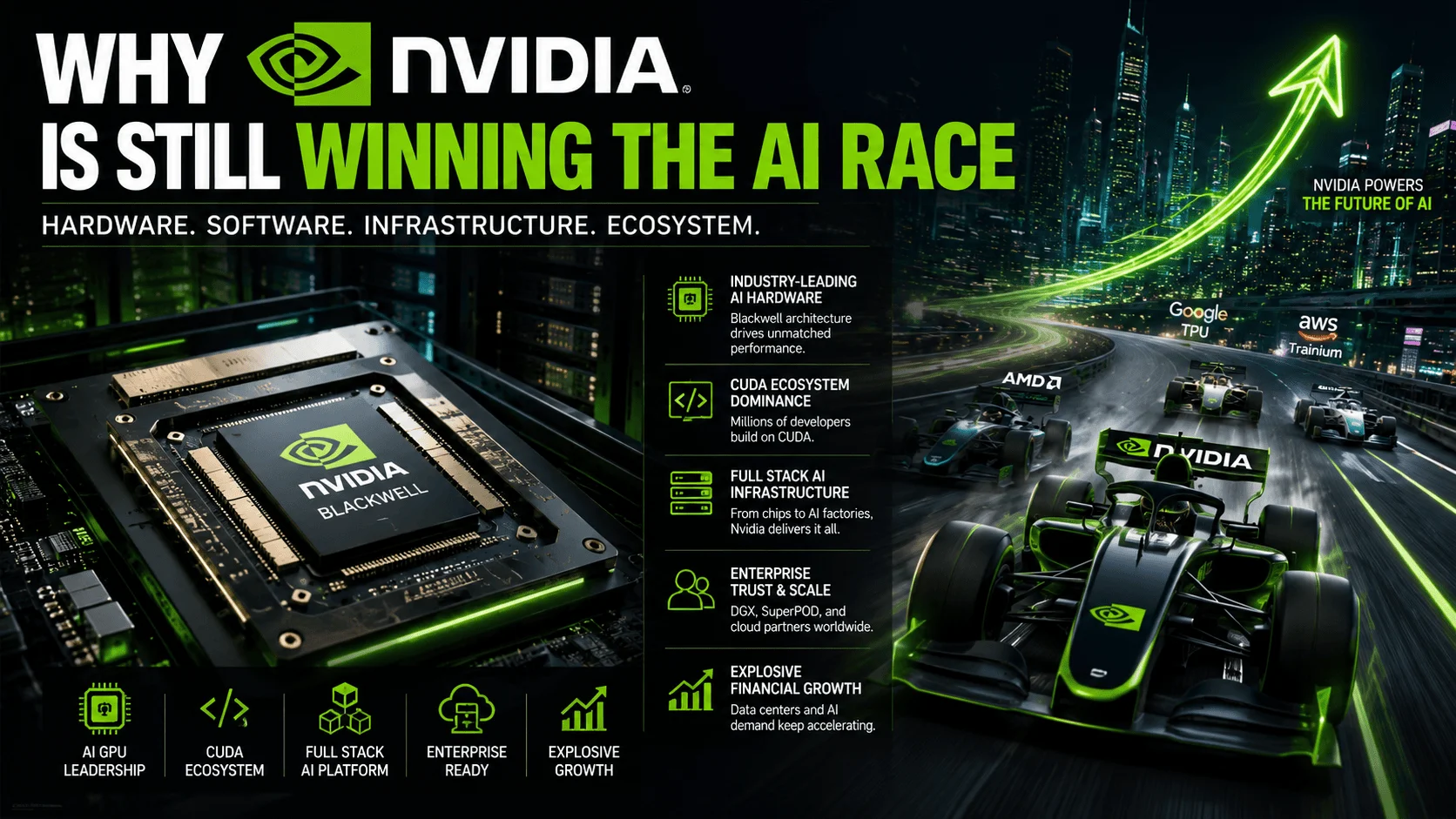
Why Nvidia Is Still Winning the AI Race
Introduction
Artificial intelligence is growing faster than almost anyone predicted. Every week, another AI model appears, another billion dollar startup enters the market, and another tech giant promises to reshape the future through AI. From ChatGPT and Gemini to enterprise copilots and autonomous systems, the modern technology industry is now locked in a race to dominate artificial intelligence. But behind almost every major AI breakthrough, there is one company quietly powering the entire system: NVIDIA.
While companies like AMD, Intel, Google, and even cloud giants are investing billions into custom AI chips, Nvidia continues pulling further ahead. The real question dominating Silicon Valley right now is not whether AI will transform the world. The real question is: Why Nvidia Is Still Winning the AI Race even as competition becomes more aggressive than ever before?
The answer goes far beyond powerful GPUs. Nvidia is no longer just a chip company selling graphics cards to gamers and data centers. It has evolved into the infrastructure layer of the AI economy itself. Through its dominance in AI hardware, its CUDA software ecosystem, and its growing portfolio of full stack AI platforms, Nvidia has positioned itself as the backbone of modern artificial intelligence. In many ways, today’s AI boom is being built directly on Nvidia’s technology stack.
Why Nvidia Is Still Winning the AI Race Through AI Hardware Dominance

Nvidia Controls the AI GPU Market
One of the biggest reasons Why Nvidia Is Still Winning the AI Race is simple: Nvidia dominates the AI GPU market at a scale competitors still cannot match. Modern artificial intelligence models require enormous computing power for both training and inference, and Nvidia has become the default choice for companies building advanced AI systems. From startups creating new language models to cloud providers running massive AI infrastructure, Nvidia hardware sits at the center of the industry.
Data centers continue choosing Nvidia GPUs because the company consistently delivers performance, scalability, and reliability at enterprise scale. AI companies are no longer running small experimental workloads. They are training trillion parameter models across thousands of GPUs simultaneously. Nvidia built its business specifically around handling these extreme computational demands, which is why its hardware remains deeply embedded inside the global AI ecosystem.
Another reason Nvidia stays ahead is momentum. Once enterprises invest millions into Nvidia infrastructure, switching becomes difficult, expensive, and risky. Developers optimize their workloads around Nvidia systems, cloud providers build AI services around Nvidia architecture, and enterprises train internal teams on Nvidia software environments. That ecosystem advantage keeps reinforcing Nvidia’s leadership position year after year.
Blackwell Architecture Is Expanding Nvidia’s Lead
The launch of Nvidia’s Blackwell architecture shows exactly why Nvidia Is Still Winning the AI Race instead of slowing down. Blackwell is not simply another GPU upgrade. It is designed specifically for the next generation of artificial intelligence workloads, including massive language models, advanced inference systems, and AI factories operating at enormous scale.
Blackwell improves training speed, inference performance, energy efficiency, and multi GPU scalability. These improvements matter because AI models are becoming dramatically larger and more expensive to run. Companies want faster model training, lower operational costs, and infrastructure that can scale across huge data center environments without performance bottlenecks. Nvidia built Blackwell to solve exactly those problems.
The architecture also strengthens Nvidia’s position inside enterprise AI. Security improvements, faster communication between GPUs, and optimized AI processing make Blackwell highly attractive for businesses deploying AI systems at scale. Instead of reacting to where the market is today, Nvidia is building infrastructure for where AI is heading next. That forward looking strategy is one of the strongest reasons Why Nvidia Is Still Winning the AI Race while competitors are still trying to catch up.
AI Factories Are Becoming the Future
Nvidia is no longer talking only about GPUs or servers. The company is increasingly focused on what it calls AI factories. This idea represents one of the most important shifts happening in the AI industry right now. Instead of treating AI as a software feature, companies are beginning to treat AI as industrial scale infrastructure that requires dedicated computing environments optimized for continuous AI production.
AI factories combine thousands of GPUs, high speed networking, storage systems, cooling infrastructure, and AI software into one integrated platform capable of training and running advanced AI models around the clock. Nvidia’s platforms such as DGX SuperPOD and GB200 systems are designed specifically for this future.
Enterprise companies are investing heavily because AI is quickly becoming central to productivity, automation, customer support, research, cybersecurity, and data analysis. Businesses no longer want disconnected hardware components that require complex assembly. They want complete AI infrastructure systems that work immediately and scale efficiently. Nvidia recognized this shift earlier than most competitors.
This is another major reason Why Nvidia Is Still Winning the AI Race. The company is not simply selling chips anymore. It is helping define the entire architecture of the future AI economy.
Why Nvidia Is Still Winning the AI Race Because of CUDA

CUDA Created Nvidia’s Biggest Competitive Advantage
One of the biggest reasons Why Nvidia Is Still Winning the AI Race has nothing to do with raw hardware power alone. Nvidia’s real advantage is CUDA, the software platform that transformed Nvidia GPUs into the foundation of modern AI computing.
CUDA allows developers to use Nvidia GPUs for accelerated computing tasks far beyond gaming graphics. Instead of relying only on traditional CPUs, developers can train AI models, process massive datasets, run simulations, and perform advanced machine learning tasks directly through Nvidia’s GPU ecosystem. Over time, CUDA became deeply integrated into the workflows of researchers, AI startups, cloud providers, universities, and enterprise software teams across the world.
That developer adoption created an enormous competitive moat. Today, millions of developers already know how to build AI applications using Nvidia’s software environment. Major AI frameworks, optimization libraries, and machine learning tools are heavily optimized around CUDA because it became the industry standard long before competitors fully entered the market.
This is why Why Nvidia Is Still Winning the AI Race cannot be explained by hardware alone. Nvidia created an ecosystem developers trust, understand, and depend on daily. In the AI industry, familiarity and reliability often matter just as much as performance benchmarks.
Software Lock In Keeps Customers Inside Nvidia’s Ecosystem
Another major reason Why Nvidia Is Still Winning the AI Race is the powerful software lock in created by its ecosystem. Once companies build their AI infrastructure around Nvidia hardware and CUDA based software tools, switching to alternative platforms becomes extremely expensive and time consuming.
AI companies do not simply buy GPUs and plug them into servers. Entire workflows are built around Nvidia infrastructure. Developers optimize models specifically for Nvidia architectures. Cloud providers configure AI services around Nvidia systems. Enterprise teams train employees on Nvidia deployment environments. Research institutions build years of code and machine learning pipelines directly on top of CUDA.
Because of this, competitors face a much harder challenge than simply releasing faster chips. They must convince companies to rebuild software pipelines, retrain engineering teams, and risk compatibility issues across mission critical AI systems. For large enterprises investing billions into artificial intelligence, that transition carries serious operational risks.
This ecosystem dependency strengthens Nvidia’s dominance every year. Even if competing hardware becomes cheaper or reaches similar performance levels, many companies still choose Nvidia because stability, compatibility, and deployment reliability matter more than isolated benchmark numbers. That network effect is one of the strongest forces keeping Nvidia ahead in the AI industry.
CUDA X and AI Development Tools Strengthen Nvidia Further
Nvidia has also expanded far beyond CUDA itself. The company now offers an entire collection of AI development tools designed to simplify enterprise AI deployment at every stage. This growing software ecosystem is another critical reason Why Nvidia Is Still Winning the AI Race while rivals struggle to match its full stack capabilities.
One major example is TensorRT, Nvidia’s inference optimization platform that helps companies run AI models faster and more efficiently in production environments. As AI applications scale globally, inference speed and operational efficiency become extremely important, especially for cloud providers and enterprise AI services handling millions of requests daily.
Another powerful tool is NeMo, Nvidia’s framework for building and customizing large language models. NeMo allows enterprises to train, fine tune, and deploy AI models more efficiently using Nvidia infrastructure. As companies increasingly develop private AI systems for internal use, tools like NeMo strengthen Nvidia’s role inside enterprise AI development.
CUDA X expands the ecosystem even further by providing accelerated libraries for AI, robotics, data science, healthcare, cybersecurity, engineering simulations, and scientific computing. Instead of forcing developers to build everything from scratch, Nvidia offers highly optimized software layers that improve performance and reduce development complexity.
This strategy gives Nvidia a massive advantage. The company is no longer competing only in semiconductor manufacturing. It is competing at the software platform level, which creates deeper long term dependency across the AI economy.
Nvidia Is No Longer Selling Chips Only

Nvidia Sells Complete AI Infrastructure
One of the clearest signs Why Nvidia Is Still Winning the AI Race is that the company no longer sells only GPUs. Nvidia now sells complete AI infrastructure systems designed for enterprise scale artificial intelligence deployment.
Products like DGX SuperPOD, GB200 NVL72, and RTX PRO data center systems show how Nvidia is moving beyond traditional semiconductor business models. These are not individual hardware components aimed at hobbyists or small developers. They are full stack AI systems engineered for hyperscale AI workloads, enterprise data centers, and advanced AI factories.
DGX SuperPOD gives enterprises pre built AI supercomputing infrastructure optimized for large scale model training. GB200 NVL72 combines massive GPU clusters with advanced networking and memory systems to handle next generation AI workloads efficiently. RTX PRO systems target enterprise AI workstations, professional visualization, simulation, and industrial AI applications.
This approach dramatically simplifies AI deployment for businesses. Instead of sourcing hardware from multiple vendors and assembling complex infrastructure internally, enterprises can purchase integrated Nvidia systems built specifically for AI performance, scalability, and reliability.
Nvidia understood something earlier than most competitors: the future AI market would not only demand chips. It would demand complete AI ecosystems ready for immediate deployment.
Why Enterprises Prefer Ready Made AI Platforms
Modern enterprises want speed, scalability, and operational stability. That is exactly why ready made Nvidia AI platforms have become so attractive across industries. Companies investing heavily in artificial intelligence do not want months of infrastructure integration problems or compatibility failures between hardware and software layers.
Nvidia solves this by offering tightly integrated systems where GPUs, networking, software frameworks, cooling architecture, and AI deployment tools are already optimized together. This reduces deployment time significantly while lowering operational complexity for enterprise IT teams.
Scalability is another major factor. AI workloads are growing rapidly, especially with large language models requiring thousands of GPUs and enormous computational resources. Nvidia platforms are specifically designed to scale efficiently across massive AI environments without creating bottlenecks in communication, storage, or processing speed.
Reliability also matters at enterprise scale. Businesses running mission critical AI systems need infrastructure that performs consistently under heavy demand. Nvidia’s enterprise ready systems provide optimized performance, long term support, and predictable deployment environments that many organizations trust more than fragmented alternatives.
This enterprise trust strengthens Nvidia’s position even further because AI spending is increasingly shifting from experimentation into full scale production infrastructure.
Nvidia Is Becoming the Operating System of AI
The biggest reason Why Nvidia Is Still Winning the AI Race may be this: Nvidia is evolving into the operating system of the AI industry itself.
Most people still think of Nvidia primarily as a GPU company, but the company’s strategy has expanded far beyond semiconductor hardware. Nvidia now controls critical layers across AI computing including chips, networking, software frameworks, developer tools, enterprise platforms, cloud integration, robotics systems, and AI deployment infrastructure.
In many ways, Nvidia is becoming the foundational platform on which the modern AI economy operates. Developers build AI applications using Nvidia software. Enterprises deploy AI systems on Nvidia infrastructure. Cloud providers rent Nvidia powered AI services. Researchers train advanced models through Nvidia optimized frameworks.
This platform level dominance creates enormous long term strategic power. Even if competitors eventually narrow the hardware performance gap, Nvidia still controls the ecosystem surrounding AI development and deployment. That ecosystem is becoming harder to replace every year.
The AI race is no longer simply about building the fastest GPU. It is about controlling the full stack infrastructure powering artificial intelligence globally. Right now, Nvidia remains far ahead in that battle.
The Financial Numbers Prove Nvidia Is Still Winning the AI Race

Nvidia Revenue Growth Shows Explosive AI Demand
One of the clearest answers to Why Nvidia Is Still Winning the AI Race can be seen directly in the company’s financial performance. Nvidia’s first quarter fiscal 2026 revenue reportedly reached an astonishing $81.6 billion, representing massive year over year growth driven almost entirely by artificial intelligence demand. These numbers are not simply strong quarterly results. They reflect how deeply Nvidia has embedded itself into the modern AI economy.
The scale of this growth matters because it shows AI is no longer a speculative technology trend. Companies across nearly every industry are now investing aggressively into AI infrastructure, and Nvidia sits at the center of that spending wave. From cloud computing giants to enterprise software firms and AI startups, organizations are purchasing Nvidia hardware at extraordinary levels to train and deploy increasingly advanced AI systems.
What makes this growth even more important is the consistency behind it. Nvidia is not benefiting from a temporary market spike alone. Demand continues increasing because AI models are becoming larger, more complex, and more computationally expensive. Every new generation of AI systems requires more GPUs, more networking power, and more infrastructure capacity. Nvidia positioned itself perfectly to capitalize on that expansion.
This financial momentum reinforces Why Nvidia Is Still Winning the AI Race because strong revenue growth allows the company to invest aggressively into research, infrastructure, software development, and future AI technologies faster than most competitors can match.
Data Centers Are Fueling Nvidia’s Expansion
The real engine behind Nvidia’s explosive growth is the global data center market. Modern artificial intelligence depends heavily on massive computing infrastructure, and Nvidia has become the dominant supplier powering that transformation.
Cloud providers such as Microsoft, Amazon, and Google continue investing billions into AI infrastructure to support enterprise AI services, generative AI platforms, and large language models. At the same time, AI startups are raising enormous amounts of funding specifically to acquire Nvidia GPUs for training advanced AI systems.
This creates a powerful cycle that continues expanding Nvidia’s dominance. As AI adoption grows globally, cloud providers need more AI infrastructure capacity. As enterprises integrate AI into business operations, demand for inference computing increases. As AI models become more advanced, training costs rise dramatically. Nearly every part of that process increases demand for Nvidia hardware and software platforms.
Data centers have effectively become the factories of the AI era, and Nvidia supplies the machinery powering those factories. This is one of the strongest reasons Why Nvidia Is Still Winning the AI Race while competitors still struggle to match Nvidia’s scale inside hyperscale AI environments.
Another important factor is speed. Cloud providers and AI companies cannot afford delays in deploying AI infrastructure because the market is moving extremely quickly. Nvidia’s mature ecosystem, optimized platforms, and enterprise ready AI systems make deployment faster and more reliable compared to less established alternatives.
Investor Confidence Keeps Growing
Wall Street increasingly views Nvidia as more than a semiconductor company. Many investors now see Nvidia as the foundational infrastructure provider behind the global AI boom. That perception has dramatically strengthened investor confidence and pushed Nvidia into the center of financial conversations surrounding the future of technology.
Investors understand that Nvidia benefits from multiple layers of the AI market simultaneously. The company earns revenue not only from GPUs, but also from networking systems, AI software platforms, enterprise infrastructure solutions, cloud deployments, and AI development tools. This diversification makes Nvidia far more powerful than a traditional hardware manufacturer.
Another reason investor confidence remains strong is Nvidia’s ability to maintain technological leadership while scaling financially at extraordinary speed. Many companies grow revenue quickly during emerging technology booms, but few manage to sustain innovation leadership while dominating enterprise adoption at the same time. Nvidia has managed both.
Wall Street also recognizes the strategic importance of Nvidia’s ecosystem. Investors understand that AI companies, cloud providers, researchers, and enterprises are deeply integrated into Nvidia’s infrastructure stack. That ecosystem dependency creates long term competitive advantages that are difficult for rivals to disrupt quickly.
This financial confidence further strengthens Why Nvidia Is Still Winning the AI Race because strong market support gives Nvidia the resources and flexibility to keep expanding aggressively into future AI technologies.
Why Competitors Still Cannot Catch Nvidia

AMD and Intel Still Face Ecosystem Problems
Companies like AMD and Intel are investing heavily into artificial intelligence hardware, but they still face one major problem: competing with Nvidia requires far more than building powerful chips.
Many competitors focus heavily on raw hardware performance comparisons, but the AI industry has already moved beyond simple benchmark wars. Nvidia’s dominance comes from the entire ecosystem surrounding its hardware including CUDA, deployment tools, enterprise integration, developer familiarity, and optimized AI workflows. That ecosystem advantage creates a much larger barrier than hardware alone.
AMD and Intel may continue improving GPU performance, but enterprises are often reluctant to switch because their AI infrastructure already depends heavily on Nvidia software environments. Existing AI pipelines, internal engineering expertise, cloud integrations, and deployment systems are deeply tied to Nvidia platforms.
This means competitors are not simply trying to replace GPUs. They are attempting to replace years of ecosystem adoption, software optimization, and enterprise trust. That challenge is significantly harder and slower than launching competitive hardware products.
This is one of the core reasons Why Nvidia Is Still Winning the AI Race despite growing pressure from rival semiconductor companies.
AI Is No Longer Just About Faster Chips
One of the biggest misconceptions in the AI industry is that success depends only on building faster chips. In reality, modern AI competition is increasingly centered around infrastructure ecosystems, deployment efficiency, and software integration rather than isolated hardware performance.
AI systems today are extremely complex. Enterprises need scalable deployment frameworks, optimized inference systems, networking integration, security layers, orchestration tools, and developer friendly software environments. Raw GPU speed matters, but it is only one part of a much larger infrastructure challenge.
Nvidia recognized this shift earlier than most competitors. Instead of focusing exclusively on hardware leadership, the company built a full stack AI ecosystem connecting chips, networking, software frameworks, cloud deployment tools, and enterprise infrastructure together into one integrated platform.
This strategy gives Nvidia enormous advantages because businesses want AI solutions that work immediately at scale. Companies investing billions into AI infrastructure prioritize reliability, compatibility, and deployment speed over isolated benchmark improvements.
That is exactly why Why Nvidia Is Still Winning the AI Race cannot be explained only through semiconductor performance. Nvidia succeeded because it understood AI would become an ecosystem battle, not just a chip battle.
Nvidia Benefits From Powerful Network Effects
Another massive reason Why Nvidia Is Still Winning the AI Race is the strength of its network effects. The more developers, enterprises, researchers, and cloud providers adopt Nvidia infrastructure, the stronger Nvidia’s ecosystem becomes for everyone inside it.
Developers continue building AI applications optimized for Nvidia systems because Nvidia remains the industry standard. Cloud providers continue expanding Nvidia powered services because enterprise customers demand them. Enterprises continue choosing Nvidia because skilled AI engineers already understand Nvidia’s software stack. Researchers continue training models on Nvidia hardware because most AI frameworks are optimized around Nvidia environments.
This creates a self reinforcing cycle that strengthens Nvidia’s dominance over time. Every new AI startup entering the market often begins inside Nvidia’s ecosystem because the tools, documentation, software libraries, and infrastructure support already exist there. That adoption then increases enterprise demand, which encourages cloud providers to invest even more heavily into Nvidia infrastructure.
These network effects are incredibly difficult for competitors to break because they extend across the entire AI industry simultaneously. Nvidia is not competing only at the hardware level anymore. It is competing through ecosystem momentum, developer familiarity, and infrastructure standardization across global AI markets.
That ecosystem gravity may ultimately be the biggest reason Why Nvidia Is Still Winning the AI Race while the rest of the industry struggles to close the gap.
Risks That Could Slow Nvidia Down
Rising Competition From AMD and Custom AI Chips
Even though Why Nvidia Is Still Winning the AI Race remains the dominant story today, Nvidia is no longer operating without serious competition. Some of the world’s largest technology companies are now investing aggressively into custom AI hardware designed specifically to reduce dependence on Nvidia infrastructure.
AMD continues expanding its AI GPU ambitions and positioning its accelerator platforms as alternatives for enterprise AI workloads. While AMD still trails Nvidia in ecosystem strength, the company is improving hardware performance rapidly and attracting growing attention from cloud providers looking for diversification.
At the same time, major cloud companies are building their own custom AI chips. Google has developed TPUs specifically optimized for large scale AI training and inference inside its cloud ecosystem. Amazon is pushing Trainium chips as part of its AI infrastructure strategy for AWS customers. Microsoft is also investing heavily into proprietary AI hardware to support its expanding AI ecosystem.
These companies understand a critical reality: relying entirely on Nvidia gives Nvidia enormous pricing and infrastructure power across the AI market. Building internal AI chips helps cloud providers lower costs, improve vertical integration, and reduce strategic dependence on external suppliers.
Still, most custom AI chips currently face limitations outside their native ecosystems. Nvidia’s advantage remains broader compatibility, stronger developer adoption, mature deployment tools, and enterprise trust. But over time, rising competition from custom AI silicon could slowly chip away at Nvidia’s dominance if competitors close the software and ecosystem gap.
Regulatory and Geopolitical Challenges
Another major risk to Nvidia’s long term dominance comes from geopolitics and global AI regulation. Artificial intelligence is increasingly viewed not just as a business opportunity, but as a strategic national technology linked directly to economic power, cybersecurity, and military competitiveness.
Governments worldwide are now paying close attention to advanced AI hardware exports, especially high performance GPUs used for training frontier AI models. Export restrictions targeting advanced chip shipments to certain regions have already created challenges for Nvidia and the broader semiconductor industry.
Tensions between major global powers could further complicate Nvidia’s supply chains, international sales, and manufacturing partnerships. Since advanced semiconductor production relies on highly interconnected global infrastructure, geopolitical instability creates risks that extend far beyond normal market competition.
Another challenge is regulatory scrutiny surrounding AI itself. As governments introduce new AI laws related to privacy, cybersecurity, data governance, and model safety, enterprise AI spending patterns could shift in unpredictable ways. Increased regulation may slow adoption in certain industries or force infrastructure changes that impact demand cycles.
Nvidia currently benefits from the explosive speed of the AI market, but global political tensions and regulatory uncertainty remain important risks that could affect long term growth.
The Danger of Over Dependence on AI Spending
One reason Why Nvidia Is Still Winning the AI Race today is the extraordinary level of spending flowing into artificial intelligence. But that dependence on aggressive AI investment also creates risk.
Right now, tech companies, startups, governments, and enterprises are pouring billions into AI infrastructure at unprecedented speed. Cloud providers are racing to expand AI capacity, startups are buying massive GPU clusters, and enterprises are experimenting with generative AI systems across nearly every department. Nvidia sits directly in the center of that spending boom.
However, technology cycles can change quickly. If enterprise AI adoption slows, if companies struggle to generate profitable returns from AI investments, or if economic conditions weaken globally, infrastructure spending could cool significantly. Since Nvidia’s growth is tied closely to AI demand expansion, a slowdown in enterprise AI enthusiasm could impact future revenue growth.
Another concern is whether all AI spending happening today is truly sustainable long term. Some analysts worry that parts of the AI market resemble earlier technology hype cycles where infrastructure investment temporarily outpaced actual monetization opportunities.
This does not mean AI will disappear. Artificial intelligence is clearly becoming foundational technology. But if the pace of enterprise AI spending slows even slightly, Nvidia’s growth trajectory could become more volatile than investors currently expect.
Can Nvidia Maintain Its Innovation Speed
One of Nvidia’s greatest strengths has been its relentless innovation cycle. The company consistently releases new architectures, AI platforms, networking systems, and enterprise solutions ahead of competitors. But maintaining that speed year after year may become increasingly difficult as the AI market grows larger and more competitive.
The expectations surrounding Nvidia are now enormous. Investors, enterprises, cloud providers, and developers all expect Nvidia to continue delivering breakthrough products that redefine AI infrastructure every generation. That level of pressure creates significant long term challenges.
Competitors are also moving faster than before. AI innovation is no longer limited to traditional semiconductor companies. Cloud giants, AI labs, and global technology firms are all building specialized hardware, AI optimization systems, and custom infrastructure solutions. Nvidia must continue leading across multiple fronts simultaneously including chips, networking, software, and enterprise AI deployment.
Another challenge is the increasing complexity of AI infrastructure itself. As AI models grow larger and data center requirements become more demanding, engineering next generation systems becomes more expensive and technically difficult.
The question is no longer whether Nvidia can innovate. The real question is whether the company can maintain its industry defining pace while the rest of the AI ecosystem aggressively attempts to close the gap.
The Future of Nvidia and the AI Industry
Nvidia Is Shaping the Next Generation of AI Infrastructure
The future of artificial intelligence is moving toward systems far larger and more computationally demanding than anything seen today. Trillion parameter models, massive multi GPU clusters, autonomous AI agents, enterprise copilots, robotics systems, and real time AI reasoning engines will require infrastructure operating at unprecedented scale.
Nvidia is positioning itself directly at the center of that future.
The company’s latest platforms are specifically designed for massive AI workloads that stretch far beyond traditional data center computing. Nvidia is building systems capable of handling enormous AI models distributed across thousands of interconnected GPUs working together simultaneously. This level of scale is becoming essential as AI companies push toward more advanced reasoning models and enterprise AI deployment at global scale.
Networking technology is also becoming increasingly important. AI infrastructure now depends heavily on ultra fast communication between GPUs, memory systems, and storage environments. Nvidia’s investments into networking and integrated AI infrastructure show that the company understands future AI performance will depend on entire system architecture rather than isolated chips alone.
This forward looking infrastructure strategy is one of the strongest reasons Why Nvidia Is Still Winning the AI Race and may continue leading the market for years ahead.
AI Factories Could Become the New Digital Economy
One of Nvidia’s most important ideas is the concept of AI factories. This concept could completely reshape how businesses think about computing infrastructure over the next decade.
In the past, companies built data centers primarily to store information and run applications. In the future, many enterprises may build AI factories designed specifically to generate intelligence continuously through training, inference, automation, simulation, and real time AI services.
These AI factories could become the production engines of the digital economy. Instead of manufacturing physical products, they would manufacture predictions, automation systems, digital agents, enterprise insights, content generation, and intelligent software operations at massive scale.
Nvidia’s infrastructure platforms are designed exactly for this transition. By combining GPUs, networking, AI software frameworks, enterprise deployment systems, and scalable architectures into integrated platforms, Nvidia is helping define what the future AI economy may actually look like.
If AI becomes as central to global business operations as cloud computing or the internet itself, then companies controlling AI infrastructure could gain enormous long term economic power. Nvidia appears determined to become one of those foundational infrastructure providers.
Why Nvidia Is Still Winning the AI Race May Continue for Years
The strongest conclusion surrounding Why Nvidia Is Still Winning the AI Race is that Nvidia’s lead may be more durable than many expected.
Competitors will continue improving hardware performance. Custom AI chips will grow more sophisticated. Enterprise AI spending patterns may eventually shift. But Nvidia’s advantage extends far beyond semiconductor performance alone. The company controls one of the deepest ecosystems in the AI industry including hardware, software, networking, deployment platforms, developer tools, enterprise infrastructure, and cloud integration.
That ecosystem dominance creates powerful long term momentum. Developers continue building around Nvidia platforms because the tools already exist there. Enterprises continue investing in Nvidia infrastructure because deployment is faster and more reliable. Cloud providers continue scaling Nvidia systems because customer demand remains enormous.
Most importantly, Nvidia continues shaping the direction of AI infrastructure itself instead of merely reacting to market trends. The company is helping define how future AI systems will be built, deployed, and scaled globally.
That is why Why Nvidia Is Still Winning the AI Race is not only a story about GPUs. It is a story about ecosystem control, infrastructure dominance, and owning the technological foundation of the AI era.
Conclusion
Final Answer to the Main Question
So, Why Nvidia Is Still Winning the AI Race?
The answer comes down to one critical reality: Nvidia built far more than powerful AI chips. It built the foundation of the modern AI ecosystem.
Nvidia still leads because its hardware remains the industry standard for training and running advanced artificial intelligence models at massive scale. From hyperscale data centers to enterprise AI systems, Nvidia GPUs continue powering the majority of the global AI infrastructure market.
But hardware leadership alone is not enough to explain Nvidia’s dominance. The company’s biggest competitive advantage is its CUDA ecosystem. Over the years, CUDA transformed Nvidia from a semiconductor company into the default software environment for AI development. Millions of developers, enterprises, researchers, and cloud providers now rely on Nvidia’s software stack to build, optimize, and deploy AI applications efficiently.
At the same time, Nvidia expanded into full stack AI infrastructure. The company no longer sells individual GPUs alone. It now offers integrated AI platforms, networking systems, enterprise deployment tools, and large scale AI factory infrastructure designed for the future of artificial intelligence.
Enterprise ready platforms like DGX SuperPOD, Blackwell powered systems, TensorRT, NeMo, and CUDA X strengthened Nvidia’s ecosystem even further. Businesses increasingly choose Nvidia not just because of performance, but because the company provides scalable, reliable, and production ready AI solutions that simplify deployment at enterprise scale.
Financially, Nvidia continues proving its dominance through explosive revenue growth, enormous data center demand, and rising investor confidence. The company’s ability to innovate rapidly while scaling globally gives it advantages that few competitors currently match.
That is the real reason Why Nvidia Is Still Winning the AI Race. Nvidia is not competing only in the semiconductor industry anymore. It is competing at the infrastructure level of the AI economy itself.
Closing Thought
The future AI race may not be decided solely by who builds the fastest chip. It may be decided by who controls the platforms, infrastructure, software ecosystems, and deployment layers powering artificial intelligence worldwide.
Right now, Nvidia controls more of that foundation than anyone else.
As artificial intelligence becomes deeply integrated into business, governments, cloud computing, robotics, cybersecurity, healthcare, and global digital infrastructure, Nvidia’s role could become even more powerful. The company is no longer simply riding the AI revolution. In many ways, it is helping build the operating system of the AI era itself.
FAQ Section
Why Nvidia Is Still Winning the AI Race over AMD?
Nvidia remains ahead of AMD because its advantage goes far beyond GPU performance. Nvidia controls a much larger AI ecosystem including CUDA, AI deployment tools, enterprise infrastructure, networking systems, and developer adoption. Even when competitors improve hardware performance, Nvidia’s software ecosystem and enterprise integration keep it in a stronger position.
What makes CUDA so important for AI?
CUDA is Nvidia’s accelerated computing platform that allows developers to use GPUs for artificial intelligence, machine learning, scientific computing, and advanced simulations. CUDA became critical because most major AI frameworks and enterprise AI systems are optimized around it. This makes AI development faster, more scalable, and easier to deploy on Nvidia hardware.
What is Nvidia Blackwell architecture?
Blackwell is Nvidia’s next generation AI architecture designed for large language models, advanced inference systems, and AI factories. It improves AI training speed, scalability, efficiency, and multi GPU communication. Blackwell is built specifically for the future of enterprise AI and trillion parameter AI models.
Why do AI companies depend on Nvidia GPUs?
AI companies depend heavily on Nvidia GPUs because modern AI models require enormous computational power for training and inference. Nvidia provides not only high performance GPUs, but also software frameworks, optimization tools, networking systems, and enterprise infrastructure that simplify large scale AI deployment.
Can competitors replace Nvidia in AI infrastructure?
Competitors may eventually reduce Nvidia’s market dominance in some areas, especially with custom AI chips and growing enterprise competition. However, replacing Nvidia completely is extremely difficult because Nvidia controls a deeply integrated ecosystem built around hardware, software, developer tools, and enterprise AI platforms. That ecosystem advantage remains one of Nvidia’s strongest long term defenses.
Sources
Official Nvidia Financial Reports
The financial data, revenue growth numbers, and investor information used in this article were based on Nvidia’s official investor relations reports and earnings updates.
Nvidia Investor Relations Financial Reports
This source includes:
- Quarterly earnings reports
- Revenue growth updates
- Data center business performance
- AI infrastructure demand analysis
- Official shareholder updates
Nvidia Blackwell Architecture Official Page
The discussion around Blackwell architecture, AI factories, AI scaling, training performance, inference improvements, and next generation AI systems was based on Nvidia’s official Blackwell architecture documentation.
Nvidia Blackwell Architecture Official Page
This source explains:
- Blackwell GPU architecture
- AI factory infrastructure
- Multi GPU scalability
- Enterprise AI performance improvements
- Large language model optimization
Nvidia 2025 Annual Review
The broader analysis of Nvidia’s AI strategy, ecosystem expansion, enterprise AI positioning, and future infrastructure direction was supported by Nvidia’s 2025 Annual Review.
This document includes:
- Nvidia CEO strategic vision
- AI industry outlook
- Enterprise AI expansion
- Future AI infrastructure roadmap
- Data center growth strategy
SEC Filing and CUDA X Information
Information related to CUDA, CUDA X, enterprise AI deployment tools, accelerated computing, and Nvidia’s software ecosystem came from Nvidia’s SEC annual filing documentation.
NVIDIA SEC Annual Filing and CUDA X Information
This source covers:
- CUDA ecosystem details
- Accelerated computing platforms
- AI software infrastructure
- Enterprise deployment ecosystem
- Nvidia competitive positioning
Additional Research References
AMD Official Website
Used for competitive analysis regarding AI GPUs and enterprise AI competition.
Google Cloud TPU Information
Used for references related to Google TPUs and custom AI chip competition.
Amazon Trainium AI Chips
Used for discussion around AWS AI infrastructure and custom AI accelerators.
Microsoft AI Infrastructure and Custom Chips
Used for research around Microsoft’s AI ecosystem and custom AI hardware development.
Microsoft AI Infrastructure Overview
Disclaimer: This article is published for informational, educational, and editorial purposes only. The opinions, analysis, and interpretations presented in this content are based on publicly available information, industry reports, and independent research at the time of writing. We do not intend to defame, misrepresent, or harm any company, organization, religion, community, individual, or belief system.
All trademarks, company names, logos, and product names mentioned in this article belong to their respective owners. References to third party companies and technologies are made strictly for commentary, reporting, and educational discussion under fair use and journalistic practices.
Our platform respects all faiths, cultures, religions, communities, and viewpoints. Any resemblance to offensive interpretation is purely unintentional. Readers are encouraged to verify information through official sources before making financial, business, legal, or investment decisions.
We are not responsible for any direct or indirect actions taken based on the information provided in this article.


